

Analytical Instrument Operational Qualification and Functional Testing
Analytical instrument Operational Qualification (OQ) provides documented evidence that the installed system performs its specified functions throughout defined operating ranges and under controlled challenge conditions.
OQ evaluates how the instrument responds to commands, parameter changes, boundary conditions, alarms, failures, user actions, calculations, data-processing operations, and system interfaces. It confirms that critical hardware, software, and data controls function as intended before the system is approved for representative routine-use testing.
OQ is not limited to demonstrating that the instrument starts, produces a signal, or completes a basic analysis. Testing should challenge the functions and controls that could affect analytical results, electronic records, product-quality decisions, or the ability to detect and respond to failures.
Purpose of Operational Qualification
The purpose of OQ is to establish a verified functional baseline for the analytical system.
Depending on the instrument and its intended use, OQ should demonstrate that:
- critical hardware functions operate correctly
- instrument modules communicate as designed
- controlled parameters can be set, maintained, and measured
- performance remains acceptable throughout defined operating ranges
- alarms and interlocks activate at appropriate conditions
- the system responds appropriately to invalid inputs and simulated failures
- software functions operate according to approved requirements
- security roles restrict users to authorized activities
- audit trails capture applicable GMP-relevant actions
- calculations and data-processing functions produce accurate results
- electronic records are generated, stored, retrieved, and protected
- interfaces transfer complete and accurate information
- applicable backup and restoration functions operate as designed
- recovery from interrupted or abnormal conditions is controlled
- deviations are documented, assessed, and resolved
- sufficient evidence exists to approve the functional baseline
The qualification depth should follow the approved risk-based analytical instrument qualification strategy. Test coverage should reflect intended use, instrument complexity, data criticality, failure detectability, software involvement, supplier evidence, and the consequences of an incorrect or unavailable result.
The following illustration summarizes the relationship between approved requirements, functional challenges, OQ evidence, and approval of the functional baseline.
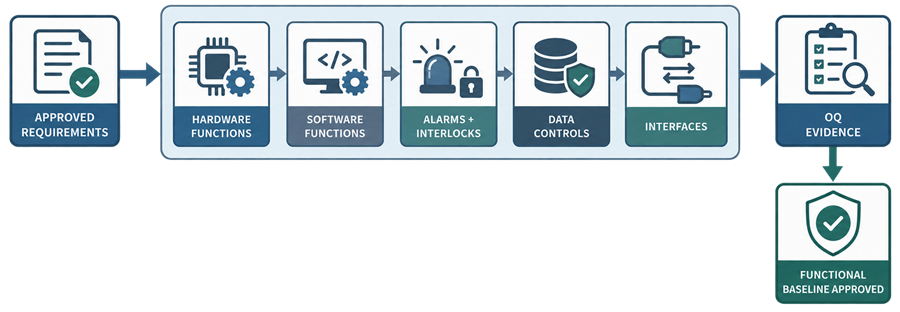
Position of OQ in the Qualification Lifecycle
OQ follows establishment and approval of the installed baseline during Analytical Instrument Installation Qualification.
The principal lifecycle distinctions are:
- IQ verifies what was installed and configured.
- OQ challenges how the installed system functions.
- Performance Qualification evaluates performance under representative routine-use conditions when a separate PQ is justified.
- Routine system suitability verifies method-specific performance at the time of use.
These activities may be combined or scaled when justified, but their objectives should remain distinguishable. Repeating serial numbers, software versions, and utility checks during OQ does not replace functional challenge testing. Similarly, successful OQ does not automatically demonstrate that every analytical method will perform suitably under routine conditions.
OQ testing should remain traceable to the approved analytical instrument user requirements, design specifications where available, risk assessment, supplier functional documentation, and configuration baseline established during IQ.
OQ Scope and System Boundary
The OQ boundary should be consistent with the approved analytical-system boundary and installed configuration. Depending on the system, OQ may include:
- instrument hardware
- measurement and control modules
- sample-handling devices
- embedded controllers
- instrument firmware
- acquisition and processing software
- workstations and servers
- databases and electronic-record repositories
- system configuration
- user roles and permissions
- audit trails
- calculations and processing algorithms
- report generation
- export and import functions
- instrument-to-software communication
- interfaces with LIMS, middleware, network storage, or other systems
- backup and restoration functions
- printers and other critical peripherals
- alarms, interlocks, diagnostic functions, and error handling
The scope should identify functions tested within the instrument OQ and functions covered by separate computerized-system or infrastructure qualification.
A network service, centralized database, identity-management service, or enterprise backup platform may be qualified separately. The analytical instrument OQ should still verify that the system uses the approved service correctly and that the connection supports the intended analytical workflow.
Prerequisites for OQ Execution
OQ should begin only after the conditions necessary for meaningful functional testing have been established.
Typical prerequisites include:
- approved IQ or documented authorization to overlap defined activities
- approved user requirements
- approved system boundary
- controlled hardware and software configuration
- resolved or accepted critical IQ deviations
- current calibration status for critical measurement functions
- available supplier manuals and functional specifications
- approved OQ protocol
- predefined acceptance criteria
- approved test materials, standards, and test equipment
- trained personnel
- established security roles and test accounts
- available deviation and change-control procedures
- confirmed data storage and backup arrangements
- controlled test environment
Some IQ and OQ activities may overlap during supplier installation when sequencing is justified and controlled. The final OQ conclusion should still identify the configuration tested and confirm that unresolved installation conditions did not compromise the results.
Requirement-Based Functional Testing
OQ testing should be derived from approved and traceable requirements rather than copied directly from a generic protocol.
A traceability matrix or equivalent structure should link:
- user requirement
- design or functional specification
- identified risk
- OQ test case
- acceptance criterion
- executed result
- deviation, when applicable
- final disposition
Traceability supports both completeness and test justification. It identifies requirements that have not been tested and tests that do not support an approved requirement or risk control.
Not every requirement requires direct OQ testing. Some requirements may be verified through design review, IQ inspection, supplier documentation, calibration, procedural control, or separate software testing. The verification method should be identified and justified.
Functional tests should include sufficient detail to make the results reproducible. Each test should identify:
- initial conditions
- required configuration
- test inputs
- execution steps
- expected results
- objective acceptance criteria
- actual results
- supporting evidence
- tester and execution date
- deviations or anomalies
Statements such as “function operates correctly” provide weak evidence unless the tested input, expected response, and observed result are recorded.
Testing Across Defined Operating Ranges
Critical operating parameters should be tested across the ranges required by intended use. Depending on the analytical technique, applicable parameters may include:
- temperature
- pressure
- flow rate
- wavelength
- detector response
- sample volume
- injection volume
- mixing or agitation rate
- timing
- voltage or current
- vacuum
- gas flow
- oven or chamber conditions
- pump composition
- acquisition rate
- measurement range
Testing only at a nominal setpoint may be insufficient when operation near the minimum or maximum could affect performance, control accuracy, alarm response, or data quality.
OQ should consider:
- minimum intended operating condition
- nominal or representative condition
- maximum intended operating condition
- control accuracy
- stability at the selected condition
- display and recorded-value agreement
- response time where critical
- alarm or interlock setpoints
- recovery after a challenged condition
The qualified operating range should be supported by documented evidence. OQ does not need to test every point within a continuous range, but selected test points should adequately represent the range and its boundaries.
The following illustration shows how minimum, nominal, maximum, and alarm conditions can be challenged without implying that values outside the verified range are qualified for routine operation.
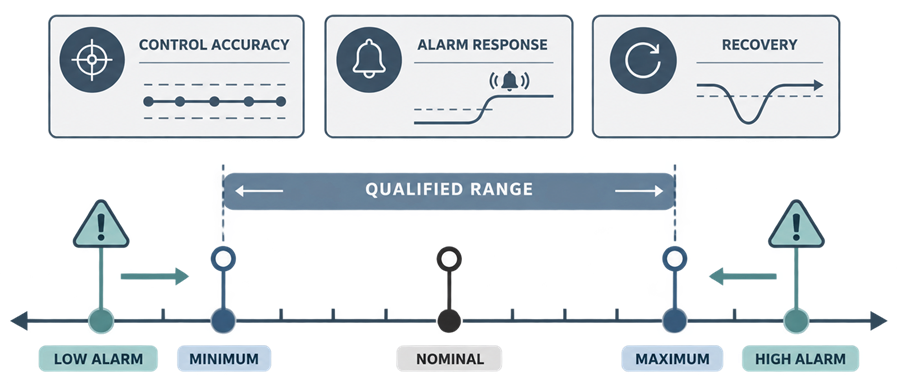
Boundary and Worst-Case Challenge Testing
Boundary testing evaluates system behavior at or near approved functional limits. It should be applied where failure at a limit may not be detected during nominal testing. Potential challenge conditions include:
- lowest and highest allowable setpoints
- maximum number of samples or sequence entries
- minimum sample volume
- maximum data-file size
- maximum supported number of modules
- permitted calculation limits
- rounding boundaries
- invalid or incomplete input
- communication interruption
- power interruption where safely simulated
- full or nearly full storage conditions
- expired or unauthorized user access
- attempted prohibited action
- recovery from an interrupted process
Worst-case selection should be technically justified. It should not become a routine requirement to test unrealistic conditions that the system is neither intended nor designed to support.
Where a challenge could damage the instrument, create a safety hazard, corrupt a qualified environment, or invalidate supplier warranties, an alternative verification method should be used. This may include simulation, supplier evidence, code or design review, or testing in a controlled nonproduction environment.
Hardware and Module Functional Testing
Hardware testing should verify the critical functions of the installed configuration. Applicable tests may include:
- startup and shutdown sequences
- module initialization
- module recognition by the controlling software
- actuator and valve operation
- pump control
- autosampler movement
- temperature control
- detector activation
- sensor response
- status indication
- local display functions
- manual and automated operating modes
- sequence execution
- diagnostic functions
- safe-state behavior
- recovery after controlled interruption
For modular systems, OQ should verify both the individual functions and communication among modules. A module may operate independently but still fail to exchange status, commands, or data correctly with the complete system.
The test scope should reflect the actual purchased configuration. Features that are not installed or enabled do not require execution testing, but their exclusion should be clear.
Module Communication and Synchronization
Communication failures can produce incomplete sequences, incorrect timing, missing data, or misleading instrument status. Testing should address applicable communication paths, including:
- controller-to-module commands
- module status returned to the controller
- instrument-to-workstation communication
- detector-to-data-system signal transmission
- autosampler synchronization
- time synchronization among connected components
- sequence coordination
- communication timeout
- loss and restoration of communication
- handling of disconnected or unavailable modules
- error-message generation
- prevention of silent data loss
Normal communication should be tested, but controlled failure conditions are often more informative. The expected safe response should be predefined before communication is interrupted.
Alarms, Interlocks, and Error Handling
OQ should challenge critical alarms, interlocks, warnings, and error-handling functions. Testing may include:
- alarm activation at the defined condition
- accuracy of alarm setpoints
- delay or persistence logic
- visible and audible annunciation
- identification of the affected condition
- recording of alarm date and time
- user acknowledgment
- escalation where supported
- automated protective action
- inhibition of unsafe or invalid operation
- continued record protection
- alarm clearance
- recovery after correction
- generation of an audit-trail entry where applicable
Examples of challenge conditions include:
- temperature outside the allowed range
- loss of gas flow
- excessive pressure
- low solvent or reagent level
- open cover or door
- detector fault
- module disconnection
- communication failure
- invalid method parameter
- unavailable data-storage location
- failed login attempts
- interrupted sequence
- insufficient disk capacity
Interlocks should be tested to demonstrate that prohibited operation cannot continue when the interlock condition exists. Bypasses, overrides, or service modes should be identified and restricted.
A visual alarm alone may be insufficient if the system is expected to stop, hold, prevent data acquisition, or protect an in-process sample. The complete required response should be verified.
Software Functional Testing
Computerized analytical systems require functional testing proportionate to software risk and intended use. Applicable functions may include:
- user login and logout
- method creation
- method approval
- method modification
- sequence creation
- sample identification
- instrument control
- data acquisition
- data processing
- integration or peak processing
- calculation
- result review
- report generation
- data export and import
- record search and retrieval
- configuration management
- audit-trail review
- electronic signatures where used
- controlled deletion or invalidation
- backup and recovery
Instrument OQ should not duplicate the entire analytical instrument software validation package. The qualification strategy should identify which software functions are tested during instrument OQ and which are verified through separate computerized-system testing.
Supplier evidence may support standard software functions. Site-configured methods, calculations, roles, workflows, interfaces, reports, and data-management arrangements normally require site-specific verification.
Security Roles and Access Control
Security testing should demonstrate that configured roles permit authorized functions and prevent unauthorized functions. Representative tests may include:
- successful login by an active authorized user
- rejected login with an incorrect password
- response to repeated failed login attempts
- account lockout where required
- password change
- session timeout
- disabled-user access
- expired-user access
- separation of administrator and routine-user privileges
- restriction of method modification
- restriction of result modification
- restriction of record deletion
- restriction of audit-trail configuration
- restriction of system-time changes
- restriction of security administration
- authorized electronic-signature use where applicable
Role testing should use representative accounts for each configured role. Reviewing a permissions table alone does not demonstrate that the controls operate correctly.
System administrators should not routinely perform regulated analytical testing when that combination of access and activity would undermine procedural or technical segregation.
Detailed access and electronic-signature controls are addressed in Access Control and Electronic Signatures.
Audit-Trail Challenge Testing
Where audit trails are required, OQ should demonstrate that applicable events are captured automatically and cannot be altered by routine users. Tests should address relevant activities such as:
- user login and failed login
- method creation
- method modification
- processing-parameter changes
- reintegration or reprocessing
- result modification
- record invalidation
- configuration changes
- security-role changes
- audit-trail configuration changes
- electronic-signature application
- attempted prohibited actions
The resulting audit-trail entry should be evaluated for:
- event date and time
- user identity
- affected record
- original and changed value where applicable
- reason for change where required
- action performed
- sequence and completeness
- availability for review
OQ should also verify that authorized reviewers can retrieve and review the audit trail in a meaningful form.
Audit-trail testing should be based on the actual system functions and GMP-relevant records, not a generic expectation that every software action requires the same audit-trail treatment. Additional lifecycle controls are addressed in Audit Trails and Data Change Control in Computerized Systems.
Calculation and Data-Processing Verification
Software-generated calculations should be verified using known inputs and independently determined expected results. Applicable calculations may include:
- concentration
- dilution
- potency
- assay
- impurity
- average
- standard deviation
- relative standard deviation
- regression
- calibration curve
- response factor
- correction factor
- unit conversion
- rounding
- integration-derived result
- acceptance-limit comparison
Calculation testing should address:
- correct formula
- correct units
- significant figures
- rounding
- constants and conversion factors
- handling of zero or negative values
- missing input
- values near decision limits
- values outside the permitted range
- result display
- report output
- retention of original inputs and calculated results
A single nominal example may not adequately challenge a critical calculation. Boundary values, rounding transitions, invalid input, and result-limit comparisons should be included when they could affect reportable results or disposition decisions.
Independent calculations should not rely on the same unverified spreadsheet, formula, or software logic used by the system under test.
Data Acquisition, Handling, and Electronic Records
OQ should demonstrate that data are acquired, processed, stored, retrieved, and retained without unauthorized loss or alteration. Testing may include:
- creation of the original electronic record
- association of data with the correct sample
- raw-data capture
- metadata capture
- sequence and method association
- date and time recording
- record naming
- processing and reprocessing
- retention of original data
- retrieval of completed records
- report generation
- controlled export
- prevention of unauthorized overwriting
- handling of interrupted acquisition
- storage-location availability
- response to unavailable storage
- record readability after retrieval
Where dynamic electronic records are required for meaningful review, a static printout or PDF should not automatically be treated as a complete substitute for the original record.
Controls should support applicable requirements under 21 CFR 211.68, 21 CFR 211.194, and 21 CFR Part 11.
FDA’s Data Integrity and Compliance With Drug CGMP guidance should also be considered when defining electronic-record, access, audit-trail, backup, and review controls.
Interface and Data-Transfer Testing
Interfaces should be challenged to demonstrate complete, accurate, and controlled information transfer. Applicable interfaces may include:
- instrument to acquisition software
- workstation to server
- instrument software to LIMS
- chromatography data system to LIMS
- middleware
- network storage
- report repository
- identity-management service
- time service
- printer
- export directory
- backup platform
Testing should consider:
- correct source and destination
- correct record identity
- field mapping
- units
- decimal precision
- date and time format
- sample identifiers
- status values
- complete transfer
- duplicate prevention
- rejected record handling
- interrupted transfer
- retry behavior
- error notification
- reconciliation
- prevention of unauthorized modification
A successful transfer of one normal record does not demonstrate control of invalid, incomplete, duplicate, or interrupted transfers.
Where interface qualification is addressed separately, OQ may reference the approved interface evidence. The article on Analytical Instrument–LIMS Integration provides additional guidance for laboratory data-system interfaces.
Backup, Restoration, and Recovery Functions
OQ should verify applicable instrument-level backup and restoration functions or confirm correct integration with a separately qualified backup service. The scope may include:
- configuration backup
- method backup
- electronic-record backup
- database backup
- automated schedule
- backup completion
- failure notification
- access restriction
- backup-file identification
- restoration to the correct location
- restoration of configuration
- restoration of representative records
- restored-record readability
- preservation of metadata
- audit-trail availability after restoration
A message indicating that a backup completed does not demonstrate that the backup can be restored. Representative restoration testing should be included where the analytical system provides or depends on the restoration function.
Testing should not jeopardize production records or the qualified system. Restoration may be performed in a controlled test environment when direct restoration to the production system would create unacceptable risk.
Backup testing does not by itself demonstrate complete disaster recovery. Broader recovery of servers, networks, applications, identity services, and infrastructure may be controlled under separate procedures.
Additional electronic-record lifecycle considerations are addressed in Electronic Record Lifecycle and Retention.
Challenge-Testing Evidence
OQ should demonstrate both successful intended operation and controlled response to inappropriate, unauthorized, or abnormal conditions.
The following illustration groups the principal computerized-system challenges that commonly require objective OQ evidence.
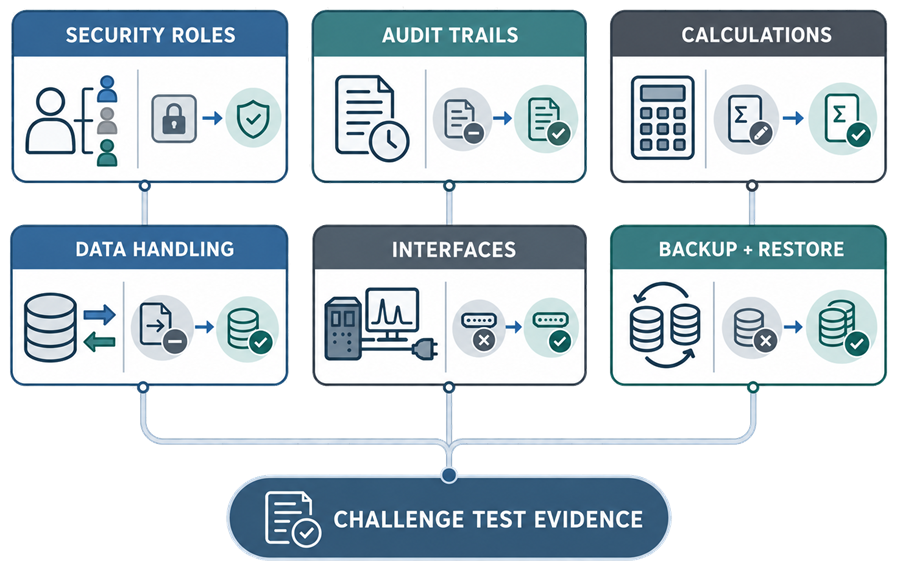
Effective challenge testing should establish:
- the challenged condition
- the required system response
- the observed response
- the resulting electronic record or audit-trail entry
- recovery or return to normal operation
- continued protection of affected data
- acceptance or deviation disposition
Simulated failure conditions should be safe, reversible, and approved. The protocol should specify how normal conditions will be restored after each challenge.
Acceptance Criteria
Acceptance criteria should be approved before execution and should be objective, measurable, and traceable to a requirement, specification, risk control, method need, or justified supplier claim.
Acceptance criteria may address:
- operating-range accuracy
- parameter stability
- response time
- repeatability
- alarm setpoint
- interlock action
- permitted user function
- prohibited user function
- calculation result
- rounding result
- data-transfer completeness
- audit-trail content
- record retrieval
- backup completion
- successful restoration
- recovery from an interruption
Avoid acceptance criteria based only on phrases such as:
- operates correctly
- functions as expected
- result acceptable
- no issue observed
The protocol should define what constitutes acceptable performance before the result is known.
Supplier OQ Documentation
Supplier OQ protocols and executed test records may be leveraged when they are applicable, complete, technically sound, and consistent with the approved qualification strategy. The assessment should determine whether supplier evidence:
- applies to the installed model and configuration
- identifies the tested modules
- covers the installed software and firmware versions
- uses controlled test procedures
- contains predefined acceptance criteria
- records actual results
- identifies test equipment
- addresses deviations
- includes appropriate review and approval
- is traceable to relevant functions or specifications
- covers the operating ranges required by the site
- addresses critical alarms and interlocks
- reflects the actual system configuration
Supplier testing often focuses on standard product functions and manufacturer specifications. It may not adequately address:
- site-configured user roles
- site security requirements
- audit-trail review
- site-specific calculations
- custom reports
- local data-storage arrangements
- backup integration
- LIMS interfaces
- network behavior
- site procedures
- intended analytical workflows
Gaps should be addressed through site-specific supplemental testing. Repeating adequate supplier tests without technical justification adds documentation without necessarily increasing assurance.
Calibration and OQ
Calibration and OQ support different conclusions. Calibration establishes the relationship between an instrument indication and a reference standard under defined conditions. OQ demonstrates that the broader instrument system and its functional controls operate as intended.
OQ may use calibrated reference devices and may verify measurement performance at selected points. It should not replace the ongoing calibration control program.
Before OQ execution, critical sensors and reference devices should have suitable calibration status. An out-of-tolerance reference device can invalidate affected OQ conclusions.
Deviations and Investigation
Unexpected results, procedural departures, test failures, and configuration discrepancies should be documented and assessed.
An OQ deviation record should identify:
- affected test and requirement
- expected result
- actual result
- supporting evidence
- immediate action
- potential impact on other tests
- impact on system function
- impact on data integrity
- impact on intended use
- root cause where investigation is required
- corrective action
- required retesting
- effect on previously executed tests
- final disposition and approval
A failed test should not be repeated until it passes without investigating the original result. Retesting should follow an approved rationale and retain the original evidence.
When a deviation results from a configuration change, the change should be documented and the effect on IQ, other OQ tests, supplier documentation, and the approved baseline assessed.
OQ Deliverables
The OQ package may include:
- approved OQ protocol
- executed test scripts
- supporting instrument outputs
- screenshots and reports
- independent calculation records
- alarm and interlock results
- security-role test records
- audit-trail evidence
- interface test records
- backup and restoration evidence
- traceability matrix
- deviation records
- configuration changes
- test-equipment records
- OQ summary report
- approval of the functional baseline
The final report should identify:
- the system and configuration tested
- the functions and ranges verified
- supplier evidence leveraged
- site-specific testing performed
- unresolved limitations
- deviations and their disposition
- requirements not tested and their verification method
- conclusion regarding fitness to proceed
- required controls or restrictions
OQ Approval and Release
OQ may be approved when:
- required tests have been executed
- acceptance criteria have been met or deviations have been acceptably resolved
- critical functions operate throughout the verified ranges
- alarms and interlocks respond as required
- software functions operate as intended
- security roles are effective
- audit trails capture required events
- calculations are accurate
- electronic records are protected and retrievable
- interfaces transfer data correctly
- applicable backup and restoration functions are verified
- the tested configuration is controlled
- no unresolved condition compromises intended use or data integrity
Approval should state whether the instrument may proceed to PQ, limited use, or another defined lifecycle activity. OQ approval should not be written as unrestricted release when additional PQ, method verification, procedural controls, or user training remain necessary.
Common OQ Weaknesses
Common weaknesses include:
- repeating IQ checks instead of challenging functions
- testing only nominal conditions
- omitting minimum and maximum operating conditions
- testing alarm annunciation without verifying protective action
- failing to challenge interlocks
- testing only successful user actions
- reviewing a role matrix without testing permissions
- confirming that an audit trail exists without generating representative entries
- verifying only one nominal calculation
- omitting rounding and boundary cases
- testing one successful interface transfer without error handling
- recording backup completion without testing restoration
- using supplier OQ documentation without applicability assessment
- failing to trace tests to requirements
- changing configuration during execution without assessment
- repeating failed tests without investigation
- using subjective acceptance criteria
- treating OQ approval as automatic release for routine GMP use
Conclusion
Analytical instrument Operational Qualification establishes evidence that the installed system functions correctly across defined operating ranges and responds appropriately to challenged, abnormal, and unauthorized conditions.
Effective OQ integrates hardware testing, module communication, alarms, interlocks, software functions, security roles, audit trails, calculations, data handling, interfaces, backup, recovery, and deviation control. It uses supplier evidence where justified but supplements that evidence for the actual site configuration and intended use.
The resulting functional baseline supports the decision to proceed to Performance Qualification, representative routine-use verification, or another justified release activity.