

Calibration and Routine Performance Verification of Analytical Instruments
Calibration and routine performance verification provide evidence that analytical instruments continue to measure and operate within defined requirements. They are related to instrument qualification, system suitability, maintenance, and adjustment, but they do not serve the same purpose.
A defensible calibration program identifies the parameters that require control, establishes scientifically justified tolerances and intervals, uses suitable traceable references, records as-found and as-left results, and defines the response to results that exceed established limits.
The program must also address the potential effect of a calibration failure on data generated since the instrument was last demonstrated to be acceptable. Simply adjusting the instrument and obtaining a passing result does not resolve the possible impact on previously reported results, product decisions, or electronic records.
Purpose and Lifecycle Position
The calibration and verification program should demonstrate that:
- critical instrument parameters are identified
- measurement requirements reflect intended use
- calibration ranges cover actual operating conditions
- acceptance tolerances support analytical requirements
- reference standards are suitable and traceable
- measurement uncertainty is understood and acceptable
- calibration procedures are approved and technically appropriate
- as-found performance is recorded before adjustment
- as-left performance is verified after adjustment or repair
- calibration intervals remain justified
- routine verification detects deterioration between calibrations
- failures receive documented investigation and impact assessment
- affected data and product decisions are evaluated
- adverse trends are identified
- instruments are formally released before return to GMP use
The program should operate within the approved risk-based analytical instrument qualification strategy and account for the instrument’s analytical instrument risk classification.
Distinguishing Related Activities
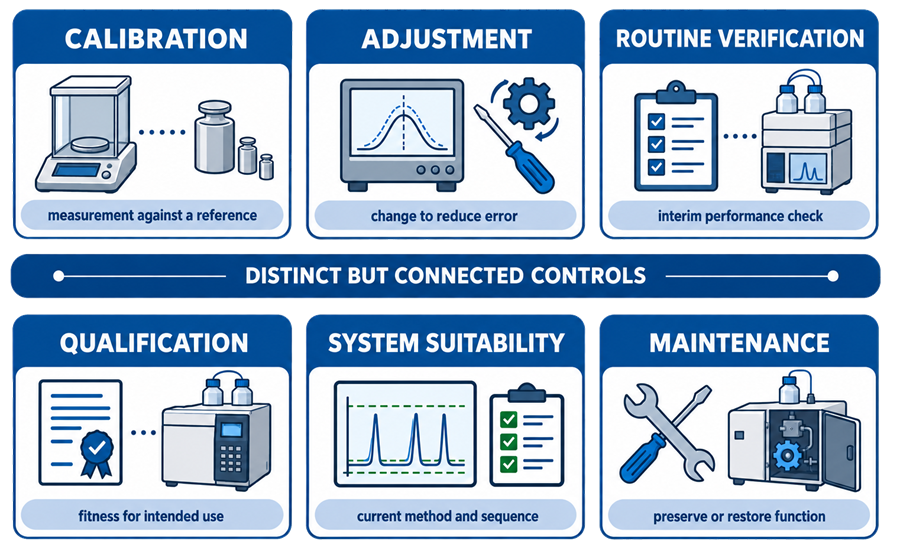
The terms calibration, adjustment, verification, qualification, system suitability, and maintenance are sometimes used interchangeably. This creates unclear responsibilities, incomplete records, and inadequate failure investigations.
| Activity | Primary purpose | Typical output |
|---|---|---|
| Calibration | Establish the relationship between instrument indication and a reference value under defined conditions | Measurement error, correction, bias, or confirmed conformity |
| Adjustment | Change the instrument to reduce measurement error or restore performance | Modified instrument configuration followed by verification |
| Routine performance verification | Confirm selected functions remain acceptable between formal calibration or qualification events | Pass/fail or quantitative interim-check result |
| Qualification | Demonstrate that the installed system is suitable for its intended use | Approved IQ, OQ, PQ, or equivalent lifecycle evidence |
| System suitability | Confirm that the current analytical system and method perform acceptably for a particular test or sequence | Method-specific acceptance results |
| Maintenance | Preserve or restore equipment function | Preventive or corrective maintenance record |
The following illustration summarizes these distinct but connected controls.
Calibration
Calibration establishes a documented relationship between a measured value produced by the instrument and a value provided by a suitable reference.
Calibration does not necessarily include adjustment. An instrument may be calibrated, found acceptable, and returned to use without alteration.
Calibration results should be quantitative where the instrument function and reference permit quantitative evaluation.
Adjustment
Adjustment changes the instrument to reduce measurement error or restore performance. Adjustment may include:
- zero adjustment
- span adjustment
- response correction
- optical alignment
- flow-controller correction
- temperature-controller adjustment
- mechanical alignment
- detector tuning
- configuration change
Adjustment can destroy evidence of the original condition. The instrument should therefore be evaluated and the as-found condition recorded before adjustment whenever technically possible.
After adjustment, the affected parameter must be calibrated or verified again. An adjustment record without acceptable as-left evidence does not demonstrate that the instrument is suitable for use.
Routine Performance Verification
Routine verification is an interim check used to detect loss of performance between more comprehensive calibration or qualification activities. Examples include:
- daily balance check
- wavelength check
- reference-temperature check
- pump-flow check
- detector-performance check
- photometric verification
- pH response check
- reference-material measurement
- instrument diagnostic
- automated self-test
Routine verification may be quantitative or qualitative. Its scope is generally narrower than calibration and should be selected because it can reveal deterioration relevant to intended use.
A passing routine check does not automatically extend an expired calibration interval unless the approved program specifically establishes that relationship.
Qualification
Qualification evaluates the integrated instrument and supporting system against approved intended-use requirements. Qualification may address:
- installation
- configuration
- functional operation
- performance range
- alarms
- controls
- software
- interfaces
- electronic records
- data integrity
- intended-use performance
Calibration supports qualification by establishing the accuracy of critical measurement functions. It does not replace qualification of the complete instrument system.
System Suitability
System suitability confirms performance of the current analytical system for a specific method, standard preparation, sample set, or analytical sequence.
It may evaluate:
- precision
- resolution
- response
- retention
- sensitivity
- blank performance
- peak symmetry
- reference-standard response
- method-specific controls
System suitability can detect some instrument problems, but it does not independently establish calibration of each critical parameter.
A chromatographic system can pass system suitability while a nonchallenged temperature or flow function remains outside its approved calibration tolerance.
Maintenance
Maintenance preserves or restores equipment function. It may include cleaning, lubrication, component replacement, alignment, inspection, software maintenance, or repair.
Maintenance does not establish measurement accuracy unless it includes or is followed by appropriate calibration or verification.
The required post-maintenance test should be based on the function affected.
Regulatory Basis
21 CFR 211.160(b)(4) requires calibration of instruments, apparatus, gauges, and recording devices at suitable intervals under an established written program. The program must include specific directions, schedules, accuracy and precision limits, and provisions for remedial action when limits are not met. Equipment that does not meet established specifications must not be used.
21 CFR 211.68 requires automatic, mechanical, and electronic equipment to be routinely calibrated, inspected, or checked according to a written program designed to assure proper performance.
21 CFR 211.194(d) requires complete records of periodic calibration of laboratory instruments, apparatus, gauges, and recording devices.
These requirements establish the necessary program elements but do not prescribe one universal interval, tolerance, reference standard, or calibration method for every analytical instrument.
Calibration Program Governance
The calibration program should define:
- equipment included in the program
- responsible departments and roles
- instrument owner
- calibration status
- critical parameters
- approved procedures
- calibration ranges
- test points
- reference standards
- acceptance criteria
- calibration intervals
- grace-period policy, if any
- overdue-calibration controls
- as-found and as-left requirements
- adjustment authorization
- documentation requirements
- failure notification
- impact-assessment process
- return-to-service authorization
- contractor controls
- record retention
- periodic review and trending
Responsibilities should be clear among the laboratory, metrology group, engineering, Quality Unit, information technology, and external service provider.
The laboratory retains responsibility for determining whether calibration evidence is adequate for the instrument’s GMP use, even when the work is performed by the manufacturer or an external calibration laboratory.
Instrument Inventory and Calibration Status
The controlled inventory should identify, as applicable:
- equipment identification number
- manufacturer
- model
- serial number
- location
- instrument owner
- intended use
- risk classification
- critical parameters
- calibration procedure
- calibration interval
- last calibration date
- next due date
- current status
- reference to qualification records
- software or firmware version
- service provider
- inactive or retired status
Calibration status should be readily available to users.
Status controls may include:
- physical label
- electronic equipment-management status
- instrument lockout
- software restriction
- laboratory scheduling restriction
- controlled status report
A label alone should not be the authoritative calibration record. It is a visible status indicator supported by the controlled calibration system.
Determining Which Parameters Require Calibration
Not every displayed value or instrument setting requires the same control.
A parameter should be evaluated for calibration or verification when it can affect:
- sample preparation
- measurement result
- calculation
- system suitability
- method execution
- specification decision
- data interpretation
- product release
- stability conclusion
- electronic record
Examples of potentially critical parameters include:
- mass
- volume
- temperature
- pressure
- flow
- time
- rotational speed
- wavelength
- absorbance
- photometric response
- refractive index
- pH
- conductivity
- detector response
- injection volume
- gradient composition
- oven temperature
- incubation temperature
- frequency
- dimensional position
The control strategy should consider both direct measurements and parameters that create the conditions under which another measurement is made.
For example, an HPLC column-oven temperature may not appear directly in the reported assay result, but it can affect retention, selectivity, resolution, and integration.
Requirements, Specifications, and Tolerances
Calibration acceptance criteria should support intended analytical use.
Requirements may originate from:
- approved user requirements
- analytical procedures
- compendial requirements
- manufacturer specifications
- development studies
- method-validation evidence
- instrument capability
- historical performance
- scientific or engineering assessment
The calibration tolerance should not be selected solely because the service provider routinely offers it.
The program should distinguish:
- manufacturer specification
- calibration tolerance
- process or method requirement
- warning or alert limit
- adjustment target
- reference-standard uncertainty
- decision rule
These values may be related but are not necessarily identical.
Calibration Tolerance
A calibration tolerance defines the acceptable difference between the instrument result and the applicable reference value.
The tolerance should:
- support the analytical requirement
- be achievable by the instrument
- account for the calibration method
- remain compatible with reference uncertainty
- cover the approved operating range
- permit an unambiguous conformity decision
An unnecessarily narrow tolerance can generate repeated adjustments without improving analytical control. An excessively broad tolerance can allow measurement error capable of affecting results.
Adjustment Target
The adjustment target is normally tighter than the final acceptance boundary so that routine drift does not immediately produce another failure.
The adjustment target should not be confused with the calibration acceptance tolerance.
Calibration Range and Test Points
Calibration should cover the range used by approved analytical procedures.
The test design should consider:
- minimum operating value
- maximum operating value
- normal working region
- critical method setpoints
- linear and nonlinear response
- ascending and descending values
- multiple channels or positions
- instrument operating modes
- environmental conditions
- load or sample effects
Testing one convenient point may be inadequate when the instrument is used across a broad range.
Examples include:
- a balance used from milligrams to hundreds of grams
- an oven used at several widely separated temperatures
- a pump used at multiple flow rates
- a detector used across different wavelength regions
- a dissolution tester used at several rotational speeds
Test points should be sufficient to characterize the required performance without converting every calibration into unnecessary full-range testing.
Accuracy, Precision, Repeatability, and Resolution
These characteristics address different aspects of measurement performance.
Accuracy
Accuracy concerns agreement between the measured value and an accepted reference value. Calibration commonly evaluates measurement error or bias relative to a reference rather than claiming absolute accuracy.
Precision and Repeatability
Precision concerns the closeness of repeated measurements under defined conditions. Repeatability is precision under the same or closely controlled conditions. A device may show good repeatability while producing consistently biased results. Repeatability therefore cannot replace evaluation against a reference.
Resolution
Resolution is the smallest change that can be meaningfully indicated by the instrument. Display resolution alone does not establish accuracy. An instrument can display many decimal places while having uncertainty or bias larger than the final displayed digit.
Stability
Stability concerns the instrument’s ability to maintain performance over time or during a defined measurement period.
It may be evaluated through:
- repeated readings
- drift studies
- calibration history
- control charts
- reference checks
- performance trends
Reference Standards
Calibration reference standards may include:
- certified weights
- calibrated thermometers
- temperature simulators
- pressure standards
- flow standards
- volumetric standards
- dimensional gauges
- tachometers
- wavelength standards
- photometric standards
- reference filters
- conductivity standards
- pH buffers
- reference materials
- electrical standards
- time or frequency references
The selected standard should be:
- suitable for the parameter
- appropriate for the range
- sufficiently accurate
- within its calibration or certification period
- identifiable
- protected from damage
- stored appropriately
- handled according to procedure
- supported by applicable documentation
Reference standards should not be used outside their certified range or under conditions inconsistent with their calibration.
Metrological Traceability
Metrological traceability links a measurement result to a stated reference through a documented, unbroken chain of calibrations, with each calibration contributing to measurement uncertainty. Traceability may be to:
- the International System of Units
- a national metrology institute
- an internationally recognized measurement standard
- a certified reference material
- a defined compendial or consensus reference where SI traceability is not technically applicable
The NIST Policy on Metrological Traceability explains that traceability requires an unbroken chain of calibrations to specified reference standards.
Traceability is a property of a measurement result, not merely of a device, certificate, or supplier.
Statements such as “NIST traceable” should be supported by:
- identified measurement result
- reference standard
- calibration chain
- documented procedure
- stated uncertainty
- applicable environmental conditions
- competent calibration provider
A reference standard with a NIST-related certificate does not automatically make every measurement performed with it fit for pharmaceutical use.
Measurement Uncertainty
Measurement uncertainty expresses the dispersion reasonably attributable to a measurement result. Contributors may include:
- reference-standard uncertainty
- instrument resolution
- repeatability
- operator technique
- environmental conditions
- method setup
- temperature effects
- loading
- drift
- interpolation
- positioning
- data processing
The required depth of uncertainty evaluation should reflect the parameter, risk, tolerance, and calibration method.
A calibration program does not need to reproduce a complete metrology-laboratory uncertainty budget for every simple routine check. It must, however, establish that the reference and method are capable of supporting the required decision.
NIST notes that metrological traceability alone does not establish that uncertainty is adequate for the intended purpose. Traceability and fitness for use must therefore be evaluated separately.
Test-Uncertainty Ratio and Decision Rules
The test-uncertainty ratio compares the allowable calibration tolerance with the expanded uncertainty of the calibration process.
TUR = Tolerance interval ÷ Expanded calibration uncertainty , Where:
- Tolerance interval is the total acceptable range between the lower and upper calibration limits.
- Expanded calibration uncertainty is the reported uncertainty of the calibration result at the stated coverage level.
Example:
If the acceptable error is ±2.0 units, the total tolerance interval is 4.0 units. If the expanded calibration uncertainty is 0.5 unit:
TUR = 4.0 ÷ 0.5 = 8:1
The calculation convention must be defined because some organizations use the total tolerance interval, while others compare a one-sided tolerance with uncertainty. The numerator and denominator must use the same units and a consistent convention.
A favorable TUR reduces the risk that measurement uncertainty will obscure the conformity decision. A universal minimum TUR should not be imposed without considering the parameter, measurement risk, available reference standards, and applicable calibration procedure.
Where uncertainty is significant relative to the tolerance, the program should define a decision rule addressing:
- acceptance
- rejection
- guard bands
- indeterminate results
- retesting
- escalation
- reporting of conformity
The decision rule should be agreed before reviewing the result rather than selected afterward to obtain a desired disposition.
Calibration Procedure
An approved calibration procedure should identify:
- instrument type and configuration
- parameter being calibrated
- required status and prerequisites
- reference standards
- reference-standard identification
- environmental conditions
- stabilization time
- setup
- range
- test points
- number of repetitions
- measurement sequence
- calculation
- acceptance criteria
- uncertainty or capability considerations
- as-found requirements
- adjustment restrictions
- as-left requirements
- failure response
- data recording
- review and approval
- return-to-service requirements
The procedure should reflect the specific instrument design. A generic temperature or flow procedure may require controlled equipment-specific instructions.
Calibration Execution
Before calibration, the person performing the work should confirm:
- correct instrument
- current procedure
- current calibration status
- intended configuration
- applicable range
- reference-standard status
- environmental suitability
- absence of unresolved damage
- required warm-up or stabilization
- access to previous records where necessary
The execution should preserve the instrument’s initial condition until as-found evidence has been collected.
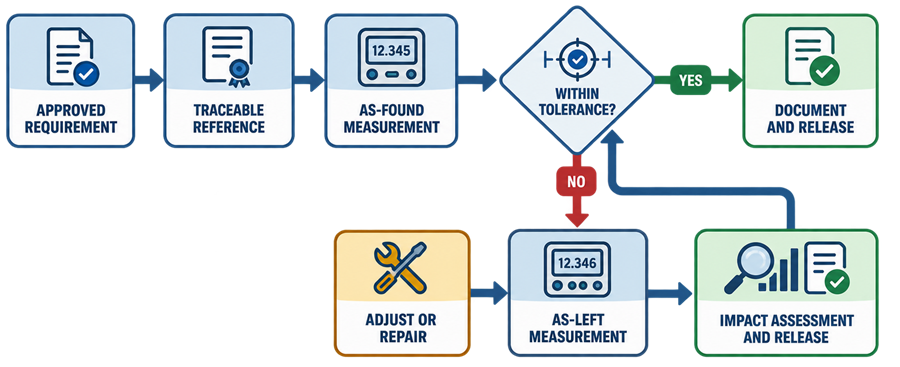
The following illustration shows the expected relationship among requirements, references, as-found data, adjustment, as-left data, impact assessment, and release.
As-Found Data
As-found data document instrument performance before adjustment, repair, or other intervention.
They are essential because they establish whether the instrument remained within its approved limits at the time of calibration.
As-found records should include, as applicable:
- parameter
- nominal value
- reference value
- instrument indication
- error or correction
- repeated measurements
- acceptance limit
- uncertainty
- environmental conditions
- pass or fail decision
- date and time
- reference-standard identification
- instrument configuration
If the instrument is adjusted before as-found data are collected, the organization may lose the strongest evidence for determining whether previously generated data could have been affected.
Cleaning, alignment, replacement, zeroing, tuning, or configuration changes may alter the as-found condition and should be controlled accordingly.
As-Left Data
As-left data document performance after adjustment, repair, or completion of calibration.
They demonstrate whether the instrument is suitable for its next period of use.
As-left data should cover the affected range and functions. Verification only at the point adjusted may be inadequate if the intervention could affect other points or channels.
The as-left record should indicate:
- adjustment or repair performed
- final configuration
- measurement results
- acceptance decision
- deviations from the approved procedure
- restrictions on use
- reviewer
- release status
Passing as-left results do not eliminate the need to evaluate a failing as-found condition.
Adjustment and Repair Control
Adjustment or repair should be performed only by authorized personnel using approved instructions or qualified service procedures.
The record should identify:
- reason for intervention
- initial condition
- adjustment performed
- parts replaced
- configuration changes
- firmware effects where applicable
- final testing
- calibration results
- required qualification or regression testing
- release authorization
The scope of post-intervention testing should be based on the functions potentially affected.
Examples:
| Intervention | Possible post-intervention verification |
|---|---|
| Balance leveling or zero adjustment | Level, zero, repeatability, sensitivity, applicable weighing-range checks |
| Temperature-sensor replacement | Temperature calibration across the intended range |
| HPLC pump repair | Flow accuracy, pressure integrity, gradient performance, leakage, representative chromatographic performance |
| Detector lamp replacement | Wavelength, response, noise, drift, linearity, representative system suitability |
| Autosampler repair | Positioning, injection precision, carryover, sequence execution |
| Software configuration change | Configuration verification, calculations, access, audit trails, data acquisition, applicable regression tests |
Calibration Intervals
Calibration intervals should be suitable for the instrument, parameter, use, and historical performance. Factors include:
- measurement criticality
- instrument technology
- expected drift
- frequency of use
- operating range
- environmental conditions
- transport or relocation
- maintenance frequency
- historical calibration results
- frequency and magnitude of adjustment
- routine-verification results
- supplier recommendations
- regulatory or compendial expectations
- consequence of undetected error
- availability of system-suitability evidence
A manufacturer’s annual recommendation may be an input, but it is not automatically the correct interval for every laboratory.
Initial Intervals
Initial intervals may be established from:
- manufacturer recommendations
- instrument design
- comparable equipment
- development evidence
- risk assessment
- calibration-provider experience
The rationale should be documented and reviewed when sufficient site history becomes available.
Interval Extension
Extension may be justified when evidence demonstrates:
- repeated acceptable as-found performance
- minimal drift
- no recurring adjustments
- successful routine verification
- stable maintenance history
- controlled environment
- unchanged use and range
- adequate detection controls between calibrations
An interval should not be extended solely to reduce workload.
Interval Reduction
Reduction may be appropriate after:
- out-of-tolerance results
- repeated near-limit results
- adverse drift
- frequent adjustment
- unstable environmental conditions
- increased use
- more demanding methods
- repeated repair
- inadequate interim detection
- change in instrument application
Calibration Due Dates and Grace Periods
The program should define how due dates are calculated and controlled.
A grace period should not become an undocumented extension of the approved interval. If grace periods are permitted, the procedure should define:
- maximum duration
- technical rationale
- authorization
- instrument restrictions
- required review
- effect on the next due date
- prohibition where risk is unacceptable
Routine scheduling convenience is not sufficient justification for repeated grace-period use.
Overdue Calibration
An instrument that exceeds its approved calibration interval should be placed under controlled status until evaluated.
The assessment should consider:
- duration overdue
- reason
- current performance
- routine-verification evidence
- system-suitability history
- instrument stability
- use during the overdue period
- results generated
- applicable product decisions
- need for retrospective review
A passing calibration performed after the due date provides useful evidence but does not erase the procedural lapse.
Routine Performance Verification Program
Routine verification should target functions most capable of detecting loss of performance between calibrations.
The program should define:
- parameter
- verification method
- reference or challenge
- frequency
- acceptance criteria
- required records
- failure response
- relationship to formal calibration
- authority to return the instrument to use
Examples include:
- balance checks using controlled weights
- pH meter checks with suitable buffers
- temperature checks against a reference
- HPLC flow or pressure checks
- detector-performance checks
- spectrophotometer wavelength or absorbance checks
- dissolution speed and temperature checks
- GC leak and flow checks
- headspace precision checks
- automated instrument diagnostics
Routine verification should be selected according to actual instrument risks. A self-test that checks electronics but does not challenge the measurement path may provide limited evidence.
Reference Checks and Control Charts
Repeated measurement of a stable reference can support continued performance monitoring.
Control charts may be used to detect:
- bias
- drift
- increasing variability
- step changes
- position-specific behavior
- deterioration after maintenance
- lot-to-lot reference differences
Control limits should be distinguished from calibration tolerances and analytical specifications.
A result can remain within the formal calibration tolerance while showing a meaningful adverse trend. Trend rules should therefore define when investigation or preventive action is required before failure occurs.
Calibration Standards and Reagents
Some instrument checks depend on standards, buffers, solutions, filters, tablets, or other materials rather than a reusable reference device.
Controls should address:
- identity
- source
- lot
- certification
- preparation
- standardization
- concentration
- storage
- expiration
- in-use period
- stability
- contamination
- traceability
- calculation
- documentation
Examples include:
- pH buffers
- conductivity standards
- photometric solutions
- wavelength standards
- reference tablets
- certified reference materials
- detector-performance standards
21 CFR 211.194(c) requires complete records of testing and standardization of laboratory reference standards, reagents, and standard solutions.
External Calibration Providers
An external calibration provider should be selected and controlled according to the importance of the service.
The assessment may address:
- technical competence
- applicable accreditation
- approved scope
- trained personnel
- traceability
- uncertainty capability
- procedures
- environmental controls
- reference-standard control
- electronic-record practices
- certificate content
- data retention
- notification of errors
- subcontracting
- change control
Accreditation can support supplier assessment, but it does not replace review of the actual service scope or calibration certificate.
The site should confirm that the provider’s accredited or demonstrated capability covers:
- the parameter
- range
- uncertainty
- calibration method
- instrument type
- required conformity statement
Calibration Certificate Review
A calibration certificate should be reviewed before acceptance. The review should address:
- customer and instrument identification
- manufacturer, model, and serial number
- calibration date
- procedure
- measurement range
- test points
- units
- as-found results
- as-left results
- acceptance limits
- reference standards
- traceability
- measurement uncertainty
- environmental conditions where relevant
- adjustments or repairs
- deviations
- conformity statement
- decision rule
- technician authorization
- certificate approval
- next-due information where contractually required
A certificate containing only “pass” provides limited evidence, particularly when adjustment occurred or retrospective impact may need to be evaluated.
Certificate review should identify whether the service provider tested the range and functions required by the site’s intended use.
Internal Versus External Calibration
Internal calibration may be appropriate when the site has:
- approved procedures
- trained personnel
- suitable reference standards
- appropriate environmental controls
- sufficient technical competence
- controlled calculation tools
- adequate records
- independent review
External calibration may be appropriate when:
- specialized standards are required
- adjustment requires manufacturer access
- uncertainty capability is unavailable internally
- proprietary diagnostics are necessary
- the instrument design requires specialist service
The decision should be based on capability and control, not solely on cost or convenience.
Software-Controlled Calibration
Modern analytical instruments may store calibration coefficients, correction factors, adjustment histories, or reference values in firmware or software.
Controls should address:
- authorized access
- calibration mode
- coefficient changes
- previous values
- new values
- audit trails
- date and time
- user identification
- approval
- backup
- restoration
- software upgrade
- configuration transfer
- calculation verification
Qualification should be coordinated with analytical instrument software validation.
A paper certificate may be incomplete if critical calibration changes occurred electronically and the corresponding metadata or audit trail were not retained.
Electronic Calibration Records and Data Integrity
Electronic calibration records may include:
- raw reference readings
- instrument readings
- calculations
- correction factors
- calibration coefficients
- electronic worksheets
- environmental data
- audit trails
- electronic signatures
- certificates
- attachments
- review records
- status changes
The system should protect these records from unauthorized alteration, deletion, replacement, or loss.
Controls should address:
- user access
- record attribution
- contemporaneous recording
- audit trails
- calculation control
- version control
- review
- approval
- backup
- restoration
- retention
- migration
- retrieval
The FDA Data Integrity and Compliance With Drug CGMP guidance should be considered when defining electronic calibration-record controls.
Additional internal guidance is provided in:
- Audit Trails and Data Change Control
- Access Control and Electronic Signatures
- Electronic Record Lifecycle and Retention
Out-of-Tolerance As-Found Results
An as-found result outside the approved tolerance should initiate controlled action.
Immediate actions should include, as appropriate:
- remove the instrument from GMP use
- identify the affected parameter
- preserve original data
- prevent unauthorized adjustment
- notify responsible personnel
- document the failure
- evaluate obvious setup or reference errors
- confirm reference-standard status
- determine whether repeat measurement is scientifically justified
- initiate deviation or calibration-failure investigation
- define the potential period of impact
The original result should not be invalidated merely because a repeat result passes.
A repeat test may help determine the nature of the failure, but it should not obscure or replace the initial as-found condition.
Calibration Failure Investigation
The investigation should consider:
- instrument malfunction
- drift
- wear
- environmental conditions
- operator technique
- setup
- stabilization
- reference-standard condition
- incorrect range
- procedure error
- calculation error
- software configuration
- damaged cable or sensor
- maintenance history
- relocation
- power interruption
- previous near-limit results
- recurring failures
The investigation should distinguish:
- confirmed instrument failure
- confirmed reference-standard failure
- assignable execution error
- intermittent condition
- unresolved cause
The absence of an identified root cause does not eliminate the need for impact assessment.
Defining the Potential Period of Impact
The potential period of impact is the interval during which the instrument may have produced unacceptable measurements.
The default starting point may be the last acceptable calibration, but the period can sometimes be narrowed using documented evidence such as:
- successful routine verification
- stable reference checks
- system-suitability results
- internal standards
- control samples
- diagnostic records
- maintenance records
- error logs
- instrument-use history
- trend data
- known failure onset
- comparison with another qualified instrument
The end point is normally when the instrument was removed from use or restored and verified.
The period should not be narrowed solely because reviewing the full interval would be burdensome.
Instrument, Data, and Product Impact
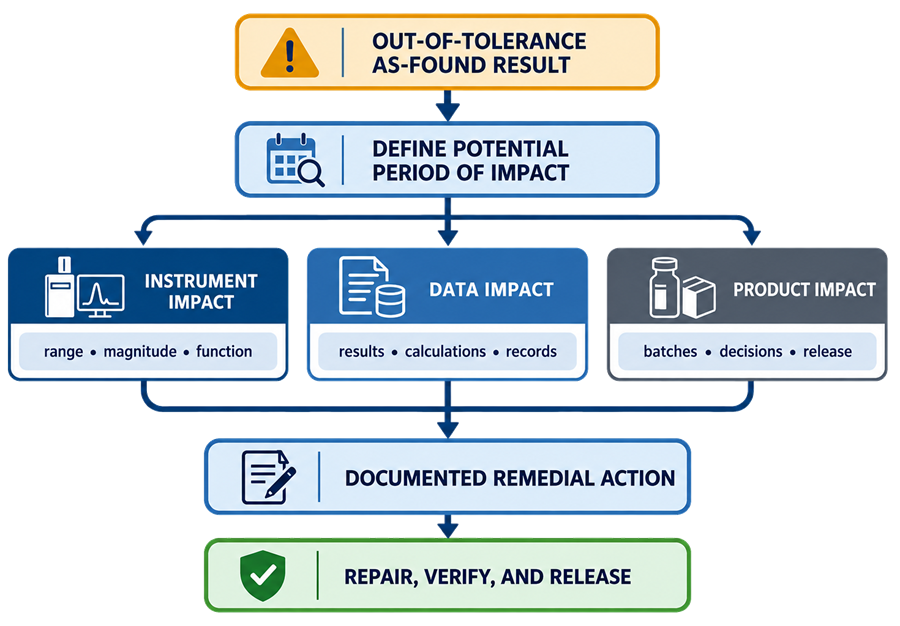
The following illustration shows the three connected impact assessments required after an out-of-tolerance as-found result.
Instrument Impact
The instrument assessment should determine:
- parameter affected
- magnitude and direction of error
- range affected
- operating modes affected
- channels or positions affected
- intermittent or continuous behavior
- influence on other functions
- repair or replacement required
- required requalification scope
Data Impact
The data assessment should identify:
- tests performed
- methods used
- operating setpoints
- samples analyzed
- standards analyzed
- system-suitability evidence
- raw data
- calculations
- reports
- invalidated or repeated tests
- stability data
- method-development data
- validation data
- transferred results
The assessment should consider whether the error would:
- change the reported value
- affect rounding
- alter a system-suitability decision
- change pass/fail status
- affect peak identification or integration
- alter a calculated correction
- affect a trend
- invalidate an analytical sequence
Product Impact
The product assessment should identify:
- batches tested
- release decisions
- rejected batches
- stability conclusions
- investigations
- regulatory submissions
- process-validation decisions
- cleaning-validation decisions
- method-validation conclusions
- complaints or recalls potentially affected
The direction of instrument error matters. A bias that makes results appear more acceptable may present a different risk from a bias that makes results appear worse.
Reference-Standard Impact
If the calibration failure involves a laboratory reference standard, the assessment should also determine whether other instruments calibrated with that standard may be affected.
The review may extend to:
- instruments calibrated
- dates of use
- measurement ranges
- secondary standards
- prior certificates
- correction factors
- resulting product or data decisions
Remedial Action
Remedial action should be proportional to the failure and supported by evidence.
Possible actions include:
- instrument repair
- adjustment
- component replacement
- recalibration
- targeted requalification
- broader requalification
- procedure revision
- reference-standard replacement
- interval reduction
- additional routine checks
- analyst retraining
- software correction
- calculation correction
- data reprocessing
- sample retesting where scientifically justified
- batch-impact assessment
- report correction
- regulatory assessment
- corrective and preventive action
Retesting should not be used as an automatic remedy for uncertainty about the original data. The scientific validity and regulatory handling of retesting must be addressed through the applicable investigation procedure.
Return to Service
An instrument should return to GMP use only after:
- failure investigation is sufficiently complete
- repair or adjustment is documented
- acceptable as-left calibration is obtained
- affected functions are verified
- required qualification testing is completed
- software or configuration is confirmed
- open restrictions are defined
- impact assessment is approved
- instrument status is updated
- release is authorized
The required evidence may include:
- calibration
- functional verification
- system suitability
- representative method testing
- software regression testing
- interface testing
- backup verification
- updated configuration baseline
- approved release record
A passing post-repair calibration does not, by itself, resolve the effect on data generated before the repair.
Calibration Trending
Calibration results should be reviewed collectively to detect deterioration before formal failure.
Useful trend inputs include:
- as-found error
- as-left error
- direction of drift
- adjustment frequency
- magnitude of adjustment
- repeatability
- uncertainty
- near-limit results
- routine-verification results
- failure frequency
- repair history
- reference-standard performance
- position-specific results
- service-provider differences
Trend review may support:
- interval extension
- interval reduction
- preventive maintenance
- component replacement
- targeted investigation
- procedure improvement
- reference-standard upgrade
- instrument replacement
Pass/fail summaries alone are inadequate for meaningful drift analysis. Quantitative as-found values should be retained and accessible.
Near-Limit and Adverse-Trend Results
A calibration result can meet the formal tolerance while indicating deteriorating performance. The program should define how to evaluate:
- repeated movement toward one limit
- sudden shift from historical performance
- increasing variability
- recurring need for adjustment
- differences among channels
- worsening uncertainty
- repeated routine-check alerts
- performance change after repair
Possible responses include:
- shorter interval
- additional verification
- preventive maintenance
- targeted investigation
- restricted operating range
- planned replacement
A near-limit result should not automatically be classified as a failure unless an approved alert or action criterion is exceeded.
Change Control and Requalification
Changes that may affect calibration include:
- new intended use
- expanded measurement range
- tighter analytical tolerance
- relocation
- new environmental conditions
- sensor replacement
- detector replacement
- controller replacement
- major repair
- firmware update
- software upgrade
- new calibration coefficient
- reference-standard change
- calibration-provider change
- procedure change
- interval change
- decision-rule change
The impact assessment should determine whether the change requires:
- document update
- new calibration points
- revised tolerance
- calibration
- routine verification
- software regression testing
- targeted qualification
- broader requalification
- method assessment
Relevant requalification decisions should follow the analytical instrument requalification framework.
Periodic Review
Periodic review should evaluate:
- inventory accuracy
- calibration status
- overdue events
- grace-period use
- as-found failures
- adjustments
- repeat repairs
- routine-verification failures
- calibration trends
- interval suitability
- reference-standard status
- supplier performance
- certificate deficiencies
- data-integrity observations
- software changes
- unresolved impact assessments
- obsolete instruments
- replacement needs
The review should determine whether the program remains capable of detecting unacceptable measurement performance before data or product quality is affected.
Common Calibration-Control Deficiencies
Common deficiencies include:
- calling every check a calibration
- treating adjustment as calibration
- adjusting before collecting as-found data
- recording only as-left results
- retaining only a pass statement
- using supplier tolerances without intended-use assessment
- calibrating at one point when multiple ranges are used
- failing to cover critical instrument modes
- using an expired or unsuitable reference standard
- claiming traceability without an identifiable calibration chain
- ignoring measurement uncertainty
- using an incapable reference for a narrow tolerance
- failing to define a conformity decision rule
- extending intervals without historical evidence
- routinely using grace periods
- continuing to use overdue instruments without assessment
- treating system suitability as a substitute for calibration
- treating calibration as a substitute for qualification
- failing to verify performance after repair
- closing a failure after adjustment without retrospective assessment
- failing to evaluate data and product impact
- omitting other instruments affected by a failed reference standard
- failing to trend quantitative as-found results
- accepting incomplete external calibration certificates
- failing to control software-stored calibration coefficients
- returning the instrument to use without documented authorization
Conclusion
Calibration control should establish whether critical analytical instrument parameters remain within scientifically justified requirements. Routine performance verification should provide timely evidence of continued operation between formal calibration or qualification activities.
Calibration, adjustment, routine verification, qualification, system suitability, and maintenance are connected controls, but they answer different questions. Their procedures, records, acceptance criteria, and failure responses should remain clearly distinguished.
A complete calibration lifecycle includes approved requirements, suitable traceable standards, understood measurement uncertainty, controlled execution, as-found and as-left results, justified intervals, routine verification, failure investigation, retrospective impact assessment, performance trending, and documented return to service.