

Analytical Instrument–LIMS Interface Validation
An analytical instrument–laboratory information management system (LIMS) interface transfers laboratory information between an instrument data system and LIMS. The transferred information may include sample identifiers, test assignments, analytical results, units, status, timestamps, method identifiers, instrument identifiers, and review information.
An interface can reduce manual transcription and improve the timeliness and consistency of laboratory records. It can also propagate incorrect identifiers, units, calculations, status values, or duplicate results across multiple systems. Validation must therefore establish more than successful connectivity. It must demonstrate that authorized data are transferred completely, accurately, securely, once only when intended, and with sufficient context to support their regulated use.
The interface should be validated within the combined boundaries of the analytical instrument software validation lifecycle and LIMS validation and laboratory data lifecycle control. The validation strategy should identify the complete data path, the responsibility of every component, and the authoritative source for each transferred field.
Intended Use and Interface Scope
The intended-use statement should define what the interface transfers, why the transfer is required, which systems participate, and which GMP decisions depend on the transferred data. The scope should identify:
- source and destination systems;
- interface direction;
- analytical techniques and instruments;
- instrument or data-system versions;
- LIMS modules and environments;
- middleware or integration services;
- transferred record types;
- transfer triggers;
- authorized users or system accounts;
- mapping and transformation rules;
- error-handling functions;
- reconciliation requirements;
- audit trails and technical logs;
- infrastructure and security services; and
- retained records required to reconstruct the transfer.
The interface boundary may include instrument software, a scientific data-management system, middleware, message queues, interface engines, application programming interfaces, file-transfer locations, LIMS, identity services, databases, network components, and monitoring tools.
Each component should have a defined responsibility. A successful transmission from the instrument system does not establish that LIMS received, interpreted, stored, and presented the information correctly.
Regulatory and Data-Integrity Context
Applicable controls depend on the records transferred and how the receiving system uses them.
Relevant US requirements commonly include:
- 21 CFR 211.68, including appropriate control of computerized systems and risk-based verification of input and output;
- 21 CFR 211.180, addressing retention and availability of required records;
- 21 CFR 211.194, addressing complete laboratory records; and
- 21 CFR 11.10, where the interface forms part of a closed electronic-record system subject to Part 11.
FDA’s Data Integrity and Compliance With Drug CGMP guidance emphasizes complete, consistent, accurate, and attributable data throughout the data lifecycle.
An interface should preserve the content and meaning of the transferred data. Transfer of a final numerical result does not necessarily transfer the complete analytical record. Raw data, methods, processing parameters, metadata, audit trails, and review history may remain in the analytical data system and should remain retained and accessible according to their regulated purpose.
Direct and Middleware-Based Interfaces
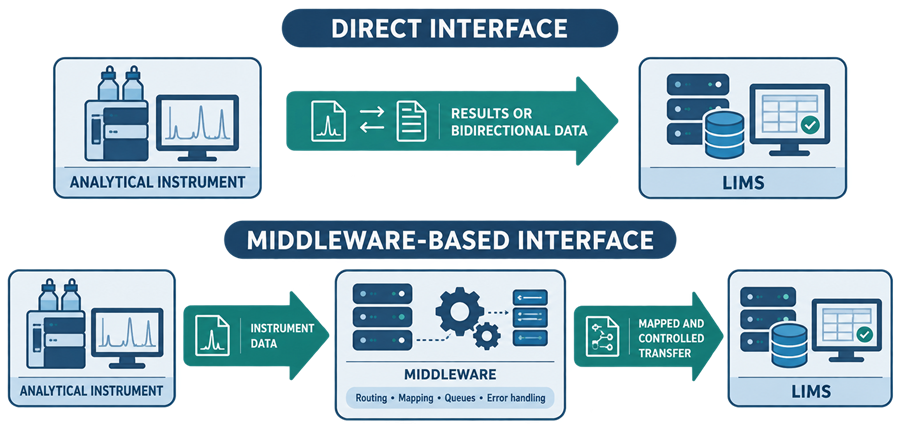
A direct interface connects the analytical instrument or instrument data system directly to LIMS. The connection may use an application programming interface, database service, web service, shared file, serial connection, or vendor-specific protocol.
Direct interfaces may involve fewer components and simpler data paths. They can also create instrument-specific configurations that become difficult to support consistently across a large laboratory.
A middleware-based interface places an integration component between the analytical system and LIMS. Middleware may perform:
- message routing;
- field mapping;
- format conversion;
- code translation;
- validation;
- queue management;
- duplicate detection;
- error handling;
- retry control;
- transaction logging; and
- interface monitoring.
Middleware does not remove the need to validate the complete transfer. It adds functions and failure modes that must be included within the system boundary and testing strategy.
The architecture decision should consider system capability, number and type of instruments, data volume, standardization, error handling, security, maintainability, supplier support, and the ability to reconstruct each transaction.
One-Way and Bidirectional Transfers
A one-way interface transfers information in one direction. Common examples include:
- analytical results from an instrument data system to LIMS;
- sample worklists from LIMS to an instrument;
- approved results from LIMS to another business system; and
- instrument status information to a monitoring platform.
A bidirectional interface exchanges information in both directions. LIMS may send sample identifiers, test assignments, methods, and worklists to the analytical system, while the analytical system returns results, status, instrument identifiers, and acquisition timestamps.
Bidirectional interfaces can reduce manual entry but increase dependency between systems. Incorrect data sent from LIMS may affect instrument acquisition, while incorrect data returned from the instrument may affect LIMS result evaluation.
Validation should treat each direction as a distinct data flow with its own:
- source and destination;
- transfer trigger;
- permitted record status;
- field mapping;
- transformation rules;
- authorization;
- error handling;
- reconciliation; and
- acceptance criteria.
A bidirectional connection should not be tested only as one combined transaction. Failures and recovery should be challenged independently in both directions.
Defining the Authoritative Data Source
The validation strategy should identify which system is authoritative for every critical data element. Examples may include:
- LIMS as the source for sample and test identifiers;
- enterprise systems as the source for material and batch information;
- the analytical data system as the source for acquired results and instrument metadata;
- middleware as a transient routing and mapping component;
- LIMS as the source for final result status and approval; and
- the analytical system as the retained source for complete electronic raw data.
Middleware should not become an uncontrolled alternative record source merely because it retains message content. Retention and availability of middleware logs and messages should be based on their role in reconstructing the transaction and supporting investigation.
If the same field can be modified in multiple systems, the ownership, synchronization, and conflict-resolution rules should be defined. Uncontrolled competing sources can create inconsistent records even when every individual transfer functions technically.
Data-Flow and Mapping Specification
A controlled interface specification should define each transferred field and its behavior throughout the data path. For each field, the specification should identify:
- field name;
- business meaning;
- source system;
- source format;
- destination field;
- destination format;
- permitted values;
- maximum length;
- required or optional status;
- unit;
- numerical precision;
- mapping or conversion rule;
- default value;
- null-value handling;
- validation rule;
- rejection condition; and
- audit or logging requirement.
The specification should distinguish direct transfer from calculated, translated, reformatted, or derived information.
Mapping should be unambiguous. Similar field names do not establish equivalent meaning. For example, “test date” could mean sample collection, preparation, acquisition, calculation, review, or approval date.
Mapping changes should be controlled as configuration changes. They can affect every subsequent transaction and may require regression testing of related fields and workflows.
Sample and Test Identifiers
Sample and test identifiers provide the primary link between the physical sample, instrument record, LIMS record, and reported result. Controls should address:
- identifier format and length;
- uniqueness;
- case sensitivity;
- spaces and special characters;
- leading zeros;
- prefixes and suffixes;
- barcode interpretation;
- parent and aliquot relationships;
- replicate and reinjection identifiers;
- test-code mapping;
- method-code mapping;
- sequence position;
- instrument worklist assignment; and
- prevention of reuse.
The interface should reject or quarantine results that cannot be matched unambiguously to an authorized sample and test assignment.
Truncation, removal of leading zeros, character substitution, or normalization of identifiers can associate a result with the wrong sample. Testing should therefore include identifiers at maximum permitted length and identifiers containing allowed special characters.
The transfer should not create a new sample or test automatically unless that behavior is explicitly intended, authorized, and validated.
Result Values, Units, and Data Types
Result transfer should preserve the numerical or qualitative meaning of the source result. The interface specification should address:
- numeric values;
- text values;
- enumerated qualitative results;
- scientific notation;
- negative values;
- zero values;
- decimal separators;
- thousands separators;
- inequality symbols;
- less-than or greater-than results;
- below-detection or below-quantitation values;
- null values;
- censored results;
- calculated results;
- units of measure; and
- unit conversions.
A value without its unit may be incomplete or misleading. The interface should transfer or reliably assign the correct unit and should prevent incompatible units from being applied to the result.
Where unit conversion occurs, the conversion formula, factor, precision, and rounding point should be specified and independently verified. The retained record should make the transformation understandable.
Text fields should not be used to bypass structured result controls. For example, transferring “5.2 mg/mL” as unrestricted text may prevent numerical specification evaluation, trending, or controlled unit handling.
Significant Figures, Precision, and Rounding
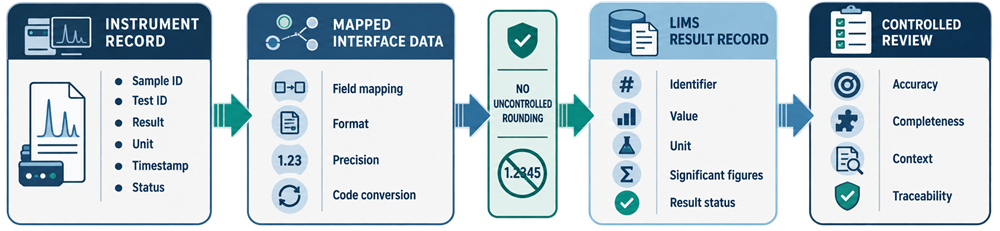
Source and destination systems may store and display different numbers of decimal places. Interface validation should distinguish:
- acquired precision;
- stored precision;
- transferred precision;
- calculation precision;
- displayed precision; and
- reportable precision.
The interface should not apply uncontrolled rounding or truncation. A result near a specification limit can change classification if precision is lost or rounding is applied at the wrong point.
Controls should define:
- the authoritative unrounded value;
- the number of digits transferred;
- numerical field capacity;
- rounding method;
- stage at which rounding occurs;
- displayed decimal places;
- specification-comparison precision; and
- treatment of scientific notation.
Testing should include values:
- immediately above and below specification limits;
- exactly equal to a limit;
- containing more decimals than the destination display;
- at the maximum field size;
- expressed in scientific notation;
- affected by unit conversion; and
- capable of revealing truncation instead of rounding.
The validation record should compare the source value, transmitted value, stored destination value, displayed value, and final reported value.
Result Status and Workflow Control
A transferred result includes more than its value. Its status determines whether it may be reviewed, approved, reported, trended, or used for disposition.
Possible source statuses may include:
- acquired;
- processed;
- preliminary;
- complete;
- reviewed;
- approved;
- invalidated;
- superseded;
- aborted;
- failed; and
- cancelled.
The interface should define which statuses are eligible for transfer and how each source status maps to the destination.
A preliminary result should not be interpreted as approved merely because the transmission succeeded. LIMS should not make a result available for final reporting or batch disposition until required review and approval controls are satisfied.
Status changes after initial transfer should be addressed. The design should define whether the interface:
- sends only the final approved result;
- sends preliminary results followed by controlled status updates;
- replaces an existing record;
- creates a new result version;
- invalidates the prior result; or
- requires manual exception handling.
Superseded or invalidated results should remain traceable. The interface should not delete or silently overwrite the earlier result without preserving its history.
Timestamps and Time Synchronization
Timestamps may be used to establish acquisition, processing, transmission, receipt, review, and approval chronology. The specification should identify:
- the event represented by each timestamp;
- the system that generates it;
- date and time format;
- time zone;
- daylight-saving-time handling;
- precision;
- clock source;
- synchronization mechanism; and
- treatment of unavailable or invalid time values.
Systems participating in the interface should use controlled time sources where chronology is important. Excessive clock differences can create misleading event sequences and complicate investigation.
Testing should address:
- different date formats;
- 12-hour and 24-hour formats;
- time-zone conversion;
- daylight-saving transitions;
- leap-day dates;
- midnight transitions;
- delayed messages;
- queued messages; and
- system clock discrepancies.
The receiving system should not replace a meaningful source-event timestamp with the receipt time without retaining the distinction.
Transfer Triggers and Transaction Control
The transfer trigger should be defined and tested. A transaction may be initiated by:
- completion of acquisition;
- completion of processing;
- analyst action;
- review;
- approval;
- status change;
- scheduled polling;
- file creation;
- message-queue event; or
- authorized retransmission.
The trigger should prevent premature, incomplete, or unauthorized records from being transmitted.
Each transaction should have a unique identifier or equivalent control that permits it to be traced across the source, middleware, and destination systems.
The transaction record should identify, as applicable:
- source record;
- message identifier;
- sender;
- transmission time;
- destination;
- receipt time;
- validation outcome;
- posting outcome;
- retry activity;
- final disposition; and
- associated exception.
Acknowledgment should be meaningful. A network-level delivery confirmation does not necessarily prove that the receiving application accepted and stored the record.
Rejected Messages
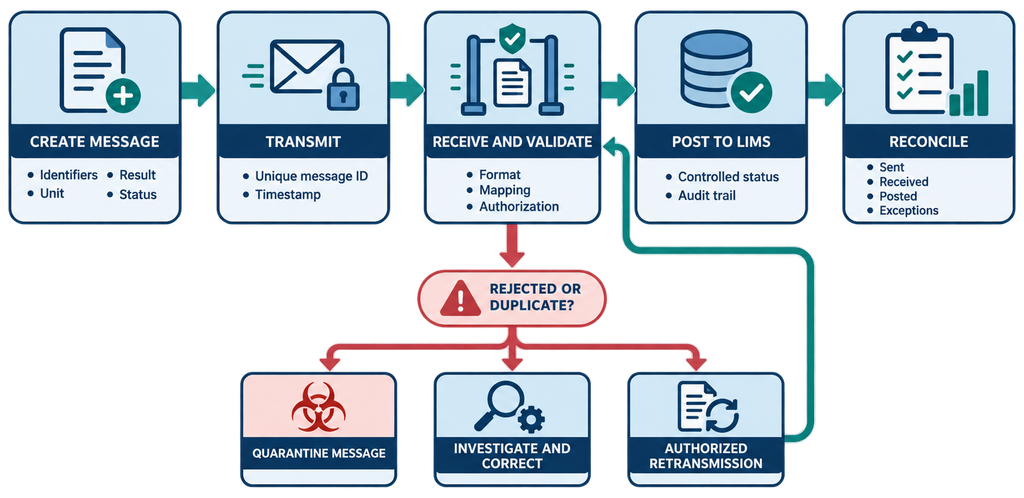
A message should be rejected or quarantined when it fails defined technical or business rules. Rejection conditions may include:
- missing required fields;
- unrecognized sample or test identifier;
- invalid field format;
- unsupported unit;
- invalid status;
- unauthorized source;
- failed authentication;
- incorrect message version;
- value outside the permitted data type;
- mapping failure;
- checksum or integrity failure;
- destination record conflict; and
- expired or cancelled assignment.
Rejected messages should not disappear from the transaction history. The system should retain sufficient information to determine:
- what was sent;
- why it was rejected;
- when rejection occurred;
- which system rejected it;
- whether any partial processing occurred;
- who investigated it;
- what correction was made; and
- whether retransmission was authorized.
Correction should occur in the appropriate authoritative system. Direct modification of queued message content can compromise attribution and should be prevented or tightly controlled.
Duplicate Transmission
Duplicate messages can arise from communication timeouts, automatic retries, manual retransmission, queue recovery, or uncertainty about whether the destination accepted the original transaction.
The interface should use a unique message identifier, transaction key, or equivalent control to detect duplicate submissions.
The required behavior should be specified. Depending on the design, the system may:
- reject the duplicate;
- identify it without reposting;
- compare it with the existing record;
- update an existing record under controlled versioning; or
- route it for investigation.
The interface should not create multiple reportable results merely because the same valid message was transmitted more than once.
Testing should include identical duplicates, duplicates with changed timestamps, duplicates with changed values, and retransmission after an acknowledgment failure.
Retry and Retransmission Controls
Automatic retry may be appropriate for temporary technical failures, such as a network interruption or unavailable destination service. It should not repeatedly resubmit a message that fails a business rule. Controls should distinguish:
- transport failure;
- authentication failure;
- format failure;
- mapping failure;
- business-rule rejection;
- destination conflict; and
- application posting failure.
Retry limits, timing, queue behavior, escalation, and final disposition should be defined.
Manual retransmission should require authorization and should preserve the original failed transaction. The user should not be able to alter the source result through the retransmission function.
A corrected transaction should be linked to the original rejected transaction and should retain a distinct message identifier where needed for traceability.
Reconciliation
Reconciliation demonstrates that messages expected to transfer were sent, received, accepted, posted, and accounted for. Reconciliation may compare:
- source records eligible for transfer;
- messages created;
- messages sent;
- messages acknowledged;
- messages accepted;
- results posted;
- rejected messages;
- duplicate messages;
- pending messages;
- manually resolved transactions; and
- destination records.
Reconciliation frequency should reflect data criticality, transfer volume, interface reliability, and the time within which an undetected failure could affect a GMP decision.
Reconciliation should not rely only on total counts. Ten sent and ten received messages do not establish that the same ten records were transferred. Matching should use sample, test, transaction, and result identifiers as appropriate.
Unreconciled differences should be investigated before affected data support final reporting, material disposition, stability conclusions, or other regulated decisions.
Exception Handling and Escalation
Interface procedures should define how users identify, investigate, correct, approve, and close exceptions. Exceptions may include:
- missing transactions;
- rejected messages;
- duplicate results;
- unmatched identifiers;
- incorrect mapping;
- unit discrepancies;
- precision or rounding differences;
- incorrect status;
- delayed transmission;
- partial records;
- queue accumulation;
- unauthorized activity;
- lost acknowledgment;
- interface downtime; and
- inconsistent source and destination records.
Exception handling should preserve the original records and technical evidence. Investigation may require coordinated review of:
- instrument audit trails;
- source-system records;
- middleware logs;
- message content;
- queue history;
- LIMS audit trails;
- network or service logs;
- security events; and
- reconciliation reports.
The investigation should determine whether the event affected only transmission or also affected data generation, processing, approval, reporting, or product decisions.
Exceptions with actual or potential data or product impact should be escalated through the applicable deviation or investigation process.
Security and Authentication
The interface should accept data only from authorized systems and services. Security controls may include:
- authenticated service accounts;
- unique system identities;
- encrypted communication;
- restricted network paths;
- protected interface endpoints;
- controlled certificates and keys;
- least-privilege permissions;
- separation of administrative responsibilities;
- protected file-transfer locations;
- monitored remote access;
- restricted database access; and
- security-event logging.
Interactive user accounts should not be used as unattended interface-service identities. Service accounts should have defined owners, permitted functions, credential controls, and periodic review.
Interface credentials should not be embedded in uncontrolled scripts, configuration files, or user-accessible locations.
Security testing should verify both permitted and prohibited activity, including attempted transmission from an unauthorized source, expired credentials, altered messages, and access beyond the required interface functions.
Audit Trails and Technical Logs
The combined interface should provide sufficient history to reconstruct each transaction. Relevant records may include:
- source-system audit trails;
- middleware transaction logs;
- message-queue history;
- transformation logs;
- validation and rejection logs;
- LIMS audit trails;
- service-account activity;
- configuration changes;
- security events; and
- reconciliation records.
Audit trails and technical logs serve different purposes. A transport log showing that a file moved does not establish that the regulated result was posted correctly. Conversely, a LIMS audit trail may not explain why middleware rejected an earlier message.
Review requirements should be based on the significance of the recorded event. Routine result review may include interface status and relevant LIMS audit trails, while periodic review may evaluate rejected transactions, retries, duplicates, security events, and configuration changes across the interface.
The principles established in Analytical Laboratory Audit Trails, User Access, and Data Review should be applied to interface-generated electronic records.
Requirements and Risk Assessment
Interface requirements should describe observable and testable behavior.
Requirements should address:
- architecture and system boundaries;
- transfer direction;
- record eligibility;
- transfer triggers;
- field mapping;
- identifiers;
- units;
- precision and rounding;
- status mapping;
- timestamps;
- authentication;
- encryption;
- acknowledgments;
- rejection rules;
- duplicate detection;
- retries;
- retransmission;
- reconciliation;
- audit trails;
- monitoring;
- downtime;
- recovery; and
- retention.
Risk assessment should evaluate potential failures and their effects on data reliability and laboratory decisions.
High-risk failures may include:
- result assigned to the wrong sample;
- incorrect test or method association;
- changed value or unit;
- loss of significant figures;
- incorrect specification evaluation;
- preliminary result treated as approved;
- missing or duplicate result;
- unauthorized data transfer;
- undetected rejected message;
- incomplete reconciliation; and
- inability to reconstruct the transaction.
The risk assessment should determine preventive controls, detection controls, testing depth, monitoring, and required response.
Interface Qualification Testing
Testing should verify the complete configured interface rather than isolated components only.
Installation and Configuration Verification
Verification should address:
- approved software and interface versions;
- enabled services;
- endpoints and ports;
- middleware configuration;
- message schemas;
- field mappings;
- code tables;
- service accounts;
- certificates;
- queue configuration;
- time synchronization;
- logging;
- monitoring; and
- environment separation.
Positive Functional Testing
Positive testing should demonstrate successful transfer of representative records, including:
- standard numeric results;
- qualitative results;
- multiple units;
- approved identifiers;
- normal status transitions;
- expected timestamps;
- permitted special characters;
- maximum field lengths; and
- authorized retransmission.
Negative and Boundary Testing
Negative testing should challenge:
- missing identifiers;
- invalid sample and test combinations;
- unsupported units;
- invalid statuses;
- excessive field length;
- null values;
- malformed messages;
- unauthorized sources;
- duplicate transmissions;
- altered messages;
- destination unavailability;
- network interruption;
- queue failure;
- timeout;
- lost acknowledgment;
- mapping errors;
- precision loss; and
- values near specification limits.
Recovery Testing
Recovery testing should demonstrate controlled handling of:
- interface-service restart;
- middleware restart;
- source-system restart;
- LIMS outage;
- network interruption;
- queued messages;
- incomplete transactions;
- automatic retries;
- manual retransmission; and
- restoration from backup where applicable.
Recovery should not create missing, duplicate, or uncontrolled records.
End-to-End Testing
End-to-end testing should use representative laboratory workflows and verify the data from initial creation through final controlled use.
A bidirectional test may include:
- creating a sample and test assignment in LIMS;
- transmitting the authorized worklist;
- confirming receipt by the correct analytical system;
- acquiring and processing the result;
- transferring the result and associated metadata;
- verifying mapping, value, unit, precision, status, and timestamps;
- reviewing the result and relevant audit trails;
- approving the record in LIMS;
- generating the final report; and
- reconciling the complete transaction.
The test should compare the source record, transmitted message, middleware record where applicable, LIMS record, displayed result, and final report.
End-to-end testing should include representative exceptions rather than only a successful transfer. A validated interface must demonstrate both correct processing and controlled failure.
Traceability and Release
Traceability should connect:
- intended use;
- interface and data-flow requirements;
- risk controls;
- mapping specifications;
- configuration;
- test evidence;
- deviations;
- procedures;
- training; and
- release approval.
Before release, the organization should confirm that:
- the architecture and system boundaries are approved;
- authoritative data sources are defined;
- mappings are verified;
- positive, negative, boundary, recovery, and end-to-end tests are accepted;
- exceptions are resolved;
- reconciliation is effective;
- monitoring is operational;
- security controls are approved;
- support responsibilities are assigned;
- procedures are effective;
- users and administrators are trained; and
- the production configuration is baselined.
Change Control and Periodic Review
Changes to any participating component can affect the interface. Changes may include:
- instrument software upgrades;
- LIMS upgrades;
- middleware updates;
- message-schema changes;
- field mappings;
- result-code tables;
- units;
- precision or rounding rules;
- interface endpoints;
- authentication methods;
- certificates;
- service accounts;
- network configuration;
- queue settings;
- retry logic; and
- monitoring tools.
The change assessment should evaluate both direct and downstream effects. A source-field change may not produce an obvious technical failure if the destination continues accepting the message but stores the information incorrectly.
Regression testing should cover affected mappings, related fields, exception handling, reconciliation, and representative end-to-end workflows.
Periodic review should consider:
- transaction volume;
- failure and rejection trends;
- duplicate messages;
- retry activity;
- unresolved exceptions;
- reconciliation performance;
- security events;
- service-account access;
- configuration changes;
- software versions;
- vendor notices;
- recurring manual intervention;
- infrastructure support; and
- obsolescence.
The review should determine whether the interface remains reliable, secure, supported, and suitable for its intended use.
Maintaining the Validated State
Maintaining a validated analytical instrument–LIMS interface requires control of the entire data path, not only the connection between two endpoints.
The control strategy should ensure that:
- transferred records remain attributable and complete;
- identifiers preserve the correct sample and test relationship;
- values, units, precision, status, and timestamps retain their meaning;
- rejected and duplicate transactions remain visible;
- exceptions are investigated and resolved;
- reconciliation detects missing or inconsistent records;
- security prevents unauthorized transfer;
- audit trails and technical logs reconstruct each transaction;
- changes are assessed and tested; and
- periodic review confirms continuing performance.
A successful interface is not merely one that moves data. It is one that moves the correct authorized data, preserves their meaning and status, detects failures, and provides defensible evidence from source record through final laboratory use.