

Lifecycle Integration and Knowledge Management in Process Validation
Process validation is most effective when it operates as an integrated lifecycle rather than as a sequence of disconnected studies. Process knowledge begins to develop during pharmaceutical and process development, is challenged and expanded during technology transfer and scale-up, is formalized during Process Design, is tested under commercial conditions during Process Qualification and Process Performance Qualification (PPQ), and continues to grow during routine manufacturing through Continued Process Verification (CPV).
FDA specifically recognizes this knowledge flow. Its process validation guidance establishes a lifecycle extending from process design through commercial manufacturing, while the FDA/ICH Q8-Q9-Q10 implementation guidance states that knowledge gained during development forms the foundation for process validation and continues to develop through technology transfer and commercial manufacture.
Knowledge management provides the mechanism for ensuring that this information does not remain fragmented among development reports, transfer packages, validation protocols, manufacturing records, investigations, statistical reports, and change controls. Instead, accumulated knowledge should be evaluated and used to support current decisions about process risk, control strategy, PPQ, CPV, changes, investigations, and maintenance of the validated state.
See General Principles of Process Validation for the overall FDA Stage 1–3 lifecycle and Regulatory Requirements and FDA Expectations for Process Validation for the U.S. regulatory framework.
Process Validation Is a Knowledge-Driven Lifecycle
The three FDA process-validation stages are often shown sequentially, but information does not move only in one direction.
Stage 1 generates the initial commercial process understanding and control strategy. Stage 2 provides commercial-scale evidence about reproducibility, variability, sampling, equipment-process interactions, and the effectiveness of controls. Stage 3 then generates substantially more manufacturing experience.
Later lifecycle information may confirm previous assumptions, but it may also challenge them. For example, commercial manufacturing may demonstrate that:
- a material attribute has greater effect on process performance than predicted during development;
- an operating range is more or less robust than originally assumed;
- equipment configuration introduces a previously unrecognized source of variability;
- a parameter previously assigned low risk warrants closer monitoring;
- the established control strategy does not adequately detect a developing condition;
- PPQ variability does not fully represent long-term commercial variability;
- a supplier or material change affects process behavior;
- recurring deviations indicate incomplete process understanding; or
- a process improvement can reduce variability or strengthen control.
The appropriate response is not simply to record the new information. The new evidence should be incorporated into the current body of process knowledge and evaluated for its effect on risk, controls, validation conclusions, and future monitoring.
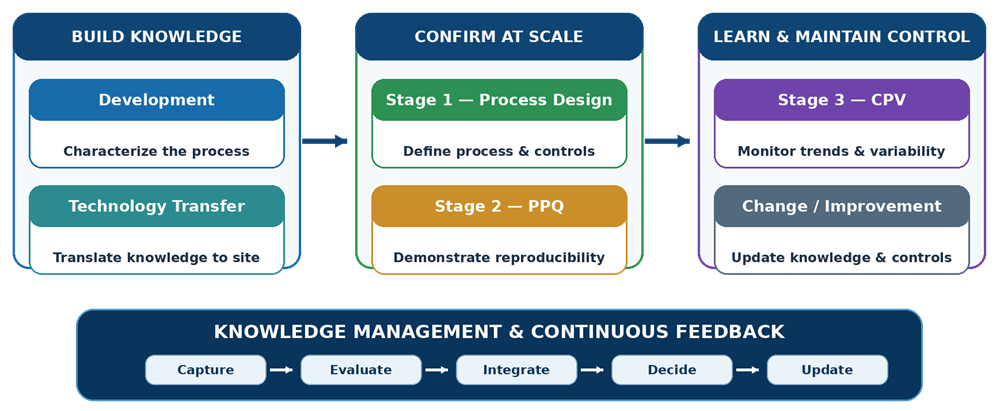
Development as the Starting Point for Process Knowledge
Process validation does not begin when a PPQ protocol is approved.
Development activities provide much of the scientific foundation later used to justify the commercial process. Relevant knowledge may include formulation or product understanding, material characteristics, process mechanisms, scale-dependent effects, preliminary parameter ranges, analytical capability, process interactions, and observed sources of variability.
ICH Q8(R2) Pharmaceutical Development describes a systematic development approach that can incorporate prior knowledge, experimental studies, Design of Experiments (DOE), Quality Risk Management, and knowledge management. Importantly, Q8 recognizes that product and process understanding can be updated as knowledge is gained throughout the product lifecycle.
Development knowledge relevant to process validation commonly includes:
- Quality Target Product Profile considerations;
- Critical Quality Attributes (CQAs);
- material characteristics and potential Critical Material Attributes (CMAs);
- process parameters and process mechanisms;
- characterization and DOE results;
- scale-up knowledge;
- interactions among materials, process parameters, equipment, and CQAs;
- proven acceptable or studied operating ranges;
- sources and magnitude of variability;
- analytical and measurement capability;
- preliminary control-strategy elements; and
- assumptions or uncertainties that require confirmation at commercial scale.
The objective is not to transfer every development record into the validation package. The objective is to identify the knowledge that explains why the commercial process has been designed as proposed and what must be demonstrated during subsequent lifecycle stages.
Detailed process-development activities are addressed in Process Characterization and Development Studies for Process Validation.
Technology Transfer as a Knowledge-Translation Step
Technology transfer is a particularly important point in the validation lifecycle because process knowledge must be translated from the development environment to the intended commercial manufacturing environment.
Technology transfer and FDA Stage 1 should not be interpreted as rigidly separate chronological blocks. Transfer, scale-up, commercial process definition, and Stage 1 Process Design can overlap. What matters is that knowledge generated during development is successfully translated into the actual manufacturing process that will undergo Process Qualification.
FDA’s Q8/Q9/Q10 implementation guidance explicitly notes that during technology transfer, site changes, and scale-up, new variables can emerge in the commercial environment and the control strategy may require further development.
A robust transfer should therefore communicate more than manufacturing instructions. Relevant knowledge should include:
- process description and scientific rationale;
- CQAs and significant material attributes;
- CPPs and other important process parameters;
- operating ranges and proven process relationships;
- process sensitivities and known failure modes;
- equipment requirements and scale-related considerations;
- mixing, heat-transfer, mass-transfer, flow, or other scale-dependent relationships where relevant;
- sampling and analytical strategy;
- control-strategy elements;
- known development deviations and atypical findings;
- unresolved uncertainties;
- risk assessments;
- supplier and material considerations; and
- assumptions requiring confirmation during commercial qualification.
Equipment differences between development and commercial manufacturing should be explicitly evaluated rather than treated as simple equipment substitutions.
A transfer package can therefore be viewed as a knowledge bridge between development and the commercial validation program.
Stage 1 — Converting Knowledge Into the Commercial Process Design
During Stage 1, accumulated development and transfer knowledge is converted into the defined commercial manufacturing process.
The process design should establish how the intended product will be manufactured and controlled at commercial scale. This includes defining the process sequence, equipment requirements, material controls, parameter ranges, in-process controls, sampling strategy, and other elements necessary to provide assurance of product quality.
Knowledge generated before and during Stage 1 supports decisions concerning:
- which attributes require control;
- which process parameters warrant particular attention;
- which sources of variability must be evaluated;
- where operating ranges should be established;
- how process interactions are managed;
- which risks require engineering, procedural, analytical, or material controls;
- which uncertainties require additional characterization; and
- what evidence must later be generated during PPQ.
The control strategy should therefore emerge from process understanding rather than from a generic validation template.
See CQA, CPP, and Material Attribute Risk Assessment and Process Control Strategy Lifecycle Management for the detailed relationship among process knowledge, risk, and control.
ICH Q8, Q9, and Q10 as an Integrated Framework
ICH Q8, Q9, and Q10 should not be treated as three independent concepts added to a validation procedure. Together, they form a complementary framework for lifecycle process validation.
ICH Q8(R2) — Pharmaceutical Development provides the scientific and development foundation. It emphasizes product and process understanding, prior knowledge, systematic experimentation, design space where applicable, and development of the control strategy.
ICH Q9(R1) — Quality Risk Management provides the mechanism for determining where knowledge, uncertainty, and potential failure matter most. Q9 defines Quality Risk Management as a systematic process for assessment, control, communication, and review of quality risk throughout the product lifecycle.
ICH Q10 — Pharmaceutical Quality System provides the management framework through which knowledge, risk, process-performance monitoring, CAPA, change management, and management review are used throughout the commercial lifecycle. Q10 specifically identifies knowledge management and Quality Risk Management as enablers of an effective Pharmaceutical Quality System.
FDA’s current Q8, Q9, and Q10 Questions and Answers (R5) further supports integrated implementation of these concepts.
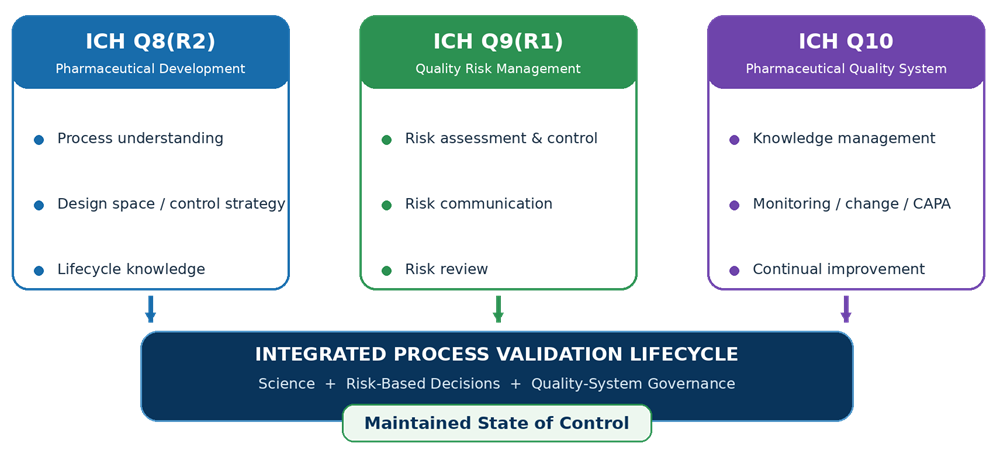
The relationship can be summarized as:
- Q8 — What do we understand about the product and process?
- Q9 — What matters, what is uncertain, and what level of control is appropriate?
- Q10 — How is that knowledge and risk managed throughout the lifecycle?
Process validation is where these principles become operational evidence.
Knowledge Management Is More Than Document Storage
ICH Q10 defines knowledge management as a systematic approach to acquiring, analyzing, storing, and disseminating information concerning products, manufacturing processes, and components. It identifies sources including prior knowledge, pharmaceutical development, technology transfer, validation studies, manufacturing experience, innovation, continual improvement, and change-management activities.
This distinction is important.
A document repository stores information. A knowledge-management system ensures that relevant information is:
captured → evaluated → contextualized → retained → communicated → applied to decisions → updated as new evidence becomes available.
Knowledge can exist in many forms, including:
- development reports;
- DOE and characterization studies;
- technology-transfer assessments;
- risk assessments;
- PPQ protocols and reports;
- statistical analyses;
- batch and process data;
- CPV reports;
- deviation and investigation records;
- CAPA;
- change controls;
- supplier and material data;
- equipment reliability information;
- laboratory data;
- complaints or product-quality information where relevant;
- management review; and
- regulatory commitments or postapproval-change information.
The knowledge-management system does not necessarily require one computerized database. The requirement is effective governance and connectivity among the information sources so that important knowledge is available to those making validation and manufacturing decisions.
Stage 2 — PPQ as a Knowledge-Confirmation and Knowledge-Generation Activity
PPQ uses the accumulated knowledge from development, transfer, risk assessment, process design, equipment qualification, and the control strategy to define how the commercial process will be evaluated.
But PPQ is not merely the final confirmation of what is already known. It also generates new knowledge. PPQ provides commercial-scale evidence concerning:
- process reproducibility;
- intra-batch variability;
- inter-batch variability;
- actual equipment-process interactions;
- material behavior under commercial conditions;
- effectiveness of CPP and CQA controls;
- sampling adequacy;
- statistical behavior;
- process capability or performance where appropriate;
- effectiveness of the control strategy;
- deviations or unexpected conditions; and
- residual uncertainty after qualification.
These findings should be compared with the assumptions that entered PPQ.
If PPQ demonstrates unexpected variability, a new material-process interaction, inadequate control, or limitations in the proposed operating strategy, those findings should update process understanding rather than disappear into the PPQ report.
See Process Performance Qualification Strategy and Batch Selection for the detailed PPQ strategy.
Transition From PPQ to Continued Process Verification
The end of PPQ should include deliberate transfer of knowledge into Stage 3. CPV should not be created independently from the evidence generated during Stage 1 and Stage 2.
The PPQ-to-CPV transition should consider:
- parameters and attributes demonstrated to be significant;
- observed process variability;
- PPQ statistical baselines;
- residual risks;
- operating conditions requiring continued attention;
- material-related variability;
- sampling locations and frequencies;
- relevant process capability information;
- deviations and investigations requiring follow-up;
- equipment or measurement-system observations;
- control-strategy assumptions requiring continued confirmation; and
- effectiveness checks for PPQ-related CAPA.
This creates continuity between qualification and routine manufacturing.
FDA’s Q8/Q9/Q10 implementation guidance states that process-performance and product-quality monitoring data support the lifecycle validation approach and continual improvement.
Stage 3 — Commercial Manufacturing as a Source of New Knowledge
Stage 3 produces the largest and most representative body of process-performance data because the process is observed across routine manufacturing over time. CPV can reveal variability that a finite PPQ campaign could not fully characterize.
Relevant knowledge can come from:
- CPP and CQA trends;
- intra-batch and inter-batch variability;
- raw-material and supplier trends;
- equipment and maintenance history;
- calibration or measurement-system behavior;
- environmental and utility conditions where relevant;
- yield and process losses;
- deviations;
- OOS and OOT findings;
- investigations;
- product complaints;
- change implementation;
- CAPA effectiveness;
- process capability or performance;
- seasonal effects; and
- long-term drift.
The purpose of CPV is therefore not simply to confirm that results remain within predefined limits. It should also answer: What are we learning about the process now that substantially more manufacturing experience exists?
See Continued Process Verification Program and Monitoring Strategy for development of the Stage 3 monitoring framework.
From Data to Process Knowledge
Data become useful process knowledge only after interpretation. A sequence such as the following is useful:
Data → Information → Interpretation → Knowledge → Decision
For example, a gradual shift in a process parameter is data. Demonstrating that the shift coincides with a particular supplier lot, equipment condition, or seasonal material property produces information. Establishing a scientifically credible relationship between that factor, process behavior, and a CQA expands process knowledge.
Using that knowledge to modify supplier controls, equipment strategy, monitoring, or operating limits is a lifecycle decision. This distinction prevents knowledge management from becoming a passive reporting activity.
Integrating Deviations, Investigations, and CAPA
Deviations and investigations are important sources of process knowledge. A deviation should not be viewed solely as an event to be closed. Investigation results may reveal:
- previously unidentified sources of variability;
- inadequate process controls;
- weaknesses in operating ranges;
- equipment-process interactions;
- insufficient material controls;
- measurement-system limitations;
- procedural dependencies; or
- incorrect assumptions made during development or PPQ.
Recurring events are particularly important because individually acceptable investigation closures may collectively indicate that process knowledge or the control strategy is incomplete. CAPA effectiveness should likewise be evaluated using subsequent process-performance data where possible.
If an action was intended to reduce variability, eliminate a recurring deviation, or improve process control, CPV should be capable of demonstrating whether the intended effect actually occurred.
Knowledge Management and Quality Risk Management
Knowledge and risk are interdependent. Risk assessment conducted before PPQ reflects the knowledge available at that point in time. When new manufacturing knowledge is generated, prior risk conclusions may need to be reconsidered.
ICH Q9(R1) explicitly includes risk review within the Quality Risk Management process and recognizes that decisions may require reconsideration when new knowledge becomes available. New knowledge may therefore result in:
- revised risk rankings;
- identification of previously unrecognized failure mechanisms;
- modification of monitoring priorities;
- additional controls;
- removal or reduction of controls where justified;
- additional characterization;
- changes to sampling;
- modification of PPQ or CPV strategy; or
- reassessment of the validated state.
See Quality Risk Management in Process Validation for application of QRM throughout the validation lifecycle.
Using Accumulated Knowledge for Lifecycle Decisions
Accumulated process knowledge should directly influence decisions.
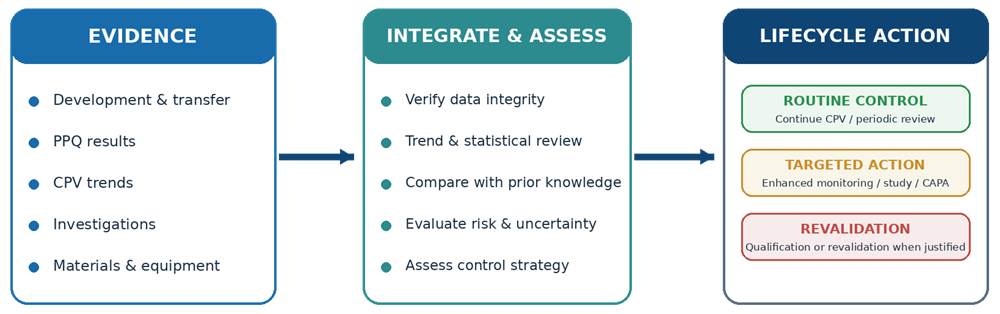
Examples include decisions about:
PPQ Strategy
Strong development and transfer knowledge may support a focused PPQ design, while substantial uncertainty may justify broader sampling, more extensive testing, additional challenge conditions, or additional PPQ evidence.
CPV Strategy
Early CPV monitoring can be relatively intensive when commercial experience is limited. As reliable knowledge accumulates, monitoring may be refined based on demonstrated process behavior and risk.
Control Strategy
Commercial evidence may confirm that controls remain appropriate or show that certain controls need strengthening, modification, or additional verification.
Change Assessment
Prior process knowledge helps determine which proposed changes could affect product quality or process performance and what evidence is necessary before and after implementation.
Revalidation
Revalidation should not be triggered merely because time has passed. Accumulated knowledge should determine whether a change, adverse trend, investigation, loss of capability, or other event materially affects prior validation conclusions.
Continual Improvement
An established validated state should not prevent scientifically justified improvement. Knowledge may support reduction of variability, optimization of controls, more reliable manufacturing, improved monitoring, or other process improvements implemented through appropriate change management.
Change Management as a Knowledge-Integration Mechanism
Change control is one of the most important points at which lifecycle knowledge must be actively used. A change assessment should consider not only the proposed change itself but also the existing body of knowledge concerning:
- process design;
- CQAs and material attributes;
- CPPs and operating ranges;
- prior characterization;
- PPQ performance;
- CPV trends;
- previous deviations and investigations;
- control-strategy effectiveness;
- equipment performance;
- supplier behavior; and
- previous related changes.
ICH Q10 connects change management with knowledge management, QRM, process monitoring, and continual improvement, while FDA’s Q8/Q9/Q10 implementation guidance recognizes that new knowledge obtained during technology transfer and commercial manufacturing can modify the control strategy.
See Process Change Control, Revalidation, and Lifecycle Management for the detailed validation impact-assessment framework.
Knowledge Management and the State of Control
A state of control is not established permanently by a successful PPQ campaign. The conclusion must continue to be supported by current process and product evidence. Accumulated knowledge should allow the organization to determine whether:
- process behavior remains consistent with prior understanding;
- variability remains adequately controlled;
- the control strategy remains effective;
- process risks remain correctly characterized;
- changes have produced the expected outcome;
- CAPA remains effective;
- new failure mechanisms have emerged; and
- additional validation activity is required.
Current FDA enforcement continues to emphasize ongoing oversight of the process throughout its lifecycle rather than reliance on initial qualification alone. Recent warning letters reiterate the expectation for successful Process Qualification followed by continued oversight of process performance and product quality.
The formal integration of CPV evidence into a state-of-control conclusion is addressed in Continued Process Verification Reporting and State-of-Control Assessment.
Organizational Responsibilities for Process Knowledge
Knowledge management requires defined ownership. No single function possesses all relevant process knowledge. Effective lifecycle integration typically requires contributions from:
- Process Development or Technical Operations — development history, characterization, scale-up, process understanding, and technical evaluation.
- Technology Transfer — transfer assumptions, site/equipment differences, gaps, and commercial readiness.
- Manufacturing — routine process execution and operational observations.
- Validation — qualification strategy, PPQ evidence, lifecycle validation conclusions, and revalidation assessment.
- Quality Unit — oversight of investigations, CAPA, change management, deviations, and validated-state decisions.
- Engineering and Maintenance — equipment capability, reliability, utilities, modifications, and technical changes.
- Quality Control and Analytical Functions — product-quality data, analytical trends, and measurement considerations.
- Statistics or appropriately trained personnel — variability evaluation, statistical analysis, monitoring strategy, and interpretation.
- Regulatory Affairs — regulatory commitments and potential reporting implications of lifecycle changes.
The governance model should define who reviews new knowledge, who determines whether it affects validated assumptions, and how conclusions are communicated to affected systems.
Documentation and Traceability
Lifecycle knowledge should be sufficiently traceable that an independent reviewer can understand how important validation decisions were made. Traceability may connect:
Development Evidence → Risk Assessment → Process Design → Control Strategy → PPQ → CPV → New Knowledge → Lifecycle Decision
Documentation does not require duplication of every underlying record. Instead, validation documentation should reference or summarize the relevant evidence and clearly show:
- what information was considered;
- what conclusion was reached;
- what prior assumptions were affected;
- whether risk changed;
- whether controls changed;
- whether additional studies were required; and
- how the decision was approved and followed through.
This is particularly important when accumulated knowledge is used to justify reduced or increased monitoring, targeted requalification, changes to control strategy, additional PPQ activity, or a conclusion that broader revalidation is unnecessary.
Continual Improvement and Lifecycle Learning
ICH Q10 identifies continual improvement as an objective of the Pharmaceutical Quality System and knowledge management as one of the enablers supporting science- and risk-based decisions. Continual improvement should not mean uncontrolled optimization.
Improvements should be based on accumulated knowledge, evaluated through QRM, implemented through the pharmaceutical quality system, and subsequently verified using appropriate process-performance evidence.
The lifecycle therefore becomes a feedback system:
Develop → Transfer → Design → Qualify → Monitor → Learn → Improve → Reassess
Each cycle can increase confidence in process understanding while also revealing new areas of uncertainty.
A mature validation program is therefore not characterized by the absence of change. It is characterized by the ability to understand change, evaluate its impact, apply accumulated knowledge, and maintain objective evidence that the process remains controlled.
Key Principles
- Process knowledge begins before PPQ and continues to develop throughout commercial manufacture.
- Technology transfer is a knowledge-transfer and knowledge-generation activity, not merely document handoff.
- Stage 1 translates development knowledge into the commercial process design and control strategy.
- Stage 2 tests process knowledge under commercial conditions and generates additional evidence.
- Stage 3 expands process knowledge through routine manufacturing and CPV.
- ICH Q8 provides the scientific development foundation, Q9 provides Quality Risk Management, and Q10 provides the Pharmaceutical Quality System and knowledge-management framework.
- Knowledge management is more than document storage; information must be evaluated and applied to decisions.
- Risk assessments should be reconsidered when new knowledge materially changes prior assumptions.
- Deviations, investigations, CAPA, materials, equipment performance, and changes are important sources of lifecycle knowledge.
- Accumulated knowledge should support PPQ, CPV, control strategy, change assessment, and revalidation decisions.
- Commercial experience must feed back into process understanding and continual improvement.
- The validated state is maintained through current evidence, not solely through historical validation documentation.