

Process Control Strategy and Design Space Development
A process control strategy translates development knowledge into the practical controls used to manufacture a product consistently at commercial scale. Within the process-validation lifecycle, this work belongs principally to Stage 1 — Process Design, after sufficient product and process understanding has been generated through development, characterization, Design of Experiments (DOE), risk assessment, and scale-up studies.
ICH Q8(R2) defines a control strategy as a planned set of controls derived from current product and process understanding that ensures process performance and product quality. The controls can include material attributes, process parameters, equipment operating conditions, in-process controls, finished-product specifications, and the methods and frequency used for monitoring and control.
FDA’s Process Validation: General Principles and Practices similarly expects Stage 1 to establish a commercial process based on development and scale-up knowledge and to identify the controls necessary to manage variability before the process enters Process Qualification.
The objective is therefore not merely to create a table of Critical Process Parameters (CPPs). A complete control strategy describes how material variability, process conditions, equipment functions, measurements, procedures, specifications, monitoring, and—where appropriate—automation or Process Analytical Technology work together to assure product quality.
See Process Characterization and Development Studies for Process Validation, Design of Experiments for Process Characterization and Validation, and CQA, CPP, and Material Attribute Risk Assessment for the Stage 1 evidence that precedes control-strategy development.
The Control Strategy Is the Output of Process Understanding
Control strategy should be viewed as an output of development knowledge, not as an independent validation document created after the process design is complete.
Stage 1 progressively establishes: Product requirements → CQAs → material/process relationships → variability → criticality → operating ranges → controls → defined commercial process
A Critical Quality Attribute (CQA) is a physical, chemical, biological, or microbiological characteristic that should remain within an appropriate limit, range, or distribution to assure the intended product quality.
A Critical Process Parameter (CPP) is a process parameter whose variability can affect a CQA and therefore requires appropriate monitoring or control.
Material attributes, including those treated as Critical Material Attributes (CMAs), describe properties of raw materials, components, intermediates, or other process inputs whose variability can influence process performance or product quality. The control strategy determines how those relationships will actually be managed during manufacturing.
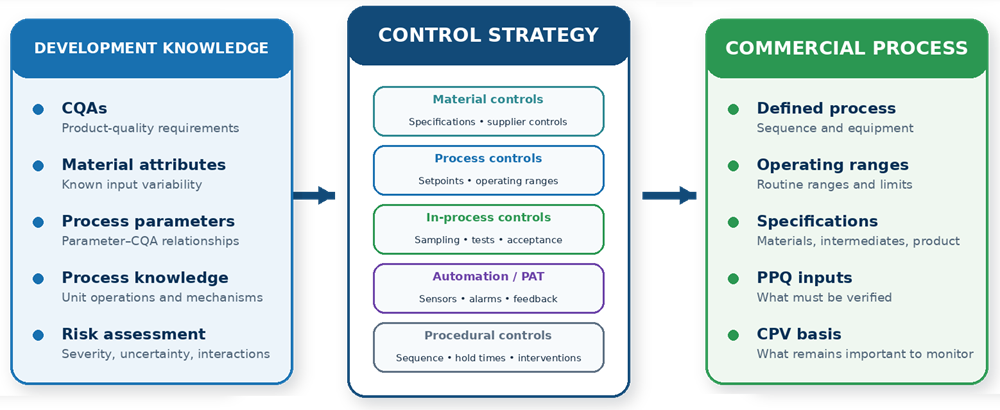
What a Process Control Strategy Includes
A control strategy is broader than CPP limits. Depending on the manufacturing process, it may include combinations of:
- raw-material specifications;
- supplier controls;
- material testing;
- component controls;
- intermediate specifications;
- equipment design and operating capability;
- CPP setpoints and operating ranges;
- control of other important process parameters;
- process sequence;
- in-process measurements;
- sampling;
- in-process acceptance criteria;
- hold-time controls;
- process alarms;
- automated interlocks;
- feedback or feed-forward control;
- Process Analytical Technology;
- environmental or utility controls where relevant;
- procedural controls;
- finished-product specifications; and
- continued monitoring requirements.
ICH Q8 explicitly recognizes that the control strategy may combine different approaches. One portion may rely on conventional end-product testing while another may use in-process measurement or real-time process control.
The strategy should therefore be designed as a system of controls, not as a collection of unrelated parameter limits.
Material Controls
Material variability can be a significant source of manufacturing variability. Material controls may address:
- identity;
- purity;
- potency;
- particle-size distribution;
- moisture;
- viscosity;
- concentration;
- density;
- morphology;
- microbial quality;
- functional properties;
- supplier or manufacturing-site differences; and
- other process-specific characteristics.
A material specification is one possible control, but specification alone may not be sufficient when variability within the approved range can influence process behavior.
For example, two raw-material lots may both comply with specification but exhibit sufficiently different physical properties to affect mixing, granulation, filtration, drying, compression, or another process operation. The Stage 1 control strategy may therefore include combinations of: Supplier control + material specification + testing + process adjustment + monitoring
Material controls should be connected to the process knowledge developed during characterization rather than selected merely because a material appears on a risk-assessment worksheet.
Process Parameter Controls
CPPs require appropriate monitoring or control because their variability can affect CQAs. However, the control strategy should distinguish among:
- parameters requiring tight automated control;
- parameters controlled within justified operating ranges;
- parameters monitored because they provide useful process information;
- parameters managed through procedural controls; and
- parameters demonstrated to have low quality impact within the intended range.
Not every process parameter needs the same type or intensity of control.
A parameter may be important to reliable process operation without being a CPP. Conversely, a CPP may require significant control even when it normally shows little routine variation. Control decisions should reflect the parameter–CQA relationship, magnitude of possible variation, process capability, detectability, uncertainty, and available preventive controls.
Setpoints and Operating Ranges
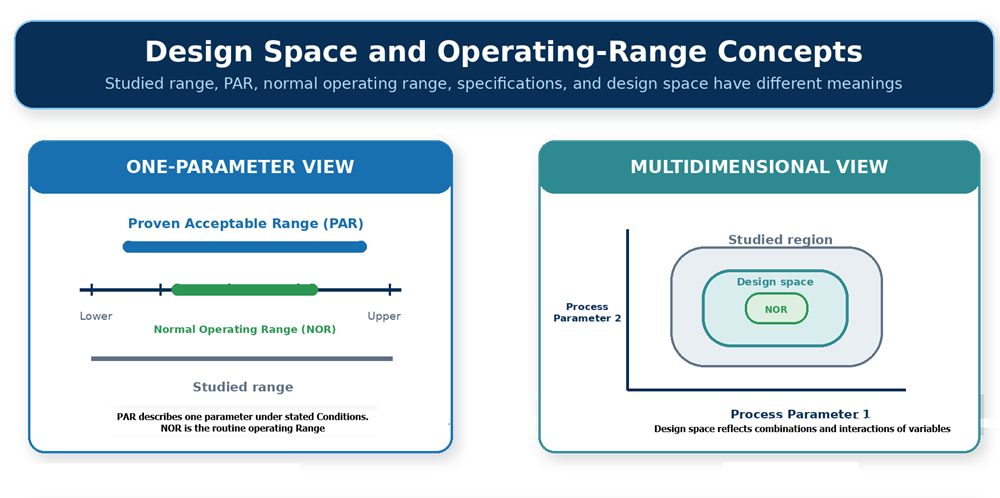
A setpoint is the target value at which a process parameter is normally intended to operate. An operating range defines the range within which the process is expected to operate during routine manufacturing.
These should not be confused with the full range investigated during development. Development may deliberately explore broader conditions to understand:
- process sensitivity;
- interactions;
- robustness;
- boundaries;
- failure mechanisms; and
- operating margin.
The routine operating range can therefore be narrower than the experimentally studied region. The appropriate relationship is often:
Studied Region > Scientifically Supported Region > Routine Operating Range
The exact terminology should be defined within the company’s pharmaceutical quality system because terms such as “normal operating range” are commonly used operationally but are not themselves formal ICH glossary terms.
Proven Acceptable Range
ICH Q8 defines a Proven Acceptable Range (PAR) as a characterized range of a process parameter for which operation within that range, while keeping other parameters constant, results in material meeting relevant quality criteria. PAR is fundamentally a univariate concept.
This distinction matters because a PAR does not necessarily account for interactions among multiple parameters. ICH Q8 explicitly states that combining several proven acceptable ranges does not by itself create a design space. For example:
- Temperature PAR: 50–70°C
- Mixing-speed PAR: 100–300 rpm
do not automatically demonstrate that every combination of 50–70°C and 100–300 rpm is acceptable. If the effect of temperature depends on mixing speed, the acceptable operating region can be substantially more complex.
Design Space
ICH Q8 defines design space as the multidimensional combination and interaction of input variables, including material attributes and process parameters, demonstrated to provide assurance of quality. A design space therefore represents relationships among variables, not merely independent limits.
It can be expressed through:
- combinations of parameter ranges;
- response-surface models;
- equations;
- multivariate models;
- time-dependent relationships;
- scale-independent parameters; or
- other scientifically justified representations.
The design space should be based on sufficient understanding that operation within the defined region provides assurance that relevant product-quality requirements will be met.
Design Space Is Optional
A formal design space is not required for a scientifically sound or validated manufacturing process. A conventional control strategy can be fully acceptable when it is supported by adequate product and process understanding. DOE and characterization studies may therefore be used to establish:
- CPPs;
- operating ranges;
- material controls;
- in-process controls;
- robustness;
- sampling strategy; and
- PPQ expectations
without proposing a regulatory design space. A design space should be developed when the multidimensional understanding provides useful manufacturing or regulatory value—not because every Stage 1 program is expected to produce one.
Regulatory Meaning of Design Space
Design space has a specific regulatory meaning under ICH Q8. It is proposed by the applicant and is subject to regulatory assessment and approval. ICH Q8 states that working within an approved design space is not considered a change, whereas movement outside the design space is considered a change and would normally trigger the applicable postapproval change process.
That regulatory meaning should not be confused with internal phrases such as:
- process window;
- operating envelope;
- proven range;
- development range;
- recommended operating area; or
- engineering operating range.
If a company uses the term design space, the scientific evidence and intended regulatory meaning should be clear.
Design Space and Parameter Interactions
Parameter interactions are central to design-space development. Suppose both temperature and mixing speed affect dissolution.
At lower mixing speeds, relatively high temperature may remain acceptable. At higher mixing speeds, the same temperature may cause an unacceptable product response. The permissible value of one parameter therefore depends on the value of another.
ICH Q8 provides examples in which the acceptable range of one parameter changes with the value of another, illustrating why design space is fundamentally multidimensional.
The detailed statistical treatment of these relationships is covered in Design of Experiments for Process Characterization and Validation.
Specifications Are Not the Same as Process Controls
A specification defines acceptance criteria for materials, intermediates, components, or finished product. Specifications are part of the control strategy but should not be viewed as substitutes for process control.
ICH Q8 specifically emphasizes that pharmaceutical quality should be built into the product and process rather than relying primarily on testing quality into the finished product. For example, finished-product testing may confirm that a batch meets assay and dissolution requirements. It does not, by itself, demonstrate that the manufacturing process was adequately controlled.
The Stage 1 strategy should determine what controls are needed upstream to provide assurance before the finished-product result is known.
In-Process Controls
An in-process control (IPC) is a measurement, observation, test, or acceptance criterion applied during manufacturing to evaluate or control the process or intermediate material. Examples include:
- blend uniformity;
- tablet weight;
- moisture;
- pH;
- conductivity;
- concentration;
- temperature;
- pressure;
- flow;
- filtration performance;
- fill volume;
- bioburden;
- viscosity; and
- other process-specific measurements.
In-process controls can serve different purposes. Some directly control a CQA.
Others confirm process progression, provide early detection of abnormal conditions, support adjustments, or provide evidence that the process remains within the established strategy. An IPC should therefore be justified by the process knowledge and the decision it supports.
Sampling Strategy as Part of Control
Sampling is itself a control-strategy element when samples provide information necessary to determine process state or intermediate quality. Stage 1 should define, where appropriate:
- what is sampled;
- why it is sampled;
- where samples are collected;
- when samples are collected;
- sample frequency;
- sample size;
- analytical or measurement method;
- representativeness;
- acceptance criteria; and
- action when results are abnormal.
Sampling should focus on known or potential sources of variability rather than merely following a generic number of locations.
Detailed PPQ sampling is addressed separately in PPQ Sampling Plan and Data Collection Strategy.
Automation and Process Control
Automation can strengthen the control strategy when it provides reliable execution or control of important process functions. Examples include:
- closed-loop temperature control;
- flow control;
- pressure control;
- automated dosing;
- sequence control;
- recipe enforcement;
- alarms;
- interlocks;
- automated hold-time management;
- feedback control; and
- feed-forward adjustment.
A feedback control adjusts a process based on a measured result after the process output begins to change. A feed-forward control adjusts the process using information about an input or predicted disturbance before the final process output is affected.
Automation should not be assumed to provide adequate control merely because a function is automated. The strategy should establish:
- what variable is controlled;
- what measurement is used;
- what algorithm or logic acts on the measurement;
- acceptable limits;
- alarms;
- failure response; and
- what evidence demonstrates that the control is reliable.
Process Analytical Technology
Process Analytical Technology (PAT) is defined by ICH Q8 as a system for designing, analyzing, and controlling manufacturing through timely measurements of critical quality and performance attributes of raw materials, in-process materials, and processes with the goal of assuring final product quality.
FDA’s PAT guidance encourages voluntary implementation of technologies that improve process understanding and process control. PAT may include:
- spectroscopic measurements;
- particle-size monitoring;
- moisture measurement;
- multivariate models;
- real-time concentration measurement;
- process sensors;
- chemometric models;
- automated feedback control; or
- real-time process-performance indicators.
PAT is not required for every process. Its use should be based on scientific value, process risk, available measurement technology, and the ability to maintain the analytical or predictive system throughout the lifecycle.
Real-Time Release and Enhanced Controls
A sufficiently developed control strategy may rely more heavily on in-process information and less exclusively on traditional finished-product testing.
ICH Q8 recognizes control strategies in which some aspects of quality assurance rely on real-time or near-real-time process measurement rather than solely on end-product testing.
This does not mean finished-product testing can simply be eliminated. Any alternative approach should be scientifically supported, validated where applicable, and consistent with the approved regulatory strategy.
Procedural Controls
Not every important control requires automation or analytical measurement. Procedural controls may remain appropriate for:
- sequence of operations;
- order of addition;
- defined hold periods;
- equipment setup;
- sampling;
- line clearance;
- manual interventions;
- transfer operations; and
- other activities where human execution remains part of process control.
The level of procedural dependence should be considered during risk assessment. Where operator technique can meaningfully affect process performance, the control strategy should address:
- clear instructions;
- training;
- verification;
- timing;
- allowable interventions;
- documentation; and
- detection of execution errors.
Hold-Time Controls
Hold times should be included in the control strategy when time between unit operations can affect material or product quality. Controls may include:
- maximum duration;
- temperature;
- agitation condition;
- storage vessel;
- environmental conditions;
- protection from light or oxygen;
- microbiological controls;
- mixing before use; and
- required sampling or testing.
Hold-time limits should be supported by development evidence rather than selected simply for scheduling convenience.
Control Strategy and Equipment Design
Equipment can provide inherent process control. Examples include:
- vessel geometry;
- impeller design;
- filtration area;
- temperature-control capacity;
- closed transfers;
- automated dosing;
- pressure protection;
- filling-system design;
- containment;
- sensor placement; and
- equipment operating limits.
Where equipment design materially contributes to process control, the relationship should be documented during Stage 1. This provides an important link between process development and equipment qualification.
Equipment qualification demonstrates that the equipment is suitable for intended use; process validation demonstrates that the integrated manufacturing process performs as intended.
Scale-Up and Commercial Relevance
Control strategy developed at laboratory or pilot scale must remain relevant to commercial manufacturing. Scale-up can change:
- mixing behavior;
- heat transfer;
- mass transfer;
- residence time;
- shear;
- filtration behavior;
- equipment loading;
- process timing;
- hold periods; and
- equipment-control response.
ICH Q8 specifically requires justification of the commercial relevance of a design space established at smaller scale and discussion of scale-up risk. It also recognizes the use of scale-independent variables where a design space is intended to apply across scales.
For example, maintaining the same mixer rpm may be meaningless when vessel size changes. A scientifically relevant variable such as shear rate, power per unit volume, or another scale relationship may be more appropriate.
Scale-up therefore needs to demonstrate that the critical process relationship is maintained—not simply that numerical equipment settings are copied.
Defining the Commercial Process
Stage 1 should conclude with a sufficiently defined commercial process. That definition should include, as applicable:
- manufacturing sequence;
- commercial equipment;
- batch size or justified operating range;
- material requirements;
- CPPs;
- other important process parameters;
- parameter setpoints and ranges;
- in-process controls;
- sampling;
- specifications;
- hold times;
- automation;
- PAT where applicable;
- alarms and interventions;
- procedural controls; and
- residual risks requiring PPQ confirmation.
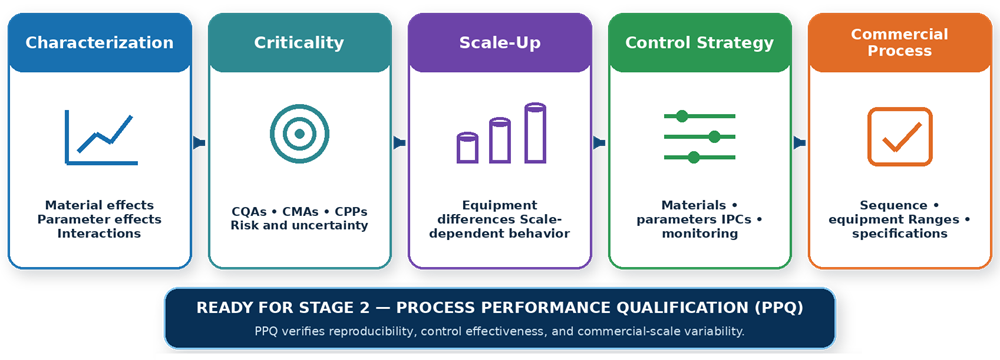
The commercial process should therefore be substantially understood before PPQ begins. PPQ should confirm that the commercial process and controls work reproducibly at scale. It should not function as the primary development program for unresolved fundamental process relationships.
Relationship Between Stage 1 and PPQ
The Stage 1 control strategy determines what PPQ must verify. PPQ may provide evidence that:
- CPPs remain controlled;
- expected material variability is accommodated;
- in-process controls perform as intended;
- process ranges are appropriate;
- automation performs reliably;
- sampling captures relevant variability;
- CQAs remain acceptable;
- scale-up assumptions were correct; and
- the control strategy provides adequate assurance under commercial conditions.
See Process Performance Qualification (PPQ) Strategy and Batch Selection and Verification of CPPs and Process Control Strategy During PPQ.
The current USValidation PPQ-control article already positions PPQ as confirmation that Stage 1 criticality and control conclusions remain valid under commercial conditions.
Control Strategy Versus Lifecycle Control Strategy Management
This article is intentionally focused on Stage 1 development of the control strategy. After PPQ and commercial release, the strategy becomes a lifecycle-controlled system.
Commercial manufacturing may provide new information about:
- material variability;
- process drift;
- equipment behavior;
- CPP relationships;
- model performance;
- sampling adequacy;
- CAPA;
- supplier changes;
- automation changes; and
- process improvement.
The broader post-PPQ governance of the established strategy belongs in Process Control Strategy Lifecycle Management, which addresses change, monitoring, maintenance, and lifecycle revision rather than initial Stage 1 development.
Continued Process Verification Feedback
Continued Process Verification (CPV) should confirm that the control strategy remains effective during routine commercial manufacturing. CPV can reveal:
- increasing variability;
- material-related shifts;
- process drift;
- inadequate operating margin;
- recurring alarms;
- control-loop deterioration;
- changes in capability;
- new interactions; or
- opportunities for process improvement.
Commercial data should therefore feed back into process knowledge.
See Continued Process Verification Program and Monitoring Strategy for Stage 3 monitoring and Continued Process Verification Reporting and State-of-Control Assessment for formal integration of that evidence.
Documentation and Traceability
The Stage 1 control-strategy record should make it possible to trace each important control back to the knowledge that justifies it. A useful traceability chain is: CQA → Material / Process Relationship → Risk / Criticality → Development Evidence → Control → PPQ Verification
For example: Dissolution CQA → Granulation moisture relationship → Drying parameter assessed as CPP → DOE establishes sensitivity → Defined temperature/moisture controls → PPQ verifies performance
Documentation may include:
- development reports;
- characterization studies;
- DOE reports;
- risk assessments;
- parameter-criticality assessments;
- design-space models;
- material assessments;
- scale-up studies;
- hold-time studies;
- equipment requirements;
- control-strategy documents;
- process descriptions; and
- PPQ strategy.
The purpose is not to duplicate data but to preserve the scientific reasoning linking knowledge to control.
Key Principles
- The process control strategy is developed primarily during Stage 1 Process Design.
- It is derived from current product and process understanding, not from a generic CPP list.
- CQAs, material attributes, CPPs, process variability, scale-up knowledge, and risk assessment are key inputs.
- Material controls are part of the strategy, not separate from process validation.
- CPP limits alone do not constitute a complete control strategy.
- Operating ranges should be distinguished from broader development ranges.
- A Proven Acceptable Range is a univariate concept.
- Multiple PARs do not automatically create a design space.
- A design space is multidimensional and incorporates interactions among variables.
- A formal design space is optional.
- If proposed, design space is subject to regulatory assessment and approval.
- Specifications are part of the control strategy but do not replace process control.
- In-process controls should be linked to a meaningful process or quality decision.
- Automation can strengthen control but must itself be scientifically justified and appropriately verified.
- PAT can provide timely process measurement and enhanced control where scientifically useful.
- Scale-up must preserve scientifically important process relationships rather than merely copy numerical settings.
- Stage 1 should define the commercial process before PPQ begins.
- PPQ confirms the control strategy under commercial conditions.
- CPV subsequently determines whether the strategy continues to remain effective.