

PPQ Deviations, Investigation, and Validation Conclusion
Process Performance Qualification (PPQ) is intended to demonstrate that the commercial manufacturing process operates reproducibly under the conditions defined during Stage 1 and implemented during Stage 2. Deviations, atypical observations, Out-of-Specification (OOS) results, and other unexpected events therefore cannot be treated only as documentation problems to be closed before the PPQ report is approved. Each event is part of the qualification evidence and should be evaluated for what it reveals about product quality, process control, data validity, and the adequacy of the overall control strategy.
FDA’s Process Validation guidance explicitly expects the PPQ protocol to provide for deviations from expected conditions and nonconforming data, and states that PPQ data should not be excluded from further consideration without documented, science-based justification. The final PPQ report should evaluate unexpected observations, manufacturing nonconformances, aberrant test results, corrective actions, and other information affecting process validity before concluding whether the protocol conditions were met and whether the process is in a state of control.
PPQ success should therefore not be defined simply as “no deviations” or “all batches passed.” A PPQ campaign may contain appropriately investigated deviations and still provide strong evidence of process reproducibility. Conversely, a campaign consisting entirely of specification-compliant batches can still provide inadequate validation evidence if unexplained process behavior, unreliable data, recurring interventions, or unresolved variability undermine confidence in the commercial process.
Deviations Are Part of the PPQ Evidence
A deviation is a departure from an approved procedure, protocol requirement, expected manufacturing condition, established process parameter, sampling plan, test method, or other controlled requirement. Under 21 CFR 211.100, written production and process-control procedures must be followed and documented at the time of performance, and deviations from those written procedures must be recorded and justified.
During PPQ, deviations may arise from the protocol itself or from routine GMP manufacturing. Examples include a missed sample, incorrect sampling time, process parameter excursion, equipment malfunction, unexpected hold, alarm or interlock event, material issue, procedural departure, analytical anomaly, or incomplete process data. The significance of the event depends on its cause and impact—not simply on the fact that a deviation record was opened.
The PPQ protocol should therefore establish how deviations will be documented, investigated, assessed, approved, and incorporated into the final qualification conclusion. It should also distinguish between events that have no meaningful effect on the validation evidence and events that challenge the process model, sampling strategy, control strategy, or representativeness of a PPQ batch.
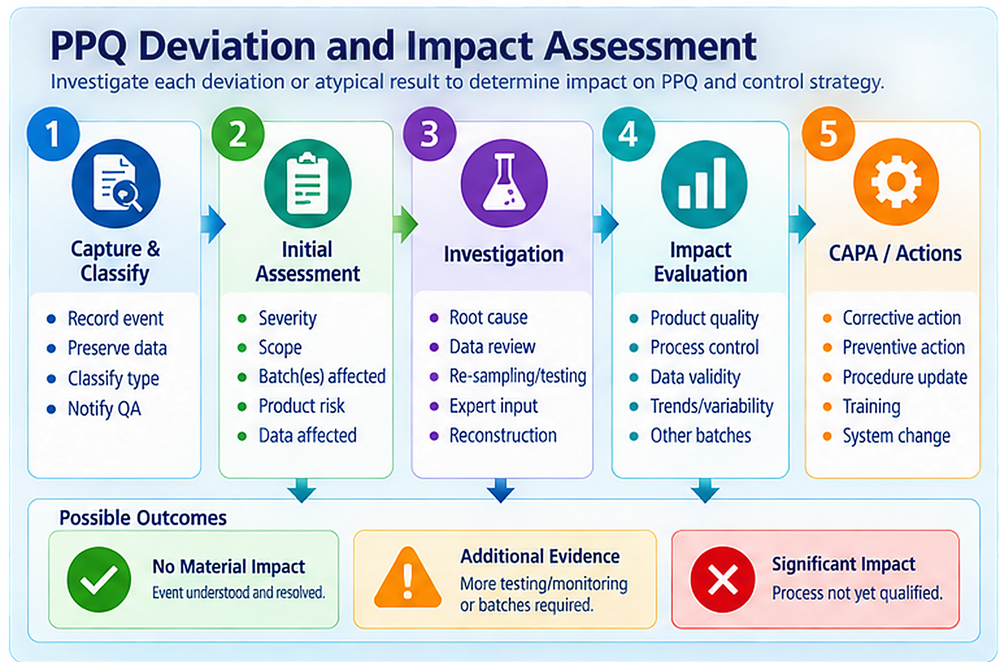
Protocol Deviations
A PPQ protocol deviation occurs when execution differs from the approved PPQ plan. Examples include missed or mistimed samples, use of an incorrect sampling location, failure to perform a required test, execution outside a specified PPQ condition, use of unapproved equipment, or departure from a predefined statistical or data-collection requirement.
FDA states that PPQ protocol execution should not begin until the protocol has been approved by the appropriate departments and Quality Unit. Departures from the protocol should be managed according to established procedures or provisions in the protocol, with appropriate justification and approval.
The impact assessment should determine whether the deviation merely represents a documentation or execution error or whether it removes evidence necessary to answer a PPQ question. Missing a duplicate sample at a well-characterized location may have little effect, whereas missing the only sample intended to evaluate a known end-of-batch risk could materially weaken the qualification conclusion.
Manufacturing Deviations
PPQ batches are commercial manufacturing batches and remain subject to normal GMP deviation and investigation requirements. Manufacturing deviations may involve equipment, materials, utilities, process parameters, automation, environmental conditions, procedures, operator actions, or process timing.
The PPQ assessment should extend beyond the immediate batch impact. A deviation that would normally be classified as minor during routine production may carry greater validation significance if it reveals that the commercial process does not behave as expected. For example, repeated operator intervention, frequent CPP adjustment, unexpected equipment response, or recurring alarm conditions may challenge Stage 1 assumptions even when finished-product testing remains acceptable.
This is why deviations should be evaluated together with the integrated control-strategy evidence described in Verification of CPPs and Process Control Strategy During PPQ.
Unexplained Discrepancies Require Investigation
21 CFR 211.192 requires thorough investigation of unexplained discrepancies or failures of a batch or its components to meet specifications, whether or not the batch has already been distributed. The investigation must extend to other potentially associated batches where appropriate, and the written investigation record must include conclusions and follow-up.
For PPQ, this requirement has a broader lifecycle implication. An unexplained discrepancy can affect not only disposition of the affected batch but also confidence in the qualification campaign itself. The investigation should therefore evaluate whether the event reflects an isolated assignable cause or exposes a systemic weakness in the commercial process.
Atypical Results
Not every unusual observation is an OOS result. PPQ frequently generates information that is technically acceptable but inconsistent with expected process behavior, such as an unusual trend, high or low in-specification result, increased variability, unexpected batch-to-batch shift, atypical process duration, or relationship between a parameter and CQA that differs from development expectations.
These observations should not automatically be treated as failures, but they should be evaluated when they could affect the validation conclusion. Atypical results can be especially important in PPQ because qualification is intended to confirm the Stage 1 process model at commercial scale. A result that remains within specification may still indicate reduced operating margin or an incomplete understanding of process variability.
The PPQ report should preserve and discuss meaningful atypical observations rather than limiting review to formal specification failures.
OOS and OOT Results
An Out-of-Specification (OOS) result is a test result outside an established specification or acceptance criterion. FDA’s current OOS guidance applies the term to results outside specifications or acceptance criteria established in applications, drug master files, compendia, or by the manufacturer, including applicable in-process laboratory tests.
An Out-of-Trend (OOT) result is generally used by companies to describe a result or pattern that is inconsistent with expected historical or process behavior but may still be within specification. OOT is not equivalent to OOS, and its investigation approach should reflect the site’s approved procedures and the significance of the trend.
During PPQ, OOS and OOT events should be evaluated not only for laboratory validity and batch disposition but also for their relationship to process performance, material variability, CPP behavior, control-strategy effectiveness, and other PPQ batches.
OOS Investigation During PPQ
FDA’s OOS guidance describes an initial laboratory investigation followed, when necessary, by a broader full-scale investigation that can include review of production and additional laboratory testing. The investigation should determine whether there is an assignable laboratory cause or whether the result may represent a manufacturing or process problem.
For PPQ, this distinction is particularly important. A confirmed laboratory error may have limited process-validation significance, although the event and original data remain documented. A valid OOS linked to manufacturing, materials, process variability, or an unknown cause can directly challenge the PPQ conclusion and may require broader assessment of other qualification batches and Stage 1 assumptions.
The investigation should therefore avoid stopping at the statement that the affected batch can or cannot be released. The validation team should separately determine what the event means for process qualification.
Retesting
Retesting may be appropriate when it addresses a defined scientific question, such as investigation of a suspected instrument malfunction, sample-handling issue, or potential analytical error. FDA states that retesting decisions should be based on the objectives of testing and sound scientific judgment, and that predetermined procedures should define the retesting approach rather than allowing repeated testing until a passing result is obtained.
“Testing into compliance” is specifically identified by FDA as scientifically objectionable. If the initial result cannot be invalidated through identification of a laboratory or calculation error, passing retest results do not provide a scientific basis for simply disregarding the original result; the complete set of results must be considered.
For PPQ, repeated favorable testing should therefore never be used to manufacture a cleaner qualification dataset.
Resampling
Retesting and resampling are different activities. Retesting analyzes additional portions of the original homogeneous sample, while resampling involves additional units or a newly collected sample from the batch. FDA recognizes that resampling can be appropriate when the investigation establishes that the original sampling process produced a sample that was not representative of the batch.
During PPQ, resampling requires particular caution because sample location and timing are often intentionally selected to characterize process variability. A new sample collected after the original process condition has disappeared may not be scientifically equivalent to the missed or questionable sample. The investigation should determine whether resampling answers the original PPQ question or merely produces additional data from a different process condition.
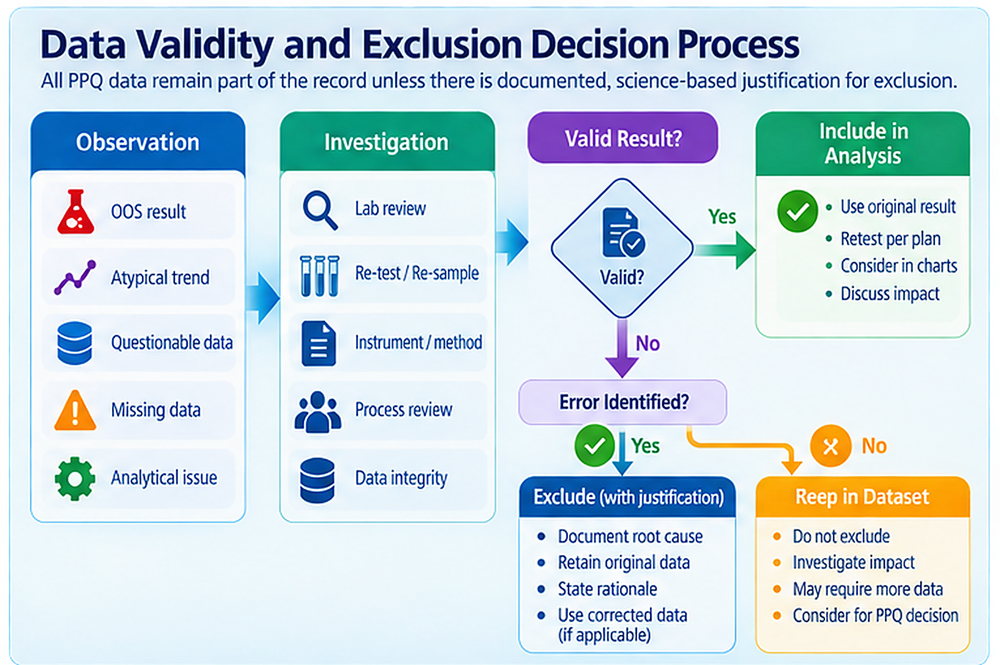
Invalid and Excluded Data
PPQ data should not disappear because they are inconvenient. FDA specifically states that data should not be excluded from PPQ consideration without documented, science-based justification.
Where an investigation conclusively identifies an analytical or data-generation error, the affected result may be considered invalid for a particular statistical or validation analysis. However, the original record should remain preserved together with the investigation, rationale, replacement result where applicable, and Quality Unit review. FDA’s OOS guidance similarly states that even when a clearly identified laboratory error justifies substitution of a retest result, the original data must be retained and the error explained.
The distinction is important: excluded from a specific calculation is not the same as deleted from the PPQ history.
Averaging Should Not Hide Variability
FDA’s OOS guidance recognizes appropriate uses of averaging when averaging is part of the predefined analytical method, but cautions that averaging can conceal variability when separate measurements are intended to characterize different portions of a batch. It specifically warns against averaging an initial OOS result together with later passing retest or resample results to produce an apparently acceptable value.
This principle is directly relevant to PPQ because the campaign frequently includes stratified sampling intended to detect within-batch variability. Beginning, middle, and end results or samples from different locations should not be collapsed into a single average when the purpose of the sampling design is to determine whether those strata behave differently.Assessing Impact on PPQ Validity
The PPQ impact assessment should answer whether the event changes confidence in the qualification evidence. Useful considerations include product-quality impact, process-control impact, data validity, recurrence, effect on other PPQ batches, relationship to Stage 1 knowledge, adequacy of the control strategy, and whether the affected data were necessary for a predefined PPQ acceptance criterion.
An isolated, fully understood laboratory error with unaffected process evidence may have little impact on PPQ validity. A recurring process deviation linked to a CPP, a valid OOS result, missing critical sampling data, or an unresolved data-integrity concern can have substantial impact even if other batches were successful.
The evaluation should avoid simplistic rules such as “any deviation invalidates the batch” or “a released batch automatically counts as a successful PPQ batch.” The scientific significance of the event should determine its validation impact.
Additional Testing
Additional testing can be justified when existing data leave a specific question unresolved. Examples include targeted characterization of an unusual process response, confirmation of a suspected material effect, additional analytical evaluation, or testing designed to assess the extent of an identified issue.
The objective and interpretation should be defined before the additional testing is performed whenever practicable. The resulting data should be incorporated into the same evidence set as the original observation rather than replacing unfavorable data.
Additional testing should not be used as a substitute for additional PPQ batches when the unresolved question concerns batch-to-batch reproducibility rather than analytical uncertainty.
Additional PPQ Batches
A deviation does not automatically require an additional PPQ batch. Likewise, additional batches should not be manufactured merely to restore an arbitrary count of successful batches.
Additional PPQ batches may be warranted when the event materially reduces the representativeness of a planned batch, creates insufficient independent evidence, identifies unexpected commercial variability, requires a significant process or control-strategy change, or leaves the original PPQ conclusion scientifically uncertain. The number and purpose of additional batches should be justified using the same principles described in Process Performance Qualification (PPQ) Strategy and Batch Selection.
If a major change is implemented after the original PPQ batches, the organization should determine whether earlier batches remain representative of the revised commercial process.
CAPA
Corrective and Preventive Action (CAPA) should address the cause and recurrence risk of significant PPQ problems rather than simply close the associated deviation. Possible actions include revising procedures, strengthening material controls, changing equipment or automation, modifying operating ranges, improving alarm strategy, retraining personnel, adding monitoring, changing the sampling plan, or performing further process characterization.
FDA expects the PPQ report to describe corrective actions or changes that should be made to existing procedures and controls when unexpected findings are identified.
Where CAPA changes an important element of the commercial process or control strategy, change control and validation impact assessment should determine whether additional PPQ evidence is required.
CAPA Effectiveness
Completion of a CAPA action does not itself demonstrate effectiveness. The PPQ conclusion or subsequent CPV plan should identify how important corrective actions will be verified.
For example, if a recurring intervention is addressed by changing an operating range, follow-up evidence should determine whether the process now operates predictably without the previous intervention. If a procedural problem is corrected through revised instructions and training, subsequent execution should confirm that the change actually prevents recurrence.
Some CAPA effectiveness evidence may be available before PPQ closure; other actions may appropriately transition into heightened early CPV monitoring when they do not prevent a scientifically justified initial qualification conclusion.
Protocol Amendments
A PPQ protocol may occasionally need prospective amendment when the planned strategy must change because of newly available information. Examples include adding a scientifically necessary sampling location, modifying a justified analytical approach, adding a planned PPQ batch, or revising an evaluation method after discovery of a valid technical limitation.
Protocol amendments should be controlled, justified, reviewed, and approved before implementation whenever practicable. They should not be used retrospectively to redefine success criteria after unfavorable results have already been observed. FDA’s guidance requires PPQ protocol departures to be managed through established procedures or provisions in the protocol, with appropriate justification and approval.
The final PPQ report should clearly distinguish the original approved plan, formal amendments, deviations from the plan, and additional analyses initiated as part of investigations.
OOS/OOT and Other Batches
21 CFR 211.192 requires investigations to extend to other batches of the same product and potentially other associated drug products when warranted.
Within PPQ, this means an event should rarely be interpreted solely within one batch when other qualification batches provide relevant comparative evidence. A material-related anomaly, equipment malfunction, analytical trend, or process shift may require review across the entire PPQ campaign.
This cross-batch assessment can help distinguish isolated assignable events from systemic behavior that challenges reproducibility.
Product Disposition and PPQ Conclusion Are Different Decisions
The disposition of an individual PPQ batch and the validation conclusion for the manufacturing process are related but distinct decisions.
Under 21 CFR 211.22, the Quality Unit has responsibility and authority to approve or reject drug products and to ensure that production records are reviewed and that errors are fully investigated. 21 CFR 211.165 separately requires appropriate testing and satisfactory conformance to specifications before release for distribution.
A PPQ batch may be releasable because it meets all applicable product-release requirements while the overall PPQ campaign still requires additional evidence before the process can be considered qualified. Conversely, a successful PPQ campaign does not override an individual batch failure or permit release of a batch that does not meet applicable requirements.
The PPQ report should therefore document the process-validation conclusion, while normal GMP batch review and disposition procedures determine whether each individual batch can be released, held, rejected, or otherwise dispositioned.
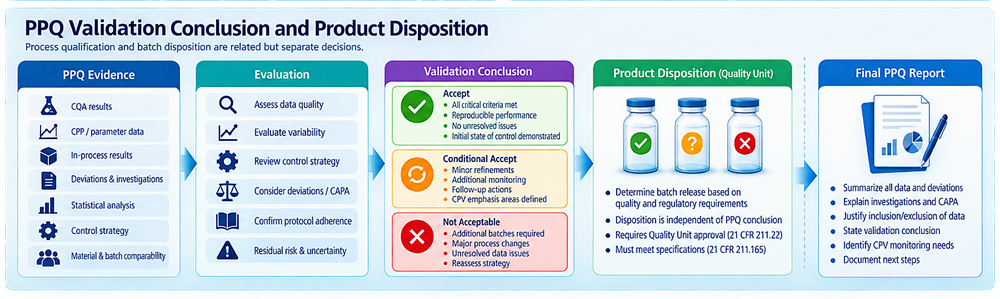
PPQ Report
FDA expects a timely report after PPQ execution that cross-references the protocol, summarizes and analyzes collected data, evaluates unexpected observations, discusses manufacturing nonconformances and aberrant results, describes corrective actions or process changes, and states whether the protocol conditions were met and whether the process is considered to be in a state of control.
The report should therefore integrate rather than merely list deviations. A useful summary for each significant event includes the event identifier, batch, description, root cause, product impact, process-validation impact, data-validity determination, CAPA or other action, effect on acceptance criteria, and final disposition within the PPQ conclusion.
The report should also explain why individual events do or do not change the overall qualification decision. Simply stating that “all deviations were closed” provides little evidence that their effect on process validation was adequately assessed.
Demonstrating an Initial State of Control
The principal PPQ conclusion should answer whether the complete Stage 1 and Stage 2 evidence demonstrates an initial state of control for the commercial process. FDA expects the PPQ report to make a clear conclusion on this point and, where the evidence does not support such a conclusion, to identify what must be accomplished before it can be reached.
A scientifically justified conclusion should integrate protocol adherence, product and process data, predefined acceptance criteria, statistical evaluation, control-strategy verification, deviations, investigations, OOS/OOT results, material variability, CAPA, and remaining uncertainty. The absence of open deviations is not sufficient; unresolved questions that materially affect reproducibility or data integrity should prevent a favorable conclusion until adequate evidence is available.
Some companies may use internal categories such as “qualified with follow-up” or similar governance terms, but these should not obscure the fundamental scientific decision: either the available evidence supports initial process control, or additional work remains necessary before that conclusion can be justified.
When PPQ Has Not Demonstrated Control
A negative PPQ conclusion does not necessarily mean the entire development program must be discarded. The appropriate response depends on what the campaign revealed.
Possible actions can include targeted investigation, process characterization, modification of an operating range, improvement of a material control, automation or equipment changes, procedural revision, additional analytical work, additional PPQ batches, or broader reconsideration of the process design. Significant findings should also be incorporated into the relevant risk assessments and control-strategy documentation.
The objective is to address the scientific reason the PPQ evidence was insufficient rather than simply repeat batches until a predetermined number succeeds.
Transition to CPV
Successful PPQ should identify deviations, residual uncertainties, CAPA effectiveness checks, sensitive parameters, material effects, or process behaviors that warrant continued attention during Stage 3 Continued Process Verification. FDA describes Stage 3 as ongoing assurance that the process remains in a state of control and expects continuing collection and analysis of process and product data capable of detecting undesirable variability.
Early CPV may therefore include enhanced monitoring of areas highlighted during PPQ. This is appropriate when the PPQ evidence already supports initial qualification but additional commercial data will strengthen confidence in a particular trend, corrective action, or process relationship.
See Continued Process Verification (CPV) Program and Monitoring Strategy and Continued Process Verification Reporting and State-of-Control Assessment for the Stage 3 framework.
Key Principles
- PPQ deviations are qualification evidence, not merely records that must be closed before report approval.
- Protocol and manufacturing deviations should be evaluated for their effect on product quality, process control, data validity, and PPQ representativeness.
- FDA expects PPQ data to remain under consideration unless there is documented, science-based justification for exclusion.
- OOS results require appropriate investigation; passing retests do not automatically invalidate an original OOS result.
- Retesting and resampling should answer defined scientific questions and should not become testing into compliance.
- Original data should remain preserved even when an investigation justifies excluding a result from a particular calculation or substituting a valid corrected result.
- Atypical and OOT results can affect PPQ even when formal specifications are met.
- Additional testing cannot substitute for additional independent PPQ batches when the unresolved question concerns batch-to-batch reproducibility.
- Protocol amendments should be prospective and controlled rather than used retrospectively to redefine success.
- CAPA should address root cause and recurrence risk; significant CAPA can require additional validation evidence.
- PPQ process qualification and individual batch disposition are related but separate GMP decisions.
- The final PPQ report should state whether an initial state of control has been demonstrated and what remains to be done if it has not.