

Process Drift, Statistical Signals, and CPV Investigation
Continued Process Verification (CPV) is intended to detect changes in process behavior before those changes develop into product-quality failures or a loss of the validated state. A statistical signal, unusual trend, increasing variability, or unexpected process response should therefore be treated as information requiring scientific interpretation—not automatically as a deviation, batch failure, or proof that the process is no longer validated.
FDA’s Process Validation: General Principles and Practices describes Stage 3 as an ongoing system for detecting unplanned departures from the process as designed and identifying undesirable process variability. FDA expects manufacturers to statistically trend relevant product and process data, investigate variation, and determine when action is necessary to correct, anticipate, or prevent problems so that the process remains in control.
This article focuses on what happens after CPV detects a signal. The broader monitoring architecture, parameter selection, statistical methods, review frequency, and reporting structure are covered in Continued Process Verification (CPV) Program and Monitoring Strategy.
Variation Is Expected
No manufacturing process operates without variation. Raw materials differ slightly from lot to lot, equipment responds within tolerances, analytical measurements contain uncertainty, environmental conditions change, and normal process interactions create variation even when everything is functioning correctly.
The purpose of CPV is therefore not to eliminate all variation. It is to determine whether observed variation remains consistent with the process as currently understood and controlled, or whether the behavior suggests that something has changed.
Statistical Process Control (SPC) commonly distinguishes common-cause variation from special-cause variation. Common-cause variation represents the normal variation inherent in the current process system, while special-cause variation suggests an additional source or condition that is not part of the established routine pattern. NIST describes process monitoring as comparison of current performance with the behavior expected from the established process and uses control charts and related statistical tools to identify possible changes.
A special-cause signal does not automatically mean that product is unacceptable. It means the observed behavior deserves evaluation because it may no longer be adequately explained by the historical process model.
What Is Process Drift?
Process drift is a gradual change in process performance over time. Drift may involve the process average, variability, duration, yield, equipment response, material sensitivity, frequency of adjustments, or another performance characteristic.
For example, a drying process may gradually require longer time to achieve the same moisture endpoint, a filling system may show increasing weight variability, or a CPP may progressively move toward one side of its normal operating range. All results may initially remain within specifications or operating limits, yet the trend can still indicate deteriorating equipment, changing material properties, measurement bias, or another developing condition.
NIST specifically notes that small but significant shifts can sometimes be recognized only by examining the complete time sequence rather than individual measurements. CPV is intended to detect this type of developing change while there is still an opportunity to understand and control it.
Statistical Signals Are Broader Than Limit Violations
The most obvious statistical signal is a point outside an established control limit, but control-chart interpretation should not stop there. NIST notes that even when all observations fall within control limits, a nonrandom sequence can indicate that the process has changed.
Important CPV patterns can include shifts, trends, runs, cycles, increased variability, isolated unusual points, or combinations of these patterns. The significance of the signal depends on the process, the statistical method, the data structure, and the manufacturing context.
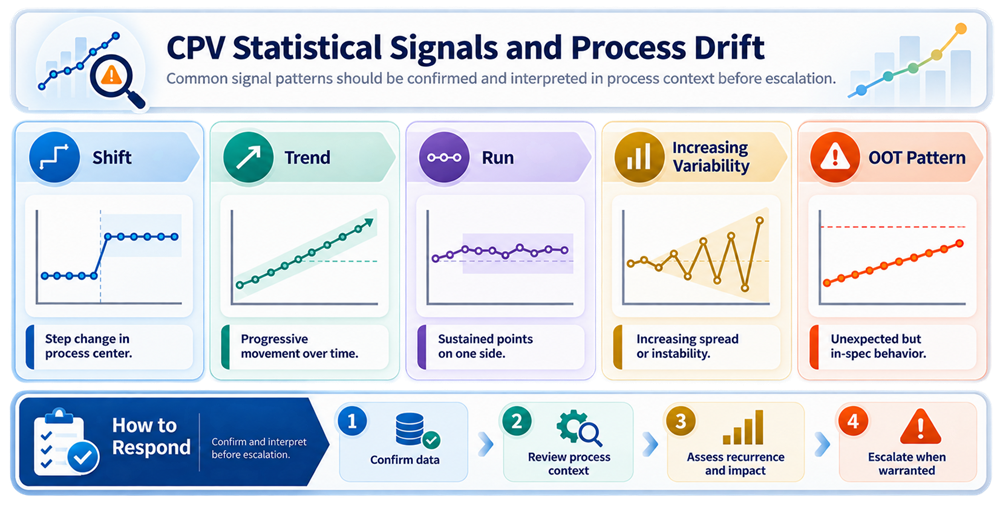
Shifts
A shift is a relatively abrupt change in the center or level of a process. For example, a process parameter may historically average 50 and then begin consistently averaging near 54 after equipment maintenance, a raw-material supplier change, or modification of a control-system setting.
An individual result of 54 may be entirely acceptable. The signal comes from the fact that the process population appears to have moved.
Shift investigation should therefore look for events occurring near the apparent change point, including maintenance, calibration, equipment replacement, software or recipe changes, material-lot changes, process adjustments, and procedural changes.
Trends
A trend is a progressive increase or decrease over successive observations. Trends can be particularly useful for detecting equipment wear, sensor drift, fouling, changing raw-material characteristics, progressive loss of process efficiency, or other slowly developing conditions.
Trend rules should be defined within the CPV statistical strategy rather than invented after observing the data. NIST describes commonly used Western Electric-type rules that include sequences such as six consecutive observations increasing or decreasing, but these are statistical signal rules rather than FDA-mandated acceptance criteria.
The appropriate rule depends on data frequency, false-alarm tolerance, expected process behavior, and the consequence of delayed detection.
Runs and Persistent Bias
A run occurs when multiple consecutive observations remain on the same side of the process center line. The values may all remain comfortably inside control and specification limits, but the pattern can indicate that the process has shifted to a different operating level.
NIST provides an example in which observations can all remain inside control limits while their nonrandom arrangement still indicates that something about the process deserves investigation.
A run is particularly important when it begins after an identifiable manufacturing event. It may indicate a new stable condition rather than continuing deterioration, but the organization still needs to understand why the center changed and whether the new state remains consistent with the approved process and control strategy.
Increasing or Unusual Variability
Loss of control can occur through increasing spread, even when the process average remains essentially unchanged. A process that once produced tightly clustered values may gradually develop larger differences among batches, sampling locations, filling heads, equipment trains, or process stages.
This may result from equipment wear, raw-material inconsistency, reduced control-loop performance, calibration deterioration, operator differences, environmental effects, or other sources. Monitoring variability separately from the mean can therefore reveal process degradation that average-value trending would miss.
NIST identifies range and standard-deviation charts as established approaches for detecting changes in process variability.
OOT Signals
Out-of-Trend (OOT) is commonly used in pharmaceutical quality systems for a result or pattern that is inconsistent with expected historical or process behavior but may still remain within specification. Unlike Out-of-Specification (OOS), OOT does not have one universal FDA regulatory definition or numerical threshold; the site should define how OOT signals are identified, assessed, and escalated.
FDA’s current OOS guidance specifically defines OOS results as results outside established specifications or acceptance criteria. An OOT signal is therefore conceptually different: the result may be acceptable against the formal specification while being unusual relative to historical or expected process behavior.
For CPV, that distinction is useful because deterioration should ideally be recognized before specification failure occurs.
A Statistical Signal Is Not Yet a Root Cause
When CPV identifies a signal, the first step should usually be confirmation of the signal, not immediate corrective action. The organization should determine whether the apparent change is real or whether it results from incorrect data, inappropriate chart construction, a change in subgrouping, analytical error, a transcription problem, or another measurement issue.
The statistical method itself should also be checked. Control limits calculated using inappropriate historical data, mixed process populations, incorrect subgrouping, or outdated baselines can generate misleading alarms.
A confirmed statistical signal means the data warrant further scientific evaluation. It does not by itself identify the reason for the change.
Signal Confirmation
A practical signal-confirmation review should determine whether the data are complete and reliable, whether the correct statistical method and limits were applied, and whether the observation belongs to the process population represented by the chart. Reviewers should also determine whether the apparent pattern can be explained immediately by a known event such as a planned change, documented maintenance activity, alternate equipment train, different approved material source, or known manufacturing campaign.
The confirmation step should be documented proportionately to the signal. A minor alert resolved through an obvious data correction may require little formal investigation, while a persistent or unexplained signal can require a full deviation or quality investigation.
The objective is to avoid both extremes: ignoring a genuine change and launching unnecessary investigations for every harmless statistical fluctuation.
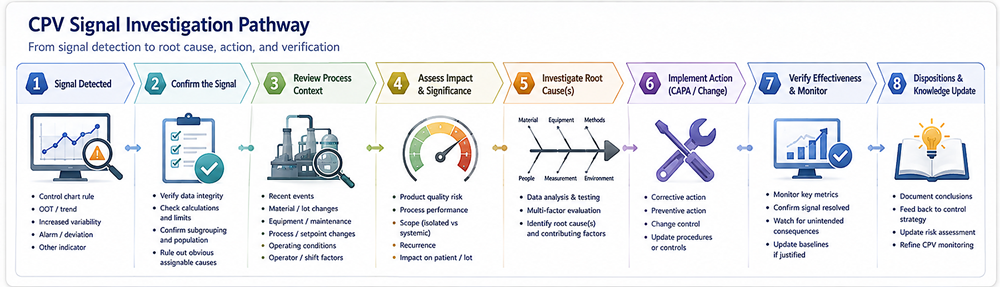
Investigating the Manufacturing Context
Once a signal is confirmed, the investigation should examine the process circumstances associated with the affected observations. The most useful question is usually not “Why did the chart fail?” but “What changed in the manufacturing system?”
Relevant context can include raw-material lots, supplier, equipment train, maintenance history, calibration, automation configuration, operating ranges, batch size, hold time, manufacturing sequence, shift, operator intervention, environmental conditions, recent CAPA, and formal process changes.
The investigation should also compare unaffected batches. Differences between signal and nonsignal populations can help identify the factor associated with the change.
Material Contributors
Raw-material variation is a common potential contributor to process signals. Even when incoming materials meet approved specifications, changes within those specifications can affect mixing, granulation, filtration, reaction behavior, drying, compression, filling, or other process operations.
CPV investigation should therefore consider material lot, supplier, relevant material attributes, storage history, age, and other characteristics identified during development or through later commercial experience. The relationship between material attributes, process parameters, and product quality should trace back to the risk and criticality framework established in CQA, CPP, and Material Attribute Risk Assessment.
A recurring association between one material population and an adverse process signal may support revision of supplier controls, material specifications, incoming testing, or process adjustment strategy.
Equipment and Utility Contributors
Equipment deterioration can produce gradual or abrupt process changes. Potential contributors include mechanical wear, fouling, damaged components, valve behavior, pump performance, filter condition, heat-transfer efficiency, mixer performance, sensor drift, actuator response, control-loop tuning, and changes following maintenance.
Utilities can also affect process performance. Changes in steam pressure, water quality, compressed gas, HVAC performance, temperature control, or other supporting utilities may appear indirectly through changes in process duration or variability.
The investigation should consider not only whether the equipment remains within qualification or calibration status but whether its actual operating behavior has changed.
Process and Control-System Contributors
Process drift may result from changes in setpoints, routine operating distribution, recipe configuration, equipment loading, process sequence, hold duration, control-loop behavior, or other aspects of the implemented control strategy.
FDA states that process knowledge forms the basis of the control strategy and that controls should be enhanced and improved as manufacturing experience is gained. A CPV signal may therefore expose an operating range that is technically valid but less robust than originally believed, an alarm limit that does not provide sufficient early warning, or a parameter interaction that was underestimated during development.
These findings should feed back into Process Control Strategy Lifecycle Management rather than remaining isolated within an investigation report.
Measurement and Data Contributors
A process signal can also originate from the measurement system rather than from manufacturing. Analytical method changes, instrument deterioration, calibration drift, sampling inconsistency, laboratory handling, changed data processing, or replacement of a sensor can alter observed results without a corresponding change in the underlying process.
The investigation should therefore evaluate data integrity, measurement-system status, analytical method performance, sample handling, and any change in how results are calculated or transferred. This is especially important when a statistical shift begins immediately after replacement of an instrument, analytical method revision, laboratory transfer, or automation upgrade.
The objective is not to dismiss inconvenient results as measurement error. A measurement cause should be supported by evidence.
Recent Changes and CAPA
Change history is one of the most important investigation inputs. Equipment modifications, software patches, recipe changes, supplier changes, procedural revisions, CAPA implementation, maintenance strategies, and facility or utility changes can all alter process behavior.
An apparently successful change may introduce a secondary effect that only becomes visible after several commercial batches. CPV therefore provides an important effectiveness check for change control and CAPA.
The relationship is bidirectional: changes can create CPV signals, and CPV signals can initiate new changes.
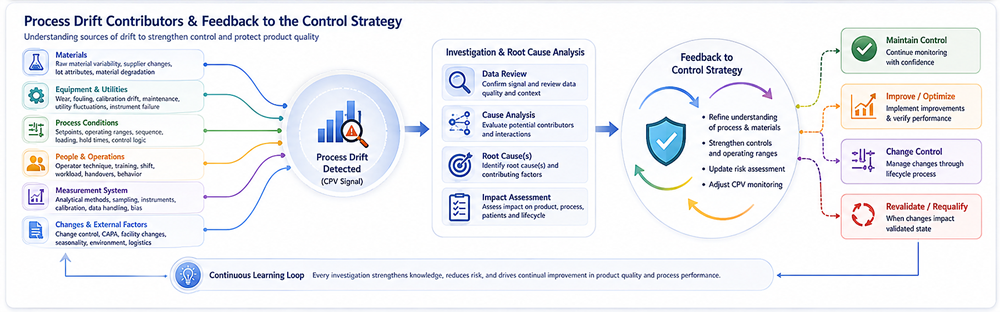
Caption: Process drift can originate from materials, equipment, process conditions, operating practices, measurement systems, or recent lifecycle changes. Investigation integrates these sources before deciding whether the control strategy remains adequate or requires CAPA, change control, additional qualification, or revalidation.
Deterioration Before Specification Failure
One of the principal benefits of CPV is the ability to detect deterioration while product remains compliant. A process may show decreasing capability, increasing variability, greater dependence on manual correction, or movement toward a specification boundary long before an OOS result occurs.
This is why CPV should not be reduced to trending the percentage of passing batches. FDA expects Stage 3 data to verify that quality attributes remain appropriately controlled and to detect undesirable process variability.
A process that repeatedly requires greater intervention to achieve the same outcome may still produce acceptable product but can no longer be considered equally robust.
Common Cause Versus Special Cause
The distinction between common and special cause helps determine what type of action is appropriate. If variability is common cause, repeatedly adjusting individual batches may not solve the problem because the variation belongs to the process system itself. Improvement may require redesign of equipment, material controls, operating ranges, procedures, or another systemic element.
If a special cause is identified, correction can instead focus on the specific assignable condition—for example, a failing valve, an unusual raw-material lot, an incorrect recipe version, or a calibration problem.
Incorrectly treating common-cause variation as a sequence of isolated special causes can generate unnecessary adjustments and actually increase variability. Conversely, repeatedly classifying genuine special-cause signals as “normal process variation” can allow deterioration to continue.
Investigation Scope Should Be Proportional
Not every CPV alert requires a full formal root-cause investigation. The response should be proportionate to the signal, recurrence, product-quality risk, strength of evidence, and remaining uncertainty.
A single low-level alert that is readily explained and does not recur may require documented review and continued monitoring. A persistent trend, repeated run rule, increasing process variability, significant shift, or signal associated with CQA deterioration may require formal deviation investigation, cross-batch assessment, CAPA, or change control.
The CPV plan should define this escalation logic in advance so that comparable signals receive comparable treatment.
Repeated Signals Matter
Repeated alerts should not be evaluated indefinitely as independent minor events. Recurrence itself becomes evidence.
For example, an equipment alarm that appears once may have little lifecycle significance. The same alarm recurring across multiple batches, accompanied by increasing process adjustments or longer processing time, can indicate deterioration even if each individual event was previously closed.
CPV should therefore evaluate the aggregate history of signals and investigations, not only the status of the most recent event.
CAPA
Corrective and Preventive Action (CAPA) should address the actual source of undesirable variability. Depending on the investigation, actions can include equipment repair, material-control changes, revised operating ranges, automation changes, procedural improvement, additional training, maintenance changes, sampling modification, increased monitoring, or targeted process characterization.
ICH Q10’s Process Performance and Product Quality Monitoring System expects the monitoring system to identify sources of variation and provide timely feedback and feed-forward information supporting CAPA and continual improvement.
CAPA should not merely force the signal back inside statistical limits. The action should address why process behavior changed and whether the underlying control strategy remains adequate.
CAPA Effectiveness
CPV provides a natural mechanism for verifying CAPA effectiveness. After corrective action, the monitoring plan should determine whether the original signal disappears, process variability returns to the expected pattern, and no new adverse effect is introduced.
Control limits should not automatically be recalculated immediately after every CAPA. Doing so can simply redefine the changed process as normal before enough evidence exists to demonstrate that the new state is stable and acceptable.
Where the CAPA intentionally establishes a new process condition, a new statistical baseline may eventually be appropriate, but it should be established only after sufficient representative data support it.
When to Recalculate Control Limits
Control limits represent expected behavior of a defined process population. They should not be continuously recalculated merely because recent observations have shifted.
A new baseline can be appropriate after a scientifically understood and approved process change, successful CAPA, equipment replacement, or another justified event that intentionally establishes a new process state. The organization should first demonstrate that the new state is stable and adequately characterized.
Otherwise, continually updating limits to include adverse drift can normalize deterioration and defeat the purpose of statistical monitoring.
Escalation to Change Control
A CPV investigation should enter formal change control when the proposed response alters the validated process, control strategy, equipment configuration, manufacturing procedure, material controls, automation, sampling plan, or another controlled element.
The change assessment should determine whether existing development and validation evidence remain applicable and what additional verification is required. This may range from documentation and targeted testing to additional process characterization or PPQ.
The broader decision path is covered in Process Change Control, Revalidation, and Lifecycle Management.
Revalidation Decisions
A statistical signal by itself does not mandate revalidation. Revalidation becomes relevant when investigation demonstrates that the established process or control strategy has materially changed, when existing validation evidence no longer adequately represents the process, or when accumulated data indicate that the original state-of-control conclusion is no longer supportable.
Possible responses include targeted verification, limited requalification, additional PPQ batches, broader process revalidation, or Stage 1 redevelopment depending on the extent of the change or knowledge gap.
The decision should be based on process impact and evidence—not on the existence of a particular statistical alarm.
Feedback Into the Control Strategy
CPV investigation closes the validation lifecycle loop. New commercial knowledge should update the understanding of material attributes, CPPs, operating ranges, in-process controls, automation, procedural controls, sampling, alarms, and monitoring expectations when warranted.
ICH Q10 explicitly expects process-performance monitoring to provide knowledge that enhances process understanding and supports continual improvement. FDA likewise recognizes that controls can be enhanced as process experience increases.
A control strategy should therefore not remain frozen simply because it was approved during PPQ. It should remain controlled, justified, and capable of evolving as evidence improves.
Updating the CPV Monitoring Strategy
An investigation can also reveal that the monitoring system itself needs improvement. A new leading indicator may need to be added, a previously monitored variable may prove uninformative, subgrouping may need revision, or statistical limits may need recalculation after a justified process change.
Monitoring intensity may increase temporarily following a change, CAPA, equipment repair, new material supplier, or other condition that increases uncertainty. Once sufficient evidence demonstrates stable behavior, monitoring can again become more representative and risk-based.
This feedback mechanism should remain linked to the overall Continued Process Verification (CPV) Program and Monitoring Strategy.
Documentation
CPV signal records should allow later reconstruction of what was detected, how the signal was confirmed, what manufacturing context was reviewed, whether formal investigation was required, what root cause or contributing factors were identified, and what action was taken.
Relevant records can include the CPV trend or dashboard, statistical output, batch and process records, material information, equipment and maintenance records, analytical data, deviation investigation, CAPA, change control, validation impact assessment, and follow-up monitoring.
The record should also explain why a signal was closed without further action when that is the scientifically appropriate decision.
Reporting and State-of-Control Assessment
Individual signals should ultimately feed into periodic CPV reporting. A series of apparently minor events may become significant when reviewed together, particularly when they involve the same equipment, material, CPP, operating condition, or CQA.
The formal evaluation should consider signal frequency, recurrence, investigation outcomes, unresolved trends, CAPA effectiveness, process capability or performance where meaningful, and whether the current control strategy continues to protect product quality.
The integration of this evidence into an explicit process-status decision is addressed in Continued Process Verification Reporting and State-of-Control Assessment.
Key Principles
- Process variation is expected; CPV distinguishes expected variation from evidence that process behavior may have changed.
- Common-cause variation belongs to the current process system, while special-cause variation suggests an additional source requiring evaluation.
- A point outside a control limit is only one type of signal; shifts, trends, runs, cycles, and increasing variability may also indicate process change.
- A statistical signal does not automatically mean product failure or loss of validation.
- Signal confirmation should precede root-cause investigation and should include data integrity, statistical method, subgrouping, and process context.
- OOT is useful as an internal concept for unusual behavior within specification, while FDA formally defines OOS as a result outside established specifications or acceptance criteria.
- Material attributes, equipment condition, process settings, automation, measurement systems, operating practices, and recent changes should all be considered as possible contributors.
- Increasing variability can be as important as movement of the process mean.
- Specification compliance does not eliminate the need to investigate deteriorating process performance.
- Repeated minor signals should be evaluated collectively rather than treated indefinitely as unrelated events.
- CAPA should address the source of variation rather than merely force results back inside statistical limits.
- Control limits should not be repeatedly recalculated to absorb unexplained drift.
- Revalidation should be based on the effect of the confirmed process change or knowledge gap, not on the statistical signal alone.
- Investigation results should feed back into the process control strategy, CPV plan, change management, and lifecycle knowledge.