

Worst-Case Product, Equipment, and Cleaning Condition Selection
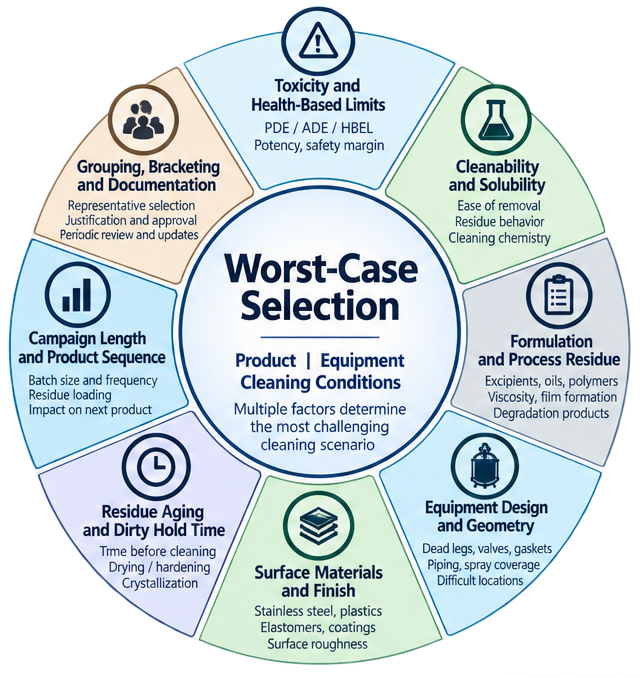
Cleaning validation does not require every product-equipment combination to be validated independently when scientifically justified grouping demonstrates that selected representatives adequately challenge the broader manufacturing scope. The validity of that strategy depends on how those representatives are chosen. Worst-case selection should therefore evaluate the factors that actually determine cleaning difficulty and cross-contamination risk rather than identify one product solely because it has the lowest solubility, highest potency, or most restrictive residue limit.
A defensible assessment addresses several related but distinct questions. Which residue creates the greatest patient or product-quality consequence if carryover occurs? Which product or formulation is most difficult for the approved cleaning process to remove? Which equipment configuration presents the greatest physical cleaning challenge? Which operating conditions produce the most difficult residue state? Which product-equipment combinations are most difficult to sample and measure reliably? These questions may identify one representative, but they can also identify several different worst-case challenges.
The broader Cleaning Validation Program Strategy, Scope, and Lifecycle should define the governance for grouping, bracketing, and representative selection. The individual worst-case assessment should then document the manufacturing scope, applicable products and intermediates, equipment trains, cleaning procedures, risk factors, supporting data, selected representatives, and the limitations of each grouping decision.
Regulatory and Scientific Basis
21 CFR 211.67 — Equipment Cleaning and Maintenance requires equipment and utensils to be cleaned and maintained at appropriate intervals to prevent contamination that could adversely affect drug-product quality. The regulation does not prescribe a numerical ranking methodology or require one universal worst-case product. The manufacturer must establish a scientifically justified cleaning-validation strategy appropriate to the products, equipment, and processes involved.
FDA’s Guide to Inspections: Validation of Cleaning Processes directs attention to equipment design, difficult-to-clean locations, cleaning-process variability, residue characteristics, dirty hold time, sampling limitations, analytical sensitivity, and scientifically justified residue limits. FDA specifically notes that dried residues can be more difficult to remove and that complex piping, valves, long transfer lines, and manual cleaning can materially affect cleaning effectiveness.
For active pharmaceutical ingredients, ICH Q7 Good Manufacturing Practice Guidance for Active Pharmaceutical Ingredients directly supports representative selection. Where several APIs or intermediates are manufactured in the same equipment and cleaned using the same process, a representative material may be selected based on solubility, difficulty of cleaning, and residue limits derived from potency, toxicity, and stability.
Risk-based decisions should also follow ICH Q9(R1) Quality Risk Management, under which risk evaluation should be based on scientific knowledge and ultimately linked to patient protection. The level of formality, effort, and documentation should be commensurate with the significance of the risk.
Worst Case Is a Challenge Envelope, Not a Single Ranking
The term worst-case product is useful only when one product clearly represents all controlling risk dimensions. In many manufacturing systems, that assumption is not valid. The validation challenge is created by the interaction among the residue, equipment, cleaning process, manufacturing history, and measurement system.
A highly potent product with a restrictive health-based exposure limit may produce the lowest allowable carryover but may be highly soluble and readily removed. Another product may have a less restrictive toxicological limit but form a sticky, hydrophobic, polymeric, or dried residue that is significantly harder to clean. A third product may be relatively easy to remove from an open vessel yet become difficult to remove from a valve cavity, gasket interface, hose, filter housing, or poorly drained process line.
The assessment should therefore define a worst-case challenge envelope. Depending on the system, this may include a toxicological worst case, cleanability worst case, equipment-design worst case, dirty-hold challenge, campaign challenge, analytical challenge, or combination of these factors. The validation studies should collectively demonstrate that the defined grouping is adequately represented.
Product Hazard and Health-Based Exposure Limits
The consequence of residue carryover should be evaluated using the toxicological and pharmacological basis applicable to the material. Where health-based exposure limits are used, lower PDE or ADE values generally indicate that less carryover can be tolerated and therefore produce more restrictive residue-control requirements.
Health-Based Exposure Limits for Cleaning Validation: HBEL, PDE, and ADE addresses the toxicological derivation and application of these values. HBELs are an important input to worst-case selection, but they do not measure physical cleanability. A material with the lowest PDE is not automatically the material most difficult to remove.
The EMA Guideline on Health-Based Exposure Limits in Shared Facilities provides a detailed scientific framework for deriving health-based thresholds for cross-contamination risk. For a U.S.-focused validation program, it is best treated as an authoritative scientific reference rather than as a requirement imposed by 21 CFR Part 211.
Other substance-specific hazards may also require consideration, including sensitization, cytotoxicity, genotoxicity, reproductive toxicity, pharmacological potency, or other effects relevant to patient protection. The assessment should use the hazard basis that actually controls the cleaning limit.
Residue Limits and Carryover Consequence
Hazard should be distinguished from the numerical cleaning criterion ultimately applied to the equipment. The allowable residue depends on the toxicological threshold, subsequent manufacturing conditions, equipment surface area, and the calculation methodology used by the cleaning-validation program.
Maximum Allowable Carryover (MACO) and Residue Limit Calculations translates the allowable exposure basis into an amount of residue permitted to carry into the subsequent product. Where the subsequent-product batch size is part of the calculation, the minimum applicable batch size normally creates the more restrictive carryover condition because the same residue amount would be distributed into less subsequent product.
This distinction is important because maximum batch size is not automatically conservative. The worst-case assessment should identify exactly how batch size enters the approved calculation and select the parameter value that actually produces the more restrictive limit.
Cleaning Validation Acceptance Criteria and Surface, Swab, and Rinse Limits then translates the allowable carryover into measurable equipment, surface, swab, or rinse criteria. The relevant worst case is therefore the condition producing the most demanding justified cleaning requirement, not simply the product with the lowest toxicological number.
Cleanability and Solubility
Solubility is an important input but should not be used as a surrogate for cleanability. Published aqueous solubility may have little relationship to a cleaning process that uses alkaline detergent, acid, surfactant, elevated temperature, mechanical action, organic solvent, or a multistep sequence.
Cleanability describes how difficult the actual process residue is to remove under the defined cleaning conditions. Relevant properties can include solubility in the cleaning medium, wettability, adhesion, viscosity, hydrophobicity, crystallization, particle behavior, film formation, polymerization, drying characteristics, and interaction with the selected cleaning chemistry.
A material with poor water solubility can clean readily with the approved detergent system. Conversely, a nominally soluble material can become difficult to remove after drying, heating, degradation, or interaction with formulation components. Where available, direct cleaning-development evidence should therefore carry more weight than a generic literature solubility value.
Cleaning Procedure Development and Efficacy Studies should provide experimental evidence when cleanability cannot be established reliably from known physical and chemical properties.
Formulation and Process Residue Characteristics
The residue left on manufacturing equipment is often not pure API. It may contain binders, polymers, oils, proteins, salts, suspending agents, coating materials, colorants, excipients, intermediates, degradants, or other process components that substantially change cleaning behavior.
Worst-case selection should therefore evaluate the actual formulation or process soil. A low-concentration API contained in a sticky polymer matrix may create a more difficult cleaning challenge than a high-concentration API present in a simple aqueous solution.
Relevant formulation characteristics include solids loading, oil content, polymer content, viscosity, hydrophobic components, tackiness, drying behavior, suspension properties, and the ability to form films or deposits. Manufacturing operations such as heating, granulation, coating, concentration, drying, homogenization, or reaction can further alter the soil before cleaning begins.
Grouping products only by API potency can therefore miss the factor that actually controls cleaning difficulty.
Residue Loading
The quantity of soil presented to the cleaning process can affect removal independently from the final acceptance criterion. Maximum product concentration, process heel, coating buildup, retained material in low points, high solids, or repeated batch exposure can increase the initial residue burden.
Worst-case validation should represent a credible maximum soil condition within the approved manufacturing process rather than create an artificial contamination level unrelated to routine production.
Residue loading should also be kept conceptually separate from subsequent-product batch size. Residue loading affects how much material must be removed. Subsequent-product batch size may affect how much residual carryover can be tolerated. They represent different mechanisms and should not be collapsed into one generic ranking factor.
Residue Aging and Dirty Hold Time
The condition of the soil at the start of cleaning can be as important as the identity of the product. Residues can dry, harden, crystallize, polymerize, oxidize, denature, degrade, or become more strongly adhered as the delay before cleaning increases.
FDA specifically identifies the interval between processing and cleaning as an important cleaning-validation consideration because dried residues may become more difficult to remove. The maximum permitted dirty hold time should therefore be included in worst-case selection where residue aging affects cleanability.
Dirty Hold Time and Clean Hold Time Studies should establish the maximum permitted interval between completion of processing and initiation of the defined cleaning process. The worst-case matrix should identify whether the selected representative must be challenged at or near that maximum dirty hold condition.
The start and end of dirty hold should be clearly defined. Product displacement, water flushing, manual pre-cleaning, or maintaining equipment in a wet condition can substantially alter the residue state and therefore the actual challenge.
Campaign Length and Manufacturing Sequence
Campaign manufacturing can increase residue loading or change residue characteristics before the final product-changeover cleaning. Repeated batches can allow buildup in difficult locations, repeated drying, thermal exposure, deposition, or progressive accumulation that may not occur after a single batch.
Where campaign length affects cleaning performance, the assessment should identify the maximum permitted campaign or another scientifically justified representative condition. The evaluation should consider the number of consecutive batches, residue accumulation, intermediate cleaning, process temperature, equipment utilization, and whether repeated operation changes the soil.
Campaign length should not automatically receive a high risk score merely because the number of batches is large. The relevant question is whether the approved campaign strategy creates a more difficult cleaning condition.
Product sequence can also matter. The same equipment may be used for several products with different subsequent-product limits or process conditions. Where sequence influences carryover consequence or cleaning difficulty, the representative challenge should reflect that interaction.
Equipment Design and Geometry
Worst-case product selection should not be performed independently from equipment design. The same residue may be readily removed from an open vessel yet remain difficult to clean from valve internals, gaskets, transfer hoses, filters, narrow passages, spray shadows, agitator components, or poorly drained sections.
Important equipment attributes include:
- dead legs or difficult-to-drain sections;
- valve bodies, seals, gaskets, and crevices;
- long piping or transfer paths;
- complex agitator or internal geometry;
- filters, screens, nozzles, dip tubes, and probes;
- spray-device coverage;
- manual-access limitations;
- disassembly requirements;
- low-flow or stagnant regions;
- surface area and configuration.
FDA specifically directs attention to equipment design, sanitary piping, valves, and long transfer lines because these features can make a cleaning process more difficult to execute and verify.
Equipment grouping should therefore be based on meaningful design equivalence rather than equipment name or nominal size alone.
Product-Contact Surface Materials and Finish
Residue interaction can differ among stainless steel, glass, polymers, elastomers, coated surfaces, hoses, gasket materials, and other product-contact substrates. Surface roughness, wear, corrosion, porosity, chemical compatibility, and adsorption behavior can affect both cleaning and sampling recovery.
A representative equipment grouping should identify materially different surfaces. A study performed only on polished stainless steel may not adequately represent a polymer hose, elastomeric gasket, coated surface, or worn component when the residue behaves differently on those substrates.
The same consideration applies to Swab and Rinse Recovery Studies for Cleaning Validation. Recovery established on one surface should not automatically be assumed applicable to a substantially different material.
Manual, COP, and CIP Cleaning Conditions
The relevant worst-case variables depend on how cleaning is performed. Manual cleaning can be strongly influenced by operator technique, access, sequence, scrubbing, cleaning tools, chemical preparation, and contact time. A defensible validation strategy may need to represent operator variability or the most difficult manually accessed surfaces.
Clean-out-of-place operations can be affected by component orientation, washer load, basket configuration, disassembly, soak conditions, rinsing, drying, and handling after cleaning.
CIP systems introduce different challenge factors, including route configuration, flow, pressure, temperature, chemical concentration, exposure time, spray-device performance, valve sequencing, coverage, drainage, and automation. Pharmaceutical Tank Cleaning and CIP Integration addresses these equipment and process interactions in greater detail.
A difficult product should not be validated only under unusually favorable cleaning parameters. The representative challenge should reflect the applicable operating boundaries of the approved cleaning procedure.
Cleaning Parameter Boundaries
Worst-case validation should consider the least favorable approved cleaning conditions where those conditions can materially affect cleaning performance. Potential examples include minimum detergent concentration, minimum contact time, minimum temperature, minimum flow, minimum spray pressure, or minimum mechanical action.
The correct challenge direction depends on the process. Lower temperature may reduce solubility or chemical effectiveness, but excessive temperature can sometimes bake, denature, or harden certain residues. The worst-case condition should therefore be derived from cleaning-development knowledge rather than from a generic assumption that the minimum value is always worst.
The validation study should remain within the approved operating range. Deliberately operating outside established limits does not provide meaningful evidence that the routine cleaning process is validated.
Analytical Detectability and Sampling Capability
Cleaning validation also depends on whether the selected residue can be measured reliably at the required level. A product may be physically easy to clean yet difficult to validate because the applicable cleaning limit is very low or the analytical response is weak.
Analytical Method Selection for Cleaning Validation addresses selection of HPLC/UHPLC, UV-visible spectroscopy, TOC, conductivity, and other appropriate techniques. Analytical Sensitivity and Quantitation Limits in Cleaning Validation addresses whether the complete analytical procedure can quantify residue at the required level, while Analytical Method Validation for Cleaning Residue Testing addresses specificity, accuracy, precision, matrix effects, recovery, range, and quantitative capability.
Analytical difficulty should not be used to remove a challenging product from the validation scope. It should influence method selection, sampling strategy, or the need for an alternative or conservative measurement approach.
Sampling difficulty should also be considered. Cleaning Validation Sampling Strategy and Worst-Case Locations should identify locations where residue is likely to persist based on equipment design, product behavior, and cleaning mechanism. Difficult-to-sample locations should influence the evidence strategy rather than simply be excluded.
Product and Equipment Grouping
Grouping is appropriate when products or equipment share attributes sufficiently similar that validation of selected representatives can support the broader group. The grouping rationale should define which characteristics must be comparable and which differences would require separate evaluation.
Product grouping may consider:
- common cleaning chemistry;
- formulation type;
- cleanability;
- residue behavior;
- toxicological-limit range;
- processing conditions;
- equipment use;
- analytical strategy.
Equipment grouping may consider:
- design and geometry;
- product-contact materials;
- surface finish;
- cleaning mechanism;
- spray or hydraulic configuration;
- manual access;
- operating range;
- sampling accessibility.
The representative does not need to be worst for every individual attribute. It should provide an equal or greater challenge for the attributes that actually determine cleaning risk within the defined group.
Different equipment trains may require different representative products even when they manufacture the same product portfolio.
Bracketing
Bracketing can be appropriate when defined extremes are capable of representing conditions within a justified range. Examples may include equipment sizes with equivalent geometry and cleaning mechanism, formulation strengths with common composition, product concentration ranges, or established residue-loading ranges.
Bracketing does not mean selecting the numerically highest and lowest values and assuming everything between them is covered. The endpoints must bound the relevant cleaning behavior.
If an intermediate product introduces a unique formulation, different surface interaction, unusual cleaning difficulty, or a different residue limit, it may not be covered merely because its numerical value lies between the two bracket endpoints.
The rationale should explicitly state what characteristic is being bracketed and why the selected extremes adequately represent the intermediate conditions.
Product-Equipment-Cleaning Selection Matrix
A documented matrix is the most effective way to demonstrate how representative validation challenges cover the manufacturing system. The matrix should connect products, equipment trains, cleaning procedures, product groups, equipment groups, applicable residue limits, cleanability information, surface materials, dirty-hold conditions, campaign limits, analytical methods, and selected representatives.
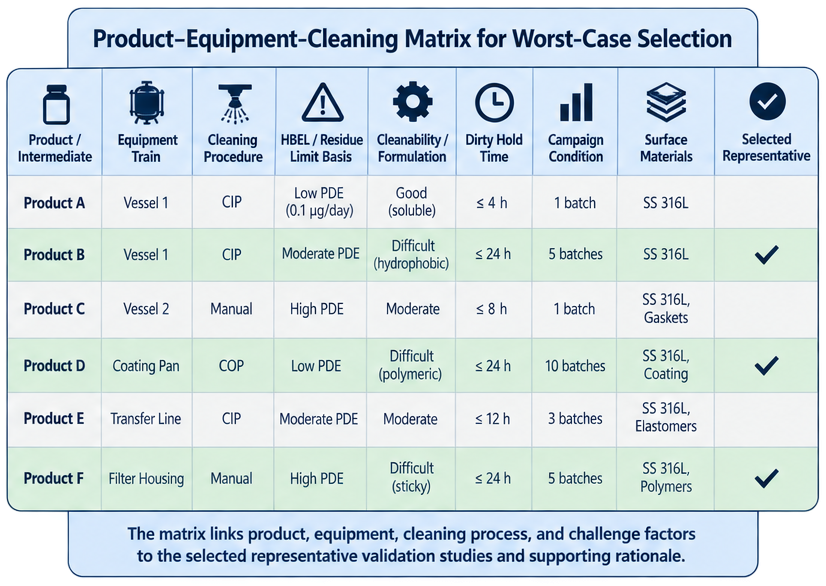
A useful matrix may include columns such as:
| Attribute | Typical information |
|---|---|
| Product or intermediate | Identity and formulation |
| Equipment train | Shared product-contact path |
| Cleaning procedure | Manual, COP, CIP, or hybrid |
| HBEL / residue-limit basis | Applicable PDE, ADE, or other basis |
| Cleanability | Development data or justified classification |
| Formulation challenge | Oils, polymers, solids, sticky components |
| Dirty hold time | Maximum approved interval |
| Campaign condition | Maximum justified sequence |
| Surface materials | Relevant product-contact substrates |
| Equipment challenge | Geometry, valves, gaskets, spray shadows |
| Sampling strategy | Swab, rinse, or combination |
| Analytical procedure | Applicable validated method |
| Representative | Selected worst-case challenge |
| Rationale | Scope represented and justification |
The matrix should make gaps visible. If a product-equipment combination is not covered by an existing representative, the assessment should either provide a defensible rationale or identify additional validation work.
Practical Worst-Case Selection Process
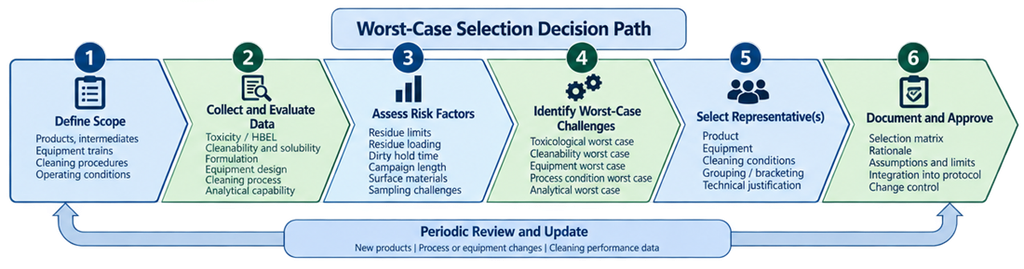
A structured process should begin by defining the complete manufacturing and cleaning scope. Products, intermediates, equipment trains, cleaning procedures, and permitted manufacturing conditions should be identified before scoring or ranking begins.
Product data should then be assembled for the attributes that influence hazard and cleaning difficulty. Depending on the product, this may include HBEL, formulation, cleanability evidence, cleaning-medium solubility, residue aging, process temperature, soil loading, and analytical detectability.
Equipment data should include design, cleaning method, product-contact materials, difficult locations, manual interventions, disassembly, flow or spray limitations, drainage, and sampling limitations. Cleaning-process data should include chemistry, parameter ranges, dirty hold time, campaign conditions, and other operating boundaries.
The assessment should then identify the product-equipment-condition combinations that create the most restrictive or difficult challenge for each controlling risk dimension. The result may be one representative, but multiple representatives are appropriate when no single combination covers the full challenge envelope.
Numerical Scoring and Ranking
Numerical scoring can help organize large portfolios, but the final score should not replace scientific judgment. A scoring system is only as defensible as the criteria, category definitions, weights, and source data used to create it.
Toxicological severity, poor cleanability, complex equipment geometry, long dirty hold time, and analytical difficulty represent different risk mechanisms. Adding them into one total can conceal a critical attribute. A product with an extremely restrictive residue criterion should not automatically be dismissed because its overall score is reduced by favorable cleanability.
Where numerical ranking is used, the methodology should define:
- scoring scales;
- weighting factors;
- data sources;
- treatment of missing information;
- tie-breaking rules;
- conditions requiring independent review regardless of score.
For smaller portfolios, a qualitative matrix may be more transparent. For larger portfolios, numerical screening followed by documented technical review is often more defensible than allowing the highest total score to determine the worst case automatically.
Documenting the Selection Rationale
The assessment should allow an independent reviewer to reconstruct why each representative was selected. Documentation should identify the scope, products and equipment considered, source data, criteria, scoring or ranking methodology where used, grouping rules, representative challenge conditions, excluded candidates, and the final scientific rationale.
The rationale should explain what each representative actually challenges. One product may represent the lowest allowable carryover, another may represent the most difficult formulation to remove, while a particular equipment train may represent the geometric worst case.
This is stronger than labeling one product simply as “the worst case” without defining the mechanism.
Data limitations and assumptions should be explicit. Where cleanability evidence is limited, conservative classification or targeted development testing may be required before a product is incorporated into an existing group.
Traceability into Cleaning Validation Execution
The selected challenges should be traceable directly into the cleaning-validation protocol. The protocol should identify the representative product or soil, equipment, cleaning procedure, dirty hold condition, campaign status, cleaning-parameter challenge, sampling locations, analytical method, acceptance criteria, and the grouping claims supported by the study.
Successful cleaning of a representative supports the group only while the assumptions underlying the selection remain valid. A successful protocol execution cannot retroactively correct an unsupported grouping strategy.
Likewise, failure of a representative challenge does not automatically mean the wrong worst case was selected. The cleaning process, equipment condition, operating parameters, sampling, analytical procedure, and original assumptions should be investigated before the selection strategy is revised.
New Products and Change Control
Worst-case selection is a lifecycle activity. A new product should be evaluated against the existing product-equipment-cleaning matrix before it is accepted into an established validation group.
Relevant changes include new or revised HBELs, formulation changes, changes in product concentration, new manufacturing processes, equipment modifications, new product-contact materials, cleaning-chemistry changes, longer dirty hold time, increased campaign length, revised CIP parameters, different sampling methods, or changes in analytical capability.
A new product does not automatically require full revalidation. If documented assessment demonstrates that the existing representative remains equal to or more challenging for all relevant attributes, the current validation evidence may continue to support the group.
Where a new product or change introduces a new worst-case condition, targeted development, verification, or revalidation should be completed before the expanded grouping is relied upon. The broader evaluation process is addressed in Cleaning Validation Change Control and Revalidation Triggers.
Periodic Reassessment
Periodic review should confirm that the assumptions underlying grouping, bracketing, and representative selection remain current. Cleaning Validation Periodic Review and Continued Verification should consider changes to product portfolio, toxicological limits, equipment, cleaning procedures, campaign strategy, dirty hold time, analytical methods, and routine cleaning performance.
Operational evidence can also challenge the original ranking. If a product classified as easier to clean repeatedly produces elevated residue results, additional cleaning, unusual visual residues, or recurrent investigation findings, the cleanability model should be reconsidered.
The objective is not to preserve the original worst-case selection indefinitely. It is to maintain a scientifically current representation of the actual cleaning risks.
Common Deficiencies
A frequent weakness is selecting the product with the lowest water solubility without evaluating the actual cleaning chemistry. Another is selecting the product with the lowest PDE while ignoring a different formulation that is substantially more difficult to remove.
Other deficiencies include treating maximum subsequent-product batch size as automatically conservative; using one representative across several equipment trains without evaluating geometry; ignoring product-contact material differences; omitting residue aging, dirty hold time, or campaign conditions; grouping products cleaned by different processes; and excluding difficult-to-sample locations from the validation strategy.
Numerical scoring can also create false confidence when arbitrary weights obscure a critical hazard or cleaning challenge. A high total score does not provide stronger scientific justification than a well-supported assessment of the mechanisms that actually control risk.
Lifecycle deficiencies include failure to assess new products against the matrix, continued use of obsolete toxicological values, failure to update the ranking when cleaning-performance data contradict the original assumptions, and equipment or process changes that invalidate the representative selection.
Key Principles
Worst-case cleaning validation should identify representative product, equipment, and cleaning-condition challenges, not simply the product with the highest numerical score. Toxicological consequence, physical cleanability, formulation, equipment geometry, surface materials, residue aging, dirty hold time, campaign conditions, cleaning parameters, sampling difficulty, and analytical capability can identify different worst cases.
HBEL or PDE values are important patient-safety inputs but do not describe cleanability. Solubility is useful only when interpreted in the context of the actual residue and cleaning chemistry. Batch-size parameters should be evaluated according to how they influence the approved carryover calculation rather than through a generic high-is-worse assumption.
Product and equipment grouping can reduce unnecessary validation work when the selected representatives scientifically cover the defining attributes of the group. Multiple representatives are appropriate when one product-equipment combination cannot adequately challenge all relevant risk dimensions.
The final selection should be documented in a controlled product-equipment-cleaning matrix that identifies the scope, data, grouping logic, challenge factors, representative studies, and limitations. Worst-case selection should remain under change control and be reassessed when products, equipment, cleaning processes, limits, or actual performance challenge the assumptions supporting the validated state.