

Cleaning Procedure Development and Efficacy Studies
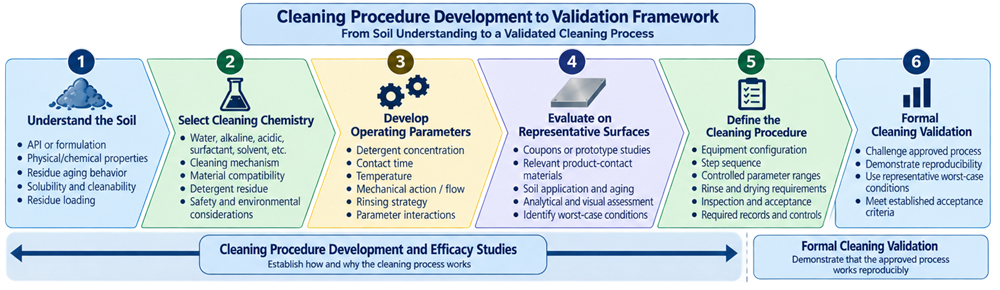
Cleaning validation should verify a cleaning process that has already been developed, characterized, and translated into a controlled operating procedure. Formal validation is not the appropriate stage for determining whether a detergent concentration is adequate, how long a surface should be exposed to cleaning solution, whether additional mechanical action is required, or which rinse sequence effectively removes both product and cleaning-agent residues. Those questions should be addressed during cleaning procedure development and efficacy studies.
Cleaning efficacy work establishes the scientific basis for the cleaning process. It evaluates the residue or soil, cleaning chemistry, concentration, temperature, contact time, mechanical action, flow, rinsing, equipment surfaces, residue aging, and other variables that determine whether the soil can be reproducibly removed. The output should be a defined cleaning procedure with justified operating conditions and sufficient process knowledge to support formal cleaning validation.
This development stage is part of the broader Cleaning Validation Program Strategy, Scope, and Lifecycle. It should also incorporate the representatives established through Worst-Case Product, Equipment, and Cleaning Condition Selection, because cleaning development should challenge the soils, surfaces, and conditions most likely to define the process boundary.
Regulatory and Scientific Basis
21 CFR 211.67 requires equipment and utensils to be cleaned and maintained at appropriate intervals to prevent contamination or malfunction that could affect drug-product quality. It also requires written procedures defining cleaning methods, schedules, responsibilities, protection of cleaned equipment, and inspection before use.
FDA’s Guide to Inspections: Validation of Cleaning Processes expects firms to have written procedures describing the cleaning process for each applicable equipment situation. FDA specifically recognizes that different cleaning processes may be required for different residues—for example, water-soluble versus non-water-soluble materials—and that residues from detergents and cleaning solvents must themselves be removed.
ICH Q7 similarly requires cleaning-validation protocols to identify the cleaning procedure, materials, acceptable cleaning levels, parameters to be monitored and controlled, analytical methods, and sampling approach. It also states that validation should reflect actual equipment-use patterns and that representative materials can be selected based on solubility, cleaning difficulty, potency, toxicity, stability, and residue limits.
ICH Q9(R1) supports applying quality risk management to equipment cleaning and specifically identifies risk-based determination of cleaning-validation limits as an application of QRM principles. Its broader principle is that risk evaluation should be based on scientific knowledge and that the degree of effort and documentation should be commensurate with risk.
Development and Validation Have Different Objectives
Cleaning procedure development asks: What cleaning process will reliably remove the identified soil from the relevant equipment surfaces?
Cleaning validation asks: Does the approved cleaning process reproducibly achieve the established acceptance criteria under representative challenge conditions?
The distinction is important. A cleaning-validation protocol should not become a sequence of experimental adjustments in which detergent concentration is increased after a failure, contact time is extended during execution, or additional rinses are introduced until samples pass. Once those changes occur, the procedure being executed is no longer the procedure originally represented by the protocol.
Development studies should therefore establish the cleaning mechanism and suitable operating region before formal validation begins. Validation can then challenge appropriate boundaries within that established region rather than discover the process experimentally.
Characterize the Soil Before Selecting the Cleaning Process
Cleaning development should begin with understanding what must be removed. The relevant soil may be an API, formulation, intermediate, coating material, protein, polymer, oil, excipient mixture, degradation product, cleaning-agent residue, or another process material.
The residue encountered on equipment can behave very differently from the pure API. A product may contain binders, oils, polymers, proteins, salts, surfactants, suspending agents, colorants, or other excipients that materially affect adhesion and cleaning behavior. Heat, drying, reaction, granulation, coating, concentration, or repeated processing can further alter the residue before cleaning begins.
Relevant soil characteristics can include:
- solubility in water and candidate cleaning solutions;
- hydrophobicity and wettability;
- viscosity and tackiness;
- tendency to form films or deposits;
- crystallization;
- adsorption to product-contact materials;
- polymerization or hardening;
- sensitivity to temperature or pH;
- chemical degradation;
- residue loading;
- aging and drying behavior.
The development program should therefore characterize the actual manufacturing residue wherever practical rather than assume that published API solubility adequately describes cleanability.
Solubility Is Only One Part of Cleanability
Low water solubility is commonly used as an indicator of cleaning difficulty, but it should not be treated as the sole basis for cleaning-process development. Cleaning may use alkaline detergents, acids, surfactants, solvents, elevated temperature, mechanical action, or combinations of these mechanisms.
A poorly water-soluble residue may be readily removed by the selected detergent chemistry. Conversely, a nominally soluble product may become difficult to remove after drying, crystallization, heating, or formation of an excipient-rich film.
Development studies should therefore evaluate solubility and removal under conditions representative of the intended cleaning process. The important question is not merely whether the residue dissolves in purified water, but whether the defined cleaning mechanism can reproducibly detach, dissolve, disperse, or otherwise remove the actual soil from the equipment surface.
Cleaning Chemistry
Cleaning chemistry should be selected according to the soil and equipment materials rather than by historical preference alone. Water may be sufficient for readily soluble residues, while other soils may require alkaline detergent, acidic cleaner, surfactant systems, solvent-based cleaning, enzymatic systems, or another scientifically justified approach.
The cleaning mechanism should be understood sufficiently to explain why the chemistry works. Alkaline systems may assist with dissolution, hydrolysis, emulsification, or saponification of certain soils. Acidic cleaners may be useful for mineral or inorganic deposits. Surfactants can improve wetting and dispersion. Organic solvents may be required for materials with poor aqueous compatibility, subject to safety, compatibility, and residue-control requirements.
Cleaning-agent selection should also consider compatibility with stainless steel, elastomers, polymers, coatings, seals, hoses, instruments, and other product-contact materials. A chemistry that removes the residue effectively but damages equipment surfaces or creates difficult-to-remove detergent residues is not an adequate process.
The amount and identity of cleaning-agent residue requiring removal should be incorporated into the overall cleaning-validation strategy.
Detergent Concentration
Detergent concentration can materially affect cleaning performance. Too little active cleaning chemistry may provide inadequate wetting, dissolution, emulsification, or soil removal. Excessive concentration may not improve cleaning and can increase rinse requirements, foam, residue burden, material-compatibility concerns, or operating cost.
Development studies should establish an effective concentration or operating range supported by cleaning data and by the manufacturer’s technical information where relevant. The selected routine range should be achievable and controllable in actual manufacturing equipment.
For manually prepared solutions, the procedure should define how concentration is measured or prepared and what variation is acceptable. For automated CIP systems, concentration may be controlled by conductivity, dosing volume, concentration measurement, or another validated process parameter.
Worst-case validation should normally challenge the less favorable condition within the approved operating range rather than use a concentration more favorable than routine operation. The scientifically adverse boundary depends on the cleaning chemistry and should be established during development.
Time
Contact time determines how long the cleaning chemistry and mechanical action are available to interact with the soil. Insufficient exposure can leave residues partially dissolved or attached, while excessive exposure may provide little additional benefit and can increase cycle duration or equipment exposure to aggressive chemistry.
Development studies should establish the relationship between contact time and cleaning effectiveness. For manual cleaning, this may involve soak time, scrubbing duration, number of passes, or total contact time. For COP systems it may include soak or washer-cycle duration. For CIP it may include pre-rinse, detergent circulation, intermediate rinse, final rinse, and other defined cycle phases.
The approved procedure should clearly identify which time parameter is critical. A nominal “30-minute cleaning cycle” provides little control if the actual critical exposure consists of only ten minutes of detergent recirculation.
Temperature
Temperature can influence solubility, reaction rate, viscosity, surface tension, detergent performance, and soil removal. Increased temperature can improve removal of many residues, but it should not automatically be assumed that hotter is always better.
Some soils can bake, denature, polymerize, or otherwise become more difficult to remove when exposed to excessive temperature. Proteins are an obvious example, but other formulations and intermediates may also undergo temperature-dependent changes.
Development should establish the temperature range that supports cleaning efficacy while remaining compatible with the soil, chemistry, equipment, and operator-safety requirements. Automated systems should demonstrate that the critical equipment path reaches and maintains the required temperature where temperature contributes materially to cleaning effectiveness.
Mechanical Action and Flow
Cleaning chemistry alone may not provide sufficient removal. Mechanical action helps detach residue, renew solution at the surface, disrupt boundary layers, and transport removed soil away from the equipment.
For manual cleaning, mechanical action may include scrubbing force, stroke pattern, brush or wipe type, number of passes, orientation, and accessibility. Because these parameters are difficult to measure precisely, the procedure should define the technique sufficiently to reduce operator-to-operator variability.
For COP, mechanical action may be provided by spray, agitation, recirculation, ultrasonics, component movement, or washer hydraulics.
For CIP, flow and spray-device performance can determine whether cleaning solution contacts the surface with adequate energy and coverage. Flow velocity, pressure, turbulence, spray pattern, return conditions, valve configuration, and equipment geometry may influence the actual mechanical challenge.
A flow value measured at the CIP skid does not necessarily demonstrate adequate conditions at every branch or internal surface. Cleaning development should identify the variables that materially affect the equipment being cleaned.
The Interaction of Time, Temperature, Chemistry, and Mechanical Action
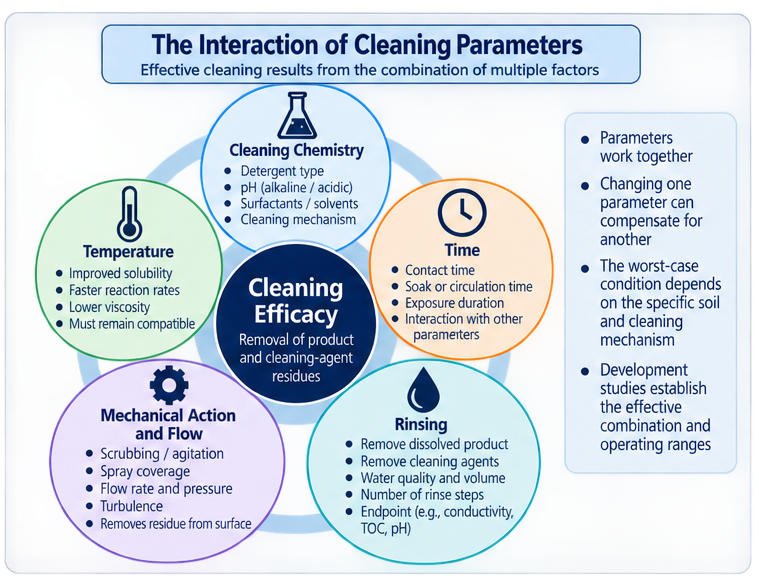
Cleaning parameters should not be developed independently because they interact. Reduced temperature may be compensated by longer contact time or stronger chemistry. Reduced chemical concentration may require greater mechanical action. Difficult residues may require both increased exposure and enhanced physical removal.
This relationship is often represented conceptually as the interaction among: Time + Temperature + Chemistry + Mechanical Action
The purpose of development is not necessarily to maximize all four factors. It is to establish a combination that provides reliable cleaning within practical and equipment-compatible operating conditions.
The development program should identify which parameters are critical and which are merely supportive. This distinction later helps define what must be monitored or controlled during validation and routine operation.
Pre-Rinse and Initial Soil Removal
A pre-rinse can remove gross residue, dilute soluble components, reduce soil loading, and prepare surfaces for the detergent step. Its effectiveness depends on water quality, temperature, volume, flow, duration, and the residue being removed.
Pre-rinse conditions should be intentionally defined. An uncontrolled preliminary rinse performed immediately after processing can substantially reduce the challenge presented to the formal cleaning procedure and can therefore become part of the validated process whether or not it was originally recognized as such.
Where routine equipment is allowed to remain dirty before cleaning, development studies should represent the actual dirty-hold condition rather than apply an immediate rinse that prevents residue drying. The relationship between residue aging and cleaning is addressed in Dirty Hold Time and Clean Hold Time Studies.
Rinsing and Removal of Cleaning Agents
The cleaning process is not complete when product residue has been detached. Detergent, solvent, dissolved product, degraded residue, and other cleaning-process materials must also be removed to the required level.
Rinse development should establish adequate water or solvent quality, volume, flow, duration, number of rinse steps, and endpoint criteria where applicable. Conductivity, TOC, pH, chemical-specific testing, visual condition, or other parameters may be useful depending on the cleaning agent and process.
A final rinse should not be extended indefinitely until an analytical sample passes. The rinse process should be defined during development and then executed consistently during validation and routine manufacturing.
FDA explicitly notes that residues from the cleaning process itself—including detergents and solvents—must be removed from equipment.
Manual Cleaning Development
Manual cleaning introduces operator-dependent variability that should be addressed during development rather than left entirely to training.
Development should establish the sequence of cleaning steps, equipment disassembly, cleaning tools, chemical preparation, contact time, brushing or wiping technique, areas requiring special attention, rinsing, inspection, and reassembly.
Instructions such as “scrub thoroughly” or “clean until acceptable” provide weak control because different operators can interpret them differently. Where practical, the process should specify observable actions such as brush type, number or direction of passes, minimum contact time, areas requiring focused cleaning, rinse quantity, or another reproducible instruction.
Development studies should include difficult-to-access areas and representative operators where operator technique materially affects efficacy. Formal validation can then evaluate reproducibility of the approved manual procedure.
COP Process Development
Clean-out-of-place cleaning requires consideration of both the cleaning chemistry and the configuration of the components being cleaned.
Development should determine how components are disassembled, identified, loaded into the washer or soak vessel, oriented, separated, exposed to spray or solution, rinsed, dried, protected, and reassembled.
Load pattern can be critical. Components that overlap, shadow one another, trap air, retain water, or block spray exposure may not receive equivalent cleaning.
The approved COP procedure should define acceptable load configurations and prohibit arrangements not supported by the development or qualification data.
CIP Process Development
CIP development should address the complete cleaning circuit rather than only the CIP skid. The manufacturing vessel, spray devices, transfer piping, pumps, valves, instrumentation, return path, drains, and automation operate as one integrated cleaning system.
Development should identify the appropriate route, recipe, chemical concentration, temperature, circulation time, flow, pressure, valve sequence, spray conditions, rinsing, drainage, and endpoint criteria. Where multiple circuits or equipment configurations are permitted, their hydraulic and cleaning differences should be understood.
Pharmaceutical Tank Cleaning and CIP Integration addresses the equipment-design and qualification aspects of these systems. Cleaning efficacy studies complement that qualification by demonstrating that the established process conditions actually remove representative product soils.
Representative Surfaces and Coupon Studies
Laboratory coupon studies can provide efficient early information about cleaning chemistry, residue behavior, contact time, temperature, and material interactions before full-scale equipment studies are performed.
Coupons should use representative product-contact materials and, where relevant, representative surface finish. Stainless steel is common, but elastomers, polymers, coated surfaces, hoses, glass, or other materials may require separate consideration when residue interaction differs materially.
A known quantity of representative soil can be applied, aged under defined conditions, and exposed to candidate cleaning conditions. Residual material can then be assessed visually, gravimetrically, analytically, or by another justified method.
Coupon studies are development tools. They do not automatically substitute for validation of the actual equipment because they cannot fully reproduce spray coverage, geometry, flow, valves, gaskets, dead spaces, drainage, manual access, or other full-scale conditions.
Apply Representative Residues Realistically
The way a residue is applied during development can strongly influence the apparent cleaning challenge. A thin solution spread uniformly across a polished coupon may be significantly easier to remove than the concentrated or dried residue generated during manufacturing.
Where practical, soil preparation should represent the actual manufacturing residue, concentration, process history, drying condition, and application thickness. If a surrogate or prepared challenge is used, the rationale should explain why it is representative or more difficult than the routine soil.
Artificially extreme soil loading can also produce misleading development conclusions. The objective is to challenge a credible manufacturing condition, not to create a residue state that cannot occur during normal operation.
Residue Aging During Development
Cleaning efficacy should be evaluated at a residue age relevant to routine manufacturing. An apparently effective procedure tested immediately after soil application may fail after the same residue has dried for several hours.
Development studies can compare multiple dirty-hold intervals to characterize how cleaning performance changes as the residue ages. This can help determine whether the cleaning process requires an immediate pre-rinse, whether the chemistry should be adjusted, or what maximum dirty hold should later be validated.
The formal hold-time program is addressed in Dirty Hold Time and Clean Hold Time Studies, but efficacy development should generate the underlying understanding of how residue aging affects cleanability.
Worst-Case Development Conditions
Development studies should identify the least favorable conditions within the intended cleaning-process range. Potential challenges include:
- lowest effective detergent concentration;
- shortest contact time;
- least favorable temperature;
- minimum mechanical action;
- minimum CIP flow or spray performance;
- maximum residue loading;
- longest dirty hold;
- maximum campaign condition;
- difficult product-contact material;
- difficult equipment geometry.
The adverse direction should be scientifically determined. Lower temperature is not universally the worst condition, and maximum concentration is not necessarily advantageous if it creates excessive foaming or difficult rinsing.
FDA’s medical-device reprocessing guidance illustrates the broader development principle by recommending challenge of shortest times, lowest temperatures, weakest dilutions, and other adverse processing limits, while also acknowledging that the correct worst case depends on the cleaning mechanism. Although that guidance applies to medical-device reprocessing rather than pharmaceutical manufacturing, the engineering principle is useful: validation should challenge the least favorable condition permitted by the procedure rather than a nominal or unusually favorable setting.
Development Acceptance Criteria
Efficacy-study acceptance criteria should be appropriate to the stage of development. The purpose is to discriminate between candidate cleaning conditions and establish a process capable of meeting the eventual cleaning requirement.
Depending on the study, acceptance can include visual cleanliness, quantitative residue removal, percent removal, absence of visible films, rinse endpoint, detergent removal, TOC, conductivity, or another measurable endpoint.
Where formal cleaning acceptance limits are already established, development should demonstrate adequate performance relative to those limits. Cleaning Validation Acceptance Criteria and Surface, Swab, and Rinse Limits should define the criteria ultimately used during validation.
Development criteria should not be manipulated after testing merely to make an ineffective cleaning condition appear acceptable.
Sampling and Analytical Support During Development
Analytical methods used during development should be sufficiently capable to differentiate cleaning conditions and support the conclusions drawn from the study.
Early development may use screening methods that are not yet fully validated, provided their limitations are understood and the data are not represented as final GMP validation evidence. As the process approaches formal validation, the sampling and analytical methods should transition to the qualified procedures intended for validation use.
Analytical Method Selection for Cleaning Validation, Analytical Sensitivity and Quantitation Limits in Cleaning Validation, and Analytical Method Validation for Cleaning Residue Testing provide the analytical framework.
Where surface sampling is used, Swab and Rinse Recovery Studies for Cleaning Validation should establish the recovery characteristics needed to interpret final validation data.
Scaling from Coupons to Equipment
Conditions successful on a laboratory coupon should be translated carefully to manufacturing equipment. Full-scale systems introduce variables that coupons cannot reproduce.
These include:
- actual surface area;
- vessel geometry;
- spray shadows;
- piping length;
- valve internals;
- gaskets and seals;
- drainage;
- flow distribution;
- temperature loss;
- manual accessibility;
- equipment orientation;
- residue accumulation.
Scale-up should therefore confirm that the selected chemistry and operating conditions remain effective when applied to the actual equipment or a sufficiently representative system.
An effective development program often progresses from laboratory screening to representative equipment trials and then to formal validation.
Translate Development Knowledge into an Executable Procedure
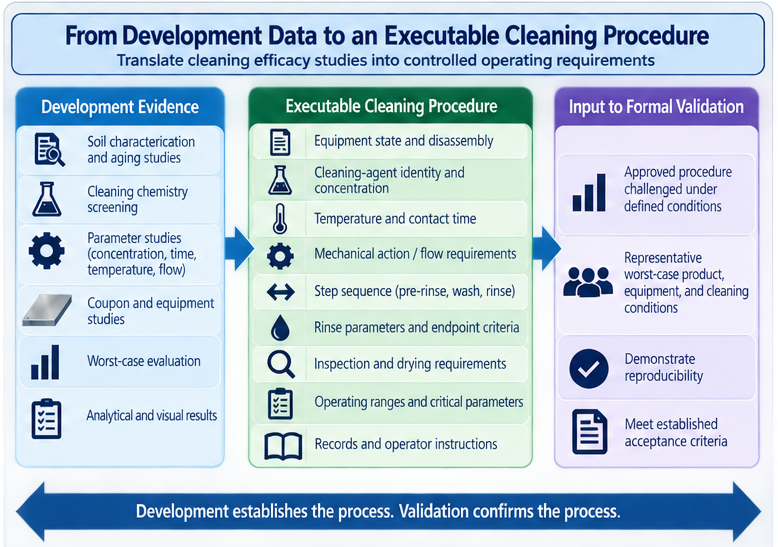
The principal output of cleaning efficacy work is not merely a development report. It is an executable cleaning procedure.
The procedure should define the elements necessary to reproduce the successful cleaning process, including:
- equipment state before cleaning;
- allowable dirty hold;
- disassembly or configuration;
- pre-rinse conditions;
- cleaning-agent identity;
- detergent or chemical concentration;
- solution preparation;
- temperature;
- contact or circulation time;
- mechanical action or flow;
- sequence of steps;
- rinse conditions;
- endpoint criteria;
- drying;
- inspection;
- post-clean protection;
- required records.
The degree of numerical control should reflect the process. Automated CIP parameters can often be defined precisely. Manual actions may require procedural descriptions, time limits, tools, sequence, and observable requirements rather than an unrealistic attempt to quantify every operator movement.
Define Critical and Supporting Cleaning Parameters
Not every cleaning parameter has equal influence on residue removal. Development should distinguish parameters that materially affect cleaning efficacy from those that primarily support execution or documentation.
A CIP detergent concentration or circulation time may be a critical cleaning parameter because deviation can directly reduce residue removal. A recipe step number may be important for procedural control but may not itself influence cleaning effectiveness.
This distinction helps determine which variables require tighter procedural limits, monitoring, alarms, calibration, data review, or challenge during validation.
The conclusions should be based on cleaning-process understanding rather than on terminology alone.
Readiness for Formal Cleaning Validation
Formal validation should begin only when the cleaning process is sufficiently defined to execute reproducibly. Readiness typically means that:
- representative soils are understood;
- cleaning chemistry has been selected;
- critical parameters and operating ranges are defined;
- equipment configuration is established;
- dirty hold is addressed;
- rinse strategy is defined;
- worst-case representatives are selected;
- sampling locations are justified;
- recovery is understood;
- analytical methods have adequate capability;
- acceptance criteria are established;
- the cleaning procedure is approved.
At this stage the validation protocol can challenge the established cleaning process rather than continue developing it.
ICH Q7 expects cleaning-validation protocols to define the procedure, materials, acceptable cleaning levels, parameters to be monitored and controlled, analytical methods, and sampling approach before execution.
Development Deviations and Unsuccessful Conditions
Failure during development is useful information when it identifies the boundaries of cleaning capability. A candidate condition that leaves residue, fails the rinse endpoint, or produces unacceptable variability should be documented and used to refine the process.
Development failures should not be handled as though they were formal cleaning-validation failures if the study is explicitly developmental and the procedure has not yet been approved as the validated process.
The distinction should be clear in study documentation. Once formal validation begins, changes in the procedure should be subject to protocol deviation assessment and may require repeating validation work under the finalized conditions.
Documentation of Cleaning Efficacy Studies
Development documentation should preserve enough information to explain how the final cleaning procedure was established.
The record should identify the soil, equipment or coupon material, cleaning chemistry, concentration, temperature, contact time, mechanical action, rinse conditions, hold time, study method, analytical or visual observations, unsuccessful conditions, selected operating ranges, and conclusions.
Where multiple studies contribute to the final process, the development summary should integrate the evidence rather than leaving the validation team to reconstruct the design from disconnected laboratory reports.
The final rationale should explain why the selected process and parameter ranges are expected to remove the applicable worst-case residue from the defined equipment.
Change Control and Further Development
Cleaning development knowledge should continue to support the lifecycle after initial validation. Changes that alter the soil, cleaning mechanism, equipment, chemistry, or operating range may require additional efficacy work before validation impact can be determined.
Relevant changes include:
- new products or formulations;
- new worst-case residue;
- new detergent;
- detergent concentration change;
- different equipment materials;
- equipment geometry modification;
- revised CIP route;
- longer dirty hold;
- increased campaign length;
- modified temperature or contact time;
- changed manual cleaning technique;
- new rinse endpoint.
Development studies can determine whether the revised process remains within established knowledge or whether targeted or broader revalidation is required.
Relationship to Cleaning Validation
Cleaning efficacy studies provide the process knowledge on which cleaning validation depends. They are not a substitute for validation, but they reduce the uncertainty entering formal validation.
Development establishes how and why the cleaning process works. Validation demonstrates that the approved process works reproducibly under the defined manufacturing and worst-case conditions.
Keeping those objectives separate prevents validation protocols from becoming uncontrolled development exercises and produces a stronger technical basis for defining operating parameters, deviations, change control, and future revalidation.
Common Deficiencies
A common weakness is moving directly from an informal cleaning SOP to formal cleaning validation without documented evidence that the cleaning chemistry and operating conditions were developed for the actual residue.
Other deficiencies include basing chemistry solely on API water solubility, ignoring formulation effects, testing fresh residue when routine equipment can remain dirty for many hours, using only polished stainless-steel coupons when other product-contact materials are present, and extrapolating laboratory results directly to complex manufacturing equipment.
Process-development weaknesses include failing to define detergent concentration, using vague manual instructions, allowing unrestricted rinse duration, failing to determine the effect of temperature or contact time, and relying on nominal CIP flow without understanding coverage of the actual equipment path.
Another common problem is changing the cleaning process during formal validation after a failed run. When development has been insufficient, validation becomes iterative experimentation rather than confirmation of an established procedure.
Key Principles
Cleaning efficacy studies should primarily serve as cleaning-process development and characterization performed before formal cleaning validation.
The development program should understand the actual manufacturing soil, formulation, residue aging, equipment surfaces, cleaning chemistry, concentration, time, temperature, mechanical action or flow, rinsing, and interactions among these variables.
Coupon studies and representative-surface experiments can efficiently screen cleaning conditions but should be followed by appropriate translation to full-scale equipment because laboratory models do not reproduce equipment geometry, spray coverage, valves, drainage, or manual accessibility.
Worst-case development should challenge scientifically adverse operating conditions within the intended process range rather than artificially favorable settings or conditions outside the approved process.
The final output should be an executable cleaning procedure with defined operating conditions and boundaries. Formal cleaning validation should then demonstrate that this established procedure reproducibly achieves the applicable acceptance criteria under representative worst-case manufacturing conditions.