

Packaging System Types and Sterile Barrier Systems
A regulated product is rarely protected by a single package. Pharmaceutical, biotechnology, and medical-device packaging normally consists of interacting components that perform different functions: direct product containment, environmental protection, physical protection, identification, sterile-barrier maintenance, handling, and distribution protection. Understanding these functions is necessary before packaging requirements, qualification boundaries, worst-case configurations, and test strategies can be established.
The common classifications of primary, secondary, and tertiary packaging (protective and consolidating packaging) describe how packaging components relate to the product and to each other. For terminally sterilized medical devices, however, the additional concept of the sterile barrier system (SBS) is more important than package layer alone. A sterile barrier system is defined by its function—maintaining the microbial barrier and enabling aseptic presentation—not simply by whether it appears to be the first or second physical layer around the device.
For pharmaceutical products, 21 CFR §211.94 requires drug-product containers and closures to be suitable for their intended use, nonreactive, nonadditive, and nonabsorptive to an extent that could adversely affect product quality, and capable of protecting the product from foreseeable external factors during storage and use. FDA’s container-closure guidance similarly treats the packaging system as the combination of components that together contain and protect the dosage form.
For terminally sterilized medical devices, ISO 11607-1 establishes requirements for packaging materials, sterile barrier systems, and packaging systems intended to maintain sterility until the point of use. The standard distinguishes the sterile barrier system from protective packaging and treats them together as the overall packaging system.
Key Principles
- Primary, secondary, and tertiary packaging describe different relationships to the product and different protection functions; they should not be treated merely as progressively larger boxes.
- A packaging component can be critical even when it does not directly contact the product.
- Functional secondary packaging may provide moisture, light, oxygen, physical, sterility, or handling protection and therefore can require controls comparable to primary components.
- Tertiary packaging is primarily associated with storage, handling, palletization, and distribution, but its failure can still affect product quality.
- A sterile barrier system is a functional medical-device packaging concept and should not automatically be equated with primary packaging.
- Protective packaging surrounding a sterile barrier system is part of the medical-device packaging system when it is necessary to protect the SBS through storage and distribution.
- Packaging qualification boundaries should include every component whose failure can affect product quality, sterility, device performance, identification, or successful distribution.
- Classification should support risk assessment and qualification strategy rather than becoming an administrative labeling exercise.
Packaging System Versus Individual Packaging Components
A packaging component is an individual element such as a vial, stopper, bottle, cap, blister, lidding material, pouch, tray, carton, overwrap, label, cushioning insert, or shipping case. A packaging system is the combination of components that collectively performs the required containment and protection functions.
This distinction matters because qualification should normally evaluate the system in its assembled configuration. A vial cannot be evaluated independently of the stopper and seal when those components collectively establish container-closure integrity. A sterile medical-device tray cannot be evaluated independently of its lid when the tray-lid interface establishes the sterile barrier. Similarly, a shipping carton may depend on dividers, cushioning, orientation, and pallet configuration for its protective function.
The article Packaging System Requirements, Design, and Risk Assessment addresses how these functional requirements are established. The purpose here is to define the packaging levels and clarify which functions belong to each.
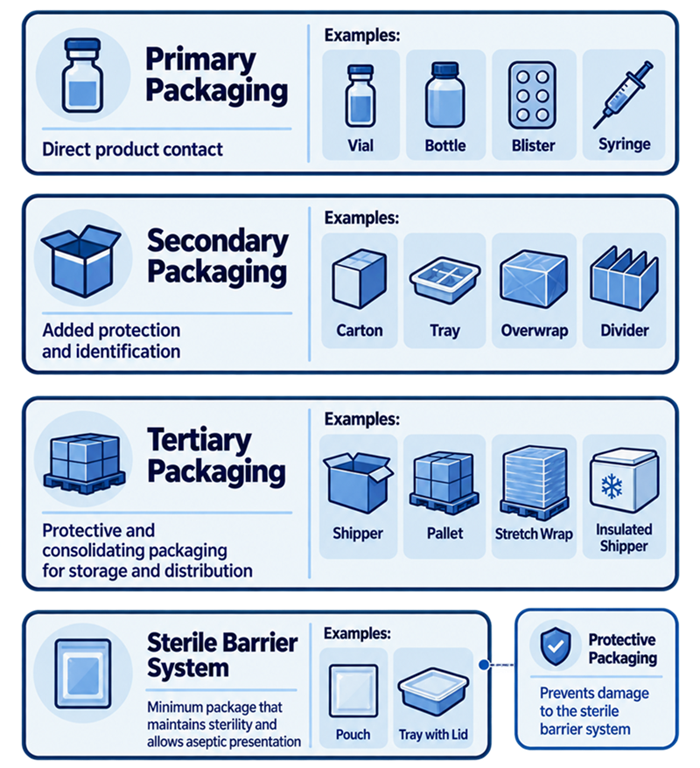
Primary Packaging
Primary packaging is the packaging component or combination of components that directly contacts, or can directly contact, the product. Because it interfaces directly with the drug, biologic, or device, it usually has the strongest connection to product compatibility, containment, cleanliness, and stability.
Common pharmaceutical examples include:
- glass or polymer vials and their stopper systems;
- ampoules;
- bottles and closures;
- prefilled syringes and associated closure components;
- cartridges;
- IV bags;
- blister cavities and lidding materials;
- sachets and pouches containing the dosage form;
- tubes for creams, gels, and ointments.
The critical functions vary by dosage form. An injectable container-closure system may need to maintain sterility and prevent leakage or contaminant ingress. A bottle for a moisture-sensitive solid dosage form may depend primarily on moisture-barrier properties and closure performance. A multidose liquid package may additionally depend on repeated opening, reclosing, dispensing, and microbial-protection characteristics.
Primary packaging materials can interact with the product through leaching, adsorption, absorption, permeation, moisture transfer, gas transmission, or other mechanisms. Accordingly, FDA requires drug containers and closures not to be reactive, additive, or absorptive in a manner that alters required drug quality attributes.
Direct product contact does not mean that every primary component has identical risk. The required level of characterization should reflect the dosage form, route of administration, formulation characteristics, contact duration, materials of construction, processing conditions, and consequences of package failure.
Container-Closure Systems
For pharmaceuticals and biologics, the term container-closure system is generally more useful than considering the container alone. A container-closure system includes the components that collectively contain and protect the dosage form.
Examples include:
| Product | Typical container-closure system |
|---|---|
| Lyophilized injectable | Glass vial + elastomeric stopper + aluminum seal |
| Liquid injectable | Vial + stopper + seal |
| Prefilled syringe | Barrel + plunger stopper + tip cap or needle shield |
| Oral tablet | Bottle + closure + liner or induction seal, as applicable |
| Blistered tablet | Forming web/cavity + lidding material |
| Ophthalmic solution | Bottle + dispensing tip + closure |
| IV product | Flexible container + ports + closures |
The functional boundary should include components necessary to maintain the claimed protection and performance. A metal overseal on a vial, for example, may not itself establish the sterile barrier, but it can influence stopper retention and protection of the closure system. The engineering question is therefore not simply whether a component touches the product, but whether its condition can influence system performance.
FDA explicitly requires container-closure systems to protect drug products against foreseeable external factors that could cause deterioration or contamination during storage and use.
Secondary Packaging
Secondary packaging surrounds or interfaces with the primary packaging and may serve one or several functions. Depending on the product, it can provide additional environmental protection, physical protection, tamper evidence, identification, organization, presentation, or support for handling and administration.
Examples include:
- folding cartons around bottles, blister cards, syringes, or vials;
- overpouches around IV bags;
- light-protective cartons;
- protective sleeves;
- trays holding primary containers;
- dividers or partitions separating fragile containers;
- cartons carrying instructions for use;
- protective caps or covers not directly contacting the product;
- secondary overwraps providing moisture or oxygen protection.
A major distinction should be made between functional and nonfunctional secondary packaging.
A functional secondary package contributes to product protection or performance. Examples include an opaque carton required to protect a light-sensitive product, an overpouch providing moisture protection, or a rigid tray that prevents damage to a delicate delivery system. Failure of such packaging can directly affect product quality or usability and should therefore be included in risk assessment and qualification.
A nonfunctional secondary carton may primarily provide labeling, branding, or unit presentation. Its physical integrity may still be important, particularly for identification and distribution, but the consequences of failure generally differ from those of a package providing a critical barrier function.
This functional distinction is more useful for validation than simply assigning the package the label “secondary.”
Tertiary Packaging
Tertiary packaging groups packaged units for storage, material handling, and distribution. Examples include:
- corrugated shipping cases;
- reusable distribution totes;
- insulated shipping containers;
- pallet configurations;
- case dividers and protective inserts;
- corner protection;
- stretch wrap and load containment;
- pallet covers;
- refrigerated or temperature-controlled shipping systems.
Tertiary packaging generally does not contact the product directly, but it can be essential to maintaining the condition of the complete packaged product during transportation. Its design must account for vibration, impact, compression, stacking, load shifting, environmental exposure, transportation mode, and handling practices.
For example, a validated vial container-closure system can still fail commercially if tertiary packaging permits vial-to-vial impact during transportation. A sterile device pouch can be punctured if the shipping configuration permits uncontrolled movement. A temperature-sensitive biologic can exceed its allowable temperature range if the thermal shipping container or pack-out is inadequate.
Tertiary packaging therefore becomes a principal subject of Distribution Simulation Strategy and Transport Testing and Shipping Validation Strategy and Distribution Risk Assessment.
Primary, Secondary, and Tertiary Are Functional Relationships
The three-level terminology can create a false impression that every packaging system contains exactly three nested layers. Actual systems are more complex.
A blister cavity is clearly primary packaging because it directly contains the dosage form. The carton surrounding the blister is secondary. A corrugated shipper containing multiple cartons is tertiary. This is straightforward.
Other configurations are less obvious. A vial may be placed in a tray, then in a carton, then in an intermediate shipper, then inside an insulated temperature-controlled shipping system. Several protective levels may exist between the primary package and final transportation container. Assigning each one a numerical level is less important than documenting its function.
The same principle applies to specialized distribution equipment. Pallets, stretch wrap, refrigerated containers, active shipping systems, and reusable transport totes may influence distribution performance even though they do not fit neatly into a three-layer packaging diagram.
For validation purposes, packaging should therefore be classified by both position and function.
Sterile Barrier Systems for Medical Devices
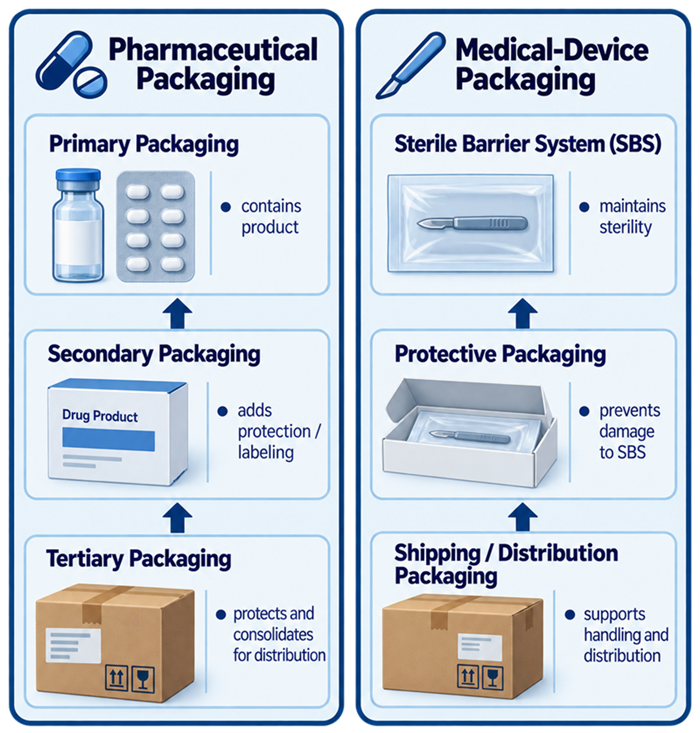
For terminally sterilized medical devices, ISO 11607-1 uses a different functional framework. It defines the sterile barrier system (SBS) as the minimum package required to minimize microbial ingress and permit aseptic presentation of the sterile contents at the point of use. The standard separately defines protective packaging as material configured to prevent damage to the sterile barrier system and its contents. Together, the SBS and protective packaging form the medical-device packaging system.
This distinction is critical.
A sterile barrier system is not simply “primary packaging for a medical device.” The classifications answer different questions:
- Primary/secondary/tertiary describe relationships among package layers and the product.
- Sterile barrier system/protective packaging describe specific functional responsibilities associated with maintaining sterility and protecting the sterile barrier.
Examples of sterile barrier systems include:
- sealed porous pouches;
- form-fill-seal pouches;
- rigid or semi-rigid trays sealed with porous lids;
- header bags;
- sterilization wraps;
- appropriately configured reusable sterilization containers.
ISO 11607-1 specifically identifies the functions of terminally sterilized medical-device packaging as allowing sterilization, providing physical protection, maintaining sterility until use, and permitting aseptic presentation.
Preformed Sterile Barrier Systems
ISO 11607 terminology also includes the preformed sterile barrier system. This is an SBS supplied partially assembled and requiring final closure or sealing after the device is placed inside. Examples include commercially supplied pouches, bags, and open reusable containers.
This distinction becomes important when defining manufacturing responsibility. A packaging supplier may manufacture the pouch or tray-lid materials, while the medical-device manufacturer places the product inside, performs the final sealing operation, sterilizes the packaged device, and validates the packaging process.
Supplier certification of the preformed system therefore does not eliminate the device manufacturer’s need to establish suitability of the final package configuration and validate the actual forming, sealing, or assembly process. This subject is addressed separately in Packaging Process Validation: Forming, Sealing, and Assembly.
Protective Packaging for Sterile Medical Devices
Protective packaging serves to prevent physical damage to the sterile barrier system and its contents between assembly and use. It may include cartons, trays, protective inserts, cushioning, corner protection, or other components.
The need for protective packaging depends on the device and SBS design. A robust pouch containing a smooth, lightweight device may require limited additional protection. A heavy implant, sharp instrument, articulated device, or component capable of moving inside a package can impose much greater mechanical stress on the sterile barrier.
Protective packaging should therefore be designed around credible damage mechanisms such as:
- puncture;
- abrasion;
- flex cracking;
- seal stress;
- crushing;
- impact;
- concentrated loading;
- migration or movement of the device;
- deformation during stacking;
- vibration during distribution.
These hazards are eventually challenged through packaging qualification and distribution simulation, but their control begins with correct classification of the packaging components responsible for protection.
Double Sterile Barrier Systems
Some sterile medical devices use two sterile barrier systems, commonly referred to as double sterile barrier or informally as double packaging. This configuration is frequently used when the product must pass through progressively cleaner environments or when an outer barrier is removed before the inner sterile package enters a controlled or sterile field.
A double sterile barrier should not be assumed necessary simply because a product is sterile. Its use should be justified by intended use, aseptic presentation, handling sequence, contamination-control needs, device characteristics, and clinical workflow.
Where two sterile barriers are used, both should be considered in package design and qualification. The outer barrier may protect the inner barrier and facilitate transfer, while the inner barrier maintains sterility until final presentation. The opening sequence and usability of the combined system can therefore become part of the package design basis.
Pharmaceutical Sterile Packaging Is Not Automatically an ISO 11607 Sterile Barrier System
The term sterile barrier system should be used carefully on a validation website covering both pharmaceuticals and medical devices.
A sterile injectable vial has a container-closure system that must maintain product sterility, but pharmaceutical terminology normally describes this as container-closure integrity, not as an ISO 11607 sterile barrier system. FDA states that container-closure systems for sterile drug products must maintain adequate integrity and that validation should demonstrate protection against microbial and other contaminant ingress.
ISO 11607-1, by contrast, is specifically written for packaging of terminally sterilized medical devices. It also notes that additional requirements can be necessary for drug-device combinations and that its scope does not address all packaging requirements for aseptically manufactured devices.
Keeping the terminology distinct avoids incorrectly applying medical-device packaging concepts to pharmaceutical container-closure systems.
Combination Products and Prefilled Delivery Systems
Combination products can blur traditional packaging boundaries. A prefilled syringe, autoinjector, inhaler, or drug-delivery system can simultaneously contain the drug, protect it, deliver it, and function as a medical-device constituent part.
In such systems, the barrel, stopper, needle shield, cap, housing, protective tray, carton, and shipping configuration can have overlapping packaging and device functions. Classification should therefore be based on the role each component performs and the consequence of failure rather than attempting to force the complete configuration into a simple packaging hierarchy.
For a prefilled syringe, for example:
- the barrel and product-contact closure components form the pharmaceutical container-closure system;
- the needle shield or tip closure can contribute to closure integrity and device functionality;
- a tray can protect the syringe from mechanical damage;
- a carton may provide labeling and light protection;
- a shipping case and pallet configuration protect multiple commercial units during distribution.
The resulting validation strategy may draw from pharmaceutical container-closure requirements, medical-device design requirements, packaging qualification, device-function testing, and distribution qualification.
Packaging Functions Across the System
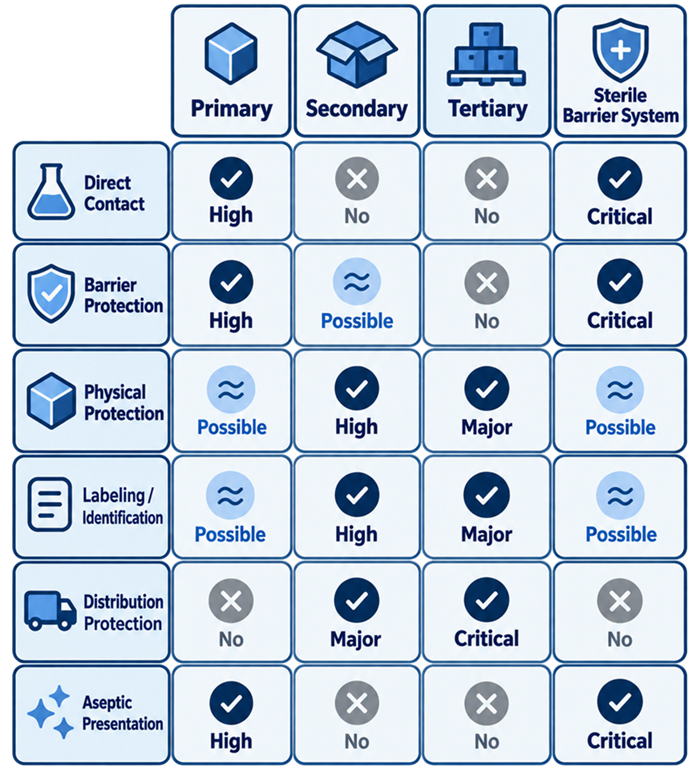
Each packaging layer should have clearly defined functions. A practical packaging-system assessment can use the following matrix.
| Function | Primary | Secondary | Tertiary | Sterile Barrier System |
|---|---|---|---|---|
| Direct product containment | Usually | No | No | Device-dependent |
| Product compatibility | Critical | Sometimes | Rarely | Material/device dependent |
| Moisture or gas barrier | Often | Sometimes | Sometimes | As required |
| Microbial barrier | Sterile drug CCS | Rarely | No | Critical |
| Physical protection | Yes | Often | Critical | Yes |
| Light protection | Sometimes | Often | Sometimes | As required |
| Labeling / identification | Yes | Often | Often | Often |
| Aseptic presentation | Not generally | No | No | Critical |
| Distribution protection | Some | Significant | Critical | Must survive distribution |
| Temperature control | Rarely | Sometimes | Often | Normally external |
The table is not intended as a regulatory classification. It demonstrates why packaging qualification cannot be based on package level alone. A secondary or tertiary component can become critical when it performs a function necessary to maintain product quality.
Defining Critical Packaging Components
Not every package component requires the same degree of qualification or control. The risk assessment should identify which components are critical to packaging-system performance.
A component can be critical when its characteristics affect:
- containment;
- product compatibility;
- sterility;
- microbial barrier performance;
- seal or closure integrity;
- moisture, oxygen, or light protection;
- mechanical protection;
- device functionality;
- aseptic presentation;
- product identification;
- storage conditions;
- distribution performance.
Criticality should lead to measurable specifications and appropriate supplier, incoming-control, process-control, and qualification requirements.
For example, the flute configuration and compression strength of a corrugated shipping case may be critical for a heavy palletized product, while the same characteristic may have little product-quality significance for another configuration. Similarly, an overpouch can be merely protective in one system but become critical to moisture control in another.
Packaging Configuration Documentation
The complete packaging configuration should be documented clearly enough that qualification and commercial production use the same system.
Documentation should identify, as applicable:
- component names and part numbers;
- materials of construction;
- drawings and dimensions;
- closure or seal interfaces;
- component suppliers;
- quantities and orientation;
- trays, inserts, dividers, or cushioning;
- secondary cartons and overwraps;
- shipper configuration;
- case quantity;
- pallet pattern;
- stretch wrap or load containment;
- temperature-control materials;
- labels and identification components;
- sterile barrier and protective packaging boundaries.
Configuration control is particularly important during distribution studies. Testing the correct primary package inside an unrepresentative shipper provides little evidence for the eventual commercial configuration.
Connecting Package Type to Worst-Case Selection
Package classification also supports selection of representative and worst-case configurations. The characteristic that creates the worst case differs by packaging function.
A large primary container may represent the worst case for headspace or impact but not for moisture transmission. A long sterile-barrier seal may challenge seal integrity more than a smaller package. A low-mass thermal payload can represent a more difficult cold-chain condition than a full payload. A maximum case quantity may create the greatest compression challenge, while a partial case can create greater movement and impact.
The qualification strategy should therefore evaluate the function of each packaging level and identify the variables capable of challenging that function. This is developed in detail in Packaging Qualification Strategy and Worst-Case Configuration.
Relationship to Package Integrity Testing
Different packaging types also require different concepts of integrity.
For sterile pharmaceutical container-closure systems, integrity concerns the ability of the closed system to prevent unacceptable ingress or egress and maintain the required product quality and sterile state.
For sterile medical-device packaging, integrity includes the condition of seals, closures, and sterile-barrier materials that collectively maintain the microbial barrier.
For nonsterile packages, package integrity can involve containment, moisture protection, leakage prevention, closure retention, physical protection, or other product-specific performance characteristics.
These distinctions are addressed in Package Seal Strength, Integrity, and Sterile Barrier Testing. Seal strength, leak testing, container-closure integrity testing, and visual inspection should not be treated as interchangeable tests simply because all relate broadly to “package integrity.”
Validation Perspective
The purpose of packaging classification is not to assign a label to every box, pouch, tray, and container. Its value is in defining functional responsibility and validation boundaries.
For each packaging component, the validation team should be able to determine:
- Where does the component sit within the packaging system?
- What protection or performance function does it provide?
- What could happen to the product or device if the component fails?
- Which specification controls the relevant characteristic?
- Which qualification, stability, integrity, or distribution study demonstrates that the component performs its function?
When packaging layers are classified in this manner, primary, secondary, tertiary, sterile-barrier, and protective packaging become useful engineering concepts rather than simple terminology. The resulting system definition provides the basis for packaging qualification, package-process validation, integrity testing, aging studies, distribution simulation, and shipping validation.