

ISTA Test Protocols
1. Purpose
This section defines the use of ISTA test protocols to evaluate the performance of pharmaceutical packaging systems under simulated distribution conditions. These protocols provide integrated test sequences that combine mechanical and environmental stresses to demonstrate that packaging can protect the product throughout the distribution process.
2. Role of ISTA Protocols in Packaging Qualification
ISTA protocols are standardized test procedures developed by International Safe Transit Association to simulate real-world distribution environments. Unlike ASTM methods, which evaluate individual stress factors, ISTA protocols apply a sequence of stresses representing handling, transport, and storage conditions.
ISTA testing is typically used for:
- shipping validation
- transport simulation studies
- verification of packaging system performance under combined stress conditions
These protocols provide a structured and reproducible approach to evaluating overall packaging system robustness.
3. Structure of ISTA Protocols
ISTA protocols define complete test sequences that may include:
- preconditioning and environmental exposure
- vibration testing
- shock and drop testing
- compression testing
- handling simulations
The sequence and severity of tests are defined based on the selected protocol and intended distribution environment.
4. ISTA Protocol Series
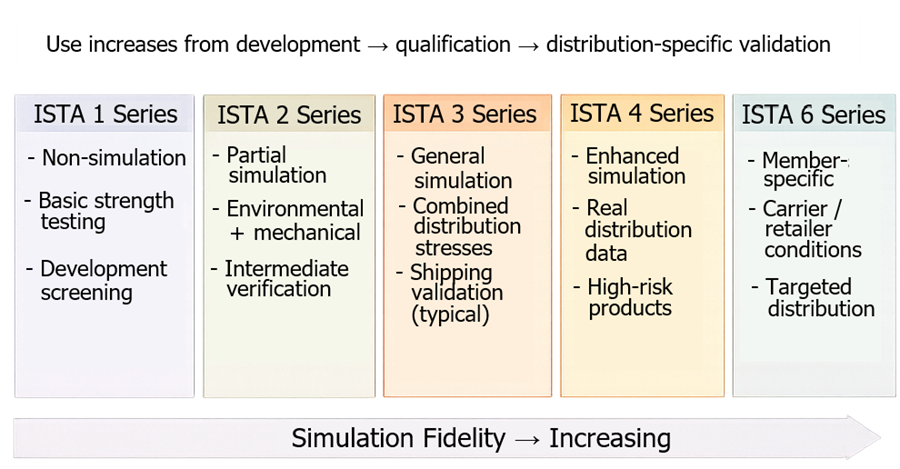
ISTA protocols are grouped into series based on the level of distribution simulation, complexity of test sequences, and intended application. The selection of a series determines how closely the test represents real-world distribution conditions and how suitable it is for qualification versus development activities.
The diagram below illustrates the progression of ISTA protocol series based on increasing simulation fidelity and application.
4.1 ISTA 1 Series — Non-Simulation Integrity Tests
ISTA 1 Series protocols are basic performance tests designed to evaluate the mechanical strength and integrity of packaging without attempting to replicate actual distribution environments. These tests apply individual stress elements such as drop, compression, or vibration in a simplified manner.
Key characteristics:
- no environmental conditioning or sequencing of real-world events
- limited representation of actual transport conditions
- focused on identifying obvious weaknesses or failure points
Typical use:
- early-stage packaging development
- comparison of alternative packaging designs
- screening for structural adequacy
These protocols are not suitable for shipping validation because they do not represent combined or realistic distribution stresses.
4.2 ISTA 2 Series — Partial Simulation Tests
ISTA 2 Series protocols introduce a combination of environmental conditioning and mechanical testing, providing a higher level of realism compared to Series 1. Tests may include preconditioning at defined temperature and humidity followed by mechanical stress such as vibration and drop.
Key characteristics:
- inclusion of environmental preconditioning
- partial sequencing of distribution-related stresses
- moderate representation of transport conditions
Typical use:
- intermediate design verification
- evaluation of packaging performance under controlled environmental exposure
- refinement of packaging configurations
These protocols provide more relevant data than Series 1 but still do not fully simulate actual distribution systems.
4.3 ISTA 3 Series — General Simulation Tests
ISTA 3 Series protocols are general simulation tests designed to represent a broad range of distribution environments using standardized and repeatable sequences. These protocols combine multiple stress elements such as vibration, shock, drop, and compression in a defined order that reflects typical handling and transport scenarios.
Key characteristics:
- integrated sequence of mechanical stresses
- simulation of common distribution hazards
- defined test profiles representing parcel and freight systems
Common examples:
- 3A for small parcel delivery systems
- 3B for packaged products shipped individually
- 3E for palletized loads
Typical use:
- shipping validation
- demonstration of packaging system performance under realistic conditions
- qualification of packaging configurations for routine distribution
This series is most commonly used in pharmaceutical applications because it provides a balanced combination of realism, standardization, and reproducibility.
4.4 ISTA 4 Series — Enhanced Simulation Tests
ISTA 4 Series protocols provide an advanced level of simulation by incorporating actual distribution data and customized test sequences. These protocols are designed to closely replicate specific supply chain conditions using measured data such as vibration profiles, handling events, and environmental exposure.
Key characteristics:
- use of real distribution data
- customizable test sequences
- higher fidelity representation of supply chain conditions
Typical use:
- high-risk or high-value products
- complex or sensitive packaging systems
- distribution lanes with known variability or risk
These protocols require more detailed input data and are more complex to execute but provide a more accurate assessment of real-world performance.
4.5 ISTA 6 Series — Member Performance Tests
ISTA 6 Series protocols are developed in collaboration with specific carriers, retailers, or logistics providers to replicate their unique distribution environments. These protocols reflect the handling practices, equipment, and conditions specific to those organizations.
Key characteristics:
- carrier-specific or system-specific test requirements
- defined handling and transport profiles based on actual operations
- high relevance for targeted distribution channels
Typical use:
- qualification for specific carriers or distribution networks
- compliance with retailer or logistics provider requirements
- evaluation of packaging for defined shipping channels
These protocols are highly specific and are used when distribution is consistently performed through a defined system.
5. Test Method Selection
Selection of the appropriate ISTA protocol must be justified based on:
- packaging configuration and weight
- distribution mode such as parcel, palletized freight, or air shipment
- expected handling conditions
- product sensitivity
The selected protocol must represent worst-case or representative distribution conditions.
6. Application in Shipping Validation
ISTA protocols are used to demonstrate that packaging systems can withstand combined distribution stresses without compromising product quality.
Testing must confirm:
- no damage to primary packaging
- maintenance of packaging integrity
- preservation of product quality attributes
- maintenance of required environmental conditions where applicable
ISTA testing is typically performed on fully assembled packaging systems.
7. Acceptance Criteria
Acceptance criteria must be predefined and based on product protection requirements. Criteria typically include:
- absence of physical damage
- no compromise of container closure integrity
- maintenance of labeling and identification
- continued compliance with environmental requirements for temperature-sensitive products
Results must demonstrate that packaging performance is acceptable under all tested conditions.
8. Relationship to ASTM Testing
ISTA protocols integrate multiple stress conditions into a single test sequence, while ASTM methods evaluate individual stresses.
ASTM testing is often used during development to characterize packaging performance, while ISTA testing is used to confirm performance under simulated distribution environments.
9. Documentation and Outcome
All ISTA testing must be documented, including:
- selected protocol and justification
- test configuration and setup
- test execution and conditions
- results and observations
- deviations and conclusions
The outcome is documented evidence that the packaging system can withstand distribution conditions and protect product quality throughout shipment.