

Distribution Environmental Monitoring and Data Logger Qualification
Distribution environmental monitoring provides objective evidence of the conditions experienced by a pharmaceutical, biological, or other temperature-sensitive regulated product during storage and transportation. Monitoring does not itself control the distribution environment. Its purpose is to verify that the established packaging, transportation, storage, and handling controls operated within the conditions required to protect product quality and to provide reliable information when those conditions are exceeded.
This article uses environmental monitoring specifically in the context of distribution. It should not be confused with microbiological or nonviable environmental monitoring used for aseptic-processing areas and cleanrooms. Distribution monitoring typically concerns temperature and, where justified by product or packaging risk, relative humidity, shock, tilt, pressure, light, or other physical conditions.
The monitoring strategy should be derived from product stability requirements, qualified packaging performance, thermal mapping, shipping-lane knowledge, and the intended use of the recorded data. Temperature-Controlled Packaging System Qualification establishes the capability of the shipping system, while Thermal Mapping, Seasonal Profiles, Payload, and Hold-Time Qualification identifies thermal extremes and appropriate monitoring locations. Routine distribution monitoring then provides evidence that commercial shipments remain within the qualified operating envelope.
For pharmaceutical products, 21 CFR §211.142 requires storage under appropriate temperature, humidity, and light conditions so product identity, strength, quality, and purity are not affected. Distribution procedures must also be established and followed under 21 CFR §211.150. WHO’s technical supplement on temperature and humidity monitoring systems for transport operations provides a particularly useful framework for device selection, monitoring strategy, data collection, and interpretation. WHO states that monitoring-device selection should be based on a defined user requirements specification and on how the resulting information will be used.
Key Principles
- Monitoring parameters should be selected from product, packaging, and distribution risks rather than from the capabilities of the available logger.
- Temperature is the principal monitoring parameter for most cold-chain applications, but humidity or other physical variables should be monitored when they can affect product or package performance.
- Monitoring-device selection should begin with a defined intended use and user requirements specification.
- Logger accuracy, resolution, range, logging interval, memory, battery life, clock performance, alarm logic, and data-retrieval capability should be suitable for the intended decision.
- Calibration should cover the relevant operating range and remain valid for the period in which the device is used.
- Routine shipment-monitor locations should be derived from qualification and thermal-mapping knowledge rather than chosen solely for convenience.
- A monitoring device used to support shipment acceptance or rejection requires stronger control than a device used only for exploratory route characterization.
- Downloaded data should remain attributable to the shipment, device, time period, and configuration that generated it.
- Electronic data should be retained and protected according to applicable predicate-rule requirements; 21 CFR Part 11 applicability should be determined from the actual electronic-record use rather than assumed automatically.
- Excursion decisions should consider magnitude, duration, location, product stability data, measurement uncertainty, and cumulative exposure where applicable.
- Monitoring records should be trended to verify continued performance of the qualified packaging and distribution system.
Monitoring Begins With Intended Use
The first qualification question is not which data logger to purchase. It is what decision the device must support.
WHO distinguishes between monitoring devices used to determine acceptance or rejection of a shipment and devices used primarily as analytical tools for route studies, trending, or identification of transport-system weaknesses. The difference is significant. A logger whose result directly supports product disposition requires a more rigorously defined measurement range, accuracy, calibration status, alarm logic, data integrity, and review process than a temporary engineering logger used only to compare two package designs.
A user requirements specification should therefore define the intended product range, required temperature or humidity range, expected shipment duration, measurement accuracy, logging interval, memory capacity, display requirements, alarm capability, single-use or reusable status, data-download method, required software, battery life, environmental durability, and record-retention needs.
The URS should also identify whether the device will be used for qualification studies, routine shipment verification, warehouse monitoring, excursion investigation, shipping-lane characterization, or product-disposition decisions. These functions can require different controls.
What Should Be Monitored
Temperature should be monitored when temperature exposure can affect product quality or when temperature control is part of the qualified distribution strategy. The required range should be derived from product stability knowledge and approved storage or transport conditions.
Relative humidity should be monitored when moisture exposure can affect the product, container-closure system, label, corrugated packaging, desiccant system, sterile barrier, or other critical packaging function. Routine humidity monitoring adds little value when the product and package are demonstrably insensitive to humidity and no distribution control depends on it.
Other parameters can be relevant in specialized applications. Shock or acceleration can be monitored for fragile products or sensitive instruments. Tilt or orientation indicators can be useful where inversion can damage the product or disrupt a thermal pack-out. Atmospheric pressure or altitude can be relevant to pressure-sensitive packages. Light exposure can matter for photosensitive products where protective packaging may be compromised.
These parameters should not be added merely because a multifunction logger can record them. Monitoring should remain tied to a defined quality or distribution risk.
Operational Metadata Is Not the Same as Environmental Data
Real-time monitoring systems increasingly record shipment location, route, door opening, geofencing events, cellular connectivity, battery status, and other operational information in addition to temperature or humidity.
These data can be useful for logistics control and investigation, but they should be distinguished from the actual environmental variable used to assess product exposure.
For example, GPS location can explain why a temperature excursion occurred but does not establish the temperature experienced by the product. A door-open event can indicate a potential thermal challenge but does not substitute for an actual temperature record.
The monitoring strategy should therefore identify which variables are quality-critical measurements and which are supporting operational metadata.
Types of Monitoring Devices
WHO describes a range of technologies for temperature-controlled distribution, including electronic data logging monitors, electronic temperature indicators, chemical indicators, time-temperature integrators, event-monitoring systems, and remotely communicating devices.
For pharmaceutical distribution, three electronic categories are especially common.
Single-use data loggers are activated for one shipment and generally provide a downloadable or automatically generated report after receipt. They reduce the logistics of retrieving and recalibrating reusable devices but require control of shelf life, battery status, activation, configuration, and manufacturer calibration.
Reusable electronic data loggers can be configured repeatedly and may provide greater flexibility in logging interval, alarm programming, external probes, and analytical capability. They require lifecycle controls for calibration, battery condition, firmware, configuration, maintenance, and device history.
Real-time or telemetry-enabled monitors transmit temperature and potentially other variables during transportation. They can enable active intervention before a shipment fails, but they introduce additional system elements including communications networks, cloud platforms, user access, data synchronization, alarms, remote configuration, and cybersecurity considerations.
WHO’s current prequalification category E006 includes temperature recorders, user-programmable data loggers, electronic shipping indicators, alarm systems, and remote equipment-monitoring systems, illustrating the wide range of available monitoring technologies.
Selecting the Measurement Range
The logger’s specified operating range should comfortably include the conditions expected during qualification and commercial shipment.
A device intended for refrigerated 2–8 °C distribution does not necessarily require the same measurement range as one used for dry ice or ultra-low-temperature shipping. Conversely, a narrow-range device can become unusable if the actual excursion falls outside its validated measurement capability.
The selected range should consider both the normal product range and the foreseeable environmental challenge. Qualification studies can expose loggers to temperatures outside the routine product specification even when the payload itself remains controlled.
The device’s measurement range, operating range, and storage range should not be assumed to be identical. A logger may store correctly at one range, measure accurately over another, and communicate only within a narrower operating environment.
Accuracy, Resolution, and Measurement Uncertainty
Accuracy should be appropriate relative to the product specification and the quality decision supported by the measurement.
A logger specified to ±1.0 °C provides relatively little decision margin for a narrow 2–8 °C requirement when the recorded value approaches the limit. Greater accuracy may be needed where the acceptable range is narrow or where small excursions drive product-disposition decisions.
Resolution should not be confused with accuracy. A device may display temperature to 0.1 °C while having a substantially larger measurement uncertainty.
WHO’s temperature-mapping guidance provides an example requirement for electronic data logging monitors of no more than ±0.5 °C error at the calibration points used for the mapping application. This should not be treated as a universal specification for every distribution logger, but it illustrates the principle that the required accuracy should be defined before device selection.
Where measurements are close to specification limits, the company’s quality system should define how calibration uncertainty, stated device accuracy, or other relevant measurement uncertainty is considered.
Calibration
Calibration demonstrates the relationship between the logger’s indicated value and a traceable reference standard.
21 CFR §211.68 requires automatic, mechanical, or electronic equipment used in drug manufacturing, packing, or holding functions to be routinely calibrated, inspected, or checked according to a written program designed to assure proper performance, with records maintained. For distribution-monitoring devices used to support GMP storage or quality decisions, a defined calibration program provides the corresponding measurement-control basis.
WHO states that temperature measurement and control devices should periodically be calibrated over their relevant operating range. Manufacturer-supplied calibration can be acceptable for devices designed for single use where the calibration certificate remains valid for the device’s useful life.
Calibration requirements should define the reference standard, calibration points, tolerance, calibration interval, certificate requirements, and disposition of devices that fail calibration.
Calibration Points Should Represent Intended Use
A one-point calibration may confirm performance near one temperature but does not necessarily demonstrate acceptable accuracy across a broad operating range.
For a refrigerated distribution logger, a multi-point calibration can reasonably bracket the operating range and relevant excursion region. For frozen or ultra-low applications, different points are required.
WHO’s temperature-mapping supplement recommends calibration points that cover the required temperature range of the application.
The calibration plan should therefore be based on how the logger is actually used rather than on a generic annual calibration procedure applied identically to every monitoring device.
Calibration Interval
Reusable devices should have a documented calibration interval based on manufacturer recommendations, historical drift, frequency of use, handling, environmental exposure, risk, and previous calibration results.
An annual interval is common but should not be treated as a universal technical requirement. A device used infrequently under mild conditions may justify a different interval from one repeatedly shipped through severe environments.
Single-use devices commonly rely on manufacturer calibration and are discarded after use. The organization should still verify that the calibration remains valid on the date of shipment and that device expiration or activation limits have not been exceeded.
As-Found Calibration Failures
An out-of-tolerance calibration result can affect more than the future use of the device.
If a reusable logger is found outside its acceptance tolerance, the investigation should determine whether data generated since the previous acceptable calibration remain reliable. The assessment should consider the magnitude and direction of the error, affected shipments, product margins, recorded results, and whether any disposition decisions could have changed.
The logger should not simply be adjusted, recalibrated, and returned to service without evaluating the potential impact of the as-found condition.
Qualification of the Data Logger
A calibration certificate does not constitute complete logger qualification. Qualification should demonstrate that the device and any associated software perform the functions required by the intended use. For a portable logger, a risk-based qualification may be more appropriate than mechanically imposing a large IQ/OQ protocol intended for complex production equipment.
The qualification can verify device identification, model and firmware where relevant, measurement range, accuracy, logging interval, memory capacity, start/stop functions, alarm logic, battery status, clock performance, display indications, report generation, data export, configuration protection, and expected behavior at memory or battery limits.
For a single-use preconfigured logger, much of this evidence may come from supplier qualification and verification supplemented by internal suitability assessment. For reusable or programmable devices, greater internal testing is generally appropriate.
Device Qualification Versus Shipment Qualification
The logger itself and its use within a shipment are different qualification questions. Device qualification demonstrates that the monitoring device can measure, record, retain, and report environmental data adequately.
Deployment qualification establishes that the logger is configured and positioned correctly for the particular packaging or shipping system.
A fully calibrated logger placed at an unrepresentative location can produce accurate but misleading data. Conversely, an ideally positioned logger that is poorly calibrated cannot provide reliable evidence.
Both device capability and deployment strategy are therefore required.
Logging Interval
The logging interval determines how frequently the environmental condition is recorded and directly affects the ability to detect short-duration events.
A one-hour interval can miss a brief but important temperature spike occurring between recorded points. A one-minute interval may generate much more data than necessary and reduce battery or memory capacity without improving the quality decision.
The interval should reflect the rate at which the monitored environment can change, product sensitivity, shipping-system thermal inertia, expected excursion duration, device capacity, and intended use of the data.
Thermal qualification studies often justify shorter intervals than routine shipping because the objective is to understand detailed package behavior. Routine monitoring intervals can sometimes be longer once the system response is well characterized.
Memory Capacity
The logger should have sufficient memory for the entire period from activation through receipt and any anticipated delay.
Memory requirements should account for the selected logging interval, expected transport duration, staging, customs delays, weekends, holidays, and potential extension of the route.
When a circular-memory device overwrites older records, its suitability should be evaluated carefully. A shipment-monitoring record should not lose the earliest exposure information before the product reaches its destination.
Battery Life
Battery capability should support the complete shipment and data-retrieval period under the temperatures expected during use.
Battery performance can deteriorate at low temperatures. A device that operates adequately at room temperature may fail prematurely during frozen or ultra-low-temperature transport unless designed for that application.
For reusable devices, battery replacement or battery-health controls should be defined. For sealed single-use devices, expiration dating and manufacturer specifications usually control battery suitability.
Qualification should also define what occurs if the battery fails during shipment and whether partial data can still be recovered.
Clock Accuracy and Time Synchronization
Temperature excursion evaluation depends on both temperature and time. Logger clocks therefore deserve explicit control.
Incorrect time settings, unsynchronized devices, time-zone changes, daylight-saving adjustments, or communication errors can make it difficult to reconstruct an event. This becomes particularly important when comparing product-temperature data with carrier records, chamber profiles, GPS information, or multiple loggers.
Qualification should verify the device’s clock behavior and the system’s approach to time synchronization. For multi-device studies, the loggers should normally be synchronized sufficiently to support direct comparison.
The report should identify the time basis being used, particularly for international shipments crossing multiple time zones.
Alarm Programming
Many monitoring devices provide visual or electronic alarms based on programmed temperature thresholds and durations.
Alarm settings should be linked to an approved quality requirement or monitoring strategy. They should not simply use the product label range if product stability data or distribution specifications use different criteria.
Alarm logic can include instantaneous high or low thresholds, cumulative exposure, delay before activation, multiple alarm zones, or time-temperature algorithms.
A device can therefore display an alarm even when the final quality assessment concludes that product remains acceptable, or it can remain free of alarm despite an event requiring further review if the programmed logic differs from the formal quality specification.
Alarm status should be treated as a screening or decision-support mechanism according to its validated intended use, not automatically as the complete product-disposition decision.
Sensor Placement During Thermal Qualification
Multiple sensors are typically used during thermal mapping and thermal shipping qualification to identify the warmest, coldest, and representative product locations.
The detailed mapping strategy is addressed in Thermal Mapping, Seasonal Profiles, Payload, and Hold-Time Qualification. Once the thermal pattern has been established, the qualification data should be used to determine where routine shipment monitors provide the most meaningful evidence.
A logger placed in the geometric center because it is protected and easy to retrieve may systematically underreport temperature extremes if qualification has demonstrated that the limiting position is near the lid, wall, corner, or refrigerant boundary.
Routine Shipment Logger Placement
Routine monitoring normally uses fewer devices than qualification mapping, so location becomes particularly important.
The selected position should represent the relevant thermal risk within the approved commercial pack-out. In some systems, a single qualified monitoring location may be sufficient. In others, one logger cannot adequately represent both high- and low-temperature risks or a large payload.
The logger should also be protected from placement errors. Pack-out instructions can use defined pockets, fixtures, labels, diagrams, or dedicated product positions to ensure reproducible deployment.
Direct contact with a frozen refrigerant should be avoided unless that condition actually represents the monitored product location. Otherwise, the device can report a local cold-source surface condition rather than representative product exposure.
Monitoring Active Vehicles and Containers
Temperature-controlled trucks, trailers, active air containers, and refrigerated ocean containers introduce different monitoring architectures from passive parcel shippers.
The transport unit may contain fixed air-temperature probes integrated with the refrigeration controller, independent reference loggers, cargo-level product monitors, remote telemetry, or some combination.
Vehicle return-air temperature can provide useful equipment-control information but may not represent temperature at the product location. Qualification and mapping should establish the relationship between system-control sensors and actual payload conditions.
Where control-system data are relied upon as the GMP monitoring record, sensor calibration, data retention, system access, time synchronization, alarm management, and record retrieval should be included in the qualification strategy.
Real-Time Monitoring and Telemetry
Real-time monitoring can provide operational advantages because abnormal conditions can be detected while corrective action is still possible.
A telemetry platform can report temperature, location, route deviation, battery status, door opening, and other events. Alerts can be sent to logistics, quality, or control-tower personnel when predefined conditions occur.
The control strategy should specify who receives alarms, how quickly they are reviewed, what actions are authorized, how communication failures are handled, and how the final record is retained.
Loss of cellular or satellite connectivity should not necessarily mean loss of environmental data. A robust device normally continues local logging and transmits stored information after communications are restored.
The qualification should therefore distinguish measurement continuity from communication continuity.
Software and Cloud Platforms
Many modern loggers depend on software or cloud platforms for configuration, download, graph generation, alarm interpretation, or record retention.
The validation effort should be proportional to the system’s intended GMP use and risk. A simple application that generates a static report from a sealed single-use logger has different risk from a configurable cloud system that stores regulated records, applies automated excursion logic, controls user access, modifies alarm profiles, and supports final disposition decisions.
Relevant controls can include user access, configuration management, data transfer, time stamps, report generation, backup, retention, auditability, interface accuracy, supplier management, and change control.
Where the system falls within the site’s computerized-system validation program, the approach should remain aligned with the broader lifecycle used for GMP computerized systems rather than creating an isolated logger-software validation methodology.
21 CFR Part 11 Applicability
The existing version of this page stated broadly that electronic monitoring systems must comply with 21 CFR Part 11. That formulation is too absolute.
FDA’s final Part 11, Electronic Records; Electronic Signatures — Scope and Application guidance explains that Part 11 applies when records required by FDA predicate rules are maintained electronically in place of paper records or when applicable records are submitted electronically to FDA. FDA recommends determining in advance whether the regulated activity will rely on the electronic record or a paper record.
A distribution logger does not become a Part 11 system merely because it contains electronics or software. Part 11 applicability depends on the regulatory status and use of the resulting electronic record.
Regardless of Part 11 applicability, GMP records used for regulated decisions should remain accurate, secure, attributable, retrievable, and protected from inappropriate alteration. 21 CFR §211.68 also requires appropriate controls over computer or related systems used in applicable drug operations.
Data Retrieval
Data retrieval should preserve the complete measurement record and maintain clear linkage to the shipment. The process should identify the shipment or lot, logger serial number or unique identifier, activation time, monitoring location, retrieval date, person performing the review, and applicable configuration or alarm profile.
Where the device generates both raw data and a PDF report, the quality system should define which record is considered authoritative and which files must be retained.
If data are converted, exported, or processed through external software, the process should ensure that the content and meaning of the record are preserved.
FDA’s Part 11 guidance recommends that electronic copies retain the content and meaning of the original record and remain reasonably accessible for inspection.
Record Retention
Distribution-monitoring records associated with a pharmaceutical batch may become part of the GMP distribution or quality record.
21 CFR §211.180 requires applicable production, control, and distribution records associated with a batch to be retained for at least one year after the expiration date of that batch, with specified exceptions for certain OTC products. The regulation also requires records to remain readily available for inspection.
The company’s records-management procedure should define the retention period for monitoring data based on applicable predicate rules, product type, regulatory commitments, and quality-system requirements.
Retention should include enough supporting information to interpret the record later. A temperature graph without shipment identification, logger information, acceptance criteria, or review disposition may have limited regulatory value.
Data Integrity
Environmental monitoring data should be attributable to the specific device and shipment, legible and retrievable, contemporaneously recorded by the device, protected as an original record or controlled copy, and accurate enough to support the intended decision. These expectations align directly with the ALCOA Data Integrity Principles, which provide the broader GMP framework for ensuring that records remain attributable, legible, contemporaneous, original, and accurate throughout their lifecycle.
Additional controls depend on the technology. For programmable reusable loggers, configuration changes should be restricted and traceable. For cloud systems, user privileges and data security should be managed. For single-use devices, activation and association with the shipment should be controlled so that reports cannot be inadvertently exchanged between shipments.
Manual transcription should be minimized where reliable electronic transfer is available because transcription creates additional opportunities for error.
Missing or Incomplete Data
A shipment should not automatically be considered acceptable simply because the logger stopped recording and no excursion was observed before the failure.
Missing data create uncertainty about the unmonitored period. The disposition should consider when the failure occurred, qualified package hold time, duration of missing exposure, route conditions, redundant monitoring, product stability, other available evidence, and whether the monitoring system itself failed.
Recurring logger failures should be investigated as a system-performance problem even if individual product lots can be released based on alternate evidence.
Excursion Detection
An excursion occurs when a monitored condition is outside the applicable transport or storage criterion. WHO defines a temperature excursion as exposure outside the temperature ranges established by the product manufacturer from stability data.
The logger should provide enough information to determine the magnitude, duration, timing, and pattern of the excursion.
A single maximum temperature is usually insufficient. A product exposed to 10 °C for five minutes presents a different stability question from the same product held at 10 °C for ten hours.
Time-temperature history is therefore the core evidence for excursion assessment.
Excursion Assessment
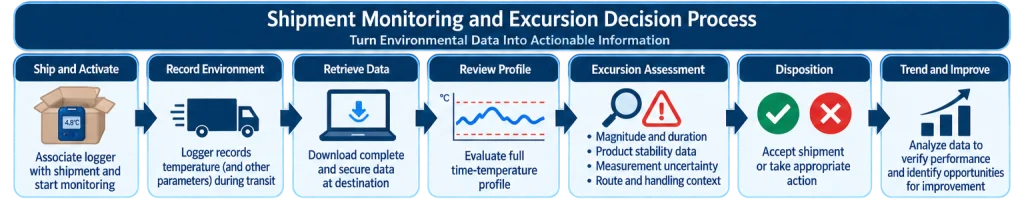
The monitoring system detects the event; it does not by itself determine product quality impact. Excursion assessment should consider the actual temperature profile, duration outside the defined range, product-specific stability data, cumulative previous exposure where relevant, logger accuracy, monitoring location, shipment configuration, and any uncertainty arising from missing data.
A predefined alarm limit can initiate the review, but final disposition should follow the approved stability and quality-assessment process.
This distinction avoids two opposite errors: rejecting acceptable product solely because a logger alarmed, and accepting questionable product solely because the logger remained below a simplistic alarm threshold.
Measurement Uncertainty Near an Excursion Limit
Borderline readings deserve particular attention. If a logger has an accuracy specification of ±0.5 °C and records 8.2 °C against an 8.0 °C limit, the quality assessment should understand the measurement capability rather than interpreting the displayed decimal place as exact truth.
The organization’s monitoring and excursion procedures should define how measurement uncertainty is treated in such cases.
The correct approach depends on the product requirement, calibration data, instrument specification, and quality-risk strategy rather than a universal mathematical adjustment applied to every shipment.
Review of the Complete Profile
Monitoring review should examine the entire environmental trace rather than only an alarm icon or minimum and maximum summary.
The shape of the profile can reveal repeated warming cycles, progressive loss of thermal control, unusual loading delays, prolonged customs holds, door-opening events, or differences from the qualified shipping profile.
For real-time platforms, route and event information can be correlated with the environmental record to identify where the exposure occurred.
This information becomes particularly useful for continued improvement of the distribution system.
Routine Monitoring Versus Qualification Monitoring
Qualification monitoring and routine shipment monitoring have different objectives.
Qualification studies typically use multiple calibrated sensors to characterize spatial temperature behavior, identify worst-case locations, and demonstrate thermal performance across defined seasonal profiles and payloads.
Routine monitoring generally uses fewer sensors to confirm that commercial distribution remains within the qualified assumptions.
The routine strategy should therefore be derived from qualification results. Repeating a full qualification mapping configuration in every shipment is normally unnecessary, while reducing routine monitoring to a convenient but unrepresentative location can undermine the purpose of ongoing verification.
Monitoring Shipping Lanes
Monitoring data can be used to verify whether a shipping lane remains consistent with the conditions assumed during qualification.
Repeated shipment data can identify seasonal changes, airport or warehouse dwell, route delays, carrier differences, geographical hot spots, or systematic loading practices that were not apparent during initial qualification.
These results should feed the shipping-lane lifecycle described in Shipping Lane Qualification and Real-World Shipment Studies once that article is implemented.
A lane whose actual thermal conditions progressively approach or exceed the qualified package envelope should trigger reassessment rather than continued reliance on historical qualification.
Monitoring Frequency
Monitoring every commercial shipment can provide the strongest shipment-specific evidence but is not necessarily required for every product and mature distribution system.
A risk-based strategy can consider product sensitivity, packaging-system performance margin, lane variability, history of excursions, regulatory commitments, customer requirements, capability of the logistics provider, and effectiveness of previous monitoring.
Reduction in monitoring frequency should be supported by accumulated evidence and a defined control strategy. It should not be based simply on the absence of recent complaints.
High-risk, highly variable, new, or recently changed shipping systems generally justify more intensive monitoring.
Single Logger Versus Multiple Loggers
The number of routine loggers should correspond to shipment size, thermal variability, qualification findings, and the quality decision being supported.
A small passive shipper with a well-characterized thermal profile may be adequately represented by one logger placed at a qualified limiting location. A palletized active shipment, large container, or heterogeneous load can require multiple sensors.
One logger should not be assumed sufficient merely because it is common industry practice.
The rationale should demonstrate that the selected monitoring configuration can detect the environmental risk relevant to the shipment.
Reusable Logger Lifecycle Control
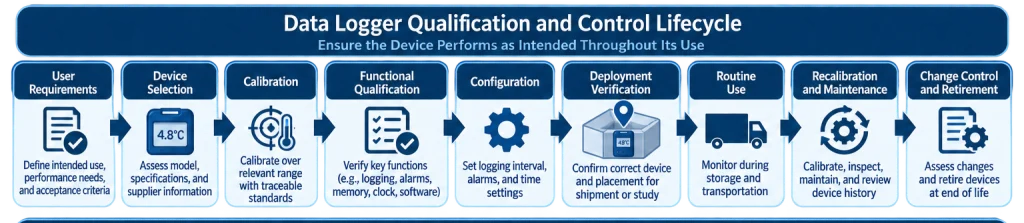
Reusable loggers should be controlled as measurement equipment. The lifecycle can include receipt and identification, qualification, calibration, configuration, deployment, cleaning where appropriate, battery maintenance, functional checks, recalibration, repair, firmware assessment, and retirement.
Device history can help identify recurring drift, battery problems, damage, or communication failures.
A logger that has been dropped, exposed beyond its specified environmental range, repaired, or otherwise potentially damaged may require verification before returning to service.
Supplier and Model Changes
Changes to logger manufacturer, model, firmware, sensor technology, reporting software, cloud platform, or calibration service should be assessed for impact on the qualified monitoring process.
A replacement logger can have different thermal response, accuracy, logging behavior, time synchronization, report format, or alarm algorithm even when its nominal specifications appear equivalent.
The change assessment should determine whether existing qualification evidence remains applicable or focused testing is required.
Real-Time Alarm Response
Where real-time monitoring is used, the organization should define how alarms are managed while the shipment is still moving.
The procedure should establish responsible roles, escalation paths, response times, carrier communication, permitted interventions, documentation, and handling when connectivity is lost.
An alarm that no one is assigned to review is not an effective control.
Real-time monitoring provides its greatest benefit when it enables action such as moving a shipment into controlled storage, replacing refrigerant, expediting customs clearance, correcting vehicle conditions, or changing logistics routing before product quality is compromised.
Trending and Periodic Review
Environmental monitoring data should support continued verification of the distribution control strategy.
Useful trends include excursion frequency, maximum and minimum temperatures, thermal margin to limits, shipment duration, logger failures, route-specific performance, seasonal performance, carrier differences, alarm frequency, and frequency of product-impact assessments.
Trend deterioration can reveal a weakening distribution system before formal failures become common.
Monitoring therefore provides the feedback mechanism connecting laboratory qualification with actual commercial performance.
Documentation
The monitoring program should maintain sufficient documentation to reconstruct both the device control and the shipment-specific record.
Depending on the application, documentation can include:
| Element | Typical evidence |
|---|---|
| Intended use | URS or monitoring specification |
| Device suitability | Model assessment and qualification |
| Calibration | Certificate and calibration status |
| Configuration | Logging interval and alarm settings |
| Deployment | Logger ID and qualified location |
| Shipment identity | Product, lot, route, dates |
| Environmental record | Complete downloaded profile |
| Review | Acceptance or excursion assessment |
| Disposition | Quality decision where required |
| Lifecycle | Trend review, changes, recalibration |
The objective is not maximum paperwork. The record should be sufficient to demonstrate that the environmental measurement used for the quality decision was reliable, representative, and properly evaluated.
Validation Perspective
Distribution environmental monitoring should be treated as a controlled measurement system within the overall shipping-validation lifecycle. The logger must be capable of generating accurate data, but accuracy alone does not create meaningful evidence. The device must also be appropriately configured, calibrated, positioned, associated with the correct shipment, reviewed against the correct requirements, and maintained under lifecycle control.
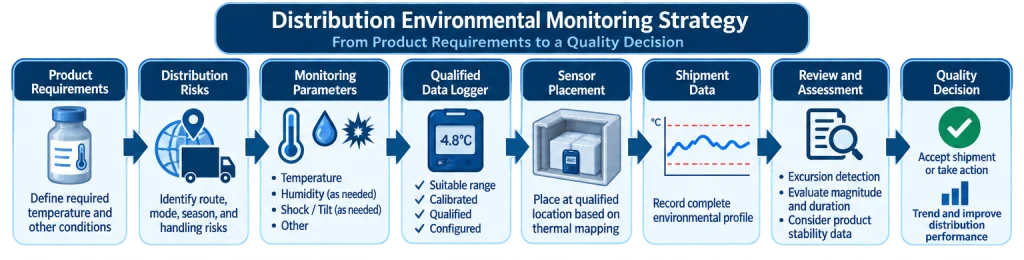
The validation logic can be summarized as: Product and distribution requirements → monitoring URS → qualified logger → valid calibration → qualified placement → complete environmental record → excursion assessment → product disposition → trend review and lifecycle control
This approach turns environmental monitoring from a passive record-collection activity into an active verification mechanism for the validated distribution system.