

Validation Requirements for Cosmetic Product Manufacturing
Cosmetic product manufacturing in the United States is regulated under the Federal Food, Drug, and Cosmetic Act (FD&C Act), as substantially amended by the Modernization of Cosmetics Regulation Act of 2022 (MoCRA). Most cosmetic products and ingredients do not require FDA premarket approval, except for certain color additives, but companies remain responsible for marketing products that are safe, properly labeled, and not adulterated or misbranded.
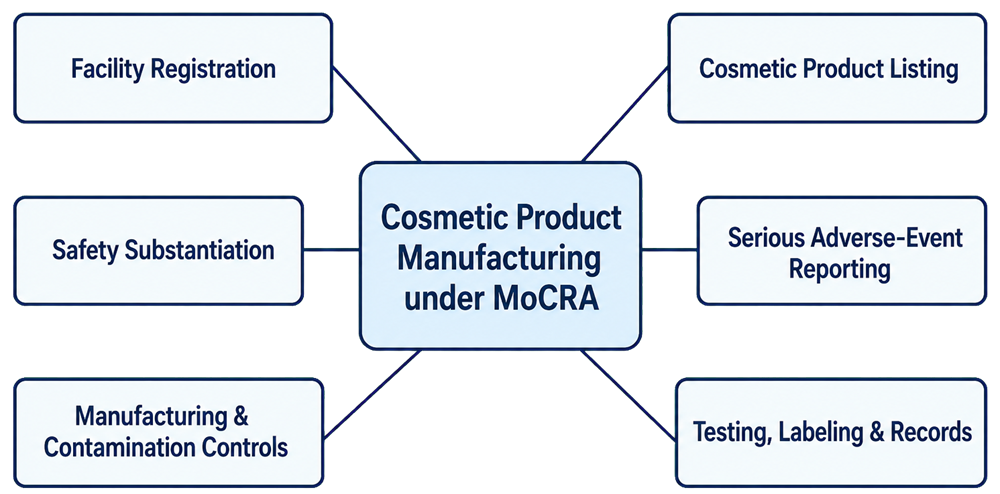
MoCRA established enforceable requirements for cosmetic-product facility registration, product listing, safety substantiation, serious adverse-event reporting, and associated records. Although FDA does not prescribe a comprehensive pharmaceutical-style validation lifecycle for cosmetics, documented control of facilities, equipment, processes, cleaning procedures, testing, labeling, and records supports compliance and consumer protection.
Regulatory Authority Under the FD&C Act
In the United States, cosmetic products are regulated under the Federal Food, Drug, and Cosmetic Act (FD&C Act). FDA may take action against cosmetic products that are adulterated or misbranded and against companies or individuals responsible for violations.
MoCRA (Modernization of Cosmetics Regulation Act) expanded this authority by establishing mandatory facility registration, cosmetic product listing, safety-substantiation, serious adverse-event reporting, and recordkeeping requirements. It also gave FDA additional records-access, facility-registration suspension, and mandatory-recall authorities under specified conditions.
The FD&C Act does not establish a pharmaceutical-style validation framework for cosmetics. Nevertheless, manufacturers and processors must maintain controls appropriate to their products and operations, while responsible persons must fulfill the statutory obligations assigned to products marketed under their names.
Modernization of Cosmetics Regulation Act Requirements
MoCRA created specific requirements for facilities that manufacture or process cosmetic products and for the responsible persons whose names appear on cosmetic product labels. These roles may belong to different organizations and should not be treated as interchangeable.
Facility Registration
Each person that owns or operates a facility that manufactures or processes cosmetic products for distribution in the United States must register the facility with FDA unless an applicable exemption applies. Registration information must be updated within 60 days of a change, and each registration must be renewed every two years.
FDA may suspend a facility registration when the statutory conditions involving a reasonable probability of serious adverse health consequences or death are met. Distribution of cosmetic products from a facility with a suspended registration is prohibited.
Cosmetic Product Listing
The responsible person must submit a listing for each marketed cosmetic product, including required product and ingredient information, and must update the listing annually.
For MoCRA purposes, the responsible person is the manufacturer, packer, or distributor whose name appears on the cosmetic product label.
Safety Substantiation
The responsible person must ensure and maintain records supporting adequate substantiation of the cosmetic product’s safety. MoCRA does not require one prescribed testing program, but the evidence used must be scientifically reliable and sufficient to support a reasonable certainty that the product is safe under its labeled or customary conditions of use.
Safety substantiation should address the finished product—not only its individual ingredients—and should consider the formulation, impurities, intended use, exposure, user population, microbiological risk, and available toxicological and technical evidence.
Serious Adverse-Event Reporting and Records
The responsible person must report a serious adverse event associated with use of a cosmetic product in the United States to FDA within 15 business days. The submission must include a copy of the label on or within the product’s retail packaging.
New and material medical information received within one year after the initial report must also be submitted to FDA within 15 business days of receipt.
Records relating to each adverse-event report—not only serious adverse events—must generally be maintained for six years. A three-year retention period applies to certain qualifying small businesses. These records must be available to FDA as authorized during an inspection.
FDA confirms the reporting deadlines and responsible-person definition. FDA serious adverse-event instructions
Small-Business Exemptions
MoCRA exempts certain small businesses from facility-registration, product-listing, and future cosmetic GMP requirements. These exemptions do not apply to specified higher-risk cosmetic products, including certain eye-contact, injected, internally used, and extended appearance-altering products. Exemption eligibility must therefore be evaluated against the statutory conditions rather than assumed solely from company size.
Ingredient and Product Safety
Cosmetic ingredients must be suitable for their intended use and comply with applicable prohibitions, restrictions, and color-additive requirements. Assessments should address ingredient identity, purity, impurities, toxicological characteristics, concentration, exposure, and interactions within the formulation.
Ingredient acceptability alone does not establish finished-product safety. The responsible person must maintain adequate safety substantiation for the cosmetic product as marketed, considering its complete formulation, intended use, labeling, packaging, and reasonably foreseeable consumer exposure.
Product Testing
FDA does not prescribe one testing regimen for all cosmetics. Testing should be selected according to the product’s formulation, intended use, exposure, microbiological risk, packaging system, and the evidence needed to substantiate safety and product claims. Testing programs may include:
- Stability and shelf-life evaluation
- Microbiological testing and preservative effectiveness
- Compatibility with packaging materials
- Physical and chemical specifications
- Finished-product microbiological quality
- Evaluation of the complete formulation under intended conditions of use
Testing results should be scientifically sound, documented, reviewed, and connected to predefined specifications or acceptance criteria. These records may support safety substantiation, product release, stability decisions, investigations, and responses to FDA inquiries.
Labeling Requirements
Accurate and compliant labeling is a core regulatory expectation for cosmetic products. Labels must clearly identify ingredients, usage instructions, warnings, and other required information to ensure consumers can use products safely and as intended.
Label accuracy and control are often treated as part of a broader quality system, particularly in larger or internationally operating cosmetic manufacturers.
Good Manufacturing Practices
MoCRA requires FDA to establish by regulation Good Manufacturing Practice requirements for facilities that manufacture or process cosmetic products.
As of July 30, 2026, FDA’s current MoCRA page describes cosmetic GMP regulations as a rulemaking requirement but does not identify a final MoCRA cosmetic GMP regulation. FDA currently links to its GMP listening-session materials and existing draft cosmetic GMP guidance. These materials must not be described as a final binding MoCRA GMP rule.
Until FDA publishes a final regulation, manufacturers should continue applying documented controls appropriate to their products and operations, including:
- Facility cleanliness and sanitary operations
- Personnel hygiene and training
- Equipment suitability, cleaning, and maintenance
- Raw-material identification and control
- Written manufacturing and packaging instructions
- In-process and finished-product controls
- Microbiological contamination control
- Labeling and packaging control
- Complaint, deviation, and investigation procedures
- Distribution and traceability records
Existing statutory prohibitions against adulterated and misbranded cosmetics remain enforceable. FDA’s cosmetic GMP guidance and inspection checklist provide useful current considerations but are not substitutes for the final regulations required by MoCRA.
Facilities and Equipment Validation
Validation of manufacturing facilities and equipment supports consistent product quality and contamination control. Cosmetic manufacturers commonly apply qualification and validation principles to demonstrate that:
- Equipment is suitable for its intended use
- Processes are repeatable and controlled
- Cleaning procedures effectively prevent cross-contamination
The level of validation applied is typically risk-based and scaled to product type, process complexity, and distribution scope.
Claims Substantiation
Cosmetic product claims must be supported by appropriate scientific or technical evidence. Claims related to product performance, benefits, or functionality are subject to regulatory scrutiny, particularly where they approach therapeutic or drug-like assertions.
Robust documentation supporting claims helps mitigate regulatory risk and supports compliance with advertising and labeling requirements.
Adverse-Event Reporting and Complaint Records
Complaint handling is therefore both a post-market quality-system function and a statutory MoCRA control.
MoCRA makes serious adverse-event reporting mandatory for the responsible person. A qualifying serious adverse event must be submitted to FDA within 15 business days, together with a copy of the product’s retail label. New and material medical information received during the following year must be reported within 15 business days of receipt.
The responsible person must also maintain records associated with every adverse-event report received for a cosmetic product used in the United States. Complaint and adverse-event procedures should define:
- Initial intake and documentation
- Seriousness assessment
- Reportability determination
- Fifteen-business-day reporting control
- Follow-up medical-information review
- Product and batch traceability
- Investigation and corrective action
- Required record retention FDA inspection access
Complaint handling is therefore both a post-market quality-system function and a statutory MoCRA control.
Regulatory Perspective
Cosmetic products generally are not subject to FDA premarket approval or the pharmaceutical CGMP regulations in 21 CFR Parts 210 and 211. That distinction does not mean cosmetic manufacturing is governed only by voluntary quality practices.
MoCRA created enforceable requirements covering facility registration, product listing, safety substantiation, serious adverse-event reporting, records, registration suspension, and mandatory recalls. Risk-based qualification, process control, cleaning verification or validation, testing, and documentation provide evidence that manufacturing operations remain controlled and that products are not adulterated or misbranded.
Bottom Line
Validation requirements for cosmetics remain less prescriptive than those for pharmaceutical products, but cosmetic manufacturing is no longer accurately described as governed primarily by general expectations. MoCRA establishes direct statutory controls, while documented, risk-based validation and verification activities support product safety, consistent manufacturing, contamination control, investigation capability, and regulatory compliance.