

Preventive Maintenance and Performance Trending of Analytical Instruments
Preventive maintenance preserves analytical instrument function before failure occurs. It may include inspection, cleaning, lubrication, replacement of wear components, leak testing, alignment, diagnostic testing, software-supported service activities, and other work recommended by the manufacturer or justified through operating experience.
Maintenance does not by itself establish measurement accuracy or fitness for use. The required post-maintenance evidence may include inspection, calibration, functional verification, software testing, system suitability, targeted qualification, or representative analytical performance testing, depending on the functions affected.
A lifecycle maintenance program should also use calibration results, system-suitability data, service history, failures, and downtime to detect deterioration. Repeated replacement of the same component should not be treated indefinitely as routine preventive maintenance when the pattern indicates a design weakness, inappropriate use, an environmental problem, or approaching obsolescence.
Purpose and Lifecycle Position
The preventive-maintenance and performance-trending program should demonstrate that:
- maintenance requirements are based on instrument design, intended use, risk, and performance history
- maintenance scope and intervals are documented
- responsibilities are assigned
- service procedures are technically appropriate
- consumables and wear components are controlled
- instrument status is established before maintenance
- data, methods, configuration, and electronic records are protected
- vendor access is authorized and supervised
- replacement parts are identified and assessed
- work performed is completely documented
- affected functions are tested after maintenance
- calibration and qualification activities are coordinated
- recurring failures and adverse trends receive investigation
- spare-parts availability and obsolescence are managed
- the instrument is formally released before GMP use resumes
Maintenance should operate within the approved risk-based analytical instrument qualification strategy and reflect the system’s analytical instrument risk classification.
Regulatory Basis
21 CFR 211.67 requires written procedures assigning responsibility and establishing schedules and sufficiently detailed methods for equipment cleaning and maintenance.
21 CFR 211.68 requires automatic, mechanical, and electronic equipment to be routinely calibrated, inspected, or checked under a written program designed to assure proper performance.
For nonclinical laboratory studies, 21 CFR 58.63 requires equipment used to generate, measure, or assess data to be adequately inspected, cleaned, maintained, tested, calibrated, or standardized. It also requires written procedures, assigned responsibility, maintenance records, and documentation of nonroutine repairs resulting from failure or malfunction.
These requirements establish the need for controlled maintenance. They do not prescribe one universal maintenance interval or require every instrument to receive the same service package.
Maintenance, Calibration, Verification, and Repair
Related activities should remain clearly distinguished.
| Activity | Primary purpose |
|---|---|
| Preventive maintenance | Reduce the probability of failure by performing planned service before loss of function |
| Corrective maintenance | Restore function after a failure or observed defect |
| Calibration | Establish the relationship between an instrument indication and a suitable reference value |
| Routine verification | Confirm selected functions remain acceptable between formal calibration or qualification events |
| Qualification | Demonstrate that the installed system remains suitable for its intended use |
| System suitability | Confirm acceptable performance of the current analytical system, method, and sequence |
| Adjustment | Change the instrument to reduce error or restore a specified operating condition |
Detailed distinctions among these activities are provided in Calibration and Routine Performance Verification of Analytical Instruments.
Maintenance can affect calibration or qualified functions. Calibration may therefore be required after maintenance, but calibration should not be described as a maintenance activity merely because the service provider performs both during one visit.
Maintenance Program Governance
The maintenance program should define:
- equipment included in the program
- responsible departments
- instrument owner
- maintenance planner
- approved service provider
- work-order process
- maintenance scope
- interval
- due-date control
- allowable scheduling window
- overdue-maintenance handling
- instrument-status control
- service procedure
- approved parts and consumables
- data-protection requirements
- vendor-access controls
- post-maintenance testing
- deviation and failure handling
- release authorization
- record retention
- trend review
- escalation and replacement criteria
The program may be administered through:
- computerized maintenance-management system
- laboratory asset-management system
- validated service platform
- controlled equipment database
- approved paper-based system
The selected system should provide an accurate view of maintenance status and preserve the required work history.
Risk-Based Maintenance Scope
Maintenance scope should reflect the probability and consequence of instrument deterioration.
The assessment should consider:
- intended analytical use
- data criticality
- product or decision supported
- instrument design
- mechanical movement
- temperature or pressure stress
- detector technology
- fluid-path exposure
- sample matrix
- corrosive or contaminating materials
- operating frequency
- operating duration
- environmental conditions
- transport or relocation
- maintenance history
- calibration drift
- system-suitability performance
- failure history
- available interim checks
- supplier recommendations
- service and spare-parts support
The following illustration shows the principal inputs used to establish maintenance scope and intervals.
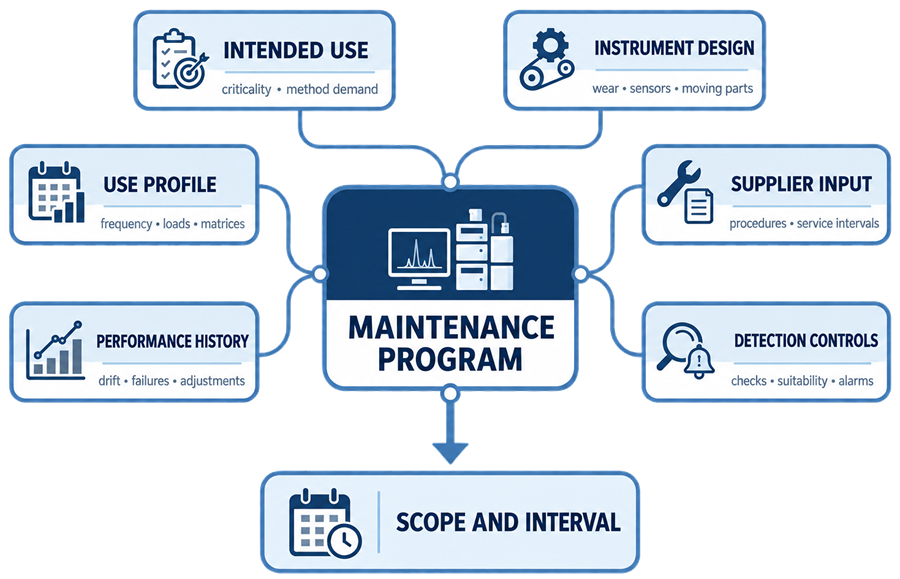
A frequently used chromatographic system analyzing difficult or contaminating matrices may require more frequent inlet, pump, seal, detector, or sample-path maintenance than an identical system used occasionally with clean standards.
Instrument Inventory and Maintenance Status
The controlled inventory should identify, as applicable:
- equipment identification number
- manufacturer
- model
- serial number
- location
- instrument owner
- intended use
- risk classification
- maintenance procedure
- maintenance interval
- last maintenance date
- next due date
- current operating status
- service contract
- approved provider
- critical spare parts
- software or firmware version
- calibration status
- qualification status
- obsolescence status
Maintenance status should be available to laboratory personnel before use.
Status designations may include:
- available for use
- maintenance due
- maintenance in progress
- out of service
- awaiting parts
- awaiting calibration
- awaiting qualification
- restricted use
- retired
A maintenance-completion date should not automatically change the instrument to “available for use” when post-maintenance verification remains incomplete.
Establishing Preventive-Maintenance Intervals
Initial intervals may be based on:
- manufacturer recommendations
- service manuals
- component life
- comparable instruments
- intended workload
- sample matrices
- environmental conditions
- risk assessment
- warranty requirements
- service-provider experience
Supplier recommendations are important inputs but should be assessed against actual site use. A less rigorous program than the supplier recommendation requires documented technical justification. More frequent service may be necessary for heavy use, aggressive matrices, or adverse performance history.
Calendar-Based Intervals
Calendar intervals may be appropriate for components affected by:
- aging
- material degradation
- lubricant deterioration
- battery life
- detector-source life
- seal hardening
- environmental exposure
- corrosion
- time-dependent support requirements
Usage-Based Intervals
Usage-based intervals may be more appropriate for components affected by:
- injection count
- operating hours
- pump cycles
- lamp hours
- detector ignitions
- column-valve actuations
- oven cycles
- sample throughput
- motor operation
- syringe cycles
Condition-Based Maintenance
Condition-based maintenance uses performance evidence to initiate service.
Inputs may include:
- pressure increase
- vacuum deterioration
- baseline noise
- detector-response decline
- temperature instability
- increased leakage
- pump ripple
- injection imprecision
- unusual sound
- abnormal vibration
- diagnostic alerts
- calibration drift
- system-suitability trends
Condition-based maintenance should use defined indicators and action criteria. It should not become informal maintenance initiated only when an analyst believes the instrument “does not look right.”
Interval Adjustment
Maintenance intervals should be periodically reassessed.
Extension may be justified when evidence demonstrates:
- repeated satisfactory inspections
- negligible wear
- stable calibration
- stable system suitability
- low failure frequency
- controlled workload
- successful routine verification
- no recurring replacement
- unchanged intended use
Reduction may be appropriate after:
- repeated component wear
- recurring leaks
- calibration drift
- increasing system-suitability variability
- repeated service calls
- heavy use
- difficult sample matrices
- environmental stress
- extended operating hours
- component-life limitation
- failure before the scheduled service date
Interval changes should be approved through the applicable document or change-control process.
Overdue Preventive Maintenance
An instrument that exceeds its approved maintenance interval should be evaluated before continued use.
The assessment should consider:
- duration overdue
- affected maintenance activity
- component-failure mechanism
- current performance
- routine checks
- calibration status
- system-suitability history
- instrument diagnostics
- workload since the due date
- known failure indicators
- risk to generated data
Where continued use is justified temporarily, the decision should define:
- authorization
- operating restrictions
- additional checks
- revised completion date
- required monitoring
- escalation if maintenance cannot be completed
Repeated administrative extensions indicate that the approved interval or resource plan is ineffective.
Maintenance Procedures
The maintenance procedure or controlled work instruction should define:
- instrument type
- applicable configuration
- responsibility
- required training
- safety precautions
- instrument shutdown
- removal from service
- data-protection steps
- tools and materials
- parts and consumables
- disassembly
- cleaning
- inspection
- lubrication
- replacement
- reassembly
- configuration checks
- diagnostic tests
- calibration requirements
- post-maintenance verification
- documentation
- release requirements
Manufacturer procedures may be referenced where they remain available, controlled, applicable to the installed model, and sufficiently detailed.
A service engineer’s personal practice should not substitute for an approved procedure.
Pre-Maintenance Status Assessment
Before work begins, the responsible person should establish the instrument’s status.
The assessment should include:
- instrument identity
- current use status
- open analytical sequences
- samples remaining in the instrument
- current calibration status
- current qualification status
- unresolved alarms
- active deviations
- known defects
- previous failed tests
- data acquisition status
- electronic records awaiting transfer
- backup status
- configuration status
- required decontamination
- required cleaning
- hazardous materials
- service scope
The instrument should be clearly removed from GMP use before maintenance that could affect operation or data.
Work Order and Maintenance Authorization
The work order should define:
- instrument
- reason for maintenance
- planned scope
- approved procedure
- service provider
- scheduled date
- parts expected
- system access required
- data-protection requirements
- calibration requirements
- anticipated post-maintenance tests
- responsible reviewer
- release authority
Unplanned work discovered during maintenance should be documented and assessed before the service scope is expanded.
A service provider should not replace additional critical components, update firmware, alter configuration, or reinstall software without authorization.
Instrument Cleaning Before Maintenance
The instrument should be placed in a condition safe for maintenance.
Cleaning may address:
- chemical residues
- potent compounds
- biological materials
- corrosive materials
- solvents
- dust
- broken glass
- compressed gases
- pressurized lines
- high-temperature components
- vacuum systems
- radiation or source-related hazards where applicable
The service provider should receive appropriate information about hazards without unnecessary disclosure of confidential product information.
Cleaning performed for service safety should be distinguished from analytical carryover control and from validated production-equipment cleaning.
Data and Configuration Protection
Maintenance can place electronic data and configuration at risk.
Before service, controls should address:
- completion or controlled termination of active runs
- transfer of raw data
- backup
- verification of backup completion
- instrument methods
- processing methods
- sequence templates
- calibration coefficients
- configuration files
- user accounts
- license information
- audit trails
- system time
- interface settings
- network configuration
- printer or report settings
- local data directories
The appropriate depth of backup depends on the service scope.
Replacing a pump seal may not require a complete server recovery test. Replacing a workstation, controller, storage drive, or instrument computer requires much stronger configuration and data-protection controls.
Vendor and Service-Engineer Access
External service personnel may require physical or logical access to the instrument.
Access should be:
- authorized
- time limited
- attributable
- appropriate to the assigned work
- supervised where necessary
- disabled after service
- documented
Controls should address:
- visitor access
- laboratory entry
- administrator credentials
- service accounts
- remote access
- temporary passwords
- removable media
- diagnostic software
- data export
- internet connection
- audit trails
- configuration changes
- file transfer
- screenshots or photographs
- proprietary and patient information
Shared laboratory administrator credentials should not be disclosed to service providers when a controlled temporary account or supervised access can be used.
Where emergency service requires exceptional access, the activity should be documented and retrospectively reviewed.
Remote Vendor Support
Remote support introduces additional risks because the service engineer may access the system without being physically present.
The process should define:
- approved remote-support method
- authorization for each session
- user initiating the connection
- systems accessible
- actions permitted
- session monitoring
- file transfer
- recording or logging
- termination
- account disabling
- review of changes
- audit-trail assessment
- cybersecurity requirements
Persistent unattended vendor connections should not be enabled without documented justification and security controls.
Service Utilities and Diagnostic Tools
Maintenance may use:
- proprietary diagnostic software
- service laptops
- configuration utilities
- calibration fixtures
- test standards
- leak detectors
- electrical measurement devices
- pressure or flow standards
- firmware-loading tools
- removable media
The site should understand whether these tools can:
- modify firmware
- change calibration coefficients
- alter instrument identity
- delete data
- reset counters
- create administrator accounts
- change system time
- export data
- disable audit trails
- restore default configuration
Service tools capable of altering GMP-relevant configuration should be controlled as part of the maintenance activity.
Consumables and Wear Components
Analytical instruments may contain consumable or limited-life components such as:
- pump seals
- pistons
- check valves
- syringes
- needles
- septa
- liners
- ferrules
- tubing
- filters
- frits
- lamps
- detector jets
- filaments
- electrodes
- batteries
- desiccants
- gas purifiers
- vacuum-pump oil
- O-rings
- gaskets
- belts
- bearings
- cooling fans
- printer supplies
The program should distinguish:
- routine operating consumables
- scheduled maintenance parts
- critical spare parts
- components requiring calibration
- components whose replacement can affect qualification
- components with shelf-life or storage requirements
Not every consumable replacement requires formal requalification. The effect depends on the component’s function and replacement procedure.
Replacement-Part Control
Replacement parts should be suitable for the installed instrument and intended use.
Controls should address:
- manufacturer
- part number
- revision
- material
- dimensions
- compatibility
- authenticity
- storage
- shelf life
- installation procedure
- equivalence assessment
- required testing
- traceability
Third-party or redesigned parts may be acceptable when equivalence is demonstrated. Cost savings alone do not establish equivalence.
A component described as “functionally equivalent” should be assessed for potential effects on:
- measurement
- pressure
- flow
- temperature
- sample contact
- adsorption
- extractables
- detector response
- communication
- software compatibility
- safety
- warranty or supplier support
Instrument-Specific Maintenance Examples
HPLC and UHPLC Systems
Maintenance may include:
- solvent filters
- degasser
- pump seals
- pistons
- check valves
- mixers
- pressure sensors
- autosampler needle
- needle seat
- rotor seal
- syringe
- wash system
- tubing
- fittings
- column oven
- detector flow cell
- detector lamp
- leak sensors
- cooling system
Post-maintenance testing should reflect the affected module. Pump repair may require flow, pressure, leakage, gradient, and representative chromatographic testing. Autosampler work may require injection precision and carryover. Detector maintenance may require wavelength, response, linearity, noise, or drift testing.
Gas Chromatography and Headspace Systems
Maintenance may include:
- gas purifiers
- traps
- regulators
- septa
- liners
- inlet seals
- split vent traps
- autosampler syringes
- detector jets
- collectors
- ignition components
- filaments
- headspace needles
- sample loops
- valves
- transfer lines
- vial-handling components
Post-maintenance testing may include leak testing, gas-flow verification, injection precision, temperature verification, detector response, headspace precision, and carryover.
Balances
Maintenance may include:
- cleaning
- leveling feet
- draft-shield components
- pan and support
- internal adjustment mechanism
- power supply
- display
- printer or interface
- environmental assessment
Cleaning or minor external service may require inspection and routine checks. Work affecting the weighing mechanism requires appropriate calibration and performance verification.
Dissolution Apparatuses
Maintenance may include:
- drive belts
- motor
- bearings
- shaft couplings
- vessel-retention components
- water-bath circulation
- heaters
- temperature sensors
- sampling pumps
- tubing
- cannulas
- dosage-delivery mechanisms
Testing may include level, centering, verticality, height, wobble, rotational speed, temperature, sampling position, sampling volume, and applicable performance verification.
Spectrometers and Optical Instruments
Maintenance may include:
- lamps or optical sources
- mirrors
- filters
- gratings
- detectors
- flow cells
- cuvette holders
- alignment
- fans
- cooling
- desiccants
- optical windows
Post-maintenance testing may include wavelength or frequency accuracy, photometric response, noise, drift, resolution, linearity, and representative application testing.
Preventive Versus Corrective Maintenance
Preventive maintenance is planned before failure. Corrective maintenance responds to a known defect, alarm, malfunction, or failed performance result.
The same physical task may be preventive in one circumstance and corrective in another.
For example:
- scheduled pump-seal replacement based on usage is preventive
- pump-seal replacement after leakage or pressure failure is corrective
Corrective maintenance normally requires evaluation of:
- failure onset
- data generated
- methods affected
- product decisions
- need for deviation
- need for retrospective review
- need for broader verification
It should not be closed as routine maintenance merely because the repair itself is common.
Maintenance Execution
The person performing maintenance should:
- verify instrument identity
- confirm work authorization
- follow the approved procedure
- record as-found observations
- identify parts removed
- identify parts installed
- document cleaning and service activities
- record adjustments
- identify software or firmware changes
- document unexpected conditions
- protect data and configuration
- confirm reassembly
- perform required diagnostics
- identify incomplete work
- maintain instrument status
As-found observations may include:
- leaks
- contamination
- corrosion
- wear
- damage
- loose connections
- abnormal noise
- diagnostic errors
- component-life counters
- pressure behavior
- temperature condition
- failed self-tests
These observations can be important for determining whether the maintenance was purely preventive or whether an undetected failure may have existed before service.
Maintenance Documentation
The maintenance record should include:
- instrument identification
- date and time
- maintenance type
- reason
- work-order number
- procedure
- technician
- service organization
- as-found condition
- work performed
- parts removed
- parts installed
- part numbers
- serial or lot numbers where relevant
- cleaning performed
- adjustments
- configuration changes
- software or firmware changes
- diagnostic results
- deviations
- unresolved issues
- recommended follow-up
- post-maintenance tests
- reviewer
- release status
The laboratory should not rely solely on a generic service statement such as “PM completed.”
Review of Vendor Service Reports
The site should review vendor documentation for completeness and technical applicability.
The review should confirm:
- correct instrument
- correct service scope
- required tasks completed
- parts identified
- unexpected findings documented
- no unauthorized changes
- software and firmware status
- calibration status
- open recommendations
- post-maintenance testing
- service engineer authorization
- attachments and raw results
- site release requirements
If the vendor report is incomplete, the site should create a controlled supplemental record rather than infer that undocumented work was performed.
Post-Maintenance Inspection
Before functional testing, the instrument should be inspected for:
- correct reassembly
- correct parts
- secure connections
- leaks
- damage
- tools or materials left inside
- removed shipping locks
- restored utility connections
- correct gas or solvent lines
- clean sample path
- restored guards and covers
- correct module arrangement
- correct cable connections
- correct instrument identity
- acceptable environmental condition
This inspection is especially important when maintenance required major disassembly.
Selecting Post-Maintenance Tests
Testing should be based on the functions potentially affected.
Possible evidence includes:
- visual inspection
- leak test
- instrument diagnostic
- calibration
- routine verification
- operational challenge
- alarm test
- communication test
- software regression test
- interface test
- system suitability
- representative analytical method
- targeted OQ
- targeted PQ
- broader requalification
The following illustration shows the controlled sequence from maintenance authorization through post-maintenance testing and release.
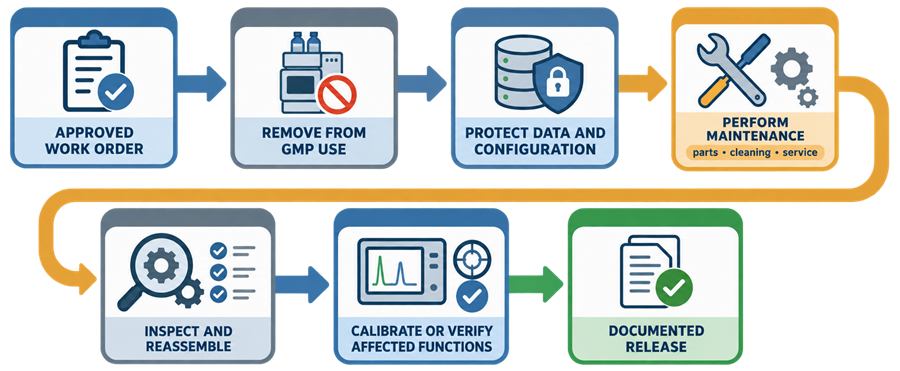
The test scope should answer three questions:
- Was the serviced component installed and functioning correctly?
- Were related or downstream functions affected?
- Does the complete system remain suitable for its approved use?
Coordination With Calibration
Maintenance affecting a measurement function may require calibration. Examples include:
- sensor replacement
- detector replacement
- flow-controller repair
- balance mechanism adjustment
- temperature-controller repair
- pressure-sensor replacement
- pump repair
- optical alignment
- speed-controller repair
- volumetric delivery repair
Calibration should follow the principles in Calibration and Routine Performance Verification of Analytical Instruments.
Where possible, as-found calibration should be completed before adjustment or repair when the result is necessary to evaluate prior data.
If the component has already failed or cannot be operated safely, the absence of usable as-found data should be documented and considered in the impact assessment.
Coordination With Qualification
Maintenance may affect qualified functions without directly affecting calibration. Examples include:
- autosampler-positioning repair
- valve replacement
- communication-board replacement
- workstation replacement
- firmware upgrade
- alarm-system repair
- data-storage replacement
- interface repair
- robotic mechanism adjustment
- sample-tray replacement
- headspace-transfer-line replacement
The impact assessment should determine whether the response requires:
- functional verification
- targeted OQ
- targeted PQ
- software regression testing
- interface testing
- broader requalification
The analytical instrument requalification framework should be used to select proportionate scope.
Software and Firmware During Maintenance
Maintenance may include or trigger:
- firmware upgrade
- driver installation
- operating-system change
- instrument-control software update
- configuration reset
- database repair
- workstation replacement
- storage replacement
- license update
- security patch
- service-pack installation
These activities should not be hidden within a hardware service report.
The change should identify:
- previous version
- new version
- reason
- compatibility
- configuration effect
- data effect
- validation assessment
- regression testing
- backup and recovery
- interface effect
- cybersecurity effect
- release status
Coordination with analytical instrument software validation is required when maintenance affects validated software or electronic records.
Audit Trails and Service Activities
Service activities can create electronic changes such as:
- calibration-coefficient changes
- configuration changes
- user-account changes
- time changes
- method changes
- software installation
- firmware updates
- data deletion
- record migration
- database repair
- audit-trail reset
Audit trails and system logs should be reviewed where the service scope could affect GMP data or configuration.
The review should confirm:
- who made the change
- when it occurred
- why it occurred
- whether it was authorized
- whether the result matches the service record
- whether any data were altered or deleted
Additional controls are discussed in:
- Audit Trails and Data Change Control
- Access Control and Electronic Signatures
- Electronic Record Lifecycle and Retention
Post-Maintenance System Suitability
System suitability can provide useful intended-use evidence after maintenance.
It may be appropriate after:
- replacement of a chromatographic flow-path component
- detector maintenance
- autosampler maintenance
- inlet maintenance
- column-oven repair
- headspace-system service
- dissolution sampling-system repair
- representative optical-system maintenance
System suitability should not be the only post-maintenance evidence when the maintenance affected functions that the method does not adequately challenge.
For example, one chromatographic method may not challenge:
- the full flow range
- gradient proportioning
- all detector wavelengths
- temperature range
- every autosampler position
- carryover at the highest intended concentration
- all configured interfaces
Return to Service
The instrument should return to GMP use only after:
- maintenance work is complete
- correct reassembly is confirmed
- open defects are resolved or controlled
- data and configuration are protected
- calibration is acceptable where required
- affected functions are verified
- required qualification testing is complete
- software changes are assessed
- audit trails are reviewed where applicable
- service documentation is approved
- status is updated
- release is authorized
A vendor statement that the instrument is operational does not constitute site authorization for GMP use.
Incomplete Maintenance
If maintenance cannot be completed, the instrument should remain under controlled status.
Possible dispositions include:
- remain out of service
- restricted use
- use only unaffected functions
- temporary compensating checks
- transfer testing to another instrument
- await parts
- replace the instrument
- retire the instrument
Restricted use requires a clear technical boundary. An instrument should not be labeled “restricted” without defining which functions, methods, ranges, or users are permitted.
Maintenance Failures and Deviations
A deviation or investigation may be required when:
- scheduled maintenance is missed
- unauthorized work is performed
- the wrong part is installed
- a service engineer changes software without approval
- data are lost
- configuration cannot be restored
- the instrument fails post-maintenance testing
- the same component repeatedly fails
- maintenance reveals significant pre-existing damage
- service documentation is incomplete
- the instrument was returned to use prematurely
- reference equipment used during service was unsuitable
The assessment should determine whether previously generated data may have been affected.
Recurring Failures
Recurring failures should be evaluated collectively. Examples include:
- repeated pump-seal leakage
- recurring autosampler misalignment
- repeated lamp failure
- frequent detector contamination
- repeated vacuum loss
- recurring temperature instability
- frequent communication interruption
- repeated drive-belt failure
- recurrent software crashes
- repeated database repair
- continued calibration drift
- frequent need for adjustment
The review should consider:
- failure frequency
- time between failures
- component lot
- service provider
- operating conditions
- sample matrix
- cleaning practices
- user technique
- environmental conditions
- power quality
- instrument design
- age
- parts quality
- software version
- effectiveness of previous corrective action
Repeated replacement of the same component without broader assessment can conceal a systemic problem.
Performance Trending
Maintenance records should be evaluated with other performance evidence.
Trend inputs may include:
- preventive-maintenance findings
- corrective-maintenance events
- calibration drift
- adjustment frequency
- routine-verification results
- system-suitability results
- failed sequences
- aborted runs
- invalidated tests
- alarms
- error logs
- leak frequency
- carryover
- noise
- baseline drift
- pressure behavior
- temperature stability
- service calls
- parts consumption
- instrument downtime
- time between failures
The following illustration shows how these inputs support lifecycle decisions.
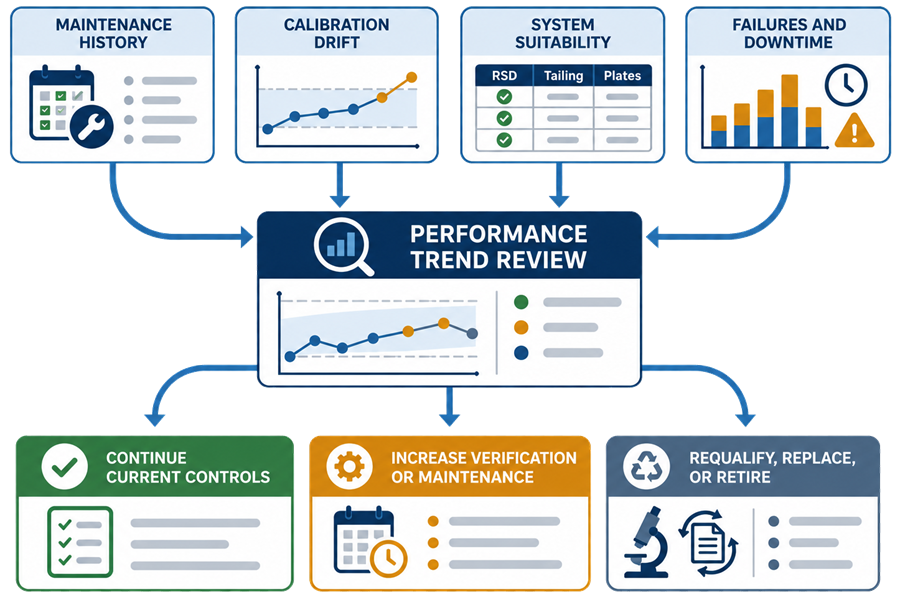
A result may remain within its formal acceptance criterion while contributing to an adverse trend. Trend review should therefore evaluate direction, variability, recurrence, and rate of deterioration rather than only pass/fail status.
Performance Indicators
Useful indicators may include:
- number of failures per period
- mean time between failures
- total downtime
- number of service calls
- repeated replacement of the same part
- calibration adjustments
- magnitude of calibration drift
- failed routine checks
- failed system-suitability tests
- aborted analytical sequences
- maintenance cost
- unavailable spare parts
- time awaiting service
- post-maintenance test failures
Metrics should support decisions. Counting work orders without distinguishing routine service from significant failure provides limited information.
Alert and Action Criteria
The program may define alert or action conditions such as:
- repeated failure within a defined period
- increasing calibration drift
- component replacement more frequently than expected
- increasing downtime
- recurring post-maintenance failure
- system-suitability deterioration
- repeated data-recovery activity
- supplier discontinuation notice
- inability to obtain qualified parts
- loss of supported software
- cybersecurity incompatibility
An alert should trigger review. An action limit should trigger documented intervention.
Criteria should not be selected only after the adverse pattern has developed.
Spare-Parts Strategy
Critical spare parts may be necessary when failure would cause significant testing delay or data risk.
The spare-parts strategy should consider:
- part criticality
- failure frequency
- supplier lead time
- shelf life
- storage requirements
- cost
- interchangeability
- installation capability
- need for vendor service
- instrument population
- production or release dependency
- obsolescence risk
Controls should address:
- approved part number
- revision
- quantity
- storage
- expiration
- environmental conditions
- inspection
- inventory
- reservation for critical systems
- replacement after use
Stockpiling unsupported components is not a complete obsolescence strategy when software, service tools, operating systems, or technical expertise are also disappearing.
Cannibalized Parts
Using parts removed from another instrument creates additional control challenges.
The assessment should address:
- donor instrument identity
- part identity
- part condition
- prior use
- compatibility
- cleaning
- storage
- installation
- traceability
- testing
- effect on both instruments
Cannibalization should not become an uncontrolled substitute for an approved spare-parts program.
Obsolescence Management
Obsolescence may involve:
- discontinued instrument model
- unavailable replacement parts
- unsupported firmware
- unsupported operating system
- unavailable service expertise
- expiring software licenses
- incompatible cybersecurity controls
- obsolete interfaces
- unavailable reference materials
- supplier acquisition or closure
- loss of documentation
The obsolescence assessment should consider:
- current condition
- failure history
- parts availability
- service support
- data migration
- method transfer
- replacement qualification
- software validation
- interface replacement
- regulatory commitments
- laboratory capacity
- transition schedule
Obsolescence should be identified before the instrument becomes unrepairable or its data become inaccessible.
Repair, Replacement, or Retirement Decisions
Replacement or retirement should be considered when:
- failures recur despite maintenance
- downtime becomes unacceptable
- calibration cannot be maintained
- parts are unavailable
- software is unsupported
- cybersecurity controls cannot be maintained
- data cannot be reliably retained or retrieved
- intended methods exceed instrument capability
- maintenance cost is disproportionate
- supplier support is inadequate
- qualification cannot be sustained
The decision should include a transition plan for:
- replacement selection
- data migration
- method transfer
- qualification
- calibration
- interface testing
- user training
- decommissioning
- record retention
- disposal
Periodic Review
Periodic review should evaluate:
- maintenance completion
- overdue events
- interval extensions
- vendor performance
- recurring failures
- parts consumption
- calibration trends
- system-suitability trends
- downtime
- software and firmware status
- data-protection incidents
- vendor-access records
- spare-parts availability
- service-contract status
- obsolescence
- replacement planning
- qualification status
The review should determine whether:
- maintenance scope remains appropriate
- intervals remain justified
- procedures remain current
- service providers remain suitable
- post-maintenance testing remains adequate
- adverse trends require action
- requalification is needed
- replacement should be initiated
Common Maintenance-Control Deficiencies
Common deficiencies include:
- using one generic annual maintenance interval for every instrument
- following supplier intervals without considering actual use
- reducing supplier-recommended scope without documented justification
- allowing overdue maintenance without assessment
- failing to remove the instrument from GMP use
- beginning maintenance with active runs or unsaved data
- failing to protect methods and configuration
- allowing uncontrolled vendor administrator access
- enabling persistent remote access
- using uncontrolled service software or removable media
- allowing unauthorized firmware or software updates
- failing to document as-found observations
- accepting a generic “PM completed” service report
- failing to identify installed parts
- using non-equivalent replacement parts without assessment
- treating corrective repair as routine preventive maintenance
- relying only on system suitability after major maintenance
- failing to calibrate affected measurement functions
- automatically repeating the entire qualification after minor service
- omitting targeted requalification after significant service
- returning the instrument to use before testing is complete
- reviewing repeated failures as isolated events
- failing to trend maintenance with calibration and system-suitability data
- lacking a critical spare-parts strategy
- waiting for complete instrument failure before addressing obsolescence
Conclusion
Preventive maintenance should preserve analytical instrument function before failure occurs. Its scope and interval should reflect intended use, design, workload, sample matrices, performance history, supplier information, and the effectiveness of controls capable of detecting deterioration.
Maintenance, calibration, verification, qualification, and system suitability provide different forms of evidence. Post-maintenance testing should be selected according to the functions affected rather than limited to a generic service checklist or expanded automatically to complete requalification.
Continued control depends on complete service records, controlled vendor access, data and configuration protection, appropriate spare parts, recurring-failure investigation, integrated performance trending, and timely replacement or retirement when the validated state can no longer be reliably sustained.