

Analytical Instrument Repair, Change Control, and Return to Service
Analytical instrument repair begins with containment of the failure, not with replacement of the defective part. Before intervention changes the instrument’s condition, the laboratory should preserve available evidence, remove the affected system from GMP use, identify the failed function, and assess whether data generated before discovery may have been affected.
The repair pathway then depends on what will change. A verified like-for-like replacement may be managed through an approved repair process. Replacement with a different part, firmware update, software change, relocation, configuration reset, or alteration of a qualified function may require formal change control and additional qualification or validation.
Return to service requires more than confirmation that the instrument starts or completes a diagnostic test. The approved evidence must demonstrate that the repair is documented, affected functions are acceptable, data and configuration remain controlled, applicable impact assessments are closed, and the instrument remains suitable for its intended use.
Purpose and Lifecycle Position
The repair and return-to-service process should demonstrate that:
- failures and abnormal conditions are promptly contained
- the instrument is removed from GMP use
- evidence is preserved before intervention
- the affected function and failure mode are identified
- the potential period of impact is defined
- data and product impact are assessed
- the repair pathway is appropriate to the proposed work
- replacement parts are technically assessed
- like-for-like claims are substantiated
- critical-component replacements receive appropriate review
- firmware, software, and configuration changes are controlled
- relocations and reconnections are assessed
- vendor and remote-service access are authorized
- data and configuration are protected
- required calibration, verification, qualification, and software testing are selected
- deviations and change controls are appropriately coordinated
- return to service is formally documented and authorized
The process should operate within the approved risk-based analytical instrument qualification strategy and account for the instrument’s analytical instrument risk classification.
Regulatory Basis
21 CFR 211.160(b)(4) requires provisions for remedial action when analytical instruments do not meet established accuracy or precision limits. Instruments, apparatus, gauges, and recording devices that do not meet established specifications must not be used.
21 CFR 211.68 requires automatic, mechanical, and electronic equipment to be routinely calibrated, inspected, or checked under a written program designed to assure proper performance. It also establishes controls for backup data and authorized changes to computerized records.
FDA’s Q7 Good Manufacturing Practice Guidance for Active Pharmaceutical Ingredients states that incidents involving computerized systems that could affect product quality or the reliability of records or test results should be recorded and investigated. Changes to computerized systems should be authorized, documented, tested, and maintained in records demonstrating continued validated status.
These requirements support a controlled repair and impact-assessment process but do not prescribe one fixed test package after every intervention.
Repair, Maintenance, Adjustment, and Change
Related activities should remain distinct.
| Activity | Primary purpose |
|---|---|
| Repair | Restore a failed or defective function |
| Preventive maintenance | Reduce the probability of failure through planned service |
| Adjustment | Change the instrument to reduce error or restore an operating condition |
| Calibration | Establish the relationship between an instrument indication and a suitable reference |
| Modification | Intentionally alter design, configuration, capability, or operation |
| Change control | Assess, authorize, implement, test, and close a planned change |
| Requalification | Re-establish documented suitability of functions affected by repair or change |
A repair may include adjustment, calibration, configuration restoration, or modification. The work should be described according to what actually occurred rather than assigned one broad label.
Related maintenance controls are addressed in Preventive Maintenance and Performance Trending of Analytical Instruments. Calibration controls are addressed in Calibration and Routine Performance Verification of Analytical Instruments.
Failure Detection
A potential instrument failure may be identified through:
- failed calibration
- failed routine verification
- failed system suitability
- analytical deviation
- out-of-specification investigation
- unexpected result
- alarm
- diagnostic error
- leak
- abnormal pressure
- unstable temperature
- unusual noise
- vibration
- detector-response loss
- increasing baseline noise
- data-acquisition interruption
- communication failure
- calculation error
- audit-trail review
- corrupted or missing record
- service observation
- user observation
The initial response should reflect the possibility that the condition existed before it was discovered.
Immediate Failure Containment
Immediate containment may include:
- stop the analytical run when scientifically and procedurally appropriate
- prevent new sample analysis
- place the instrument out of service
- identify affected modules
- preserve displayed errors
- preserve raw data
- preserve audit trails and system logs
- prevent automatic deletion or overwriting
- retain samples, standards, and preparations where stability permits
- record the instrument configuration
- photograph or document physical conditions where useful
- identify the last known acceptable performance evidence
- notify responsible laboratory and Quality personnel
- initiate the applicable deviation or investigation
The following illustration shows the sequence from failure detection through definition of the repair pathway.
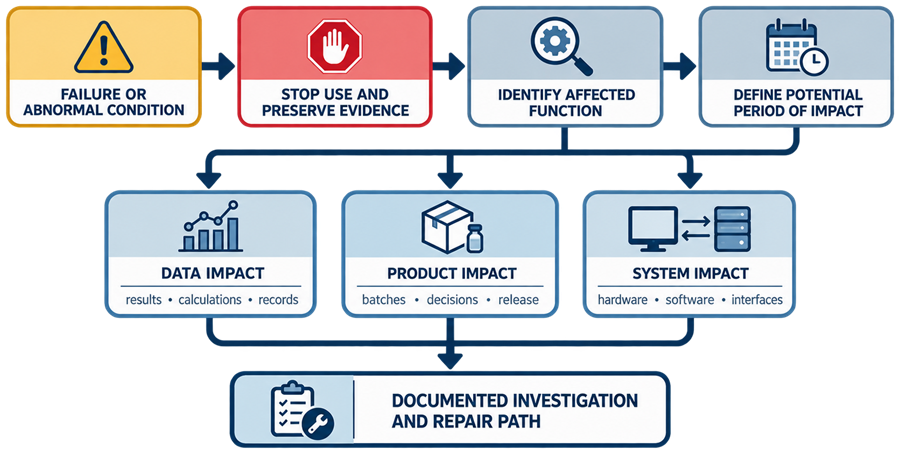
The instrument should not be adjusted, restarted repeatedly, cleared, reinitialized, or repaired before useful evidence is captured unless necessary for safety or data protection.
Preserving the As-Found Condition
The as-found condition may provide the only evidence available for determining:
- the failed component
- the magnitude of error
- the direction of bias
- whether the failure was intermittent
- whether the condition affected one function or the complete system
- when the failure may have started
- which data may require review
Evidence may include:
- instrument readings
- calibration results
- pressure values
- temperatures
- diagnostic codes
- chromatograms
- spectra
- audit trails
- event logs
- system-suitability results
- photographs
- damaged parts
- leak location
- error messages
- configuration files
- service counters
A failed component should be retained when examination could support root-cause or impact assessment.
Instrument Status Control
An instrument under repair should have a controlled status such as:
- out of service
- under investigation
- repair in progress
- awaiting parts
- awaiting calibration
- awaiting qualification
- restricted use
- awaiting Quality review
Status should be visible to users and represented in the authoritative equipment-management system.
Disconnection from the network or physical removal of a module does not by itself provide sufficient status control.
Initial Technical Assessment
The initial assessment should determine:
- what failed
- how the failure was detected
- which module or function is affected
- whether the condition is confirmed
- whether the failure is continuous or intermittent
- whether data are accessible
- whether the instrument can be safely powered
- whether additional diagnostic testing is justified
- whether vendor support is required
- whether the proposed intervention could change qualified functions
- whether formal change control is required
- what evidence must be collected before repair
The assessment may be revised as additional information becomes available.
Defining the Potential Period of Impact
The potential period of impact is the interval during which the instrument may have generated unreliable results. The starting point may initially be the last acceptable calibration, qualification, routine verification, or other suitable performance check.
The period may be narrowed using documented evidence such as:
- successful system suitability
- control-sample results
- reference-standard performance
- routine checks
- instrument diagnostics
- maintenance records
- audit trails
- alarm history
- calibration trends
- pressure or temperature logs
- comparison with another qualified instrument
- known component-failure time
- known event such as relocation, power loss, or service activity
The end point is normally when the instrument was removed from use or the affected function was isolated.
The review should not narrow the period solely to reduce the amount of data requiring assessment.
Data Impact Assessment
The data-impact assessment should identify:
- analytical runs
- methods
- samples
- standards
- blanks
- system-suitability results
- operating conditions
- affected instrument functions
- raw data
- calculations
- reports
- interfaces
- data transfers
- invalidated tests
- repeated tests
- stability data
- validation data
- development data used for GMP decisions
The assessment should determine whether the failure could have affected:
- measured result
- precision
- sensitivity
- specificity
- resolution
- retention
- integration
- peak or analyte identification
- sample association
- calculation
- dilution factor
- units
- rounding
- acceptance decision
- data completeness
- audit trail
- record reconstruction
A failure does not automatically invalidate every result generated during the potential impact period. The disposition should be based on the failed function, magnitude and direction of effect, method conditions, and corroborating evidence.
Product and Decision Impact
The product-impact assessment should identify decisions supported by potentially affected data, including:
- raw-material release
- in-process decisions
- finished-product release
- rejected material
- stability conclusions
- validation acceptance
- cleaning verification
- environmental-monitoring decisions
- complaint investigations
- deviation investigations
- regulatory submissions
- process-development decisions used in commercial control
The evaluation should consider whether the potential instrument error could change:
- pass/fail classification
- specification compliance
- trend interpretation
- batch disposition
- shelf-life conclusion
- validated-state conclusion
- regulatory commitment
Released product does not automatically require recall because an instrument was repaired. The need for market action depends on the documented product-risk assessment.
System and Configuration Impact
The system-impact assessment should address:
- hardware
- firmware
- operating system
- instrument-control software
- acquisition software
- processing software
- database
- network
- interfaces
- user accounts
- audit trails
- electronic signatures
- backup
- time synchronization
- configuration
- calculation settings
- report templates
- connected analytical modules
A localized hardware failure may still affect the wider system if the repair requires controller replacement, firmware installation, configuration restoration, or database intervention.
Investigation Pathway
The failure should be managed through the site’s applicable quality-system pathway. Possible records include:
- laboratory investigation
- calibration-failure investigation
- equipment deviation
- computerized-system incident
- data-integrity investigation
- corrective-maintenance record
- work order
- change control
- corrective and preventive action
These records may operate together. A maintenance work order documents the physical repair but may not provide adequate investigation, data-impact, or change-control evidence.
Repair Classification
Repair classification helps determine authorization, documentation, and testing, but it should not replace technical impact assessment. A practical classification may distinguish:
- minor like-for-like repair
- significant like-for-like repair
- critical-component replacement
- non-like-for-like replacement
- hardware modification
- firmware change
- software change
- configuration restoration
- relocation or reinstallation
- emergency repair
The same replacement can have different significance depending on intended use and system architecture.
Like-for-Like Replacement
A replacement may be considered like-for-like when the new part has the same:
- manufacturer or approved source
- part number
- revision or approved equivalent revision
- material
- dimensions
- operating specification
- performance characteristics
- interfaces
- firmware where embedded
- intended function
- compatibility
A like-for-like designation does not mean that no testing is required.
Replacement of an identical critical component may still require:
- calibration
- leak testing
- alignment
- functional verification
- system suitability
- targeted qualification
Examples include:
- identical temperature sensor
- identical HPLC pump seal
- identical autosampler syringe
- identical detector lamp
- identical GC inlet seal
- identical dissolution shaft
- identical power supply
The required evidence depends on the function affected.
Approved Equivalent Parts
A part may be technically equivalent without being identical. The assessment should compare:
- part number
- specification
- material
- tolerances
- dimensions
- electrical characteristics
- communication protocol
- performance range
- chemical compatibility
- sample-contact characteristics
- embedded firmware
- supplier support
- installation requirements
An approved equivalent may require formal change control when equivalence cannot be established solely through an existing approved parts specification.
Statements such as “newer version” or “vendor-recommended replacement” do not establish equivalence.
Critical-Component Replacement
Critical components may directly affect measurement, control, data acquisition, calculations, records, or sample identity. Examples include:
- balance load cell
- temperature sensor
- pressure sensor
- flow controller
- HPLC pump
- autosampler metering device
- detector
- optical grating
- wavelength encoder
- GC electronic pressure controller
- headspace sample loop
- dissolution drive assembly
- pH electrode
- conductivity cell
- instrument controller
- acquisition board
- workstation
- database server
- storage drive
- network interface
Replacement should address:
- component identity
- configuration
- calibration
- affected operating range
- interaction with other modules
- software recognition
- communication
- stored coefficients
- required qualification
- representative intended-use performance
Minor Repairs
Minor repairs may include work that does not affect measurement, control, data, configuration, sample identity, or qualified operation. Examples may include:
- replacement of an exterior panel
- replacement of a noncritical handle
- replacement of an equivalent power cord
- replacement of a cosmetic cover
- external cleaning
- replacement of an approved printer component where the authoritative record is electronic
The classification depends on actual system design. A cable replacement that initially appears minor may be significant if the cable carries a detector signal or controlled communication.
Repair and Change-Control Decision
The repair pathway should be selected before work begins where possible. The following illustration distinguishes like-for-like repair, documented impact assessment, and formal change control.
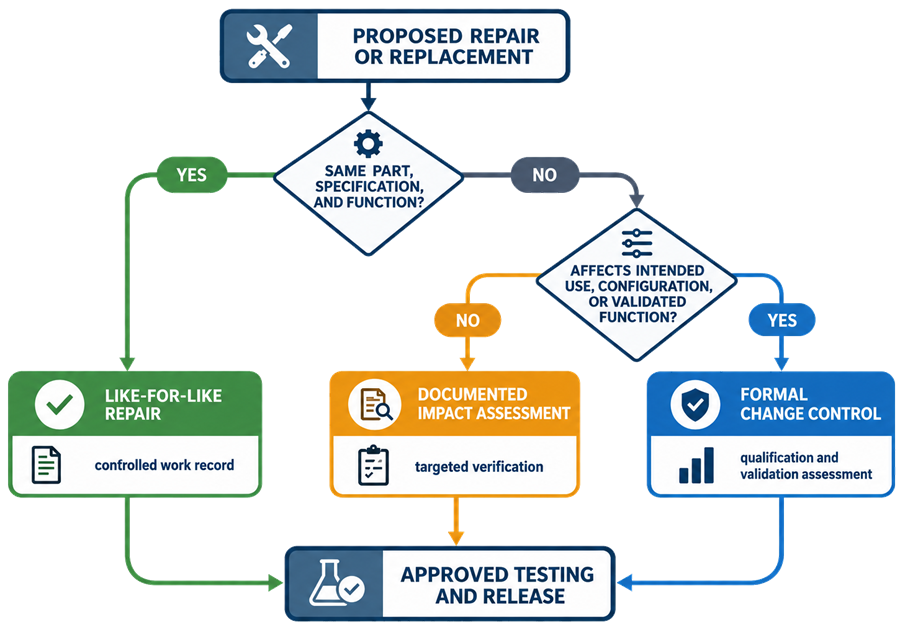
Formal change control is generally appropriate when the proposed work affects:
- approved intended use
- qualified range
- system architecture
- critical specification
- hardware design
- software or firmware
- electronic records
- interfaces
- user access
- cybersecurity
- calculations
- configuration baseline
- validated function
- regulatory commitment
A like-for-like repair may proceed under an approved repair procedure when the part, function, risk, and required testing are already defined.
Deviation Versus Change Control
A deviation documents an unplanned event or departure. Change control manages a planned alteration.
A failure normally begins as a deviation or incident because it was not planned. The repair may then require change control if the proposed solution changes the approved system.
Examples:
| Situation | Likely pathway |
|---|---|
| Failed identical lamp replaced under an approved procedure | Repair record with defined post-replacement testing |
| Failed pressure sensor replaced with the same approved part | Deviation or repair record plus calibration and targeted verification |
| Obsolete sensor replaced with a different model | Deviation plus formal change control |
| Workstation restored from an approved image after drive failure | Computerized-system incident with configuration and recovery verification |
| Workstation replaced with a new model and operating system | Deviation plus formal change control and validation assessment |
| Emergency repair performed before approval to protect data or safety | Emergency deviation followed by retrospective change assessment where applicable |
Closing the deviation does not automatically close the change control, and vice versa.
Emergency Repairs
Emergency repairs may be necessary to:
- protect samples
- preserve data
- prevent unsafe conditions
- stop leakage
- prevent further damage
- restore critical laboratory capability
The emergency process should define:
- who can authorize the work
- immediate permitted actions
- evidence to preserve
- data-protection requirements
- parts permitted
- temporary configuration
- retrospective assessment
- required testing
- restrictions on use
- Quality review
Emergency status should not be used to bypass required validation or release evidence.
Hardware Repairs
Hardware repair assessment should consider:
- mechanical fit
- electrical compatibility
- materials
- sample-contact surfaces
- pressure rating
- temperature rating
- flow characteristics
- operating range
- accuracy
- precision
- detector response
- communication
- embedded firmware
- safety
- environmental suitability
The repair record should identify parts removed and installed. “Module repaired” is inadequate when the identity and effect of the replacement cannot be determined.
Firmware Changes
Firmware may control:
- sensors
- pumps
- detectors
- valves
- autosamplers
- temperatures
- pressures
- acquisition timing
- module communication
- diagnostics
- data buffering
- error handling
A firmware change should identify:
- current version
- proposed version
- reason
- release notes
- corrected defects
- new functions
- removed functions
- hardware compatibility
- software compatibility
- configuration effect
- data-format effect
- cybersecurity effect
- rollback capability
- testing
- approval
Firmware should not be updated automatically during repair without site authorization.
Software Changes
Repair may involve:
- reinstalling instrument software
- replacing a workstation
- changing drivers
- installing a service pack
- changing database components
- repairing an application
- restoring a virtual machine
- applying a security patch
- replacing interface software
- updating license services
These changes should be coordinated with analytical instrument software validation.
Testing may address:
- installation
- version
- configuration
- user access
- audit trails
- data acquisition
- processing
- calculations
- reporting
- electronic signatures
- interfaces
- backup
- restoration
- record retrieval
A successful login does not demonstrate that the application remains validated.
Configuration Restoration
Repair may reset or remove instrument configuration. Configuration elements may include:
- module identity
- serial number
- sensor coefficients
- calibration coefficients
- communication addresses
- instrument methods
- acquisition settings
- processing methods
- report templates
- calculation parameters
- user roles
- audit-trail settings
- time zone
- network address
- interface mappings
- storage location
- backup schedule
Restoration should use an approved baseline, verified backup, controlled installation record, or documented reconstruction.
The site should verify restored values rather than assume that a successful file import reproduced the approved state.
Workstation and Controller Replacement
Replacement of a workstation or controller may affect:
- operating system
- hardware drivers
- instrument communication
- application version
- licenses
- security configuration
- user accounts
- database connectivity
- time synchronization
- printers
- interfaces
- data paths
- backup
- audit trails
- historical-data access
The impact assessment should determine whether the replacement is:
- restoration to an approved baseline
- like-for-like hardware replacement
- infrastructure change
- software change
- broader computerized-system change
Historical data should remain available and readable after replacement.
Data Recovery
Repair may require recovery from:
- backup
- database copy
- redundant storage
- instrument buffer
- local workstation
- server
- archive
- disaster-recovery environment
Recovery verification should confirm:
- correct records
- completeness
- metadata
- audit trails
- relationships among dynamic records
- sample identification
- timestamps
- calculations
- review status
- electronic signatures
- accessibility
- protection from alteration
Recovered reports alone may be insufficient when original dynamic electronic records are required.
Service Access
Vendor or internal service personnel may require privileged access. Access should be:
- authorized
- attributable
- limited to required functions
- time restricted
- monitored where appropriate
- disabled after work
- documented
Controls should address:
- administrator accounts
- service accounts
- temporary passwords
- remote support
- removable media
- diagnostic programs
- file transfers
- audit trails
- screenshots
- configuration changes
- data exports
- internet connections
The FDA Data Integrity and Compliance With Drug CGMP guidance should be considered when controlling access to GMP computerized systems and records.
Remote Service
Remote service should require authorization for each session unless a continuously available connection has been specifically justified and controlled.
The record should identify:
- date and time
- vendor
- service engineer
- account
- system accessed
- reason
- actions performed
- files transferred
- changes made
- session termination
- post-session review
The site should review applicable logs or audit trails when the remote session could alter configuration, software, or records.
Relocation
Relocation can affect an analytical instrument even when no repair occurs.
The assessment should consider:
- transport method
- shock and vibration
- temperature and humidity
- disassembly
- shipping locks
- optical alignment
- leveling
- utilities
- gases
- ventilation
- bench stability
- electromagnetic environment
- network
- data connection
- instrument address
- environmental controls
Relocation scope may range from a minor movement on the same bench to shipment between buildings or sites.
Testing may include:
- installation verification
- level
- alignment
- calibration
- leaks
- temperature
- flow
- communication
- software configuration
- interface testing
- system suitability
- targeted OQ
- targeted PQ
Reconnections and Utility Changes
Repair or relocation may require reconnection of:
- electrical supply
- uninterruptible power supply
- gases
- vacuum
- exhaust
- cooling water
- compressed air
- drainage
- network
- time service
- printers
- servers
- LIMS interfaces
The assessment should verify correct identity, specification, direction, pressure, flow, security, and communication.
A reconnected instrument should not be released solely because it powers on.
Repair Documentation
The repair record should include:
- instrument identification
- failure description
- date and time detected
- detection method
- status applied
- as-found evidence
- affected function
- potential impact period
- work-order number
- deviation or incident number
- change-control number where applicable
- service provider
- repair procedure
- parts removed
- parts installed
- part numbers
- revisions
- serial or lot numbers where relevant
- adjustments
- firmware changes
- software changes
- configuration changes
- data-recovery actions
- diagnostics
- calibration
- qualification
- unresolved recommendations
- reviewer
- release decision
Vendor service reports may support the record but do not replace the site’s impact assessment and release authorization.
Selecting Required Testing
Post-repair testing should be based on:
- failure mode
- component function
- repair scope
- adjustment performed
- configuration changed
- software or firmware affected
- potential downstream effects
- intended use
- operating range
- available supplier evidence
- risk of undetected failure
Possible evidence includes:
- visual inspection
- installation verification
- leak testing
- calibration
- routine verification
- functional challenge
- alarm testing
- communication testing
- software regression testing
- interface testing
- backup and recovery testing
- system suitability
- representative analytical testing
- targeted OQ
- targeted PQ
- broader requalification
The test package should be defined before results are known.
Calibration After Repair
Calibration is appropriate when repair affects a measurement or control function. Examples include:
- mass
- temperature
- pressure
- flow
- time
- speed
- wavelength
- absorbance
- detector response
- injection volume
- dimensional position
Where possible, as-found calibration should occur before adjustment or repair so prior data can be assessed.
A passing as-left calibration demonstrates final condition. It does not resolve retrospective impact.
Functional Verification
Functional testing may address:
- startup
- shutdown
- module recognition
- operating modes
- setpoint control
- alarms
- interlocks
- sequence execution
- sample handling
- valve operation
- communication
- error handling
- recovery after interruption
Vendor diagnostics may support functional verification, but proprietary tests should be understood sufficiently to determine what they challenge.
Software Regression Testing
Regression testing should focus on functions that could have been affected by the repair or change. Applicable tests may include:
- login
- roles
- permissions
- method execution
- acquisition
- calculations
- processing
- audit trails
- electronic signatures
- reporting
- interfaces
- backup
- restoration
- historical-record retrieval
Full repetition of the original software validation is not automatically required. The scope should be justified through impact assessment.
Qualification Testing
Targeted qualification may be required when repair affects an originally qualified function. Examples include:
- pump replacement
- autosampler repair
- detector replacement
- oven-controller repair
- dissolution drive repair
- headspace loop replacement
- optical alignment
- robotic positioning
- workstation replacement
- communication-controller replacement
Testing may include targeted OQ, PQ, or both.
The analytical instrument requalification framework should determine the appropriate scope.
System Suitability and Representative Testing
System suitability can provide intended-use evidence after repair. It may demonstrate:
- injection precision
- response
- resolution
- retention
- carryover
- blank performance
- detector suitability
- method execution
It should not be used as the only evidence when the repair affects functions not adequately challenged by the selected method.
Representative testing should be chosen to challenge the repaired function, not merely because the method is convenient.
Failed Post-Repair Testing
Failure of post-repair testing should trigger:
- continued out-of-service status
- preservation of results
- investigation
- review of repair adequacy
- review of installed parts
- review of configuration
- additional repair
- revised impact assessment
- additional testing
Repeated adjustment until a passing result is obtained should not replace investigation of instability or recurring failure.
Return-to-Service Evidence
The following illustration shows the principal evidence streams that may support return to service.
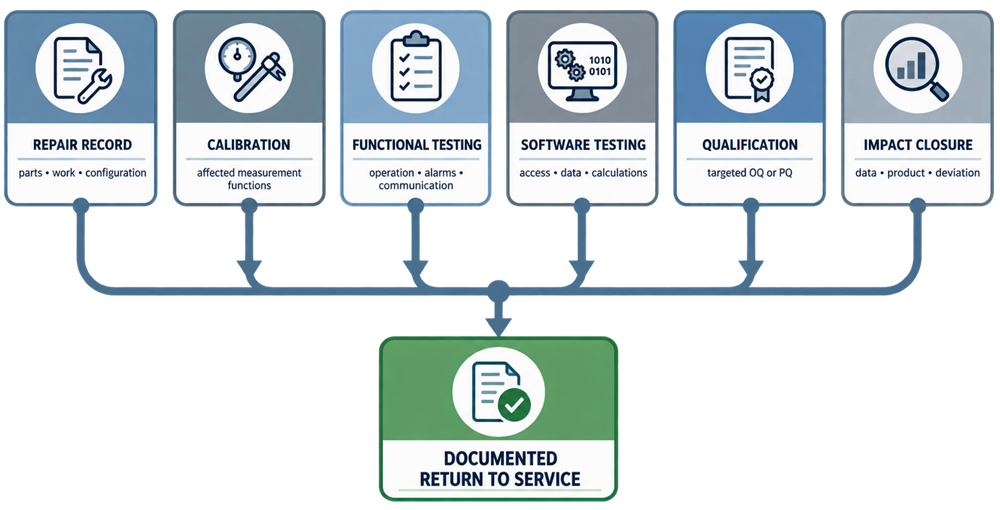
Not every repair requires every evidence stream. The approved impact assessment should identify which are applicable and justify exclusions.
Documented Release
The release record should confirm:
- repair is complete
- installed parts are acceptable
- configuration is restored
- data are protected and accessible
- required calibration passed
- required functional tests passed
- required software tests passed
- required qualification passed
- impact assessment is approved
- deviations are closed or appropriately controlled
- change control is approved for use
- remaining restrictions are documented
- equipment status is updated
- authorized person approved return to service
The person authorizing release should have access to the complete evidence package, not only the vendor’s completion statement.
Restricted Return to Service
Restricted use may be appropriate when only specific functions are demonstrated acceptable. The restriction should define:
- permitted modules
- permitted methods
- permitted range
- prohibited functions
- required additional checks
- responsible users
- expiration or review date
- condition for full release
A generic “limited use” status without defined technical boundaries is inadequate.
Temporary Repairs
A temporary repair may be justified when:
- the permanent part is unavailable
- laboratory continuity is necessary
- risk is controlled
- the temporary configuration is technically acceptable
- additional verification is established
- duration is limited
- replacement is planned
The record should define:
- temporary part or configuration
- technical rationale
- limitations
- required checks
- expiration
- responsible owner
- permanent corrective action
A temporary repair should not remain indefinitely through repeated extensions.
Recurring Repairs
Recurring repair of the same function should trigger broader assessment. The review should consider:
- frequency
- time between failures
- common component
- common supplier
- operating conditions
- sample matrix
- environmental conditions
- power quality
- user practices
- maintenance interval
- software version
- design weakness
- instrument age
- obsolescence
Possible actions include:
- root-cause investigation
- preventive-maintenance revision
- interval reduction
- expanded verification
- supplier escalation
- design modification
- replacement
- retirement
Recurring repair data should be integrated with performance trending in Preventive Maintenance and Performance Trending of Analytical Instruments.
Periodic Review
Periodic review should evaluate:
- repair frequency
- repeated components
- emergency repairs
- temporary repairs
- deviations
- change controls
- post-repair test failures
- calibration drift
- downtime
- vendor performance
- service access
- firmware and software changes
- configuration-restoration events
- data-recovery events
- spare-parts availability
- obsolescence
- replacement planning
The review should determine whether the repair process remains effective and whether continued investment in the instrument is justified.
Common Repair-Control Deficiencies
Common deficiencies include:
- repairing before preserving the as-found condition
- failing to remove the instrument from GMP use
- treating every repair as an isolated maintenance event
- failing to define the potential impact period
- omitting retrospective data assessment
- omitting product or batch-impact assessment
- calling a different part like-for-like without comparison
- assuming an identical critical part requires no testing
- using vendor recommendation as the sole equivalence justification
- failing to control emergency repairs
- closing a deviation without opening required change control
- performing firmware updates without authorization
- reinstalling software without validation assessment
- restoring configuration without verifying values
- allowing uncontrolled vendor administrator access
- failing to review remote-service activity
- overlooking data and audit trails during workstation replacement
- treating relocation as simple physical movement
- using system suitability as the only evidence after significant repair
- automatically repeating complete qualification after minor repair
- failing to perform targeted qualification after critical repair
- returning the instrument to use based only on a service report
- failing to define restricted-use boundaries
- allowing temporary repairs to become permanent
- repeatedly replacing the same component without trend review
- failing to update equipment status after approved release
Conclusion
Analytical instrument repair should be controlled from failure detection through documented return to service. The first priorities are containment, preservation of evidence, removal from use, and assessment of potentially affected data and product decisions.
The repair pathway depends on what will change. Verified like-for-like work may follow an approved repair process, while non-equivalent components, critical modifications, firmware or software changes, configuration changes, and significant relocations may require formal change control and additional qualification or validation.
Return to service should be supported by a complete evidence package appropriate to the repair: repair records, configuration restoration, calibration, functional testing, software testing, qualification, impact closure, and documented authorization.