

Chromatography Columns, Packing, and Resin Lifecycle Control
Chromatography performance depends on more than the skid delivering the correct flow, pressure, and buffer composition. The column hardware, packed bed, chromatography resin, packing procedure, cleaning strategy, storage conditions, and reuse controls function together as a product-contact system. Weakness in any one of these elements can affect flow distribution, binding capacity, impurity removal, recovery, and batch-to-batch consistency.
This article describes lifecycle controls for reusable, prepacked, and single-use chromatography columns used in pharmaceutical and biopharmaceutical manufacturing. It distinguishes column qualification, packing verification, resin-lifetime control, and purification-process validation.
Purpose and Lifecycle Position
The purpose of chromatography column lifecycle control is to demonstrate that:
- Column hardware is suitable for its intended process conditions.
- The resin is received, identified, stored, and used under approved conditions.
- Packing is performed reproducibly using defined parameters.
- The packed bed meets established performance criteria before use.
- Cleaning, regeneration, sanitization, and storage procedures maintain the column in a controlled condition.
- Resin performance remains acceptable throughout the approved reuse period.
- Changes, adverse trends, investigations, and retirement decisions remain traceable.
Column control is related to—but not interchangeable with—chromatography skid qualification or purification-process validation.
Column qualification establishes that the hardware and associated packing equipment are installed and operate as intended. Packing verification evaluates the condition and hydraulic performance of the packed bed. Process validation establishes that the complete purification operation can consistently deliver material meeting its predefined quality requirements.
Column and Resin System Boundary
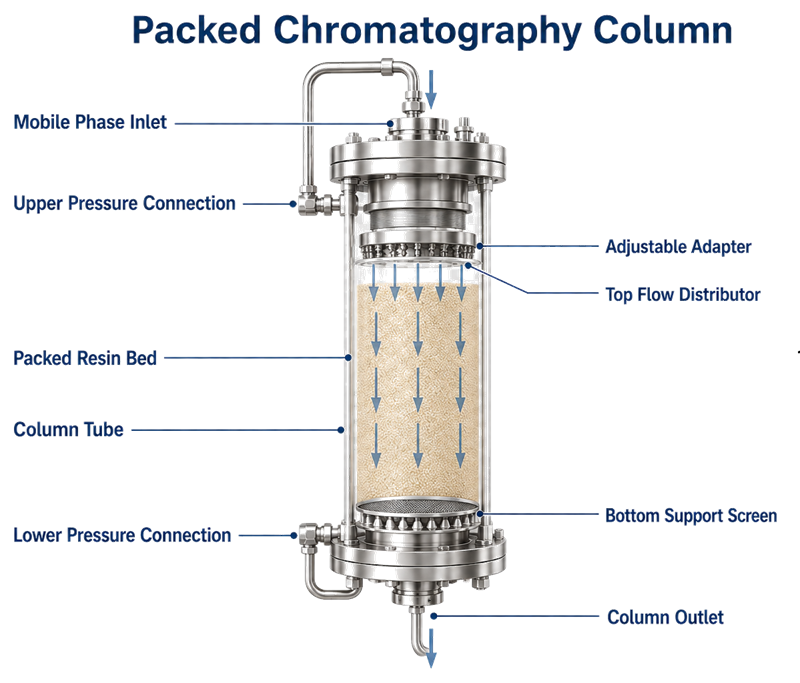
The column-and-resin boundary normally begins at the column inlet connection and ends at the column outlet connection. It includes the components that distribute mobile phase through the bed, contain the resin, maintain bed compression, and protect the downstream process from loss of resin or mechanical debris.
Typical components include:
- Column tube or body
- Adjustable or fixed adapters
- Inlet and outlet distributors
- Bed-support screens or frits
- Seals, O-rings, and gaskets
- Pressure-monitoring connections
- Process and drain connections
- Packing ports and vent points
- Retaining hardware
- Packed chromatography resin
The associated chromatography skid design, architecture, and process control article addresses the equipment that supplies and controls flow, buffers, pressure, valve routing, and fraction collection.
Column Configurations
Column configuration should be selected according to process scale, resin properties, operating pressure, required bed height, cleaning strategy, and anticipated reuse.
Common configurations include:
- Fixed-bed-height columns
- Adjustable-adapter columns
- Axial-compression columns
- Dynamic axial-compression columns
- Prepacked columns
- Single-use columns
- Multi-column chromatography arrangements
Design review should consider the operating pressure rating, pressure distribution, flow-direction restrictions, usable bed-height range, materials of construction, seal compatibility, drainage, venting, cleaning access, and the ability to inspect or replace critical components.
The column should be adequately sized and located to support its intended operation, cleaning, and maintenance, consistent with the equipment principles in 21 CFR 211.63.
Resin Selection and Supplier Control
Chromatography resin selection is normally based on the separation mechanism and the process-development control strategy. Examples include affinity, ion-exchange, hydrophobic-interaction, mixed-mode, and size-exclusion media.
Resin suitability should consider:
- Ligand chemistry and separation mechanism
- Particle size and pressure-flow characteristics
- Dynamic binding capacity
- Selectivity and impurity clearance
- Chemical and temperature compatibility
- Cleaning and sanitization tolerance
- Storage requirements
- Expected reuse
- Potential ligand leakage or resin-derived impurities
- Supplier manufacturing and change-notification controls
Supplier documentation can support resin assessment, but it does not replace site-specific evaluation. Supplier qualification, technical agreements, certificates, change notifications, and incoming controls should be proportionate to risk. Broader supplier controls are discussed in Supplier Assessment and Vendor Qualification.
Resin Lifecycle
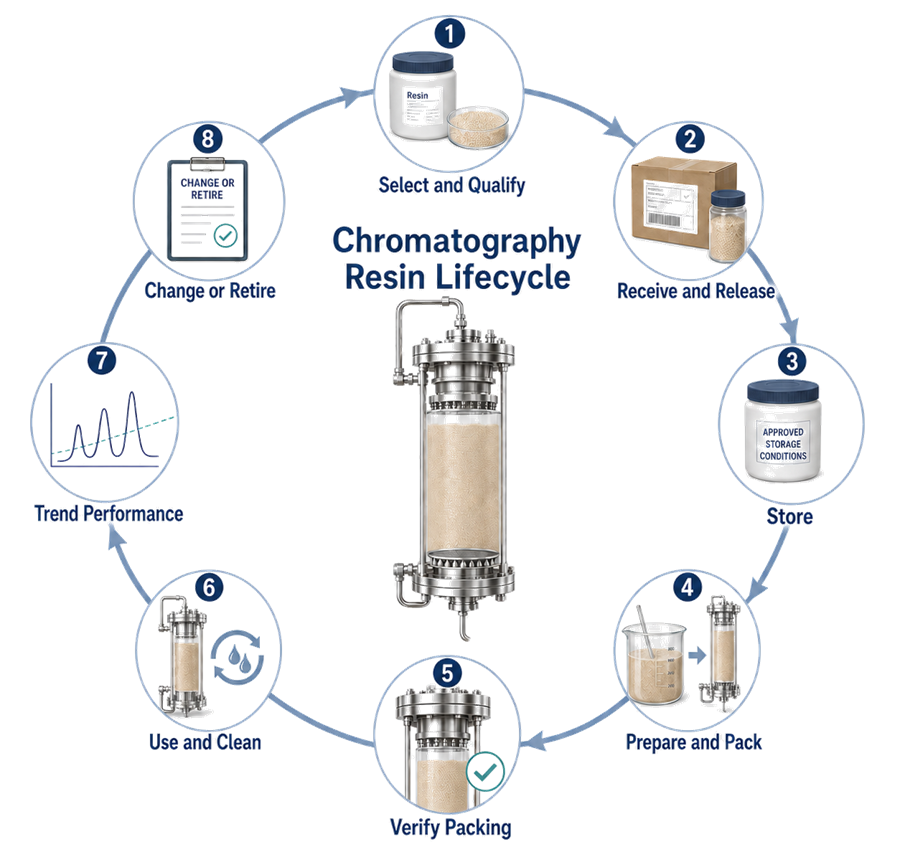
The resin lifecycle begins before packing and continues until the material is formally retired. A controlled lifecycle normally includes:
- Selection and technical qualification
- Supplier approval
- Receipt and release
- Storage before use
- Slurry preparation
- Column packing
- Packing verification
- Process use
- Cleaning, regeneration, and sanitization
- Storage between uses
- Performance monitoring and trending
- Change evaluation or retirement
The approved lifecycle should define how resin identity, lot number, column assignment, cycle count, cleaning history, storage history, and performance results remain connected.
Resin Receipt, Release, and Storage
Receipt controls should confirm resin identity, supplier lot, quantity, container condition, expiration or retest information where applicable, and conformity with the approved specification.
Storage controls should address:
- Supplier and site-approved storage conditions
- Container closure and labeling
- Protection from freezing, overheating, drying, or microbial contamination
- Maximum storage duration
- Required preservative or storage solution
- Status identification
- Traceability after partial container use
- Handling of temperature or storage excursions
Storage requirements are resin-specific. A universal temperature, preservative, or maximum storage interval should not be applied across different chromatography media.
Slurry Preparation and Column Packing
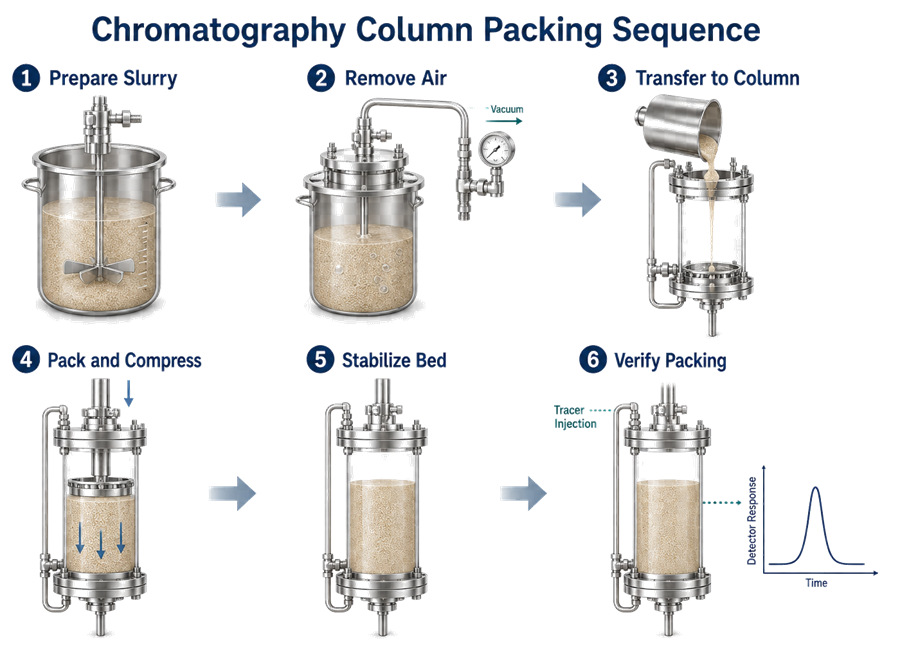
Packing should be performed using an approved procedure appropriate for the column and resin combination. Important parameters may include:
- Slurry concentration
- Packing buffer composition
- Resin and buffer temperature
- Mixing conditions
- Removal or control of entrained air
- Slurry-transfer method
- Column orientation and leveling
- Target bed height
- Packing flow or velocity
- Packing pressure
- Adapter position
- Compression factor
- Stabilization volume or time
The procedure should define how slurry concentration is determined and how settling, foaming, resin damage, or nonuniform transfer is prevented. Resin should not be allowed to settle unpredictably during transfer unless that behavior is incorporated into the validated packing method.
Column assembly should be checked before packing. Incorrect adapter alignment, damaged seals, obstructed screens, improperly installed distributors, trapped air, or an unlevel column can produce a poor bed even when the nominal packing parameters are met.
Packing Verification
Packing verification confirms that the resin bed is level, intact, properly compressed, and able to distribute liquid evenly. It commonly includes:
- Bed-height and visual checks
- Leak testing
- Pressure testing at defined flow rates
- A tracer or pulse-injection test
- Evaluation of peak shape, High Equivalent to a Theoretical Plate (HETP), and peak asymmetry
During a tracer test, a small amount of nonbinding solution is passed through the column and measured by a downstream detector. A well-packed bed normally produces a relatively narrow and symmetrical peak. A broad or irregular peak may indicate uneven flow, channeling, a void, incorrect compression, trapped air, or a problem with the test setup.
Theoretical plates, represented by N, estimate packed-bed efficiency:
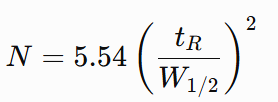
Here, tR is the time or volume required for the tracer to reach the detector, and W1/2 is the peak width measured at half height. A narrower peak generally produces a higher N value.
HETP relates this result to the packed-bed height:
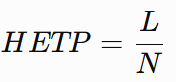
Here, L is the bed height. A lower HETP generally indicates less tracer spreading and more uniform bed performance.
Peak asymmetry evaluates whether the peak is balanced or shows tailing or fronting. Because test conditions can affect all these results, the tracer, flow rate, injection volume, temperature, tubing, detector, and calculation method should be controlled.
Acceptance criteria must be established for the specific column, resin, scale, and approved procedure. A passing packing test confirms bed condition; it does not by itself demonstrate process validation, binding capacity, impurity clearance, or cleaning effectiveness.
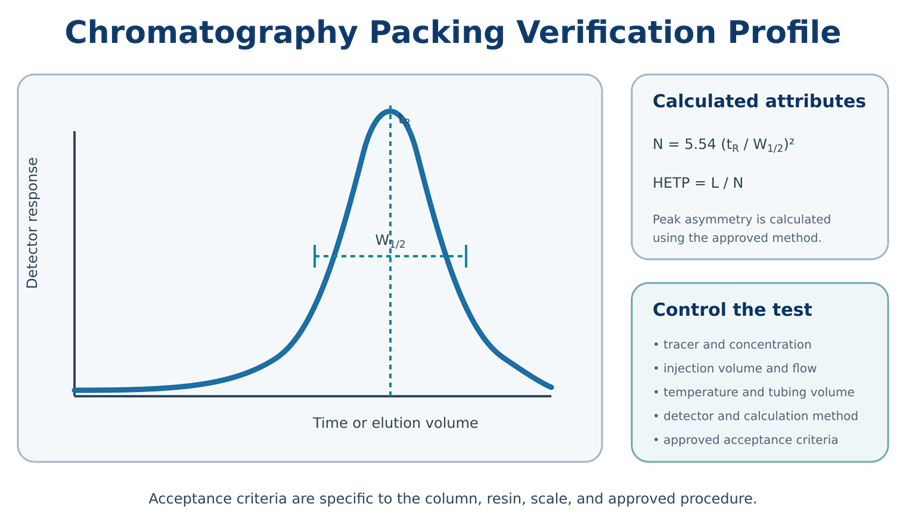
A satisfactory packing test does not independently demonstrate binding capacity, impurity clearance, cleaning effectiveness, or validated process performance. Conversely, an atypical tracer result should not be dismissed solely because a previous process batch met release requirements.
Process Use and Routine Monitoring
A chromatography cycle may include equilibration, loading, washing, elution, stripping or regeneration, cleaning or sanitization, and storage. The applicable phases depend on the chromatography mode and process design; not every operation is a bind-and-elute process.
Routine monitoring may include:
- Inlet and outlet pressure
- Differential pressure across the column
- Flow rate
- UV response
- Conductivity
- pH
- Temperature
- Load quantity
- Elution volume
- Pool volume
- Yield or recovery
- Binding or breakthrough behavior
- Impurity clearance
- Cleaning and rinse endpoints
- Bioburden or endotoxin controls where applicable
Results should be evaluated within the complete process context. Rising pressure may result from resin compression, fouling, blocked supports, buffer precipitation, tubing restrictions, or an upstream skid condition. Reduced recovery may originate from the column, resin, load material, buffer preparation, operating recipe, or fraction-collection strategy.
Resin Reuse and Lifetime Studies
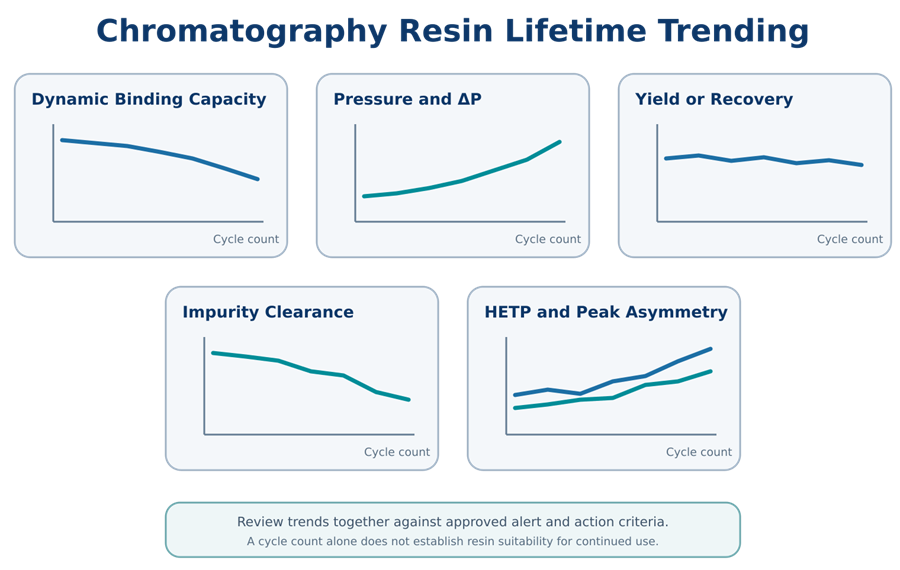
Reuse limits should be supported by scientific evidence rather than selected only as an operational target. Resin-lifetime studies should represent expected and reasonably challenging process conditions, including applicable cleaning, regeneration, sanitization, storage, and hold-time exposures.
A resin-lifetime program may evaluate:
- Dynamic binding capacity
- Product recovery
- Product-quality attributes
- Impurity clearance
- Ligand leakage where relevant
- Carryover
- Pressure and differential-pressure trends
- HETP and peak asymmetry
- Cleaning effectiveness
- Microbial or endotoxin control where relevant
- Physical resin condition
- Cumulative exposure to cleaning chemicals
- Maximum storage intervals
- Number and sequence of process cycles
Small-scale studies can support development of the reuse strategy, but their representativeness should be justified. Commercial experience should confirm the expected lifecycle under actual manufacturing conditions.
The approved reuse limit should account for the total number and type of exposures, not merely the number of product batches. Development cycles, aborted cycles, repeated cleaning, extended holds, and atypical storage conditions may need to be included in the resin history.
Cleaning, Regeneration, Sanitization, and Storage
Cleaning and regeneration procedures should be compatible with the resin, column materials, seals, screens, and associated flow path.
Procedures should define, as applicable:
- Cleaning-agent identity and concentration
- Sequence and direction of flow
- Flow rate or column volumes
- Contact or recirculation time
- Temperature
- Rinse endpoint
- Maximum hold times
- Sanitization conditions
- Storage solution
- Storage duration
- Protection of cleaned connections
- Pre-use flushing requirements
Not every resin requires the same cleaning or sanitization approach. The selected strategy should reflect product characteristics, process risks, resin capability, microbial considerations, and the intended reuse model.
Column design and qualified cleaning sequences support reproducible cleaning, but they do not replace the evidence required by the site’s Cleaning Validation Approach. Written cleaning and maintenance procedures are addressed in 21 CFR 211.67.
Prepacked and Single-Use Columns
Prepacked and single-use columns can reduce site packing activities, but they introduce different controls.
The lifecycle strategy should consider:
- Supplier qualification
- Column and resin lot traceability
- Shipping and storage conditions
- Certificate review
- Shipping-protection removal
- Visual inspection
- Connection and assembly verification
- Pressure rating
- Integrity or packing-test requirements
- Extractables and leachables where relevant
- Sterility, bioburden, or microbial controls where applicable
- Expiration or use-by period
- Disposal and batch-record reconciliation
Supplier packing records may support acceptance, but the required site verification should be determined from risk, transport sensitivity, process criticality, and available supplier evidence.
Single-use designation does not automatically establish sterility, eliminate incoming inspection, or remove the need to control assembly and process connections.
Automation, Calculations, and Data Integrity
Packing skids, automated axial-compression systems, chromatography software, or calculation tools may generate GMP-relevant records. Controls should address:
- Approved recipes and parameter limits
- User access
- Recipe and calculation version control
- Audit trails
- Time synchronization
- Raw tracer data
- Integration and peak-processing settings
- Manual data entry
- Calculation verification
- Electronic approvals
- Backup and retrieval
- Data retention
The original electronic data and associated metadata should remain available when they are required to reconstruct the test or decision. FDA describes audit trails as secure, computer-generated, time-stamped records that allow reconstruction of the creation, modification, or deletion of electronic records in its Data Integrity and Compliance With Drug CGMP guidance.
Additional lifecycle controls are discussed in Data Governance and Risk-Based Control Strategy.
Failure Modes and Investigation
Potential column and packing failures include:
- Preferential flow or channeling
- Bed voids
- Bed cracking
- Excessive settling
- Incorrect compression
- Air trapped in the bed
- Distributor damage
- Fouled or blocked bed supports
- Resin aggregation
- Seal leakage
- High differential pressure
- Abnormal tracer peak shape
- Loss of capacity or recovery
- Deteriorating impurity clearance
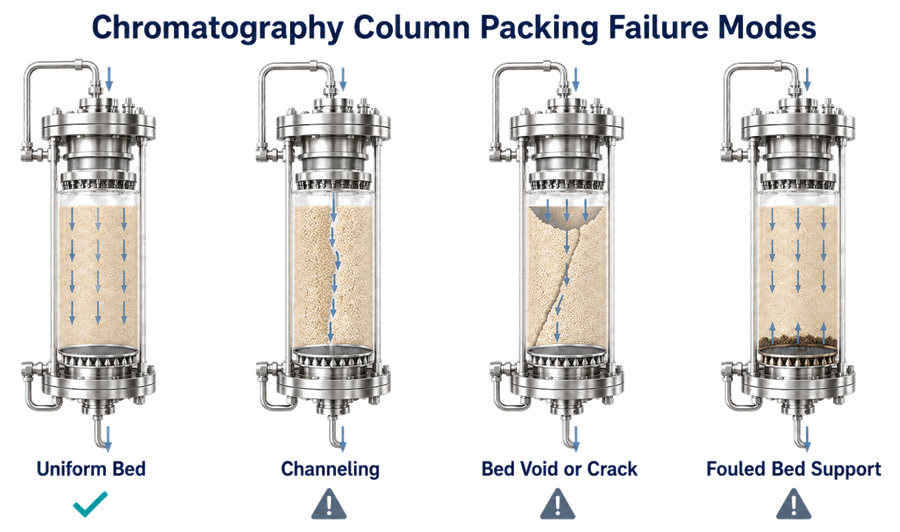
An investigation should evaluate the complete event history, including packing parameters, equipment status, resin lot and history, buffer preparation, pressure and flow data, alarms, cleaning records, storage conditions, tracer data, process chromatograms, maintenance, and recent changes.
Repacking may correct the bed condition, but it does not by itself establish the original cause. Corrective action should address the identified or most scientifically supportable cause and should define any additional verification needed before the column is returned to service.
Maintenance and Calibration Interfaces
Column maintenance may include inspection or replacement of:
- Adapters and drive mechanisms
- Distributors
- Bed-support screens
- Seals and gaskets
- Pressure connections
- Clamps and fasteners
- Tubing and process connectors
- Leveling or support components
Maintenance intervals should be based on supplier recommendations, operating history, risk, and observed condition. Instruments used for packing pressure, differential pressure, temperature, flow, or other acceptance decisions should be included in the applicable Calibration Program and Metrology Control.
Change Control, Repacking, and Retirement
Changes requiring documented impact assessment may include:
- Resin type, grade, supplier, or manufacturing site
- Column dimensions or bed height
- Resin lot or ligand characteristics
- Packing method or packing equipment
- Slurry concentration
- Packing buffer
- Packing flow, pressure, or compression
- Adapter, distributor, screen, or seal design
- Packing-test tracer or calculation method
- Acceptance criteria
- Cleaning, sanitization, or storage conditions
- Automated recipe or software configuration
- Extension of the approved reuse limit
The change assessment should determine whether document revision, engineering testing, repacking, qualification, process studies, cleaning-validation work, comparability assessment, or additional process validation is required.
A column or resin should be retired when continued use is no longer supported by approved limits, performance trends, physical condition, cleaning capability, supplier status, or investigation outcome. Retirement should be documented so the equipment and resin cannot inadvertently return to service.
Periodic review principles are addressed in Periodic Review and Continued Verification.
Relationship to Qualification and Process Validation
The Chromatography System Qualification and Lifecycle Control article should establish qualification expectations for the integrated skid, column, instruments, utilities, software, alarms, interlocks, and operating ranges.
Packing verification is narrower: it demonstrates the condition of a specific packed bed using an approved test.
Purification-process validation is broader: it evaluates whether the complete chromatography operation, operating within its control strategy, consistently produces acceptable output. FDA defines process validation as lifecycle-based collection and evaluation of data establishing scientific evidence that a process can consistently deliver quality product. See General Principles of Process Validation.
Documentation and Traceability
The lifecycle record should allow reconstruction of:
- Column identity and configuration
- Resin identity, supplier, and lot
- Packing date and personnel
- Packing equipment and approved procedure
- Actual packing parameters
- Bed height and resin quantity
- Packing-test raw data and results
- Process-use history
- Cycle count
- Cleaning, regeneration, sanitization, and storage history
- Maintenance and component replacement
- Deviations and investigations
- Changes and approvals
- Periodic-review conclusions
- Retirement and disposal
Where required, equipment cleaning, maintenance, and use records should align with 21 CFR 211.182.
Common Deficiencies
Common deficiencies include:
- Treating supplier documentation as complete site qualification
- Using an uncontrolled spreadsheet for packing calculations
- Applying universal HETP or asymmetry limits
- Failing to define the peak-asymmetry calculation convention
- Counting product batches while excluding cleaning or aborted cycles
- Extending resin life without approved supporting evidence
- Repacking repeatedly without investigating the failure mechanism
- Losing traceability between resin lots, columns, and batches
- Failing to evaluate storage excursions
- Treating a satisfactory packing test as process validation
- Changing packing or cleaning parameters without impact assessment
- Retaining only a printed summary when electronic raw data are required
Conclusion
Chromatography column control requires coordinated management of the hardware, packed bed, resin, procedures, electronic records, cleaning strategy, and process-performance data. Effective control begins with appropriate column and resin selection, continues through reproducible packing and verification, and is maintained through cleaning, storage, reuse studies, performance trending, change control, and documented retirement.
A passing packing test provides evidence about the packed bed at a defined point in time. Continued suitability depends on the broader lifecycle evidence demonstrating that the column, resin, skid, and purification process remain within their approved state of control.