

Cleaning Validation Periodic Review and Lifecycle Assessment
Cleaning validation should remain supported by current evidence throughout the life of the manufacturing process. A validation study completed several years earlier does not by itself demonstrate that the original assumptions still represent the current products, equipment, cleaning procedures, analytical methods, toxicological limits, and operating conditions. Periodic review provides the formal lifecycle mechanism for determining whether the complete body of evidence continues to support the validated state.
The periodic review is not another execution of the cleaning-validation protocol and should not duplicate routine monitoring activities. Ongoing Cleaning Verification and Performance Trending generates routine evidence through visual inspection, residue monitoring, process parameters, deviations, and trends. The periodic review takes those accumulated data together with changes, maintenance, investigations, CAPA, product additions, analytical updates, and validation assumptions and asks a broader question: Does the current body of evidence still justify the conclusion that the cleaning process remains validated for its approved scope?
The answer should be documented explicitly. A defensible periodic review should conclude that the validated state remains supported, remains supported subject to defined actions, requires targeted additional evidence, or can no longer be supported without revalidation.
Purpose of the Periodic Review
The purpose of periodic review is to assess the continuing validity of the cleaning-validation program rather than to verify one individual cleaning event. It should determine whether the original scientific rationale remains applicable, whether significant changes have been appropriately assessed, whether routine performance continues to support process capability, and whether any accumulated evidence changes the original validation conclusion.
This distinction is important. A cleaning process may have no individual residue failures during the review period yet still require lifecycle attention because equipment has changed, a new product has been introduced, a PDE has been revised, recovery assumptions have changed, or multiple minor changes have accumulated. Conversely, an isolated cleaning deviation may not invalidate the overall validated state when the cause is well understood, corrected, and supported by appropriate verification.
The periodic review therefore provides the point at which routine operational evidence and validation governance are integrated.
Regulatory and Lifecycle Basis
21 CFR 211.67 — Equipment Cleaning and Maintenance requires equipment to be cleaned and maintained at appropriate intervals and requires written procedures governing cleaning and maintenance. The continued adequacy of those procedures is therefore part of the lifecycle control of manufacturing equipment.
21 CFR 211.180(e) — General Requirements requires at least annual evaluation of the quality standards for each drug product to determine the need for changes in specifications or manufacturing and control procedures. Cleaning validation is not independently prescribed as an annual review by this provision, but the same lifecycle principle supports systematic evaluation of accumulated GMP evidence where cleaning processes can affect product quality.
ICH Q7 provides a more explicit validation-lifecycle principle. It states that validated systems and processes should be periodically evaluated to verify that they are still operating in a valid manner and that where no significant changes have been made and quality review confirms consistent acceptable performance, there is normally no need for revalidation.
The periodic review should therefore be evidence based. Revalidation should not occur merely because a calendar interval has elapsed, but continued validation should likewise not be assumed indefinitely without systematic review.
Periodic Review Is Different from Ongoing Verification
The distinction between the two articles should remain explicit throughout the Knowledge Base.
- Ongoing Cleaning Verification and Performance Trending evaluates routine performance as data are generated. It identifies changes in residue levels, variability, visual findings, recleaning, process parameters, and other indicators that may require immediate response.
- Cleaning Validation Periodic Review and Lifecycle Assessment evaluates the complete accumulated body of evidence at a defined review point. It asks whether products, equipment, limits, methods, procedures, changes, investigations, and routine performance still support the original validation strategy.
The periodic review should therefore reference the conclusions and trends from the ongoing verification program rather than recreate the underlying trend charts, sampling frequencies, alert levels, or routine monitoring rules.
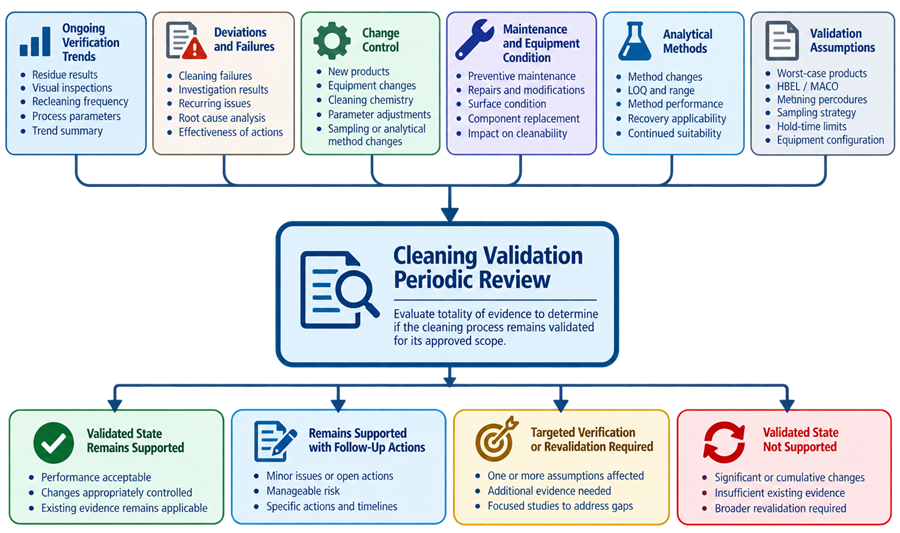
Define the Review Period and Scope
The periodic review should identify the time interval covered and the cleaning-validation systems included. The scope can be organized by cleaning procedure, equipment train, cleaning group, manufacturing area, or another structure appropriate to the site’s validation architecture.
The review boundary should be broad enough to capture interactions among products, equipment, and methods. A review performed only at individual equipment level can miss changes that affect an entire cleaning group, such as a revised HBEL, new detergent, new analytical method, or new product introduction.
The report should identify the last approved periodic review or baseline date so that changes and accumulated evidence can be traced without gaps or duplication.
Start with the Approved Validation Basis
The reviewer should first establish what the current cleaning-validation program is supposed to cover. This prevents the review from becoming a collection of unrelated deviations and analytical results.
The baseline should include the approved cleaning procedures, equipment and product groups, worst-case products, validated operating conditions, dirty-hold and clean-hold limits, cleaning chemistry, acceptance criteria, sampling strategy, recovery assumptions, analytical methods, and applicable validation reports.
The review then determines whether these elements still represent current manufacturing. A validation program cannot be meaningfully reviewed without knowing which assumptions originally supported it.
Review the Ongoing Verification Conclusion
The periodic review should use the summarized conclusions from Ongoing Cleaning Verification and Performance Trending as one major input. It should determine whether routine performance remained stable, whether meaningful drift occurred, whether variability increased, and whether repeated adverse observations developed during the review period.
The periodic review does not need to repeat the event-by-event statistical methodology. Instead, it should evaluate what the accumulated monitoring evidence means for the validated state.
For example, a stable monitoring program with residue results consistently well below the acceptance criteria supports continued cleaning capability. A program showing increasing recleaning, repeated visual observations, or progressively higher results can indicate that validation assumptions require reassessment even when formal acceptance criteria have not yet been exceeded.
Review Cleaning Deviations and Failures
All significant cleaning-related deviations during the review period should be evaluated collectively rather than only as individually closed investigations.
Cleaning Validation Deviations, Failures, and Investigations should establish the event-level investigation process. The periodic review should determine whether those investigations reveal recurring or systemic patterns.
Several apparently unrelated deviations can point to a common weakness. Repeated missed manual steps may indicate inadequate procedure design. Repeated residue at the same valve may indicate an equipment-cleanability problem. Multiple rinse-volume deviations may indicate that the sampling procedure is difficult to execute reliably.
The periodic review should therefore assess both the number of events and their technical relationship.
Review Recleaning and Repeated Cleaning Events
Recleaning should be included in the lifecycle assessment even when the equipment ultimately passed its release criteria.
Repeated need for additional wash cycles, manual touch-up, extra rinses, or unscheduled intervention can indicate that the process is less robust than the original validation demonstrated. A program that achieves acceptable final cleanliness only after increasingly frequent repeated cleaning may be drifting away from the validated operating condition.
The review should determine whether recleaning remains exceptional and attributable to understood causes or has become an emerging routine practice.
Evaluate CAPA and Its Effectiveness
Cleaning-related CAPA should be reviewed for both completion and effectiveness. Closing a CAPA record does not by itself demonstrate that the underlying cleaning problem has been corrected.
The review should determine whether actions such as procedure revisions, equipment modifications, revised detergent conditions, operator qualification, maintenance changes, analytical improvements, or increased monitoring produced the intended result.
Recurring events after CAPA can indicate that the original root cause was incomplete or that the action addressed the symptom rather than the underlying failure mechanism.
Where CAPA effectiveness remains uncertain, the periodic review conclusion should identify the unresolved risk rather than simply note that the administrative record is closed.
Review Change-Control Activity
Cleaning Validation Change Control and Revalidation Triggers evaluates individual changes when they occur. The periodic review provides a second-level assessment of whether those changes were collectively controlled and whether the resulting cleaning-validation configuration remains coherent.
The review should examine relevant changes involving products, formulation, equipment, product-contact materials, cleaning chemistry, parameters, automated recipes, sampling methods, recovery factors, analytical procedures, HBELs, acceptance criteria, and cleaning-group structure.
The objective is not to reopen every completed change record. It is to confirm that validation-impact assessments were appropriate, required supporting studies were completed, documentation was updated, and the cumulative effect of changes has not moved the process beyond the validated basis.
Cumulative Change Is a Key Periodic-Review Risk
One of the strongest reasons to perform periodic lifecycle assessment is that multiple individually minor changes can collectively become significant.
For example, during several years a site may replace several valves, change gasket materials, reduce routine wash temperature within an approved range, change detergent supplier, introduce two products into an existing group, revise the swab material, and update the analytical method. Each individual change may have received a reasonable no-revalidation or limited-verification conclusion.
The periodic review should ask whether the combined system still resembles the configuration originally validated. This cumulative-change assessment cannot be performed effectively by reviewing individual change controls in isolation.
New Products and Product-Group Assumptions
The review should confirm that products introduced since the previous assessment were evaluated appropriately against the established worst-case and grouping strategy.
Worst-Case Product, Equipment, and Cleaning Condition Selection should define the technical basis for product representation. The periodic review should determine whether new products remain covered by that rationale or whether the current portfolio contains a more challenging product than the one originally used for validation.
The review should consider both toxicological consequence and physical cleanability. A product with a lower HBEL may create the most restrictive residue limit, while another product may remain the most difficult formulation to remove.
If the original worst-case hierarchy has changed, the validation strategy should be updated accordingly.
HBEL, PDE, MACO, and Acceptance-Limit Changes
The periodic review should confirm that toxicological values supporting the cleaning program remain current and that changes were propagated into downstream calculations.
Health-Based Exposure Limits for Cleaning Validation establishes the toxicological basis, while Maximum Allowable Carryover (MACO) in Cleaning Validation and Cleaning Validation Acceptance Criteria and Residue Limits translate those values into operational criteria.
The review should determine whether updated HBELs, product doses, minimum batch sizes, or new product sequences have changed MACO or sample acceptance criteria. Historical validation and routine monitoring data should then be assessed against any revised limit where appropriate.
A lower limit does not automatically require revalidation when existing data already demonstrate acceptable performance against that limit. The review should document that conclusion rather than assume it.
Equipment Modifications and Current Configuration
The review should confirm that the equipment represented by the validation program remains consistent with the current product-contact configuration.
Relevant changes can include vessels, pumps, valves, transfer lines, hoses, filters, agitators, spray devices, filling pathways, surface finish, product-contact materials, drainability, and sampling access.
Maintenance and engineering changes should be reviewed together because equipment can change materially through accumulated repair activity even when no major capital project occurred.
A current equipment walkdown or comparison with updated engineering documentation can be particularly useful where the validation package is old or where multiple modifications occurred during the review period.
Maintenance as a Validation Input
Maintenance records can reveal deterioration that affects cleaning performance. The review should consider product-contact repairs, repeated gasket failures, blocked spray devices, recurring valve problems, pump degradation, corrosion, surface damage, weld repairs, hose replacement, and other conditions that can alter cleanability or sampling recovery.
The review should not attempt to evaluate every preventive-maintenance work order. It should focus on maintenance with plausible cleaning-validation impact. Recurring maintenance at the same component can also explain trends observed in cleaning verification or deviation data.
Cleaning Procedure and Parameter Changes
The current cleaning procedure should be compared with the procedure represented by validation. The review should confirm that important parameters remain within approved and supported ranges and that changes introduced since the last review were appropriately assessed.
Relevant elements include cleaning chemistry, detergent concentration, temperature, time, flow, pressure, rinse conditions, mechanical action, disassembly, manual steps, final endpoints, and drying.
For automated systems, cleaning recipes, sequences, valve logic, dosing, alarms, and setpoints should also be considered where changes can affect the physical cleaning process.
The objective is to confirm that the process now being executed remains the process represented by validation evidence.
Analytical Methods and Quantitative Capability
The review should determine whether analytical procedures remain suitable for the current cleaning acceptance criteria.
Changes in chromatography, TOC, conductivity, sample preparation, extraction volume, reporting convention, LOQ, instrumentation, or calculation method can affect comparability with historical validation data and the ability to verify current residue limits.
Analytical Sensitivity and Quantitation Limits in Cleaning Validation should define practical quantitative capability, while Analytical Method Validation for Cleaning Residue Testing should establish method suitability.
The periodic review should confirm that no current acceptance criterion lies below the reliable capability of the complete sampling and analytical procedure.
Sampling Strategy and Worst-Case Locations
Sampling plans should remain aligned with the current equipment and cleaning risks.
The review should confirm that locations identified through Cleaning Validation Sampling Strategy and Worst-Case Locations remain representative after equipment modifications, changes in product flow, new residue behavior, maintenance history, or new operating experience.
A location that repeatedly exhibits residue may become more important than originally assumed. Conversely, an equipment redesign may eliminate an old worst-case geometry and introduce a new one.
Sampling maps should evolve with the equipment rather than remain fixed solely because they were used in the original validation protocol.
Recovery Studies and Sampling Changes
The periodic review should verify that current recovery factors remain applicable to the surfaces, swabs, solvents, rinse procedures, and analytical methods actually used.
Swab and Rinse Recovery Studies for Cleaning Validation should provide traceability between sampling conditions and applicable recovery data.
Changes in swab material, extraction solvent, surface material, rinse configuration, extraction volume, or analytical method can invalidate an older recovery factor. The periodic review should identify mismatches that may not have been apparent when individual changes were implemented.
The objective is not to repeat recovery studies periodically without cause. It is to confirm continued applicability.
Hold-Time Assumptions
The review should confirm that the dirty-hold and clean-hold conditions used in routine operation remain within the established claims.
Dirty Hold Time and Clean Hold Time Studies should define those limits. The periodic review should identify repeated excursions, operational extensions, changes in manufacturing scheduling, longer campaigns, or storage practices that could alter the original validation challenge.
An approved maximum dirty hold provides little assurance if routine operations repeatedly approach or exceed it through deviations or informal scheduling practices.
Cleaning Validation Periodic Review Input Matrix
The periodic review should integrate the major evidence streams without reproducing the detailed procedures used to generate them.
| Review Input | Periodic Review Question | Potential Lifecycle Significance |
|---|---|---|
| Ongoing verification and trends | Has routine cleaning performance remained stable and predictable? | Supports continued capability or identifies drift |
| Cleaning deviations and failures | Are events isolated, recurring, or systemic? | May challenge process robustness or validated assumptions |
| Recleaning history | Has additional cleaning remained exceptional? | Repeated recleaning can indicate declining capability |
| CAPA | Were corrective actions effective and sustained? | Ineffective CAPA can leave unresolved validation risk |
| New products / formulations | Are current products still represented by the validated worst-case strategy? | May change cleanability or toxicological worst case |
| HBEL / MACO / limits | Are current toxicological values and residue limits reflected in the program? | May change acceptance criteria and historical-data interpretation |
| Equipment and maintenance | Does current equipment still match validated geometry, materials, and cleanability? | Can affect residue retention, cleaning coverage, and recovery |
| Cleaning procedures / parameters | Is routine cleaning still executed within the validated process definition? | Changes can alter cleaning effectiveness |
| Automation / recipes | Have software or recipe changes affected the physical cleaning sequence or controls? | Can change validated process execution |
| Sampling strategy | Do current locations still represent meaningful cleaning risks? | Outdated locations can weaken validation evidence |
| Recovery studies | Are recovery factors still applicable to current surfaces and sampling methods? | Incorrect recovery can bias residue interpretation |
| Analytical methods | Can current methods reliably quantify at the current cleaning limits? | Inadequate LOQ or method changes can compromise verification |
| Hold times / campaign conditions | Do current operations remain within validated worst-case conditions? | Extensions may create a greater cleaning challenge |
| Change controls | Were validation impacts appropriately assessed and supporting actions completed? | Unassessed cumulative change can erode the validated state |
The matrix is an organizing tool rather than a checklist that automatically determines the review conclusion. The significance of each input depends on the cleaning process, product risk, available evidence, and relationship among the findings.
Review Open and Overdue Actions
The periodic review should identify unresolved actions that can affect the cleaning-validation conclusion. These may include incomplete CAPA, overdue recovery work, temporary procedural controls, pending toxicological reassessment, open equipment modifications, unresolved analytical issues, or required validation studies that have not been completed.
An open action does not automatically mean the validated state is lost. The reviewer should determine whether interim controls adequately manage the risk and whether the action remains appropriately prioritized.
A review conclusion that ignores significant overdue validation commitments is not defensible.
Assess Consistency of the Validation Documentation
The current validation package should present one coherent description of the cleaning program. The periodic review should identify inconsistencies among current SOPs, equipment lists, cleaning matrices, product groupings, surface-area calculations, acceptance limits, sampling maps, analytical methods, and validation reports.
A common lifecycle problem is that each document was updated independently after changes, leaving no single reliable representation of the current validated state.
The review should therefore identify documentation reconciliation as an action where necessary, even when cleaning performance itself remains acceptable.
Determine Whether Historical Validation Still Represents Current Operations
The central technical judgment should compare the current system with the one represented by the original or most recent revalidation evidence.
The question is not whether every detail is identical. Change is expected during the life of a manufacturing system. The question is whether the accumulated changes remain scientifically covered by the existing evidence.
A cleaning process can remain valid after many well-controlled changes. It can also become poorly represented by old validation evidence even when no single change appeared sufficiently large to trigger full revalidation.
The periodic review should make that judgment explicit.
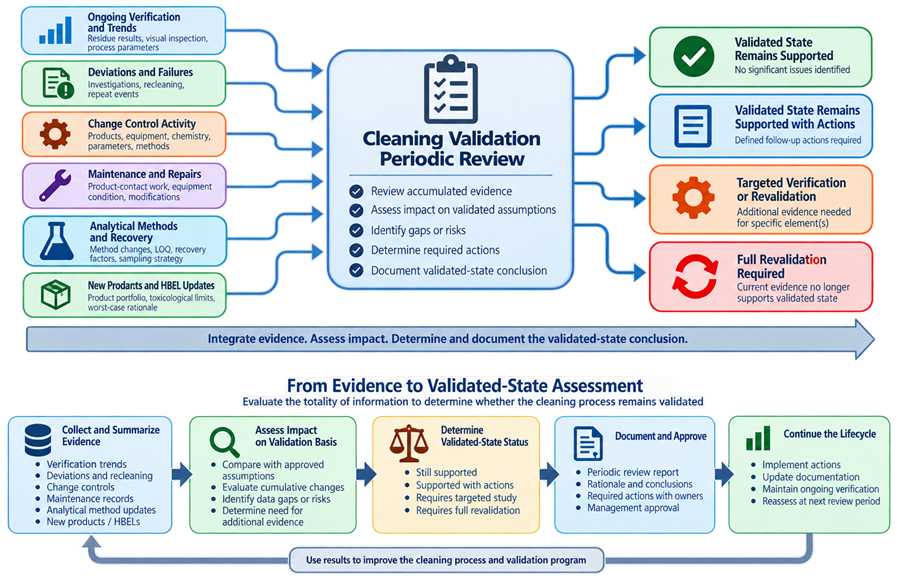
Validated-State Conclusions
The periodic review should end with a clear validation conclusion rather than simply state that the review was completed. A practical conclusion structure can include four outcomes:
- Validated state remains supported. Routine performance is acceptable, significant changes were adequately controlled, and existing validation evidence remains applicable.
- Validated state remains supported with defined follow-up actions. No immediate loss of validation is identified, but specific documentation, monitoring, analytical, maintenance, or verification actions are required.
- Targeted verification or revalidation is required. One or more validation assumptions have changed or available evidence is insufficient for a specific element, but the issue is limited enough that focused work can resolve it.
- Validated state cannot be adequately supported without broader revalidation. Significant or cumulative changes, recurring failures, insufficient historical evidence, or unresolved process-capability concerns materially undermine the existing validation basis.
The report should state which conclusion applies and why.
Revalidation Should Follow the Evidence
A periodic review should not automatically generate revalidation because a fixed number of years has passed. ICH Q7 specifically supports the principle that periodic evaluation can demonstrate that a validated process remains valid without revalidation when no significant changes have occurred and performance remains consistently acceptable.
At the same time, age of the validation package can increase uncertainty when documentation is incomplete, equipment has changed substantially, or the site cannot reconstruct the current validation basis. In such cases, targeted or broader revalidation may become appropriate because available evidence is no longer adequate.
The decision should therefore be driven by evidence rather than calendar age alone.
Follow-Up Actions
Actions arising from the review should be specific to the identified gap. Possible outcomes can include updating product or equipment matrices, revising the worst-case rationale, recalculating MACO, changing sampling locations, performing recovery bridging, revising analytical methods, improving cleaning procedures, completing maintenance, increasing ongoing verification, performing targeted studies, or executing revalidation.
The review should assign ownership, priority, and completion expectations according to risk. High-risk validation gaps should not be left as routine administrative actions without appropriate interim control.
Review Frequency
There is no universal regulatory requirement that cleaning validation itself undergo a dedicated annual revalidation exercise. The periodic-review interval should be established by the site’s quality and validation system based on process risk, manufacturing activity, complexity, change rate, product hazard, historical performance, and the effectiveness of other lifecycle controls.
A formal annual review may be practical for complex or high-risk multiproduct operations. A different interval can be appropriate where cleaning systems are stable, low risk, and already subject to strong routine and quality-system review.
The defined interval should be frequent enough to identify cumulative change and unresolved validation risk before the original validation basis becomes obsolete.
Responsibility and Approval
The review should involve functions capable of evaluating the technical evidence represented in the cleaning-validation program. Depending on the site, this can include Validation, Quality, Manufacturing, Engineering, Analytical Laboratory, Toxicology, and Automation or IT where automated cleaning systems are involved.
The report should identify responsible reviewers and receive approval consistent with the site’s validation and quality system.
The review should not become solely a validation-document exercise. Manufacturing and Engineering knowledge can be necessary to understand actual changes in cleaning execution and equipment condition, while Quality provides independent oversight of the validated-state conclusion.
Common Periodic-Review Deficiencies
A common weakness is treating periodic review as a summary of cleaning-validation dates and reports without evaluating whether the current manufacturing system still matches the validated assumptions. Another is reproducing routine trend charts without reaching a validation conclusion. The periodic review should use trends as evidence, not become a duplicate of the ongoing verification program.
Other deficiencies include reviewing individual changes without assessing their cumulative effect, ignoring repeated recleaning because final equipment release was successful, failing to reassess worst-case products after portfolio changes, and overlooking updated HBELs or product doses that alter residue limits.
The review can also be weakened by failing to reconcile equipment modifications and maintenance with sampling maps, continuing to use obsolete recovery factors after surface or sampling-method changes, or assuming that an analytical method remains adequate without comparing its quantitative capability with current acceptance limits.
A further deficiency is concluding simply that “no revalidation is required” without first stating whether the validated state remains supported and what evidence supports that conclusion. Revalidation is one possible lifecycle action; the primary conclusion should address continued validation.
Key Principles
- Cleaning-validation periodic review is a formal lifecycle assessment of the complete validated cleaning program. It should not duplicate routine residue monitoring, trend detection, or event-level escalation performed through Ongoing Cleaning Verification and Performance Trending.
- The review should begin with the approved validation basis and determine whether current products, equipment, cleaning procedures, operating conditions, acceptance limits, sampling methods, recovery data, and analytical procedures remain represented by that evidence.
- Routine verification trends, deviations, failures, recleaning, CAPA, maintenance, change controls, product additions, and analytical changes are review inputs. Their significance lies in what they collectively indicate about the continued validated state.
- Cumulative change deserves specific attention because individually minor changes can collectively alter the cleaning system enough that the original validation evidence no longer represents current operation.
- New products should be reassessed against the established worst-case strategy, and revised HBELs, doses, batch sizes, or product sequences should be propagated through MACO and cleaning acceptance criteria where applicable.
- Equipment modifications and maintenance should be evaluated for changes to cleanability, product-contact geometry, materials, drainage, sampling access, and recovery applicability.
- Sampling, recovery, and analytical methods should remain capable of demonstrating compliance with current cleaning acceptance criteria. Periodic repetition of these studies is unnecessary when they remain applicable, but their continued relevance should be confirmed.
- The review should conclude explicitly whether the validated state remains supported, remains supported with actions, requires targeted verification or revalidation, or can no longer be adequately supported without broader revalidation.
- Revalidation should follow the evidence. A calendar interval alone does not demonstrate the need for revalidation, and the absence of an individual failure does not by itself demonstrate that the complete validation program remains current.