
Cleaning Validation Program Strategy, Scope, and Lifecycle
Cleaning validation provides documented evidence that an established cleaning process can consistently reduce product residues, cleaning-agent residues, and other relevant contaminants to predefined acceptable levels. A defensible program does not begin with swabbing equipment after cleaning. It begins with understanding the manufacturing process, contamination risks, equipment and cleaning boundaries, residues that require control, and the conditions under which the approved cleaning process must perform.
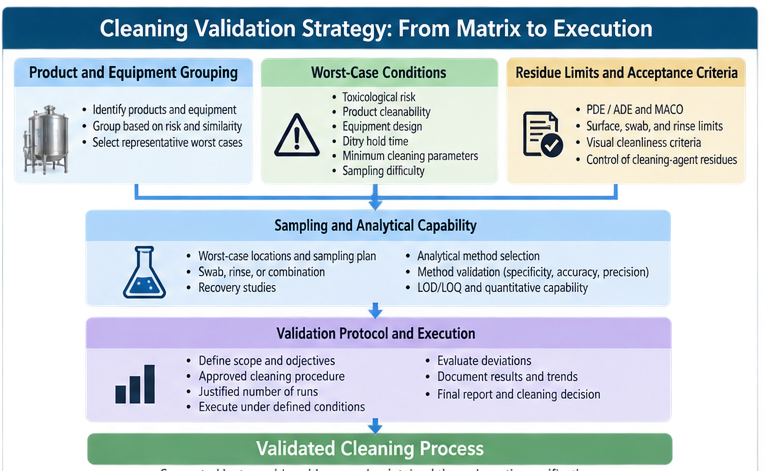
The program should integrate cleaning-process development, equipment capability, health-based or otherwise scientifically justified residue limits, product and equipment grouping, worst-case selection, sampling strategy, analytical capability, protocol execution, deviation assessment, and lifecycle control. Each element supports a different part of the validation conclusion. A sensitive analytical method cannot compensate for an inadequately defined cleaning process, and a well-designed cleaning cycle cannot be demonstrated reliably if sampling locations or recovery methods are inappropriate.
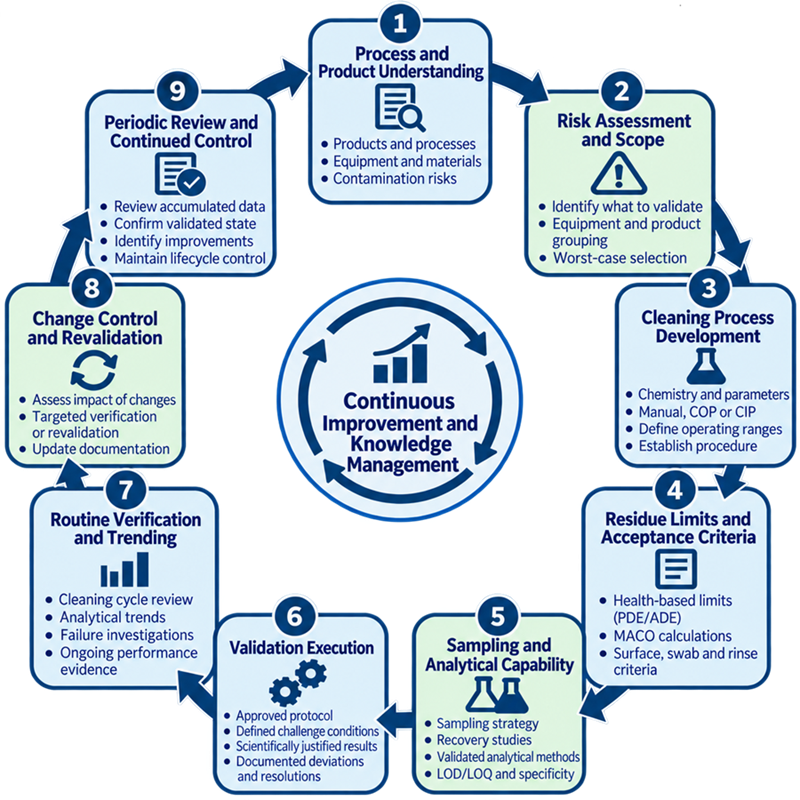
Cleaning validation should therefore be treated as a lifecycle control system rather than a one-time qualification exercise. Initial validation establishes evidence that the approved cleaning process performs as intended under justified challenge conditions. Routine verification, change control, investigation, periodic review, and revalidation then maintain confidence that the validated cleaning state remains applicable as products, equipment, procedures, and manufacturing conditions change.
Regulatory and Scientific Basis
21 CFR 211.67 — Equipment Cleaning and Maintenance requires equipment and utensils to be cleaned, maintained, and, where appropriate, sanitized or sterilized at suitable intervals to prevent contamination or malfunction that could affect drug-product quality. It also requires written cleaning and maintenance procedures with responsibilities, schedules, methods, protection of cleaned equipment, inspection before use, and maintenance of records.
FDA’s Guide to Inspections: Validation of Cleaning Processes establishes the longstanding inspection framework for cleaning validation. FDA expects written cleaning procedures, general validation procedures, predefined protocols, scientifically justified residue limits, appropriate sampling and analytical methods, documented execution, and a final approved report supporting the conclusion that residues have been reduced to acceptable levels.
FDA’s current CGMP Questions and Answers — Equipment further emphasizes that manufacturers must control cross-contamination risk in nondedicated equipment and demonstrate that cleaning procedures are adequate for the relevant products, equipment, materials, and surfaces.
For active pharmaceutical ingredients, ICH Q7 Good Manufacturing Practice Guidance for Active Pharmaceutical Ingredients states that cleaning procedures should normally be validated where contamination or carryover poses meaningful risk and that validation should reflect actual equipment-use patterns. It also supports representative product selection based on cleanability and residue-limit considerations.
Risk-based decisions within the cleaning program should follow the principles of ICH Q9(R1) Quality Risk Management, under which the level of effort, formality, and documentation should be commensurate with risk to product quality and ultimately patient protection. Lifecycle governance and knowledge management are consistent with ICH Q10 Pharmaceutical Quality System.
Define the Cleaning Validation Scope
The first program decision is what requires cleaning validation and what is controlled through another mechanism. The scope should be based on actual contamination pathways rather than on a generic list of equipment.
Product-contact equipment used for multiple products is normally central to the program because residues remaining after cleaning can transfer to the next product. Examples include vessels, mixers, granulators, tablet presses, filling equipment, transfer lines, pumps, hoses, filters, manifolds, and reusable product-contact accessories. Equipment used for intermediates may also require validation where carryover can affect subsequent processing or product quality.
Dedicated equipment does not automatically eliminate cleaning-control requirements. Cross-product carryover risk may be reduced, but cleaning can still be needed to control degradation products, cleaning agents, microbial proliferation, buildup from repeated campaigns, or residues capable of affecting the next batch of the same product. The appropriate validation or verification approach should reflect the actual risk.
Single-use product-contact components may fall outside conventional cleaning validation when they are discarded after use and are not reused. Reusable interfaces, transfer connections, fixed piping, vessel surfaces, or other retained components remain within scope when they can contribute contamination.
Non-product-contact surfaces should be included when a credible pathway exists for material to reach product or product-contact equipment. General facility cleaning and cleanroom disinfection are related but distinct control programs and should not be confused with manufacturing-equipment cleaning validation.
The scope should identify the complete equipment train and all product-contact components rather than stopping at convenient organizational boundaries. Shared hoses, removable parts, valve bodies, transfer paths, filters, gaskets, product-contact probes, and manually cleaned accessories can become validation gaps when responsibility is divided among departments or systems.
Cleaning Process Development Comes Before Validation
Cleaning validation should verify an established process; it should not be used as the primary mechanism for developing that process. The cleaning procedure should already define how residues are removed, what parameters govern performance, and what operating conditions are permitted before formal validation begins.
Development work should establish the appropriate cleaning chemistry, concentration, contact time, temperature, mechanical action, flow or spray conditions, rinsing strategy, equipment configuration, disassembly requirements, and drying conditions. Difficult soils may require laboratory or pilot studies to understand solubility, adhesion, degradation, film formation, or response to cleaning chemistry. These development concepts are addressed further in Cleaning Procedure Development and Efficacy Studies.
The development stage should also identify the operating parameters that materially affect cleaning performance. A validated process cannot be defined simply as “clean according to SOP.” The procedure should establish sufficiently specific conditions so routine execution can be compared with those represented during validation.
Cleaning-process knowledge should be documented before the validation protocol is approved. When significant optimization occurs during validation execution, the final process may no longer be the process originally challenged by the protocol. In that situation, additional validation evidence may be required for the revised procedure.
Manual, COP, CIP, and Hybrid Cleaning Boundaries
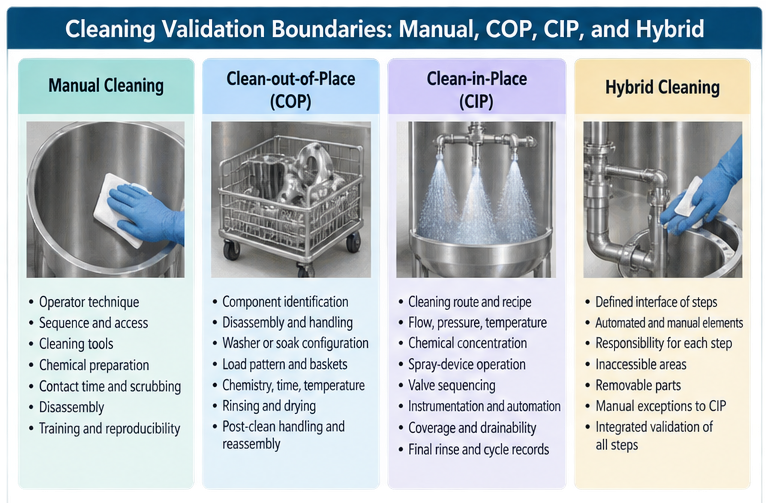
Cleaning methods differ in the type and source of variability that must be controlled. The validation strategy should define the cleaning boundary and identify which portions of the process are automated, equipment-dependent, or operator-dependent.
| Cleaning approach | Primary validation considerations |
|---|---|
| Manual cleaning | Operator technique, sequence, access, cleaning tools, scrubbing action, chemical preparation, contact time, rinse technique, disassembly, visual access, training, and reproducibility between operators |
| Clean-out-of-place (COP) | Component identification, disassembly, transfer to cleaning location, washer or soak configuration, load pattern, baskets or racks, chemistry, time, temperature, mechanical action, rinse, drying, post-clean handling, and correct reassembly |
| Clean-in-place (CIP) | Cleaning route, recipe, flow, pressure, temperature, chemical concentration, exposure time, spray-device operation, valve sequencing, instrumentation, automation, coverage, drainability, final rinse, alarms, and cycle records |
| Hybrid cleaning | Defined interface between automated and manual steps, responsibility for each step, sequence, inaccessible areas, removable parts, manual exceptions to CIP coverage, and integration of all steps into one validated cleaning process |
Manual cleaning is often more variable because successful execution depends directly on operator technique. Validation should therefore challenge realistic operator variability and ensure that instructions are sufficiently detailed to reproduce the validated process. Training is necessary but does not compensate for an ambiguous procedure.
COP processes introduce a different boundary. Validation should account for how components are removed, oriented, loaded into a washer or soak system, rinsed, dried, protected after cleaning, and returned to the correct equipment. A validated parts washer cycle does not by itself demonstrate that every permitted load configuration or component has been adequately cleaned.
CIP processes can provide strong reproducibility, but only when the complete cleaning circuit is properly designed and qualified. The CIP skid, process vessel, transfer piping, spray devices, instruments, valve routes, automation, and return path function as an integrated system. Pharmaceutical Tank Cleaning and CIP Integration addresses this equipment and qualification boundary in greater detail.
Product, Equipment, and Cleaning Matrices
A cleaning-validation program becomes difficult to control when products, equipment, and cleaning procedures are evaluated independently. A cleaning matrix provides the structured relationship among these elements.
The matrix should identify which products or intermediates contact each equipment train, which cleaning procedure applies, whether equipment is dedicated or shared, which product and equipment groups are used, the applicable worst-case representatives, the residue-limit basis, and the validation status. It can also identify detergent systems, manual versus automated cleaning, dirty-hold limits, sampling approaches, and relevant analytical methods.
Product grouping can reduce unnecessary validation where products have sufficiently comparable characteristics. Relevant attributes can include toxicity or health-based exposure limit, formulation, solubility, residue behavior, cleanability, concentration, manufacturing sequence, and cleaning procedure. Equipment grouping can be justified when equipment items have sufficiently comparable design, materials of construction, product-contact surface characteristics, geometry, cleaning mechanism, and operating conditions.
Grouping should not be used merely to reduce the number of studies. The selected representative must challenge the attributes that determine cleaning risk. Different products may represent the worst case for toxicity, cleanability, analytical detectability, or residue aging. Likewise, different equipment items may represent the worst case for geometry, surface area, manual access, or cleaning coverage.
The detailed selection approach is addressed in Worst-Case Product, Equipment, and Cleaning Condition Selection. The cornerstone program should establish the grouping rules and governance, while the individual assessment documents the data and rationale used for each group.
Risk Assessment and Worst-Case Strategy
Cleaning-validation risk assessment should identify the conditions most capable of producing an unacceptable cleaning result and determine how those conditions will be represented in validation.
Product-related risk includes toxicity, potency, health-based exposure limit, solubility, tendency to adhere or form films, degradation behavior, formulation complexity, and difficulty of analytical detection. Equipment-related risk includes inaccessible surfaces, gaskets, seals, valves, dead spaces, internal components, surface finish, drainability, spray shadows, manual access, and cleaning-system configuration.
Process-related risk includes dirty hold time, campaign length, residue loading, cleaning chemistry, minimum permitted cleaning conditions, manual interventions, product sequence, disassembly requirements, and potential for equipment to remain wet after cleaning. The risk assessment should also consider consequences of false analytical results, including inadequate sampling recovery or an analytical method incapable of measuring the required residue limit.
Worst-case validation does not necessarily mean one single “worst-case product.” A cleaning program may need separate challenge conditions for product cleanability, toxicological risk, equipment design, longest dirty hold time, minimum cleaning parameters, or manual operation. The selected validation scenarios should collectively challenge the defined cleaning process.
Dirty Hold Time and Clean Hold Time Studies should establish how long equipment may remain dirty before cleaning and how long cleaned equipment may be stored before reuse. Dirty hold time can materially change residue cleanability through drying, hardening, crystallization, degradation, or microbial growth and should therefore be represented in the validation strategy where relevant.
Equipment Qualification and Cleaning Validation Are Different Evidence
Cleaning validation should use equipment and systems capable of executing the defined cleaning process reproducibly. Qualification evidence may include installation verification, instrumentation calibration, spray-device performance, flow and pressure capability, temperature control, chemical dosing, valve routing, recipe logic, alarm testing, drainability, and data recording.
These activities establish equipment capability; they do not establish residue removal. Spray coverage can demonstrate that solution reaches an equipment surface, but it does not demonstrate that a specific product residue has been removed to an acceptable level. Conversely, an acceptable residue sample does not establish that the cleaning system was configured or operated correctly.
The validation strategy should therefore establish the prerequisite qualification evidence before cleaning-validation execution. Otherwise, a failed cleaning run may be difficult to distinguish from an equipment, automation, instrumentation, or cleaning-process failure.
Residues and Acceptance Criteria
The program should define which residues require control and how acceptance criteria are established. Relevant residues may include active ingredients, intermediates, degradants, formulation components, detergents, cleaning agents, processing aids, or other contaminants capable of remaining on product-contact equipment.
Patient-safety-based limits for product carryover may be derived from toxicological assessments such as permitted daily exposure (PDE) or acceptable daily exposure (ADE). Health-Based Exposure Limits for Cleaning Validation: HBEL, PDE, and ADE addresses development and use of these values. Maximum Allowable Carryover (MACO) and Residue Limit Calculations translates the allowable exposure into an equipment or process-related carryover quantity.
The allowable carryover must then be translated into criteria that can actually be measured. Cleaning Validation Acceptance Criteria and Surface, Swab, and Rinse Limits addresses the conversion of residue limits into surface limits, swab-sample criteria, rinse concentrations, and other operational acceptance criteria.
Visual cleanliness remains an important control because localized residue may be missed by limited analytical sampling. Visual inspection should be performed under defined conditions and should complement, rather than automatically replace, analytical residue control when quantitative acceptance criteria are required.
Cleaning-agent residues should be evaluated independently from product residues where appropriate. A cleaning process that removes the product but leaves unacceptable detergent or chemical residue has not achieved its intended state.
Sampling Strategy and Worst-Case Locations
Sampling should provide evidence from locations and surfaces capable of challenging the cleaning process. A large number of convenient samples does not compensate for failing to sample the locations where residue is most likely to persist.
Cleaning Validation Sampling Strategy and Worst-Case Locations should define the rationale for sample location, sampling technique, number of locations, accessibility, equipment geometry, soil behavior, and the relationship between direct and indirect evidence.
Swab Sampling for Cleaning Validation provides localized direct evidence from accessible surfaces and can target locations such as gaskets, valve interfaces, welds, corners, impeller surfaces, and other areas where residues may remain. Rinse Sampling for Cleaning Validation can provide broader coverage and can be useful for closed or inaccessible systems, but the result may dilute localized residue and should not be assumed to represent every internal surface equally.
Sampling effectiveness must also be demonstrated. Swab and Rinse Recovery Studies for Cleaning Validation should establish how effectively the defined sampling procedure recovers representative residue from relevant equipment surfaces. A negative analytical result is not meaningful when the sampling procedure cannot adequately recover the residue being evaluated.
Analytical Method Capability
The analytical method must be capable of supporting the cleaning decision at the established acceptance limit. Method selection should be based on the residue, required specificity, sample matrix, expected concentration, background, and practical quantitative capability.
Analytical Method Selection for Cleaning Validation addresses the use of specific and nonspecific methods such as HPLC/UHPLC, UV-visible spectroscopy, TOC, conductivity, and other suitable techniques. Selection of an analytical platform should be based on the intended measurement rather than simply on laboratory availability.
Analytical Sensitivity and Quantitation Limits in Cleaning Validation addresses LOD, LOQ, background response, extraction and dilution effects, and the relationship between analytical sensitivity and the actual cleaning acceptance criterion.
Analytical Method Validation for Cleaning Residue Testing addresses accuracy, precision, specificity or selectivity, range, recovery, matrix effects, robustness, and quantitative capability. The validated analytical procedure should demonstrate that results at and around the cleaning acceptance limit can be interpreted reliably.
Sampling and analytical methods form one measurement system. Extremely sensitive instrumentation cannot compensate for poor surface recovery, and excellent sampling recovery cannot compensate for an analytical method that lacks adequate selectivity or quantitative capability.
Validation Protocol and Execution Strategy
The cleaning-validation protocol should define the objective, scope, equipment, products or product groups, cleaning procedure, worst-case conditions, residue limits, sample locations, sampling methods, analytical procedures, acceptance criteria, responsibilities, execution requirements, deviation handling, and final reporting expectations before the study begins.
The number of validation runs should be scientifically justified according to process risk, process knowledge, variability, cleaning method, automation level, operator dependence, equipment grouping, and available development evidence. Three consecutive successful cleaning runs have been widely used as an industry convention, but they should not be presented as a universal FDA requirement. A fixed number of runs should not substitute for an assessment of whether the available evidence adequately demonstrates reproducible cleaning performance.
Manual processes may require greater attention to operator-to-operator variability. Automated CIP processes may require representation of different equipment configurations, recipes, circuits, or worst-case hydraulic conditions. Grouped equipment may require evidence that the selected representative truly challenges the group.
Validation execution should represent the approved cleaning procedure under defined challenge conditions rather than intentionally operating outside approved conditions merely to create an artificial worst case. Where minimum permitted temperature, concentration, flow, contact time, or other parameters are critical to cleaning performance, validation can challenge the lower validated boundary if that boundary remains within the approved operating range.
A deviation during execution should be evaluated according to its impact on the validation objective. The existence of a deviation does not automatically invalidate all evidence from a run, and a passing analytical result does not automatically make a process-related deviation acceptable. The investigation should determine whether the event affected cleaning performance, sampling, analytical validity, or representativeness of the study.
Validation Report and Evidence Traceability
The final report should do more than state that samples passed. It should demonstrate that the approved protocol was executed as intended, that deviations and atypical results were assessed, and that the accumulated evidence supports the conclusion that the defined cleaning process is validated for the claimed scope.
Traceability should connect the manufacturing and equipment scope to the risk assessment, grouping rationale, worst-case selection, cleaning procedure, residue-limit calculations, sampling plan, recovery evidence, analytical procedure, executed results, deviations, and final disposition.
The documentation package commonly includes the cleaning-validation program strategy or master plan, product-equipment-cleaning matrix, risk assessments, cleaning-development evidence, approved cleaning procedures, equipment qualification evidence, toxicological assessments, residue-limit calculations, sampling and recovery studies, analytical method validation, protocols, raw data, executed records, deviations, investigations, reports, and lifecycle assessments.
Documentation depth should be proportional to risk and complexity. A highly automated multiproduct CIP network generally requires more formal evidence and configuration control than a simple manually cleaned piece of dedicated equipment. In both cases, the documentation should be sufficient to reconstruct what was cleaned, how it was cleaned, what evidence was generated, and why the final conclusion was scientifically justified.
Equipment Release After Cleaning
Routine equipment release should be based on predefined evidence rather than on the absence of an obvious problem. The release mechanism should confirm that the correct cleaning procedure was executed, required process conditions were achieved, equipment status is known, visual inspection or other required verification is acceptable, and any required analytical results have been reviewed.
Automated cycle completion should not automatically equal equipment release. A CIP cycle can complete while containing an alarm, manual intervention, out-of-range condition, or abnormal return pattern that requires assessment. Likewise, a clean analytical sample cannot automatically override evidence that the wrong recipe or equipment configuration was used.
The procedure should define how interrupted or failed cleaning cycles, repeated cleaning, additional rinsing, resampling, and recleaning are handled. Repeatedly cleaning or testing until an acceptable result is obtained does not demonstrate that the original validated process performed correctly.
Ongoing Cleaning Verification and Performance Trending
Initial validation demonstrates that the approved cleaning process can perform reproducibly under the studied conditions. Continued confidence requires evidence from routine operation.
Ongoing Cleaning Verification and Performance Trending should integrate appropriate routine information such as cleaning-cycle performance, residue results, visual inspection outcomes, cleaning failures, manual-cleaning observations, dirty-hold excursions, analytical trends, repeat-cleaning events, and other indicators of process performance.
The amount and frequency of ongoing verification should reflect risk and process knowledge. A highly reproducible automated cleaning process with extensive process monitoring may use a different verification strategy from a manual process with significant operator dependence. Monitoring should be capable of identifying deterioration before repeated failures establish that the process is no longer in control.
Deviations and Cleaning Failures
Cleaning-validation failures should be investigated as process events rather than resolved through immediate resampling alone. Potential causes can arise from cleaning chemistry, equipment configuration, inadequate flow or temperature, excessive dirty hold time, incorrect recipe, operator execution, blocked spray devices, incomplete disassembly, poor sampling recovery, analytical interference, instrument failure, or incorrect acceptance calculations.
Cleaning Validation Deviations, Failures, and Investigations should define how the original result is preserved, how analytical and sampling causes are distinguished from cleaning-process causes, and when additional cleaning or validation evidence is required.
A successful retest does not erase the original failure. The investigation should determine whether the original result represented actual residue, sampling variability, analytical error, or another assignable cause and should assess the impact on the validation conclusion and any potentially affected routine equipment use.
Change Control and Revalidation
Changes that affect the validated cleaning process should be assessed before implementation or release for routine use. Relevant changes can include new products, revised toxicological limits, formulation changes, equipment modification, new gaskets or product-contact materials, changes in cleaning chemistry, altered cleaning parameters, new or revised CIP recipes, changes in sampling locations, analytical-method changes, automation changes, and significant maintenance.
Cleaning Validation Change Control and Revalidation Triggers should determine whether the existing validation remains applicable and whether the change requires documentation only, targeted verification, partial revalidation, or broader revalidation.
Revalidation should be driven by risk and evidence rather than by an arbitrary calendar interval. Significant adverse trends, repeated cleaning failures, changes that challenge the original worst-case assumptions, or loss of confidence in analytical or sampling capability can also trigger reassessment.
Periodic Review and Continued Validated State
Periodic review should integrate the accumulated evidence from routine cleaning rather than duplicate ongoing monitoring. Cleaning Validation Periodic Review and Continued Verification should evaluate changes, deviations, analytical trends, failures, repeated cleaning, equipment modifications, maintenance, new products, revised residue limits, and the continued appropriateness of grouping and worst-case selections.
The review should reach a documented conclusion about whether the cleaning program remains in a validated state and whether additional actions are required. Possible outcomes include continuation without change, targeted improvements, revised monitoring, reassessment of a worst-case product, updated residue limits, corrective action, or revalidation.
The cleaning-validation lifecycle is therefore continuous: initial validation establishes the validated state, routine verification generates current evidence, change control evaluates modifications, investigations address failures, and periodic review integrates the accumulated data into a formal state-of-control assessment.
Common Program Weaknesses
Cleaning-validation programs become vulnerable when they rely on convention rather than documented scientific rationale. Common examples include selecting a worst-case product only because it has the lowest solubility, applying the same product grouping to every equipment train, using three validation runs without considering process variability, or assuming that passing rinse samples demonstrate that every internal surface is clean.
Other weaknesses include validating an incompletely developed cleaning procedure, excluding manual steps from a nominally automated CIP process, failing to define dirty hold time, using residue limits that cannot be translated into measurable sample criteria, relying on analytical instrument sensitivity without demonstrating sampling recovery, and treating equipment qualification as evidence of residue removal.
Lifecycle weaknesses include maintaining obsolete product-equipment matrices, failing to reassess new products against existing worst-case selections, changing cleaning chemistry or equipment components without validation-impact assessment, responding to repeated failures only through recleaning, and conducting periodic review without integrating actual performance trends.
A defensible program maintains alignment among process knowledge, validation scope, worst-case assumptions, residue limits, sampling, analytical capability, executed cleaning conditions, and lifecycle evidence.
Key Principles
Cleaning validation is a coordinated validation program rather than a residue-testing exercise. The cleaning process should be developed and defined before formal validation, and the validation boundary should include all manual, COP, CIP, and hybrid steps that determine final product-contact cleanliness.
Product and equipment grouping can reduce unnecessary studies, but each grouping decision requires a scientific basis and a representative challenge. Worst-case selection should consider toxicological risk, cleanability, equipment design, dirty hold time, operating conditions, sampling difficulty, and analytical capability rather than relying on one universal ranking factor.
Acceptance criteria, sampling methods, recovery studies, and analytical procedures should be established before validation execution and should function as an integrated measurement system. The number and design of validation runs should be justified by risk and process knowledge rather than by an assumed universal batch count.
Initial validation establishes the cleaning process within a defined scope. Ongoing verification, failure investigation, change control, periodic review, and risk-based revalidation maintain confidence that the validated cleaning state remains applicable throughout the manufacturing lifecycle.