

Backup, Restoration, Disaster Recovery, and Business Continuity
Computerized systems supporting GMP operations must protect regulated data and remain recoverable after equipment failure, software corruption, cyberattack, utility loss, facility disruption, or supplier outage. Achieving this requires several related but distinct controls: backup, restoration, replication, snapshots, high availability, disaster recovery, business continuity, and archival.
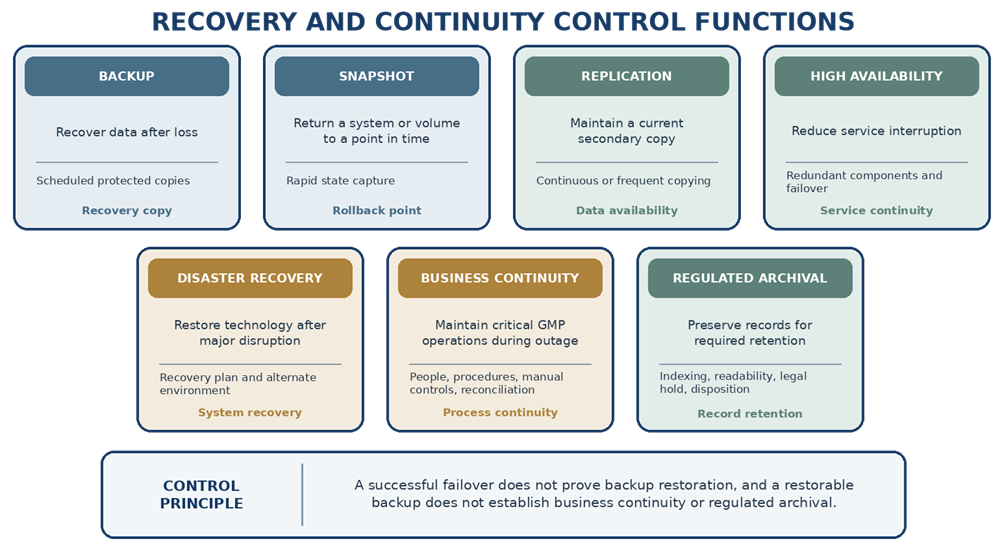
These controls are not interchangeable. Replication can improve availability but may immediately copy corrupted or deleted data. A snapshot may support rapid rollback but may not provide independent protection. High availability may reduce downtime but does not demonstrate that historical data can be restored. Backup protects recoverability, while business continuity defines how regulated operations will continue when technology is unavailable.
The strategy should be based on intended use, system criticality, data criticality, process dependencies, credible failure scenarios, and the length of interruption or data loss the regulated process can tolerate.
Regulatory Context and Terminology
Under 21 CFR 211.68, backup data must be exact and complete and protected from alteration, inadvertent erasure, or loss.
FDA’s Data Integrity and Compliance With Drug CGMP guidance explains that FDA uses “backup” in this regulatory context to mean a secure true copy of the original record maintained throughout the required retention period. FDA distinguishes that retained copy from temporary recovery copies created to recover from a system crash or interruption.
This terminology differs from common Information Technology usage, where backup generally refers to recovery copies retained according to a rotational schedule. The organization should therefore distinguish:
- regulated retained copies or archives required for record retention;
- operational backups used for restoration;
- replicated data used for availability;
- snapshots used for rollback;
- and disaster-recovery copies used to restore a complete environment.
The governing procedures should define these terms clearly and assign appropriate controls to each.
Operational Backup
Operational backup creates protected copies of data and system components so they can be restored after loss, corruption, deletion, or system failure. Backup arrangements may include:
- full backups;
- incremental backups;
- differential backups;
- database backups;
- transaction-log backups;
- file-system backups;
- application-level exports;
- virtual-machine backups;
- image-based backups;
- cloud-provider backup services;
- and configuration backups.
The selected method should support the required recovery point, restoration sequence, system architecture, and data-integrity controls.
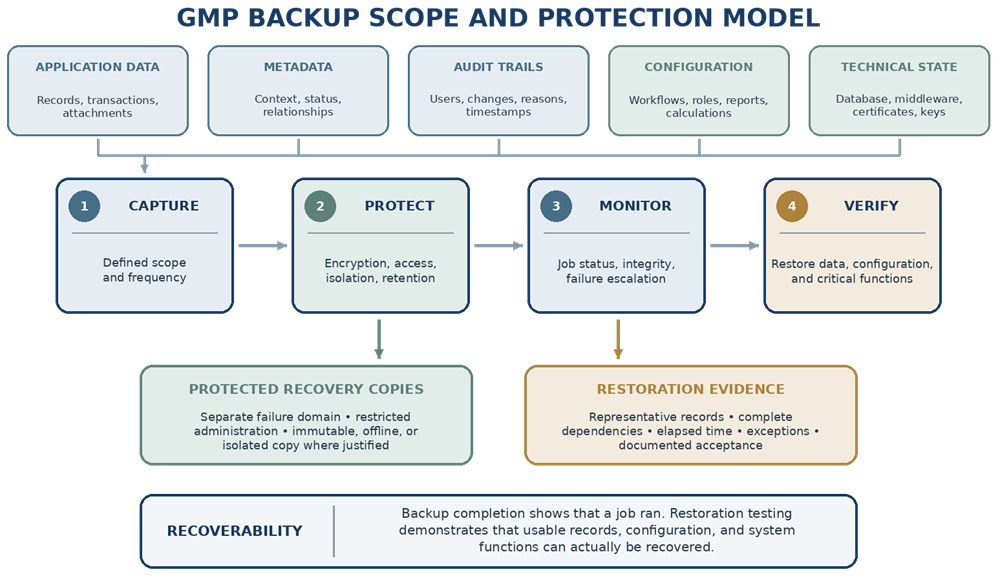
A backup job reported as successful does not establish that the backup is complete, uncorrupted, readable, or restorable. Recoverability must be demonstrated through restoration testing.
Replication
Replication copies data from a primary environment to another system, storage location, region, or service. It may occur synchronously, asynchronously, continuously, or at short intervals. Replication can:
- reduce data loss;
- support rapid failover;
- improve availability;
- maintain a secondary database;
- support geographic redundancy; and
- shorten recovery time.
Replication does not replace backup because deletion, corruption, malware, or incorrect transactions may be copied to the secondary environment. The replicated environment may also be affected by the same identity service, administrator credentials, software defect, configuration error, or supplier failure.
A resilient strategy normally combines replication with protected recovery points that cannot be modified through the same failure path.
Snapshots
A snapshot captures the state of a storage volume, database, virtual machine, or cloud resource at a particular time. Snapshots can support rapid rollback, testing, troubleshooting, and short-term recovery. Snapshot limitations should be understood. A snapshot may:
- depend on the original storage platform;
- share the same physical failure domain;
- exclude external dependencies;
- contain an application-inconsistent state;
- be deleted through compromised administrator credentials;
- or expire according to a short retention schedule.
Where snapshots support GMP recovery, the organization should define their scope, consistency method, frequency, retention, access controls, monitoring, and restoration verification.
High Availability
High availability uses redundant components and automated or controlled failover to reduce service interruption. High-availability arrangements may include:
- server clustering;
- redundant application nodes;
- database clustering;
- load balancing;
- redundant network paths;
- replicated storage;
- redundant power;
- multiple availability zones;
- and automated cloud failover.
High availability addresses service availability, not historical recovery. A highly available system can continue processing incorrect data or replicate corruption across every active node.
Failover testing should confirm that:
- the alternate component activates as intended;
- data remain consistent;
- users and interfaces reconnect correctly;
- alarms and monitoring operate;
- transactions are not lost or duplicated;
- and return to the primary environment is controlled.
Regulated Archival
Archival preserves regulated records throughout their required retention period. It should support:
- record ownership;
- indexing and search;
- metadata preservation;
- audit trails;
- electronic signatures;
- readable retrieval;
- legal holds;
- access control;
- technology migration;
- and controlled disposition.
Operational backups should not be treated as the sole archival method unless they provide record-level retrieval, complete metadata, long-term readability, retention control, and approved disposition.
The boundary between recovery copies and regulated archival is addressed in Electronic Records Lifecycle, Retention, and Archival.
Disaster Recovery
Disaster recovery is the coordinated restoration of technology following a major disruption. It normally addresses infrastructure, applications, databases, configuration, interfaces, identity services, security controls, and supporting technical services. A disaster-recovery plan should define:
- activation criteria;
- declaration authority;
- response organization;
- contact and escalation lists;
- recovery priorities;
- recovery dependencies;
- recovery-point and recovery-time objectives;
- alternate environments;
- backup locations;
- restoration sequences;
- verification activities;
- communication responsibilities;
- release authority;
- and return to normal operation.
Disaster recovery may be activated following:
- extended infrastructure failure;
- facility loss;
- major cloud-service disruption;
- destructive cyberattack;
- unrecoverable database corruption;
- regional utility failure;
- storage failure;
- or another event that cannot be resolved through routine incident management.
Business Continuity
Business continuity defines how the organization will maintain essential operations while systems, facilities, suppliers, personnel, or utilities are unavailable.
For GMP processes, continuity planning may include:
- approved manual forms;
- controlled temporary logbooks;
- alternate applications;
- alternate laboratories or manufacturing areas;
- redundant equipment;
- temporary communication methods;
- manual material-status controls;
- controlled label issuance;
- alternate approval pathways;
- predefined production restrictions;
- and recovery priorities.
Business continuity should identify which operations may continue, which require additional controls, and which must stop because they cannot be performed reliably without the unavailable system.
A continuity plan should not assume that every computerized process can be replaced with paper. Some automated controls, calculations, audit trails, electronic interlocks, interfaces, and real-time decisions cannot be reproduced safely through manual procedures.
Distinguishing the Control Functions
| Control | Primary objective | Principal limitation |
|---|---|---|
| Operational backup | Recover data after loss or corruption | Does not itself maintain process availability |
| Snapshot | Return a resource to a prior state | May share the original failure domain |
| Replication | Maintain a current secondary copy | Can replicate corruption, deletion, or malware |
| High availability | Reduce service interruption | Does not preserve historical recovery points |
| Regulated archival | Preserve records for required retention | Does not necessarily restore an operational system |
| Disaster recovery | Restore technology after major disruption | Does not by itself define how business operates during downtime |
| Business continuity | Maintain critical operations during disruption | Does not replace technical recovery |
| Restoration testing | Demonstrate that recovery copies are usable | Must represent the actual recovery scope and dependencies |
Backup Scope
Backup scope should be defined from the complete computerized-system boundary. Copying only the primary database may be inadequate when the system depends on external files, configuration, encryption keys, middleware, identity services, or supplier-managed components. The scope should consider:
- application data;
- database records;
- metadata;
- audit trails;
- electronic signatures;
- attachments;
- generated reports;
- calculation methods;
- workflow configuration;
- roles and permissions;
- master data;
- code tables;
- custom reports;
- scripts and custom code;
- interface configuration;
- integration queues;
- operating-system configuration;
- middleware;
- database configuration;
- virtual-machine configuration;
- cloud-resource definitions;
- certificates;
- encryption keys;
- scheduling services;
- technical logs;
- and documentation required for recovery.
The system owner and process owner should confirm that the backup scope covers everything necessary to restore the intended GMP use, not merely the components most convenient for Information Technology to copy.
Data, Metadata, and Audit Trails
Backup and recovery controls should preserve the complete regulated record. Depending on the system, this may include:
- entered or acquired values;
- user identity;
- date and time;
- record status;
- units;
- processing parameters;
- method versions;
- audit trails;
- electronic signatures;
- approval history;
- attachments;
- record relationships;
- and interface history.
Restoring visible values without their associated metadata can make records incomplete or misleading. Restoration testing should therefore verify record context and traceability, not only database counts or file availability.
Audit trails should be restored with the corresponding records and remain protected from alteration. Their timestamps, user identities, previous values, reasons for change, and relationship to the affected records should remain available.
Configuration and Technical Dependencies
Configuration can be as important as data. A recovered database may be unusable or unsafe if the application configuration does not match the restored records. Recovery scope should include or reproducibly establish:
- enabled modules;
- workflows;
- business rules;
- calculation settings;
- specifications;
- status transitions;
- user roles;
- audit-trail settings;
- electronic-signature settings;
- reports;
- interfaces;
- schedulers;
- service accounts;
- environment variables;
- certificates;
- encryption keys;
- time synchronization;
- and infrastructure dependencies.
The approved configuration baseline should identify how these components are backed up, reconstructed, or verified after recovery.
Infrastructure dependencies should be coordinated with IT Infrastructure Qualification for GMP Computerized Systems.
Backup Frequency
Backup frequency should reflect how much data the process can tolerate losing and how frequently important records or configuration changes occur. Factors include:
- rate of transaction creation;
- process criticality;
- manual reconstruction capability;
- interface frequency;
- laboratory or production schedule;
- audit-trail activity;
- configuration-change frequency;
- supplier capability;
- storage and network constraints;
- and recovery-point objective.
A daily backup may be inadequate for a system processing critical transactions continuously. Conversely, continuous replication may be unnecessary for a low-volume application when controlled reconstruction is practical.
The frequency should be documented, monitored, and reassessed when intended use, data volume, architecture, or business requirements change.
Backup Retention
Operational backup retention should provide sufficient recovery points for credible failure scenarios. A short retention period may cause every available copy to contain an undetected corruption or malicious change. Retention decisions should consider:
- time required to detect data loss or corruption;
- availability of daily, weekly, monthly, or annual recovery points;
- ransomware dwell time;
- application release and patch schedules;
- configuration-change history;
- investigation needs;
- storage capacity;
- contractual requirements;
- and archival arrangements.
Backup retention should not be confused with regulated record retention. Operational copies may rotate or expire, while regulated records must remain protected for the period established by applicable requirements and the site retention schedule.
Protected Copies and Separation
At least one recovery path should be protected against the failures capable of affecting the production environment. Protection may include:
- offline copies;
- immutable storage;
- write-once controls;
- separate administrative credentials;
- separate identity domains;
- network isolation;
- geographic separation;
- separate cloud accounts or subscriptions;
- restricted deletion;
- multifactor authentication;
- delayed deletion;
- and independent monitoring.
The appropriate combination should be based on system criticality, threat assessment, architecture, and the consequence of simultaneous production and backup loss.
Encryption and Key Management
Backup data should be encrypted when required by risk, data sensitivity, company policy, contract, or applicable security requirements. Encryption controls should address:
- data in transit;
- data at rest;
- approved algorithms;
- key ownership;
- key rotation;
- access to keys;
- backup of keys;
- key recovery;
- separation of duties;
- certificate expiry;
- and secure destruction.
Encrypted backups are unusable if the required keys or certificates cannot be recovered. Restoration testing should therefore include the actual key-recovery process where applicable.
Encryption should not prevent authorized inspection, investigation, or timely recovery.
Backup Monitoring
Backup operations should be monitored through automated controls and responsible human review. Monitoring should identify:
- failed jobs;
- incomplete backups;
- missed schedules;
- excessive duration;
- capacity limitations;
- unavailable agents;
- authentication failures;
- replication lag;
- integrity-check failures;
- expired credentials;
- media errors;
- and unauthorized configuration changes.
A successful job status should be supported by meaningful criteria. A job that copied only part of the intended scope should not be classified as successful.
Backup failures should generate alerts, escalation, investigation, and documented resolution based on system criticality and the risk created by the missed recovery point.
Failure Response
Backup failures should be evaluated promptly to determine:
- which systems and records are affected;
- the last successful recovery point;
- whether redundant copies remain available;
- whether the recovery-point objective is threatened;
- whether production operation can continue;
- whether an additional backup is required;
- whether supplier escalation is needed;
- and whether a deviation or quality event should be initiated.
Repeated or unexplained backup failures should be trended and investigated. Closing individual alerts without addressing recurring failure patterns can conceal deterioration in recoverability.
Restoration Testing
Restoration testing demonstrates whether backed-up information can be recovered and used. Testing should confirm, as applicable:
- access to the backup copy;
- decryption;
- file and database integrity;
- restoration of representative records;
- restoration of metadata;
- restoration of audit trails;
- restoration of attachments;
- restoration of configuration;
- restoration of user roles;
- application startup;
- interface operation;
- report generation;
- record search and retrieval;
- electronic-signature visibility;
- and critical business functions.
The test should identify the selected backup, restoration environment, procedure, responsible personnel, elapsed time, exceptions, verification evidence, and acceptance decision.
Testing only a small, technically convenient file may not demonstrate that the complete GMP system can be recovered.
Restoration-Test Frequency and Scope
Restoration testing should be performed at a defined risk-based frequency and following significant changes that could affect recoverability. Relevant triggers include:
- application upgrades;
- database upgrades;
- infrastructure migration;
- cloud-region changes;
- backup-product changes;
- encryption changes;
- architecture changes;
- major configuration changes;
- supplier changes;
- failed restoration;
- cyber incidents;
- and significant backup failures.
The frequency should reflect system criticality, complexity, data volume, supplier dependence, prior results, and the consequences of unsuccessful recovery.
Tests may be scaled, but cumulative coverage should demonstrate recovery of the full system and its critical dependencies.
Complete-System Recovery
File or database restoration is only one part of complete-system recovery. Complete recovery may require:
- establishing the infrastructure;
- configuring the operating system;
- restoring databases and file repositories;
- installing or activating the application;
- restoring configuration;
- restoring certificates and keys;
- connecting identity services;
- restoring middleware and interfaces;
- verifying time synchronization;
- confirming access controls;
- reconciling transactions;
- testing critical functions;
- documenting discrepancies;
- and authorizing return to service.
Recovery sequencing matters. Restoring components in the wrong order can cause duplicate transactions, interface failures, incorrect status, or inconsistent records.
The recovery plan should identify prerequisites and dependencies rather than treating applications as isolated systems.
Recovery-Point Objective
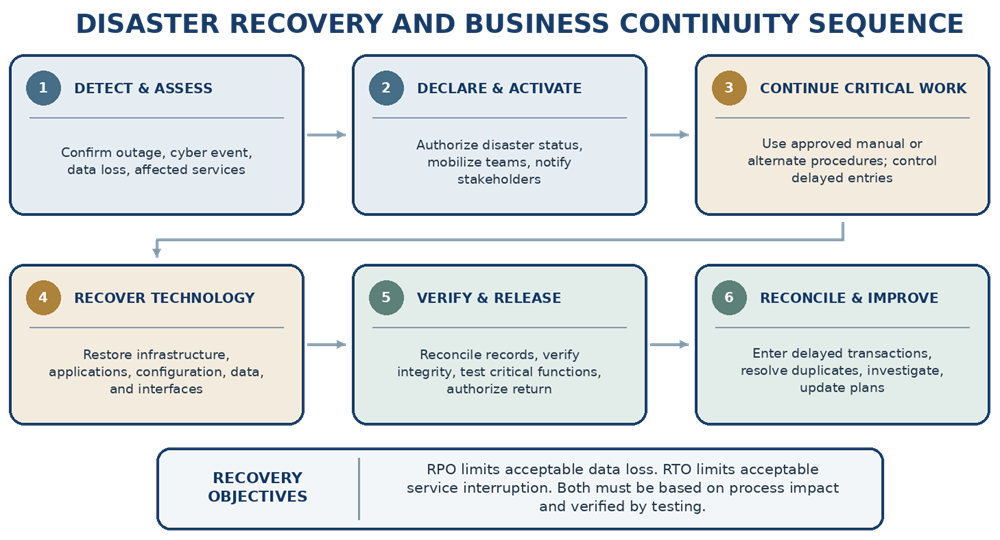
The recovery-point objective, or RPO, defines the maximum acceptable period of data loss measured backward from the disruption.
For example, an RPO of four hours means the recovery strategy should be capable of restoring data to a point no more than four hours before the event. It does not guarantee that no data will be lost.
The RPO should be based on:
- regulated process impact;
- transaction frequency;
- reconstruction capability;
- critical data;
- patient and product risk;
- interface dependencies;
- and the consequences of missing records.
The RPO should drive backup or replication frequency, but the selected technology must also be demonstrated to achieve it.
Recovery-Time Objective
The recovery-time objective, or RTO, defines the maximum targeted time to restore an acceptable level of service after disruption. The RTO may include:
- incident assessment;
- disaster declaration;
- personnel mobilization;
- environment provisioning;
- restoration;
- verification;
- reconciliation;
- and release authorization.
An RTO should not be defined solely by technical restoration speed. The system is not recovered for GMP use until data integrity, configuration, interfaces, critical controls, and operating readiness have been confirmed.
The NIST Contingency Planning Guide for Federal Information Systems provides a useful general framework for business-impact analysis, recovery priorities, contingency planning, testing, and plan maintenance.
Alternate Recovery Environments
Recovery may occur in:
- a secondary data center;
- another site;
- a cloud availability zone;
- another cloud region;
- a separately controlled cloud account;
- a warm standby;
- a hot standby;
- a cold recovery site;
- or a newly provisioned environment.
The alternate environment should provide the services necessary to support the intended recovery objectives, including:
- computing capacity;
- storage;
- network connectivity;
- security;
- identity services;
- domain services;
- time synchronization;
- certificates;
- middleware;
- backup access;
- interface connectivity;
- monitoring;
- and technical support.
Environment differences should be understood and controlled. A recovery environment should not introduce unassessed software versions, security settings, or configuration differences.
Disaster Declaration and Activation
The recovery plan should define who can declare a disaster and activate the recovery organization. Activation criteria may include:
- expected outage duration;
- loss of the primary facility;
- widespread infrastructure failure;
- destructive cyberattack;
- inability to meet the RTO;
- loss of critical data;
- supplier declaration;
- or management determination that routine incident response is insufficient.
The declaration process should establish:
- incident command;
- recovery leadership;
- Quality involvement;
- business-process leadership;
- supplier engagement;
- communications;
- decision authority;
- and documentation requirements.
Unclear authority can delay recovery or cause conflicting technical and business actions.
Business Operation During Outages
Continuity procedures should define how regulated work will be controlled while systems are unavailable. The plan should address:
- processes permitted to continue;
- processes that must stop;
- temporary record formats;
- unique record numbering;
- material and batch status;
- approvals;
- segregation of duties;
- label controls;
- laboratory-result handling;
- deviation management;
- access to current procedures and specifications;
- communication with affected departments;
- and entry of delayed transactions after recovery.
Temporary procedures should be approved before they are needed whenever practical. Improvised controls created during an emergency increase the risk of missing, duplicated, unauthorized, or inconsistent records.
Delayed Transactions and Reconciliation
Transactions performed outside the system during an outage should be entered or otherwise reconciled after service is restored. The reconciliation process should address:
- identification of every temporary record;
- sequence of activities;
- original dates and times;
- identity of the original performer;
- identity of the person entering delayed information;
- reason for delayed entry;
- duplicate prevention;
- status reconciliation;
- inventory reconciliation;
- interface-message reconciliation;
- approval preservation;
- and resolution of discrepancies.
The recovered system should not be released to normal use until the organization understands whether transactions were lost, duplicated, delayed, or processed inconsistently.
Contemporaneous temporary records should be retained according to applicable requirements and should not be destroyed merely because information was later entered into the application.
Recovery Verification and Release
Recovery verification should confirm that the system is technically functional and suitable for resumed GMP use. Verification should include:
- expected recovery point;
- backup integrity;
- record counts or control totals;
- critical record review;
- metadata and audit trails;
- configuration baseline;
- user access;
- critical calculations;
- reports;
- interfaces;
- alarms;
- electronic signatures;
- pending transactions;
- and unresolved discrepancies.
Quality approval should be included where required by the system’s risk and governing procedures.
Conditional release may be appropriate when defined limitations, compensating controls, responsibilities, and completion dates are documented and accepted.
Periodic Recovery Exercises
Disaster-recovery and business-continuity plans should be exercised periodically. Exercises may include:
- tabletop review;
- notification exercises;
- technical component restoration;
- application restoration;
- failover testing;
- alternate-site activation;
- cyber-recovery exercises;
- business-continuity simulations;
- and complete end-to-end recovery.
An effective exercise tests decisions, communication, personnel availability, supplier coordination, technical recovery, business workarounds, reconciliation, and release—not merely whether a recovery document exists.
Exercise results should document:
- planned objectives;
- participants;
- scenario;
- observed performance;
- actual recovery times;
- data-loss position;
- deviations;
- control failures;
- lessons learned;
- corrective actions;
- and plan updates.
Supplier and Cloud Responsibilities
Supplier involvement does not remove the regulated organization’s accountability for recoverability and continuity. Contracts, service agreements, or quality agreements should define:
- backup scope;
- frequency;
- retention;
- storage locations;
- geographic separation;
- encryption;
- subcontractor involvement;
- monitoring;
- failure notification;
- restoration responsibilities;
- restoration-test frequency;
- test evidence;
- RPO and RTO commitments;
- availability commitments;
- disaster declaration;
- customer communication;
- cyber-incident response;
- data export;
- termination support;
- and supplier-failure arrangements.
The customer should understand whether the supplier’s “backup” covers data, metadata, audit trails, configuration, attachments, integrations, and tenant-specific records.
Supplier evidence may be assessed and leveraged, but site-specific testing should confirm that the organization can restore or access its own data and resume its intended process.
See Computerized System Supplier Assessment and Evidence Leverage and Cloud and SaaS Systems in GMP Environments.
Change Control
Backup, restoration, recovery, and continuity arrangements should be maintained through change control.
Changes requiring assessment may include:
- application upgrades;
- database changes;
- infrastructure changes;
- cloud-service changes;
- backup-software changes;
- retention changes;
- encryption changes;
- certificate or key changes;
- identity-service changes;
- new interfaces;
- data-volume growth;
- system relocation;
- supplier changes;
- alternate-site changes;
- and revised business processes.
The impact assessment should determine whether to update:
- backup scope;
- frequency;
- retention;
- RPO;
- RTO;
- recovery procedures;
- supplier agreements;
- restoration tests;
- continuity procedures;
- training;
- and validation evidence.
Emergency changes made during recovery should be documented and retrospectively reviewed under the established emergency-change process.
Periodic Review
Periodic review should evaluate whether recovery controls remain suitable and effective. Review inputs should include:
- backup success and failure trends;
- missed recovery points;
- restoration-test results;
- recovery exercise results;
- actual incidents;
- supplier performance;
- capacity;
- encryption and key status;
- privileged access;
- retention configuration;
- protected-copy status;
- RPO and RTO performance;
- unresolved corrective actions;
- infrastructure changes;
- business-process changes;
- cybersecurity threats;
- and technology obsolescence.
The review should determine whether continued use is justified or whether remediation, additional testing, revised continuity controls, or revalidation is required.
Maintaining Recovery Readiness
Recovery readiness depends on more than the existence of backup files. The organization should be able to demonstrate:
- complete and approved backup scope;
- protected and monitored recovery copies;
- defined RPO and RTO;
- verified restoration;
- documented system dependencies;
- controlled alternate environments;
- trained recovery personnel;
- approved business-continuity procedures;
- controlled delayed transactions;
- reconciliation before normal operation;
- supplier accountability;
- periodic exercises;
- and lifecycle change control.
The objective is not simply to restart a server. It is to restore trustworthy records, validated functions, controlled business processes, and the evidence necessary to resume GMP operations safely.