

Computerized System Validation (CSV) Planning and Strategy
Computerized system validation (CSV) planning defines how an organization will establish and maintain confidence that a system is fit for its intended GxP use.
The validation plan should convert the system’s intended use, risks, architecture, software type, supplier capabilities, and operating model into a proportionate set of lifecycle activities and evidence.
It should answer five practical questions:
- What system and business process are being validated?
- Which functions, records, and decisions are GxP-relevant?
- What could go wrong, and which controls are required?
- What evidence is needed before release?
- How will the validated state be maintained until retirement?
A validation plan should not be a generic list of IQ, OQ, and PQ protocols. It should explain why the selected lifecycle activities are appropriate for the actual system.
Intended Use and Business Process
Planning begins with the intended use.
The intended-use statement should identify:
- the business process;
- principal users;
- regulated functions;
- records created or maintained;
- decisions supported;
- relevant interfaces;
- operating environment; and
- important exclusions.
For example:
The configured quality-management system is used to initiate, investigate, review, approve, and retain deviation and corrective-action records supporting GMP operations. The system controls workflow status, required approvals, due dates, electronic signatures, audit trails, and record retention.
The business process should then be described from beginning to end, including:
- process inputs;
- principal activities;
- decisions;
- approvals;
- outputs;
- records;
- exceptions;
- and connected systems.
Validation should address the actual configured use rather than every function available in the supplier’s product.
System Boundary
The system boundary defines what is included in the validation scope and how external dependencies are controlled.
The boundary may include:
- application modules;
- configured workflows;
- custom code;
- reports;
- calculations;
- interfaces;
- databases;
- middleware;
- infrastructure;
- identity services;
- time synchronization;
- backup services;
- data;
- procedures;
- users;
- administrators; and
- supplier services.
The boundary should also identify exclusions and explain how excluded components are governed.
For example, a shared directory service may be qualified centrally rather than fully retested within each application. The application validation should still verify that authentication and role mapping operate correctly for the intended use.
A narrow boundary may omit critical interfaces or services. An unnecessarily broad boundary may duplicate evidence without improving assurance.
The boundary should therefore include every component whose operation or failure can affect the system’s intended GxP use.
System Ownership and Responsibilities
Responsibilities should be assigned before validation work begins.
Process Owner
The process owner should:
- define the business process;
- approve intended use;
- identify regulated decisions;
- approve business requirements;
- identify process risks;
- ensure procedures and users are ready; and
- accept the system for operational use.
System Owner
The system owner should:
- maintain the system inventory;
- coordinate validation;
- maintain system documentation;
- control configuration and access;
- coordinate changes;
- monitor support and performance;
- lead periodic review; and
- manage retirement.
Information Technology
Information Technology should:
- provide or manage infrastructure;
- maintain environments;
- control technical access;
- manage backup and recovery;
- support cybersecurity;
- assess infrastructure changes;
- and maintain technical records.
Supplier
The supplier may provide:
- product documentation;
- architecture information;
- development and testing evidence;
- release documentation;
- configuration guidance;
- security information;
- known-defect information;
- and technical support.
Quality Unit
The Quality unit should provide appropriate oversight of:
- GxP and Part 11 assessments;
- validation strategy;
- risk acceptance;
- deviations;
- release;
- significant changes;
- periodic review;
- and retirement.
The plan should identify who prepares, reviews, approves, executes, and maintains each required deliverable.
GxP Applicability
The GxP assessment should determine whether the system:
- performs a regulated function;
- controls a GMP process;
- performs a critical calculation;
- creates or maintains a required record;
- determines material or product status;
- supports batch release;
- manages laboratory data;
- supports quality-system records;
- or protects regulated records and data.
The assessment should identify the specific functions and records that are GxP-relevant rather than classifying the complete software product without explanation.
A system may contain both GxP and non-GxP functions. The plan should define which modules, workflows, data, reports, and interfaces are included in validation.
For drug-manufacturing systems, 21 CFR 211.68 requires appropriate controls over computer or related systems and risk-based verification of input and output accuracy.
Part 11 Assessment
A separate assessment should determine whether 21 CFR Part 11 applies to the system’s electronic records or electronic signatures.
The assessment should address:
- applicable predicate-rule records;
- electronic records relied upon;
- electronic signatures;
- closed or open system status;
- hybrid paper and electronic arrangements;
- record retention;
- accurate and complete copies;
- access control;
- audit trails;
- authority checks;
- operational checks;
- signature manifestation;
- signature-to-record linking;
- and legacy-system considerations.
Part 11 applicability does not determine the complete validation scope. A system may be GxP-relevant even when it does not use electronic signatures.
The FDA’s Part 11—Scope and Application guidance supports a risk-based approach while maintaining the underlying requirements for regulated records.
Risk Classification
Risk assessment should connect intended use with credible failure consequences.
The assessment should consider whether a system failure could affect:
- patient safety;
- product quality;
- material or product status;
- a regulated decision;
- data integrity;
- record availability;
- process control;
- or regulatory reporting.
Risk assessment should also consider:
- likelihood of failure;
- ability to detect the failure;
- independent controls;
- software complexity;
- configuration;
- custom code;
- interfaces;
- data migration;
- supplier controls;
- and operational experience.
A numerical risk score should not be the sole basis for excluding requirements or testing. The rationale should explain what can fail, why it matters, which controls manage the risk, and how those controls will be verified.
The system classification process is explained further in Computerized System Types, Intended Use, and GxP Classification.
Software Category and Configuration Approach
Software category helps determine the type of lifecycle evidence required. It does not determine GxP risk by itself.
The plan should identify whether the system includes:
- infrastructure software;
- nonconfigured commercial products;
- configured commercial products;
- custom applications;
- scripts;
- macros;
- custom reports;
- custom calculations;
- or low-code components.
A system may contain components from several categories.
The plan should distinguish configuration from customization.
Configuration
Configuration uses supported settings to establish:
- workflows;
- roles;
- permissions;
- code tables;
- notifications;
- reports;
- audit-trail settings;
- and business rules.
Configuration should be specified, reviewed, tested, and included in the controlled baseline.
Customization
Customization introduces code or logic beyond standard supported configuration.
Examples include:
- custom software;
- custom scripts;
- custom calculations;
- custom interfaces;
- unsupported extensions;
- and complex custom reports.
Customization normally requires additional design information, code control, technical review, testing, and maintenance planning.
See GAMP 5 Software Categories and Validation Strategy for the relationship between software type and lifecycle evidence.
Supplier Strategy
The validation plan should define how supplier evidence will be assessed and used.
Supplier assessment depth should reflect:
- system criticality;
- product maturity;
- software category;
- development practices;
- supplier quality controls;
- cybersecurity;
- service model;
- support arrangements;
- and the organization’s reliance on supplier-controlled activities.
Supplier documentation may reduce unnecessary duplication when it is:
- relevant;
- current;
- approved;
- complete enough for its intended use;
- applicable to the deployed version;
- and supported by an acceptable supplier assessment.
Supplier evidence does not replace verification of the organization’s:
- intended use;
- configuration;
- interfaces;
- migrated data;
- user roles;
- operating procedures;
- and production environment.
Further guidance is provided in Computerized System Supplier Assessment and Evidence Leverage.
Lifecycle Model
The plan should define the lifecycle model that will be followed from initial assessment through retirement.
A typical lifecycle includes:
- Intended use and scope
- Requirements
- Supplier and software assessment
- Risk assessment
- Functional, design, and configuration specifications
- Build or configuration
- Installation and environment verification
- Functional and control testing
- Data migration and interface verification
- End-to-end or user acceptance testing
- Traceability and deviation resolution
- Release
- Change control and continued operation
- Periodic review
- Retirement
The lifecycle may be sequential, iterative, or agile. The plan should describe how requirements, configuration, testing, approvals, and traceability will remain controlled when work is performed in increments.
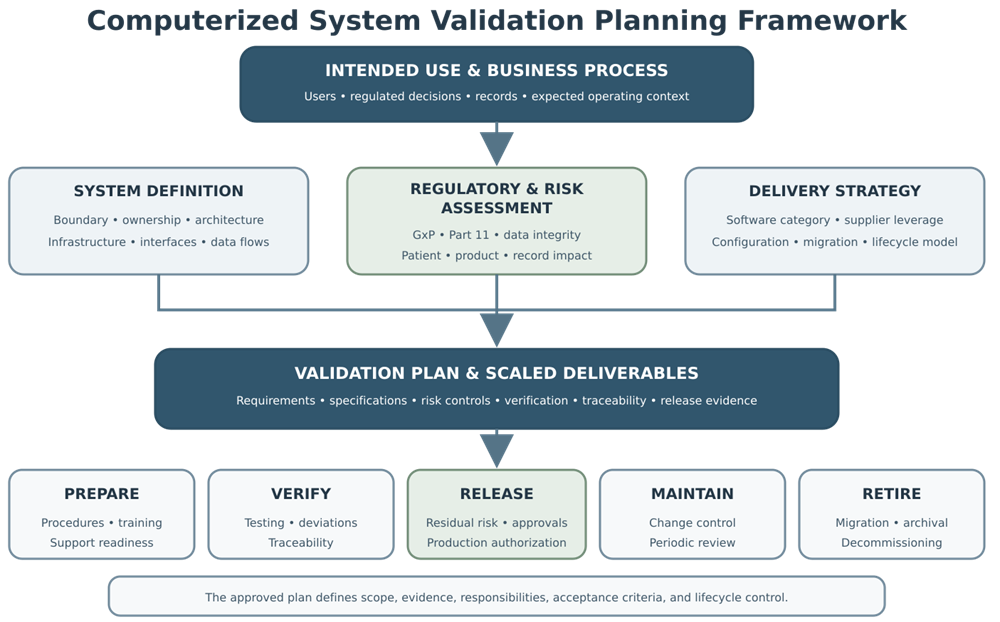
Validation Deliverables
The plan should list the required deliverables, owners, reviewers, approvers, and acceptance criteria.
Typical deliverables include:
| Deliverable | Purpose |
|---|---|
| Intended-use and GxP assessment | Define regulated use and scope |
| Part 11 assessment | Determine electronic-record and signature requirements |
| Validation plan | Define lifecycle strategy and responsibilities |
| User requirements | Define required business and control capabilities |
| Supplier assessment | Determine supplier reliance and evidence leverage |
| Risk assessment | Identify critical functions, failures, and controls |
| Functional or configuration specification | Define how requirements are implemented |
| Architecture and interface documentation | Define technical dependencies and data flows |
| Migration plan and specification | Define how existing data will be transferred |
| Test protocols or test records | Verify requirements, controls, and intended use |
| Traceability record | Connect requirements, risks, configuration, and evidence |
| Deviation and defect records | Document unexpected results and resolution |
| Validation summary or release report | Confirm readiness and residual-risk acceptance |
| Procedures and training records | Establish operational readiness |
| Configuration baseline | Define the approved production state |
| Periodic-review record | Confirm continued suitability |
| Retirement plan and report | Control migration, archival, and decommissioning |
Documents may be combined when their content remains clear, approved, and traceable. Creating separate documents solely to satisfy a standard template does not improve validation.
Infrastructure and Environments
The plan should define the infrastructure supporting the application, including:
- servers or cloud services;
- virtual machines;
- operating systems;
- databases;
- networks;
- storage;
- identity services;
- time synchronization;
- middleware;
- backup;
- monitoring;
- and certificates.
It should identify which infrastructure is:
- qualified centrally;
- supplied as a managed service;
- controlled by the application supplier;
- or verified specifically for the application.
Development, test, validation, training, production, and disaster-recovery environments should be identified where applicable.
Environment use should be controlled so that:
- unapproved configuration does not reach production;
- test activity does not affect production records;
- production data are protected in nonproduction environments;
- and the version tested can be related to the version released.
See IT Infrastructure Qualification for GMP Computerized Systems for detailed infrastructure controls.
Interfaces and Data Flows
Interfaces should be included in the plan because they can affect data completeness, accuracy, status, and traceability. The plan should identify:
- source and destination systems;
- authoritative data source;
- transfer direction;
- data transferred;
- mapping and transformation;
- units and precision;
- transfer trigger;
- acknowledgments;
- rejected transactions;
- duplicate handling;
- retries;
- reconciliation;
- security;
- and monitoring.
Testing should cover successful transfers and relevant failure conditions.
An interface should not be considered validated merely because a message reached the destination. End-to-end verification should confirm that the correct information is associated with the correct material, batch, sample, user, or record.
Data Migration
Where data will be transferred from a legacy system, spreadsheet, database, or supplier environment, the plan should define a migration strategy. The strategy should address:
- migration scope;
- source-data assessment;
- data ownership;
- inclusion and exclusion rules;
- field mapping;
- transformations;
- data cleansing;
- metadata;
- audit trails;
- electronic signatures;
- attachments;
- relationships;
- migration tools;
- dry runs;
- counts;
- control totals;
- sampling;
- reconciliation;
- exception handling;
- rollback;
- and legacy-system disposition.
Migration verification should be based on data criticality and transformation risk. Record counts alone are not sufficient when data may be altered, truncated, misclassified, or assigned to the wrong record.
Data-Integrity Strategy
The validation plan should identify the technical and procedural controls needed to maintain complete, consistent, accurate, and attributable records.
The strategy should address, as applicable:
- original data;
- metadata;
- audit trails;
- user attribution;
- time stamps;
- data changes;
- calculation and processing methods;
- review;
- approval;
- retention;
- backup;
- restoration;
- archival;
- and retrieval.
The plan should identify where the authoritative record resides and whether reports contain all information necessary to reconstruct the regulated activity.
FDA’s Data Integrity and Compliance With Drug CGMP guidance describes flexible, risk-based strategies for maintaining reliable and accurate GMP data.
Test Strategy
The plan should define what will be tested, why it will be tested, and what evidence will be retained. Testing may include:
- installation and environment verification;
- configured functions;
- workflows;
- calculations;
- roles and permissions;
- audit trails;
- electronic signatures;
- reports;
- interfaces;
- alarms and notifications;
- negative conditions;
- boundary values;
- unauthorized actions;
- error handling;
- recovery;
- data migration;
- end-to-end processes;
- and representative user activities.
The strategy should distinguish among:
- supplier testing;
- configuration testing;
- scripted testing;
- exploratory testing;
- automated testing;
- regression testing;
- user acceptance testing;
- and production-readiness checks.
Supplier evidence may support standard product functions. Site-specific configuration, interfaces, data, procedures, and intended use still require appropriate verification.
Testing effort should focus on critical functions and controls. Risk-based testing does not mean omitting functions without documented justification.
Deviations and Defects
The plan should define how test deviations, discrepancies, and defects will be recorded and resolved. The process should address:
- description;
- affected requirement;
- severity;
- root cause;
- correction;
- impact on other tests;
- retesting;
- regression testing;
- residual risk;
- and approval.
Not every unexpected result is a software defect. It may result from:
- an incorrect requirement;
- test-script error;
- configuration error;
- data issue;
- environment problem;
- user error;
- interface failure;
- or supplier defect.
Unresolved items should be assessed before release. The release decision should state why any remaining issue is acceptable and which interim controls are required.
Traceability
Traceability should connect the evidence needed to demonstrate fitness for intended use. It may link:
- intended use;
- requirements;
- risks;
- specifications;
- configuration;
- supplier evidence;
- tests;
- deviations;
- procedures;
- training;
- migration;
- and release approval.
Traceability should support both forward and backward review:
- each requirement should have appropriate implementation and verification evidence;
- each test and configuration item should relate to an approved requirement, risk control, or technical need.
A traceability matrix is one method, but traceability may also be maintained through controlled lifecycle tools or linked records.
Procedures, Training, and Operational Readiness
Validation testing alone does not make a system ready for production use. Before release, the organization should have approved procedures covering, as applicable:
- system use;
- record review;
- access management;
- audit-trail review;
- backup and restoration;
- incident management;
- change control;
- periodic review;
- business continuity;
- and retirement.
Users, administrators, reviewers, and support personnel should be trained for their assigned responsibilities.
Operational readiness should also confirm:
- approved production access;
- support arrangements;
- escalation contacts;
- monitoring;
- backup;
- recovery procedures;
- configuration baseline;
- and supplier support.
Release
The plan should define the conditions required for production authorization. Release criteria should confirm that:
- validation deliverables are approved;
- requirements are adequately covered;
- testing is complete;
- critical deviations are resolved;
- residual risks are accepted;
- migration is accepted;
- interfaces are ready;
- access is approved;
- procedures are effective;
- training is complete;
- backup and recovery are established;
- support is available;
- and the production configuration is documented.
Conditional release should be exceptional. It should identify:
- unresolved items;
- interim controls;
- responsible owner;
- completion date;
- monitoring requirements;
- and final closure approval.
Change Control and Revalidation
The validation plan should establish how post-release changes will be assessed. Changes may affect:
- application software;
- configuration;
- reports;
- calculations;
- interfaces;
- databases;
- infrastructure;
- security;
- master data;
- supplier services;
- or operating procedures.
Change assessment should determine:
- affected requirements;
- data and record impact;
- risk;
- required documentation;
- test scope;
- regression testing;
- migration needs;
- rollback;
- procedure changes;
- training;
- and release approval.
Revalidation should be based on the effect of the change, not on the change label alone.
Periodic Review
Periodic review should confirm that the system remains suitable for its intended use and remains in a validated state. Review inputs may include:
- current intended use;
- configuration baseline;
- changes;
- deviations;
- incidents;
- unresolved defects;
- access reviews;
- audit-trail review;
- backup and restoration;
- interface performance;
- cybersecurity;
- supplier notices;
- patches;
- support status;
- procedures;
- training;
- and data retention.
The validation plan or governing procedure should define the review frequency or the method used to determine it.
Retirement
Retirement planning should begin before the system becomes unsupported or unsuitable. The retirement strategy should address:
- replacement system;
- migration;
- retained records;
- metadata;
- audit trails;
- electronic signatures;
- attachments;
- archival;
- retrieval;
- access removal;
- interface shutdown;
- infrastructure disposition;
- supplier termination;
- and retirement approval.
A system remains GxP-relevant after operational use ends when it continues to retain regulated records.
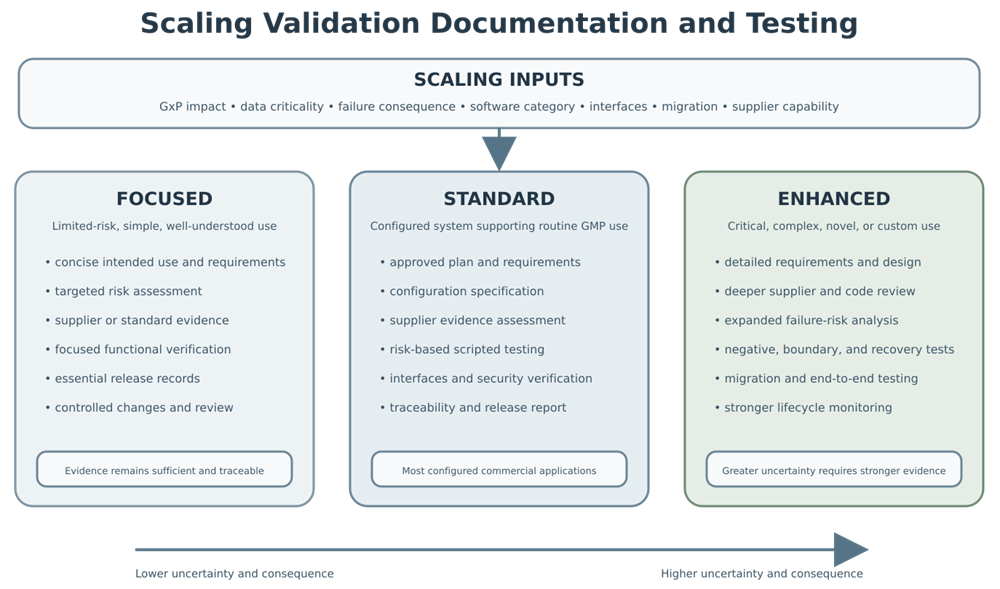
Scaling Documentation and Testing
Validation should be scaled according to risk and uncertainty. Relevant scaling factors include:
- intended-use criticality;
- patient and product impact;
- data criticality;
- software category;
- configuration complexity;
- custom code;
- novelty;
- number and complexity of interfaces;
- migration scope;
- supplier capability;
- operating history;
- security exposure;
- and ability to detect failure.
A practical model may use three levels.
| Approach | Typical application | Documentation and testing |
|---|---|---|
| Focused | Simple, limited-risk, well-understood use | Concise requirements, targeted risk assessment, focused verification, and essential release evidence |
| Standard | Configured commercial system supporting routine GMP use | Approved plan, requirements, configuration specification, supplier assessment, risk-based testing, traceability, and release report |
| Enhanced | Critical, complex, novel, highly customized, or custom system | Detailed requirements and design, deeper supplier or code review, expanded risk analysis, negative and recovery testing, migration testing, and stronger lifecycle monitoring |
Scaling should reduce unnecessary documentation, not eliminate necessary evidence.
Even a focused approach should demonstrate:
- approved intended use;
- understood risk;
- adequate requirements;
- objective verification;
- controlled release;
- and lifecycle control.
A critical custom application may require extensive evidence even when its user population is small.
Validation Plan Content
A practical validation plan should contain:
- System identification and description
- Business process and intended use
- Scope and system boundary
- Ownership and responsibilities
- GxP applicability
- Part 11 applicability
- Risk classification
- Software category
- Supplier strategy
- Lifecycle model
- Required deliverables
- Configuration and customization approach
- Infrastructure and environment strategy
- Interface strategy
- Data-migration strategy
- Data-integrity controls
- Test strategy
- Deviation and defect handling
- Traceability approach
- Procedure and training requirements
- Release criteria
- Change-control strategy
- Periodic-review approach
- Retirement strategy
- Document-retention requirements
- Approval
The plan should be updated when material changes affect the strategy, scope, responsibilities, deliverables, or acceptance criteria.
Practical Outcome
An effective validation plan should allow an independent reviewer to understand:
- what the system is intended to do;
- where its boundary lies;
- which functions and records are regulated;
- what risks matter;
- how supplier evidence will be used;
- what will be configured or customized;
- which documents and tests are required;
- how deviations will be resolved;
- what is required for release;
- and how the validated state will be maintained.
The plan is not a ceremonial document. It is the approved control strategy connecting the system’s intended use and risks with the evidence required throughout its lifecycle.