

Disinfectant Efficacy Studies for GMP Cleanrooms and Controlled Areas
Disinfectant efficacy studies demonstrate that the disinfectants and sporicidal agents used in GMP cleanrooms and controlled areas can achieve the required microbiological reduction on surfaces representative of the actual facility when applied under defined operating conditions. The study should evaluate the disinfectant as it is actually used: at the approved concentration, with the approved application method, on relevant facility materials, against appropriate microorganisms, and for a contact time that can be reproduced during routine operations.
Disinfectant efficacy is not established by supplier literature or EPA registration alone. Those data can support initial product selection, but they do not demonstrate performance on a facility’s specific epoxy flooring, stainless steel, glass, vinyl, polymers, elastomers, wall systems, equipment surfaces, or other construction materials. Nor do they establish efficacy against microorganisms repeatedly recovered from that facility.
The study therefore bridges laboratory antimicrobial testing and the site contamination-control program. It should demonstrate that selected disinfectants have suitable spectrum and performance under defined conditions and should provide the technical basis for written procedures covering preparation, application, wet contact time, sporicide use, storage, expiration, and lifecycle reassessment.
Regulatory and Scientific Basis
- 21 CFR 211.42 requires aseptic-processing facilities to include a system for cleaning and disinfecting rooms and equipment to produce aseptic conditions.
- 21 CFR 211.56 requires written sanitation procedures describing the cleaning schedules, methods, equipment, materials, and use of sanitizing agents.
- 21 CFR 211.113 further requires appropriate written procedures to prevent microbiological contamination of sterile and nonsterile drug products.
FDA’s Sterile Drug Products Produced by Aseptic Processing — Current Good Manufacturing Practice states that the suitability, efficacy, and limitations of disinfecting agents and procedures should be assessed. Routinely used disinfectants should be effective against the normal vegetative microbial flora recovered from the facility, while a sound program should also include a sporicidal agent because common disinfectants such as alcohols are not effective against bacterial spores. FDA also expects disinfection procedures to define preparation, sequence, and contact time sufficiently to support reproducible execution.
FDA’s sterile-drug inspection program further states that disinfectant efficacy assessments typically include laboratory studies using material coupons representative of production surfaces, the same disinfecting agents used in the facility, and clearly defined contact times.
USP General Chapter <1072>, Disinfectants and Antiseptics, provides an additional scientific framework for selection and qualification of disinfectants used in pharmaceutical controlled environments. It addresses disinfectant selection, surface challenge testing, microorganisms, neutralization, recovery, and use of site-relevant isolates. Because USP text and revision status can change, the applicable official chapter version should be confirmed by the user organization rather than relying on an outdated excerpt.
Cleaning and Disinfection Are Different Operations
Disinfection should not be confused with cleaning. Cleaning removes soil, residue, organic matter, and other contamination that can physically protect microorganisms or interfere with disinfectant activity. Disinfection applies a chemical agent under defined conditions to reduce viable microorganisms remaining on the surface.
A disinfectant efficacy study should therefore not imply that a disinfectant can compensate for inadequate cleaning. Organic residue can reduce the effectiveness of many disinfectants, and the facility procedure should define whether cleaning is required before disinfection.
For controlled-area programs, the sequence is typically: Remove soil → apply disinfectant → maintain required wet contact time → allow appropriate drying or removal → restore area for use
Where both cleaning and disinfection are required, the efficacy study should represent the surface condition intended by the procedure rather than challenge the disinfectant through an unrealistic soil load unless a specific “dirty condition” claim is being evaluated.
Define the Intended Use Before Designing the Study
The protocol should define where and how each agent will be used. The same disinfectant may be applied to floors, walls, stainless-steel equipment exteriors, glove surfaces, transfer carts, cleanroom furniture, or barrier systems, but the study design should not assume that efficacy is identical across all materials and applications. The intended-use definition should include:
- disinfectant or sporicide identity;
- active ingredient;
- use concentration;
- preparation method;
- ready-to-use versus diluted formulation;
- applicable cleanroom or controlled area;
- surface materials;
- application method;
- routine wet contact time;
- organisms or organism groups requiring control;
- storage and in-use period;
- whether the product is sterile where required;
- frequency or schedule of use.
This definition should align with the broader Environmental Monitoring Program Design and Execution and, where applicable, the Aseptic Processing Validation Strategy and Lifecycle, because disinfectant efficacy should support the actual contamination-control risks identified for the manufacturing environment.
Representative Surface Coupons
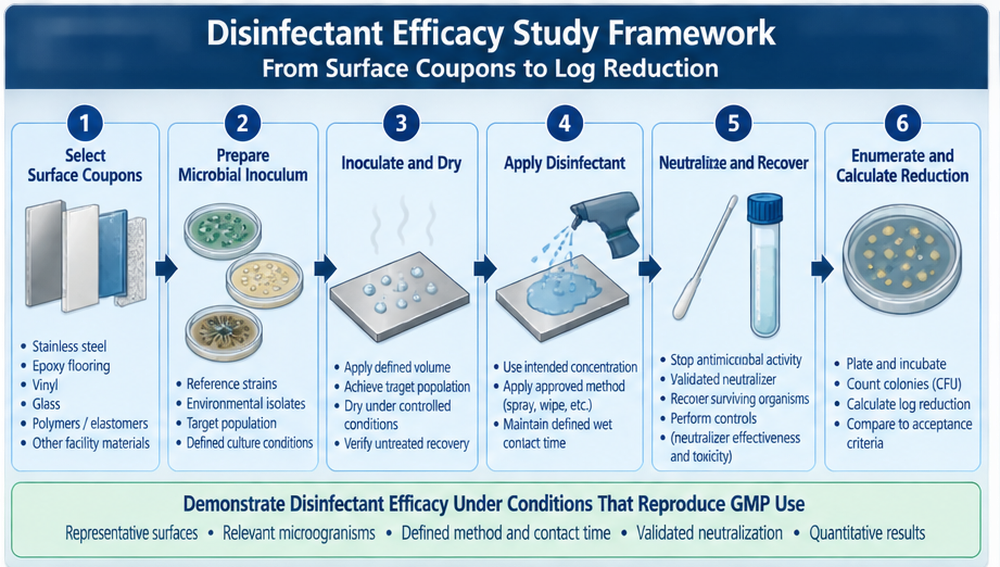
Surface coupon studies are the primary laboratory model for demonstrating disinfectant efficacy under facility-specific conditions. Coupons should represent the materials actually present in the cleanroom or controlled area and should include surfaces that could materially alter antimicrobial performance or microbial recovery.
Representative materials may include stainless steel, glass, epoxy-coated surfaces, vinyl flooring, polycarbonate, polypropylene, acrylics, elastomers, gasket materials, wall panels, coated metals, and other facility-specific construction materials.
Surface finish also matters. Polished stainless steel may not represent a rough, worn, textured, porous, cracked, or chemically aged surface. Where a material exists in multiple finishes or conditions, the study should assess whether one coupon type adequately represents the broader group.
The objective is not to test every material in the building. A scientifically justified grouping approach can be used when materials have sufficiently similar composition, finish, disinfectant compatibility, and recovery behavior. Unique or more challenging surfaces should be tested independently.
Selection of Challenge Microorganisms
A robust study should use microorganisms that address both reproducibility and facility relevance. Reference strains provide standardized organisms with defined characteristics and support comparison across studies. Facility environmental isolates demonstrate efficacy against organisms actually recovered from the manufacturing environment.
Reference organisms may be selected to represent relevant categories such as Gram-positive bacteria, Gram-negative bacteria, yeasts, molds, and bacterial spores. Common examples used in established microbiological methods include Staphylococcus aureus, Pseudomonas aeruginosa, Candida albicans, Aspergillus brasiliensis, and a suitable Bacillus spore-forming organism, depending on the study objective and governing method.
The final organism panel should not be based solely on a generic list. Environmental-monitoring history should be reviewed to identify organisms that are frequently recovered, persist in particular areas, demonstrate recurrence after cleaning and disinfection, or represent microorganisms of special concern.
FDA specifically expects routinely used disinfectants to be effective against normal vegetative flora recovered from the facility.
Environmental Isolates
Environmental isolates are important because organisms recovered from the facility may behave differently from laboratory reference strains. Cleanroom isolates may have experienced desiccation, nutrient limitation, repeated disinfectant exposure, surface adaptation, or other stresses that affect their behavior.
The study should select representative isolates based on actual environmental-monitoring data rather than automatically test every organism ever recovered. Selection factors can include:
- frequency of recovery;
- location of recovery;
- persistence or recurrence;
- organism type;
- spore formation;
- unusual resistance characteristics;
- presence in higher-classified areas;
- adverse trends;
- relevance to product or process risk.
Where several closely related isolates occur repeatedly, a scientifically justified representative can be used if the grouping rationale is documented.
The environmental-monitoring program should therefore provide the organism data that support isolate selection and subsequent lifecycle reassessment.
Inoculum Preparation
Challenge inocula should be prepared in a controlled and reproducible manner. The study should define the organism culture conditions, growth phase where relevant, target population, preparation method, diluent, and enumeration approach.
The inoculum should be high enough to allow meaningful quantitative demonstration of log reduction while remaining recoverable from the untreated control. Excessively large inocula can create an artificial challenge unlike routine cleanroom contamination and can alter drying behavior or disinfectant exposure.
For bacterial spores, the preparation should contain a characterized spore population suitable for the study objective. FDA has noted that sporicidal efficacy can vary substantially by organism and preparation method, reinforcing the need for well-controlled spore challenges.
The actual inoculum population should be confirmed rather than assumed from a nominal preparation value.
Coupon Inoculation and Drying
A defined volume of microbial suspension is applied to the coupon and allowed to dry before disinfectant exposure. Drying creates a reproducible surface challenge and avoids testing only organisms freely suspended in liquid.
The protocol should define the inoculation area, target population, drying conditions, and maximum drying period. The dried inoculum should remain recoverable from untreated control coupons at a level sufficient to support the intended log-reduction calculation.
Drying should not be described simply as making the organism “more resistant.” The effect depends on the microorganism, surface, inoculum medium, drying period, and environmental conditions. The purpose is to create a standardized surface-associated challenge representative enough to support comparison.
Where excessive drying causes large losses before disinfectant exposure, the untreated recovery control becomes especially important.
Disinfectant Concentration
The disinfectant should be tested at the concentration actually approved for GMP use. For diluted products, the study should consider the preparation tolerance and whether the lower end of the permitted concentration range presents the least favorable antimicrobial condition.
Testing only a concentration stronger than routine use provides weak evidence for the operating procedure.
Relevant variables can include:
- nominal concentration;
- preparation tolerance;
- dilution water quality;
- concentrate lot;
- ready-to-use versus prepared solution;
- age after preparation;
- storage condition;
- in-use expiration;
- container or spray-system compatibility.
If the procedure permits a concentration range, the study rationale should identify the concentration that represents the appropriate challenge.
Application Technique
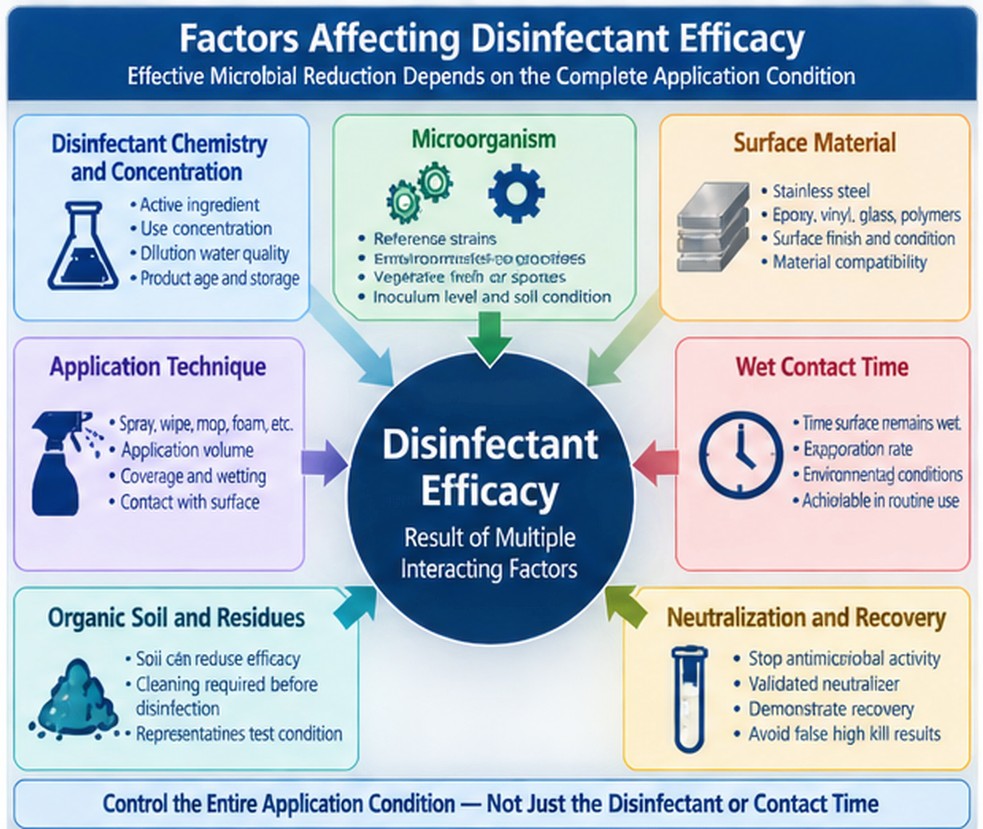
Disinfectant efficacy depends not only on the chemical formulation but also on how the product reaches the surface. Spray application, wiping, mopping, flooding, foaming, or another technique can produce different wetting and contact conditions.
The coupon study should therefore represent the approved application method as closely as practical. If routine procedure specifies wiping after spraying, the laboratory study should evaluate whether the physical wiping step changes microbial recovery or disinfectant exposure.
Application volume should be sufficient to create the intended wet surface condition without using an unrealistically large volume that cannot be maintained operationally.
For wipes or saturated materials, the study should consider whether the disinfectant concentration and delivery characteristics remain representative throughout routine use.
Wet Contact Time
The relevant parameter is wet contact time, not simply elapsed time after application. The surface must remain adequately wet for the duration required by the procedure and supported by the efficacy study.
This distinction is important because a disinfectant can evaporate or dry before the nominal contact period is complete. Alcohol-based products are particularly susceptible to this problem. A procedure that requires ten minutes of contact but produces a dry surface after three minutes does not represent ten minutes of wet antimicrobial exposure.
The study should therefore document:
- start of contact time;
- surface-wetting condition;
- application quantity;
- whether reapplication is permitted;
- actual wet duration;
- defined endpoint;
- temperature or environmental factors affecting evaporation where relevant.
The validated contact time should be achievable in routine operations. A laboratory contact time that cannot be maintained in the cleanroom should not become the basis for the approved procedure.
Neutralization
Neutralization is one of the most important controls in disinfectant efficacy testing. At the end of the defined contact time, antimicrobial activity must be stopped promptly so that microorganisms are not continuing to die during recovery, dilution, or plating.
If residual disinfectant remains active after the nominal contact period, the calculated log reduction will overstate the efficacy achieved during the validated exposure.
The selected neutralizer should therefore be demonstrated to:
- effectively inactivate the disinfectant under the test conditions; and
- not adversely affect recovery or viability of the challenge microorganism.
USP <1072> specifically identifies neutralization as part of surface-challenge testing and refers to validation of microbial recovery principles.
The fact that a commercial recovery medium contains neutralizers does not prove suitability for every disinfectant concentration and organism combination.
Recovery Controls
Microbial recovery from the coupon should be demonstrated independently from antimicrobial kill. A low survivor count may otherwise reflect poor recovery rather than effective disinfection.
Appropriate controls typically include an untreated or control coupon containing the same microorganism and undergoing the same drying and recovery process without exposure to the test disinfectant.
Additional controls may address:
- inoculum enumeration;
- coupon recovery;
- neutralizer effectiveness;
- neutralizer toxicity;
- media growth promotion;
- sterility of diluents and materials;
- disinfectant-free procedural controls.
The study should be designed so that the difference between treated and control coupons represents disinfectant effect rather than method bias.
Survivor Recovery and Enumeration
After neutralization, surviving organisms are recovered from the coupon through an established method such as extraction, rinsing, swabbing, vortexing, agitation, or another justified approach. The recovery solution is then cultured using a method capable of enumerating the surviving population.
The method should provide a suitable quantitative range and should account for expected high and low survivor populations. Appropriate serial dilutions may be required.
Where no organisms are detected after treatment, the report should consider the method detection limit. A result of zero colonies does not demonstrate infinite log reduction; the maximum reportable reduction is constrained by the control population and detection capability of the recovery method.
Log Reduction
Disinfectant efficacy is commonly expressed as logarithmic reduction relative to the recovered population on the untreated control.
Conceptually: Log Reduction = log10(Control Recovery) − log10(Treated Recovery)
The untreated control is important because it reflects losses associated with inoculation, drying, the coupon material, and recovery. Comparing survivors only to the nominal inoculum can incorrectly attribute these losses to the disinfectant.
Results should be reported by microorganism, surface, disinfectant, concentration, contact time, replicate, and study condition. Summary averages should not conceal an individual surface-organism combination that fails the predefined acceptance criterion.
Acceptance Criteria
Acceptance criteria should be defined before study execution and should reflect the intended application, organism class, governing methodology, and site contamination-control strategy.
Historically, USP <1072> surface-challenge guidance has used examples such as approximately 3-log reduction for vegetative bacteria and 2-log reduction for bacterial spores under the defined test conditions. The current USP revision process has also proposed clarifications for fungal-spore acceptance. Because chapter requirements and proposed text can change, the study protocol should cite the official USP version actually adopted by the organization rather than present one historical criterion as a universal regulatory mandate.
Acceptance should also address:
- successful neutralization;
- acceptable untreated-control recovery;
- valid growth and sterility controls;
- defined replicate consistency;
- passing performance on all required representative surfaces;
- passing performance for required microorganism categories;
- compliance with the approved wet contact time.
A passing average should not automatically compensate for a failed critical surface or challenge organism.
Sporicidal Agents
Many routine disinfectants are effective against vegetative bacteria but have limited or no activity against bacterial spores. FDA specifically cites 70% isopropyl alcohol as ineffective against Bacillus spores and expects a sound program to include a sporicidal agent used according to a written schedule and when environmental data indicate spore-forming organisms.
The sporicide should therefore be evaluated against suitable spore-forming challenge organisms and the representative facility surfaces on which it will be used.
The study should consider:
- sporicide concentration;
- wet contact time;
- surface compatibility;
- material degradation;
- residues;
- corrosivity;
- personnel-safety controls;
- neutralization;
- recovery of spores;
- actual application technique.
Sporicidal contact times are often longer than those for routine vegetative disinfectants. The validated duration must remain practical for facility execution.
Disinfectant Rotation and Multiple-Agent Programs
A GMP disinfectant program does not need to be justified on the vague assertion that routinely rotating chemicals “prevents microbial resistance.” The stronger scientific rationale is that no single disinfectant necessarily provides optimal activity against every microbial category or under every environmental condition.
FDA states that most disinfectants have limitations and that firms should normally use more than one type of disinfectant; it specifically identifies the need for sporicidal capability because many common agents do not kill spores.
A program may therefore use a routine broad-spectrum disinfectant together with a periodic sporicide. Where two or more routine disinfectants are alternated, the purpose and schedule should be documented and supported by the contamination-control strategy rather than by an unsupported assumption that rotation itself is necessary.
Each disinfectant relied upon for microbiological control should have efficacy data supporting its intended use.
Reference Strains Versus Environmental Isolates
Reference strains and environmental isolates answer different questions. Reference organisms provide standardized challenge models and demonstrate expected broad-spectrum activity. Environmental isolates confirm that the disinfectant remains effective against representative microorganisms encountered under actual site conditions.
Neither should automatically replace the other.
A balanced study usually begins with suitable standard organisms and supplements them with facility isolates selected from environmental-monitoring history. The extent of isolate testing should remain risk based.
Repeated recovery of an organism after routine disinfection should trigger evaluation of whether the organism, surface, application technique, wet contact time, or disinfectant program requires additional study.
Replication and Study Robustness
The number of replicate coupons should be sufficient to distinguish antimicrobial performance from normal laboratory variability. The protocol should define the number of replicates before execution and should not rely on a single coupon per microorganism-surface-disinfectant combination where variability could materially affect the conclusion.
Study robustness is strengthened when replicate results remain consistent and controls demonstrate stable inoculum, recovery, and neutralization.
Where a large matrix of materials and isolates exists, justified grouping can be used to avoid unnecessary combinations. The rationale should identify the representative surface and organism selected for each group.
Laboratory Qualification and In-Situ Verification
Coupon studies demonstrate microbiological efficacy under controlled laboratory conditions. They do not, by themselves, prove that facility personnel consistently apply the disinfectant correctly in the manufacturing environment.
In-situ or operational verification can provide complementary evidence that procedures produce adequate wetting, contact time, coverage, sequence, and application on actual cleanroom surfaces.
Environmental-monitoring data after implementation also provide ongoing evidence of contamination-control performance, but routine EM results should not be treated as a substitute for controlled efficacy studies. Low environmental counts cannot establish log-reduction capability because the starting microbial population is unknown.
The site should use laboratory efficacy, procedural qualification, and environmental monitoring as complementary forms of evidence.
Relationship to Environmental Monitoring
The Environmental Monitoring Program Design and Execution provides the organism history that supports environmental-isolate selection and the trend data used to determine whether the disinfectant program remains effective.
Disinfectant efficacy studies provide controlled experimental evidence of microbial reduction. Environmental monitoring evaluates the microbiological state of the operating environment. The two programs should inform one another but should not be conflated.
If environmental monitoring identifies recurring molds, spore-forming bacteria, or persistent vegetative organisms, the disinfectant efficacy program should assess whether the currently qualified agent and application procedure provide adequate control against representative isolates.
Protocol Requirements
The protocol should define the study before laboratory execution begins. At minimum, it should identify:
- objective and scope;
- disinfectants and sporicides;
- lot or preparation controls;
- concentrations;
- coupon materials;
- surface preparation;
- challenge organisms;
- environmental isolates;
- inoculum preparation;
- target population;
- drying conditions;
- application method;
- wet contact times;
- neutralizers;
- recovery method;
- incubation conditions;
- enumeration method;
- replicate strategy;
- controls;
- log-reduction calculation;
- acceptance criteria;
- deviations;
- final reporting requirements.
The study matrix should clearly show every required disinfectant × microorganism × surface × contact-time combination.
Study Report
The final report should allow an independent reviewer to reconstruct the study and determine whether the approved disinfectant program is supported by the data.
The report should include raw recovery results, control recoveries, calculated log reductions, neutralization results, deviations, atypical findings, failed combinations, investigations, and final conclusions.
The conclusion should state which disinfectant, concentration, surface groups, organism groups, and contact times are supported. Limitations should be documented rather than implied.
If one product performs poorly on a particular surface or organism, the report should not generalize the remaining passing results into an unrestricted facility-wide claim.
Lifecycle Reassessment
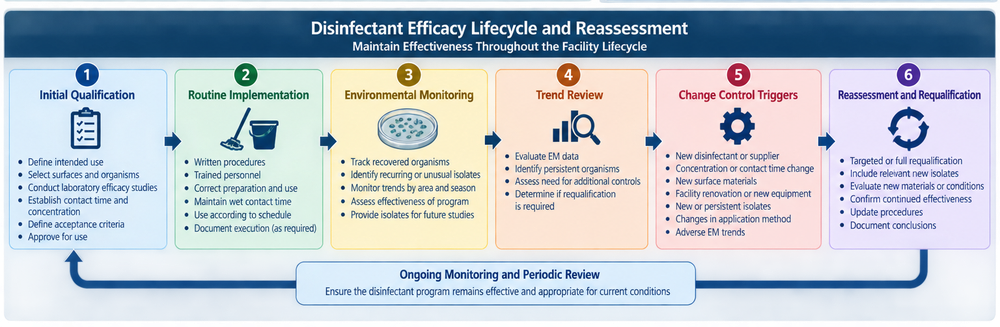
Disinfectant efficacy is a lifecycle control, not a one-time study. Reassessment should be considered when changes affect the original study assumptions.
Potential triggers include:
- introduction of a new disinfectant or sporicide;
- formulation or supplier change;
- concentration change;
- revised wet contact time;
- new surface material;
- facility renovation;
- new cleanroom equipment;
- new application technology;
- changed wipe or mop system;
- changed neutralizer or recovery method;
- recurring environmental isolate;
- increased fungal or spore recovery;
- adverse environmental-monitoring trend;
- change in disinfectant preparation or in-use period.
A change does not automatically require repetition of the entire study matrix. The impact assessment should identify which organism, surface, disinfectant, or procedural characteristics were affected and determine whether targeted verification or broader requalification is appropriate.
Common Deficiencies
Common deficiencies include testing only stainless steel even though the facility contains substantially different materials; relying solely on supplier or EPA efficacy claims; testing only reference organisms while ignoring significant site isolates; using contact times that cannot be maintained operationally; and failing to document actual surface wetness.
Other weaknesses include inadequate disinfectant neutralization, failure to demonstrate neutralizer non-toxicity, low untreated-control recovery, inconsistent inoculum populations, excessive drying losses, poor replicate agreement, and calculating log reduction from nominal inoculum rather than an appropriate recovered control.
Program-level deficiencies include assuming that a routine alcohol provides sporicidal control, rotating disinfectants without a defined scientific rationale, treating environmental monitoring as a substitute for efficacy qualification, and failing to reassess the program when persistent organisms or new surfaces are introduced.
Key Principles
Disinfectant efficacy studies should demonstrate that the actual GMP disinfectant procedure performs effectively on representative facility surfaces against microorganisms relevant to the manufacturing environment.
Surface coupon studies should evaluate reference organisms and scientifically selected environmental isolates using controlled inoculation, drying, disinfectant concentration, application technique, wet contact time, neutralization, recovery, and quantitative log-reduction assessment.
Wet contact time should represent the period for which the surface remains adequately wet, not simply a nominal clock time stated in the procedure.
Neutralization and recovery controls are essential. Without them, apparent microbial reduction may reflect continued disinfectant action after the defined exposure or poor recovery from the surface.
A sound program should address both routine vegetative disinfection and sporicidal control. The rationale for multiple disinfectants should focus on spectrum and contamination-control needs rather than relying on an unsupported statement that chemical rotation inherently prevents microbial resistance.
Acceptance criteria should be predefined and linked to the governing study methodology and intended use. Historical USP <1072> reduction targets may provide useful scientific benchmarks, but the study should cite the official chapter version adopted by the organization.
Disinfectant efficacy should remain under lifecycle control. Environmental-monitoring trends, persistent isolates, new surfaces, new disinfectants, concentration changes, and procedural changes should trigger documented assessment of whether existing efficacy evidence remains applicable.