

Design of Experiments for Process Characterization and Validation
Design of Experiments (DOE) is a structured statistical approach for studying how multiple process inputs affect one or more measured outputs. In process validation, DOE is most useful during development and Stage 1 — Process Design, where it can convert preliminary process knowledge into quantitative understanding of parameter effects, interactions, operating ranges, variability, and process robustness.
FDA specifically recognizes DOE as a process-development tool. FDA’s Process Validation: General Principles and Practices explains that DOE studies can reveal relationships, including multivariate interactions, between variable inputs such as material characteristics or process parameters and resulting process or product outputs. FDA also notes that risk-analysis tools can be used to screen potential variables before DOE so that experimental effort is concentrated where it can generate the most useful knowledge.
DOE is therefore not simply a statistical exercise and should not be treated as a mandatory validation document. Its value is determined by whether it improves process understanding and whether its conclusions are appropriately translated into the commercial process design, control strategy, Process Performance Qualification (PPQ), and subsequent Continued Process Verification (CPV).
For the preceding development framework, see Process Characterization and Development Studies for Process Validation.
What Design of Experiments Means
Design of Experiments (DOE) means deliberately changing selected input variables according to a predefined experimental plan and measuring the effect on defined outputs.
A conventional one-factor-at-a-time study changes one variable while attempting to hold everything else constant. DOE can vary several inputs systematically and can therefore identify relationships that one-factor studies may miss.
The basic DOE terminology is:
| Term | Meaning in process development |
|---|---|
| Factor | An input variable deliberately studied, such as temperature, mixing speed, time, material moisture, or pressure |
| Response | A measured output used to evaluate the effect of the factors, such as assay, yield, moisture, dissolution, impurity, viscosity, or uniformity |
| Level | A specific value assigned to a factor during the experiment, such as 50°C and 70°C |
| Experimental run | One defined combination of factor levels that is executed and evaluated |
| Main effect | The estimated effect of changing one factor, averaged across the conditions of the other studied factors |
| Interaction | A condition in which the effect of one factor depends on the value of another factor |
| Model | A mathematical representation relating the studied factors to the measured response |
| Prediction | An output value estimated from the model for a defined combination of factor values |
| Residual | The difference between an observed result and the result predicted by the model |
| Robustness | The ability of a process to tolerate expected variation while continuing to produce acceptable performance and product quality |
DOE does not automatically determine which parameters are critical. It generates evidence about relationships and process sensitivity that can subsequently support risk assessment and criticality decisions.
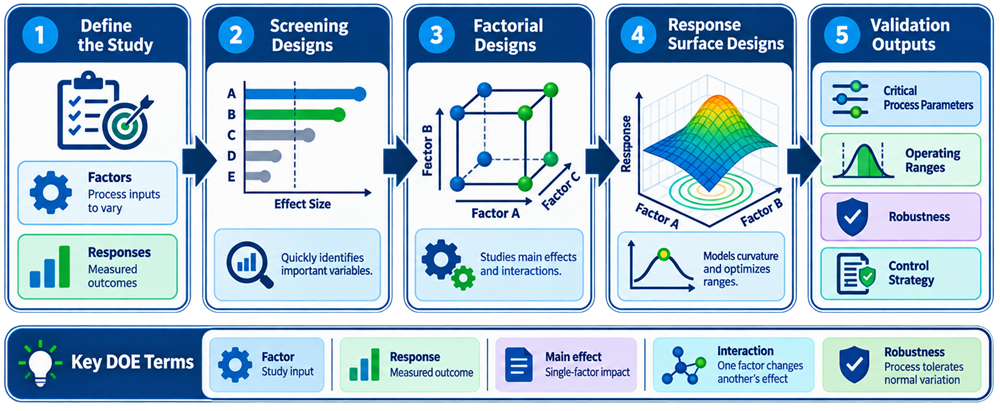
Factors, Responses, and the Experimental Question
A useful DOE begins with a clearly defined scientific question. For example: How do drying temperature and drying time affect residual moisture and degradation?
In that example:
- drying temperature and drying time are the factors;
- residual moisture and degradation are the responses.
A more complex study might ask: How do material moisture, impeller speed, granulation time, and binder-addition rate affect granule size, flow, and tablet compression behavior?
The factors and responses should therefore come from process knowledge rather than from statistical convenience. Relevant inputs may include:
- material attributes;
- equipment settings;
- process parameters;
- timing;
- environmental conditions;
- formulation variables;
- equipment geometry where it can be represented experimentally; and
- other sources of variability.
Responses should represent scientifically meaningful process or product outcomes. A Critical Quality Attribute (CQA) is a product or intermediate property that must be appropriately controlled to assure intended product quality. A Critical Material Attribute (CMA) is a material property whose variability can meaningfully affect a CQA or process performance. A Critical Process Parameter (CPP) is a process parameter whose variability can affect a CQA and therefore requires appropriate control.
DOE can help characterize these relationships, but the classification of an attribute or parameter should integrate product knowledge, process understanding, risk assessment, and other available evidence.
See CQA, CPP, and Material Attribute Risk Assessment for the detailed criticality framework.
Selecting Variables for DOE
Including every conceivable variable in an experimental design is rarely efficient. Variable selection should begin with:
- prior development knowledge;
- process characterization;
- mechanistic understanding;
- known material variability;
- equipment knowledge;
- prior failures or deviations;
- scientific literature where relevant; and
- Quality Risk Management.
Quality Risk Management (QRM) is the systematic process of assessing, controlling, communicating, and reviewing risks to quality. FDA’s final ICH Q9(R1) Quality Risk Management guidance emphasizes risk-based decision-making and reducing inappropriate subjectivity in pharmaceutical quality decisions.
Risk assessment is useful before DOE because it helps distinguish:
- variables already known to have negligible influence;
- variables requiring experimental investigation;
- variables that may need to be challenged over a wider range;
- interactions that are scientifically plausible; and
- responses that should receive greater emphasis because of product-quality risk.
The DOE should then test the uncertainty that matters, rather than merely generating a large dataset.
Screening Designs
A screening design is an experimental design intended primarily to identify which factors among a relatively large candidate set appear to have meaningful effects. Screening is useful early in characterization when many variables may influence the process but detailed modeling of all of them would require excessive experimentation.
A screening study may evaluate, for example:
- temperature;
- mixing speed;
- mixing time;
- material moisture;
- addition rate;
- equipment load; and
- hold time.
The output may indicate that only temperature, material moisture, and mixing speed warrant more detailed investigation. Screening should generally be considered a factor-prioritization activity, not a final basis for commercial operating ranges.
Two-Level Designs
A two-level design studies each factor at two defined conditions, commonly described as low and high levels. Two-level designs can efficiently estimate main effects and some interactions, but they provide limited information about curvature.
Curvature means that the relationship between a factor and a response is not adequately represented by a straight line. For example, increasing temperature from 40°C to 50°C might improve a response, while increasing it further from 50°C to 60°C causes deterioration. A simple linear model would not adequately represent that behavior.
Plackett–Burman Designs
A Plackett–Burman design is an efficient screening design commonly used when many factors need to be examined with relatively few experimental runs.
Its principal purpose is estimation of main effects. Its limitation is that interactions are not well separated from main effects. A factor appearing important in a Plackett–Burman design may therefore require additional study before its actual mechanism is understood. For pharmaceutical process characterization, this makes Plackett–Burman designs useful for preliminary prioritization but generally insufficient for establishing multidimensional operating regions.
Factorial Designs
A factorial design studies combinations of factor levels so that the effects of individual factors and their interactions can be evaluated.
Full Factorial Design
A full factorial design includes every combination of the selected factor levels. For three factors studied at two levels each, the design contains eight unique combinations. Full factorial designs provide strong information about main effects and interactions but become increasingly large as the number of factors increases.
Fractional Factorial Design
A fractional factorial design deliberately executes only a selected fraction of all possible factor combinations. This reduces experimental effort but introduces confounding, also called aliasing.
Confounding means that two or more effects cannot be independently distinguished using the available experimental data. For example, a particular two-factor interaction may be mathematically combined with another effect. The design should therefore be selected with knowledge of which interactions are scientifically plausible and which effects can reasonably be assumed to be small. A statistically efficient design is not useful if it aliases the effects most important to process understanding.
Main Effects and Interactions
A main effect describes the average change in a response associated with changing one factor across the studied conditions. An interaction occurs when the effect of one factor changes depending on the value of another.
Consider a process in which temperature and mixing speed affect dissolution. At low mixing speed, increasing temperature may have little effect. At high mixing speed, the same temperature increase may substantially change dissolution. Temperature and mixing speed therefore interact.
This distinction is important for validation because independent parameter ranges can be misleading when interactions are significant. A temperature of 60°C may be acceptable at one mixing speed but unacceptable at another.
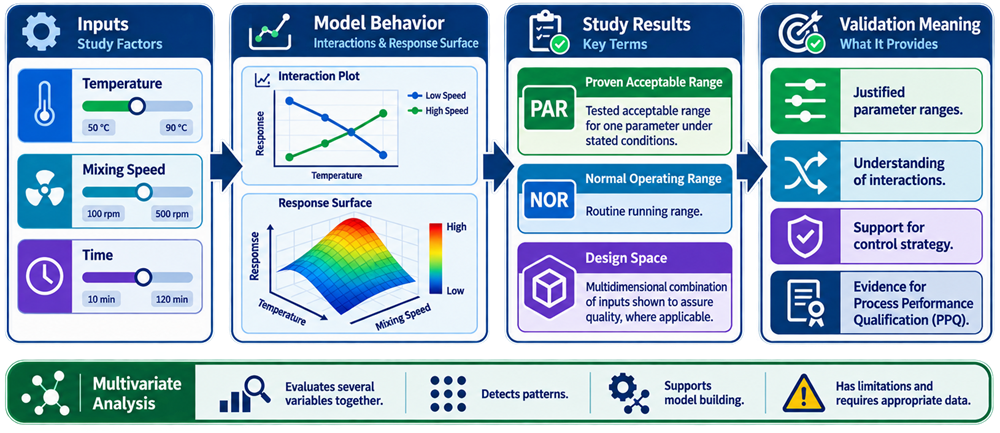
Interaction Plots
An interaction plot graphically shows whether the effect of one factor changes across different levels of another factor. When plotted lines are approximately parallel, interaction may be limited.
When the lines diverge, converge, or cross, interaction may be present. The graphical result is useful for interpretation, but the conclusion should also be supported by the experimental design, statistical analysis, process mechanism, and data quality. An interaction should not be accepted merely because a plot appears visually dramatic.
Center Points and Detection of Curvature
A center point is an experimental run conducted near the midpoint of the studied factor ranges. Center points can help determine whether the process response behaves approximately linearly across the studied region or whether meaningful curvature exists. They can also provide information about experimental variability when repeated.
If substantial curvature exists, a basic two-level factorial design may no longer be sufficient. A response-surface design may be appropriate.
Response Surface Methodology
Response Surface Methodology (RSM) is a family of DOE and modeling techniques used to characterize curved relationships between multiple factors and one or more responses. RSM is commonly used when the objective has moved beyond screening and the important factors are reasonably well identified.
It can support:
- characterization of parameter interactions;
- modeling of curvature;
- identification of operating regions;
- optimization;
- robustness evaluation; and
- development of a design space where justified.
The resulting mathematical surface describes the estimated response across combinations of factor settings. A response surface is the graphical or mathematical representation of that relationship. A contour plot is a two-dimensional representation of a response surface in which lines or regions represent similar predicted response values.
Central Composite Design
A Central Composite Design (CCD) is a response-surface design that combines factorial points, center points, and additional points used to estimate curvature. CCD can efficiently support estimation of a quadratic model. A quadratic model includes squared terms such as temperature² in addition to ordinary factor and interaction terms. These squared terms allow the model to represent curvature. CCD can be useful when:
- factor ranges are reasonably established;
- curvature is expected;
- process optimization is needed; or
- a multidimensional acceptable region is being investigated.
The actual design should consider whether the required experimental combinations are technically feasible and scientifically meaningful.
Box–Behnken Design
A Box–Behnken Design (BBD) is another response-surface design used to estimate interactions and curvature without necessarily requiring experiments at combinations where all factors simultaneously operate at their extreme values.
This can be advantageous when extreme combinations could be unrealistic, unsafe, or unnecessarily damaging. BBD does not eliminate the need to understand the actual operating boundaries. It is simply one experimental structure available for characterizing the response surface.
Experimental Range, Operating Range, PAR, and Design Space
Several terms related to parameter ranges should remain clearly distinguished.
- An experimental range is the range deliberately studied during development.
- A Normal Operating Range (NOR) is the range intended for routine process operation under established control.
- A Proven Acceptable Range (PAR) is an experimentally supported acceptable range for an individual parameter under stated conditions.
- A design space is a multidimensional combination and interaction of material attributes and process parameters demonstrated to provide assurance of quality.
FDA’s ICH Q8(R2) Pharmaceutical Development guidance recognizes that formal experimental designs can provide enhanced process understanding and support design-space development. Q8 also makes clear that a design space is proposed by the applicant and subject to regulatory assessment and approval.
DOE results do not automatically establish a design space. In particular, combining multiple independent PARs does not necessarily create a design space because the effects of parameter combinations and interactions may not have been demonstrated.
The detailed regulatory and control implications are addressed in Process Control Strategy and Design Space Development.
Design Space Is Not Required for Process Validation
A design space can provide valuable process understanding and regulatory flexibility, but it is not a prerequisite for a valid pharmaceutical process.
A conventional control strategy can be scientifically robust without a formally approved design space. DOE may instead support:
- justified operating ranges;
- parameter classification;
- control limits;
- sampling strategy;
- robustness understanding;
- PPQ design; or
- targeted CPV monitoring.
The purpose of DOE should therefore be driven by the process question rather than by a desire to produce a response-surface graphic or claim a design space.
Multivariate Analysis
Multivariate Analysis (MVA) refers broadly to statistical methods that evaluate several variables simultaneously. DOE itself is multivariable by design, but MVA can also be applied to larger development, PPQ, or commercial datasets. The distinction is important:
- DOE deliberately changes inputs according to a planned experimental design.
- MVA can analyze relationships and patterns among multiple variables in either designed or observational datasets.
Observational manufacturing data can reveal useful associations but may contain correlations arising from uncontrolled factors. DOE generally provides stronger evidence for causal relationships because the factors are deliberately manipulated according to an experimental structure.
Principal Component Analysis
Principal Component Analysis (PCA) is a multivariate method used primarily to simplify and visualize datasets containing many correlated variables.
PCA transforms the original variables into new composite dimensions called principal components. A principal component represents a combination of the original variables that explains a portion of the observed data variation. PCA can help:
- identify clusters;
- detect unusual observations;
- visualize relationships among batches;
- identify correlated measurements;
- identify patterns in high-dimensional datasets; and
- compare development, PPQ, and commercial data.
PCA does not by itself prove causation or establish a CPP. It is primarily an exploratory and pattern-recognition tool.
Partial Least Squares Regression
Partial Least Squares (PLS) regression is a multivariate modeling method used to relate several potentially correlated input variables to one or more responses.
PLS can be useful when conventional regression is difficult because many process measurements are correlated. Applications may include:
- Process Analytical Technology data;
- spectroscopy;
- complex bioprocess datasets;
- multivariable process monitoring; or
- linking process measurements with product-quality responses.
The same model limitations apply: the data must be representative, the model must be adequately evaluated, and predictions outside the supported domain should not be assumed reliable.
Regression
Regression is a statistical method for estimating the relationship between one or more predictor variables and a response. A DOE response-surface model is usually a form of regression.
Multiple regression uses more than one predictor. Regression coefficients estimate how each factor or combination of factors contributes to the modeled response. The model should be interpreted scientifically rather than simply accepting software output.
Statistical Significance and Practical Significance
A statistically detectable effect is not necessarily important to process validation.
- Statistical significance indicates that an observed relationship is unlikely to be attributable solely to experimental variation under the assumptions of the statistical analysis.
- Practical significance considers whether the magnitude of the effect is meaningful for product quality, process performance, process control, or manufacturing risk.
A very small parameter effect may be statistically detectable with a large dataset but operationally irrelevant. Conversely, a clinically or technically important effect may require attention even when a limited study provides uncertain statistical evidence. Validation decisions should therefore integrate statistics with engineering, scientific knowledge, and risk.
Replication, Randomization, and Blocking
A defensible DOE should consider how experimental variability will be managed.
- A replicate is an independent repetition of an experimental condition. Replication provides information about experimental variability and improves confidence in estimated effects.
- Randomization means executing experimental runs in an order determined independently of the factor settings rather than always following a convenient progression from low to high conditions. Randomization helps reduce bias from time-related or uncontrolled influences.
- Blocking means grouping experimental runs according to a known nuisance source of variation that is not the principal subject of the experiment.
Examples of blocks can include:
- day of execution;
- raw-material lot;
- equipment train;
- analyst;
- manufacturing campaign; or
- experimental setup.
A nuisance variable is a variable that can affect the response but is not the primary subject of the study. Blocking allows its contribution to be distinguished from the factor effects of interest where the design permits.
DOE and Process Robustness
Process robustness means the ability of the process to maintain acceptable performance despite expected variation. DOE can evaluate robustness by deliberately studying:
- ranges around intended setpoints;
- normal material variability;
- equipment load;
- expected environmental conditions;
- relevant process interactions; and
- operating conditions near proposed boundaries.
Robustness does not mean that every parameter combination within an experimentally studied rectangle is acceptable. If interactions exist, some combinations of otherwise individually acceptable parameter values may produce poor performance. That is one reason multivariable experimentation is particularly useful.
Model Adequacy
A statistical model should be treated as an approximation of process behavior, not as the process itself. Model adequacy should be evaluated using:
- residual patterns;
- agreement between observed and predicted results;
- evidence of curvature;
- potential interactions;
- experimental variability;
- model complexity;
- scientific plausibility; and
- confirmation data where appropriate.
Lack of fit means that the chosen mathematical model does not adequately describe the observed relationship beyond the normal experimental variation. A model with unacceptable lack of fit should not be used as the primary basis for parameter ranges or validation decisions.
Confirmation Runs
A confirmation run is an experiment performed at a selected combination of conditions to determine whether the actual response agrees sufficiently with the model prediction. Confirmation is particularly useful when:
- selecting an optimum operating point;
- establishing a proposed operating range;
- verifying a predicted worst case;
- supporting scale-up;
- supporting a design-space region; or
- translating a statistical model into a manufacturing decision.
Confirmation should preferably occur at scientifically relevant conditions rather than only at the easiest center point.
Extrapolation
Extrapolation means using a model to predict process behavior outside the factor ranges or conditions represented by the supporting data.
Extrapolation should be treated cautiously. A DOE conducted from 40°C to 60°C does not, by itself, justify a prediction at 75°C. Likewise, a model established at laboratory scale cannot automatically be assumed to predict commercial-scale performance.
FDA specifically cautions that models and simulations should be understood in terms of how well they represent the commercial process and that differences can affect the relevance of the resulting information.
Scale Dependence of DOE Results
DOE can quantify relationships within the studied system, but those relationships may change with scale. Potential scale-dependent effects include:
- mixing;
- heat transfer;
- mass transfer;
- shear;
- residence time;
- equipment geometry;
- batch load;
- filtration area;
- drying behavior; and
- other equipment-process interactions.
A factor called “mixing speed” may therefore represent different physical conditions on development and commercial equipment. The validation team should understand the underlying process mechanism and identify the scale-up criterion that must be preserved.
See Process Characterization and Development Studies for Process Validation for scale-up and commercial relevance.
Model Limitations Should Be Explicit
Every DOE model has a domain in which its conclusions are supported. Important limitations may include:
- restricted material lots;
- limited equipment configurations;
- laboratory-scale data;
- narrow factor ranges;
- inadequate representation of commercial variability;
- confounded effects;
- limited replication;
- measurement uncertainty;
- missing interactions;
- model assumptions;
- insufficient data near boundaries; or
- lack of confirmation at commercial-relevant conditions.
These limitations should be documented rather than hidden behind statistical model-fit values. A statistically strong model can still have limited validation value if the experiment does not represent the commercial process.
From DOE to Risk Assessment
DOE results can update Quality Risk Management by replacing assumptions with experimental evidence. For example, DOE may demonstrate that:
- a parameter believed to have high impact has little practical effect within the studied region;
- another parameter has a previously unrecognized influence on a CQA;
- two individually moderate factors have an important interaction;
- a material attribute changes process sensitivity;
- an operating range is too broad; or
- additional commercial-scale confirmation is needed.
Risk assessment should therefore be iterative. DOE is evidence entering the risk process; it is not a separate statistical exercise disconnected from validation.
From DOE to CPP Determination
DOE can provide quantitative evidence that a process parameter influences a CQA.
However: Statistical effect ≠ automatic CPP designation.
CPP determination should consider:
- magnitude of the effect;
- relationship to CQAs;
- operating range;
- process sensitivity;
- detectability;
- existing controls;
- material interactions;
- downstream controls;
- process knowledge; and
- risk.
This prevents statistical significance from being confused with regulatory or process criticality.
From DOE to the Control Strategy
DOE can directly support the process control strategy by helping determine:
- which parameters require active control;
- where routine setpoints should be located;
- appropriate operating ranges;
- which parameter combinations need restriction;
- material controls;
- sampling requirements;
- alarm or monitoring needs;
- feedback or feed-forward controls;
- acceptable process margins; and
- conditions requiring escalation.
A control strategy is the planned set of controls derived from current product and process understanding that assures process performance and product quality. DOE provides evidence supporting the strategy; it does not replace the broader engineering and quality-system design required to implement it.
From DOE to PPQ
Process Performance Qualification (PPQ) is the Stage 2 activity in which the integrated commercial manufacturing process is evaluated to determine whether it can reproducibly perform as intended.
DOE results should inform PPQ rather than be repeated unnecessarily during PPQ. Development DOE can support:
- identification of conditions requiring confirmation;
- selection of CPPs;
- PPQ sampling locations;
- sampling timing;
- parameter monitoring;
- expected variability;
- statistically meaningful acceptance approaches;
- potential worst-case conditions;
- control-strategy verification; and
- residual uncertainty that remains to be resolved.
See Process Performance Qualification (PPQ) Strategy and Batch Selection and PPQ Sampling Plan and Data Collection Strategy.
FDA expects PPQ statistical methods to be predefined and capable of evaluating both within-batch and between-batch variability.
DOE Does Not Mean Running PPQ at Artificial Failure Conditions
Development experiments and PPQ have different objectives. DOE may deliberately explore parameter combinations outside routine operating conditions to understand process sensitivity.
PPQ should represent the intended commercial process and should demonstrate reproducibility under appropriately justified commercial conditions. Development DOE therefore provides knowledge that helps define PPQ without requiring the PPQ campaign itself to become a development experiment.
DOE Results and PPQ Acceptance Criteria
DOE can help establish expectations for process behavior, but a model prediction should not automatically become a PPQ acceptance criterion. PPQ criteria should consider:
- CQA requirements;
- process parameter ranges;
- commercial process capability;
- expected variability;
- measurement uncertainty;
- sampling strategy;
- control strategy;
- development evidence; and
- commercial relevance.
See PPQ Acceptance Criteria and Statistical Evaluation for the Stage 2 statistical framework. The live PPQ article already positions development and DOE data as one input to acceptance criteria, while requiring interpretation in the context of process knowledge.
From DOE to Continued Process Verification
Continued Process Verification (CPV) is FDA Stage 3, in which ongoing commercial data are evaluated to provide continued assurance that the process remains in a state of control. DOE can help determine which relationships deserve continued monitoring.
For example:
- a sensitive CPP-CQA relationship may warrant ongoing trending;
- an interaction may require monitoring of parameter combinations;
- a material attribute may need supplier or lot trending;
- an important DOE response may establish the baseline against which commercial performance is compared; or
- a narrow robustness margin may justify enhanced CPV attention.
Commercial data can also challenge the original DOE conclusions. If routine manufacturing demonstrates relationships different from development predictions, the knowledge base, risk assessment, control strategy, and potentially the statistical model should be reconsidered.
See Continued Process Verification (CPV) Program and Monitoring Strategy.
Multivariate Models in Continued Monitoring
MVA methods can become particularly useful during Stage 3 when many process variables are generated simultaneously. PCA, PLS, correlation analysis, and other multivariate methods can assist in identifying:
- unusual batch profiles;
- correlated process shifts;
- complex process drift;
- clusters of related observations; or
- changing relationships among process parameters and quality results.
However, multivariate monitoring should not become an unexplained algorithm.
The organization should understand:
- what variables enter the model;
- how data are preprocessed;
- what represents normal behavior;
- how model signals are interpreted;
- what limitations exist; and
- what action follows a meaningful signal.
Documentation of DOE Studies
FDA specifically emphasizes documentation of variables studied, why they were selected, and how development knowledge supports later Process Qualification and Continued Process Verification. DOE documentation should therefore include:
- study objective;
- scientific question;
- prior knowledge;
- risk assessment;
- factors;
- factor ranges;
- responses;
- experimental design;
- run sequence;
- randomization or blocking strategy;
- replication;
- equipment and materials;
- analytical methods;
- raw data;
- deviations;
- statistical methods;
- model assumptions;
- model limitations;
- interaction assessment;
- confirmation runs;
- conclusions;
- commercial relevance; and
- resulting validation decisions.
A DOE report should make it possible to reconstruct how the data were converted into process knowledge.
Translating DOE Results Into Validation Decisions
The final value of DOE lies in the decisions it supports.
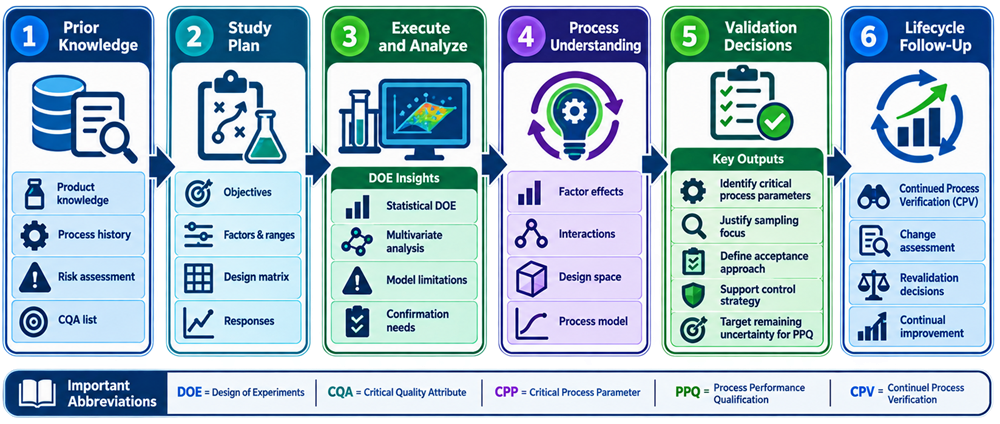
The translation can be represented as:
Prior Knowledge → DOE Strategy → Experimental Evidence → Process Understanding → Validation Decision → Lifecycle Follow-Up
Potential decisions include:
- refine a parameter range;
- identify or reassess a CPP;
- revise a material control;
- define an interaction-based operating restriction;
- select a routine setpoint with appropriate margin;
- establish additional sampling;
- strengthen the control strategy;
- identify uncertainty requiring PPQ confirmation;
- define CPV monitoring;
- support a change-impact assessment; or
- determine whether additional characterization is necessary.
DOE therefore becomes validation evidence only when its conclusions are incorporated into the controlled lifecycle documentation.
Key Principles
- DOE means Design of Experiments and is a structured method for studying multiple process variables.
- A factor is an input; a response is a measured output; a level is a defined value of a factor.
- Screening designs identify variables requiring further investigation.
- Full factorial designs evaluate all selected combinations; fractional factorial designs reduce runs but may confound effects.
- Main effects and interactions are different. An interaction means the effect of one factor depends on another.
- Center points can help detect curvature.
- Response Surface Methodology (RSM) evaluates curved, multivariable relationships.
- Central Composite Design (CCD) and Box–Behnken Design (BBD) are common response-surface designs.
- Multivariate Analysis (MVA) evaluates multiple variables together.
- Principal Component Analysis (PCA) is primarily a pattern-recognition and dimensionality-reduction method.
- Partial Least Squares (PLS) regression can model relationships between multiple correlated inputs and responses.
- Statistical significance should not be confused with practical or quality significance.
- A statistically significant factor is not automatically a CPP.
- Experimental range, Normal Operating Range (NOR), Proven Acceptable Range (PAR), and design space are different concepts.
- Independent PARs do not automatically constitute a design space.
- DOE can support a design space but does not automatically establish one.
- Process robustness describes tolerance to expected variability while maintaining acceptable performance.
- Model predictions are supported only within the domain represented by adequate data.
- Extrapolation outside studied conditions should be treated cautiously.
- Scale dependence and commercial relevance must be evaluated before development models are applied to PPQ.
- DOE should inform PPQ rather than turn PPQ into a development experiment.
- Commercial manufacturing and CPV can provide new evidence that confirms or challenges the original DOE conclusions.