

HVAC Qualification Strategy
HVAC qualification in pharmaceutical manufacturing provides documented evidence that the system is designed, installed, operated, and controlled to support the environmental conditions required for its intended GMP use.
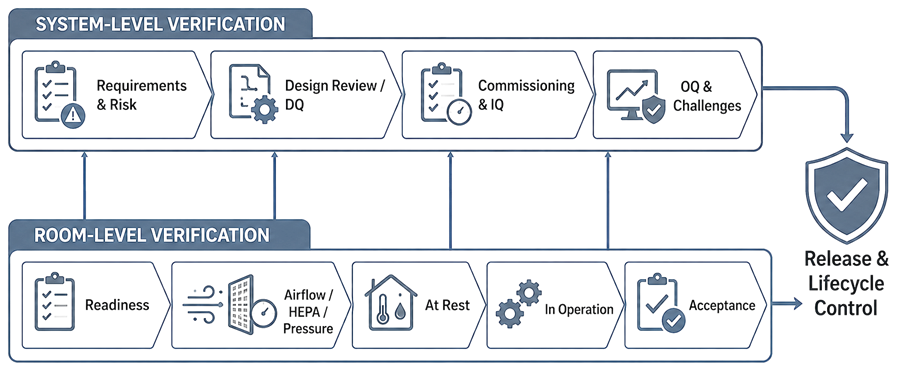
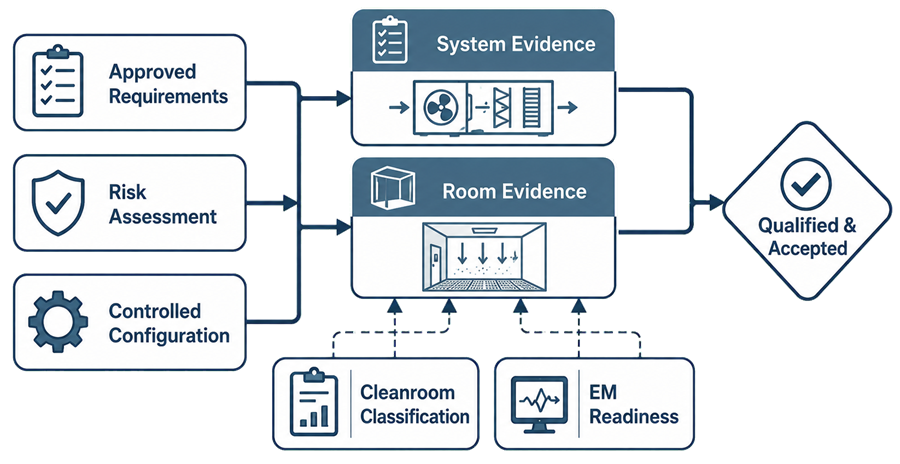
The strategy must address more than the air-handling unit. It should connect system boundaries, room requirements, contamination risks, design controls, commissioning, qualification testing, room-level verification, cleanroom classification, environmental-monitoring readiness, acceptance, and lifecycle control.
An effective strategy distinguishes among:
- HVAC-system capability
- Integrated room performance
- Cleanroom classification
- Environmental performance qualification
- Routine environmental monitoring
These activities support one control strategy, but they do not provide interchangeable evidence. A passing cleanroom-classification result does not prove that HVAC alarms, failure responses, or control sequences operate correctly. A completed HVAC OQ does not establish sustained microbiological control during manufacturing.
The required scope depends on the system’s intended use, room classification, product exposure, process risk, containment requirements, operating states, and overall HVAC system architecture.
Purpose of the HVAC Qualification Strategy
The HVAC qualification strategy defines:
- Systems, rooms, functions, and interfaces included in qualification
- GMP-impact and risk classification
- Requirements subject to formal traceability
- Design reviews and DQ activities
- Commissioning evidence that may be leveraged
- IQ and OQ scope
- Room-level performance-verification activities
- Required operating states and challenge conditions
- Acceptance criteria and data-evaluation methods
- Seasonal-verification requirements
- Responsibilities for execution, review, approval, and release
- Management of deviations and unresolved items
- Ongoing monitoring, maintenance, calibration, change control, and requalification
The strategy may be documented in a validation master plan, facility qualification plan, system-specific qualification plan, commissioning and qualification plan, or a combination of controlled documents.
The document name is less important than having a complete, approved, and traceable strategy.
Regulatory and Technical Basis
21 CFR 211.42 requires suitable building design and defined areas to prevent contamination and mix-ups. For aseptic processing, §211.42(c)(10) addresses appropriate environmental control, including HEPA-filtered air supplied under positive pressure.
21 CFR 211.46 requires adequate ventilation and, where appropriate, equipment for controlling air pressure, microorganisms, dust, humidity, and temperature.
FDA’s Sterile Drug Products Produced by Aseptic Processing—Current Good Manufacturing Practice provides additional recommendations concerning cleanroom design, air quality, pressure relationships, HEPA-filter integrity, airflow patterns, cleanroom qualification, and environmental monitoring.
Applicable cleanroom standards include:
- ISO 14644-1:2015 for classification of air cleanliness by particle concentration
- ISO 14644-2:2015 for monitoring that provides evidence of cleanroom performance
- ISO 14644-3:2019 for cleanroom test methods under as-built, at-rest, and operational occupancy states
- ISO 14644-4:2022 for cleanroom requirements, design, construction, start-up, and lifecycle considerations
The qualification strategy should identify which regulations, standards, guidance documents, engineering practices, and internal procedures apply. Requirements from different sources should not be combined without confirming that their terminology, scope, test conditions, and acceptance bases are compatible.
Defining the HVAC System Boundary
The qualification boundary should be established before protocol development. The boundary must show what belongs to the qualified system and where responsibility transfers to another system, utility, room, or qualification package.
The physical boundary may include:
- Outside-air intake and weather protection
- Return-air and recirculation paths
- Exhaust and relief systems
- Air-handling units
- Fans and variable-frequency drives
- Heating and cooling coils
- Humidification and dehumidification equipment
- Prefilters, final filters, and terminal HEPA filters
- Supply, return, transfer, and exhaust ductwork
- Dampers, airflow-control valves, and terminal units
- Diffusers, grilles, and room returns
- Condensate drains
- Local exhaust and containment interfaces
- Utility connections
- Control panels, sensors, transmitters, and actuators
- Building-management and environmental-monitoring interfaces
The functional boundary should identify:
- Rooms and zones served
- Pressure-control relationships
- Temperature- and humidity-control zones
- Recirculating and single-pass air paths
- Shared and dedicated AHUs
- Normal, setback, cleaning, shutdown, emergency, and recovery modes
- Interlocks with doors, process equipment, exhaust systems, fire protection, and access controls
- Data, alarm, and communication interfaces
A single AHU may serve several rooms with different classifications or risk profiles. Conversely, one room may depend on multiple coordinated systems. Equipment ownership alone does not define the qualification boundary.
A boundary drawing should identify interfaces clearly enough to prevent untested gaps and unnecessary duplication.
Intended Use and GMP-Impact Classification
The intended use should describe the environmental-control function in terms relevant to the supported process.
It should identify:
- Products and processes supported
- Product exposure and contamination sensitivity
- Room classification or controlled status
- Required temperature and humidity conditions
- Product-protection requirements
- Containment requirements
- Required room-pressure relationships
- Required airflow behavior
- Occupancy and activity assumptions
- Equipment heat, moisture, particle, or vapor loads
- Operating schedules and permitted modes
- Environmental-monitoring requirements
The system should then be classified according to its potential GMP impact.
A practical model may distinguish:
| Classification | Typical HVAC meaning | Qualification approach |
|---|---|---|
| Direct GMP impact | The system directly maintains conditions that protect exposed product, control contamination, provide containment, or support a classified environment | Formal qualification with risk-focused design, installation, operational, and room-performance verification |
| Indirect GMP impact | The system supports a direct-impact HVAC system or controlled area without independently maintaining a critical condition | Documented assessment with suitable commissioning, engineering verification, and targeted qualification |
| No GMP impact | Failure would not reasonably affect product quality, patient safety, data integrity, or GMP compliance | Normal engineering, maintenance, and business controls |
Classification should consider individual functions as well as the overall system. A direct-impact HVAC system may contain noncritical components, while an indirect support system may contain an alarm or interface that requires formal verification.
Risk-Based Qualification Planning
A risk-based validation approach determines the depth and rigor of qualification without eliminating required evidence.
The risk assessment should consider failure conditions such as:
- Loss or reduction of supply airflow
- Loss of return or exhaust airflow
- Incorrect air balance
- Reversal of a required pressure relationship
- Loss of HEPA-filter integrity
- Filter loading or blockage
- Inadequate outdoor-air capacity
- Coil, valve, damper, fan, or drive failure
- Temperature or humidity control failure
- Simultaneous heating and cooling or humidification and dehumidification
- Sensor drift or failure
- Incorrect sensor location
- Loss of automation or communications
- Unauthorized changes to setpoints or control logic
- Alarm, interlock, or notification failure
- Door-opening disturbances
- Failure of local exhaust or containment equipment
- Utility interruption
- Incorrect startup, shutdown, or setback sequence
- Seasonal capacity limitations
- Failure to recover after a disturbance
The assessment should identify critical aspects requiring formal verification. These may include:
- Airflow quantity and direction
- Room differential pressure
- HEPA-filter integrity
- Temperature and humidity control
- Alarm and interlock functions
- Failure responses
- Critical sensors and instruments
- Control sequences
- Data recording and trending
- Recovery performance
- Cleanroom classification
- Operational airflow behavior
Higher-risk functions normally require stronger traceability, more rigorous challenges, more representative operating conditions, and more independent evidence.
User Requirements and Acceptance Basis
Approved requirements provide the foundation for qualification. They should be measurable, testable, and linked to the intended GMP use.
HVAC requirements may address:
- Room classifications
- Temperature and relative-humidity ranges
- Required airflow volume or air-change performance
- Supply, return, transfer, and exhaust balance
- Room-pressure differentials
- Airflow direction
- HEPA-filter class and location
- Filter-integrity requirements
- Recovery time
- Occupancy and equipment-load conditions
- Alarm thresholds, delays, priorities, and responses
- Operating and failure modes
- Required data records and retention
- Seasonal design conditions
- Maintenance and test access
- Calibration requirements
- Redundancy and failure tolerance
- Containment or exhaust requirements
Requirements should distinguish among:
- Design targets
- Normal operating ranges
- Proven acceptable ranges
- Alert limits
- Alarm or action limits
- Qualification acceptance criteria
- Routine environmental-monitoring limits
These values may be related, but they should not be treated as automatically identical. A control setpoint is not necessarily an acceptance limit, and an EM action level is not an HVAC control limit.
Design Review and Design Qualification
Design review should begin while meaningful changes can still be made. DQ provides documented confirmation that the proposed design is suitable for the approved requirements and intended use.
The review should evaluate:
- System capacity and redundancy
- Single-pass versus recirculating architecture
- Dedicated versus shared AHUs
- Zoning and pressure-control strategy
- Supply, return, transfer, and exhaust arrangement
- Filtration stages and terminal-filter location
- Heating, cooling, humidification, and dehumidification capacity
- Summer and winter design conditions
- Occupancy and process loads
- Filter-loaded conditions
- Simultaneous exhaust demand
- Air-distribution effectiveness
- Sensor type and location
- Control sequences and failure responses
- Alarm and interlock strategy
- Automation and monitoring architecture
- Access for testing, calibration, maintenance, and filter replacement
- Drainability and condensation prevention
- Cleaning and decontamination compatibility
- Energy-reduction or setback modes
- Commissioning and qualification testability
The review should confirm that required test ports, airflow-measurement locations, aerosol-injection points, filter-scan access, dampers, sensors, and monitoring points are incorporated into the design.
Qualification cannot reliably compensate for inadequate test access or a design that lacks the required capacity.
Prerequisites for Qualification
Qualification should begin only when the applicable prerequisites are complete or formally controlled.
Typical prerequisites include:
- Approved user requirements
- Approved system boundary
- Completed GMP-impact and risk assessments
- Approved design documents and control narratives
- Current equipment and instrument lists
- Approved commissioning and qualification plan
- Defined acceptance criteria
- Construction substantially complete
- Ductwork cleaned and protected
- Filters installed
- Utilities available and stable
- Controls and software configuration released
- Test instruments calibrated
- Critical installed instruments calibrated
- Airflow testing, adjusting, and balancing sufficiently complete
- Required maintenance and operating procedures available
- Personnel trained for assigned activities
- Open construction and commissioning items assessed
- Rooms cleaned to the required condition
- Representative equipment and room configurations established
- Other supporting systems available
Qualification should not proceed merely to preserve a project schedule when construction, uncontrolled configuration changes, missing instruments, unstable utilities, or incomplete balancing could invalidate the results.
A controlled phased approach may be acceptable when boundaries are clear and subsequent work cannot affect completed testing.
Leveraging Commissioning Evidence
Commissioning establishes that equipment and systems have been installed, started, adjusted, and shown to perform according to engineering requirements. Suitable commissioning evidence can support qualification and reduce unnecessary repetition.
Commissioning evidence may be leveraged when it has:
- A defined test objective
- Approved or technically justified acceptance criteria
- Identified initial and operating conditions
- Appropriate test instruments
- Recorded instrument calibration status
- Complete raw data
- Traceability to equipment and requirements
- Documented deviations and corrective actions
- Review by qualified personnel
- Correspondence with the final installed configuration
- Sufficient control over execution and records
Examples may include:
- Equipment inspections
- Factory and site acceptance testing
- Fan rotation and operational checks
- Duct-leakage tests
- Coil and valve functional checks
- Damper stroke verification
- Sensor-loop checks
- Control-sequence testing
- Airflow balancing
- Alarm and interlock testing
- Filter-housing inspections
Commissioning evidence should be assessed requirement by requirement. It may be accepted directly, supplemented, or repeated depending on its suitability.
The principle is not that commissioning automatically replaces IQ or OQ. The principle is that reliable existing evidence should be used when it satisfies the approved qualification requirement.
Installation Qualification
HVAC installation qualification confirms that critical components and configuration items are installed according to approved requirements, specifications, drawings, and manufacturer instructions.
IQ may verify:
- Equipment manufacturer, model, capacity, and identification
- AHU components and arrangement
- Fans, drives, coils, filters, dampers, and terminal units
- Materials of construction where critical
- Supply, return, exhaust, and transfer ductwork
- Duct and room pressure-sensing connections
- HEPA-filter housings and test ports
- Instrument type, range, location, accuracy, and calibration
- Utilities, drains, and isolation provisions
- Control panels and electrical supplies
- Software and configuration versions
- Interfaces with automation and monitoring systems
- Equipment and room labeling
- Approved drawings and as-built status
- Operating, maintenance, and calibration documentation
- Spare parts and consumable specifications where required
Discrepancies should be evaluated according to risk. Cosmetic or administrative punch-list items may remain open when they cannot affect testing or intended use. Items that could invalidate OQ or room-performance results must be resolved before affected testing begins.
Operational Qualification
HVAC operational qualification demonstrates that critical functions operate as intended throughout defined operating ranges and challenge conditions.
OQ should evaluate applicable functions such as:
- System startup and shutdown
- Occupied and unoccupied modes
- Temperature control
- Humidity control
- Fan-speed and duct-static-pressure control
- Supply, return, transfer, and exhaust coordination
- Room-pressure control
- Setpoint changes
- Mode transitions
- Alarm thresholds and delays
- Interlocks
- Sensor or transmitter failure
- Loss of power or utilities
- Loss of supply, return, or exhaust fan
- Local exhaust-system interaction
- Manual overrides
- Communication failure
- Data collection, trending, and reporting
- Access and configuration controls
- Recovery after representative disturbances
Tests should challenge meaningful conditions rather than merely confirm that values appear normal. Challenges should remain safe, controlled, and representative of credible operation or failure.
An alarm challenge is incomplete if it proves only that an alarm appears. Testing should also confirm notification, required equipment response, recovery, record generation, and return to normal service.
System-Level and Room-Level Verification
HVAC qualification requires two coordinated verification lanes.
System-Level Verification
System-level testing establishes whether the HVAC equipment, controls, alarms, interlocks, and failure responses operate according to the approved design.
Typical evidence includes:
- IQ results
- Control-loop testing
- Sequence-of-operation verification
- Alarm and interlock challenges
- Utility-loss responses
- Equipment-failure responses
- Automation and data-recording tests
- Operating-range challenges
Room-Level Verification
Room-level testing establishes whether the installed HVAC system produces the required conditions in the spaces it serves.
Typical evidence includes:
- Supply, return, transfer, and exhaust airflow measurements
- Air-change calculations
- Room-pressure measurements
- Directional-airflow verification
- HEPA-filter integrity testing
- Temperature and humidity mapping
- Recovery testing
- Airflow visualization
- Cleanroom classification
- Operational-load verification
System-level acceptance cannot be based solely on room measurements. A room may temporarily meet its environmental requirements while an alarm, redundant component, or failure response remains defective.
Room-level acceptance cannot be based solely on equipment tests. An AHU may operate correctly while inadequate balancing, poor diffuser placement, room leakage, process equipment, or door operation prevents acceptable room performance.
Airflow, Filtration, and Pressure Verification
Detailed airflow, filtration, and pressure verification should be planned as an integrated test package.
Testing may include:
- Supply-air volume
- Return- and exhaust-air volume
- Transfer airflow
- Calculated ACH
- Terminal HEPA-filter integrity
- Filter and housing inspection
- Differential-pressure measurements
- Airflow direction
- Room-to-room pressure relationships
- Door-opening effects
- Pressure recovery
- Airflow velocity and uniformity where applicable
- Airflow visualization
- Alarm and sensor comparisons
The results should be reconciled. For example:
- Supply airflow should be consistent with balancing records and room-volume calculations.
- Supply, return, transfer, and exhaust measurements should support the measured pressure relationship.
- HEPA integrity, airflow volume, and room classification should support a consistent conclusion.
- Airflow visualization should be evaluated against the measured balance and room configuration.
A collection of individual passing results is not sufficient when the results conflict with one another.
At-Rest and In-Operation Conditions
Qualification documents must define the room condition under which each test is performed.
At-Rest Condition
At rest generally means that the installation is complete, equipment is installed and operating in the agreed manner, but personnel required for routine manufacturing are not present.
At-rest testing may establish:
- Baseline classification
- Baseline temperature and humidity distribution
- Airflow and pressure performance
- Recovery capability
- Performance without personnel-generated contamination
The exact condition must identify which process equipment is operating, which doors are closed, whether exhaust systems are active, and how long the room has stabilized.
In-Operation Condition
In operation means that the room is functioning in its defined operating mode with the specified number of personnel and the process or representative activity being performed.
In-operation verification should consider:
- Representative or maximum justified occupancy
- Personnel movement
- Material transfer
- Door and airlock use
- Operating process equipment
- Heat and moisture loads
- Local exhaust
- Contamination-generating activities
- Interventions affecting protected airflow
- Representative operating duration
Where live manufacturing cannot be used during initial qualification, a documented simulation may be appropriate. The simulation must reproduce the conditions that materially affect environmental performance.
“At rest” and “in operation” should not be used as labels without defining the actual room configuration.
Cleanroom Classification
Cleanroom classification determines airborne-particle concentration under a defined occupancy state according to the approved classification method.
Classification is an important room-performance result, but it does not independently demonstrate:
- HEPA-filter integrity
- Correct control-system operation
- Microbiological control
- Acceptable airflow direction
- Product protection during interventions
- Containment
- Suitable temperature or humidity
- Long-term environmental control
Classification should be scheduled after the room and HVAC system have reached a stable, controlled configuration. A failed classification result should be investigated with consideration of filtration, airflow, room cleaning, occupancy, sampling method, equipment condition, and contamination sources.
Repeated classification without identifying the underlying cause is not an acceptable corrective strategy.
Relationship to Environmental Performance Qualification and Monitoring
Facilities may use terms such as room qualification, environmental qualification, environmental PQ, cleanroom qualification, or HVAC PQ. Terminology varies. The qualification plan must define what each activity demonstrates.
Environmental performance qualification may evaluate the room under representative operational conditions using data such as:
- Nonviable particles
- Viable-air and surface samples
- Temperature and humidity
- Room pressure
- Airflow behavior
- Operational interventions
- Occupancy and equipment loads
This performance phase may be included in the broader HVAC or facility qualification package or controlled as a separate environmental qualification program.
Routine environmental monitoring begins after the monitoring locations, methods, limits, frequencies, responsibilities, and response procedures are approved and the rooms are released for their intended use.
Routine EM provides continuing evidence of environmental control. It does not retroactively replace incomplete design verification, IQ, OQ, HEPA-integrity testing, balancing, classification, or initial room-performance studies.
Seasonal Performance
HVAC capacity and control performance may vary substantially with outdoor conditions.
Seasonal evaluation should consider:
- Maximum summer temperature
- High outdoor moisture load
- Winter heating demand
- Low outdoor humidity
- Humidification demand
- Dehumidification capacity
- Minimum and maximum outdoor-air positions
- Economizer modes
- Loaded-filter conditions
- Maximum occupancy and process heat load
- Simultaneous exhaust operation
- Condensation and freeze-protection risks
- Seasonal room-pressure effects
- Utility-capacity limitations
Seasonal testing is especially important for single-pass systems and systems with high outdoor-air fractions.
Initial qualification performed during mild weather may not directly demonstrate summer or winter capacity. Where waiting for seasonal extremes is impractical, the strategy may combine:
- Approved design calculations
- Equipment-capacity data
- Commissioning results
- Controlled load challenges
- Automation trends
- Initial qualification data
- Deferred seasonal verification
Deferred verification must have an approved protocol, responsibility, due date, interim operating controls, and predefined response if acceptance criteria are not met.
Test Rationale and Sampling Strategy
Each test should have a documented rationale explaining:
- Requirement or risk addressed
- Selected method
- Test locations
- Operating condition
- Challenge condition
- Number and duration of measurements
- Instrument requirements
- Acceptance criteria
- Data-evaluation method
- Relationship to other qualification evidence
Sampling locations should not be selected only for convenience. They should consider:
- Room geometry
- Supply and return locations
- Process and product locations
- Personnel and material flow
- Doors and pass-throughs
- Equipment obstructions
- Heat and moisture sources
- Local exhaust
- Identified worst-case locations
- Previous mapping or commissioning results
The strategy should distinguish between complete verification, representative sampling, and risk-based sampling. Representative sampling is defensible only when the represented population, common design, installation controls, and failure consequences are understood.
Acceptance Criteria and Data Evaluation
Acceptance criteria should be approved before testing and linked to requirements, design intent, process needs, regulatory expectations, and risk controls.
They should distinguish among:
- Individual measurements
- Average values
- Calculated results
- Spatial variation
- Temporal stability
- Permitted transients
- Recovery time
- Measurement uncertainty
- At-rest and in-operation requirements
- Initial and loaded-filter conditions
Acceptance should not be reduced to whether every data sheet contains a checked “pass” box. The final evaluation should determine whether the complete evidence set is technically consistent.
A room should not be accepted when individual tests pass but the combined results reveal an unresolved contradiction, unstable control, inadequate capacity, or unsupported operating restriction.
Deviations and Qualification Failures
Qualification deviations should be documented when:
- A test step is not executed as approved
- An acceptance criterion is not met
- The system configuration differs from the approved basis
- Test conditions are not representative
- An instrument is unsuitable or outside calibration
- Data are missing, inconsistent, or unreliable
- An unexpected condition affects the conclusion
The assessment should address:
- Description and extent of the deviation
- Immediate correction or containment
- Requirement and risk affected
- Root cause or technical cause, where required
- Effect on completed and pending testing
- Effect on other rooms or systems
- Need for repeat or expanded testing
- Product or operational impact
- Required corrective action
- Residual risk
- Final disposition
Repeating a failed test after adjustment does not erase the original result. The initial failure, correction, retest, and impact assessment must remain visible in the qualification record.
A passing retest demonstrates the condition after correction. It does not prove that the condition was always acceptable.
Traceability
Traceability should connect:
- Intended use
- User requirements
- GMP-impact classification
- Identified risks
- Critical design features
- Design-review and DQ conclusions
- Commissioning evidence
- IQ tests
- OQ tests
- Room-performance tests
- Cleanroom classification
- Environmental-PQ requirements
- Deviations and corrective actions
- Final acceptance status
- Lifecycle monitoring and requalification requirements
Each requirement should have a clear disposition:
- Verified by qualification testing
- Satisfied through accepted commissioning evidence
- Verified through another referenced system or facility package
- Controlled procedurally
- Not applicable with documented rationale
- Open and subject to an approved release restriction
Traceability should identify evidence, not merely list document numbers without explaining what each document demonstrates.
Final Qualification Report and Release
The final report should determine whether the HVAC system and affected rooms are suitable for their intended use.
It should confirm:
- Approved scope and boundaries
- Required deliverables completed
- Commissioning evidence assessed
- IQ and OQ accepted
- Room-performance testing completed
- Cleanroom classification accepted where required
- Environmental-monitoring readiness established
- Deviations resolved or formally dispositioned
- Requirements and risks traced
- Residual risks accepted
- Procedures and training available
- Maintenance and calibration programs active
- Monitoring and alarm-response processes active
- Seasonal commitments controlled
- Remaining restrictions clearly identified
Conditional release may be acceptable for limited unresolved items when:
- The item cannot affect product quality or the validity of completed testing
- The risk is documented and acceptable
- Interim controls are defined
- Responsibility and due date are assigned
- The permitted use is explicitly restricted
Critical failures affecting filtration, airflow direction, pressure control, classification, alarms, or data reliability should not be converted into administrative punch-list items.
Lifecycle Control
Initial qualification establishes the approved baseline. Continued control depends on:
- Routine monitoring and trending
- Alarm and excursion review
- HEPA-filter integrity testing
- Calibration
- Preventive and corrective maintenance
- Filter-pressure-drop review
- Airflow and pressure trending
- Environmental-monitoring review
- Configuration management
- Change control
- Deviation and CAPA management
- Periodic review
- Event-driven and periodic HVAC requalification
Changes should be assessed for their potential effect on:
- System capacity
- Airflow balance
- Room pressure
- HEPA integrity
- Temperature and humidity
- Control sequences
- Alarms and monitoring
- Room classification
- Environmental-monitoring locations or limits
- Previously accepted qualification evidence
Requalification may range from targeted verification to comprehensive repetition of affected lifecycle activities. Its scope should be determined by the change, failure, trend, or new risk—not by blindly repeating every original test.
Summary
A pharmaceutical HVAC qualification strategy should connect system design, installation, operation, and room performance in one traceable evidence chain.
The strategy should:
- Define system and room boundaries
- Classify GMP impact and risk
- Establish testable requirements
- Review the design before installation
- Use suitable commissioning evidence
- Verify installation through IQ
- Challenge operation through OQ
- Confirm room performance at rest and in operation
- Address seasonal conditions
- Distinguish qualification from classification and routine EM
- Evaluate deviations and contradictory evidence
- Maintain traceability through final acceptance
- Establish monitoring, maintenance, change control, and requalification requirements
The objective is not completion of a standard set of protocols. It is documented evidence that the HVAC system and the rooms it serves can consistently support their approved GMP use.