

LIMS Validation and Laboratory Data Lifecycle Control
A laboratory information management system (LIMS) controls laboratory information across sample receipt, testing, review, approval, reporting, retention, and disposition. Depending on its intended use, a LIMS may manage sample identities, specifications, analytical methods, worksheets, calculations, stability studies, instrument interfaces, results, electronic signatures, certificates of analysis, and connections with other business or quality systems.
Because these functions can directly support material disposition, batch release, stability conclusions, regulatory reporting, and other GMP decisions, a LIMS should be treated as a regulated laboratory computerized system rather than as a general database or administrative application. The overall validation lifecycle should therefore follow the principles defined in Computerized System Validation (CSV) Planning and Strategy while applying the additional controls required for laboratory workflows, master data, interfaces, calculations, and regulated records.
Validation should establish that the configured system consistently performs its intended functions, protects regulated records, applies approved laboratory controls, prevents unauthorized activity, and maintains complete data throughout the record lifecycle. The approach should align with the broader analytical instrument software validation lifecycle while addressing the additional risks created by centralized master data, automated workflows, interfaces, and laboratory-wide use.
Intended Use and Regulatory Scope
LIMS qualification begins with a controlled intended-use statement. The statement should identify the laboratory activities performed through the system, the decisions supported by its data, the regulated records maintained within it, and the functions that remain outside the LIMS boundary.
Typical intended uses may include:
- registering samples and assigning unique identifiers;
- recording sample source, material, product, lot, batch, location, and collection information;
- assigning required tests from approved specifications;
- controlling analytical methods and worksheet versions;
- scheduling and tracking laboratory work;
- receiving results from instruments or other systems;
- supporting manual result entry;
- performing calculations;
- evaluating results against specifications;
- managing stability protocols, pulls, and results;
- documenting review and approval;
- applying electronic signatures;
- generating reports and certificates of analysis;
- transferring approved results to other systems;
- retaining laboratory records and metadata; and
- supporting searches, trending, investigations, and regulatory inspection.
The applicable requirements depend on the records and decisions supported by the system. Relevant US requirements commonly include 21 CFR 211.68, 21 CFR 211.160, 21 CFR 211.194, and, where electronic records and signatures fall within its scope, 21 CFR Part 11.
The regulatory assessment should identify the applicable predicate-rule records and explain how the LIMS preserves their required content and meaning. Applying Part 11 controls without first defining the underlying regulated records does not establish an adequate record strategy. The applicability and assessment framework is addressed in 21 CFR Part 11 Applicability, Assessment, and Compliance.
System Boundary and Architecture
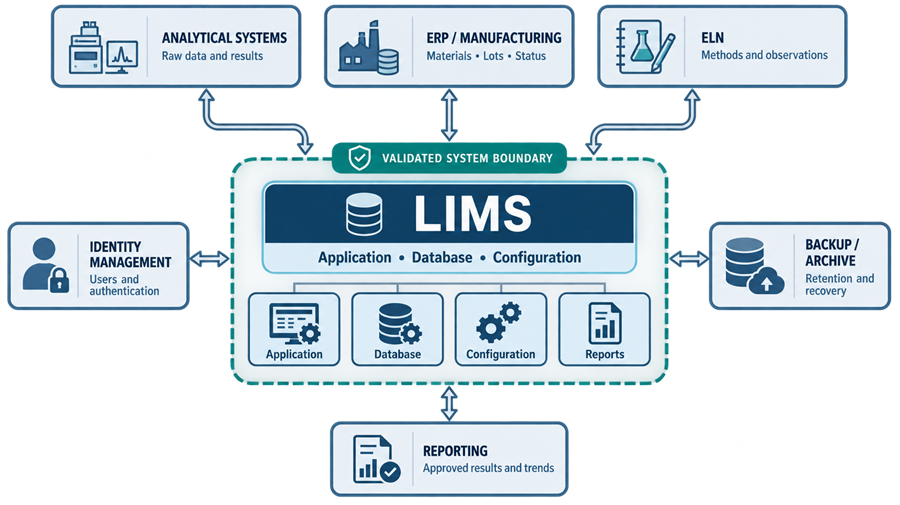
A LIMS rarely operates alone. Its validated boundary may include application software, configured workflows, calculation services, databases, reports, interfaces, identity-management services, servers or cloud services, and supporting infrastructure.
The system-boundary assessment should identify:
- the LIMS application and database;
- configured modules and enabled functions;
- client applications and browser requirements;
- application, database, interface, and report servers;
- identity and authentication services;
- analytical instruments and data systems;
- enterprise resource planning systems;
- manufacturing or batch-management systems;
- electronic laboratory notebooks;
- chromatography or scientific data-management systems;
- quality-management systems;
- stability-management modules;
- data warehouses and reporting platforms;
- backup, archive, and restoration services;
- label printers, scanners, and barcode devices;
- time-synchronization services; and
- vendor-hosted or cloud infrastructure.
The assessment should distinguish validated LIMS functions from external systems that create, process, approve, or retain related data. It should also identify which system is authoritative for each data element.
For example, the enterprise system may be authoritative for material and batch identifiers, the LIMS for sample and approved-result status, and an instrument data system for original analytical raw data. Transferring a result into LIMS does not automatically make LIMS the system of record for the complete analytical data package.
Laboratory Data Lifecycle
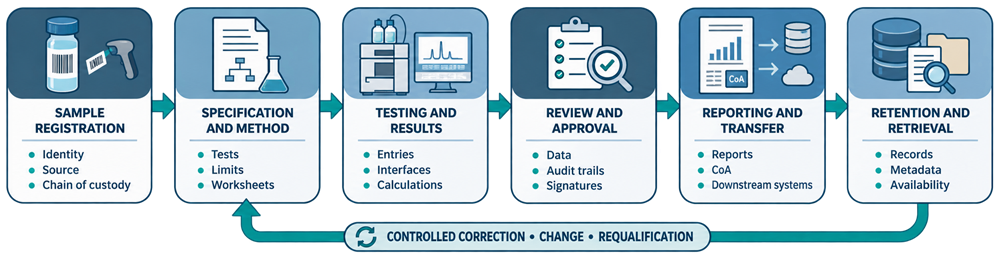
The LIMS data lifecycle begins before a result is entered and continues beyond approval. Validation should address how data are created, received, transformed, reviewed, reported, corrected, retained, retrieved, migrated, and eventually disposed of under approved controls.
A typical lifecycle includes:
- creation or receipt of sample information;
- assignment of a unique sample identifier;
- selection of specifications and required tests;
- assignment of approved analytical methods;
- generation of worklists, worksheets, or labels;
- recording or transfer of test results;
- calculation and specification evaluation;
- review of results and supporting records;
- approval or rejection;
- reporting and transfer to downstream systems;
- retention, retrieval, and trending;
- controlled correction or amendment; and
- archival or disposition after the retention requirement is satisfied.
Each transition should preserve attribution, status, context, and traceability. The system should not allow incomplete, unreviewed, invalidated, or superseded data to be presented as approved results.
Sample Management and Chain of Custody
Sample-management controls should establish a traceable relationship between the physical sample, its electronic record, required testing, and final disposition. The LIMS may need to control:
- unique sample identifiers;
- sample type and source;
- material, product, lot, and batch association;
- sampling location and sampling plan;
- collection and receipt dates and times;
- sample quantity and unit of measure;
- container and storage requirements;
- receipt condition;
- aliquots, composites, and derived samples;
- sample transfers and custody;
- assigned laboratory or analyst;
- required tests;
- retest or resample status;
- retained samples;
- disposal authorization; and
- links to deviations or investigations.
Barcode functions can reduce transcription errors, but label generation, barcode uniqueness, scanning logic, printer configuration, and reprinting controls should be verified. The system should prevent duplicate identifiers and inappropriate reassignment of an identifier to a different sample.
Changes to critical sample information after registration should be restricted and recorded. The review process should identify changes that could affect sample identity, testing requirements, or result interpretation.
Specifications and Test Assignment
Specifications are controlled master data. Their configuration can determine which tests are performed, which limits apply, and whether a result is classified as passing, failing, or requiring further evaluation.
Specification controls should address:
- material and product applicability;
- test name and test code;
- acceptance criteria;
- units of measure;
- numerical precision and rounding;
- qualitative result lists;
- effective dates;
- version status;
- market or compendial differences;
- stage-specific or release-specific requirements;
- conditional tests;
- reduced-testing rules;
- retest requirements;
- approval workflow; and
- retirement of superseded versions.
The system should apply the correct approved specification to the correct sample. Changes to a specification should not silently alter the requirements or evaluation of historical samples.
Validation testing should include boundary values, equality with specification limits, rounding near limits, null values, text results, unit conversions, and situations in which multiple specifications could apply.
Analytical Methods and Worksheets
A LIMS may reference an analytical method, generate a controlled worksheet, guide the analyst through procedural steps, or execute calculations associated with the method. Method-related master data should identify:
- method number and title;
- approved version;
- applicable materials or products;
- required instruments;
- standards, reagents, and solutions;
- sample-preparation instructions;
- calculation formulas;
- specification relationships;
- system-suitability requirements;
- required attachments;
- effective date; and
- approval status.
Where the LIMS does not contain the complete method, it should provide an unambiguous reference to the controlled source. A method number without a version or effective status may not adequately establish which instructions governed the test.
Electronic worksheets should preserve the sequence and context of entries. Required fields, conditional steps, units, significant figures, and reason-for-change requirements should be configured according to the approved process.
Free-text fields should not be used as an uncontrolled substitute for structured data when the information drives calculations, specification evaluation, workflow routing, or reporting.
Calculations and Result Evaluation
Calculations performed by LIMS are configured GMP functions and should be specified, verified, and controlled. The validation package should identify the source and intended use of each formula. Calculations may include:
- averages and statistical values;
- dilution and preparation factors;
- potency or purity corrections;
- moisture or water-content corrections;
- unit conversions;
- assay and impurity calculations;
- microbial counts;
- content-uniformity calculations;
- dissolution evaluations;
- specification comparisons;
- stability time-point calculations; and
- derived reportable results.
Testing should use independently calculated expected results and should cover:
- normal values;
- zero and negative values where permitted;
- upper and lower boundaries;
- results equal to specification limits;
- excessive decimal places;
- rounding rules;
- missing inputs;
- invalid entries;
- unit conversions;
- divide-by-zero conditions;
- revised inputs;
- recalculation after data changes; and
- handling of below-quantitation or below-detection results.
The system should distinguish stored raw entries, intermediate calculated values, rounded display values, and final reportable results. Rounding should occur at the defined stage and should not conceal an out-of-specification result.
Spreadsheet calculations performed outside the controlled LIMS workflow should be minimized. Where external calculations remain necessary, their validation, version control, data transfer, review, and retention should be defined.
Master-Data Governance
Master data influence repeated laboratory decisions and therefore require controls comparable to other critical configuration. LIMS master data may include:
- sample and material types;
- products and specifications;
- tests and analytical methods;
- calculations;
- units and conversion factors;
- result-entry formats;
- instruments;
- laboratories and locations;
- analysts and reviewer assignments;
- stability protocols;
- storage conditions;
- report templates;
- approval workflows;
- reason codes;
- lists of values; and
- interface mappings.
Master-data governance should define ownership, creation, independent review, approval, effective dating, versioning, periodic verification, change control, and retirement.
Direct production-database editing should be prohibited except under tightly controlled, exceptional technical procedures. Changes should normally be made through validated application functions that preserve attribution and audit-trail history.
Copying master data from one product, method, or site to another can improve efficiency but may also propagate obsolete limits, formulas, units, or workflow settings. Copied records should undergo the same review and approval required for newly created master data.
Stability-Management Functions
Where LIMS manages stability studies, qualification should address the complete stability workflow rather than only result entry.
Functions may include:
- protocol and study creation;
- product, strength, package, and batch assignment;
- storage condition;
- chamber and location;
- pull intervals;
- scheduled pull dates;
- allowable pull windows;
- sample quantity;
- required tests;
- test assignment;
- missed or late pulls;
- additional time points;
- sample transfers;
- study amendments;
- result trending;
- report generation; and
- study closure.
Date calculations and pull-window logic should be independently verified. Testing should include leap years, month-end dates, missed pulls, rescheduled pulls, additional time points, and changes to storage condition.
The system should preserve the originally approved protocol and provide traceability for amendments. A protocol change should not retrospectively rewrite the historical requirements for completed time points.
Review, Approval, and Status Control
The LIMS workflow should ensure that data progress through defined states and that only authorized personnel can perform each transition. Typical statuses may include:
- registered;
- received;
- assigned;
- in progress;
- complete;
- awaiting review;
- reviewed;
- approved;
- rejected;
- invalidated;
- superseded;
- cancelled; and
- archived.
The meaning of each status should be defined. Transition permissions, prerequisites, and effects on downstream systems should be tested.
Review should address the complete electronic record needed to support the result, including entered data, calculations, attachments, comments, changes, exceptions, and relevant audit trails. The controls described in Analytical Laboratory Audit Trails, User Access, and Data Review apply when LIMS records are used for GMP decisions.
The system should prevent users from approving their own work where independent review is required. Reopening an approved record should be restricted, justified, recorded, and followed by appropriate re-review and reapproval.
Electronic Signatures
Electronic signatures should be assessed against their intended regulatory use and the applicable provisions of Part 11. Controls should ensure that:
- each signature belongs to one individual;
- the signer’s identity is verified;
- the signature is applied only after authentication;
- the signed record shows the signer’s printed name;
- the date and time of signing are recorded;
- the meaning of the signature is displayed;
- the signature remains linked to the record;
- the signature cannot be transferred to another record;
- failed or unauthorized signature attempts are controlled; and
- changes after signing are prevented or require controlled reopening and reapproval.
The distinction between review, approval, verification, authorship, and responsibility should be clear. A generic “complete” action should not be treated as an electronic signature unless the system applies the required controls and defined meaning.
Reports and Certificates of Analysis
LIMS reports should accurately represent the approved electronic records. Qualification should address report content, selection logic, formatting, version control, approval status, and data-source mapping. Reports may include:
- sample worksheets;
- analytical result summaries;
- specification reports;
- stability reports;
- exception reports;
- workload reports;
- audit-trail reports; and
- certificates of analysis.
Testing should confirm that reports include the correct sample, material, batch, method, specification, result, unit, status, approval, and revision information.
A certificate of analysis should not be generated from incomplete or unapproved results unless the output is clearly identified and controlled as a draft. Reissued or corrected reports should remain traceable to the original version and the reason for reissue.
Static reports do not necessarily represent the complete electronic record. The underlying data, metadata, audit trails, calculations, and approval history should remain retained and available.
Interfaces and Data Transfer
Interfaces can transfer data accurately and efficiently, but they also create risks of omission, duplication, truncation, incorrect mapping, and loss of context. For each interface, the validation package should define:
- source and destination systems;
- authoritative data source;
- data elements transferred;
- direction and frequency;
- trigger conditions;
- units and formats;
- field mappings;
- transformation rules;
- status requirements;
- error handling;
- reconciliation;
- security;
- audit-trail expectations; and
- recovery following interruption.
Interface testing should include:
- correct transactions;
- invalid and missing values;
- duplicate messages;
- delayed messages;
- partial transmission;
- communication interruption;
- destination unavailability;
- rejected transactions;
- incorrect status;
- excessive field length;
- special characters;
- unit and precision differences;
- retransmission; and
- reconciliation after recovery.
A successful transmission message does not by itself demonstrate that the destination stored and applied the data correctly. End-to-end verification should confirm the meaning and status of the received data.
Security, Audit Trails, and Administrative Control
LIMS access should be based on unique user accounts and role-based permissions. Shared analyst or administrator accounts undermine attribution and should not be used for regulated activity. Security roles should separate, where practical:
- sample registration;
- data entry;
- method and specification maintenance;
- calculation configuration;
- result review;
- approval;
- report issuance;
- user administration;
- system configuration; and
- database or infrastructure administration.
Administrative access should be limited and independently controlled. Laboratory users responsible for generating or approving data should not routinely administer their own permissions or modify audit-trail configuration.
Audit trails should record significant activity involving:
- sample information;
- test assignments;
- specifications;
- methods;
- results;
- calculations;
- status changes;
- review and approval;
- master data;
- user accounts and roles;
- configuration;
- reports; and
- interfaces.
Audit-trail review should be integrated with the associated data review and supplemented by periodic review of administrative, master-data, and security activity.
Configuration Management
LIMS products are commonly configured rather than developed entirely for one laboratory. Configuration remains part of the validated system and should be specified, tested, approved, and controlled. Configuration items may include:
- workflows;
- screen layouts;
- field requirements;
- business rules;
- calculations;
- specification logic;
- approval routes;
- role permissions;
- notifications;
- reports;
- dashboards;
- stability rules;
- interface mappings; and
- system parameters.
A controlled configuration baseline should identify the approved production state. The baseline may include configuration specifications, exported configuration records, version identifiers, report definitions, interface mappings, security-role matrices, and infrastructure records.
Configuration differences between development, test, training, and production environments should be understood and controlled. Promotion to production should follow an approved process that prevents untested or unauthorized changes.
Data Migration
Migration may be required during initial implementation, consolidation of legacy systems, major upgrades, platform changes, or system retirement. The migration strategy should identify:
- source systems and data populations;
- records within scope;
- data ownership;
- selection and exclusion rules;
- field mapping;
- transformation rules;
- handling of obsolete or invalid values;
- preservation of metadata and audit history;
- electronic-signature considerations;
- reconciliation requirements;
- exception handling;
- acceptance criteria; and
- retention of legacy records.
Migration testing should verify more than record counts. It should confirm that data remain complete, accurate, readable, attributable, and usable for their intended purpose.
Verification may include:
- population reconciliation;
- field-level comparison;
- critical-record sampling;
- calculation verification;
- report comparison;
- status and approval verification;
- attachment retrieval;
- audit-history preservation;
- date and time verification; and
- confirmation of links between related records.
Where complete migration is impractical, the organization may retain a validated or controlled legacy archive. The archive should remain secure, searchable, readable, and available throughout the applicable retention period.
Risk Assessment and Requirements
The risk assessment should connect intended use with data and process risks. It should evaluate what could occur if the LIMS assigns the wrong tests, applies an incorrect specification, calculates a result incorrectly, loses data, permits unauthorized changes, or transfers an incorrect status to another system.
Requirements should cover both functional behavior and control characteristics. High-risk requirements commonly include:
- unique sample identification;
- correct specification and method assignment;
- calculation accuracy;
- status and workflow enforcement;
- segregation of duties;
- approval controls;
- electronic signatures;
- audit trails;
- interface accuracy;
- master-data control;
- record retention;
- backup and restoration; and
- prevention of unauthorized deletion or modification.
Risk assessment should determine the depth and priority of testing. It should not be used to remove necessary verification of critical functions merely because the vendor has tested the standard product.
Supplier and Service-Provider Assessment
Supplier evidence can support the validation effort when its relevance, quality, and applicability are assessed. The assessment should consider:
- supplier development and quality practices;
- product maturity;
- release and defect-management processes;
- standard product testing;
- configuration and customization approach;
- security and vulnerability management;
- data ownership;
- backup and recovery;
- service availability;
- subcontractors;
- change notification;
- regulatory support;
- audit access;
- export capability;
- business continuity; and
- system-retirement support.
For hosted or cloud LIMS, responsibilities should be divided clearly between the regulated company and the service provider. Outsourcing infrastructure or application management does not transfer responsibility for the reliability and integrity of regulated records.
Supplier documentation should be incorporated selectively. Marketing material, generic test summaries, or undocumented claims should not replace evidence that the site-specific configuration, workflows, interfaces, and controls meet approved requirements.
Qualification and Testing Strategy
Qualification should verify the installed and configured system within its intended operating environment. The terminology may vary, but the lifecycle should provide evidence comparable to installation, operational, and performance qualification where those stages are applicable.
Installation and Environment Verification
Verification should address:
- approved hardware and software versions;
- enabled modules;
- server or cloud environment;
- database and middleware;
- network and domain configuration;
- authentication services;
- time synchronization;
- security certificates;
- printers and scanners;
- backup configuration;
- interfaces;
- environmental separation; and
- system documentation.
Functional and Control Testing
Testing should challenge:
- sample registration;
- unique identification;
- test and specification assignment;
- worksheets;
- calculations;
- stability scheduling;
- result entry and transfer;
- status transitions;
- review and approval;
- electronic signatures;
- reports;
- interfaces;
- audit trails;
- security roles;
- configuration controls;
- error handling; and
- recovery.
Testing should include negative and boundary conditions, not only successful workflows. Attempts to bypass required fields, use unauthorized functions, approve one’s own work, alter approved records, or submit invalid interface data should be challenged.
End-to-End Process Testing
End-to-end scenarios should represent actual laboratory use from sample creation through approved reporting and downstream transfer. Representative scenarios may include:
- raw-material testing;
- in-process testing;
- finished-product release;
- microbiological testing;
- stability testing;
- resampling or retesting;
- out-of-specification results;
- corrected records;
- amended specifications;
- instrument-interface failure; and
- report reissuance.
Users performing acceptance testing should understand both the laboratory process and the expected system behavior. Execution evidence should show the data entered, actual results, discrepancies, resolution, and final approval.
Traceability and Release
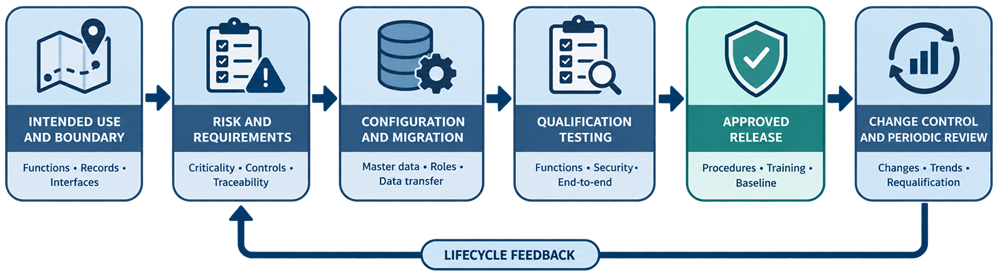
Requirements should be traceable to risk controls, configuration or design elements, test evidence, deviations, and release decisions. Before release, the organization should confirm that:
- intended use and system boundaries are approved;
- applicable regulatory assessments are complete;
- critical requirements are verified;
- configuration is baselined;
- interfaces are operational;
- migration is accepted;
- security roles are approved;
- users are trained;
- procedures are effective;
- backup and restoration are verified;
- deviations are resolved or formally accepted;
- residual risks are approved; and
- production release is authorized.
Release should establish the starting point for lifecycle control. It is not the end of validation responsibility.
Backup, Restoration, Archival, and Continuity
Backup controls should protect the database, configuration, reports, attachments, audit trails, and other records required to reconstruct laboratory activity.
Restoration testing should demonstrate that the recovered system and records are complete and usable. Confirmation that a backup job completed successfully does not establish that the data can be restored.
Business-continuity procedures should define:
- operation during LIMS unavailability;
- control of temporary paper or alternate electronic records;
- sample and test identification during downtime;
- prevention of duplicate identifiers;
- approval during the outage;
- reconciliation after restoration;
- delayed interface transactions; and
- entry of downtime data into LIMS.
Retrospective entry should remain attributable and distinguishable from contemporaneous system entry.
Change Control and Requalification
Changes should be evaluated for effects on intended use, data, validated functions, interfaces, security, and regulatory records. Changes may include:
- software upgrades;
- patches and hotfixes;
- new modules;
- workflow changes;
- specification or method changes;
- revised calculations;
- new reports;
- interface modifications;
- infrastructure changes;
- identity-management changes;
- security-role changes;
- database maintenance;
- vendor-service changes; and
- data migration.
The change assessment should determine the required documentation, testing, regression scope, migration verification, procedure updates, training, and release authorization.
Requalification should be proportionate to impact. A report-format change may require focused verification, while a major version upgrade affecting workflows, calculations, interfaces, or data structures may require extensive regression and end-to-end testing.
Emergency changes should remain authorized, documented, tested to the extent practicable, retrospectively reviewed, and incorporated into the controlled baseline.
Periodic Review
Periodic review should determine whether the LIMS remains suitable for its intended use and continues to operate in a controlled state. Review inputs should include:
- changes and releases;
- deviations and investigations;
- unresolved defects;
- audit-trail review trends;
- user-access reviews;
- privileged-account activity;
- security incidents;
- interface failures;
- master-data changes;
- calculation and report changes;
- backup and restoration results;
- performance and availability;
- vendor notices;
- patches and vulnerabilities;
- training status;
- procedure changes;
- data-retention and archive status;
- infrastructure support; and
- obsolescence.
The review should document identified deficiencies, required corrective actions, continued-use justification, and any need for targeted or comprehensive requalification.
Maintaining the Validated State
A validated LIMS depends on continuing control of the application, configuration, master data, users, interfaces, infrastructure, and laboratory procedures.
The validated state is maintained through:
- controlled master-data governance;
- qualified configuration changes;
- periodic access review;
- audit-trail review;
- backup and restoration verification;
- interface monitoring and reconciliation;
- incident and problem management;
- vendor and patch assessment;
- periodic review;
- risk-based requalification; and
- controlled archival and retirement.
The central validation question is not whether the LIMS can store laboratory results. It is whether the complete configured system reliably controls the information and decisions assigned to it throughout the laboratory data lifecycle.