

PPQ Acceptance Criteria and Statistical Evaluation
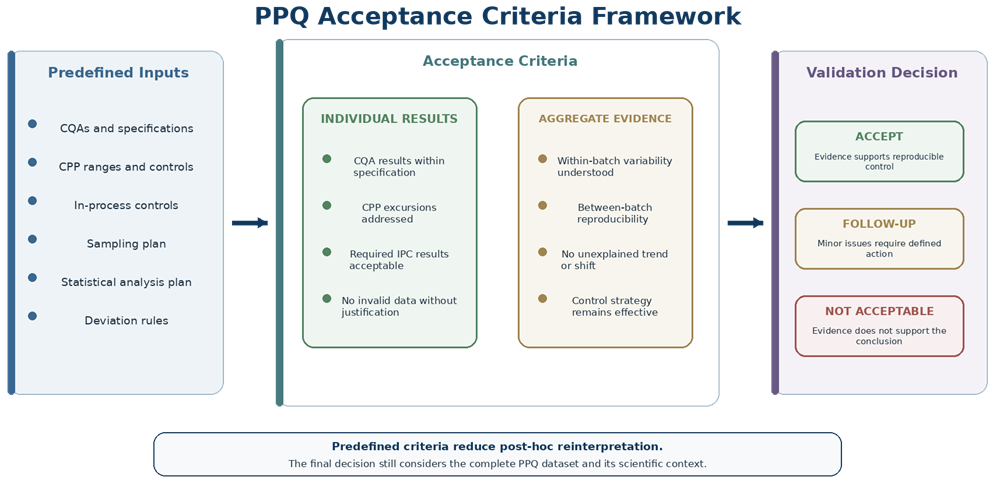
Process Performance Qualification (PPQ) acceptance should be based on predefined criteria and a scientifically planned evaluation of the complete dataset, not simply on whether several commercial batches were manufactured without obvious failure. Acceptance criteria establish what evidence is required before execution begins; statistical evaluation determines what the resulting data demonstrate about process variability, reproducibility, control, and uncertainty.
FDA’s Process Validation: General Principles and Practices expects the PPQ protocol to include criteria and process-performance indicators that support a science- and risk-based decision about whether the process can consistently produce quality product. FDA also expects the protocol to identify the statistical methods used to evaluate the collected data, including metrics addressing both intra-batch and inter-batch variability, and to define how deviations and nonconforming data will be handled.
The objective is therefore broader than demonstrating that individual test results meet specifications. A sound PPQ conclusion should establish that the defined commercial process operates reproducibly, that variability is consistent with process understanding, that the control strategy performs as intended, and that the available evidence provides sufficient confidence for transition into routine commercial manufacturing and Continued Process Verification (CPV).
Acceptance Criteria Should Be Predefined
Acceptance criteria should be established in the approved PPQ protocol before execution. This limits retrospective interpretation of results and forces the validation team to define in advance what evidence will support the qualification conclusion.
Criteria should be derived from Stage 1 process knowledge, product specifications, Critical Quality Attributes (CQAs), Critical Process Parameters (CPPs), operating ranges, the control strategy, risk assessment, process characterization, sampling strategy, expected variability, and the statistical questions the PPQ campaign is intended to answer. They should also be specific enough that the final PPQ report can determine whether the intended objectives were actually achieved.
Predefinition does not mean every PPQ observation must be converted into a rigid numerical pass/fail limit. Some requirements are true acceptance criteria—for example, conformance of required CQAs to approved specifications—while others are evaluation criteria or process-performance indicators that require interpretation of distributions, trends, variability, and relationships. The protocol should make that distinction clear.
See Process Performance Qualification (PPQ) Strategy and Batch Selection and PPQ Sampling Plan and Data Collection Strategy for development of the PPQ strategy and dataset that precede this evaluation.
Product Specifications Are Necessary but Not Sufficient
Every required drug-product result must satisfy applicable release specifications. Under 21 CFR 211.165, each batch must undergo appropriate laboratory determination of satisfactory conformance to final specifications before release, and acceptance criteria for sampling and testing must adequately assure conformance with appropriate specifications and statistical quality-control criteria.
However, meeting finished-product specifications does not by itself demonstrate successful PPQ. A process could produce three specification-compliant batches while showing increasing variability, inconsistent CPP behavior, unusual adjustments, unexplained batch differences, or progressively reduced margin from a specification limit.
PPQ should therefore ask two different questions: Did the product meet its required quality criteria? and Does the complete process evidence demonstrate reproducible commercial performance? Both must be addressed.
In-Process Acceptance Criteria
21 CFR 211.110 requires appropriate in-process controls for manufacturing processes capable of causing variability and states that valid in-process specifications should, where possible, reflect previous acceptable process averages and process-variability estimates using suitable statistical procedures where appropriate.
PPQ in-process criteria can include intermediate attributes, endpoint measurements, yields, weight variation, mixing uniformity, moisture, pH, concentration, filtration performance, or other product-specific measurements. The criteria should reflect the role of the measurement in the control strategy rather than simply repeat routine manufacturing limits without considering the heightened purpose of PPQ.
A result that remains technically acceptable but repeatedly approaches an in-process limit can be meaningful validation evidence. The PPQ report should evaluate whether that pattern is compatible with the expected process behavior and operating margin.
CPP Acceptance Criteria
CPP verification should not be reduced to the statement that “all CPPs remained within limits.” CPP acceptance criteria should consider both conformance and behavior within the accepted range.
Depending on the process, evaluation can include parameter excursions, proximity to operating boundaries, centering around the intended setpoint, within-batch drift, batch-to-batch differences, frequency of adjustments, control-loop response, interactions with other parameters, and relationships with corresponding CQAs. A CPP that remains nominally acceptable only because of repeated corrective adjustments may provide weaker evidence of process robustness than a parameter that remains naturally stable under routine control.
These relationships are addressed in detail in Verification of CPPs and Process Control Strategy During PPQ.
Individual Criteria and Aggregate Criteria
PPQ protocols should distinguish individual-result criteria from aggregate or campaign-level criteria. An individual CQA specification applies to each applicable test result or batch; an aggregate statistical assessment, by contrast, evaluates the collective behavior of multiple observations or batches.
Typical individual criteria can include conformance to approved product specifications, adherence to required CPP or process limits, acceptable in-process results, required equipment/process status, and absence of unresolved data-integrity concerns. Aggregate criteria may evaluate within-batch uniformity, between-batch reproducibility, overall variability, centering, trends, control-strategy effectiveness, and whether the collected evidence is consistent with the process model established during development.
An aggregate average should never be used to obscure an individual result that violates an applicable specification or mandatory criterion. Conversely, one unusual but valid in-specification observation should not automatically invalidate PPQ without evaluation of its cause, context, and significance.
Predefine the Statistical Analysis Plan
The PPQ protocol should describe the statistical methods that will be applied before the data are generated. FDA specifically expects statistical methods capable of evaluating intra-batch and inter-batch variability.
The statistical plan should identify the data to be evaluated, grouping or stratification, graphical methods, summary statistics, comparisons among batches, treatment of repeated or correlated observations, distributional assumptions where relevant, handling of missing data, treatment of potential outliers, and any confidence, tolerance, or capability methods intended for use.
The plan does not need to predict every possible analysis that might later become scientifically useful. Exploratory analyses can be added when unexpected results require investigation, but the main decision criteria should not be selected retrospectively because they produce a favorable conclusion.
Descriptive Statistics Come First
Descriptive statistics provide the foundation for PPQ evaluation. Useful measures can include mean, median, standard deviation, range, interquartile range, coefficient of variation where scientifically meaningful, minimum and maximum values, and batch-specific versus overall summaries.
These statistics should normally be paired with graphical review. Run charts, dot plots, box plots, histograms, parameter profiles, scatter plots, and stratified plots frequently reveal relationships that are hidden by summary statistics alone.
A mean of 50 may describe both a tightly controlled dataset ranging from 49 to 51 and an unstable dataset ranging from 30 to 70. Statistical evaluation should therefore characterize center, spread, pattern, and process context, not merely calculate an average.
Within-Batch Variability
Within-batch analysis determines whether process performance remains consistent throughout an individual batch. The sampling design may permit comparison by beginning/middle/end, equipment location, process stage, filling head, vessel location, hold condition, or another scientifically meaningful stratum.
The statistical objective is to determine whether variation is random and expected or whether there are gradients, shifts, transitions, localized effects, or other patterns indicating incomplete process control. The evaluation should preserve the stratification established in the PPQ sampling plan rather than immediately pooling all observations into one overall distribution.
This is especially important where a pooled average could conceal a location- or time-dependent failure mechanism.
Between-Batch Variability
Between-batch analysis addresses reproducibility. The PPQ campaign should determine whether different batches show sufficiently comparable process behavior under the intended commercial conditions.
This evaluation may compare batch means, distributions, CPP profiles, CQA results, yields, process responses, material lots, operating durations, or other meaningful parameters. Differences do not automatically indicate failure; manufacturing processes contain normal variation. The important question is whether those differences are explainable, remain within the established process model, and do not indicate an uncontrolled source of variability.
FDA specifically emphasizes both intra-batch and inter-batch evaluation as part of PPQ and continued lifecycle monitoring.
Statistical Independence Matters
Large numbers of PPQ observations do not necessarily mean there are large numbers of independent observations. Samples collected from the same batch, closely spaced timepoints, repeated measurements of the same material, or measurements from the same equipment run may be correlated.
Treating highly correlated observations as independent can create artificially narrow confidence intervals and exaggerated statistical certainty. The analysis should preserve the hierarchy of the data—such as samples nested within locations and locations nested within batches—where that structure matters to the validation question.
This is one reason that thirty samples collected from each of three PPQ batches do not necessarily provide the same information about batch-to-batch reproducibility as thirty independent commercial batches.
Distribution Assumptions
Many common statistical methods assume a particular probability distribution, frequently the normal distribution. That assumption should be evaluated rather than applied automatically.
PPQ data may be skewed, bounded, discrete, censored, multimodal, time-correlated, or influenced by different process strata. Examples include microbial counts, impurity results near analytical reporting limits, percentage values near a physical boundary, defect counts, and measurements containing distinct beginning/end process populations.
When the assumed distribution is inappropriate, possible responses include transformation, use of another scientifically justified distribution, nonparametric methods, direct percentile approaches, or greater reliance on descriptive and graphical analysis. NIST notes that parametric procedures require assumptions about the underlying distribution, while distribution-free approaches can be appropriate when those assumptions cannot be supported.
Normality Testing Should Not Become a Checkbox
A formal normality test alone should not determine whether a statistical model is appropriate. With a very small dataset, a normality test may have little power to detect meaningful non-normality; with a very large dataset, trivial departures from normality can become statistically significant.
Distribution assessment should therefore consider plots, process mechanism, data type, sample size, known boundaries, potential subgroups, and the sensitivity of the intended statistical method to departures from its assumptions.
The question is not simply, “Did the normality test pass?” It is, “Is this statistical model credible enough for the decision being made?”
Confidence Intervals
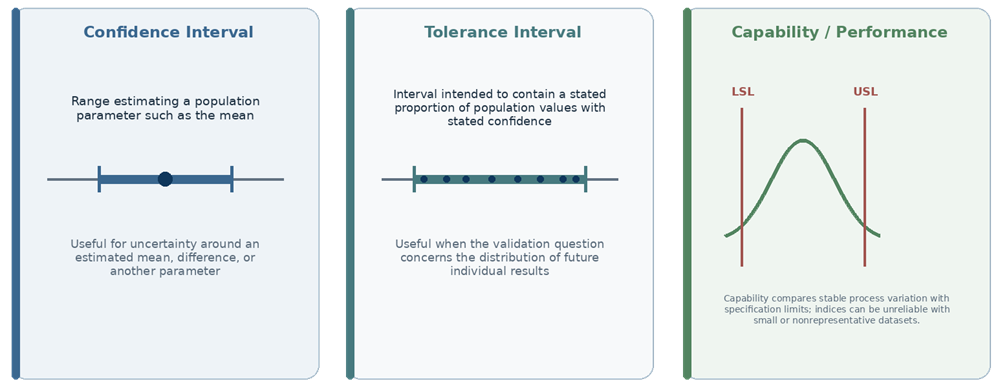
A confidence interval (CI) quantifies uncertainty around an estimated population parameter, such as a mean. A 95% confidence interval does not mean that 95% of future observations will lie inside the interval; it addresses uncertainty about the parameter being estimated.
NIST describes a confidence interval as a range of values intended to contain the population parameter of interest with a stated confidence level.
In PPQ, confidence intervals can be useful when the question concerns uncertainty around a mean, a difference between batches, a proportion, or another estimated quantity. Their usefulness depends on the sampling design, independence, sample size, and statistical assumptions.
Tolerance Intervals
A statistical tolerance interval (TI) answers a different question. Rather than estimating where a population parameter such as the mean lies, a tolerance interval is constructed to contain a specified proportion of the underlying population with a stated confidence.
For example, a study might ask whether an interval can be constructed that contains at least 95% of future results with 95% confidence. NIST specifically distinguishes this from a confidence interval: confidence intervals concern population parameters, while tolerance intervals concern a stated proportion of population measurements.
Tolerance intervals can therefore be useful in certain PPQ applications where the validation question concerns the expected distribution of individual future measurements. They should not be inserted automatically into every PPQ protocol, and the assumed distribution, sample size, independence, and required coverage/confidence should be justified.
Capability and Process Performance
Process capability compares the natural variation of a stable process with its specification limits. Common indices include Cp, which describes potential capability based principally on process spread, and Cpk, which additionally reflects how well the process is centered relative to its specification limits.
Capability indices can be useful, but they should be applied carefully during PPQ. NIST notes that capability analysis assumes a stable process and that commonly used Cp/Cpk calculations generally rely on adequate independent data and, for conventional formulas, a normal distribution. NIST also notes that capability-index estimates require an adequately large sample; about 50 independent observations is commonly cited as a practical minimum for these estimates.
A PPQ campaign may contain many measurements but relatively few independent batches. Calculating a highly precise Cpk from numerous samples within three batches can therefore give an exaggerated impression of confidence regarding long-term commercial performance.
Capability should be treated as one piece of evidence rather than a universal PPQ acceptance requirement.
Cp and Cpk Should Not Have Universal Thresholds
A site may establish internal expectations such as Cpk ≥ 1.33 for certain applications, but such values should not be presented as universal FDA PPQ requirements. The appropriate statistical criterion depends on the product, attribute, process, risk, data structure, specification, sample size, and intended decision.
Where a capability target is used as a predefined PPQ criterion, the protocol should define the calculation, data source, assumptions, required sample size, treatment of batches or subgroups, and rationale for the selected threshold.
A rigid capability threshold can otherwise produce misleading decisions—for example, rejecting a medically and technically robust process because of an unstable estimate from too little data, or accepting a poorly understood process because an inadequately constructed capability calculation happens to produce a high number.
Process Performance Measures
Some organizations distinguish process capability indices from process performance indices, commonly using terms such as Pp and Ppk for calculations based on overall observed variation rather than within-subgroup estimates. If these metrics are used, the PPQ statistical plan should explicitly define the formula and interpretation because terminology and software conventions can differ.
The more important distinction is conceptual: PPQ should not imply long-term steady-state capability from a short qualification campaign when long-term commercial variability has not yet been observed. Stage 3 CPV provides a much larger and more representative dataset for mature capability or performance assessments.
Specification Limits and Statistical Limits Are Different
Specification limits define acceptable product or material requirements. Statistical limits describe observed or expected process behavior. Control limits, confidence limits, tolerance limits, and specification limits therefore have different purposes and should not be used interchangeably.
A process can be statistically stable while centered too close to a specification boundary, making it incapable. It can also produce all results within specification during a short PPQ campaign while exhibiting statistical instability that suggests future performance may deteriorate.
This distinction is fundamental to interpreting PPQ data correctly.
Limited PPQ Datasets
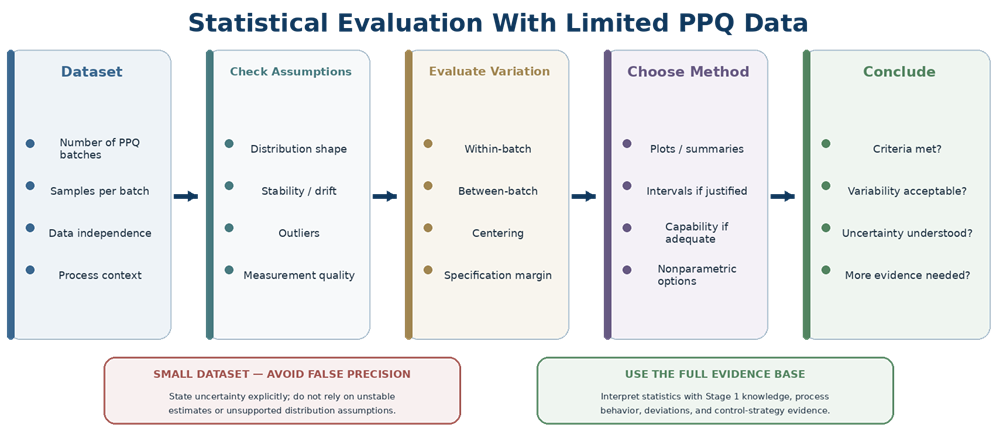
PPQ often involves a relatively small number of commercial batches because qualification must occur before routine manufacturing generates a large historical dataset. A limited number of batches does not make statistical analysis invalid, but it does limit what can be concluded with confidence.
The analysis should distinguish the amount of within-batch information from the amount of between-batch information. Many individual samples can provide excellent characterization of spatial or temporal variability inside a batch while still providing limited evidence about long-term batch-to-batch variation.
With limited data, it is often better to use transparent descriptive statistics, graphical comparisons, predefined individual criteria, confidence or tolerance methods where justified, and integration with Stage 1 process knowledge than to produce unstable capability estimates with excessive apparent precision.
More Samples Within a Batch Do Not Replace More Batches
This distinction deserves particular emphasis. Increasing the number of samples within each PPQ batch can improve understanding of intra-batch variability, sampling locations, gradients, and unit-operation behavior, but it does not provide the same evidence about inter-batch reproducibility as manufacturing additional independent batches.
For example, 100 measurements collected from one homogeneous batch do not constitute 100 independent demonstrations of commercial process reproducibility. The PPQ statistical strategy should therefore recognize the hierarchical structure of the data and avoid overstating the effective sample size.
The required amount of evidence remains a process-specific scientific decision, consistent with FDA’s broader expectation that PPQ strategy be justified using process understanding rather than arbitrary numerical formulas.
Outliers and Atypical Results
Outlier analysis should not be used to remove inconvenient PPQ data. A statistically unusual observation may represent analytical error, sampling error, data error, a legitimate extreme observation, or evidence of an actual process condition.
FDA specifically states that PPQ data should not be excluded from consideration without documented science-based justification.
The evaluation should determine the cause and process context before deciding how the observation is handled statistically. If an observation is excluded from a calculation for a justified reason, the original result, investigation, rationale, and effect on the PPQ conclusion should remain traceable.
Missing Data
Missing PPQ data can also affect statistical interpretation. The significance depends on what is missing and why.
A missing sample at a redundant routine location may have little effect, whereas a missed sample at a unique worst-case location, an unrecorded CPP profile during a critical process stage, or missing data from a batch exhibiting unusual performance may materially reduce the strength of the PPQ evidence.
The protocol should therefore define how missing or invalid data are assessed and whether additional sampling, testing, investigation, or PPQ evidence is necessary.
Attribute and Discrete Data
Not all PPQ data are continuous measurements. Some outcomes are binary, categorical, count-based, or defect-related.
Examples include pass/fail observations, defect counts, microbial recovery, visual defects, intervention frequency, or occurrence of alarms. These data may require binomial, Poisson, categorical, nonparametric, or other methods rather than normal-distribution statistics.
The statistical method should follow the data-generating process, not the statistical software’s default option.
Scientific Significance Versus Statistical Significance
Statistical significance and validation significance are not the same.
A small difference between two PPQ batches may be statistically detectable because many samples were collected but have no meaningful effect on product quality or process control. Conversely, an operationally important shift may fail to reach conventional statistical significance because only a few independent batches are available.
PPQ conclusions should therefore integrate statistical evidence with effect magnitude, product-quality consequence, process mechanism, operating margin, prior knowledge, and risk.
Marginal but In-Specification Results
An in-specification result close to a limit should not automatically fail PPQ, but it should not be ignored either. Its significance depends on the surrounding process evidence.
Relevant questions include whether the result represents an isolated observation or a repeated pattern, whether it is associated with a particular material lot or process condition, whether the process is shifting toward the specification boundary, whether other PPQ batches show similar behavior, and whether Stage 1 data predicted that operating region.
An acceptable PPQ process should provide reasonable assurance of continued performance under routine variation, not merely demonstrate that the qualification batches narrowly avoided failure.
PPQ Should Not Be Judged by One Statistical Number
There is rarely one statistic capable of summarizing an entire PPQ campaign appropriately. A high Cpk does not prove that CPPs were controlled, a narrow confidence interval does not demonstrate acceptable individual future results, and an acceptable batch mean does not demonstrate within-batch uniformity.
The final evaluation should integrate:
- individual CQA and IPC results;
- CPP and process-response profiles;
- within-batch variability;
- between-batch reproducibility;
- material effects;
- statistical distributions and trends;
- specification margin;
- deviations and investigations;
- control-strategy performance; and
- uncertainty remaining after PPQ.
This integrated approach is more defensible than selecting whichever statistical metric produces the most favorable result.
Deviations and Acceptance Criteria
Failure to meet a predefined PPQ criterion requires documented investigation and impact assessment. It should not be resolved simply by changing the statistical method after reviewing the result.
Some departures may be attributable to an invalid test, sampling error, protocol error, or another cause that does not challenge the underlying process. Other failures may reveal insufficient process understanding, excessive variability, inadequate control, or an inappropriate acceptance criterion. The response should follow the evidence.
See PPQ Deviations, Investigation, and Validation Conclusion for the detailed disposition framework.
Final Validation Conclusion
The PPQ report should make a scientifically justified overall determination rather than simply state that “all three batches passed.” FDA expects the report to summarize and analyze the data, address unexpected observations and nonconformances, evaluate corrective actions or process changes, and determine whether the PPQ conditions were met and the process is in a state of control.
A defensible conclusion should address whether all mandatory product requirements were met, predefined criteria were satisfied or adequately resolved, variability is consistent with process understanding, commercial batches are reproducible, the control strategy performs effectively, statistical assumptions are appropriate, remaining uncertainty is acceptable, and no unresolved deviation materially challenges the validation conclusion.
Where evidence is insufficient, the appropriate result may be additional investigation, additional PPQ batches, targeted characterization, revised controls, or reconsideration of the original process design. Additional evidence should be generated because the original scientific question remains unresolved—not merely to accumulate enough successful batches to obtain a desired outcome.
Transition to CPV
PPQ provides only the first commercial-scale dataset. FDA recommends maintaining monitoring and sampling at the Process Qualification level until sufficient additional data are available to generate meaningful estimates of process variability, after which monitoring can be adjusted to a statistically appropriate and representative level.
Stage 3 CPV therefore becomes the appropriate environment for strengthening estimates of long-term variability, confirming distribution assumptions, establishing mature control limits, refining capability or performance assessments, and determining whether the PPQ conclusions remain valid over time.
A PPQ report should identify which statistical indicators, CQAs, CPPs, material attributes, process responses, or residual uncertainties require continued attention during CPV.
Key Principles
- PPQ acceptance criteria should be predefined before execution.
- Product specifications are necessary but do not alone demonstrate process qualification.
- Individual-result and aggregate process criteria serve different purposes.
- PPQ statistical methods should evaluate both intra-batch and inter-batch variability.
- Distribution assumptions should be verified rather than automatically imposed.
- A confidence interval estimates uncertainty around a population parameter; it does not describe where most future observations will fall.
- A tolerance interval addresses a stated proportion of population measurements with stated confidence.
- Capability analysis requires a sufficiently stable and adequately characterized process.
- Cp/Cpk or similar indices should not be treated as mandatory PPQ outputs or assigned universal FDA acceptance thresholds.
- Numerous within-batch measurements do not substitute statistically for independent batches when evaluating between-batch reproducibility.
- Small PPQ datasets require explicit treatment of uncertainty and should not create false statistical precision.
- Outliers and nonconforming data should not be excluded without documented scientific justification.
- Statistical significance must be interpreted together with practical and product-quality significance.
- Marginal but in-specification results require contextual evaluation rather than automatic acceptance or rejection.
- The final PPQ conclusion should integrate statistics with process knowledge, control-strategy performance, deviations, and risk.
- CPV expands the commercial dataset and provides the longer-term evidence required to refine statistical monitoring and capability conclusions.