

Process Gas Systems for GMP Manufacturing
Process gases support many pharmaceutical and biopharmaceutical operations. Nitrogen may blanket an oxygen-sensitive solution, drive a product transfer, purge equipment, protect a lyophilizer chamber, or establish an inert headspace. Carbon dioxide may control bioreactor pH or support cell-culture incubation. Oxygen may support aerobic cultivation. Argon, helium, hydrogen, and specialty gas mixtures may serve particular manufacturing or analytical functions.
These services do not present one uniform GMP risk. A gas operating a non-product-contact actuator is fundamentally different from the same gas entering a sterile vessel, contacting exposed product, or becoming part of a finished formulation. The required purity, distribution controls, testing, qualification, and supplier oversight must therefore follow intended use and the credible contamination or interruption pathway.
A process-gas control strategy should connect:
- Gas identity and grade
- Supplied or on-site-generated source
- Intended process function
- Direct, indirect, or no-product-contact status
- Chemical, particulate, microbial, and endotoxin risks, as applicable
- Distribution and point-of-use configuration
- Supplier and incoming-release controls
- Capacity, reserve, changeover, and interruption response
- Instrumentation, alarms, and retained data
- Maintenance, change control, and lifecycle verification
- Personnel, pressure, fire, cryogenic, and oxygen-deficiency hazards
The governing question is not whether a utility is called a process gas. It is whether the complete supply and delivery system can consistently provide the correct gas, at the required quality and operating conditions, to the defined point of use.
Purpose and Scope
This article addresses process-gas systems used in drug, biological-product, and related GMP manufacturing. It covers:
- Nitrogen
- Carbon dioxide
- Oxygen
- Argon
- Helium
- Hydrogen and other specialty gases where used in manufacturing
- Defined gas mixtures
- Cylinder, cylinder-bank, dewar, microbulk, and bulk supply
- On-site gas generation
- Pressure regulation, storage, distribution, filtration, and points of use
- Supplier control, receipt, identity, purity, and traceability
- Capacity, redundancy, source changeover, and interruption
- Testing, monitoring, maintenance, and safety interfaces
This article does not establish requirements for gases manufactured and distributed as drug products under 21 CFR Part 213. It also does not treat breathing air as a process gas; breathing-air controls are addressed separately from GMP process-gas quality. The relationship between compressed air and other gas utilities is described in Compressed Air Systems for GMP Manufacturing.
Detailed execution of DQ, IQ, OQ, performance verification, routine monitoring, and requalification is addressed in Qualification, Monitoring, and Requalification of Gas Utilities.
Process-Gas Status Is Determined by Use and Impact
A gas becomes GMP-relevant when its identity, quality, availability, pressure, flow, or delivery condition can reasonably affect product identity, strength, quality, purity, safety, sterility, process control, or an approved manufacturing requirement. The same central supply may serve both GMP and non-GMP users, but the criticality of each branch and point of use remains application-specific.
Utility Systems in GMP Manufacturing provides the broader framework for classifying utilities by intended use and product-quality impact.
Functional Use
Common process functions include:
- Blanketing or overlay: maintaining an inert or controlled headspace above product, solution, or raw material
- Purging: removing air, oxygen, moisture, solvent vapor, or another gas from equipment or piping
- Sparging: introducing gas into a liquid for oxygenation, carbon-dioxide control, stripping, mixing, or process adjustment
- Product transfer: applying gas pressure to move a liquid, powder, or intermediate
- Equipment pressurization: establishing controlled pressure in a vessel, filter housing, lyophilizer, or process assembly
- Drying: displacing moisture or supporting a drying step
- Incubation or environmental control: maintaining carbon-dioxide or oxygen conditions in incubators, chambers, or controlled enclosures
- Packaging: flushing or establishing a defined package headspace
- Analytical or detector support: supplying carrier, fuel, zero, purge, or calibration gas to an instrument
- Equipment actuation: operating valves or devices without a credible product-contact pathway
Functional use describes what the gas does. It does not by itself establish the required quality grade.
Product-Impact Pathway
The product-impact assessment should separately determine whether the gas:
- Has no credible contact with product, product-contact surfaces, or a critical environment.
- Can indirectly affect the process through pressure, atmosphere, equipment function, or barrier failure.
- Directly contacts product or product-contact surfaces.
- Enters an aseptic process, sterile boundary, or critical processing zone.
- Becomes an ingredient or remains in the product or package headspace.
The classification should consider normal operation, start-up, shutdown, source changeover, loss of pressure, regulator failure, filter failure, maintenance, and foreseeable operator error. A normally noncontact branch should not be assumed noncritical when a failed diaphragm, incorrect hose, reverse-pressure event, or open bypass can create contact.
Gas Identity, Function, and Impact Are Different Attributes
The statement “nitrogen is used in the process” is incomplete. The requirements change materially depending on whether that nitrogen operates a valve, blankets a nonsterile intermediate, sparges a bioreactor, transfers a sterile solution, or remains in a container headspace.
Each use point should therefore identify:
- Gas name and required grade
- Source and distribution system
- Process function
- Contact or impact classification
- Required pressure and flow
- Relevant quality attributes
- Point-of-use treatment
- Sampling or monitoring method
- Loss-of-supply response
- Responsible owner
User Requirements and System Boundaries
The URS for GMP Facilities, Utilities, and Equipment should define the process-gas system from the accepted source through the final included delivery interface.
The boundary may include:
- Supplier fill source and contracted grade
- Cylinder, cylinder bank, dewar, microbulk tank, bulk tank, or tube trailer
- Delivery and unloading connection
- Vaporizers and pressure-building systems
- Primary and secondary regulation
- Automatic changeover manifold
- Gas generator and feed-gas treatment
- Product receiver or buffer vessel
- Distribution headers and branches
- Valves, regulators, check valves, relief devices, filters, and traps
- Instruments, analyzers, alarms, and control panels
- Sample valves and test connections
- Flexible hoses, quick-connects, and portable assemblies
- Equipment-boundary isolation valve
- Final point-of-use filter or sterile barrier
- Vent, exhaust, and gas-detection interfaces
The system boundary should state which components are facility-owned, supplier-owned, leased, maintained by a third party, or controlled by manufacturing. Responsibility gaps commonly occur at bulk storage, automatic manifolds, regulator panels, delivery hoses, final filters, and equipment connections.
Requirements by Use Point
Requirements should be specific enough to support design, qualification, and routine decisions. They may include:
- Identity
- Assay or minimum purity
- Maximum oxygen, nitrogen, carbon dioxide, carbon monoxide, moisture, hydrocarbons, or other relevant impurities
- Particulate limits
- Microbial or endotoxin controls where justified
- Odor or other application-specific attributes
- Supply pressure and allowable variation
- Flow and peak demand
- Temperature or dew point where relevant
- Required reserve duration
- Source-changeover behavior
- Point-of-use filtration
- Filter-integrity-test expectations
- Sampling locations and methods
- Alarm, interlock, and notification requirements
- Traceability to delivery, lot, batch, tank, or generation period
- Data retention and review
One general “high-purity gas” designation is not an adequate specification. Grades with similar purity percentages can have different impurity profiles, analytical methods, production sources, container-preparation controls, or suitability for a particular application.
Supply Models
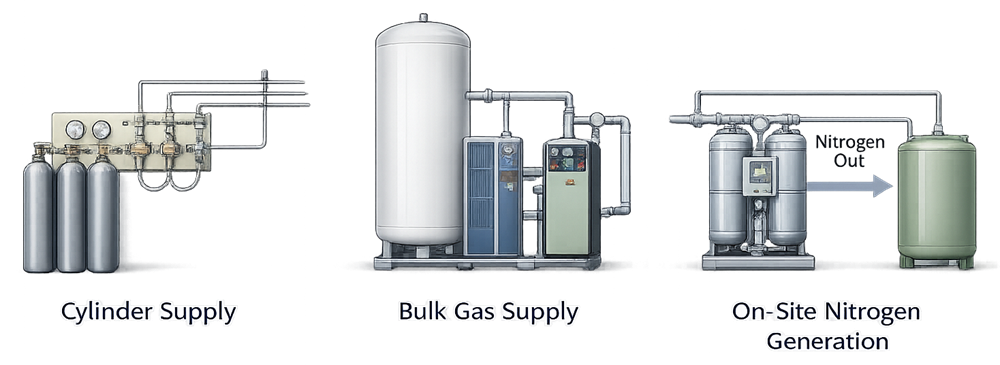
Process gases may be supplied from off-site production or generated on site. Supply selection should consider demand, use-point criticality, impurity profile, continuity requirements, available space, delivery logistics, safety, maintenance capability, and the evidence needed to demonstrate control.
Cylinders and Cylinder Banks
Cylinders are commonly used for low-volume, intermittent, or specialty-gas applications. Multiple cylinders may be connected through a manifold with manual or automatic bank changeover.
Advantages include source segregation, lot traceability, flexibility, and limited installed infrastructure. Principal risks include:
- Wrong gas or wrong grade
- Misconnection
- Damaged or contaminated valve outlet
- Incorrect regulator
- Incomplete line purge after changeover
- Loss of pressure during cylinder depletion
- Air ingress when an empty cylinder or bank is changed
- Uncontrolled cylinder storage and status identification
- Missing certificate or broken traceability
- Regulator creep or manifold leakage
Cylinder status should distinguish received, quarantined, released, connected, empty, rejected, and returned units. Controls should prevent an unreleased or incorrect cylinder from being connected to a GMP system.
Dewars, Microbulk, and Bulk Supply
Liquid or bulk supply is generally used for higher demand. The installed system may include a storage vessel, fill connection, pressure-building circuit, vaporizer, regulators, relief devices, telemetry, and distribution connection.
Bulk systems reduce routine cylinder handling but create different risks:
- Incorrect delivery into the wrong tank
- Uncontrolled delivery connection
- Loss of lot separation because successive deliveries commingle
- Variable impurity profile from supplier source changes
- Contamination from transport or transfer equipment
- Inadequate purge of a delivery connection
- Vaporizer icing or undercapacity
- Low-tank condition or delayed delivery
- Common failure of a single tank, vaporizer, or regulator train
- Limited ability to segregate suspect gas after receipt
The receiving strategy should define how delivery identity, grade, supplier, vehicle, connection, seals, documentation, and tank destination are verified before transfer begins.
On-Site Generation
On-site generation is used most often for nitrogen but may also support oxygen or other gases in specialized applications. Generation changes the control model. The facility becomes responsible for converting a feed stream into gas of the required identity and purity and for continuously or periodically demonstrating generator performance.
Typical nitrogen technologies include:
- Pressure-swing adsorption
- Membrane separation
- Cryogenic generation at very large scale
Generated-gas purity can vary with feed-air quality, flow, pressure, temperature, adsorbent or membrane condition, valve sequencing, start-up, turndown, and analyzer performance. A generated-gas system therefore requires defined diversion or use-prevention logic when acceptable quality has not been established.
Supplier Qualification and Supply-Chain Control
Supplier control should be proportionate to the gas use, contact pathway, detectability of failure, reliance on supplier testing, and difficulty of detecting an adverse delivery after it enters the system. The general supplier-control model is addressed in Supplier Assessment and Vendor Qualification.
Supplier Assessment
The assessment should address, as applicable:
- Legal manufacturer, distributor, and fill location
- Production or recovery process
- Raw or feed-gas sources
- Purification process
- Grade definition and specification
- Analytical methods, detection limits, and sampling basis
- Certificate-of-analysis content
- Cylinder cleaning, evacuation, drying, and change-of-service controls
- Bulk tanker dedication or change-of-grade controls
- Product, container, and valve identification
- Lot, batch, fill, or delivery traceability
- Control of subcontracted production or transportation
- Deviation and out-of-specification handling
- Change-notification commitments
- Complaint, investigation, and recall processes
- Business continuity and alternate-source arrangements
- Quality-system history and audit results
The supplier name on a purchase order may not identify the actual gas producer or fill site. Qualification should resolve the complete supply chain when source differences could change the impurity profile or assurance level.
Quality or Technical Agreement
For critical supplied gases, documented responsibilities may address:
- Approved grade and specification
- Permitted production and fill sites
- Certificate requirements
- Lot or delivery definition
- Change notification
- Transport and delivery controls
- Dedicated versus nondedicated equipment
- Tanker or cylinder change-of-service requirements
- Deviations and nonconforming deliveries
- Investigation support
- Retention of production and test records
- Notification of regulatory or safety events
- Emergency supply arrangements
The agreement should not merely require “USP,” “pharmaceutical,” “food,” or “high-purity” gas without identifying the actual specification and intended-use requirements.
Certificate Reliance
A supplier certificate is evidence about the supplied gas; it does not demonstrate that the correct gas was delivered into the correct receiving system or that its quality was preserved through site distribution.
When a gas is used as a drug-product component, 21 CFR 211.84 applies to component testing and permits reliance on a supplier report of analysis only under its stated conditions, including at least one specific identity test and establishment of supplier-test reliability at appropriate intervals. Utility or processing-aid uses require a site-defined control strategy based on intended use and GMP risk, even when the gas is not treated as a formulation component.
Commodity and Compendial Standards
CGA commodity specifications can support contractual grades and impurity limits for gases such as nitrogen, carbon dioxide, oxygen, and argon. A USP–NF monograph may apply when a gas is procured or used as a compendial article. These references do not eliminate the need to assess the actual application, supplier process, distribution system, and point-of-use condition.
The approved specification should state which standard and edition applies, which attributes are required, and whether site-specific limits supplement the referenced grade.
Receipt, Identity, Release, and Traceability
Cylinder Receipt
Receipt controls should verify, as applicable:
- Supplier and approved source
- Gas identity and grade on the supplier label
- Cylinder or bundle identification
- Lot, batch, or fill reference
- Certificate availability and acceptability
- Valve outlet and connection type
- Tamper-evident seal or protective cap
- Cylinder condition and inspection status
- Absence of visible contamination or damage
- Quantity and receipt date
- Quarantine or release status
Color should not be the sole identity control. Labels, valve-outlet connections, purchasing information, receiving documents, and required identity tests provide stronger assurance.
Bulk Delivery
Bulk receipt requires a controlled transfer sequence. Controls may include:
- Approved delivery schedule and supplier
- Driver and vehicle identification
- Gas identity and grade verification
- Certificate or delivery record review
- Confirmation of receiving-tank identity and available capacity
- Dedicated, keyed, locked, or otherwise controlled fill connection
- Independent verification before connection or transfer
- Hose condition and suitability
- Defined purge or connection-cleaning procedure
- Correct valve lineup
- Pre-transfer or post-transfer sample where required
- Recorded delivered quantity and tank level
- Closure, disconnection, and restoration checks
Where new delivery commingles with existing inventory, the site should define the traceability model and the response to a later rejected certificate, supplier notification, or adverse test result. The inability to isolate a delivery increases the importance of pre-transfer controls and supplier reliability.
Source Change and Alternate Supply
An alternate supplier, fill site, production technology, tanker fleet, gas grade, or on-site temporary source may change the impurity profile even when the nominal assay is unchanged. Alternate sources should be approved before use or managed through an authorized emergency process with documented impact assessment, enhanced verification, and follow-up review.
Gas-Specific Quality Considerations
The required attributes should follow both gas identity and application. The examples below are not universal specifications.
| Gas | Representative GMP uses | Potentially relevant attributes |
|---|---|---|
| Nitrogen | Blanketing, purging, product transfer, lyophilizer backfill, packaging, inerting | Nitrogen assay, oxygen, moisture, hydrocarbons, carbon monoxide, carbon dioxide, particles, microbial quality where justified |
| Carbon dioxide | Bioreactor pH control, incubators, controlled atmosphere, process addition | Carbon-dioxide assay, moisture, oxygen, carbon monoxide, hydrocarbons, sulfur compounds, source-related volatile impurities, particles, microbial quality where justified |
| Oxygen | Cell-culture or fermentation aeration, controlled oxidation, gas blending | Oxygen assay, moisture, carbon dioxide, carbon monoxide, hydrocarbons, particles, oxygen-service cleanliness |
| Argon | Inert blanketing or specialized processing | Argon assay, oxygen, nitrogen, moisture, hydrocarbons, particles |
| Helium | Leak testing, carrier or specialty process use | Helium assay and application-specific impurities; system leak integrity is often critical |
| Hydrogen | Controlled atmosphere, reaction, analytical or specialty use | Hydrogen assay, moisture, oxygen, hydrocarbons, compatible materials, ignition and leak hazards |
| Gas mixture | Incubation, calibration, controlled process atmosphere | Identity and concentration of each declared component, mixture tolerance, homogeneity, stability, trace impurities |
Purity Percentage Is Not the Entire Specification
A gas described as 99.999% pure can still be unsuitable if the unidentified remainder contains a process-critical impurity. Conversely, an application may not require the highest commercially available assay when lower purity with controlled relevant impurities is scientifically adequate.
The specification should focus on impurities capable of affecting:
- Product oxidation or reduction
- Cell growth or metabolism
- pH control
- Protein stability
- Reaction selectivity
- Moisture-sensitive materials
- Package headspace
- Sterility or bioburden control
- Analytical performance
- Equipment compatibility
Microbial and Endotoxin Considerations
Dry gases generally do not support microbial growth within a properly designed dry system, but organisms and endotoxin can be introduced through contaminated piping, wet sections, maintenance, hoses, regulators, filters, or sampling equipment. The need for microbial or endotoxin requirements should be based on the use pathway and downstream controls rather than imposed identically on every process gas.
For a gas entering an aseptic process, FDA inspection guidance specifically directs attention to final gas filtration and filter-integrity testing. The system should define the sterilizing-grade filter location, sterilization or replacement strategy, integrity-test method and frequency, installation controls, and response to failed integrity.
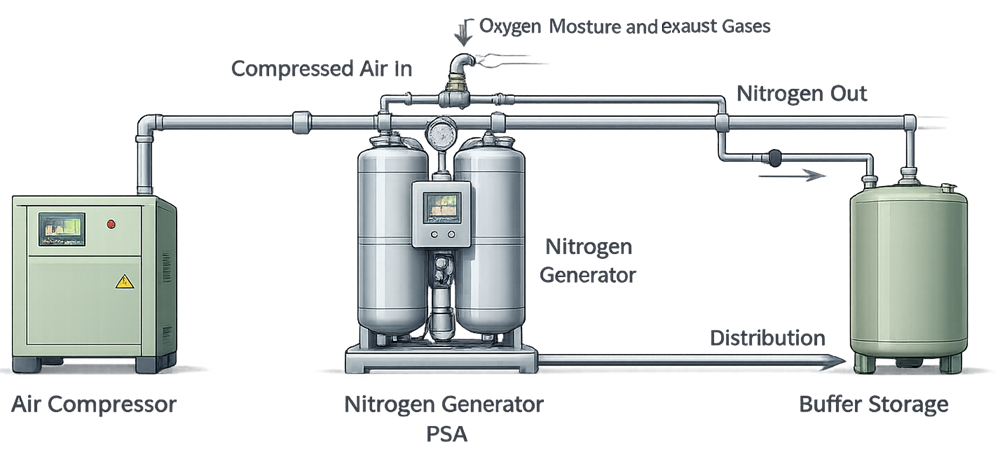
On-Site Nitrogen Generation
On-site nitrogen generation requires the same intended-use definition as supplied gas plus control of the generation process itself.
Feed-Air Dependency
PSA (Pressure Swing Adsorption) and membrane systems depend on compressed-air feed. Feed-air quality and operating conditions can affect generator performance. The design should define acceptable:
- Feed pressure and flow
- Temperature
- Moisture or dew point
- Oil and hydrocarbon content
- Particulate loading
- Pretreatment and filtration status
A bypass, degraded dryer, saturated filter, compressor change, or temporary air source can affect the nitrogen generator even if the generator itself has not changed.
PSA Generation
PSA is an on-site gas-generation process commonly used to produce nitrogen from compressed air. Adsorbent material, typically carbon molecular sieve, preferentially captures oxygen, moisture, carbon dioxide, and certain other components under pressure. Nitrogen-rich gas passes through as the product. Reducing the pressure regenerates the adsorbent.
PSA systems use adsorbent beds that preferentially retain oxygen and other components while nitrogen passes as product gas. Performance depends on bed condition, cycle timing, valves, equalization, pressure, demand, and adsorbent exposure to contamination.
Relevant controls may include:
- Sequencing and valve-state verification
- Oxygen or nitrogen analyzer
- High-oxygen alarm
- Off-specification diversion or use isolation
- Buffer-vessel pressure and capacity
- Start-up stabilization
- Bed-change criteria
- Feed-air interlocks
- Analyzer calibration and failure response
Membrane Generation
Membrane systems separate gases by different permeation rates. Purity is strongly affected by flow, pressure, temperature, membrane condition, and demand. Operation above the qualified flow can reduce nitrogen purity.
The control strategy should verify the relationship among flow, pressure, temperature, and achieved purity across the approved operating range.
Release of Generated Gas
Generated gas should not be considered acceptable solely because the generator is running. The system should define:
- Start-up qualification criteria
- Minimum stabilization time or measured release condition
- Required online analyzer status
- Off-specification diversion or isolation
- Alarm and interlock setpoints
- Response to analyzer fault or calibration failure
- Quality status after shutdown and restart
- Traceability of operating and analyzer data to use periods
Distribution-System Design
The distribution system must preserve gas identity and quality while delivering the required pressure and flow. The design basis should consider the complete path from source through the most demanding and most remote use points.
Materials and Construction
Material selection should consider:
- Gas compatibility
- Product-contact or aseptic-use risk
- Required cleanliness
- Corrosion and particle shedding
- Oxygen-service requirements
- Pressure and temperature
- Joint design and leak integrity
- Cleaning, passivation, drying, and installation methods
- Maintainability and inspection
Stainless-steel tubing with controlled fabrication may be appropriate for critical product-contact gases, but it is not a universal requirement for every gas branch. Copper, compatible polymer tubing, carbon steel, or other materials may be suitable for defined noncritical applications when justified and controlled.
Distribution Configuration
The system may use a branched header, loop, dedicated line, or combination. Design considerations include:
- Pressure drop at normal and peak demand
- Simultaneous-use assumptions
- Branch length and internal volume
- Flow direction
- Isolation strategy
- Ability to purge or flush
- Sample representativeness
- Low-use or abandoned branches
- Potential for condensate or ingress
- Access to regulators, filters, and valves
- Safe venting and depressurization
Continuous circulation is not normally required for dry process gases. However, stagnant or low-use branches can retain air, maintenance residue, or an incorrect gas after intervention. Purge requirements should reflect branch volume, gas consumption, required endpoint, and use risk.
Pressure Regulation and Protection
Regulation may occur at the source, building entry, area header, equipment, or point of use. The arrangement should control:
- Maximum and minimum allowable pressure
- Normal pressure stability
- Demand transients
- Regulator creep or failure
- Relief-device discharge
- Backpressure from connected equipment
- Isolation during maintenance
- Safe depressurization
Redundant regulators may improve availability but can introduce concealed failure when the standby train is not periodically challenged or when common valves, analyzers, or headers remain single points of failure.
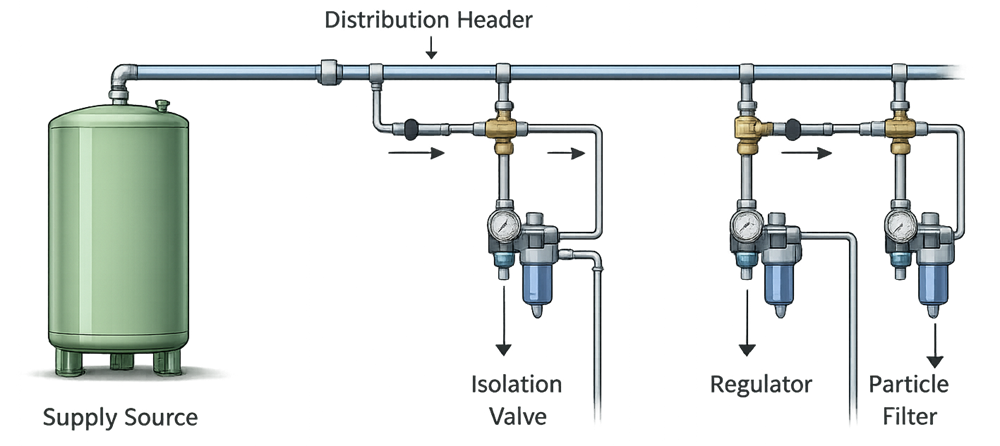
Point-of-Use Components
Depending on application, a point of use may include:
- Isolation valve
- Pressure regulator
- Pressure indicator or transmitter
- Flowmeter or mass-flow controller
- Check valve or backflow preventer
- Particle or coalescing filter
- Sterilizing-grade filter
- Sample port
- Hose or quick-connect
- Equipment connection
The component sequence should be defined. A sample taken upstream of a final regulator, hose, or sterile filter does not automatically represent the gas delivered to the process.
Cross-Connection and Backflow Prevention
Cross-connection is a high-consequence failure because pressure and flow may appear normal while the wrong gas reaches the process. Prevention should use multiple independent controls where the consequence warrants them.
Design Controls
Controls may include:
- Dedicated and noninterchangeable connections
- Gas-specific valve outlets and fittings
- Physical separation of unlike services
- Durable pipe labels with gas name and flow direction
- Consistent equipment and panel identification
- Locked or access-controlled bulk-fill connections
- Keyed or coded connectors
- Dedicated regulators, hoses, and manifolds
- Check valves or engineered backflow prevention
- Positive isolation for maintenance tie-ins
- Controlled valve lineups
- Elimination or locked control of temporary cross-ties
- Line tracing and as-built verification
Color coding can support identification but should not be the only control. Pressure difference alone is also not a reliable cross-connection safeguard because abnormal equipment pressure, regulator failure, or shutdown can reverse the expected gradient.
Backflow from the Process
Product, cleaning solution, steam, moisture, or another gas can enter the utility through a failed check valve, abnormal pressure, incorrect sequence, or open connection. The assessment should consider:
- Maximum process-side pressure
- Gas-supply minimum pressure
- Cleaning and sterilization cycles
- Vacuum conditions
- Vessel pressurization and depressurization
- Hose connection practices
- Check-valve reliability and testability
- Required air gap, double isolation, bleed, or physical disconnection
- Response to suspected reverse flow
Where the consequence is significant, a single check valve may not provide sufficient protection.
Modification and Line-Break Control
New branches, relocated drops, temporary connections, and maintenance line breaks create elevated wrong-service and contamination risk. Work controls should include current drawings, positive gas identification, isolation, purge, pressure or leak testing, cleaning, inspection, labeling, and documented return-to-service verification.
Capacity, Redundancy, and Supply Interruption
Process-gas capacity should be established from a documented demand basis rather than the sum of equipment nameplate maxima alone. The calculation should consider:
- Normal demand
- Peak simultaneous demand
- Start-up and purge demand
- Batch overlap
- Future approved expansion
- Minimum source pressure
- Distribution pressure drop
- Generator turndown and recovery
- Vaporizer capacity under adverse ambient conditions
- Cylinder-bank usable capacity
- Reserve duration
- Delivery lead time
Redundancy Claims
Redundancy should be evaluated as an end-to-end function. Two cylinder banks or two generators do not provide complete redundancy when both depend on one regulator, analyzer, buffer vessel, control panel, power supply, distribution header, or feed-air system.
The design should define:
- Duty and standby arrangement
- Automatic or manual changeover
- Conditions initiating changeover
- Alarm and notification
- Standby readiness checks
- Maximum acceptable transition disturbance
- Reserve capacity after changeover
- Common-mode failures
- Testing without unacceptable production risk
Interruption Response
The response should be based on the process consequence. Loss of gas may cause oxidation, contamination, loss of mixing or aeration, vessel vacuum, filter damage, batch interruption, unsafe atmosphere, or loss of an aseptic boundary.
Approved procedures should define:
- Detection threshold
- Immediate operator action
- Automated safe state
- Product or batch status control
- Alternate supply authorization
- Required purge before restart
- Quality testing after restoration
- Deviation and impact assessment
- Maintenance and investigation
- Criteria for resuming use
Temporary cylinders, portable vaporizers, rental generators, or cross-connected emergency supplies should not be introduced solely as operational workarounds. Their gas grade, cleanliness, capacity, connections, controls, qualification status, and safety consequences require documented assessment before use.
Instrumentation, Automation, and Alarms
Critical instruments may include:
- Source and distribution pressure
- Flow or totalized consumption
- Tank level or weight
- Dew point or moisture
- Oxygen concentration in generated nitrogen
- Nitrogen purity
- Carbon-dioxide or oxygen concentration in gas mixtures
- Differential pressure across filters
- Gas detection for oxygen deficiency, oxygen enrichment, toxicity, or flammability
- Temperature affecting generation or vaporization
Instrument range, accuracy, response time, sample conditioning, location, and maintainability should support the intended decision. An oxygen analyzer selected only for normal high-purity nitrogen may not be suitable for detecting the full off-specification range or verifying safe start-up.
Calibration Program and Metrology Control provides the lifecycle basis for critical gas analyzers, pressure instruments, flow devices, and alarm sensors.
Alarm Design
Alarms should distinguish operating advisory conditions from conditions that require immediate use prevention or process action. Relevant alarms may include:
- Low source pressure
- Low tank level or weight
- Primary-bank depletion
- Changeover to reserve supply
- Low distribution pressure
- High or low generator purity
- Analyzer fault
- High dew point
- High filter differential pressure
- Vaporizer or feed-air failure
- Ventilation failure
- Oxygen-deficiency, enrichment, toxic-gas, or flammable-gas detection
Alarm setpoints, delays, priorities, recipients, and response instructions should be justified. Silenced, disabled, or repeatedly recurring alarms require review rather than normalization as routine operation.
Electronic Records
Where automated records support gas release, use authorization, deviation assessment, or proof of continuous control, the system should address access, configuration, time synchronization, data retention, review, backup, recovery, and auditability. Loss of analyzer history can prevent reconstruction of which batches were exposed during an adverse period.
Testing and Monitoring Strategy
Testing should demonstrate both source quality and preservation through distribution. The strategy should distinguish:
- Supplier release testing
- Incoming identity or acceptance testing
- Qualification testing
- Routine source monitoring
- Representative point-of-use monitoring
- Online generation monitoring
- Filter integrity testing
- Testing after maintenance or change
- Investigation testing
Test Selection
Potential tests include:
- Identity
- Assay or concentration
- Oxygen or nitrogen content
- Moisture or dew point
- Carbon dioxide and carbon monoxide
- Total hydrocarbons or oil-related impurities
- Specific source-related volatile impurities
- Particles
- Microbial count
- Endotoxin
- Pressure
- Flow
- Leak integrity
- Sterilizing-filter integrity
Not every test applies to every gas or use. The rationale should connect each selected attribute to a credible risk, requirement, supplier reliance, or process need.
Source versus Point-of-Use Evidence
A certificate or source sample can demonstrate gas quality before site distribution. It cannot detect site-introduced particles, moisture, air ingress, wrong-service connection, regulator contamination, hose contamination, or filter failure.
Point-of-use selection should represent materially different conditions, such as:
- Most remote use point
- Lowest-pressure point
- Highest-demand branch
- Low-use or intermittent branch
- Branch downstream of additional regulators or flexible hoses
- Aseptic or direct-product-contact use
- New or modified branch
- Point associated with adverse history
Sampling Method
Gas sampling is part of the measurement system. The method should control:
- Sample location
- Valve and connection cleanliness
- Purge volume or time
- Flow and pressure
- Pressure reduction
- Condensation or adsorption
- Sample container or tubing
- Environmental contamination
- Transport and hold time
- Instrument range and detection limit
- Recovery or method suitability where microorganisms are measured
Sampling at excessive flow can distort particle or microbial results. Poor pressure reduction can create condensation, cooling, or unsafe discharge. Long polymer tubing can adsorb or release analytes. The procedure and qualification protocol should therefore define conditions rather than merely state “collect a gas sample.”
Frequencies and Trending
Routine frequency should reflect use, risk, system design, supplier controls, qualification results, online monitoring, changes, and history. Generated gas commonly warrants more continuous performance monitoring than a stable certified supply, but online purity data do not replace every point-of-use assessment.
Trend review may include:
- Purity or impurity values
- Moisture or dew point
- Pressure and flow
- Source consumption
- Changeover frequency
- Generator performance and reject time
- Filter differential pressure and integrity results
- Analyzer drift and calibration history
- Alarm frequency
- Supplier deviations or certificate trends
- Point-of-use particles or microbial results
- Interruption and maintenance history
Maintenance and Return to Service
Maintenance can directly introduce contamination, air, moisture, particles, lubricant, wrong components, or incorrect valve alignment. The Preventive Maintenance and System Reliability Strategy should address process-gas assets according to criticality and failure mode.
Typical tasks may include:
- Regulator inspection and replacement
- Automatic manifold and changeover testing
- Leak surveys
- Relief-device inspection or testing
- Filter replacement and integrity testing
- Trap or drain inspection where present
- Vaporizer inspection and defrost control
- Analyzer maintenance and calibration
- PSA valve and adsorbent maintenance
- Membrane performance review
- Buffer-vessel inspection
- Gas-detector functional testing
- Label and line-identification inspection
- Inspection of hoses and connectors
- Verification of standby supply readiness
Return-to-service requirements should be established before work begins. Depending on impact, they may include inspection, cleaning, line clearance, pressure testing, leak testing, purge, identity verification, purity testing, particle or microbial testing, filter integrity testing, alarm challenge, drawing update, and documented release.
Materials used for oxygen service require specific cleanliness and compatibility controls. Lubricants, thread compounds, seals, cleaning agents, and replacement parts should not be treated as interchangeable across gases.
Change Control and Lifecycle Review
Changes requiring documented assessment may include:
- New supplier or fill site
- Different gas grade or specification
- Supplier production-process change
- Alternate or emergency supply
- Cylinder-to-bulk or bulk-to-generation conversion
- Generator capacity or technology change
- Feed-air system change
- New tank, vaporizer, regulator, manifold, or buffer vessel
- Distribution extension or new point of use
- Changed product-contact classification
- Regulator, filter, valve, hose, or connector change
- Analyzer or alarm change
- Setpoint or software-configuration change
- Changed sampling method or frequency
- Extended shutdown
- Major repair or line break
- Recurring impurity, pressure, or interruption event
Utility System Change Control, Requalification, and Deficiencies explains how utility changes and adverse evidence lead to documented impact assessment, targeted verification, or broader requalification.
Periodic review should integrate:
- Approved uses and current system boundary
- Supplier performance and notifications
- Certificates and incoming-test history
- Online and point-of-use trends
- Alarms, interruptions, and reserve-supply events
- Deviations, investigations, and CAPA
- Maintenance and calibration history
- Filter replacement and integrity results
- Changes and temporary configurations
- Demand and capacity trends
- Drawing and asset-record accuracy
- Obsolescence and spare-part status
- Open actions and prior-review commitments
The review outcome may support continued use, corrective verification, revised monitoring, targeted requalification, comprehensive requalification, or restriction of affected uses.
Safety and GMP Interfaces
Process-gas systems contain stored energy and may create oxygen-deficient, oxygen-enriched, toxic, flammable, reactive, or cryogenic hazards. Safety and GMP controls serve different purposes and must be coordinated.
Principal Hazards
- Nitrogen, argon, helium, and carbon dioxide can displace oxygen.
- Oxygen enrichment increases combustion risk and requires oxygen-compatible materials and cleanliness.
- Hydrogen is highly flammable and readily leaks through small openings.
- Carbon dioxide can create toxic physiological effects before or in addition to oxygen depletion.
- Cryogenic liquids can cause cold burns, embrittlement, pressure rise, and high expansion volumes.
- Cylinders and pressurized systems can release substantial mechanical energy.
- Relief and purge discharges can create hazardous local atmospheres.
Interface Controls
The design should coordinate:
- Ventilation
- Oxygen-deficiency or gas detection
- Oxygen-enrichment detection where justified
- Flammable or toxic-gas detection
- Relief and vent discharge location
- Emergency shutoff
- Cylinder restraint and storage
- Separation and fire protection
- Electrical area classification where applicable
- Lockout and depressurization
- Confined-space controls
- Cryogenic personal protective equipment
- Emergency response and evacuation
A safety interlock can stop gas flow without preserving product quality, and a GMP alarm can identify a purity concern without protecting personnel from an atmospheric hazard. Cause-and-effect documentation should define both outcomes.
Safety changes can also affect the validated state. Relocating a detector, changing ventilation, revising emergency shutoff logic, or modifying relief routing may change equipment behavior or the ability to operate a process-gas system within its approved conditions.
Design Review and Qualification Readiness
Design Qualification (DQ) should confirm that the selected supply, distribution, control, sampling, maintenance, and safety architecture can meet approved process-gas requirements before installation is accepted.
Design evidence should include, as applicable:
- Intended-use and contact-risk assessment
- Approved gas and impurity specifications
- Supplier and supply-model basis
- Demand and capacity calculations
- Reserve and interruption strategy
- Process-flow diagrams and P&IDs
- Valve, regulator, filter, and instrument schedules
- Materials and cleaning requirements
- Cross-connection and backflow assessment
- Point-of-use configuration
- Sampling and monitoring strategy
- Control narrative, alarm list, and cause-and-effect matrix
- Safety assessment
- Maintenance and calibration strategy
- Commissioning and qualification requirements
- Responsibility and boundary matrix
Qualification should then establish the installed configuration, function, capacity, identity, purity, distribution performance, point-of-use condition, alarm response, changeover, interruption recovery, and controlled release baseline. It should not be reduced to collecting one acceptable gas sample.
Common Control Weaknesses
Recurring weaknesses include:
- Calling every gas service “utility nitrogen” without defining each use
- Selecting a gas grade from tradition or supplier marketing rather than process need
- Treating assay alone as the complete specification
- Accepting certificates without qualifying the actual producer or fill site
- Failing to verify identity when the gas is a product component
- Using cylinder color as the primary identity control
- Leaving bulk-fill connections uncontrolled
- Allowing undocumented alternate suppliers or temporary sources
- Assuming source quality represents every point of use
- Sampling upstream of the components that present the greatest risk
- Omitting purge criteria after cylinder change or maintenance
- Relying on pressure difference as the sole backflow control
- Using interchangeable connectors for different gases
- Failing to assess common-mode failures in a “redundant” system
- Treating online analyzer output as sufficient without calibration and failure logic
- Installing a final filter without defined sterilization, replacement, or integrity testing
- Ignoring feed-air changes affecting on-site nitrogen generation
- Returning a line to service without identity and cleanliness verification
- Managing safety and GMP controls in separate documents with conflicting responses
- Failing to connect supplier changes, alarms, maintenance, and test trends to lifecycle review
Regulatory and Technical Framework
No single FDA regulation prescribes one purity class or one architecture for all pharmaceutical process gases. Applicable controls arise from intended use and from the broader CGMP requirements for facilities, equipment, components, production, laboratory controls, records, and quality review.
Principal references include:
- 21 CFR Part 211 — Current Good Manufacturing Practice for Finished Pharmaceuticals
- 21 CFR 211.42 — Design and construction features
- 21 CFR 211.63 — Equipment design, size, and location
- 21 CFR 211.65 — Equipment construction
- 21 CFR 211.67 — Equipment cleaning and maintenance
- 21 CFR 211.68 — Automatic, mechanical, and electronic equipment
- 21 CFR 211.84 — Testing and approval or rejection of components, drug-product containers, and closures
- 21 CFR 211.100 — Written procedures and deviations
- 21 CFR 211.160 — General requirements for laboratory controls
- 21 CFR 211.180 — General records and annual evaluation requirements
- FDA Compliance Program 7356.002A, Sterile Drug Process Inspections — includes process-gas controls, final filtration, filter-integrity testing, and gas used as a finished-product component
- FDA Guidance for Industry: Sterile Drug Products Produced by Aseptic Processing — aseptic-processing expectations relevant to sterile gas pathways and filters
- OSHA 29 CFR 1910.101 — general compressed-gas requirements
- OSHA 29 CFR 1910.103 — hydrogen systems
- OSHA 29 CFR 1910.104 — oxygen systems
- CGA G-10.1 — Commodity Specification for Nitrogen
- CGA G-6.2 — Commodity Specification for Carbon Dioxide
- CGA G-4.3 — Commodity Specification for Oxygen
- CGA G-11.1 — Commodity Specification for Argon
- Applicable adopted building, fire, pressure-vessel, piping, electrical, and environmental requirements
The applicable edition and legal status of each code or standard should be confirmed for the facility location and application. A commodity or safety standard becomes part of the GMP basis when it is incorporated into an approved requirement, specification, procedure, quality agreement, regulatory commitment, or design standard.
Lifecycle Position
This article establishes the design and control basis for supplied and generated process gases. It defines how identity, purity, intended use, supplier controls, distribution, cross-connection prevention, interruption response, testing, maintenance, and safety interfaces should be integrated.
Qualification and continued verification must convert that basis into objective evidence. The released system should have a controlled as-built configuration, approved operating ranges, representative quality data, verified changeover and alarm functions, defined routine monitoring, and predetermined responses to changes, interruptions, adverse trends, and maintenance.