

Process Change Control, Revalidation, and Lifecycle Management
Process change is expected throughout the commercial lifecycle. Materials change, equipment is replaced, suppliers evolve, manufacturing scales change, process understanding improves, automation is updated, facilities are transferred, and continued process verification may identify opportunities or weaknesses requiring modification. The validation system therefore needs a controlled mechanism for determining whether each change is compatible with the existing validated state and what additional evidence is necessary before that state can be considered maintained.
FDA’s treats validation as a lifecycle activity linking process development, qualification of the commercial process, and continued maintenance of a state of control. FDA also explicitly encourages quality risk management and lifecycle approaches at all stages of manufacturing.
ICH Q10 goes further by defining change management as a systematic process for proposing, evaluating, approving, implementing, and reviewing changes. It expects risk-based evaluation of proposed changes, assessment against the marketing authorization and current process understanding, appropriate technical expertise, prospective evaluation criteria, and post-implementation confirmation that the change achieved its objective without adversely affecting product quality.
This article focuses on that validation-impact and revalidation decision process. The detailed methodology for quality-risk assessment is addressed in Quality Risk Management in Process Validation, while maintenance of the individual control-strategy elements affected by a change is addressed in Process Control Strategy Lifecycle Management.
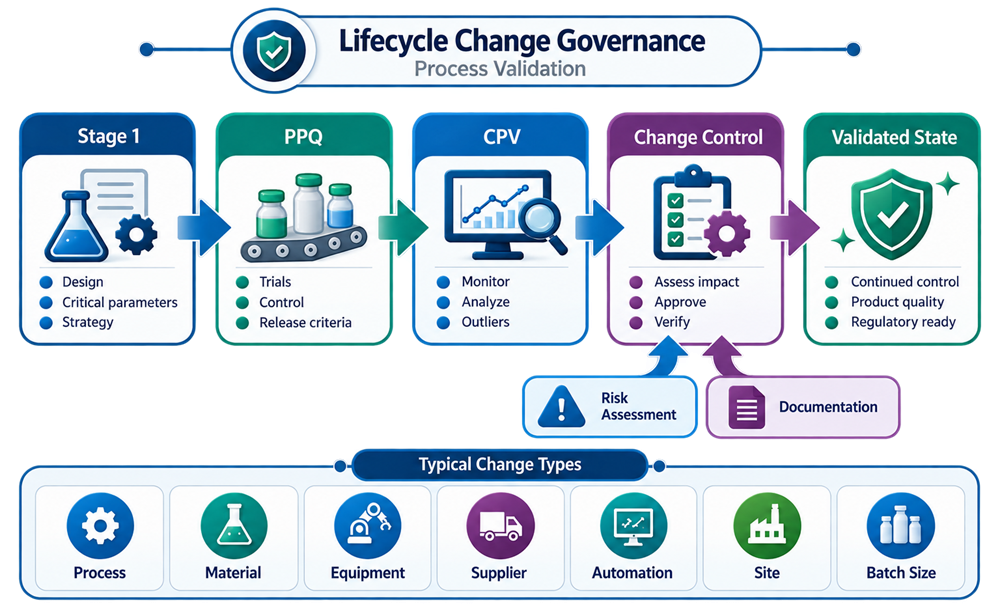
Change Management Is a Cross-Stage Validation Activity
Change control should not be viewed as a Stage 3 activity that begins only after PPQ. Changes occur during development, technology transfer, PPQ preparation, PPQ execution, commercial manufacturing, CPV, and subsequent revalidation. The level of formality may differ by lifecycle stage, but the underlying principle remains the same: the organization should understand what is changing, why it is changing, what existing knowledge remains applicable, and what evidence is required before the revised process can be accepted.
ICH Q10 specifically recognizes that change-management formality differs before and after the initial regulatory submission while still expecting lifecycle-stage-appropriate change management. Formal Quality Unit oversight becomes particularly important during commercial manufacturing.
A development adjustment may therefore require documentation within a development study, while a comparable change to the approved commercial process may require formal change control, validation-impact assessment, regulatory assessment, implementation controls, and post-change verification.
What Constitutes a Validation-Relevant Change?
A validation-relevant change is any modification that can alter the assumptions, controls, process conditions, equipment functions, materials, operating ranges, or evidence supporting the validated process.
The significance of a change is not determined only by how large the physical modification appears. A small software change affecting a critical calculation may have greater validation impact than replacement of a large mechanical component with an equivalent part. Likewise, a supplier change may appear administratively minor but become significant if material attributes strongly influence process behavior.
Common change categories include:
| Change category | Examples | Typical validation questions |
|---|---|---|
| Process | Unit-operation sequence, mixing method, hold time, process step | Does the process mechanism or variability change? |
| Material | Raw material grade, excipient, intermediate, component | Are material-process or material-CQA relationships affected? |
| Equipment | Replacement, new model, changed scale, new configuration | Is the operating principle or process capability equivalent? |
| Site / facility | Manufacturing transfer, new area, utilities, layout | Does the new environment reproduce the validated process? |
| Batch size / scale | Scale-up, scale-down, campaign size | Do scale-dependent parameters or equipment interactions change? |
| Parameters | Setpoint, operating range, alarm or control limit | Is the existing process understanding still applicable? |
| Supplier | New supplier, alternate source, manufacturing-site change | Does material variability remain adequately controlled? |
| Automation | Recipe, software, logic, control loop, interface | Does the process-control function or data handling change? |
| Analytical / IPC | Method, sampling, test frequency, specification | Is detection or process-control capability affected? |
| Control strategy | CPP, IPC, specification, procedure, automation control | Does the overall process-control system remain adequate? |
The table is intentionally non-exhaustive. The change-control system should avoid relying solely on predefined lists because unusual combinations of otherwise minor changes can collectively create significant process impact.
Change Initiation
A formal change record should clearly describe the proposed change, its reason, affected product or process, implementation scope, timing, and intended benefit. The description should be specific enough that reviewers can distinguish the current validated condition from the proposed condition.
The rationale may include obsolescence, equipment reliability, supplier continuity, process improvement, CAPA, capacity increase, new scientific knowledge, cost reduction, facility transfer, regulatory commitment, or correction of a known process weakness.
A change request should not begin with a predetermined conclusion such as “no validation required.” The validation response should emerge from the impact assessment rather than being built into the change description.
Establish the Current Validated Baseline
Before evaluating the proposed state, the organization should understand the existing validated state. This may require reviewing the current control strategy, PPQ evidence, applicable Stage 1 studies, equipment qualification, material controls, current operating ranges, CPV performance, unresolved deviations, and relevant previous changes.
This is one reason Process Validation Documentation and Traceability is important to lifecycle management. A change assessment becomes much weaker when reviewers cannot readily identify which evidence supports the existing process.
The baseline should answer a practical question: What current evidence would become less applicable if this change were implemented?
That question is generally more useful than simply asking whether the change “affects validation.”
Impact Assessment
The impact assessment should evaluate how the proposed change can alter product quality, process performance, process variability, the control strategy, and the underlying validation evidence. Important considerations can include:
- affected CQAs;
- affected CPPs and other important parameters;
- material-process relationships;
- process mechanism;
- operating margin;
- equipment design and operating principle;
- control loops and automation;
- sampling and analytical capability;
- facility or utility dependence;
- sterility or contamination-control implications where applicable;
- process scale;
- manufacturing sequence;
- historical variability;
- current CPV performance; and
- applicable regulatory commitments.
The assessment should distinguish direct impact from indirect or consequential impact. A new mixer, for example, directly changes equipment but can indirectly affect blending uniformity, mixing time, material shear, downstream compression, or analytical sampling behavior.
Quality Risk Assessment
Risk assessment helps determine how much evidence is necessary, but this article does not duplicate the broader QRM methodology described in Quality Risk Management in Process Validation.
For change control, the practical risk questions are narrower:
- What could become different after the change?
- How could that difference affect process performance or product quality?
- Which existing controls would detect or prevent the effect?
- How much uncertainty remains?
- Which existing validation evidence remains applicable?
- What new evidence is necessary to close the knowledge gap?
ICH Q10 expects the level of effort and formality of change evaluation to be commensurate with risk and requires proposed changes to be assessed relative to current product and process understanding.
Knowledge and Uncertainty Matter
A change with high theoretical impact can sometimes be supported with relatively focused verification when process understanding is mature and existing evidence is strong. Conversely, a change that appears moderate may require extensive studies when process knowledge is weak or the new condition introduces significant uncertainty.
For example, replacement of a pump with an equivalent model operating within a well-characterized process may require qualification and targeted confirmation rather than PPQ. A new mixing technology for a process whose product quality depends strongly on mixing dynamics could require new characterization and substantial revalidation.
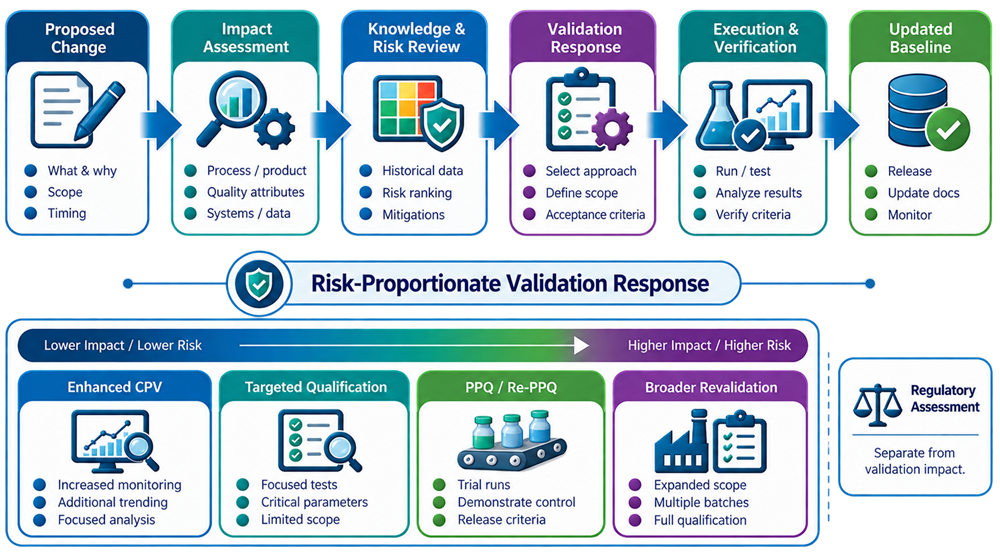
Validation response should therefore reflect impact × uncertainty × strength of existing knowledge, not only a numerical change classification.
Regulatory Assessment Is Separate From Validation Impact
The internal validation classification of a change should not be confused with its regulatory reporting category.
For approved NDAs, 21 CFR 314.70 requires applicants to notify FDA of changes to approved conditions and classifies changes according to their potential adverse effect on product identity, strength, quality, purity, or potency. The regulation distinguishes changes requiring prior approval, changes that can be submitted through applicable Changes Being Effected mechanisms, and changes that may be reported annually.
A change can therefore require substantial validation work while having one regulatory reporting pathway, or require a particular regulatory submission even when the technical validation burden is relatively limited.
Regulatory Affairs should evaluate filing requirements based on the approved application, product type, applicable commitments, relevant FDA guidance, and the specific nature of the proposed change.
Regulatory Review Should Occur Early
Regulatory assessment should not be left until all engineering and validation work has been completed. A proposed site transfer, significant formulation modification, new sterilization approach, new manufacturing technology, or major process change can affect implementation timing and the evidence expected within a regulatory filing.
Under 21 CFR 314.70, an NDA holder must assess the effect of a manufacturing change before distributing product made using that change, and major changes with substantial potential to adversely affect product quality require approval before distribution.
For product-specific post-approval changes, FDA’s SUPAC guidances provide additional examples involving site, scale, equipment, process, and composition changes. These should be used only where applicable to the specific dosage form and regulatory situation rather than as universal validation rules.
Changes Within an Established Design Space
Where an approved design space exists, movement within that approved design space may not require a regulatory filing, but that does not mean internal change management can be bypassed.
FDA’s Q8/Q9/Q10 Points to Consider states that movement within an approved design space does not call for a regulatory filing, while changes outside the design space should be evaluated using risk assessment and the appropriate regulatory filing strategy. The same document notes that additional verification can be triggered by changes such as site, scale, or equipment changes.
The validation system should therefore distinguish: Regulatory flexibility within an approved design space from internal confirmation that the process remains appropriately controlled after the operational change.
Determine the Validation Response
The outcome of change assessment should be an evidence plan proportionate to the change. The available responses form a continuum rather than a binary “revalidation / no revalidation” decision.
Possible responses include:
- documentation update only;
- routine monitoring;
- temporarily enhanced CPV;
- engineering or feasibility study;
- targeted functional testing;
- targeted equipment qualification;
- targeted process verification;
- additional sampling or statistical evaluation;
- limited PPQ;
- additional PPQ batches;
- re-PPQ;
- partial process revalidation;
- full process revalidation; or
- return to Stage 1 development or characterization.
The selected approach should address the specific uncertainty created by the change.
No Additional Process Validation
Some changes may not require additional process validation when the assessment demonstrates that the change does not alter the process mechanism, relevant controls, validated operating conditions, or product-quality risk.
Examples can include administrative document updates, like-for-like replacement of non-process-critical components, or procedural clarification that does not change the manufacturing operation.
The conclusion should still be documented. “No validation required” should be supported by the impact assessment rather than treated as an exemption from change control.
Targeted Qualification
Targeted qualification is appropriate when the change affects equipment, utility, automation, or another enabling system but does not materially challenge the established commercial process.
Examples might include:
- replacement of a component with equivalent design and operating principle;
- modification of an equipment function;
- a revised alarm or interlock;
- addition of a sensor;
- utility-system modification;
- automation configuration change; or
- relocation of equipment within an otherwise equivalent qualified environment.
The scope should verify the affected function rather than unnecessarily repeating the entire original qualification package.
Where the change can affect process performance, targeted equipment qualification alone may not be enough and should be supplemented by process-level evidence.
Targeted Process Verification
Some changes are best addressed through focused process studies rather than full PPQ. The studies should be designed around the specific mechanism affected by the change.
A parameter-range adjustment, for example, may require targeted runs demonstrating expected product and process response at the revised condition. A material-supplier change may require comparison of relevant material attributes and downstream process behavior. An equipment change may require evidence demonstrating comparable mixing, heat transfer, filtration, filling, or another affected process function.
The objective is not to perform a smaller generic PPQ. It is to obtain evidence directly addressing the uncertainty introduced by the change.
PPQ and Re-PPQ Decisions
Additional PPQ is appropriate when the change materially affects the commercial manufacturing process and commercial-scale reproducibility needs to be reconfirmed.
Potential triggers include:
- major scale change;
- significant process-step modification;
- new manufacturing technology;
- site transfer;
- equipment with a materially different operating principle;
- significant formulation or material change;
- substantially revised process ranges;
- control-strategy redesign; or
- accumulated evidence suggesting that the previous PPQ no longer adequately represents the process.
The decision should not default to “three batches.” Process Performance Qualification (PPQ) Strategy and Batch Selection explains that the number of PPQ batches should be scientifically justified using process knowledge, variability, complexity, risk, and the evidence needed to establish confidence.
A re-PPQ strategy should similarly explain why the selected number and type of batches adequately represent the changed process.
Partial Revalidation
Partial revalidation can be appropriate when the change affects a defined portion of a process while the remainder of the original validation evidence remains scientifically applicable.
For example, a change to one unit operation may justify focused revalidation of that unit operation and downstream consequences rather than repeating qualification of unaffected upstream steps.
The challenge is to demonstrate that the boundary truly is limited. Process steps are interconnected, and a change to an upstream material or operation can alter downstream variability even if later equipment is unchanged.
The revalidation rationale should therefore explicitly state which previous evidence remains applicable and why.
Full Revalidation
Full revalidation should be considered when the change materially alters the process basis or invalidates a substantial portion of the existing process understanding. Examples may include:
- fundamentally different manufacturing technology;
- major process redesign;
- new site with substantial differences in process environment;
- major formulation change;
- significant change to sterility-assurance strategy;
- extensive change to multiple interacting process steps; or
- evidence that previous process understanding is no longer adequate.
In such situations, the organization may need to return partly to Stage 1 rather than moving directly into PPQ.
Site Changes
Manufacturing-site transfer can affect facilities, utilities, equipment, operators, materials logistics, environmental conditions, automation, and process scale simultaneously.
ICH Q10 identifies technology transfer as a lifecycle activity in which process and product knowledge should be transferred between sites and used as the basis for the manufacturing process, control strategy, validation approach, and continual improvement.
A site-transfer assessment should compare the sending and receiving sites rather than simply confirming that both sites are qualified.
Important questions include:
- Is the equipment equivalent in design and operating principle?
- Are utilities and environmental conditions equivalent?
- Are process ranges and control logic equivalent?
- Are material sources and logistics unchanged?
- Are sampling and analytical systems comparable?
- Is scale unchanged?
- Are operator-dependent steps affected?
- Is prior process knowledge transferable without qualification?
The answers determine whether comparability studies, targeted qualification, PPQ, or broader revalidation are required.
Batch-Size and Scale Changes
Scale changes can alter heat transfer, mass transfer, mixing, residence time, spray rate, shear, equipment loading, process time, sampling representativeness, and other scale-dependent behavior.
A batch-size change should therefore be assessed using process understanding rather than only percentage increase or decrease.
FDA’s Q8/Q9/Q10 Points to Consider specifically recognizes that additional design-space verification may be triggered by scale or equipment changes and recommends using risk assessment and prior knowledge to determine appropriate studies.
Where scale-dependent relationships are well characterized, targeted verification may be sufficient. Where scale introduces new operating behavior or uncertainty, additional characterization and PPQ may be appropriate.
Equipment Changes
Equipment replacement ranges from like-for-like substitution to introduction of an entirely different operating principle.
The assessment should consider:
- equipment design;
- operating principle;
- capacity;
- geometry;
- product-contact surfaces;
- control functions;
- instrumentation;
- operating ranges;
- scale dependence;
- cleaning implications;
- hold-up volume;
- process dynamics; and
- interactions with automation.
Qualification demonstrates that the equipment is installed and functions correctly. It does not automatically demonstrate that the changed manufacturing process performs equivalently. Process-level verification should be added when equipment changes can alter product or process behavior.
Material and Supplier Changes
A supplier change should not be evaluated solely by comparing incoming specifications. Materials from different sources can meet the same specification while behaving differently in manufacturing.
The assessment should consider relevant physical and chemical attributes, variability, manufacturing source, impurity profile, particle characteristics, moisture, viscosity, density, morphology, or other properties known to influence the process.
Stage 1 knowledge and CQA, CPP, and Material Attribute Risk Assessment can help identify which attributes require comparison.
A supplier change may therefore require material comparability data, targeted process verification, enhanced CPV, or PPQ depending on its relationship with process performance and product quality.
Parameter and Operating-Range Changes
Changing a setpoint is not automatically equivalent to changing an operating range.
A setpoint adjustment within a well-understood and approved range may require relatively limited verification. Expanding the operating range beyond previously characterized or validated conditions can create substantially greater uncertainty.
The assessment should consider:
- location within the characterized range;
- relationship with CQAs;
- interaction with other parameters;
- process capability;
- actual commercial operating distribution;
- control-loop behavior; and
- historical CPV evidence.
The updated control strategy should remain managed through Process Control Strategy Lifecycle Management.
Automation and Control-System Changes
Automation changes can affect process sequence, calculations, alarms, interlocks, recipes, control loops, data transfer, or operator decision points.
The computerized-system component of the change should be assessed through the applicable computerized-system lifecycle procedures. This article focuses on the process-validation consequence.
A software change that modifies a CPP control algorithm, for example, may require system functional testing and process-level verification. A change to a non-GxP display element may have no process-validation consequence.
The two assessments should remain linked without duplicating one another.
Changes Driven by CPV
Not all changes begin as planned engineering improvements. CPV may identify drift, declining capability, recurring intervention, growing material sensitivity, or repeated deviations that demonstrate the need to modify the process.
Process Drift, Statistical Signals, and CPV Investigation addresses how those signals are confirmed and investigated. If the investigation concludes that the established process or control strategy should change, the resulting modification should enter formal lifecycle change control.
This closes an important loop: CPV signal → investigation → proposed change → validation-impact assessment → implementation → post-change verification → revised CPV baseline
Enhanced CPV After Change
Enhanced CPV is one of the most useful post-change verification tools, particularly when the change is scientifically understood but additional commercial experience is needed before returning to routine monitoring.
FDA’s Q8/Q9/Q10 Points to Consider notes that CPV can provide immediate feedback on the effect of manufacturing changes and facilitate change management.
Enhanced CPV can temporarily increase:
- monitoring frequency;
- sampling frequency;
- stratification;
- review frequency;
- alarm review;
- material trending;
- capability assessment;
- deviation review; or
- cross-batch comparison.
The enhanced period should have defined objectives and exit criteria rather than continuing indefinitely.
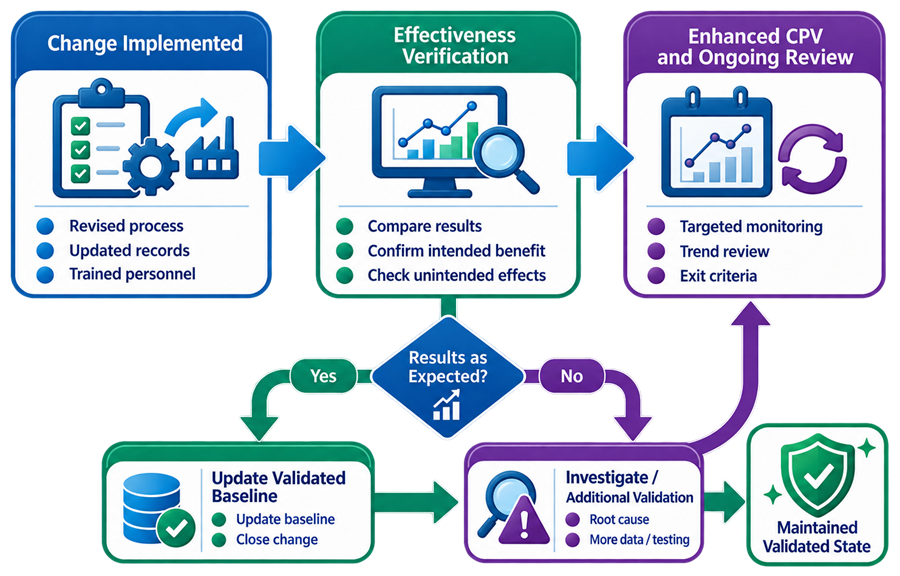
Effectiveness Verification
A change should not be considered complete merely because implementation activities were executed successfully.
ICH Q10 specifically requires post-implementation evaluation to confirm that the change achieved its intended objective and did not have a deleterious effect on product quality.
Effectiveness verification should therefore evaluate both: Did the change achieve the intended benefit? and Did it create an unintended adverse effect?
Evidence may include qualification results, PPQ or targeted verification, CPV data, trend comparisons, process capability, deviations, complaints, laboratory results, alarm performance, or other indicators appropriate to the change.
Effectiveness Criteria Should Be Defined Prospectively
Where practical, the change plan should define success criteria before implementation. Examples include:
- specified equipment performance achieved;
- revised parameter maintained within the intended range;
- comparable CQA distribution demonstrated;
- no adverse increase in variability;
- expected process-capability improvement achieved;
- alarm frequency reduced as intended;
- new material performs comparably;
- no unexpected deviation trend observed; or
- enhanced CPV period completed without adverse signal.
Prospective criteria reduce the risk of judging success differently after results are known.
When Effectiveness Is Not Demonstrated
Failure to demonstrate effectiveness does not necessarily mean the entire product is invalid, but it does mean the change cannot simply be closed as successful. The organization should determine whether the failure reflects:
- incorrect change assumptions;
- inadequate implementation;
- insufficient data;
- uncontrolled variability;
- unintended process interaction;
- weak control strategy;
- inadequate qualification scope; or
- a genuinely unsuitable change.
Potential responses include further investigation, CAPA, additional testing, modification of the change, additional PPQ, broader revalidation, or reversal of the change where feasible.
Updating the Validated Baseline
A successfully implemented and verified change becomes part of the new validated baseline. Relevant controlled records may need updating, including:
- process description;
- control strategy;
- master batch records;
- SOPs;
- equipment configuration;
- parameter ranges;
- alarm limits;
- specifications;
- sampling instructions;
- automation recipes;
- CPV plans;
- risk assessments;
- validation summaries; and
- regulatory commitments.
The documentation relationships should remain traceable through Process Validation Documentation and Traceability.
The objective is that a future reviewer can determine which validation evidence supported the process before the change and which evidence supports the process after the change.
Change Closure
Change closure should confirm that planned implementation activities are complete, validation evidence is acceptable, deviations have been resolved, required regulatory actions are complete, documentation has been updated, training has been completed, and post-change monitoring requirements are established.
Closure should not occur merely because the physical modification is complete.
A strong closure statement answers: What evidence demonstrates that the changed process can now be considered part of the validated state?
Periodic Review of Change History
Individual changes should also be reviewed collectively. Several small parameter changes, equipment adjustments, supplier changes, or procedural revisions can cumulatively alter a process more significantly than any one change-control record suggests.
CPV reporting and lifecycle review should therefore consider whether the accumulated change history has materially shifted the process away from the conditions represented by the original PPQ.
Continued Process Verification Reporting and State-of-Control Assessment provides the appropriate context for integrating accumulated change history with process trends, deviations, CAPA, and overall state-of-control decisions.
Revalidation Should Not Be Calendar-Driven by Default
Revalidation should be triggered by lifecycle evidence and change impact rather than by an arbitrary calendar requirement unless a specific internal or regulatory requirement establishes a periodic frequency.
A mature process with stable CPV performance and no significant changes may not benefit from repeating PPQ simply because a fixed interval has elapsed. Conversely, a major change can require revalidation immediately even when the original PPQ was completed recently.
The appropriate question is: Does current evidence still support the validated state?
Maintaining the Validated State
The validated state is maintained through the interaction of process knowledge, control strategy, CPV, deviation management, change control, CAPA, documentation, and periodic lifecycle review.
ICH Q10 describes commercial manufacturing as a lifecycle stage in which the organization should establish and maintain a state of control while continually expanding product and process knowledge and evaluating improvement opportunities.
Change control therefore does not compete with validation. It is one of the principal mechanisms through which validation remains current.
Key Principles
- Change control is a cross-lifecycle validation activity, not only a Stage 3 function.
- Every significant change should be assessed against the current validated baseline and existing process knowledge.
- Validation impact should be evaluated separately from regulatory reporting classification.
- Risk, uncertainty, and strength of existing evidence should determine the amount of additional validation required.
- Equipment qualification alone may not be sufficient when equipment changes can alter process performance.
- Targeted verification is appropriate when the affected process mechanism is well understood and the scope of impact is limited.
- Additional PPQ or re-PPQ should be scientifically justified when commercial-scale reproducibility must be reconfirmed.
- Partial revalidation is appropriate only when unaffected portions of the original validation evidence remain demonstrably applicable.
- Enhanced CPV can provide valuable post-change evidence and should have defined objectives and exit criteria.
- Change effectiveness should be verified before the revised process is accepted as the new validated baseline.
- Accumulated minor changes should be periodically reviewed for cumulative validation impact.
- Revalidation should be driven by change impact and lifecycle evidence rather than an arbitrary calendar interval unless specifically required.