

Quality Risk Management in Process Validation
Quality Risk Management (QRM) provides the decision framework that connects process knowledge, validation evidence, uncertainty, controls, monitoring, change, and revalidation across the complete manufacturing lifecycle. It should not be treated as a single risk assessment performed during development and filed away after Process Performance Qualification (PPQ). Risk changes as knowledge increases, commercial experience accumulates, controls are implemented, deviations occur, and the manufacturing process evolves.
The current ICH Q9(R1) Quality Risk Management guideline defines QRM as a systematic process for the assessment, control, communication, and review of risks to product quality across the lifecycle. Its two primary principles are that evaluation of quality risk should be based on scientific knowledge and ultimately linked to patient protection, and that the level of effort, formality, and documentation should be commensurate with risk.
For process validation, those principles align directly with FDA’s lifecycle model. FDA Process Validation: General Principles and Practices expects manufacturers to understand sources of variation, detect the presence and degree of variation, understand their impact on process and product attributes, and control variation in a manner commensurate with the risk it represents.
QRM Across the Validation Lifecycle
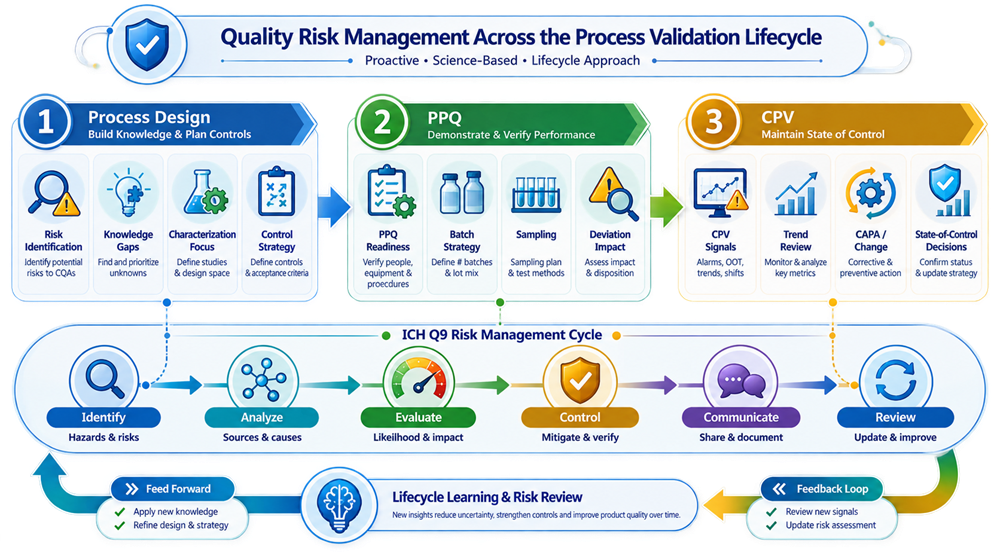
QRM should be embedded from process development through continued commercial manufacturing. During Stage 1, risk management helps focus process characterization, scale-up studies, control-strategy development, and the reduction of important knowledge gaps. During Stage 2, it helps determine PPQ readiness, the amount and type of qualification evidence needed, sampling intensity, challenging conditions, and the significance of deviations. During Stage 3, it supports interpretation of process signals, escalation, CAPA, monitoring changes, and decisions about whether the validated state remains adequately supported.
This article deliberately has a broader scope than CQA, CPP, and Material Attribute Risk Assessment. Article 120 addresses the specific scientific assessment of CQAs, material attributes, process parameters, and CPP criticality during process development. The present article uses those conclusions as inputs and focuses on how risk is managed throughout validation decisions, execution, commercial monitoring, change, and revalidation.
QRM Is a Decision Process, Not a Risk Score
Risk matrices, Failure Modes and Effects Analysis (FMEA), Failure Mode, Effects and Criticality Analysis (FMECA), Hazard Analysis and Critical Control Points (HACCP), fault-tree analysis, ranking tools, and statistical methods can all support QRM. The tool, however, is not the risk-management process itself.
ICH Q9(R1) describes a general process containing risk assessment, risk control, risk communication, and risk review. Risk assessment itself includes hazard identification, risk analysis, and risk evaluation, beginning with a clearly defined problem or risk question. The guideline proposes three fundamental questions: what might go wrong, what is the likelihood that it will go wrong, and what are the consequences.
For validation, a well-framed risk question is usually more useful than a generic instruction to “perform an FMEA.” Examples might include whether available development knowledge is sufficient to enter PPQ, whether a proposed material change can affect the validated process, whether a CPV trend challenges the established control strategy, or whether a process change requires targeted verification or broader revalidation.
Risk Identification
Risk identification determines what conditions, failures, sources of variability, or knowledge gaps could adversely affect process performance or product quality. The information can come from development studies, prior knowledge, process characterization, equipment studies, historical manufacturing data, investigations, complaints, supplier information, statistical trends, or subject-matter expertise.
The objective is not to generate the longest possible failure-mode list. The risk question should establish the scope and determine which hazards are relevant. A Stage 1 assessment of scale-up uncertainty, for example, should concentrate on relationships that may change with commercial equipment and batch size rather than cataloguing every conceivable manufacturing failure.
ICH Q9(R1) specifically recognizes historical data, theoretical analysis, informed opinion, and stakeholder concerns as potential inputs to hazard identification.
Risk Analysis
Risk analysis estimates the significance of the identified risks. Depending on the problem, analysis may consider severity, probability or likelihood, detectability where useful, exposure, process capability, operating margin, reliability of existing controls, and the quality of supporting evidence.
Numerical scoring can help organize thinking but should not replace scientific interpretation. A calculated Risk Priority Number (RPN), for example, can conceal very different combinations of severity, probability, and detectability and may create false precision when the underlying estimates are uncertain. Two risks with the same numerical score can require very different control strategies.
ICH Q9(R1) emphasizes that risk scores, ratings, and assessments should be based on appropriate evidence, science, and knowledge. This is particularly relevant to validation because development knowledge, process characterization, and accumulated commercial evidence should directly affect the risk conclusion.
Risk Evaluation
Risk evaluation compares the analyzed risk with the organization’s criteria for determining whether additional control is necessary. This step should answer whether the current risk is acceptable, whether stronger controls or additional evidence are required, and what residual uncertainty remains.
Risk acceptance should not be confused with accepting poor process performance. ICH Q9 explicitly states that QRM should not be used to justify a practice that would otherwise be unacceptable under regulation or guidance. A risk assessment therefore cannot be used to rationalize failure to meet a regulatory requirement, approved specification, or fundamental validation expectation.
The result may instead be a decision to obtain additional knowledge, improve a control, limit an operating range, strengthen monitoring, add qualification evidence, or redesign part of the process before the risk can reasonably be accepted.
Risk Control
Risk control includes decisions to reduce risk, accept residual risk, or both. ICH Q9(R1) recommends considering whether risk is above an acceptable level, what can be done to reduce it, how benefits and risks should be balanced, and whether the proposed control introduces new risks.
In process validation, risk controls can take many forms. They may involve material specifications, supplier controls, equipment design, operating ranges, automation, alarms, in-process controls, procedures, sampling, analytical testing, maintenance, additional process characterization, PPQ verification, or CPV monitoring. The appropriate control should address the mechanism by which harm or loss of process control could occur rather than simply lower a number in a risk worksheet.
A strong QRM process also distinguishes risk reduction from risk detection. Improved monitoring can make a developing problem easier to detect, but detection alone may not reduce the probability or severity of the underlying process failure.
Residual Risk
Controls rarely reduce all risk to zero. After controls are selected, the organization should understand the residual risk that remains and determine whether it is acceptable for the intended decision.
Residual risk is particularly important at validation transitions. Stage 1 may leave uncertainty that is intentionally addressed during PPQ. PPQ may demonstrate adequate initial control while identifying specific issues requiring heightened early CPV monitoring. A change may be approved with defined follow-up monitoring to verify that assumptions remain valid.
The risk record should make these dependencies visible so that an unresolved risk is not unintentionally forgotten when responsibility moves from development to validation, from PPQ to routine manufacturing, or from change implementation to CPV.
Uncertainty and Knowledge Level
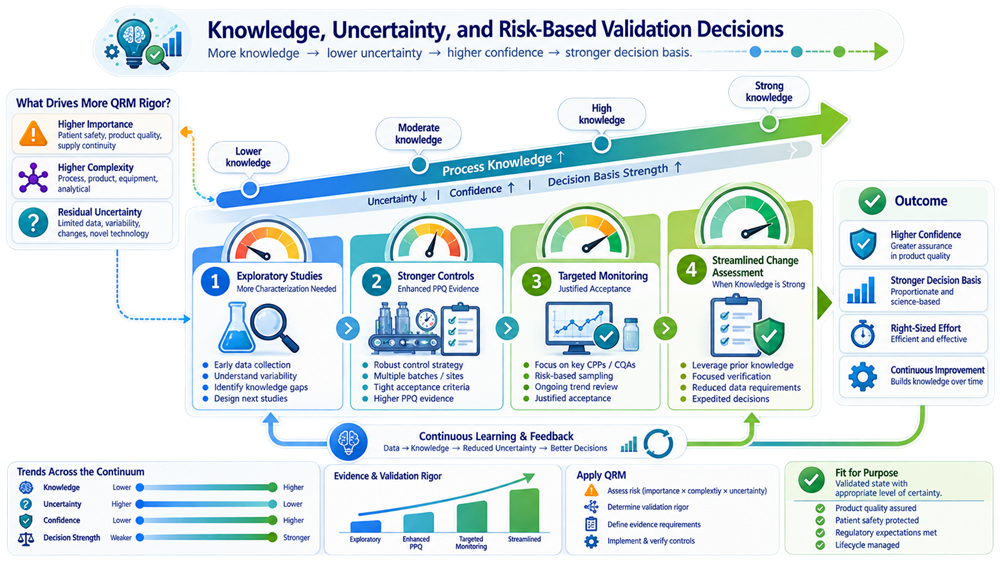
One of the most important additions emphasized in ICH Q9(R1) is the role of uncertainty. The guideline defines uncertainty in QRM as lack of knowledge about hazards, harms, and associated risks and explains that uncertainty can arise from incomplete process understanding, unknown variability, scientific knowledge gaps, and limitations in detection.
This has direct consequences for validation strategy. A high-risk conclusion based on strong scientific evidence is different from a moderate-looking risk score built on weak information. When uncertainty is high, the appropriate response may be additional characterization, data collection, engineering study, sampling, or monitoring before a confident risk-based decision can be made.
As knowledge increases, uncertainty can decrease and the risk-management approach can become more targeted. This is why Lifecycle Integration and Knowledge Management in Process Validation and QRM should operate together rather than as separate quality-system activities.
ICH Q10 reinforces this relationship by identifying knowledge management and QRM as lifecycle enablers. Product and process knowledge should be managed from development through commercial manufacture, and QRM provides a proactive mechanism for identifying, scientifically evaluating, and controlling risks throughout that lifecycle.
QRM Formality Should Be Proportionate
Not every validation decision requires a large cross-functional FMEA with dozens of failure modes. ICH Q9(R1) explicitly describes QRM formality as a continuum rather than a binary formal/informal choice and identifies uncertainty, importance, and complexity as factors that can determine how much structure, documentation, and effort are appropriate.
A routine change to a well-understood noncritical parameter may be evaluated within an established change-control form using existing process knowledge. A major scale change, new manufacturing technology, unexplained CPV trend, significant equipment redesign, or change affecting multiple CQAs may warrant a more formal cross-functional assessment supported by experimental or statistical evidence.
The level of documentation should therefore follow the decision—not the preferred paperwork template. ICH Q9 also states that resource limitations should not be used as justification for applying an inappropriately low degree of formality.
Managing Subjectivity
Risk assessments inevitably contain judgment, particularly when probability data are limited or severity depends on assumptions about process failure. ICH Q9(R1) specifically addresses subjectivity as a potential weakness in QRM and recommends managing bias, assumptions, tool selection, and use of relevant data and knowledge.
For validation teams, this means assumptions should be explicit. The basis for probability estimates, severity classifications, risk thresholds, and control effectiveness should be traceable to scientific evidence wherever possible. Cross-functional review is especially valuable when different disciplines may see different aspects of the same risk.
Risk scores should not be adjusted simply to obtain the desired validation outcome. If uncertainty prevents a defensible conclusion, obtaining additional evidence is generally stronger than manipulating category definitions.
Stage 1 — QRM During Process Design
Stage 1 contains many of the highest-uncertainty validation decisions because commercial experience is limited. QRM should help determine where additional process understanding is most important and which development questions must be resolved before defining the commercial process.
Inputs can include process characterization, DOE, scale-up studies, material variability, hold-time studies, equipment capability, process interactions, and prior manufacturing knowledge. The outputs support decisions about operating ranges, material controls, in-process controls, automation, sampling, and the broader Process Control Strategy and Design Space Development.
The detailed determination of CQAs, material attributes, potential CPPs, confirmed CPPs, and evolving parameter criticality remains within CQA, CPP, and Material Attribute Risk Assessment. This article should not duplicate that analysis; instead, QRM takes those conclusions and asks what additional evidence or controls are necessary to manage the resulting risks throughout the lifecycle.
QRM and Process Characterization
Risk management should guide where development resources are concentrated. A poorly understood operation with high potential product impact generally deserves more characterization than a well-established step with broad operating margin and strong prior knowledge.
This does not mean testing only the highest-ranked risk items. Interactions, uncertainty, scale dependence, and detectability may make apparently moderate-risk areas important to investigate. Process Characterization and Development Studies for Process Validation and Design of Experiments for Process Characterization and Validation provide the evidence that should progressively replace assumptions with process knowledge.
The QRM record should be updated when those studies materially change the understanding of a risk.
Risk and the Decision to Enter PPQ
PPQ readiness is itself a risk-based decision. Before entering Stage 2, the organization should have sufficient confidence that the commercial process has been defined, important sources of variability are understood, controls are established, and unresolved uncertainty can reasonably be addressed during qualification.
A readiness assessment should distinguish legitimate residual uncertainty from incomplete development. PPQ can confirm commercial-scale reproducibility and test the integrated control strategy, but it should not serve as a substitute for fundamental Stage 1 knowledge that was reasonably obtainable before qualification.
The broader readiness framework is covered in Process Performance Qualification (PPQ) Strategy and Batch Selection.
QRM During PPQ Strategy
Risk informs the strength and type of PPQ evidence required. Factors can include expected process variability, process complexity, commercial scale-up uncertainty, material sensitivity, manual interventions, equipment dependence, control-strategy maturity, and the consequences of reaching an incorrect validation conclusion.
This is one reason FDA does not prescribe a universal number of process-validation batches for finished dosage manufacturing. Its current Production and Process Controls Q&A states that a minimum number is not specified and manufacturers are expected to provide a sound rationale using science-based approaches.
Risk can therefore influence PPQ batch selection, enhanced sampling, coverage of material lots, commercial operating conditions, statistical objectives, and criteria for deciding whether additional evidence is required. It should not be reduced to a rule that “high risk equals more batches”; the evidence needed depends on the specific uncertainty the PPQ program must resolve.
Risk-Based PPQ Sampling
Sampling strategy should target credible sources of variability. Locations, timing, number of samples, stratification, and test selection should reflect what is known about process mechanisms and where inadequate control could remain undetected.
A high-severity CQA does not automatically require maximum sampling everywhere. If an effective upstream control prevents the relevant failure mechanism and PPQ evidence already provides strong assurance, sampling should be designed accordingly. Conversely, an area with substantial uncertainty may warrant enhanced PPQ sampling even when its preliminary risk score is not the highest.
See PPQ Sampling Plan and Data Collection Strategy for the detailed framework.
Risk and PPQ Deviations
PPQ deviations should trigger an assessment of whether the event changes the risk associated with the process or the confidence in the qualification evidence. A minor procedural deviation with an obvious cause and no effect on process representativeness may have little validation significance. A repeated unexplained CPP adjustment, material-related anomaly, data-integrity concern, or commercial-scale behavior inconsistent with Stage 1 assumptions may materially change the risk picture.
The deviation assessment should therefore consider not only batch impact but also whether the event identifies a new hazard, changes estimated probability, demonstrates weakness in an existing control, or increases uncertainty. Those principles are addressed in PPQ Deviations, Investigation, and Validation Conclusion.
Stage 3 — QRM During CPV
Stage 3 transforms risk management from predominantly predictive assessment into a process informed by accumulating commercial evidence. CPV can confirm assumptions made during development and PPQ, but it can also reveal risks that were underestimated or not previously recognized.
Continued Process Verification (CPV) Program and Monitoring Strategy should therefore be risk-based in both what it monitors and how signals are escalated. Parameters, material attributes, CQAs, yields, alarms, interventions, deviations, equipment behavior, and other indicators can receive different levels of attention depending on potential impact and historical behavior.
ICH Q10 identifies QRM as a mechanism for identifying appropriate process-performance and product-quality monitoring and for prioritizing continual improvement.
Statistical Signals Change the Risk Picture
A CPV signal does not automatically establish a quality failure, but it provides new information that may alter the risk assessment. A persistent trend can increase the estimated probability of loss of control; repeated deviations can demonstrate that a control is less reliable than previously assumed; deterioration in capability can reduce operating margin; and new material-process relationships can expose previously unrecognized variability.
The response should therefore integrate statistical evidence with process knowledge rather than mechanically escalating every alert. Process Drift, Statistical Signals, and CPV Investigation describes the detailed path from signal confirmation through investigation, CAPA, and control-strategy feedback.
An important lifecycle principle follows: risk assessments should change when the evidence changes.
Risk Review
ICH Q9(R1) requires risk management to remain an ongoing part of the quality-management process. Risk outputs should be reviewed when new knowledge or experience becomes available, including planned events such as product reviews, audits, and change control and unplanned events such as investigation findings or recalls; review frequency should be based on risk.
For validated processes, appropriate review triggers can include CPV trends, repeated deviations, OOS/OOT patterns, material or supplier changes, equipment failures, CAPA, regulatory findings, process changes, maintenance history, new scientific information, or unexpected product-performance data.
Risk review should determine whether assumptions remain valid, whether controls are still effective, whether residual risk is acceptable, and whether the monitoring or validation strategy needs revision.
Risk Communication
Risk communication is the sharing of information about risk and risk-management decisions among decision makers and other stakeholders. ICH Q9(R1) permits communication throughout the QRM process and expects outputs and results to be appropriately communicated and documented.
For validation, the practical concern is that risk information should reach the functions that act on it. Development, Engineering, Manufacturing, Quality, Validation, Statistics, Regulatory, laboratories, and technical operations may each own part of the evidence or control strategy.
A risk assessment that identifies heightened CPV monitoring, for example, has little value if that requirement never reaches the CPV plan. Similarly, a risk assumption used in PPQ should remain traceable when later changes are evaluated.
QRM and Change Control
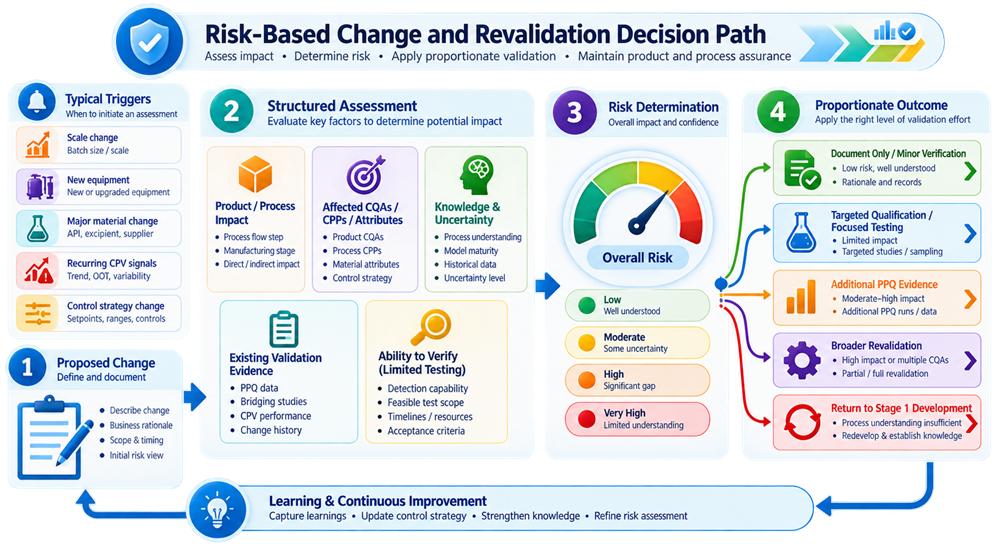
Changes are one of the most important lifecycle applications of QRM. ICH Q10 states that proposed changes should be evaluated using QRM and that the level of effort and formality should be commensurate with risk. After implementation, the change should also be evaluated to confirm that its objectives were achieved and that there was no detrimental effect on product quality.
A validation change assessment should evaluate what is changing, which process knowledge remains applicable, what failure mechanisms could be introduced or altered, which controls are affected, what uncertainty increases, and what verification is needed before and after implementation.
The question should not simply be “Does this change affect validation?” Nearly every meaningful manufacturing change has some relationship to the validated state. The useful question is what evidence is needed to maintain justified confidence after the change.
Risk-Based Revalidation Decisions
Revalidation is not automatically required for every change, deviation, or CPV signal. The extent of additional validation should reflect the effect of the new information on existing process understanding and evidence.
A well-understood change with limited impact and strong supporting data may require documented assessment and targeted verification. A change affecting commercial scale, process mechanism, critical equipment functionality, material-process relationships, control strategy, or multiple CQAs may require more extensive qualification or PPQ. An investigation showing that the original process model is materially incorrect can require return to Stage 1 development work.
Process Change Control, Revalidation, and Lifecycle Management addresses these decisions in detail.
Risk Acceptance and Validation Decisions
Risk acceptance should be explicit when it affects important validation decisions. The justification should explain what residual risk remains, why it is acceptable, what evidence supports the conclusion, and whether additional monitoring or follow-up is required.
The decision may be embedded in a PPQ report, deviation investigation, CPV assessment, change control, validation-impact assessment, or dedicated QRM record depending on the issue and level of formality. What matters is that the logic remains reconstructable.
Statements such as “risk acceptable” without explaining the evidence, assumptions, and controls provide weak lifecycle knowledge and make future reassessment difficult.
Risk Records Should Remain Connected to Evidence
QRM should not become an isolated documentation stream. Validation risk decisions should remain connected to the development studies, process-characterization data, qualification evidence, deviations, statistical analyses, CAPA, change records, and monitoring data that support them.
A useful lifecycle trace is:
Risk question → Evidence → Risk assessment → Control / decision → Verification → Monitoring → New evidence → Risk review
This structure prevents risk assessments from becoming static snapshots disconnected from the actual validated process.
QRM Tools
Different tools can be appropriate for different questions. FMEA or FMECA may help organize failure modes, preliminary hazard analysis can be useful when information is limited, fault trees can explore causal combinations, HACCP-type approaches can focus on preventive controls, and ranking/filtering tools can help prioritize large groups of issues.
ICH Q9(R1) specifically allows QRM methods and statistical tools to be used in combination and states that tool selection should provide flexibility appropriate to the issue.
The preferred tool is therefore the one that improves the decision. A detailed FMEA should not be required when a simple structured assessment provides adequate control, and a simple matrix should not be used for a highly uncertain, complex, high-impact validation decision merely because it is easier to complete.
Lifecycle Application of QRM
| Validation stage or activity | Primary QRM purpose | Typical outputs |
|---|---|---|
| Stage 1 Process Design | Focus knowledge generation and reduce development uncertainty | Study priorities, risk controls, operating strategy, unresolved questions |
| Control-strategy development | Determine how identified risks will be controlled | Material, process, IPC, automation, procedural and monitoring controls |
| PPQ readiness | Determine whether sufficient knowledge exists to enter qualification | Readiness decision, residual risks, PPQ objectives |
| PPQ strategy | Determine the strength and representativeness of required evidence | Batch strategy, sampling, statistical approach, challenging conditions |
| PPQ execution | Evaluate unexpected events and effect on qualification confidence | Deviation impact, additional testing/batches, CAPA |
| CPV | Detect changes in risk using commercial evidence | Alerts, investigations, risk updates, monitoring changes |
| Change control | Evaluate potential impact before implementation | Validation-impact assessment, verification or revalidation strategy |
| Post-change review | Confirm that change objectives were achieved without unintended effects | Effectiveness evidence, updated risk and monitoring |
| Periodic risk review | Reassess conclusions using accumulated knowledge | Revised risk acceptance, controls, monitoring or validation strategy |
Management Review and Governance
ICH Q10 positions QRM and knowledge management as lifecycle enablers and expects the pharmaceutical quality system to integrate process monitoring, CAPA, change management, and management review. Significant validation risks should therefore be visible to the management processes responsible for resources and lifecycle decisions.
Management review need not examine every individual risk worksheet. It should identify whether major unresolved risks exist, whether controls remain effective, whether repeated signals indicate broader process weakness, whether significant changes have appropriate validation support, and whether sufficient resources are available to resolve important uncertainty.
This converts QRM from a validation-document requirement into an operating part of the pharmaceutical quality system.
Key Principles
- QRM applies across the complete process-validation lifecycle, not only during Stage 1 risk assessment.
- The detailed identification of CQAs, CMAs, process parameters, and CPP criticality belongs principally in CQA, CPP, and Material Attribute Risk Assessment; this article uses those outputs to support broader lifecycle decisions.
- ICH Q9(R1) defines QRM around risk assessment, risk control, risk communication, and risk review.
- Risk decisions should be based on science, evidence, and current knowledge and ultimately linked to patient protection.
- Risk scores are decision aids rather than substitutes for scientific reasoning.
- Uncertainty is itself important; weak knowledge should not be hidden behind precise-looking numerical ratings.
- Higher uncertainty, importance, or complexity can justify greater QRM formality.
- QRM cannot be used to justify practices that would otherwise be unacceptable under regulation or guidance.
- Stage 1 QRM should guide characterization, scale-up, control-strategy development, and reduction of important knowledge gaps.
- PPQ risk assessment should determine what evidence is needed to establish commercial-scale confidence rather than apply arbitrary formulas.
- CPV provides new evidence that can increase or reduce previously assessed risk.
- Risk assessments should be reviewed when new knowledge, investigations, trends, changes, or other significant events affect their assumptions.
- Risk-based change assessment should determine the appropriate amount of verification or revalidation rather than automatically requiring or dismissing revalidation.
- Risk acceptance should identify the residual risk, supporting evidence, and required follow-up.
- QRM outputs should feed validation planning, control strategy, PPQ, CPV, change control, CAPA, and management review rather than remain isolated documents.