
Process Validation Documentation and Traceability
Process validation documentation should provide more than a collection of approved protocols and reports. It should preserve the lifecycle evidence trail showing how process knowledge was developed, how risks and controls were defined, how commercial performance was confirmed, how continued performance is monitored, and how later changes affect the validated state.
FDA’s states that documentation at each stage of the process-validation lifecycle is essential for effective communication in complex, multidisciplinary projects. FDA specifically links documentation with making process knowledge accessible and understandable so that responsible functions can make informed, science-based decisions.
This article therefore focuses on the architecture, relationships, and traceability of validation evidence. Detailed expectations for contemporaneous entries, raw-data integrity, corrections, metadata, excluded data, and GDP during execution are addressed in Data Integrity and Good Documentation Practices in Process Validation. Likewise, detailed change-control and revalidation decision processes belong in Process Change Control, Revalidation, and Lifecycle Management.
Validation Documentation Is Lifecycle Evidence
Traditional validation files were often organized around individual protocols: execute the protocol, approve the report, place the package in the archive, and move on. The FDA lifecycle model requires a broader view because evidence generated during development, PPQ, and commercial manufacturing remains relevant to later validation decisions.
The documentation system should make it possible to follow the development of process understanding from Stage 1 into PPQ, determine how PPQ conclusions were reached, identify assumptions carried into CPV, and then trace how commercial evidence, deviations, CAPA, and changes affected the validated state.
ICH Q10 similarly treats knowledge management as a lifecycle activity and identifies development studies, process-validation studies, commercial manufacturing experience, continual improvement, and change management as sources of product and process knowledge.
The validation record should therefore preserve not merely what documents exist, but how they support one another.
Validation Strategy
The documentation hierarchy should begin with a clearly defined validation strategy. Depending on the organization and product, that strategy may be contained in a validation master plan, product-specific validation plan, process-validation strategy, or another controlled document.
The strategy should establish the scope of validation, lifecycle approach, organizational responsibilities, principal validation deliverables, relationship with facility and equipment qualification, intended approach to Stage 1 evidence, PPQ, CPV, change management, and applicable quality-system controls.
Its purpose is not to reproduce the content of every subordinate protocol. It should provide the framework explaining how the organization intends to establish and maintain validation evidence for the process.
A good strategy also makes important boundaries clear. Equipment qualification, analytical-method validation, cleaning validation, computerized-system validation, and other supporting disciplines can provide necessary evidence without becoming part of the process-validation protocol itself.
Lifecycle Documentation Architecture
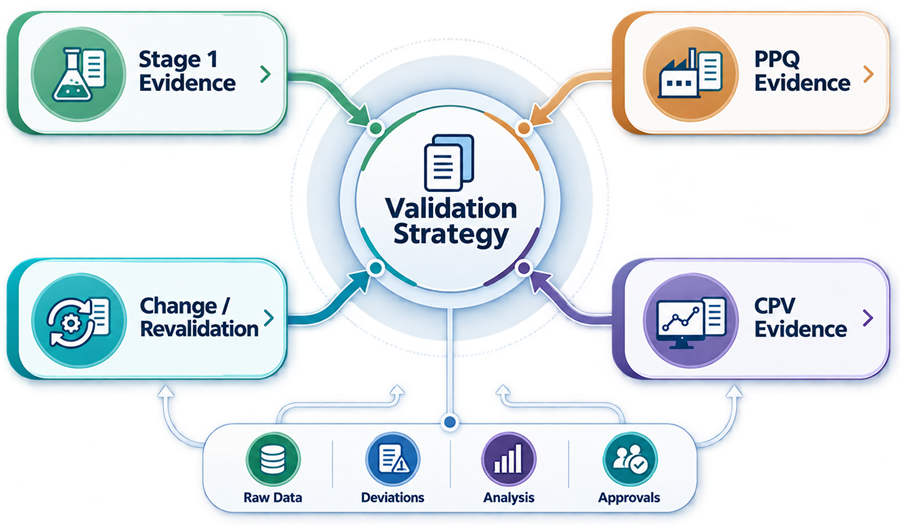
The principal documentation packages should remain connected as the process moves from design into commercial operation:
Validation strategy → Stage 1 evidence → PPQ package → CPV evidence → lifecycle changes → continued state-of-control evidence
Each stage produces different information, but later decisions depend on earlier evidence. A PPQ protocol should therefore trace to Stage 1 process understanding and control-strategy decisions. CPV plans should trace to PPQ conclusions and residual uncertainties. Change assessments should trace back to the evidence supporting the current validated process.
Stage 1 Evidence
Stage 1 documentation should preserve the scientific basis for the commercial process that will later be qualified. Relevant records can include development reports, process-characterization studies, DOE results, scale-up studies, material studies, hold-time evaluations, process models, risk assessments, and control-strategy development.
FDA’s lifecycle guidance recognizes that documentation requirements differ by stage, but it still emphasizes documenting development information sufficiently so that process knowledge remains accessible and understandable.
The objective is not to convert every laboratory notebook or development experiment into a formal validation protocol. Instead, the validation documentation system should identify which development evidence materially supports commercial process decisions.
For example, if an operating range used during PPQ was established through a characterization study, the PPQ strategy should be able to reference that study. If a particular raw-material attribute was identified as a significant source of variability, the relevant risk assessment and development evidence should remain traceable.
Detailed development activities are addressed in Process Characterization and Development Studies for Process Validation and Design of Experiments for Process Characterization and Validation.
Risk Assessments
Risk assessments often connect several levels of validation documentation. A Stage 1 risk assessment may identify important material attributes or process uncertainties; the PPQ strategy can then use those findings to define sampling, testing, or challenging conditions; CPV may later determine whether the original risk assumptions remain valid.
The risk record should therefore not become an isolated spreadsheet referenced only during initial approval. Significant risk conclusions should remain connected to the controls, tests, monitoring activities, and lifecycle decisions they influenced.
Quality Risk Management in Process Validation addresses the methodology for evaluating and reviewing risk. This article focuses on maintaining the resulting risk decisions within the validation evidence trail.
A reviewer should be able to determine: Risk identified → evidence evaluated → control selected → validation activity performed → result obtained → residual risk accepted or further action required
That relationship is often more valuable than the numerical risk score itself.
Control-Strategy Evidence
The documentation structure should also preserve how the process control strategy was established and later maintained.
Initial control-strategy development is covered in Process Control Strategy and Design Space Development, while Process Control Strategy Lifecycle Management addresses its continued maintenance. The documentation architecture should connect those two activities.
For example, a CPP range established during Stage 1 may be confirmed during PPQ, monitored during CPV, and later revised through change control. The lifecycle record should make that sequence understandable without requiring an investigator to search through unrelated repositories.
PPQ Documentation Package
Stage 2 generally requires the most formal and concentrated process-validation documentation. FDA specifically notes that documentation expectations are greatest during Process Qualification and Continued Process Verification and that these stages operate under CGMP requirements and Quality Unit oversight.
A PPQ evidence package normally includes the approved PPQ protocol and associated approvals, batch-selection rationale, sampling strategy, statistical plan, relevant manufacturing records, source data references, test results, deviations, investigations, protocol amendments where applicable, statistical evaluations, and the final PPQ report.
The package should also identify evidence that exists outside the validation file. For example, complete batch records, laboratory raw data, automation records, or historian data may remain in their authoritative systems rather than being copied into the PPQ report.
The key requirement is traceability, not duplication.
PPQ Protocol
The approved PPQ protocol defines the prospective plan for generating qualification evidence. FDA expects the protocol to describe the manufacturing conditions being evaluated, data to be collected, tests to be performed, acceptance criteria, sampling plan, and statistical methods used to evaluate the data.
The protocol should trace to the process understanding and control strategy that justify those activities. It should not appear as an independent testing exercise developed without reference to Stage 1.
Where protocol requirements originate from a risk assessment, characterization study, control-strategy decision, or regulatory commitment, those relationships should be identifiable either directly in the protocol or through supporting traceability documentation.
Executed PPQ Evidence
Execution produces substantially more evidence than the approved protocol itself. The documentation system should preserve links to actual batch records, equipment records, process data, sampling records, laboratory data, statistical datasets, deviations, and other execution evidence.
Detailed data-integrity requirements are addressed in Data Integrity and Good Documentation Practices in Process Validation. From a documentation-architecture perspective, the important question is whether each material PPQ conclusion can be traced back to its supporting evidence.
The validation package should therefore distinguish among:
- controlled source records;
- summarized data reproduced in the protocol or report;
- calculations and statistical analyses;
- deviations and investigations; and
- final conclusions.
A summary table should never become an unexplained endpoint disconnected from the source evidence used to create it.
PPQ Deviations and Investigations
PPQ deviations are part of the validation evidence and should remain connected to both protocol execution and the final validation conclusion.
21 CFR 211.192 requires investigation of unexplained discrepancies and specification failures, including documented conclusions and follow-up. For validation, the investigation should also address whether the event affects the representativeness or validity of the qualification evidence.
A useful trace is:
Protocol step → deviation → investigation → impact assessment → corrective action → report conclusion
The detailed scientific evaluation is covered in PPQ Deviations, Investigation, and Validation Conclusion. The documentation framework should ensure that the investigation cannot be separated from the PPQ conclusion it influenced.
PPQ Report
The PPQ report should reconcile the complete execution package and explain why the accumulated evidence supports—or does not support—the validation conclusion.
The report should reference the protocol, batches evaluated, acceptance criteria, deviations, statistical analyses, significant exclusions, relevant supporting records, and unresolved limitations. It should distinguish batch disposition from the broader process-validation conclusion where those decisions differ.
For APIs, FDA’s Q7 guidance similarly states that a validation report should cross-reference the protocol, summarize results, comment on deviations, and draw appropriate conclusions.
The report should therefore function as a reasoned synthesis of the evidence, not merely a list of passed protocol sections.
Raw Data and Supporting Records
The documentation system should clearly identify where authoritative raw data reside. This is particularly important when process validation depends on large electronic datasets, laboratory systems, historians, automation records, or external testing records.
It is generally unnecessary to duplicate all source records into the validation package. Doing so can create additional document-control and reconciliation problems. Instead, the validation file should provide reliable references that allow the source record to be retrieved and linked to the corresponding validation requirement or analysis.
This relationship can be represented as: Validation requirement → supporting source record → evaluated result → validation conclusion
That approach supports both traceability and efficient inspection response.
Statistical Evidence
Statistical analyses should also remain connected to their underlying datasets and validation objectives. The final validation report may contain only selected charts and summary statistics, but the analysis should be traceable to the approved statistical plan, authoritative source data, analysis dataset, applicable assumptions, and final interpretation.
Sampling and Statistical Strategy for Process Validation establishes the cross-lifecycle statistical governance framework. PPQ Acceptance Criteria and Statistical Evaluation addresses detailed PPQ evaluation.
The documentation architecture should connect those statistical activities to the actual validation decision rather than retaining them as isolated analyst files.
Approval Relationships
Validation documentation typically requires several different forms of review and approval. Technical functions may confirm scientific content and execution, Manufacturing may verify operational accuracy, Validation may evaluate protocol compliance, and Quality provides independent oversight.
The document system should clearly indicate what was approved and at what stage. Approval of the validation strategy is different from approval of a PPQ protocol, execution deviation, statistical analysis, or final PPQ conclusion.
21 CFR 211.22 assigns the Quality Control Unit responsibility and authority to approve or reject procedures and records affecting drug-product quality. FDA’s validation guidance also specifically identifies Quality Unit approval as an important component of Stage 2 and Stage 3 documentation.
Approval history should therefore remain visible as part of the lifecycle evidence.
Traceability Is More Than a Matrix
Traceability in process validation is the ability to follow a validation decision back through the evidence that supports it. A formal traceability matrix can be useful, particularly for complex processes, but traceability does not depend on one prescribed document format. It can also be achieved through controlled document relationships, cross-references, validation plans, protocols, reports, risk assessments, and lifecycle records when those relationships are clear and consistently maintained.
The objective is to make the validation logic reconstructable. For each significant requirement or validation question, the organization should be able to identify the scientific or regulatory basis, locate the supporting evidence, understand how that evidence was evaluated, and determine what decision resulted. The following table illustrates how those relationships can be maintained across the process-validation lifecycle.
| Validation question / requirement | Source evidence | Evaluation | Result / decision |
|---|---|---|---|
| Commercial process adequately defined | Stage 1 reports, process-characterization studies, development data, control strategy | Development and risk review | Commercial process definition approved |
| PPQ demonstrates reproducible commercial performance | PPQ protocol, executed batch records, sampling records, laboratory and process data | Statistical and technical evaluation | PPQ conclusion established |
| Control strategy performs as intended | CPP, IPC, material-attribute and CQA results; alarms and process responses where relevant | Integrated PPQ assessment | Control strategy confirmed or follow-up actions defined |
| Process remains in a state of control | CPV data, statistical trends, deviations, OOT signals, capability or performance information | Periodic state-of-control assessment | Continue routine monitoring, investigate, or escalate |
| Process change remains acceptable | Change record, validation-impact assessment, risk assessment, verification data | Technical and validation-impact review | Maintain validated baseline, perform targeted verification, or revalidate |
| Revalidation supports the revised process | Qualification or PPQ evidence, updated risk assessment, post-change monitoring | Technical and Quality review | Revised validated baseline approved |
This type of table is not intended to duplicate the underlying records. Its value is to provide a clear map from the validation question to the authoritative evidence and resulting decision. For smaller or less complex processes, equivalent traceability may be achieved through well-designed cross-references within the validation strategy, protocols, reports, CPV documentation, and change records.
The important requirement is continuity of evidence. A reviewer should be able to move from a validation conclusion back to the applicable requirement, source data, analysis, deviations, and approvals without relying on undocumented knowledge or extensive manual reconstruction.
CPV Documentation
Validation documentation does not end with PPQ approval. Stage 3 requires ongoing evidence that the process remains in a state of control.
The CPV documentation structure can include the approved monitoring plan, parameter and attribute definitions, sampling or data-acquisition strategy, statistical methods, alert or escalation rules, periodic CPV reports, investigations, CAPA, and state-of-control conclusions.
FDA describes Stage 3 as continued assurance during routine production and recommends ongoing collection and statistical trending of relevant process and product data.
Continued Process Verification (CPV) Program and Monitoring Strategy addresses how the program operates, while Continued Process Verification Reporting and State-of-Control Assessment addresses formal integration of monitoring evidence into the process-status conclusion.
This article focuses on ensuring that those Stage 3 records remain connected to the PPQ baseline they are intended to verify.
CPV Plans and PPQ Conclusions
A CPV plan should not appear disconnected from the PPQ report. The monitoring strategy should reflect known sources of variability, residual risks, PPQ findings, control-strategy elements, and any areas requiring heightened early monitoring.
For example, if PPQ identified greater-than-expected variability in one process response but still demonstrated acceptable control, the CPV plan might intentionally monitor that response more closely. The lifecycle documentation should preserve why that enhanced monitoring was selected.
As evidence accumulates, the CPV strategy may change. The basis for reducing, increasing, or redirecting monitoring should remain documented so that later reviewers understand how the program evolved.
CPV Reports
CPV reports should reference the data period evaluated, monitored parameters and attributes, significant trends, statistical analyses, deviations, changes, CAPA, and the resulting state-of-control assessment.
A periodic report should not merely repeat numerical trends. It should record the validation interpretation of those trends.
This creates another lifecycle trace: PPQ baseline → CPV monitoring → emerging evidence → investigation or action → updated state-of-control conclusion
That trace becomes particularly important when later changes or revalidation decisions are evaluated.
Change Records
Changes can affect both the validated process and the evidence used to support it. ICH Q10 expects an effective change-management system to evaluate proposed changes using current product and process understanding and to assess after implementation whether the intended objectives were achieved without detrimental effect on product quality.
The process-validation documentation system should therefore link important change records to the affected validation evidence. A validation-relevant change record may reference:
- the affected process or control;
- existing validation evidence;
- risk or impact assessment;
- required verification;
- regulatory assessment where applicable;
- implementation records;
- post-change monitoring;
- effectiveness evaluation; and
- revalidation evidence where required.
Detailed change governance belongs in Process Change Control, Revalidation, and Lifecycle Management.
Revalidation Evidence
Revalidation should not create a second disconnected history of the process. New qualification or PPQ evidence should remain linked to the baseline that preceded the change.
The documentation should identify what changed, which original validation evidence remains applicable, which evidence was superseded, what additional testing or qualification was performed, and what new baseline resulted.
This is especially important for partial or targeted revalidation. Without clear traceability, later reviewers may be unable to determine whether an older PPQ report remains valid for portions of the process or has been completely replaced.
A useful lifecycle structure is:
Original validated baseline → change → impact assessment → targeted evidence or revalidation → effectiveness verification → revised validated baseline
Superseded Versus Historical Evidence
Superseded validation documents should normally remain available as historical evidence. Replacing a protocol, specification, control strategy, or CPV plan does not eliminate the need to understand what was previously approved.
The documentation system should distinguish between current effective documents and historical evidence.
This distinction supports investigations, retrospective trend analysis, change assessment, and inspection reconstruction. It also prevents an important error: assuming that the latest version of a document accurately represents the process conditions under which an older validation study was performed.
Version history is therefore part of validation traceability.
Document Relationships
A mature validation system should make document relationships visible without requiring detailed institutional knowledge.
Typical relationships include:
- Validation strategy → Stage 1 reports
- Stage 1 reports → risk assessments and control strategy
- Risk assessments → PPQ strategy and sampling
- PPQ protocol → execution data and deviations
- Execution evidence → PPQ report
- PPQ report → CPV plan
- CPV findings → investigations and CAPA
- Changes → validation impact and verification
- Revalidation → revised baseline
The specific document names may differ among organizations. The important element is continuity of evidence.
Document Indexing
Complex process-validation programs benefit from a controlled document index or evidence map. The index can identify the document title, identifier, version, status, owner, applicable lifecycle stage, repository, and principal relationships to other validation evidence.
An index is particularly useful when evidence is distributed among a document-management system, laboratory system, manufacturing system, statistical repository, deviation system, and change-control system.
The index should not become another manually maintained database that is consistently out of date. Its complexity should be proportionate to the process and documentation architecture.
For smaller validation programs, well-controlled cross-references within the validation plan and reports may provide adequate traceability.
Retention and Accessibility
Process-validation documentation should remain available for the required retention period and accessible for review.
21 CFR 211.180 establishes record-retention and availability requirements for production, control, and laboratory records. For validation, the practical implication is that references within a validation report should point to controlled records that remain retrievable.
A source-data reference to an uncontrolled shared folder, analyst desktop, obsolete system location, or temporary network directory is not a reliable lifecycle relationship.
The documentation strategy should therefore account for retention when deciding how validation evidence is referenced.
Inspection-Ready Reconstruction
One of the strongest tests of a validation documentation system is whether a technically qualified person who did not participate in the original work can reconstruct the basis of the validation decision.
For a PPQ conclusion, that reviewer should be able to determine why the qualification was performed, how batches were selected, what acceptance criteria were established, what data were collected, where the authoritative data reside, what deviations occurred, how analyses were performed, and why the final conclusion was approved.
For an older process, the reviewer should also be able to determine what happened afterward: whether significant changes occurred, whether CPV remained acceptable, whether revalidation was performed, and what documentation currently defines the validated process.
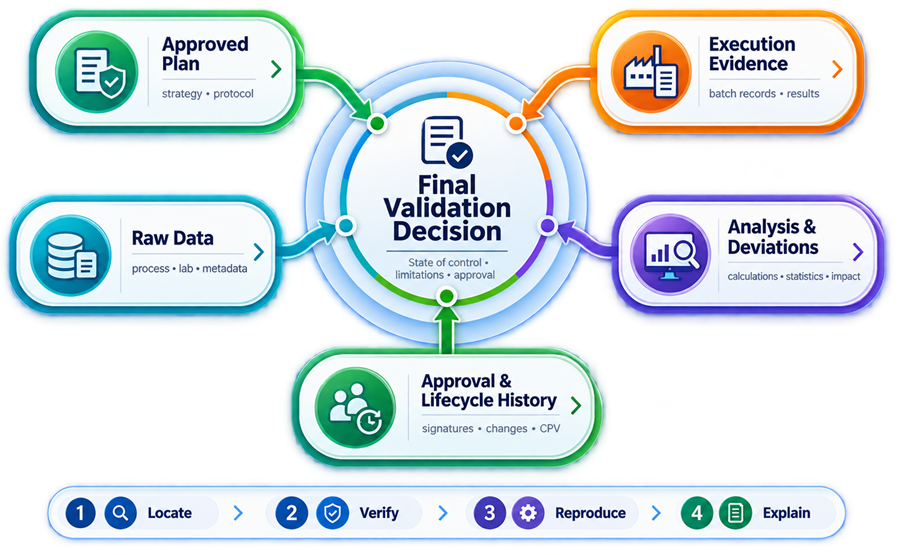
FDA’s validation guidance emphasizes accessibility and transparency of lifecycle knowledge specifically because multiple functions must be able to make informed decisions from the accumulated evidence.
Inspection Questions the Documentation Should Answer
A well-structured validation record should allow straightforward answers to questions such as:
- What is the current validated process?
- What Stage 1 evidence established the process and control strategy?
- Why were the PPQ batches and sampling plan considered adequate?
- Where are the raw data supporting the PPQ report?
- What deviations occurred and how did they affect the validation conclusion?
- Who approved the qualification and on what evidence?
- What CPV evidence demonstrates continued control?
- What significant changes occurred after PPQ?
- What verification or revalidation supported those changes?
- What documentation defines the current validated baseline?
If these questions require extensive reconstruction from personal memory, disconnected email, or uncontrolled spreadsheets, the documentation architecture is weaker than it should be.
Reconstruction Should Follow Decisions, Not Just Dates
A chronological document list can be useful, but inspection-ready reconstruction should focus on decision pathways.
For example, an investigator asking why a process range was widened may need to follow characterization data, risk assessment, change control, targeted qualification, updated control strategy, and subsequent CPV evidence. Those documents may have been generated over several years.
The documentation system should make that relationship visible even though the records were not produced in one validation campaign.
This is one reason lifecycle traceability is more important than simply maintaining a complete archive.
Validation Summary Documents
For complex or mature processes, a lifecycle validation summary can be useful. It can provide a concise description of the original validation basis, major PPQ conclusions, significant process changes, revalidation history, current CPV status, and outstanding lifecycle risks.
Such a summary should not replace source evidence. Its purpose is to provide a map to that evidence.
A lifecycle summary is particularly useful where multiple partial revalidations, major changes, manufacturing transfers, or long commercial histories make the current validated baseline difficult to infer from individual reports.
Avoiding Documentation Duplication
Traceability does not require copying every source document into every validation package. Excessive duplication can create multiple uncontrolled versions of the same evidence and make later reconciliation more difficult.
Instead, validation documentation should rely on authoritative records and controlled references.
For example, a PPQ report can reference approved laboratory results maintained in the laboratory system, batch records maintained in the manufacturing record system, and deviation investigations maintained in the quality system. The validation report should reproduce only the information needed to explain the validation conclusion.
This approach is both more efficient and more defensible when the source repositories are appropriately controlled.
Documentation and Data Integrity
Documentation architecture and data integrity are closely related but not identical.
Data Integrity and Good Documentation Practices in Process Validation addresses whether individual records are attributable, contemporaneous, complete, accurate, correctly corrected, and appropriately retained with metadata.
Process Validation Documentation and Traceability addresses whether those records are organized and linked in a way that supports the lifecycle validation decision.
A perfectly documented individual test result provides limited value if no one can determine which validation requirement it supports. Conversely, a beautiful traceability matrix cannot compensate for unreliable source data. Both controls are necessary.
Documentation and Knowledge Management
ICH Q10 identifies knowledge management as a systematic approach to acquiring, analyzing, storing, and disseminating information throughout the product lifecycle and specifically recognizes process-validation studies, manufacturing experience, continual improvement, and change management as sources of knowledge.
Validation documentation is one of the principal mechanisms through which that knowledge becomes durable organizational evidence.
The documentation system should therefore preserve not only successful validation results but also important limitations, assumptions, failed studies, deviations, and lessons that influence future lifecycle decisions.
A validation history that records only successful conclusions can lose precisely the knowledge needed to manage future changes safely.
Key Principles
- Process-validation documentation should operate as a connected lifecycle evidence system, not as isolated protocol packages.
- The validation strategy should define the overall documentation and evidence framework before PPQ execution begins.
- Stage 1 development studies, risk assessments, and control-strategy decisions should remain traceable into PPQ planning and acceptance decisions.
- PPQ protocols, execution records, raw data, deviations, analyses, and final reports should remain linked without unnecessary duplication of authoritative source records.
- The PPQ report should explain how the complete evidence supports the validation conclusion and identify significant limitations or unresolved lifecycle actions.
- CPV plans and reports should remain connected to the PPQ baseline and document how accumulated commercial evidence affects the state-of-control conclusion.
- Significant changes should remain traceable to existing validation evidence, impact assessments, verification activities, and any resulting revalidation.
- Historical and superseded validation evidence should remain identifiable so that the process conditions and decisions applicable at a particular point in time can be reconstructed.
- Traceability should connect the scientific or regulatory requirement to source evidence, analysis, result, approval, and final validation decision.
- Inspection-ready documentation should allow an independent reviewer to reconstruct why the process was considered validated and why it remains in a state of control.