

General Principles of Process Validation
Process validation is the collection and evaluation of data from process design through commercial production that establishes scientific evidence that a manufacturing process can consistently deliver quality product. It is a lifecycle activity rather than a single protocol, study, or group of qualification batches.
The lifecycle connects process development, qualification of the commercial process, and ongoing verification during routine manufacturing. Effective validation therefore depends on process understanding, control of variability, qualified supporting systems, an appropriate control strategy, reliable data, and continued evaluation of process performance.
FDA’s lifecycle approach provides the primary framework for these activities in U.S. pharmaceutical manufacturing. FDA’s Process Validation: General Principles and Practices establishes this lifecycle model and organizes process validation into Process Design, Process Qualification, and Continued Process Verification.
Purpose and Scope of Process Validation
The purpose of process validation is to establish and maintain a high degree of assurance that a manufacturing process can consistently produce material and finished product meeting predetermined quality requirements.
Validation does not mean proving that every future batch will be acceptable. It means developing sufficient process knowledge, establishing effective controls, demonstrating reproducible commercial performance, and maintaining objective evidence that the process remains in a state of control.
Process validation should therefore address the complete manufacturing process and the factors capable of influencing its performance, including materials, equipment, process parameters, measurement systems, procedures, personnel, and the interactions among them.
The underlying regulatory principle is reflected in 21 CFR 211.100 and 211.110: manufacturing processes and controls must be designed and implemented to assure that drug products have the identity, strength, quality, and purity they are represented to possess. FDA’s process validation guidance translates these CGMP principles into a lifecycle approach.
For a more detailed regulatory treatment, see Regulatory Requirements and FDA Expectations for Process Validation.
The Three-Stage Process Validation Lifecycle
FDA organizes process validation into three connected stages:
- Stage 1 – Process Design: The commercial manufacturing process is defined based on knowledge obtained through development, characterization, scale-up, and process understanding.
- Stage 2 – Process Qualification: The process design is evaluated to determine whether it is capable of reproducible commercial manufacturing. This includes qualification of supporting facilities, utilities, and equipment and execution of Process Performance Qualification (PPQ).
- Stage 3 – Continued Process Verification: Ongoing manufacturing data are evaluated to provide continued assurance that the process remains in a state of control.
These stages should not operate as isolated validation exercises. Knowledge generated during PPQ and routine manufacturing should feed back into process understanding, risk assessment, monitoring, and the control strategy.
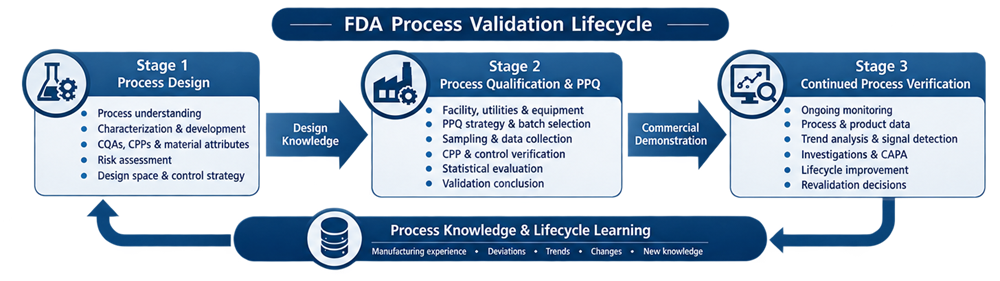
Stage 1 – Process Design
During Process Design, development and characterization knowledge is used to define the proposed commercial manufacturing process.
Stage 1 should establish sufficient understanding of:
- product Critical Quality Attributes (CQAs);
- material attributes that can affect process performance or product quality;
- process parameters and their relationships to product quality;
- Critical Process Parameters (CPPs), where applicable;
- sources and magnitude of process variability;
- parameter interactions;
- operating ranges;
- scale-dependent effects;
- process robustness; and
- the controls needed to manage identified risks.
ICH Q8(R2) specifically connects pharmaceutical development with process understanding, material attributes, process parameters, design space, control strategy, risk management, and lifecycle improvement.
See Process Characterization and Development Studies for the detailed Stage 1 approach.
Stage 2 – Process Qualification and PPQ
Stage 2 evaluates whether the process design is capable of reproducible commercial manufacturing.
An important distinction is that Process Qualification is broader than PPQ. FDA Stage 2 includes qualification of the facility, utilities, and equipment as well as PPQ of the commercial manufacturing process.
PPQ brings together:
- specified materials;
- qualified facilities, utilities, and equipment;
- approved manufacturing procedures;
- trained personnel;
- appropriate analytical methods;
- the established process control strategy;
- defined commercial manufacturing conditions; and
- enhanced sampling and monitoring appropriate to the process.
The PPQ protocol should establish the study design, batches, sampling, data collection, acceptance criteria, statistical evaluation, deviation handling, and requirements for reaching a validation conclusion.
FDA does not prescribe a universal minimum of three PPQ batches. The number of batches must be supported by a scientifically sound rationale appropriate to the process and available knowledge.
See PPQ Strategy and Batch Selection for detailed Stage 2 planning, PPQ batch selection, and justification of the number of PPQ batches.
Stage 3 – Continued Process Verification
Successful PPQ does not end process validation. Continued Process Verification (CPV) uses data from routine commercial manufacturing to determine whether the process continues to perform as expected.
The monitoring program may include:
- CPPs and other meaningful process parameters;
- CQAs and relevant in-process attributes;
- material attributes;
- intra-batch variability;
- inter-batch variability;
- yield and process-loss data;
- statistical trends and signals;
- process capability or performance measures where appropriate;
- deviations and investigations; and
- other indicators of changing process behavior.
The purpose is not simply to generate trend reports. CPV should detect meaningful changes in process performance and provide evidence for investigation, corrective action, process improvement, control-strategy adjustment, or revalidation where warranted.
FDA continues to emphasize ongoing monitoring of both intra-batch and inter-batch variation as part of maintaining a continuing state of control.
See Continued Process Verification (CPV) Program and Monitoring Strategy.
Process Variability and the State of Control
Understanding and controlling variability is one of the central principles of process validation. Potential sources include:
- raw materials and components;
- equipment performance;
- process parameters and operating conditions;
- analytical and measurement systems;
- personnel practices;
- environmental conditions;
- scale and batch-size effects; and
- interactions among these factors.
FDA expects a scientifically sound validation program to identify and control sources of variability that could affect process performance or product quality. Recent FDA enforcement language continues to emphasize identification and control of variability, suitability of equipment, reliability of process steps, PPQ, and ongoing monitoring.
Not every variation indicates loss of control. Manufacturing processes exhibit inherent variability. Validation must provide enough process understanding and monitoring capability to distinguish expected variation from meaningful shifts, trends, disturbances, or deterioration.
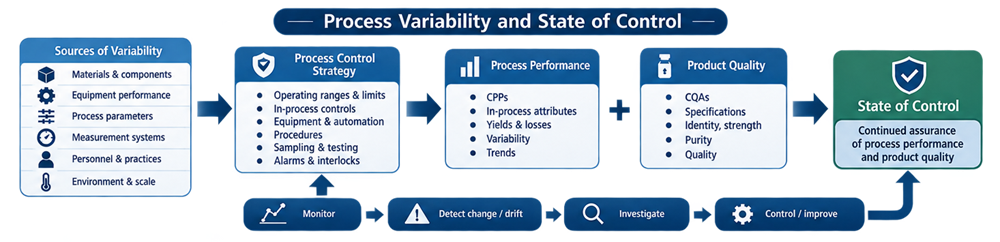
A process is not considered adequately controlled merely because individual finished-product batches meet specifications. Process data can reveal increasing variability or drift while finished-product results remain within specification.
The lifecycle objective is therefore continued assurance that the process is understood, appropriately controlled, and capable of delivering the intended product quality.
Process Understanding and the Control Strategy
Process validation depends on understanding the relationships among materials, process conditions, process performance, and product quality.
A useful conceptual relationship is:
Material Attributes → Process Parameters → Process Performance → Product Quality
This knowledge supports development of the process control strategy.
The control strategy may include:
- material specifications and supplier controls;
- process operating ranges;
- parameter limits;
- in-process controls;
- equipment and automation controls;
- alarms and interlocks;
- procedural controls;
- environmental controls;
- sampling and testing;
- monitoring requirements; and
- finished-product specifications.
ICH Q8(R2) identifies process understanding, design space, risk assessment, and control strategy as interconnected elements of pharmaceutical development.
The control strategy should also evolve as new knowledge becomes available. PPQ may identify commercial-scale behavior that was not fully apparent during development, while CPV may identify new sources of variability or gradual process changes.
See Process Control Strategy Lifecycle Management for the lifecycle management of established process controls.
Quality Risk Management in Process Validation
Quality Risk Management (QRM) provides a structured basis for determining where validation effort, control, monitoring, and evidence should be concentrated.
Risk-based validation does not mean arbitrarily reducing testing. It means using scientific knowledge, process understanding, uncertainty, and potential impact on product quality to determine an appropriate level of validation rigor.
Risk considerations can influence:
- development and characterization studies;
- evaluation of process parameters and material attributes;
- PPQ scope;
- sampling strategy;
- statistical methodology;
- acceptance criteria;
- monitoring intensity;
- investigation priorities;
- change-impact assessments; and
- revalidation decisions.
ICH Q9(R1) defines QRM as a systematic process for the assessment, control, communication, and review of risks to product quality across the lifecycle and establishes that the level of effort, formality, and documentation should be commensurate with risk.
See Quality Risk Management in Process Validation.
Equipment PQ Is Not Process Performance Qualification
The abbreviation PQ creates frequent confusion because Equipment Performance Qualification and Process Performance Qualification address different validation questions.
| Equipment Performance Qualification | Process Performance Qualification |
|---|---|
| Evaluates equipment or system performance | Evaluates the integrated manufacturing process |
| Focuses on functions and operating capability | Focuses on reproducible commercial process performance |
| Demonstrates equipment is fit for intended use | Demonstrates the process can consistently produce acceptable product |
| Normally precedes PPQ | Follows required facility, utility, and equipment qualification |
| May use defined challenges or simulations where appropriate | Uses the defined commercial process under intended manufacturing conditions |
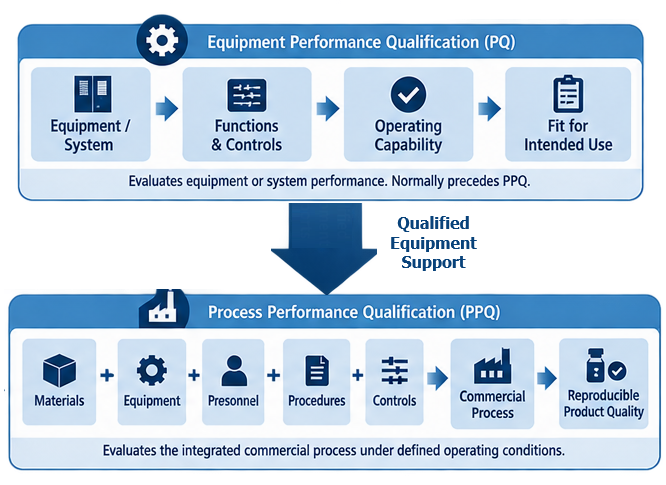
Qualified equipment supports PPQ, but equipment qualification does not demonstrate that the manufacturing process itself is validated. Conversely, PPQ should not be used to compensate for incomplete qualification of equipment, facilities, or utilities that are necessary to execute the process reliably.
PPQ Is Not the Entire Validation Program
Historically, process validation was sometimes reduced to successful completion of a predetermined number of consecutive batches. The lifecycle approach is fundamentally different.
Stage 1 establishes the process knowledge and controls on which PPQ depends. Stage 2 provides commercial-scale evidence that the process can operate reproducibly. Stage 3 then determines whether that performance continues during routine manufacturing.
FDA explicitly states that validation cannot be reduced to the simplistic formula of completing three successful full-scale batches. The lifecycle can therefore be summarized as:
Process Understanding → Process Design → Process Qualification and PPQ → Continued Process Verification → Lifecycle Learning and Control
PPQ is a critical validation milestone, but it is neither the beginning nor the end of process validation.
Validation Evidence Should Be Scientifically Justified
Validation decisions should be supported by evidence rather than convention. The required extent of evidence depends on factors such as:
- process complexity;
- product-quality and patient risk;
- process understanding;
- sources and magnitude of variability;
- development and scale-up knowledge;
- prior manufacturing experience;
- strength of the control strategy;
- reliability of measurement systems; and
- remaining uncertainty.
Statistical methods can support characterization of variability, sampling-plan development, PPQ evaluation, signal detection, and ongoing assessment of process performance.
The statistical method should fit the data and the decision being made. Validation should not be designed around a particular statistical calculation simply because it has historically been used.
Lifecycle Governance
Process validation requires governance that extends across all three lifecycle stages. Important controls include:
- quality risk management;
- control-strategy management;
- sampling and statistical governance;
- data integrity;
- good documentation practices;
- validation documentation and traceability;
- deviation and investigation management;
- CAPA;
- change control;
- knowledge management; and
- revalidation decisions.
ICH Q10 provides a lifecycle pharmaceutical quality-system framework incorporating process performance and product-quality monitoring, CAPA, change management, management review, and knowledge management.
Detailed documentation principles are addressed in Process Validation Documentation Structure.
Maintaining the Validated State
The validated state is maintained through accumulated lifecycle evidence rather than through the existence of an approved PPQ report. Relevant evidence can include:
- CPV results;
- routine process and product data;
- deviations and investigations;
- OOS and OOT trends;
- material and supplier performance;
- process-relevant equipment and utility performance;
- maintenance and calibration information;
- CAPA effectiveness;
- process changes;
- complaints and other relevant quality signals; and
- new process knowledge.
When this evidence indicates that assumptions established during development or PPQ may no longer be valid, the manufacturer should determine whether investigation, additional characterization, control-strategy modification, enhanced monitoring, qualification, or revalidation is necessary.
Knowledge should therefore move in both directions across the validation lifecycle. The existing Lifecycle Integration and Knowledge Management in Process Validation article addresses this feedback mechanism in greater detail.
Key Principles
- Process validation extends from process design through the commercial manufacturing lifecycle.
- Quality must be designed and controlled through the process rather than assured solely by finished-product testing.
- Stage 1 establishes process understanding and the commercial process design.
- Stage 2 includes qualification of supporting systems and PPQ of the commercial process.
- Stage 3 provides continuing evidence that the process remains in a state of control.
- Process understanding and control of variability are fundamental to validation.
- Validation scope and rigor should be scientifically justified and risk-informed.
- PPQ batch numbers require scientific rationale rather than reliance on a fixed three-batch convention.
- Equipment PQ and process PPQ are related but distinct.
- CPV results and manufacturing experience should feed back into process understanding and control.
- Changes must be evaluated for their potential effect on process knowledge, validation evidence, and the state of control.
- The validated state must be actively maintained throughout commercial manufacturing.
Regulatory and Technical References
FDA’s Process Validation: General Principles and Practices is the primary U.S. lifecycle process-validation guidance and establishes the Stage 1, Stage 2, and Stage 3 framework.
FDA’s CGMP Questions and Answers — Production and Process Controls clarifies, among other issues, that FDA does not specify a universal minimum number of process-validation batches.
ICH Q8(R2) — Pharmaceutical Development provides the supporting framework for pharmaceutical development, CQAs, material attributes, process parameters, design space, control strategy, and lifecycle process knowledge.
ICH Q9(R1) — Quality Risk Management establishes principles for risk-based quality decision-making across the product lifecycle.
ICH Q10 — Pharmaceutical Quality System provides the lifecycle quality-system framework supporting process-performance monitoring, change management, CAPA, knowledge management, and continual improvement.