

Regulatory Requirements and FDA Expectations for Process Validation
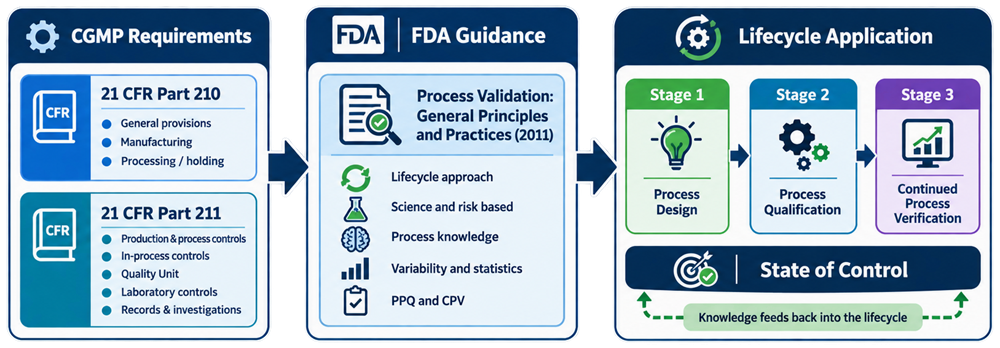
Process validation is a fundamental CGMP expectation for pharmaceutical manufacturing in the United States. The legal foundation is established principally through 21 CFR Parts 210 and 211, while FDA’s process validation guidance explains how the Agency expects manufacturers to apply those requirements through a science- and risk-based lifecycle approach.
FDA’s Process Validation: General Principles and Practices is the principal U.S. guidance for this lifecycle model. It describes process validation as an integrated program extending from process design and development through Process Qualification and continuing commercial monitoring. The guidance applies to human and animal drugs and biological products, including drug substances and active pharmaceutical ingredients within its stated scope.
A critical regulatory distinction should be maintained: 21 CFR establishes legally enforceable CGMP requirements; FDA guidance describes the Agency’s current thinking and recommended approaches for satisfying applicable requirements. FDA guidance itself does not create independently enforceable obligations unless specific statutory or regulatory requirements are cited.
For validation organizations, this means compliance should not be reduced to execution of a protocol or completion of a predetermined number of validation batches. The regulatory expectation is a documented body of scientific evidence demonstrating that the manufacturing process is appropriately designed, qualified, controlled, monitored, and maintained throughout its lifecycle.
Regulatory Foundation in 21 CFR Parts 210 and 211
21 CFR Part 210 establishes general CGMP provisions for manufacturing, processing, packing, and holding drugs, while Part 211 contains the detailed CGMP requirements applicable to finished pharmaceuticals.
Process validation is supported by multiple requirements within Part 211 rather than by a single regulation titled “process validation.” Several provisions are particularly important.
21 CFR 211.100 — Written Procedures and Process Control
21 CFR 211.100 requires written procedures for production and process control designed to assure that drug products have the identity, strength, quality, and purity they purport or are represented to possess.
This requirement establishes a fundamental connection between the defined manufacturing process, its approved operating procedures, and assurance of product quality.
Changes to these procedures must be drafted, reviewed, and approved by appropriate organizational units and reviewed and approved by the Quality Control Unit. Deviations from written procedures must also be recorded and justified. For validation purposes, this means that the qualified and validated process cannot exist independently from the approved procedures and controls used during routine manufacturing.
21 CFR 211.110 — Sampling and Testing of In-Process Materials and Drug Products
21 CFR 211.110 requires written procedures describing in-process controls and appropriate tests or examinations used to monitor output and validate the performance of manufacturing processes that may cause variability in the characteristics of in-process material and drug product.
This provision is particularly important because it directly connects process monitoring with process variability and validation.
Depending on the product and process, in-process controls may address characteristics such as adequacy of mixing, dissolution time, weight variation, disintegration, clarity, completeness of solutions, pH, bioburden, or other relevant attributes. Sampling plans and acceptance criteria should therefore be scientifically connected to the manufacturing process and the sources of variability being evaluated.
Other Relevant Part 211 Requirements
The process-validation program also interacts with requirements governing:
- responsibilities of the Quality Unit;
- buildings and facilities;
- equipment design, construction, maintenance, and cleaning;
- equipment calibration and checks;
- component and material controls;
- production and process controls;
- laboratory controls;
- batch production and control records;
- investigation of unexplained discrepancies and failures;
- record retention and review; and
- annual evaluation of product quality.
Process validation should therefore not be treated as an isolated validation-department activity. It depends on evidence generated across the pharmaceutical quality system.
FDA’s Lifecycle Approach to Process Validation
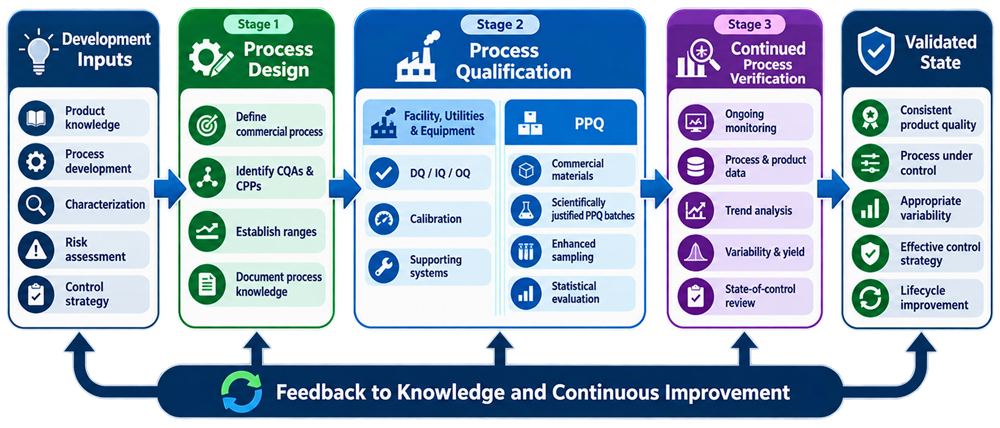
FDA’s 2011 process validation guidance replaced the older concept of validation as primarily a pre-commercial batch exercise with an explicit lifecycle approach. FDA organizes process validation into three stages:
Stage 1 — Process Design
The commercial manufacturing process is defined based on knowledge gained through development and scale-up activities.
Stage 2 — Process Qualification
The process design is evaluated to determine whether it is capable of reproducible commercial manufacturing.
Stage 3 — Continued Process Verification
Ongoing assurance is obtained during routine production that the process remains in a state of control.
These stages are interconnected rather than independent validation events. Information generated during commercial manufacturing should feed back into process knowledge, risk assessment, control strategy, change management, and future validation decisions. See General Principles of Process Validation for the overall lifecycle framework.
Stage 1 — Regulatory Expectations for Process Design
FDA expects manufacturing processes to be designed using knowledge obtained from product development and process-development activities. Process design should establish sufficient understanding of how material attributes, process parameters, equipment, operating conditions, and other variables affect product quality and process performance.
Stage 1 evidence may include:
- product and process development studies;
- process characterization;
- scale-up studies;
- identification and evaluation of Critical Quality Attributes (CQAs);
- evaluation of material attributes and process parameters;
- Design of Experiments (DOE), where appropriate;
- risk assessments;
- establishment of operating ranges;
- development of the process control strategy; and
- accumulated process knowledge supporting the proposed commercial process.
The objective is not to generate development documentation merely to support a validation protocol. The accumulated knowledge should provide the scientific basis for the commercial process and for the qualification strategy that follows.
See Process Characterization and Development Studies for Process Validation for the detailed Stage 1 approach.
Stage 2 — Process Qualification
FDA divides Process Qualification into two related elements:
- design and qualification of the facility, utilities, and equipment; and
- Process Performance Qualification (PPQ).
This distinction is important. Equipment Performance Qualification and process PPQ are not interchangeable.
Equipment and supporting systems must be demonstrated to be suitable for their intended use. PPQ then evaluates the integrated commercial manufacturing process using qualified facilities, utilities, equipment, trained personnel, approved procedures, commercial materials, and the established control strategy.
FDA describes successful Process Qualification as establishing a high degree of assurance that the process can reproducibly produce acceptable product under commercial manufacturing conditions.
Process Performance Qualification
PPQ represents a major evidentiary point in the validation lifecycle because the proposed commercial process is evaluated under defined commercial manufacturing conditions. A PPQ protocol should be scientifically justified and should define, as appropriate:
- manufacturing conditions;
- equipment and utilities;
- materials and components;
- batch size;
- operating parameters;
- significant process variables;
- sampling locations and frequencies;
- in-process tests;
- product-quality testing;
- statistical methods;
- acceptance criteria;
- deviation handling;
- data evaluation; and
- requirements for the final PPQ report and conclusion.
PPQ generally involves more intensive sampling, monitoring, and testing than routine commercial production because the objective is to demonstrate process reproducibility and characterize relevant variability.
The PPQ protocol should be approved before execution, and the final report should evaluate the actual results against the predefined strategy rather than simply document that batches were manufactured.
See Process Performance Qualification (PPQ) Strategy and Batch Selection for development of the PPQ strategy.
FDA Does Not Require a Universal Three-Batch Rule
One of the most persistent misconceptions in pharmaceutical validation is that FDA regulations universally require three successful validation batches. They do not.
FDA explicitly addresses this question in its CGMP Questions and Answers — Production and Process Controls. FDA states that neither CGMP regulations nor FDA policy specifies a minimum number of batches required to validate a manufacturing process. The manufacturer is expected to provide a sound rationale for the number of batches selected.
The number of PPQ batches should therefore be scientifically justified considering factors such as:
- process knowledge;
- development and scale-up experience;
- process complexity;
- process variability;
- product and patient risk;
- manufacturing experience;
- control-strategy effectiveness;
- equipment and process configuration;
- statistical confidence;
- available prior knowledge; and
- the amount and quality of evidence generated within each PPQ batch.
Three batches may still be appropriate for a particular process. The regulatory problem is not the use of three batches; it is using three solely because of an assumed universal regulatory requirement. FDA’s current approach is explicitly science- and lifecycle-based rather than a fixed numerical formula.
Sampling and Statistical Expectations
FDA’s lifecycle guidance places substantial emphasis on collection and evaluation of meaningful process data.
Sampling during PPQ should provide sufficient information to evaluate process behavior and relevant sources of variability. Sampling plans should therefore be based on process knowledge and risk rather than simply increasing the number of samples without considering where and when variability may occur.
See PPQ Sampling Plan and Data Collection Strategy for the detailed PPQ sampling approach.
Statistical methods should be appropriate to the type and amount of data generated and the questions being addressed. Depending on the process, evaluation may include:
- measures of central tendency and dispersion;
- intra-batch and inter-batch variability;
- confidence or tolerance intervals;
- trend analysis;
- control charts;
- process capability or performance measures;
- regression analysis;
- analysis of variance; or
- other statistically justified methods.
FDA recommends that PPQ data be subjected to appropriate statistical analysis where appropriate and also emphasizes statistical methods during continued process verification. Statistical tools should support scientific interpretation. A statistical metric should not become an arbitrary validation criterion without consideration of the process, data distribution, sample size, specifications, risk, and intended decision.
See PPQ Acceptance Criteria and Statistical Evaluation for detailed treatment of PPQ statistical evaluation.
Variability Is a Central FDA Concern
A recurring theme in FDA’s process validation guidance is variability. FDA expects manufacturers to understand sources of variation, detect their presence and degree, understand their effect on the process and product, and control them in a manner commensurate with the risk they represent.
This extends beyond confirming that finished-product results meet specifications. A process may continue producing conforming batches while:
- variability increases;
- process centering shifts;
- operating parameters move toward limits;
- material characteristics change;
- equipment performance deteriorates; or
- recurring deviations indicate weakening process control.
Process validation should therefore demonstrate both acceptable product quality and an adequately understood and controlled manufacturing process.
Recent FDA enforcement continues to emphasize data-driven programs that identify and control sources of variability and ongoing monitoring of intra-batch and inter-batch variation.
Stage 3 — Continued Process Verification
Validation does not end when PPQ is completed. FDA expects an ongoing program to collect and analyze process and product data to confirm that the process continues to operate in a state of control.
Continued Process Verification may include monitoring of:
- CPPs and other meaningful process parameters;
- CQAs and in-process attributes;
- intra-batch and inter-batch variability;
- yield and process losses;
- material characteristics;
- statistical trends and signals;
- process capability or performance, where appropriate;
- deviations;
- OOS and OOT results;
- equipment-related trends;
- changes; and
- other indicators of process performance.
The monitoring program should be capable of detecting adverse trends or emerging variability early enough to permit investigation and appropriate lifecycle action.
FDA warning letters continue to request evidence of PPQ together with ongoing monitoring of intra-batch and inter-batch variation to demonstrate a continuing state of control. For example, FDA made these expectations explicit in its 2025 Sanofi warning letter and again in 2026 enforcement actions.
See Continued Process Verification (CPV) Program and Monitoring Strategy for development of the Stage 3 monitoring program and Continued Process Verification Reporting and State-of-Control Assessment for integration of CPV evidence into formal lifecycle conclusions.
Deviations and Investigations During Validation
A deviation occurring during PPQ should not automatically invalidate the validation exercise, nor should it be dismissed merely because the affected batch ultimately meets finished-product specifications.
The significance of the deviation should be scientifically evaluated.
The investigation should consider:
- what occurred;
- whether the predefined process was followed;
- whether a source of variability was identified;
- potential effect on process performance and product quality;
- whether the event challenges assumptions underlying the process design or control strategy;
- whether other PPQ batches may be affected;
- whether additional data or manufacturing experience is required; and
- whether the PPQ conclusion remains scientifically supportable.
Under 21 CFR 211.192, unexplained discrepancies and failures of batches or components to meet specifications require thorough investigation, including consideration of other potentially associated batches or products where appropriate.
Validation conclusions should therefore incorporate relevant investigation findings rather than treating deviations as records external to validation.
See PPQ Deviations, Investigation, and Validation Conclusion for the detailed PPQ investigation framework.
Validation Documentation and Scientific Rationale
FDA inspection does not evaluate process validation merely by asking whether an approved protocol and report exist.
The documentation should demonstrate the scientific reasoning connecting:
Process Knowledge → Risk → Requirements and Controls → PPQ Strategy → Data → Evaluation → Conclusion → Continued Monitoring
Important validation documentation can include:
- development and characterization evidence;
- risk assessments;
- process descriptions;
- control-strategy documentation;
- qualification evidence;
- PPQ protocols;
- sampling rationale;
- statistical rationale;
- executed manufacturing records;
- laboratory and process data;
- deviations and investigations;
- PPQ reports;
- CPV plans and reports;
- change assessments; and
- revalidation decisions.
Documentation should permit an independent reviewer to understand not only what was done, but why the validation approach was appropriate and how the evidence supports the conclusion.
See Process Validation Documentation and Traceability for the broader documentation framework.
Process Changes and the Validated State
A validated process is not frozen permanently. Changes are expected during the commercial lifecycle as manufacturing experience and process knowledge increase. However, changes that can affect the process or control strategy should be evaluated through the pharmaceutical quality system before implementation.
The impact assessment should consider whether the change affects:
- process design;
- material attributes;
- process parameters;
- equipment or utilities;
- automation;
- analytical or measurement systems;
- operating ranges;
- sampling;
- control strategy;
- product quality;
- prior PPQ conclusions; or
- the continuing state of control.
The appropriate response may range from documented assessment with routine CPV follow-up to targeted qualification, process characterization, additional PPQ activity, or broader revalidation.
FDA enforcement demonstrates continuing attention to uncontrolled process changes. For example, FDA has cited manufacturers for changing manufacturing processes without adequate justification or change control and has emphasized that lifecycle oversight must continue after qualification.
See Process Change Control, Revalidation, and Lifecycle Management for the lifecycle change-control framework.
What FDA Inspectors Are Likely to Examine
FDA inspection of process validation is fundamentally an examination of whether the manufacturer’s evidence supports a reliable and controlled commercial process. The inspection may extend well beyond the PPQ protocol itself.
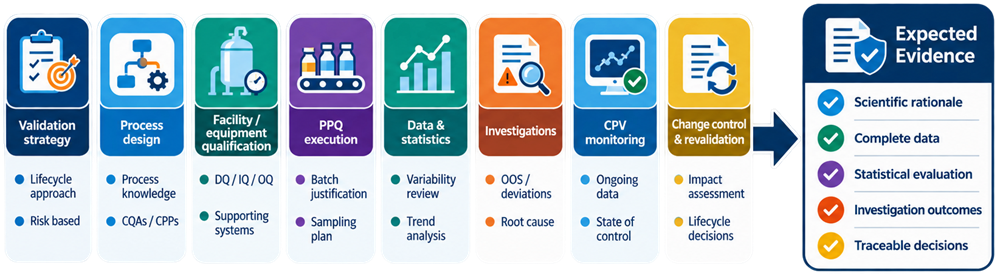
Important areas can include:
- whether the validation program follows a lifecycle approach;
- adequacy of process development and characterization;
- justification of PPQ batch number and selection;
- PPQ protocol design and execution;
- sampling-plan rationale;
- appropriateness of statistical methods;
- evaluation of intra-batch and inter-batch variability;
- investigation of PPQ deviations;
- traceability between process risks, controls, testing, and conclusions;
- qualification status of facilities, utilities, and equipment;
- implementation of CPV;
- investigation of adverse trends;
- effectiveness of the process control strategy;
- process-related CAPA;
- change-control decisions;
- revalidation decisions; and
- accuracy, completeness, and integrity of validation data.
Recent FDA enforcement is particularly instructive. In a July 2026 warning letter, FDA again stated that process qualification includes intensive monitoring and testing across significant process stages, that successful qualification is necessary before commercial distribution, and that ongoing vigilant oversight is necessary thereafter.
This reinforces an important inspection principle: FDA is looking for evidence of an effective validation lifecycle, not merely the existence of completed validation documents.
Regulatory Compliance Is a Lifecycle Obligation
The U.S. regulatory model for process validation combines enforceable CGMP requirements with FDA’s science- and risk-based lifecycle expectations. A defensible validation program should demonstrate that:
- the manufacturing process was scientifically developed and understood;
- facilities, utilities, and equipment are suitable for intended use;
- PPQ demonstrates reproducible commercial-scale performance;
- the PPQ strategy and number of batches are scientifically justified;
- relevant variability is evaluated and controlled;
- sampling and statistical methods are appropriate;
- deviations and unexpected results are investigated;
- commercial process performance is continuously monitored;
- changes are evaluated against the validated state; and
- lifecycle evidence continues to support a state of control.
The regulatory objective is therefore not simply to complete process validation. It is to establish and maintain documented scientific assurance that the manufacturing process remains capable of consistently producing product meeting its predetermined quality requirements throughout its commercial lifecycle.