

Quality Management System Regulation (QMSR) — 21 CFR Part 820
The Quality Management System Regulation (QMSR) became effective on February 2, 2026, and is the current regulatory framework governing quality management system requirements for medical device manufacturers in the United States. The QMSR amended 21 CFR Part 820 by incorporating ISO 13485:2016 by reference, while retaining FDA-specific requirements and the inspection and enforcement authority established under the Federal Food, Drug, and Cosmetic Act.
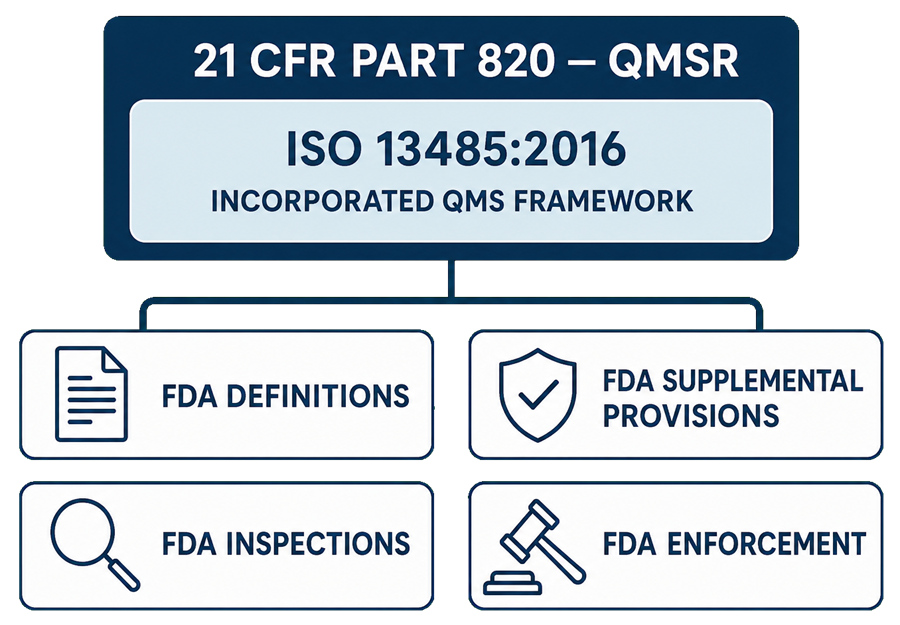
The QMSR reflects FDA’s determination that the requirements of ISO 13485:2016 provide a level of assurance for device safety, effectiveness, and quality that is consistent with the statutory requirements of the Federal Food, Drug, and Cosmetic Act. This harmonization aligns U.S. regulatory expectations more closely with those applied by regulatory authorities worldwide while preserving FDA’s inspection and enforcement authority.
Regulatory Scope and Applicability
The QMSR applies to manufacturers of finished medical devices subject to FDA regulation. The rule incorporates ISO 13485:2016 by reference, with specific FDA clarifications and retained provisions to ensure alignment with U.S. statutory requirements. Manufacturers subject to Part 820 must document and maintain a quality management system that complies with the applicable requirements of ISO 13485:2016, the supplemental requirements of Part 820, and all other applicable FDA statutory and regulatory requirements.
Terminology and Structural Changes
Under the QMSR, ISO 13485 terminology replaces many legacy QSR-specific terms. Concepts such as quality manuals, documented procedures, and risk-based controls are now central to regulatory compliance. While the terminology has shifted, FDA expectations for control, traceability, and documented evidence remain unchanged in substance.
Manufacturers must now operate under the QMSR framework. Quality manuals, procedures, validation documents, regulatory matrices, audit practices, and training materials should identify the current requirements and should not continue presenting former QSR sections as the current regulatory basis. Legacy records remain usable when they adequately demonstrate compliance with applicable QMSR requirements.
Inspection and Oversight Expectations
FDA inspections under the QMSR assess conformity to ISO 13485-based quality management system requirements as incorporated into Part 820. Unlike the former QSR, management reviews and quality audit reports are no longer exempt from FDA inspection. Inspectors may review these records to evaluate the effectiveness of the quality system, management oversight, and continuous improvement processes.
On February 2, 2026, FDA discontinued the Quality System Inspection Technique (QSIT) and began using the inspection process described in Compliance Program 7382.850. FDA investigators may review quality-management-system records, including management-review, internal quality-audit, and supplier-audit records that were previously exempt from routine FDA review under the former QSR.
FDA retains full authority to conduct inspections, issue regulatory observations, and take enforcement actions where deficiencies are identified.
Relationship to ISO 13485 Certification and MDSAP
ISO 13485 certification and participation in the Medical Device Single Audit Program (MDSAP) do not exempt a manufacturer from FDA inspection. FDA inspections under the QMSR do not follow the MDSAP audit model. They assess compliance with FDA regulations and are scheduled using applicable risk factors. FDA does not require or issue ISO 13485 certificates, and an ISO 13485 certificate does not establish QMSR compliance.
MDSAP remains a voluntary third-party audit program. Participation may provide useful quality-system evidence and support inspection readiness, but it does not restrict FDA’s inspection or enforcement authority.
Practical Implementation Considerations
Since February 2, 2026, manufacturers subject to Part 820 must operate under fully implemented QMSR-compliant quality management systems. Organizations without prior ISO 13485 experience may encounter challenges related to documentation structure, risk management integration, and management responsibility requirements. These challenges do not alter FDA expectations for compliance.
Successful implementation depends on disciplined quality system design, conservative interpretation of regulatory requirements, and demonstrable operational control.
Regulatory Perspective
The QMSR represents a structural alignment of U.S. medical device quality regulation with international standards, not a reduction in regulatory rigor. FDA continues to expect manufacturers to demonstrate effective control over design, production, validation, change management, and post-market activities.
Manufacturers operating in the U.S. market are expected to maintain QMSR-compliant systems as a condition of ongoing regulatory compliance.
Bottom Line
The Quality Management System Regulation is now the established regulatory baseline for U.S. medical device manufacturers. Organizations that treat ISO 13485 alignment as optional or interpret harmonization as reduced oversight risk significant compliance exposure during FDA inspection.