

PPQ Sampling Plan and Data Collection Strategy
A Process Performance Qualification (PPQ) sampling plan defines how evidence will be collected to determine whether the commercial manufacturing process performs reproducibly and whether relevant process variability is adequately understood and controlled.
Sampling during PPQ should not be designed by simply adding more samples to the routine manufacturing plan. The PPQ strategy should deliberately determine where variability may occur, when it may occur, which data can reveal it, and how much evidence is needed to evaluate both within-batch and between-batch performance.
FDA’s process validation guidance specifically recommends that the PPQ protocol define sampling points, the number of samples, and the frequency of sampling for each relevant unit operation and attribute. FDA also states that sample numbers should provide sufficient statistical confidence regarding quality both within a batch and between batches and that PPQ sampling should generally be more extensive than routine production.
This makes the PPQ sampling plan a direct extension of Stage 1 process understanding and the overall Process Performance Qualification (PPQ) Strategy and Batch Selection.
Sampling Is Designed to Detect Variability
The purpose of PPQ sampling is not to maximize the number of laboratory results.
The sampling plan should generate representative, interpretable evidence capable of answering questions such as:
- Is product or intermediate quality uniform throughout the batch?
- Do Critical Process Parameters (CPPs) behave consistently through the process?
- Are Critical Quality Attributes (CQAs) consistent across relevant locations and times?
- Are beginning, steady-state, transition, and end-of-process conditions comparable where applicable?
- Do different PPQ batches show reproducible behavior?
- Are material, equipment, location, time, or operational effects visible?
- Does the control strategy adequately manage expected variability?
- What sampling and monitoring should continue during Continued Process Verification (CPV)?
21 CFR 211.110 requires appropriate in-process controls and testing to assure batch uniformity and integrity and specifically connects these controls with manufacturing processes that may cause variability. The regulation also requires in-process specifications, where possible, to reflect previous process averages and variability estimates and suitable statistical procedures.
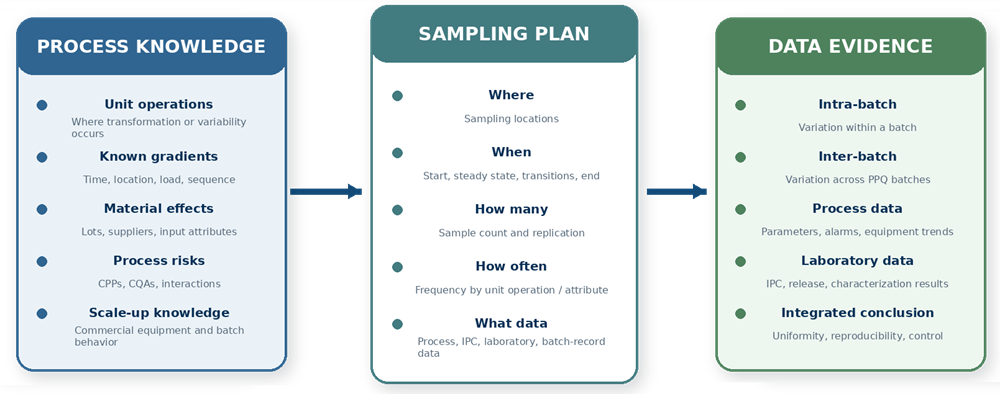
Start With Process Knowledge
Sampling locations and frequencies should originate from Stage 1 knowledge. Relevant inputs include:
- unit-operation understanding;
- process characterization;
- Design of Experiments (DOE);
- known CPP–CQA relationships;
- material attributes;
- equipment geometry;
- scale-up studies;
- hold-time studies;
- process-risk assessments;
- expected process gradients;
- known transitions;
- process sequence;
- previous engineering or development batches; and
- known measurement limitations.
See Process Characterization and Development Studies for Process Validation for the development basis.
A sampling plan created without this information tends to become either too sparse to characterize variability or unnecessarily large without improving the validation conclusion.
Sampling Locations
Sampling location should reflect the physical process. The question is not simply, “How many locations should we sample?”
It is: Where could meaningful differences reasonably exist? Possible location-related considerations include:
- top, middle, and bottom of a vessel;
- different blender regions;
- filling heads or lanes;
- compression stations;
- lyophilizer shelf locations;
- coating-bed regions;
- filtration beginning and end;
- transfer-line locations;
- equipment dead legs where relevant;
- different collection containers;
- different equipment trains; and
- other process-specific positions.
A location should be included because it provides useful information about process performance—not because a generic validation template requires it.
For example, three vertically distributed blender samples may provide useful information if segregation or mixing gradients are credible. They may provide little information for a different unit operation whose primary variability occurs over time rather than location.
Sampling Timing
Timing can be as important as physical location. Sampling may be designed around:
- process start-up;
- steady-state operation;
- transitions;
- material additions;
- equipment adjustments;
- process interruptions;
- hold periods;
- beginning and end of long operations;
- changes in feed characteristics;
- filling progression;
- material depletion; or
- other time-dependent effects.
A sample taken at the correct physical location but at the wrong process time may fail to detect the variability being investigated. Time should therefore be recorded accurately enough to align the sample with the actual process state.
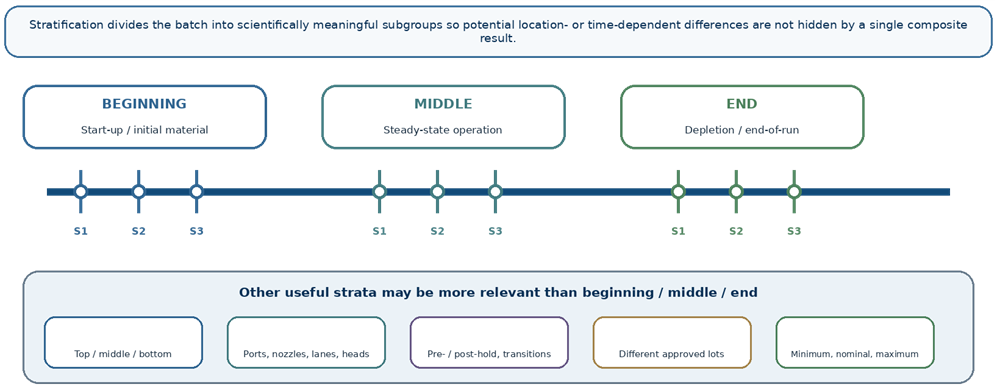
Stratified Sampling
Stratified sampling divides the batch or process into scientifically meaningful subgroups, or strata, and obtains samples from those subgroups separately. The objective is to prevent important differences from being hidden by overall averages. Possible strata include:
- time period;
- process stage;
- physical location;
- equipment zone;
- filling head;
- raw-material lot;
- shift;
- process hold;
- container group;
- minimum versus maximum equipment loading; or
- another source of expected variation.
Stratification can be particularly valuable during PPQ because the objective is to characterize process behavior rather than merely determine whether a composite result passes specification.
Beginning, Middle, and End Sampling
Beginning/middle/end sampling is widely used because many continuous or semi-continuous operations can change during execution.
Examples include:
- Beginning — start-up conditions, initial equipment stabilization, first material through the process.
- Middle — relatively steady-state operation.
- End — material depletion, long equipment run time, end-of-batch effects, or altered process dynamics.
However, beginning/middle/end should not become a universal PPQ formula. For some processes, a more meaningful design may be:
Top / Middle / Bottom or: Minimum Load / Nominal Load / Maximum Load or: Pre-Hold / Post-Hold or: Filling Head 1 / Filling Head 10 / Filling Head 20
The sampling structure should follow the mechanism by which variability can occur.
Intra-Batch Variability
Intra-batch variability means variation within a single manufacturing batch. PPQ should be capable of identifying meaningful intra-batch differences where they can occur. Examples include:
- blend uniformity among locations;
- tablet weight or hardness during compression;
- coating weight gain over time;
- fill-volume variation during filling;
- concentration changes during transfer;
- temperature gradients;
- moisture changes during drying;
- filtration performance during filter loading;
- beginning-to-end differences; and
- process effects before and after a hold.
FDA specifically expects sufficient sampling to evaluate quality within the batch, not merely the final batch average. A single average can conceal meaningful variation. For example, an acceptable average assay does not demonstrate batch uniformity if individual samples show an unacceptable spatial or temporal pattern.
Inter-Batch Variability
Inter-batch variability means variation among different batches. Each PPQ batch should not be evaluated only as an independent pass/fail event. The combined dataset should determine whether the manufacturing process behaves reproducibly from batch to batch. Relevant comparisons can include:
- batch means;
- distributions;
- variability;
- CPP profiles;
- CQA results;
- yield;
- material lots;
- process duration;
- equipment behavior;
- interventions; and
- sampling patterns.
FDA explicitly recommends sufficient statistical confidence regarding both within-batch and between-batch quality. Inter-batch analysis is also important because a process may produce individually acceptable batches while displaying inconsistent centering or increasing variability between runs.
Sampling by Unit Operation
Different unit operations usually require different sampling logic.
| Unit operation | Possible PPQ sampling considerations |
|---|---|
| Blending | Spatial locations, beginning/end discharge, segregation potential |
| Granulation | Binder addition, moisture, granule properties, process endpoint |
| Drying | Time, location, moisture gradient, endpoint consistency |
| Compression | Beginning/middle/end, press stations, weight, hardness, thickness |
| Coating | Time intervals, spray progression, weight gain, appearance, dissolution where relevant |
| Liquid mixing | Vessel locations, concentration, pH, mixing time |
| Filling | Beginning/middle/end, filling heads, line speed, fill volume |
| Filtration | Pre/post filter, pressure or flux progression, beginning/end loading |
| Bioprocessing | Time profile, viable-cell or biochemical attributes, additions, harvest |
| Lyophilization | Shelf/location effects, cycle stage, product temperature, residual moisture |
The specific plan should be based on the process, not on the examples themselves.
Enhanced PPQ Sampling
FDA states that PPQ will generally include more sampling, additional testing, and greater process scrutiny than routine commercial manufacturing. Enhanced PPQ sampling can include:
- more sampling locations;
- more frequent sampling;
- additional characterization tests;
- additional intermediate testing;
- additional samples within each batch;
- more extensive process-data capture;
- evaluation of attributes not routinely tested; and
- enhanced statistical analysis.
The additional sampling should have a purpose. A plan that collects three times as many samples at the same uninformative location may provide less useful process knowledge than a smaller but properly stratified plan.
Sample Number
The sample number should be scientifically and statistically justified. Important considerations include:
- expected variability;
- process-risk level;
- number of relevant strata;
- ability to detect meaningful differences;
- analytical variability;
- destructive versus nondestructive testing;
- process size;
- number of PPQ batches;
- confidence required for the validation conclusion; and
- feasibility of obtaining independent samples.
FDA does not establish a universal sample count.
The guidance instead expects the number of samples to provide sufficient statistical confidence for the specific attribute and process. The selected confidence can be informed by risk analysis.
The statistical strategy should therefore be developed with personnel who understand the process and the statistical question being addressed.
Sampling Frequency
Sampling frequency should reflect how quickly process conditions can change. For example, a rapidly changing filling process may require relatively frequent sampling. A stable long-duration hold may require sampling at scientifically justified timepoints instead. A continuously recorded CPP may require no separate manual data collection beyond verification that the measurement system and data are reliable. Sampling frequency should consider:
Rate of process change + potential quality impact + measurement capability + expected variability
rather than a standard interval applied to every process.
Process Data and Laboratory Data
PPQ evidence should combine two major data streams.
Process Data
Process data describe what happened during manufacturing. Examples include:
- CPP values;
- equipment settings;
- temperatures;
- pressures;
- flows;
- speeds;
- times;
- alarms;
- control-loop behavior;
- automation records;
- operator interventions;
- equipment states;
- yield; and
- environmental or utility information where relevant.
Laboratory and Product Data
Laboratory data describe the resulting material or product condition. Examples include:
- in-process control results;
- CQAs;
- assay;
- potency;
- moisture;
- dissolution;
- impurities;
- microbiological results;
- physical properties;
- release tests; and
- additional PPQ characterization tests.
The strongest PPQ analysis connects these datasets. For example: Process condition → sample location/time → laboratory response
This permits the validation team to determine whether variation in process conditions produces meaningful variation in product or intermediate quality.
See Verification of CPPs and Process Control Strategy During PPQ for the integrated CPP–CQA evaluation. The current USValidation article similarly emphasizes alignment of CPP data with process stages, sampling locations, and corresponding product results.
Aligning Data by Time and Process State
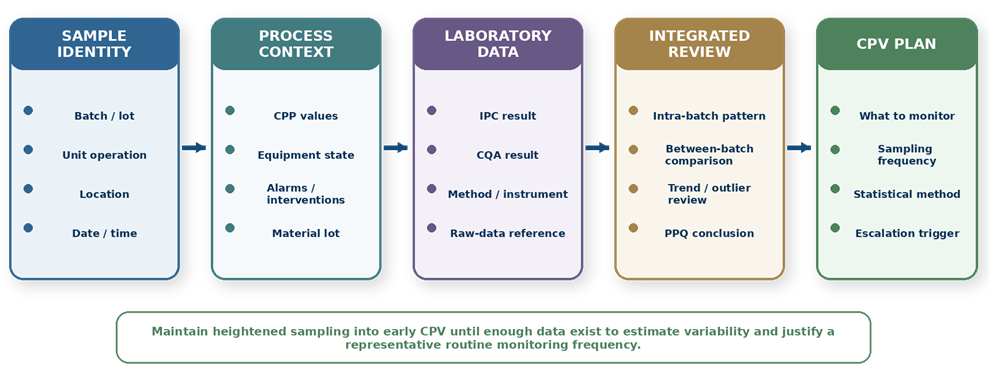
A laboratory result is substantially more useful when its process context is known. For each relevant sample, the PPQ dataset should allow reconstruction of:
- manufacturing batch;
- unit operation;
- sampling location;
- date and time;
- process stage;
- equipment or equipment train;
- material lot;
- relevant process parameters;
- operator or shift where relevant;
- hold condition;
- associated laboratory result; and
- deviations or unusual events.
Without this alignment, process and laboratory data may both be complete individually but difficult to interpret together.
Sample Traceability
Sample traceability should preserve the identity and context of each PPQ sample from collection through final evaluation. 21 CFR 211.160 requires representative samples to be properly identified. 21 CFR 211.194 further requires laboratory records to identify the sample source or location, quantity, lot or distinctive code, sampling date, test method, complete data, calculations, results, performer, and review.
A practical PPQ sample identifier may therefore link: Batch → Unit Operation → Sampling Location → Timepoint → Sample Number
For example: PPQ02-COMP-EOS-H07-S03 could identify a defined sample from PPQ Batch 2, a compression stage, end-of-run conditions, filling or compression head 7, and sample 3—provided the coding convention is formally defined.
The exact naming convention is site-specific. The key requirement is that the sample can be unambiguously traced to its process context.
Composite Samples
A composite sample combines material from two or more sampling locations or timepoints into one sample for analysis. Composite sampling can be useful for some purposes, but it can also conceal variability.
For example, a high assay at one location and low assay at another can produce an acceptable composite average even though the batch is not uniform. During PPQ, individual stratified samples may therefore be more informative when the objective is to evaluate:
- uniformity;
- gradients;
- beginning/end behavior;
- location effects;
- segregation;
- equipment differences; or
- other variability.
Composite sampling should be used only when its purpose is scientifically consistent with the validation question.
Representative Samples
21 CFR 211.160 requires sampling plans to be scientifically sound and samples to be representative and properly identified. A representative sample is not necessarily a random sample. Depending on the process, representative PPQ sampling may deliberately include:
- worst-case locations;
- process extremes;
- distinct strata;
- known gradient areas;
- transitions; and
- conditions likely to reveal process variability.
Purely random sampling can sometimes miss these conditions. PPQ sampling therefore often combines statistical principles with process knowledge and risk.
Sampling and Worst-Case Conditions
Worst-case sampling should identify conditions reasonably expected to provide less favorable or more variable performance within the approved commercial process. Examples can include:
- longest intended hold;
- maximum equipment load;
- minimum equipment load;
- beginning or end of an extended production run;
- known difficult sampling locations;
- high-risk material characteristics;
- representative supplier variation; or
- a process transition.
Worst-case conditions should be justified. They should not be invented simply to make the PPQ campaign appear challenging.
Handling Missing or Invalid Samples
Sampling deviations should be addressed prospectively in the PPQ protocol. Examples include:
- missed sample;
- wrong sampling time;
- wrong location;
- insufficient quantity;
- sample mix-up;
- laboratory failure;
- instrument malfunction;
- lost sample;
- damaged sample; or
- documented collection error.
The missing sample should not automatically be replaced without considering whether the original sampling opportunity represented a unique process condition.
For example, an end-of-batch sample collected later cannot necessarily replace a missed beginning-of-batch sample. The investigation should evaluate whether the missing information affects the PPQ conclusion and whether additional evidence is required.
Retesting and Resampling
Retesting and resampling should not be used to erase unfavorable PPQ information. Where resampling is scientifically appropriate, the reason should be documented and the original result should remain part of the PPQ evidence. The validation team should distinguish among:
- analytical error;
- sampling error;
- true process variation; and
- an unresolved atypical result.
This subject should align with the site’s OOS/OOT and deviation procedures and the broader PPQ Deviations, Investigation, and Validation Conclusion framework.
Statistical Evaluation of Sampling Data
The PPQ sampling plan and statistical analysis plan should be developed together. Sampling determines what information exists. Statistics determine how that information is evaluated.
Depending on the process and study objective, analysis may include:
- descriptive statistics;
- stratified comparisons;
- beginning/middle/end comparisons;
- spatial comparisons;
- within-batch variance;
- between-batch variance;
- confidence intervals;
- tolerance intervals;
- trend analysis;
- regression;
- analysis of variance;
- process capability or performance measures where justified; and
- other appropriate methods.
A statistically sophisticated analysis cannot compensate for poor sampling design. If the samples do not capture the relevant variability, the resulting statistics can give false confidence.
See PPQ Acceptance Criteria and Statistical Evaluation for the detailed statistical framework.
Transition From PPQ Sampling to CPV
PPQ sampling should explicitly establish the bridge into Stage 3 Continued Process Verification.
FDA recommends continuing sampling and monitoring of process parameters and quality attributes at the level established during Process Qualification until sufficient data exist to generate meaningful estimates of variability. Those estimates can then support statistically appropriate and representative routine monitoring frequencies.
This means the transition should normally be: Enhanced PPQ Sampling → Early CPV Monitoring → Accumulated Variability Data → Justified Routine Monitoring
—not: PPQ completed → immediately reduce sampling
Initial CPV monitoring may therefore retain:
- PPQ sampling locations;
- PPQ sampling frequencies;
- key CPP monitoring;
- selected CQA testing;
- material tracking; and
- enhanced statistical evaluation.
As confidence grows, monitoring can be refined.
See Continued Process Verification (CPV) Program and Monitoring Strategy for the Stage 3 framework. The current CPV article likewise identifies risk-based sampling locations, timing, sample count, and frequency as central monitoring-plan elements.
When Sampling May Be Reduced
Sampling frequency may be reduced when accumulated evidence demonstrates that:
- process variability is sufficiently characterized;
- the process remains stable;
- meaningful gradients are understood;
- the control strategy is effective;
- sample-location effects are predictable;
- PPQ and early CPV results are consistent;
- statistical uncertainty is acceptable; and
- the reduced plan remains representative.
Reduced sampling should not be based solely on the passage of time or completion of a fixed number of batches.
FDA also recommends periodically reassessing process variability and adjusting monitoring as appropriate.
When Sampling Should Increase Again
Sampling may need to increase when new information challenges previous assumptions. Examples include:
- process drift;
- increased variability;
- supplier changes;
- material changes;
- equipment modification;
- process scale change;
- significant maintenance;
- new process interactions;
- recurring deviations;
- OOS/OOT trends;
- CAPA verification; or
- revalidation activities.
PPQ and CPV sampling should therefore be viewed as parts of one lifecycle monitoring strategy rather than unrelated programs.
Data Integrity and Documentation
PPQ sampling documentation should permit reconstruction of: Why the sample was required → where and when it was collected → what process conditions existed → how it was tested → what result was obtained → how that result contributed to the PPQ conclusion
Relevant controlled records can include:
- approved PPQ protocol;
- sampling diagrams;
- sampling instructions;
- sample labels;
- chain-of-custody records where used;
- batch records;
- process historian data;
- laboratory records;
- analytical raw data;
- calculations;
- statistical datasets;
- deviations;
- investigation records; and
- PPQ report.
Data should not be manually copied between systems more than necessary. Where data are transferred, transformed, grouped, or excluded, the rationale and traceability should remain clear.
See Data Integrity and Good Documentation Practices in Process Validation for the broader execution-data framework.
PPQ Sampling Plan Documentation
The protocol should clearly define:
| Element | PPQ sampling-plan expectation |
|---|---|
| Attribute | What will be measured |
| Unit operation | Where in the process |
| Location | Physical sampling point |
| Timing | When the sample is collected |
| Frequency | How often |
| Sample count | Number of samples |
| Sample quantity | Material required |
| Test method | How it will be measured |
| Rationale | Why this sampling is appropriate |
| Acceptance approach | How the result will be interpreted |
| Statistical method | How variability will be evaluated |
| Traceability | How sample and process context are linked |
This table can become a useful core of the PPQ protocol because it connects process knowledge directly with execution.
Key Principles
- PPQ sampling should be designed to characterize process variability, not merely increase laboratory workload.
- FDA expects the PPQ protocol to define sampling points, sample numbers, and sampling frequency.
- Sampling should provide sufficient evidence to evaluate quality within batches and between batches.
- Sampling locations should be derived from process knowledge, risk, and credible sources of variability.
- Beginning/middle/end sampling is useful only when time progression is a meaningful source of variation.
- Stratification can address time, location, equipment zone, material lot, load, hold condition, or other scientifically relevant subgroups.
- Composite sampling can hide variability and should be used only when appropriate to the validation objective.
- Process data and laboratory data should be aligned by batch, unit operation, location, and time.
- Samples should be representative and properly identified as required by 21 CFR 211.160.
- Sample source, identity, testing, raw data, calculations, results, and review should remain traceable in accordance with 21 CFR 211.194.
- PPQ should generally use more extensive sampling and scrutiny than routine manufacturing.
- Heightened monitoring should normally continue into early CPV until sufficient data characterize process variability.
- Routine monitoring frequencies should be statistically appropriate and representative rather than automatically reduced when PPQ ends.