

Shipping Lane Qualification & Real-World Shipment Studies
Shipping lane qualification establishes documented evidence that a defined transportation route and logistics process can operate within the conditions assumed by the overall shipping-validation strategy. The objective is not simply to demonstrate that several shipments arrived successfully. A lane study should characterize how the product actually moves through the supply chain, measure the environmental and operational conditions experienced during representative shipments, identify route-specific risks, and confirm that the qualified packaging and distribution controls remain suitable for those conditions.
The companion article Shipping Validation Strategy and Distribution Risk Assessment establishes the overall distribution-control framework. Shipping lane qualification goes deeper into the actual route: origin, destination, transportation modes, carriers, hubs, transfer points, seasonal exposure, dwell periods, customs clearance, shipment duration, handling practices, and the real environmental profile encountered between release and receipt.
WHO’s technical supplement on Transport Route Profiling Qualification specifically addresses this activity for time- and temperature-sensitive pharmaceutical products. WHO’s route-profiling framework includes a study protocol, execution of representative shipments, data retrieval, analysis of temperature exposure, and use of the results to select or verify suitable shipping systems. WHO’s broader model guidance states that transport routes should be profiled and qualified so that suitable protection methods can be selected against anticipated ambient temperature and humidity conditions throughout the year.
Key Principles
- A shipping lane includes the complete operational pathway between defined origin and destination, not merely the geographical route.
- Lane qualification should characterize actual transportation modes, carriers, hubs, storage periods, transfer points, handling practices, and environmental exposure.
- Laboratory packaging qualification establishes system capability; lane studies demonstrate whether actual commercial conditions remain within that qualified capability.
- Historical shipment data can support lane characterization when the data are representative, traceable, and generated under sufficiently comparable conditions.
- Dummy or engineering shipments can be used when commercial data are unavailable or when characterization must occur before product distribution.
- Hot-season and cold-season conditions should be addressed where ambient temperature can affect the product or shipping system.
- Transit duration, including delays and dwell time, should be evaluated separately from peak temperature because prolonged moderate exposure can be more significant than a short extreme event.
- Shipping lanes may be grouped or bracketed when their relevant risk characteristics are demonstrably comparable.
- Lane qualification should not be based solely on one favorable shipment or on average conditions.
- Qualified environmental monitoring devices should be used, and logger placement should be based on the study objective.
- Deviations occurring during lane studies should be evaluated as potential information about the actual distribution process rather than automatically invalidated.
- Commercial monitoring, excursions, carrier performance, and route changes should be used to maintain lane qualification throughout the lifecycle.
Shipping Lane Qualification Versus Shipping Validation
Shipping validation and shipping lane qualification are related but not equivalent. Shipping validation asks whether the overall distribution process has adequate controls to protect the product. It integrates packaging qualification, thermal performance, transport simulation, environmental monitoring, logistics-provider controls, procedures, and field evidence.
Shipping lane qualification asks whether a specific route or defined group of routes is adequately represented by those controls.
For example, a passive refrigerated shipping system may have demonstrated 96 hours of thermal performance under qualified summer and winter chamber profiles. Lane qualification then determines whether a Boston-to-Chicago overnight route, a Boston-to-Phoenix parcel route, and an international Boston-to-Singapore air route actually remain within the environmental and duration assumptions represented by that qualification.
A package can be technically qualified while a lane is operationally unsuitable. Excessive customs dwell, repeated missed connections, exposure to extreme airport temperatures, or extended delivery delays can cause the actual distribution process to exceed the qualified packaging envelope.
Conversely, several successful shipments through a mild route do not prove that the packaging system has adequate capability for other lanes or seasonal conditions.
Define the Shipping Lane
A useful lane definition should be specific enough to identify the conditions being qualified.
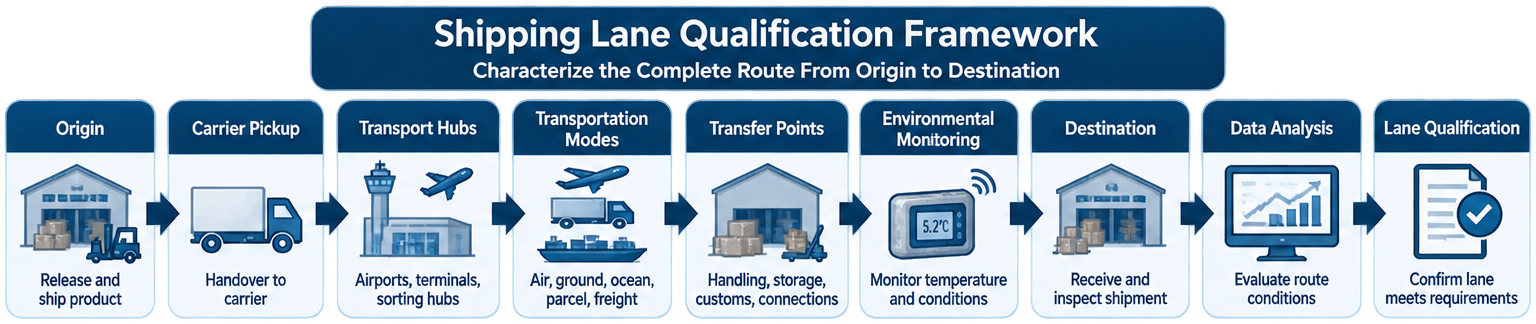
The lane can include origin and destination facilities, transport mode, carrier or carrier class, intermediate hubs, transfer points, staging locations, customs entry, distribution-center handling, expected transit time, frequency, shipping days, environmental-control strategy, monitoring requirements, and receiving process.
The route should not be reduced to: Site A → Site B
A more meaningful representation is: Origin warehouse → carrier pickup → regional hub → airport terminal → air transport → customs → destination hub → final-mile carrier → receiving warehouse
Each transition can create different environmental and handling conditions.
The lane definition should also identify whether the shipment is parcel, less-than-truckload, full truckload, dedicated refrigerated transport, air freight, ocean freight, courier, or another logistics model. These distinctions can materially affect exposure duration, handling frequency, mechanical hazards, and environmental variability.
Start With the Product and Qualified Shipping System
Lane qualification should not begin independently of the existing packaging and product requirements.
The study should identify the product storage or transport requirements, qualified packaging configuration, allowable payload range, permitted seasonal pack-out, qualified thermal duration, mechanical packaging qualification, environmental monitoring strategy, and any known product excursion tolerances.
Temperature-Controlled Packaging System Qualification establishes the capability of the thermal packaging system, while Thermal Mapping, Seasonal Profiles, Payload, and Hold-Time Qualification establishes payload behavior, seasonal challenges, limiting sensor locations, and qualified duration.
The lane study should then determine whether actual transportation conditions remain bounded by those established capabilities.
If the lane routinely requires 80–90 hours while the thermal shipping system is qualified for 96 hours, the operational margin may be inadequate even though individual shipments technically remain within the tested duration.
Route Profiling Before Qualification
Route profiling is the process of collecting real distribution data to understand how a lane actually behaves. WHO identifies route profiling as a formal technical activity and organizes the work around study protocol preparation, execution, data retrieval, evaluation of temperature exposure, and analysis of the resulting profiles.
The data can reveal:
- actual shipment duration;
- exposure during carrier pickup;
- warehouse or terminal dwell;
- airport or ramp exposure;
- customs delay;
- daily temperature cycling;
- unusually warm or cold portions of the route;
- repeated handling or transfer points;
- seasonal variation;
- carrier-to-carrier differences;
- delays at destination receipt.
The purpose is not simply to accumulate temperature graphs. The resulting information should influence the qualification strategy.
Historical Data Versus Prospective Route Studies
Lane characterization can use historical data, prospective dummy shipments, commercial shipments, or a combination.
Historical data can be efficient when sufficiently detailed shipment records already exist. Useful historical data should be traceable to the same or comparable route, transportation mode, carrier process, season, monitoring system, and distribution configuration. Historical evidence becomes weak when the prior shipments used different carriers, different hubs, different monitoring locations, materially different shipping configurations, or obsolete routes.
Prospective dummy shipments can be useful before product launch. A representative shipping package can be sent through the intended commercial route with environmental monitoring, without risking released commercial product.
Commercial field studies provide the strongest evidence of operational execution when performed using the approved packaging system, trained personnel, actual carriers, and normal distribution processes.
The appropriate combination depends on product risk and the amount of prior knowledge available.
Dummy Shipments Must Be Representative
A dummy shipment should reproduce the conditions that affect the distribution profile. For thermal lane characterization, the purpose may primarily be to measure ambient exposure, in which case payload simulation may be relatively simple. When the study also evaluates shipping-system performance, however, payload thermal mass, package configuration, refrigerant condition, and internal logger placement become important.
A lightweight empty shipper can respond differently from a fully loaded commercial shipper. Likewise, a dummy shipment moving under special handling arranged solely for qualification may fail to represent normal commercial operations.
The protocol should therefore distinguish between:
- route characterization, where the primary concern is the external logistics environment, and
- field performance qualification, where the complete product-shipping system is being evaluated under real conditions.
Seasonal Qualification
Seasonal exposure is often one of the dominant lane variables. A lane that performs well in spring cannot automatically be assumed representative of peak summer or winter conditions. Ambient temperatures, airport ramp conditions, truck interiors, loading docks, distribution centers, and final-mile vehicles can change substantially during the year.
For temperature-sensitive products, lane qualification commonly requires evaluation of hot-season and cold-season conditions. The study should define what constitutes a representative seasonal period rather than selecting shipment dates arbitrarily.
Historical climatological data, prior monitoring records, standardized thermal profiles, and actual route experience can help identify the periods most likely to challenge the distribution system.
WHO’s route-profiling guidance explicitly connects qualification with anticipated ambient temperature and humidity conditions throughout the year.
Seasonal Extremes Versus Average Weather
Average seasonal temperature is usually not the relevant qualification challenge. A lane may experience moderate average conditions while containing short but severe exposures at an airport apron, warehouse dock, parked vehicle, or customs facility.
Similarly, cold-season risk can arise from short exposure to very low ambient temperature even when the average transit temperature is much warmer.
The qualification strategy should therefore consider the distribution conditions capable of challenging the shipping system rather than basing qualification solely on monthly average weather data.
This is particularly important for passive thermal shippers because transient environmental peaks can consume thermal capacity rapidly.
Shipping Duration Is a Major Lane Variable
Transit duration should be analyzed independently from environmental temperature. Two shipments can experience similar peak temperatures but impose very different thermal burdens when one route lasts 20 hours and the other lasts 75 hours.
WHO’s route-profiling methodology includes evaluation of both temperature exposure and total journey time. The lane study should evaluate normal transit duration, maximum observed duration, delays, weekend effects, customs clearance, missed connections, carrier rescheduling, and other foreseeable events.
A lane whose routine transit consumes nearly the entire qualified shipping hold time should be considered higher risk even if all initial qualification shipments pass.
Degree-Hour Analysis
WHO’s route-profiling guidance introduces the degree-hour concept as a method for comparing severity of temperature exposure among different shipments. The method evaluates both the magnitude of temperature above or below a defined threshold and the duration of that exposure.
Conceptually: Degree-hour exposure = temperature deviation from a selected threshold × exposure duration
The method can distinguish two shipments that have similar peak temperatures but very different cumulative thermal exposure.
For example, a shipment that briefly reaches 35 °C may be less severe than one that remains at 28–30 °C for many hours, depending on the selected threshold and product or shipping-system context.
Degree-hour analysis should not be confused with product stability modeling or automatically interpreted as an allowable product exposure. It is primarily a tool for comparing route severity and selecting representative or challenging transport profiles.
Selecting the Most Challenging Lane
Where a product is distributed through many routes, the company may not need an independent qualification study for every origin-destination combination.
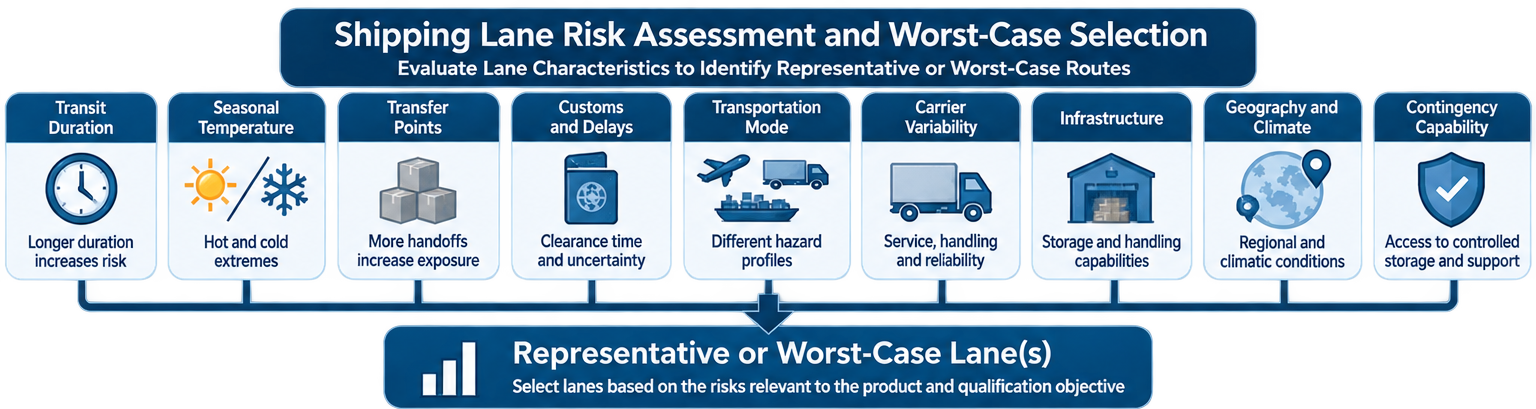
Representative or worst-case lanes can be selected when they adequately bound the relevant risks of the remaining lanes. Potential ranking factors include:
| Lane characteristic | Higher-risk condition |
|---|---|
| Transit duration | Longer duration |
| Seasonal exposure | More extreme heat or cold |
| Transfers | More handoffs or hubs |
| Customs | Greater delay potential |
| Transportation mode | More variable or uncontrolled exposure |
| Infrastructure | Limited controlled storage or support |
| Carrier performance | Greater historical variability |
| Geography | Severe climate or altitude |
| Shipping frequency | Limited data / infrequent lane |
| Contingency capability | Poor access to controlled storage |
| Security | Higher theft or tampering exposure |
The lane selected as worst case should be worst case for the failure mechanism being evaluated. The lane with the highest temperature may not have the longest duration, greatest number of transfers, or greatest security risk. A single universal “worst lane” should therefore not be assumed.
Lane Grouping and Bracketing
Grouping can substantially reduce unnecessary qualification work when multiple lanes have comparable characteristics. A lane family may be justified when the routes use the same origin process, packaging system, transportation mode, carrier network, hub structure, expected duration, seasonal exposure range, and receiving controls.
However, grouping should not be based only on common destination region.
Two routes to neighboring cities can differ because one passes through a major air hub while another uses ground transport, or because different carriers use different transfer facilities.
The grouping rationale should identify which lane characteristics are considered equivalent and which lane or lanes provide the bounding challenge. Where meaningful differences remain, focused supplemental qualification can be used instead of repeating the entire validation program.
Carrier Variability
The carrier is part of the lane. Different logistics providers can use different hubs, schedules, vehicle types, handling procedures, subcontractors, storage practices, routing algorithms, and contingency processes.
Changing carriers can therefore alter the qualified lane even when origin and destination remain unchanged. The study should identify whether qualification applies to a named carrier, an approved group of comparable carriers, or a broader transportation category.
Where multiple providers are permitted, their relevant operational differences should be addressed through the distribution risk assessment and provider qualification program described in Shipping Validation Strategy and Distribution Risk Assessment.
Transportation Mode
Transportation mode materially influences route behavior.
- Parcel distribution can involve repeated sorting and numerous handling events.
- Less-than-truckload freight can introduce multiple terminals and mixed freight.
- Full truckload distribution can reduce transfer frequency but may involve prolonged vehicle exposure.
- Air freight introduces airport dwell, aircraft schedules, pressure and altitude considerations, and missed-connection risk.
- Ocean transport introduces much longer duration and a different environmental profile.
A route qualification should therefore specify the transportation mode represented by the data. Evidence from one mode should not automatically be extended to another.
Transfer Points and Dwell Time
Transfer points frequently represent the most significant exposure locations within a lane. These can include regional parcel hubs, airport cargo terminals, customs warehouses, freight terminals, distribution centers, and receiving docks.
The product may remain stationary at these locations longer than it remains in active transportation, and environmental control may differ substantially from that available inside a refrigerated vehicle or qualified container. The lane profile should therefore identify where dwell occurs and how long it lasts.
Real-time GPS and temperature monitoring can be particularly useful for correlating environmental events with specific transfer locations, although the data should remain controlled according to Distribution Environmental Monitoring and Data Logger Qualification.
Customs and International Distribution
Customs clearance can become one of the largest uncertainties in international shipping. Potential risks include document delays, inspection, unloading, warehouse transfer, limited access to controlled storage, refrigerant depletion, weekend closure, and inability of the shipper to intervene.
The lane study should characterize normal customs duration and credible delay scenarios.
Where customs delay can materially consume the qualified thermal hold time, contingency controls should be established. These can include expedited customs processes, pre-clearance, approved storage, local refrigerant replenishment, alternate routing, emergency contact arrangements, or shipment return.
A qualification strategy that assumes immediate customs release without evidence is not robust.
Environmental Monitoring During Lane Studies
Environmental monitoring should be selected according to the study objective. For route profiling, external ambient temperature can be particularly important because the purpose is to characterize the environment the shipping system experiences.
For shipment-performance qualification, internal product or payload temperatures are generally more relevant because they demonstrate whether the qualified packaging actually protected the product. In some studies, both should be monitored.
External and internal sensors should be clearly distinguished during data analysis. The ambient sensor should not be positioned where it is shielded by the packaging system and therefore fails to represent the actual environment.
Internal sensor positions should follow knowledge established during thermal mapping.
Logger Qualification
All monitoring devices used to support the qualification conclusion should be appropriately controlled. Distribution Environmental Monitoring and Data Logger Qualification addresses intended use, accuracy, calibration, logging interval, configuration, placement, software, records, and lifecycle controls.
For lane qualification, loggers should be synchronized where data from multiple sensors are compared. Device IDs, serial numbers, calibration status, recording intervals, activation times, placement, and shipment associations should be documented.
Missing or incomplete logger data should be evaluated based on how much information remains available and whether the missing period affects the qualification conclusion.
Real-Time Monitoring
Real-time tracking can strengthen lane characterization by linking temperature exposure with location and logistics events. A real-time system may show that a temperature increase consistently occurs at one airport terminal, that delays occur primarily during a specific connection, or that shipments remain too long at a receiving dock.
These data can convert a generic excursion into an identifiable process failure and support targeted corrective action.
Real-time monitoring should not be confused with qualification itself. It is an information source. The validation conclusion still depends on whether the overall route, shipping system, and operational controls provide adequate product protection.
Number of Shipments
There is no universal regulatory rule that every shipping lane must be qualified with three shipments. The number of studies should reflect product risk, lane variability, seasonal requirements, existing historical data, shipping frequency, packaging performance margin, and the amount of prior knowledge available.
Three successful shipments may provide reasonable evidence for a stable, well-characterized lane, but repeating an arbitrary number without understanding variability does not necessarily create a defensible qualification.
A highly variable international route may require more data. A mature lane supported by years of reliable historical monitoring may require less prospective testing than a newly established route with no prior evidence.
The protocol should explain why the selected number of shipments is sufficient.
Real-World Shipment Studies
A real-world shipment study should use commercial operations as closely as practical.
This normally means:
- approved packaging and pack-out;
- production-equivalent payload;
- trained shipping personnel;
- qualified environmental monitors;
- normal logistics provider;
- normal shipping documents;
- routine pickup;
- actual transfer facilities;
- normal receiving process.
The purpose is to confirm operational performance, not create an artificially protected qualification shipment. Special handling should be avoided unless it is itself part of the commercial control strategy.
For example, instructing a carrier to personally escort a validation shipment while normal commercial shipments move through routine sorting can produce evidence that is not representative.
Product Versus Representative Payload
Actual product can provide the strongest operational representation, but product simulants may be justified when the study objective does not require commercial product. Where the thermal response of the payload is relevant, the simulant should reproduce thermal mass, geometry, fill configuration, packaging, and other characteristics important to the system.
Where the primary study objective is ambient route profiling, the payload itself may be less important than the external logger configuration. The protocol should define what the shipment is intended to demonstrate and select the payload accordingly.
Pre-Shipment Verification
Each study shipment should be verified against the approved configuration before release. Typical checks include package type, component revision, refrigerant or PCM condition, payload quantity, internal arrangement, logger configuration, logger activation, logger placement, shipping documents, security seal, route, carrier, and expected duration.
The objective is to demonstrate that the lane—not an incorrectly assembled shipping system—is being evaluated. Any deviation from the approved configuration should be documented and assessed before the study result is incorporated into the qualification conclusion.
Receiving and End-of-Route Controls
Qualification does not necessarily end when the carrier marks the package as delivered. The receiving process can affect the final product condition. A shipment can be delivered within the qualified thermal duration but remain unopened on an uncontrolled receiving dock for several additional hours.
The study should therefore define the endpoint of the qualified lane.
This may be: carrier delivery, receipt by trained personnel, opening of the shipper, or placement of product into qualified storage.
The endpoint should correspond to the distribution responsibility and product-protection strategy. Receiving records can include arrival time, package condition, security-seal condition, logger status, unpacking time, product condition, and placement into controlled storage.
Acceptance Criteria
Acceptance criteria should reflect the lane risks and the objectives of the study. For a temperature-controlled pharmaceutical lane, criteria may include complete logger records, product temperatures remaining within the defined qualification condition, transit duration within the approved envelope, no significant package damage, correct receiving condition, and successful completion of all critical process steps.
For non-temperature-sensitive shipments, greater emphasis may be placed on package integrity, damage, labeling, security, or delivery performance.
A useful acceptance structure is:
| Qualification aspect | Example criterion |
|---|---|
| Transit duration | Within defined lane and shipping-system limit |
| Environmental condition | Within qualified exposure envelope |
| Product temperature | Meets specified requirement |
| Packaging | No functionally significant damage |
| Monitoring record | Complete and attributable |
| Security | No tamper evidence or unexplained breach |
| Route execution | Approved route / carrier configuration |
| Receiving | Product promptly transferred to required storage |
| Deviations | No unresolved event affecting qualification |
The criteria should be approved before the study begins.
Qualification Does Not Require Every Shipment to Be Identical
Real distribution is inherently variable. Two shipments on the same qualified lane can follow slightly different timing, routing, or environmental conditions and still remain within the established lane envelope.
The objective is therefore not to demonstrate identical profiles. It is to demonstrate that the variability remains within the capabilities of the qualified shipping system and product controls.
A qualification conclusion based only on average profiles can hide this variability. Review should include the individual shipment records and the range of observed conditions.
Analyze Duration, Temperature, and Route Together
Lane qualification should not treat environmental temperature, time, and logistics events as separate datasets. The strongest analysis correlates them.
A temperature increase can be associated with a five-hour airport dwell. A long transit time can be traced to customs. A cold excursion may occur during regional ground delivery rather than during air transport.
This type of analysis identifies where the distribution process requires control rather than merely documenting that variation occurred.

Comparing Lane Data With Laboratory Qualification
Field data should be compared directly with the qualification envelope established during laboratory studies. For thermal shipments, relevant comparisons include:
- actual ambient temperature versus qualified seasonal profile;
- actual product temperature versus acceptance range;
- actual transit duration versus qualified hold time;
- observed payload configuration versus qualified payload range;
- actual delays versus available operational margin.
If field exposure is materially less severe than the laboratory challenge, this strengthens confidence that the laboratory qualification appropriately bounds the lane.
If commercial exposure approaches or exceeds the laboratory qualification conditions, the lane or shipping system should be reassessed.
The appropriate response can include additional chamber testing, revised pack-out, shorter shipping-duration limits, carrier changes, route restrictions, or more intensive monitoring.
Use of Standardized Profiles After Route Profiling
Route data can also be used to develop or select laboratory challenge profiles. WHO’s route-profiling supplement specifically describes using route data for the design and testing of packaging solutions and for assessing passive containers with known performance characteristics.
In the vaccine-distribution context, WHO’s current international packaging and shipping guidance states that new packaging solutions should use transport-route profiling data—either historical or experimentally generated—to derive representative chamber test profiles for operational qualification.
That requirement is vaccine-specific and should not be presented as a universal pharmaceutical requirement, but it illustrates the direction of modern distribution qualification: laboratory qualification should increasingly reflect measured distribution conditions rather than arbitrary stress profiles.
Degree-Hour Analysis and Worst-Case Profile Selection
When several route profiles are available, the most challenging shipment should not automatically be selected by peak temperature alone. WHO’s degree-hour methodology integrates exposure magnitude and duration so that profiles can be compared more meaningfully. In WHO’s example, a shipment with a high peak temperature did not produce the highest degree-hour severity because the elevated temperature lasted for a shorter period.
This method can help identify the route profile that should be used as the basis for laboratory thermal qualification.
For product disposition, however, product-specific stability data remain the governing scientific basis. Degree-hours should not be substituted automatically for formal stability evaluation.
Lane Qualification and Package Hold Time
The relationship between route duration and packaging hold time is central to qualification. The Thermal Mapping, Seasonal Profiles, Payload, and Hold-Time Qualification article distinguishes demonstrated thermal hold time from approved commercial shipping duration.
Lane qualification provides the actual operating data needed to determine whether the resulting margin is adequate.
If normal lane duration is 24 hours and the package is qualified for 96 hours, substantial margin exists. If the route routinely requires 78–85 hours, the same package may technically pass but provide little protection against delay.
The lane qualification report should therefore state both typical and challenging observed duration relative to the approved shipping-system limit.
Route Excursions During Qualification
A lane study can produce unexpected events. These should not automatically be excluded from the qualification dataset. A missed flight, customs delay, excessive ambient temperature, lost package, logger alarm, or prolonged receiving delay can reveal exactly the type of variability the qualification was intended to understand.
The investigation should determine whether the event represents an abnormal nonrepresentative condition or a credible feature of the commercial lane.
If the event is reasonably foreseeable, it may need to influence the final control strategy.
Deleting an inconvenient shipment from the study without technical justification can create an artificially favorable lane profile.
Qualification Failures
A failure should be traced to the appropriate level of the distribution system.
Potential causes include:
- inadequate shipping-system capacity;
- lane duration exceeding qualified hold time;
- incorrect pack-out;
- incorrect seasonal configuration;
- carrier delay;
- customs delay;
- handling damage;
- monitoring failure;
- receiving delay;
- unqualified provider;
- inaccurate assumptions about the lane.
Corrective action should address the actual failure mechanism.
A packaging-system failure may require redesign or requalification. A route problem may require changing carrier, transfer hub, shipping day, customs arrangement, or contingency plan. An execution problem may require procedure or training changes.
Establishing Lane Qualification
The final lane conclusion should state precisely what has been demonstrated. A lane can be qualified for a defined:
- origin and destination;
- transportation mode;
- carrier or approved carrier group;
- packaging system;
- payload range;
- seasonal configuration;
- shipment-duration limit;
- monitoring strategy;
- receiving process.
The conclusion can also define allowable variation within those conditions. The phrase “lane qualified” should not be interpreted as permanent approval irrespective of later changes.
Lane Qualification Report
The final report should integrate the route definition, study design, shipment configuration, environmental data, duration, route events, deviations, acceptance criteria, and final qualification boundary.
A useful report summary can include:
| Element | Qualified condition |
|---|---|
| Origin | Defined shipping facility |
| Destination | Defined receiving location or lane family |
| Carrier | Approved provider(s) |
| Mode | Air, ground, parcel, FTL, etc. |
| Packaging | Approved configuration |
| Payload | Qualified range |
| Seasonal coverage | Hot / cold / year-round basis |
| Monitoring | Defined devices and locations |
| Transit duration | Qualified operational limit |
| Route profile | Demonstrated exposure |
| Receiving | Required receipt and storage process |
| Contingency | Defined delay / excursion controls |
This table makes the qualification envelope visible to change control and future reviewers.
Lane Families
For organizations shipping globally, lane families can make lifecycle control more practical. Lanes can sometimes be grouped according to characteristics such as transportation mode, duration, climate, hub structure, customs process, carrier, and infrastructure.
For example, several U.S. domestic overnight parcel routes can potentially be grouped if they share comparable carrier systems, transit duration, climate exposure, and package performance assumptions.
International routes with different customs, airport operations, or climatic exposure may require separate groups.
The family should be defined from technical similarity rather than organizational convenience.
New Lane Introduction
A formal process should define how new lanes are added. The assessment can determine whether the proposed lane is already bounded by an existing qualified family or whether new data are needed.
A new lane may require only documented risk assessment if it is clearly less challenging than qualified routes. A lane with longer duration, new climate exposure, a different transportation mode, new carrier, or additional customs steps may require prospective route profiling or field verification.
This prevents every new destination from automatically triggering full qualification while still protecting the validated state.
Changes to Existing Lanes
Changes that can affect lane qualification include:
- carrier changes;
- new carrier hubs;
- routing changes;
- transportation-mode changes;
- service-level changes;
- customs entry changes;
- new distribution centers;
- increased transit duration;
- revised pickup schedules;
- seasonal expansion;
- changes to receiving hours;
- new subcontractors;
- modifications to controlled storage availability.
Changes should be assessed for their impact on the original qualification assumptions.
A carrier may change routing without changing the service name. Commercial monitoring and periodic review therefore remain necessary even when no formal internal change request has been initiated.
Commercial Monitoring After Qualification
Lane qualification establishes the initial evidence base. Routine monitoring verifies continued performance. Monitoring data can reveal gradual increases in transit time, greater seasonal exposure, changing carrier behavior, new transfer points, or weakening packaging margin.
The strategy can range from monitoring every shipment to risk-based sampling, depending on product sensitivity, lane variability, history, and regulatory commitments.
Reduction in monitoring frequency should be supported by stable historical performance rather than assumed simply because initial qualification passed.
Trending
Trend analysis should move beyond excursion counts.
Useful lane metrics include:
- actual shipment duration;
- thermal margin to specification;
- minimum and maximum temperatures;
- delay frequency;
- carrier on-time performance;
- frequency of customs delay;
- logger failure rate;
- package damage;
- receiving delay;
- excursion frequency;
- seasonal differences.
These data provide a direct measure of whether the lane remains inside its validated operating space.
Periodic Review
Shipping lanes should be incorporated into the broader periodic review of the shipping-validation program. The review should consider actual performance, excursions, complaints, carrier changes, route modifications, monitoring data, package changes, product changes, CAPA, and new distribution risks.
WHO’s current distribution guidance maintains the broader expectation that supply-chain risks be assessed, controlled, communicated, and reviewed.
The review should determine whether the original route profile remains representative and whether additional profiling or qualification is needed.
Shipping Lane Qualification for Non-Cold-Chain Products
Shipping-lane qualification is not limited to refrigerated products. Ambient pharmaceutical products, medical devices, combination products, and other regulated products can be sensitive to shock, vibration, humidity, light, extended duration, security risks, or package damage.
For these products, the lane study may focus less on temperature and more on actual handling environment, transit duration, mechanical damage, humidity, security, or delivery process.
Laboratory transport simulation remains addressed in Distribution Simulation Strategy and Transport Testing. Lane qualification determines whether those standardized challenges adequately represent the commercial distribution environment.
Medical-Device Lane Qualification
For medical devices, route studies can be particularly useful where the product contains fragile assemblies, sterile barrier systems, diagnostic reagents, batteries, electronics, or other transportation-sensitive elements.
The qualification should remain linked to packaging-system requirements and the manufacturer’s overall QMS.
A sterile barrier can pass laboratory distribution simulation but still be compromised by an unanticipated route-specific handling condition. Complaint data and actual shipment monitoring should therefore remain part of the lifecycle review.
Pharmaceutical Lane Qualification
For pharmaceutical and biological products, shipping-lane qualification should remain tied to stability-supported storage and transportation conditions.
21 CFR §211.142 requires appropriate storage conditions, while §211.150 requires controlled written distribution procedures and lot traceability. Product stability under §211.166 provides the technical basis for determining the conditions that must be maintained during distribution.
WHO provides the more explicit technical framework for transport-route profiling, including route data collection, analysis, and application to shipping-system qualification.
The lane study should therefore be treated as supporting evidence for the controlled GMP distribution process rather than as an independent regulatory exercise.
Validation Perspective
A technically defensible shipping-lane qualification should answer five questions:
- What actual route and logistics process is being qualified?
- What environmental, duration, handling, transfer, and provider risks characterize that lane?
- Do the qualified packaging and distribution controls adequately bound those conditions?
- Do representative real-world shipments confirm successful operational execution?
- How will lane changes and commercial monitoring maintain qualification over time?
The validation logic is:
Lane definition → risk characterization → route profiling → representative or worst-case shipments → environmental and operational data → comparison with qualified system limits → lane approval → commercial monitoring → periodic reassessment
This structure keeps shipping-lane qualification focused on real distribution evidence. It avoids the two common extremes of assuming that laboratory qualification alone validates every route or requiring unnecessary independent qualification of every individual origin-destination pair.