

Shipping Validation Strategy and Distribution Risk Assessment
Pharmaceutical shipping validation establishes documented evidence that a defined distribution process can protect a drug product or other regulated product from conditions capable of affecting its quality, safety, identity, strength, sterility, functionality, or other required characteristics between release from the shipping site and receipt at the intended destination. It should evaluate the distribution system as a controlled process rather than treating transportation as an activity that begins only after the product leaves the manufacturing facility.
The shipping-validation strategy therefore extends beyond package testing. It integrates product stability requirements, packaging-system capability, transportation hazards, shipping lanes, carriers, seasonal exposure, handling and transfer points, environmental monitoring, delays, security, and documented operational controls. Laboratory distribution simulation, thermal packaging qualification, and data logger qualification each provide important evidence, but none independently demonstrates that the complete commercial distribution process is adequately controlled.
For pharmaceutical products, there is no single FDA regulation titled “shipping validation.” The regulatory basis is distributed across applicable CGMP requirements. 21 CFR §211.142 requires appropriate storage conditions; §211.150 requires written distribution procedures and distribution traceability; §211.166 requires stability data to establish appropriate storage conditions; and §211.94 requires container-closure systems to provide protection against foreseeable external factors capable of causing deterioration or contamination. Together, these requirements establish the technical basis for protecting product quality through storage and distribution.
WHO’s current Good Storage and Distribution Practices for Medical Products, TRS 1025 Annex 7, is more explicit about transportation controls. It requires risks throughout the supply chain to be assessed, controlled, communicated, and reviewed; states that products should be transported under manufacturer-defined conditions; and calls for qualification of transport vehicles where appropriate, maintenance of environmental conditions, calibrated monitoring equipment, and investigation of transit events that could affect product quality.
Key Principles
- Shipping validation should evaluate the complete distribution process, not only the shipping container.
- Product stability and product-protection requirements should define the conditions the distribution system must maintain.
- Distribution risk assessment should identify credible hazards before qualification activities are selected.
- Package qualification, distribution simulation, thermal qualification, environmental monitoring, and shipping-lane studies answer different validation questions and should be integrated rather than duplicated.
- The shipping configuration should represent commercial product, packaging, payload, labeling, palletization, and handling conditions.
- Worst-case conditions should be selected according to the relevant failure mechanism rather than from one universal “worst-case shipment.”
- Transportation providers and outsourced logistics activities remain part of the manufacturer’s controlled distribution system.
- Seasonal extremes, delays, transfer points, route variability, and abnormal but foreseeable conditions should be considered.
- Acceptance criteria should address product and package condition, environmental exposure, integrity, functionality, and other characteristics relevant to the product.
- Excursions and transport failures should be investigated against product stability data and the validated distribution assumptions.
- Commercial monitoring and complaint data should be used to verify continued performance and identify deterioration of the validated state.
- Changes to product, package, carrier, route, shipment duration, transport mode, or environmental controls should be assessed for requalification impact.
Shipping Validation Is Broader Than Package Qualification
Several activities within this domain are related but should remain technically distinct.
Packaging Qualification Strategy and Worst-Case Configuration demonstrates that the packaging system can perform its intended protective functions. Distribution Simulation Strategy and Transport Testing subjects the packaged product to controlled laboratory hazards such as vibration, shock, drop, and compression. Temperature-Controlled Packaging System Qualification demonstrates the thermal capability of a defined temperature-controlled pack-out.
Shipping validation asks the broader operational question: Can the complete commercial distribution process consistently keep the product within the conditions supported by those qualification activities?
A laboratory-qualified shipper can still fail in commercial use if refrigerants are incorrectly conditioned, a carrier leaves the shipment on a loading dock, transit duration exceeds the qualified hold time, the wrong seasonal pack-out is selected, or a route introduces environmental conditions outside the qualification envelope.
Conversely, several successful field shipments do not replace controlled package or thermal qualification because normal commercial shipments may never experience the hazards required to demonstrate adequate performance margin.
The strongest validation program uses laboratory qualification to establish capability and real distribution evidence to confirm that commercial operations remain inside that capability.
Define the Distribution System Boundary
The validation boundary should identify where responsibility for the controlled shipment begins and ends.
For one company, the boundary may begin when released product is removed from a controlled warehouse and end when a qualified customer or distribution center accepts the shipment. In another supply chain, responsibility may extend through an external logistics provider, airport transfer, customs clearance, regional warehouse, and final delivery.
The boundary should identify the principal facilities, transport modes, carriers, transfer points, distribution centers, storage locations, customs interfaces, and recipient conditions involved in the process.
The system boundary should also define the physical shipping configuration. Depending on the shipment, this may include the primary container, secondary packaging, protective packaging, insulated shipper, pallet, stretch wrap, temperature logger, shock indicator, security seal, refrigerated vehicle, or active transportation container.
Without a defined boundary, it becomes difficult to determine which conditions are qualified, which parties have responsibility, and what evidence supports the final shipping-validation conclusion.
Product Requirements Drive the Distribution Strategy
The distribution strategy should begin with the product rather than the logistics provider.
Relevant product requirements can include temperature range, sensitivity to freezing, sensitivity to heat, moisture sensitivity, light sensitivity, shock or vibration susceptibility, sterile-barrier requirements, container-closure integrity, orientation restrictions, remaining shelf-life requirements, and allowable excursion conditions.
For pharmaceutical products, the approved storage and transport requirements should be supported by stability knowledge. 21 CFR §211.166 specifically requires stability results to be used in determining appropriate storage conditions and expiration dating.
The distribution requirement should therefore distinguish between the normal controlled condition and scientifically supported excursion information. For example, a product labeled for refrigerated storage may have stability data supporting limited exposure above or below the labeled range. Those data become important during excursion assessment but should not automatically be used to relax the validated shipping condition.
Distribution Risk Assessment
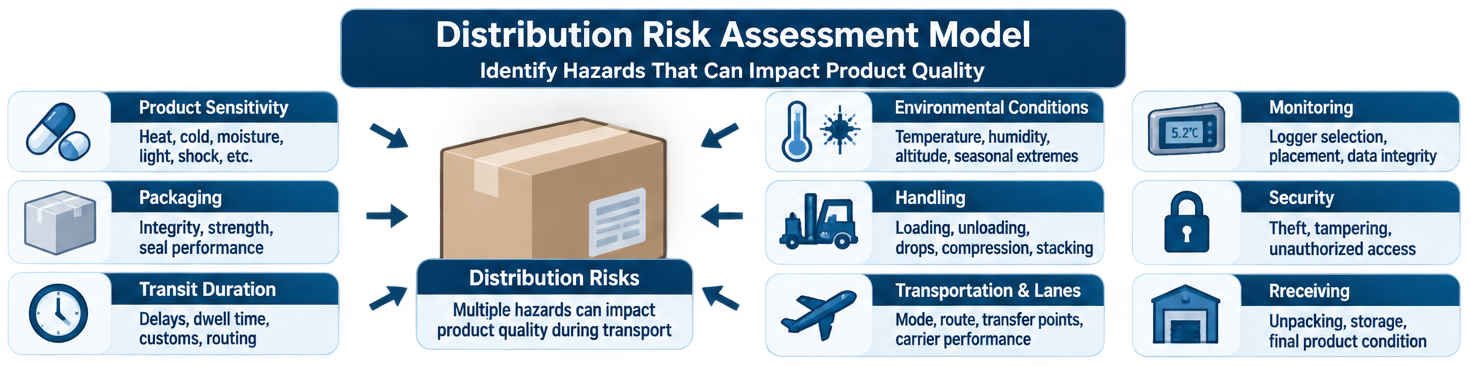
The distribution risk assessment should identify the events capable of compromising the required product condition between shipping and receipt.
ICH Q9(R1) defines quality risk management as a systematic approach to assessment, control, communication, and review of risks to product quality. FDA’s current final guidance emphasizes science-based decision-making and reduction of subjectivity in QRM activities. WHO applies the same concept directly to supply-chain activities and states that risks should be assessed, controlled, communicated, and reviewed at all stages of distribution.
The assessment should therefore produce more than a numerical risk score. Its useful output is identification of the hazards requiring preventive controls, qualification evidence, monitoring, contingency planning, or lifecycle review.
A practical distribution risk matrix can include:
| Risk category | Examples of potential hazards | Potential consequence |
|---|---|---|
| Product sensitivity | Heat, freezing, moisture, shock, light | Degradation or functional failure |
| Package performance | Leakage, puncture, crushing, seal failure | Loss of containment or protection |
| Transit duration | Delay, missed connection, customs hold | Exceed qualified hold time |
| Environmental exposure | Seasonal heat/cold, humidity, altitude | Product or package deterioration |
| Handling | Drops, forklift impact, orientation, stacking | Physical damage |
| Transportation mode | Parcel, LTL, FTL, air, ocean | Different hazard profile |
| Route / lane | Climate, transfer points, airport dwell | Increased exposure variability |
| Carrier execution | Refrigeration failure, poor handling | Loss of controlled condition |
| Monitoring | Wrong logger, incorrect placement, data loss | Inability to verify exposure |
| Security | Theft, tampering, unauthorized access | Product integrity or traceability risk |
| Documentation | Missing shipment records, identification error | Recall and investigation weakness |
| Receiving | Delayed unpacking, incorrect storage | Post-delivery excursion |
The analysis should be specific enough to explain which validation activities are required.
Product Risk and Distribution Risk Should Be Connected
The same transportation event can have very different significance for different products. A short exposure to elevated temperature may be inconsequential for one solid oral dosage product but critical for a temperature-sensitive biologic. A moderate drop may have little impact on a flexible package but could break a glass vial or damage a precision medical device.
Risk assessment should therefore evaluate the relationship: Distribution hazard → product/package vulnerability → potential quality consequence → existing control → required additional evidence
This prevents qualification from being driven primarily by generic transportation standards.
The goal is not to reproduce every possible logistics event. The goal is to demonstrate sufficient control over hazards that could credibly affect the regulated product.
Distribution Control Strategy
The risk assessment should be converted into a defined distribution control strategy.
Depending on the product, controls can include qualified packaging, seasonal pack-outs, refrigerated vehicles, selected carriers, route restrictions, maximum transit time, environmental monitoring, security seals, trained pack-out operators, receiving instructions, alarm escalation, contingency storage, and predefined excursion-assessment procedures.
The control strategy should identify which controls prevent loss of product quality and which controls merely detect that an event occurred.
For example, insulation and refrigerants are preventive thermal controls. A temperature logger is primarily a monitoring control. The logger does not prevent an excursion; it provides evidence that the preventive system succeeded or failed.
The distinction is important because monitoring should not be used as a substitute for an inadequately designed shipping process.
Qualification Evidence Should Follow the Risk
Shipping validation is normally supported by several evidence streams rather than one protocol.
The required evidence may include:
| Validation question | Relevant evidence |
|---|---|
| Can the package withstand mechanical transport hazards? | Distribution simulation |
| Can the package maintain required physical integrity? | Package integrity and post-test evaluation |
| Can a temperature-controlled shipper maintain product conditions? | Thermal OQ |
| Where are thermal hot/cold locations? | Thermal mapping |
| What payload and seasonal conditions are supported? | Payload and seasonal qualification |
| How long can the system protect the product? | Hold-time qualification |
| Can environmental exposure be reliably measured? | Data logger qualification |
| Does the commercial route remain within qualified conditions? | Shipping-lane studies |
| Can the process be executed by routine personnel? | Operational / field verification |
| Does commercial performance remain acceptable? | Monitoring, complaints, trends, periodic review |
This structure prevents one validation document from repeating the detailed technical content of every supporting qualification.
Mechanical Package Performance
Mechanical package qualification should remain within the framework established in Distribution Simulation Strategy and Transport Testing.
ASTM and ISTA procedures can be used to apply standardized laboratory hazards, but the shipping-validation plan should define why those hazards are relevant to the distribution process being validated.
The detailed choice among ASTM and ISTA procedures belongs in ASTM Distribution and Package Performance Test Methods and ISTA Distribution Simulation Protocols and Test Selection.
Shipping validation should use the resulting reports as evidence supporting the overall distribution strategy rather than repeating those method discussions.
Thermal Shipping Capability
For temperature-sensitive products, the shipping system must have sufficient thermal capability to maintain the product through the defined transport period and ambient challenge.
Temperature-Controlled Packaging System Qualification establishes the overall qualification framework. Thermal Mapping, Seasonal Profiles, Payload, and Hold-Time Qualification defines how hot and cold profiles, payload configurations, sensor mapping, and qualified duration should be established.
The shipping-validation strategy should then ensure that actual operations remain within those qualified conditions.
If thermal OQ supports a defined pack-out for a maximum 96-hour period, the commercial process should not routinely depend on shipment durations approaching or exceeding 96 hours without adequate operational margin.
The validated state therefore includes not only the physical shipper but also conditioning, pack-out, payload, seasonal configuration, shipment duration, and handling assumptions.
Shipping Lanes
A shipping lane is more than an origin and destination. It includes the transportation modes, carriers, intermediate facilities, handoffs, transit duration, geographical conditions, and logistics practices associated with moving the product through that pathway. Different lanes can expose the same package to substantially different risks.
A domestic overnight parcel shipment may involve multiple automated sorting hubs but short duration. An international air shipment may introduce airport dwell, customs clearance, tarmac exposure, and delayed connections. Ocean distribution can involve much longer duration and different environmental conditions.
The shipping-validation strategy should determine which lanes require specific qualification and which can be grouped or bracketed. Detailed lane development belongs in the planned Shipping Lane Qualification and Real-World Shipment Studies.
Shipping-Lane Risk Ranking
Where many commercial lanes exist, a risk-based approach can identify representative or worst-case lanes rather than qualifying every origin-destination pair independently.
Relevant factors can include:
- longest expected transit duration;
- greatest seasonal temperature exposure;
- highest number of transfer points;
- customs clearance requirements;
- airport or terminal dwell;
- reliability of the logistics provider;
- transportation mode;
- infrastructure limitations;
- security risk;
- availability of controlled contingency storage;
- history of excursions or delays.
A lane can be considered representative only when the technical characteristics relevant to the qualification are comparable.
Geographical proximity alone does not establish equivalence. Two destinations in the same region can have different carriers, hubs, flight schedules, customs procedures, and exposure conditions.
Seasonal Risk
Seasonal variability should be addressed when temperature or environmental exposure can influence the product or package.
Hot-season and cold-season challenges should be derived from the actual distribution environment or justified standardized profiles. Temperature-controlled shipments can require different summer and winter pack-outs, while mechanically sensitive corrugated packaging may also respond differently under changing humidity.
Seasonal qualification should account for transition periods. A shipment cannot be reliably controlled if personnel have no defined method for deciding when to switch between seasonal configurations.
The control strategy should therefore establish how seasonal conditions are classified and how the applicable pack-out or route control is selected.
Transit Duration and Delay
Transit time should be treated as a controlled parameter where product quality depends on the duration of package protection. The risk assessment should distinguish normal transit duration from foreseeable delays. These can include late carrier pickup, missed flights, customs holds, weekend storage, weather disruption, mechanical failure, incorrect routing, or failed delivery attempts.
The qualified package duration should provide appropriate operational margin beyond expected routine transit. A shipping strategy that is acceptable only when everything occurs exactly on schedule has little robustness.
Contingency procedures should address what happens when a shipment approaches its validated time limit, including possible transfer to controlled storage, refrigerant replenishment, expedited transport, return, or quality escalation.
Handling and Transfer Points
Distribution hazards frequently occur during transitions rather than during steady-state transportation. Loading docks, parcel hubs, airports, customs warehouses, transfer terminals, distribution centers, and final receiving areas can introduce uncontrolled temperature exposure, impact, compression, misrouting, or delays.
The risk assessment should identify high-risk handoff points and determine whether controls are required.
These can include priority handling, controlled staging areas, time limits outside controlled storage, special labeling, carrier instructions, security controls, data monitoring, or approved contingency procedures.
Transportation Providers
Use of a carrier or third-party logistics provider does not transfer responsibility for product quality. WHO’s GDP guidance applies to logistics providers, transport companies, and forwarding agents and specifically requires appropriate control of outsourced storage and distribution activities.
Provider qualification can consider capabilities, licenses where applicable, quality-system maturity, temperature-control systems, vehicle qualification, calibration programs, maintenance, subcontracting, deviation handling, security, training, monitoring, and historical performance.
The level of supplier qualification should correspond to the risk of the service being outsourced.
A common parcel carrier transporting ambient-stable product may require less extensive qualification than a specialized provider operating refrigerated vehicles for a high-value biologic.
Quality Agreements and Logistics Agreements
Where external providers perform activities that can affect regulated product quality, responsibilities should be defined clearly.
The agreement can address transport conditions, monitoring, allowable subcontracting, equipment requirements, maintenance, calibration, alarm response, deviations, damaged shipments, security, document retention, change notification, and escalation.
The purpose is not to rewrite the carrier’s operating procedures. The agreement should make clear which quality-critical responsibilities belong to each party and how exceptions are communicated.
A transportation contract focused only on cost and delivery times is not a substitute for quality responsibilities where the service directly affects product condition.
Vehicle Qualification
Vehicles should be evaluated according to the service they perform. WHO GDP states that vehicles should be suitable for their intended purpose and that vehicles used for transporting medical products should be qualified where applicable to demonstrate their capability to maintain required transport conditions. Environmental conditions should be monitored and recorded, and monitoring instruments should be calibrated.
A refrigerated vehicle may therefore require temperature mapping, control-system qualification, alarm verification, maintenance, calibration, and seasonal assessment.
A conventional parcel-delivery vehicle may not require full thermal qualification when product protection is provided by a qualified passive shipper. The packaging system rather than the vehicle becomes the primary environmental control.
The validation strategy should identify where the actual control resides.
Environmental Monitoring
Distribution Environmental Monitoring and Data Logger Qualification defines the qualification and lifecycle control of shipping-monitoring devices.
The shipping strategy should specify when monitoring is required, which parameter is monitored, where the device is placed, how it is activated, who reviews the data, and what constitutes an excursion requiring quality assessment.
Monitoring intensity can vary. Some high-risk shipments may require continuous real-time monitoring, while mature low-risk routes may support a reduced strategy based on accumulated qualification and performance evidence.
Monitoring frequency should be a risk-based lifecycle decision, not simply a permanent convention established during launch.
Security and Traceability
Shipping validation should consider physical security where loss, theft, diversion, or tampering can affect product quality or regulatory control.
WHO recommends measures to prevent unauthorized access, tampering, theft, or misappropriation of transported medical products and identifies GPS tracking as a possible measure for improving traceability and security.
Controls can include tamper-evident seals, chain-of-custody records, controlled access, GPS tracking, approved routes, vehicle security, shipment identification, and escalation procedures.
The significance of these controls depends on the product. Controlled substances, high-value biologics, and products subject to counterfeiting or diversion may require substantially stronger measures than conventional products.
Shipping Procedures
The approved shipping process should be sufficiently defined that trained personnel can reproduce the validated configuration. Procedures can address product release status, correct packaging selection, payload configuration, pack-out instructions, logger placement, refrigerant conditioning, seasonal decision logic, labeling, documentation, carrier selection, shipment release, tracking, receipt confirmation, and excursion escalation.
21 CFR §211.150 requires written procedures for distribution and requires the distribution of each lot to be readily traceable to support recall.
The SOP should not attempt to contain all validation rationale. Detailed technical justification belongs in qualification protocols, risk assessments, and reports; the operating procedure should translate the validated state into repeatable actions.
Training
Shipping validation depends heavily on operational execution. Personnel preparing temperature-controlled shipments, loading vehicles, configuring monitoring devices, selecting seasonal pack-outs, or reviewing shipment data should be trained for the tasks they perform.
Training should focus particularly on activities where small errors can invalidate the qualified configuration, such as incorrect refrigerant conditioning, wrong payload placement, failure to activate a logger, use of the wrong seasonal configuration, or excessive staging time.
Where an external logistics provider performs critical activities, its training controls should be addressed through qualification and agreement rather than assumed.
Shipping Validation Acceptance Criteria
Acceptance criteria should be established before qualification or field verification begins. Depending on the product, criteria can address environmental exposure, physical package condition, container integrity, sterile-barrier integrity, device functionality, product appearance, orientation, labeling, security seals, delivery duration, logger completeness, and shipment documentation.
Examples include:
- product temperature remains within the defined qualification range;
- all required product monitoring locations remain acceptable for the required duration;
- no primary containers are broken or leaking;
- no package-integrity failure is detected;
- no unacceptable sterile-barrier defect is present;
- product or device functionality remains within specification;
- transit duration remains within the qualified operating window;
- shipment-monitoring records are complete and attributable;
- security seals and shipping identification remain intact;
- any observed damage does not compromise required product protection.
Generic criteria such as “shipment arrived in good condition” should not be used as the sole validation acceptance standard.
Field Verification and Representative Shipments
Real shipping studies can confirm that the commercial process operates within the assumptions established by laboratory qualification. Field studies should use the approved commercial configuration, trained personnel, actual logistics providers, representative shipment timing, and appropriate monitoring.
The objective is not necessarily to prove that a field shipment experienced the worst possible environmental challenge. Laboratory qualification normally addresses controlled worst-case exposure. Field verification demonstrates that the process can be implemented successfully in real operations.
These studies become particularly important for complex routes, temperature-sensitive products, international logistics, or supply chains with multiple handoffs.
Representative Versus Worst-Case Shipments
The distinction used elsewhere in packaging qualification also applies to field shipping. A worst-case lane is selected because its characteristics challenge the distribution system—for example, long transit duration, severe seasonal temperature, multiple transfers, or limited infrastructure.
A representative shipment demonstrates normal commercial execution.
Both can be useful, but they answer different questions. A validation program relying entirely on unusually severe shipments may provide little evidence about routine operational reproducibility, while a program containing only normal shipments may fail to challenge important risk assumptions.
Deviations During Shipping Validation
Qualification deviations should be investigated according to their potential effect on the study conclusion. Examples include incorrect pack-out, failed logger, route change, unexpected delay, chamber or transport-system malfunction, incorrect shipment configuration, missing documentation, package damage, or uncontrolled environmental exposure.
The first question should be whether the deviation affected the validity of the evidence or revealed a real weakness in the shipping process.
A study should not be repeated merely to obtain a passing shipment. The original event should remain documented and its relevance to the commercial process understood.
Commercial Excursions
Excursions after validation should be evaluated both as individual product events and as potential signals that the distribution system is deteriorating.
The immediate product assessment can consider temperature magnitude and duration, product stability data, packaging condition, measurement uncertainty, route information, and cumulative exposure where applicable.
Repeated excursions require a broader investigation. Even when stability data support release of each affected lot, recurring events can indicate that the package, route, carrier, hold-time assumption, seasonal profile, or operating procedure no longer provides adequate control.
Product disposition and distribution-system CAPA are related but separate decisions.
Complaints and Shipping Damage
Distribution-related complaints provide valuable lifecycle evidence. Recurring crushed cartons, broken vials, punctured sterile barriers, temperature excursions, damaged labels, or delayed deliveries can demonstrate that laboratory qualification did not fully represent commercial exposure or that the distribution process has changed.
Complaints should therefore be periodically categorized and trended for potential distribution causes.
A complaint pattern can trigger focused route studies, package redesign, carrier review, revised handling instructions, or requalification.
Shipping Validation Documentation
Shipping validation should be supported by a coherent set of documents rather than one oversized protocol. A useful evidence structure can include:
| Document | Purpose |
|---|---|
| Product distribution requirements | Defines required product conditions |
| Shipping-system specification | Defines package and logistics configuration |
| Distribution risk assessment | Identifies hazards and required controls |
| Packaging qualification | Demonstrates physical package capability |
| Thermal qualification | Demonstrates temperature-control capability |
| Monitoring-system qualification | Demonstrates reliable environmental measurement |
| Lane assessment / qualification | Demonstrates route applicability |
| Provider qualification | Demonstrates outsourced logistics capability |
| Field verification | Confirms operational execution |
| Shipping validation report | Integrates evidence and defines validated scope |
| SOPs and training | Maintain routine execution |
| Periodic review | Confirms continued validated state |
The shipping-validation report should reference supporting qualification evidence rather than duplicate it.

Shipping Validation Report
The final report should define what distribution process has actually been validated. The conclusion should identify the products or product families covered, shipping configurations, packaging revisions, payload ranges, transport conditions, permitted carriers or carrier categories, applicable lanes, qualified duration, seasonal configurations, monitoring requirements, acceptance criteria, deviations, and limitations.
An overly broad conclusion such as “shipping is validated worldwide” is rarely defensible unless the supporting evidence genuinely covers that scope.
A stronger conclusion defines the operating envelope and identifies which assumptions require reassessment when conditions change.
Medical-Device Shipping Considerations
For finished medical devices distributed in the United States, FDA’s Quality Management System Regulation became effective February 2, 2026 and incorporates ISO 13485:2016 by reference.
For medical devices, shipping controls should therefore remain connected to the manufacturer’s overall QMS, product specifications, packaging requirements, risk-management activities, and preservation of product conformity through distribution.
Sterile devices also require coordination with packaging-system evidence demonstrating maintenance of the sterile barrier through transportation. Shipping validation should not replace that packaging qualification; it establishes how the qualified package is controlled in the actual distribution system.
Pharmaceutical Shipping Considerations
For pharmaceuticals and biologics, shipping validation should remain tied directly to approved storage conditions, product stability, container-closure suitability, and GMP distribution procedures.
WHO GDP states that medical products should be transported according to conditions specified on labeling and by the manufacturer, with transport risks minimized to an acceptable level. The same guidance addresses qualified vehicles where appropriate, monitoring, calibrated instruments, security, documentation, and investigation of transit problems.
This provides a useful lifecycle framework even where the U.S. CFR does not prescribe a particular shipping-validation format.
Change Control
The validated shipping state should be protected through change control. Changes requiring assessment can include new products, revised storage conditions, new primary or secondary packaging, new shipper size, refrigerant or PCM changes, payload changes, new carriers, route changes, transportation-mode changes, revised seasonal pack-outs, longer transit duration, new distribution centers, monitoring-system changes, or changes to external logistics providers.
The assessment should determine which validation assumptions are affected.
A new carrier using the same established lane and qualified transport conditions may require provider assessment and limited verification. Changing from palletized truckload distribution to parcel delivery can introduce an entirely different hazard profile and may require new mechanical package qualification.
Requalification Triggers
Requalification should be based on impact to the validated distribution envelope. Potential triggers include repeated excursions, significant package damage, new worst-case lanes, extended transport duration, major carrier changes, modified packaging, revised product temperature requirements, new seasonal conditions, different payload configuration, equipment changes, or evidence that the original qualification no longer represents commercial performance.
Not every trigger requires repetition of the complete validation package. The requalification scope should correspond to the evidence affected by the change.
Periodic Review
Shipping validation should be periodically reviewed as a lifecycle system. The review can integrate environmental-monitoring trends, shipment duration, deviations, temperature excursions, complaints, carrier performance, package damage, route changes, calibration failures, logistics-provider audits, CAPA effectiveness, and changes to the qualified shipping configuration.
WHO GDP explicitly expects systems for quality risk management, changes, deviations, CAPA, complaints, outsourced activities, qualification, and ongoing distribution control.
A periodic review should therefore determine whether the original risk assessment and qualification evidence remain representative of actual commercial distribution.
Validation Perspective
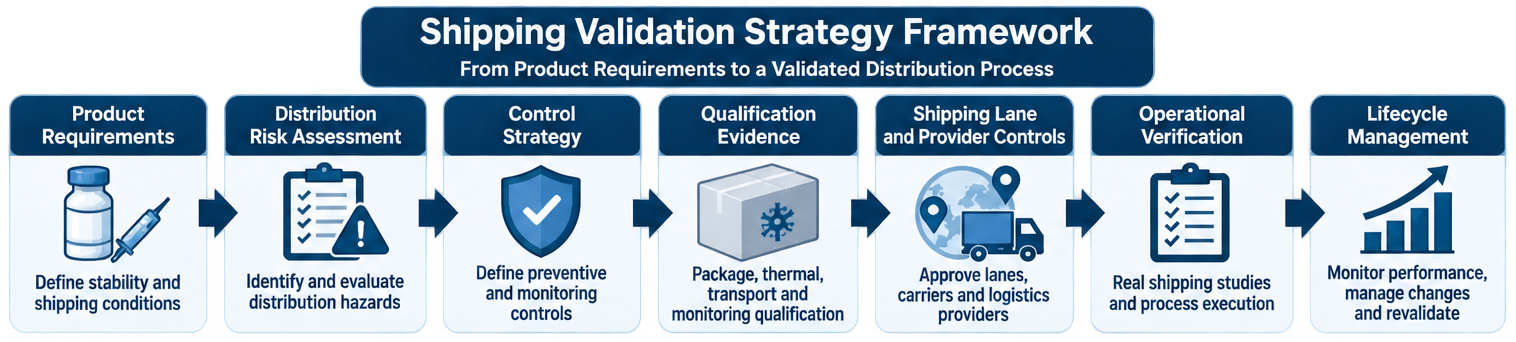
A defensible shipping-validation strategy should answer six questions:
- What product conditions must be protected during distribution?
- What transportation hazards could cause those conditions to be lost?
- What packaging, logistics, monitoring, and operational controls prevent or detect those failures?
- What qualification evidence demonstrates that the controls are capable?
- Does commercial shipping operate within the qualified envelope?
- How will changes, excursions, complaints, and performance trends protect the validated state over time?
The overall validation logic is: Product requirements → distribution risk assessment → shipping control strategy → package and thermal qualification → route and provider controls → field verification → commercial monitoring → periodic review and requalification
This structure keeps shipping validation focused on the distribution process itself while using the detailed package, ASTM/ISTA, thermal, mapping, and monitoring studies developed elsewhere in the Packaging and Shipping Validation domain as supporting evidence rather than duplicating them.