

Computerized System Supplier Assessment and Evidence Leverage
Computerized systems used in regulated operations increasingly depend on software developers, cloud providers, implementation partners, infrastructure providers, service organizations, and specialist subcontractors. These suppliers may develop the application, configure workflows, host regulated records, manage infrastructure, perform backups, deploy updates, provide cybersecurity monitoring, or support recovery from failures.
The regulated organization may delegate activities to a supplier, but it retains responsibility for ensuring that the computerized system is fit for its intended use and that applicable Good Practice (GxP) requirements remain satisfied.
Supplier assessment should establish whether the supplier is capable of consistently providing the product and services relied upon. It should also determine what supplier documentation can be accepted as validation evidence, what requires supplementation, and what must be verified independently.
The objective is not to audit every supplier or reproduce every test already performed. The objective is to understand the dependency, evaluate supplier capability, identify the evidence available, address material gaps, and establish controls proportionate to:
- the system’s intended use;
- patient-safety and product-quality impact;
- data criticality;
- supplier responsibilities;
- product maturity;
- configuration and customization;
- service and hosting model;
- cybersecurity exposure;
- business-continuity risk;
- supplier transparency;
- and the quality of available evidence.
Supplier assessment should begin during product selection and continue throughout implementation, operation, major change, and retirement.
Supplier Assessment Versus Supplier Qualification
The terms supplier assessment and supplier qualification are sometimes used interchangeably, but they represent different concepts.
Supplier Assessment
Supplier assessment is the collection and evaluation of information about:
- supplier capability;
- quality and development practices;
- product maturity;
- services;
- security;
- operational controls;
- support;
- available evidence;
- contractual commitments;
- and identified risks.
Assessment methods may include:
- public-information review;
- product documentation;
- questionnaires;
- certifications;
- independent audit reports;
- remote interviews;
- demonstrations;
- reference checks;
- and remote or on-site audits.
Supplier Qualification
Supplier qualification is the regulated organization’s documented decision that a supplier is acceptable for a defined product, service, and intended relationship.
Qualification should identify:
- what supplier and legal entity were assessed;
- which product and service were evaluated;
- applicable versions or service models;
- intended GxP use;
- approved scope;
- identified limitations;
- required agreements;
- required follow-up actions;
- monitoring requirements;
- reassessment triggers;
- and approval status.
A supplier should not be described as universally qualified. A supplier may be acceptable for a standard, noncritical software product but require additional controls before hosting critical regulated records or developing custom release logic.
Supplier qualification is therefore specific to the relationship, product, service, and intended use.
Regulated-Company Responsibility
The regulated organization remains responsible for:
- defining intended use;
- determining GxP and 21 CFR Part 11 applicability;
- establishing the system boundary;
- assessing process and data risks;
- selecting an appropriate supplier;
- defining requirements;
- approving the configuration;
- evaluating supplier evidence;
- performing necessary site-specific verification;
- authorizing release;
- controlling access;
- maintaining procedures and training;
- reviewing changes;
- monitoring supplier performance;
- protecting and retaining records;
- and managing retirement.
Contracts and service agreements do not transfer regulatory accountability to the supplier.
For drug manufacturing systems, 21 CFR 211.68 requires appropriate controls over computer and related systems, accuracy of relevant inputs and outputs, authorized changes, and secure backup data.
Where electronic records or electronic signatures are used to meet applicable FDA requirements, 21 CFR Part 11 may apply. Use of a hosted or cloud service does not remove the regulated organization’s responsibility for applicable record controls.
The previous GAMP 5 Principles for Computerized System Validation article explains how supplier involvement fits within the risk-based lifecycle.
Supplier Inventory and Ownership
The organization should maintain visibility of suppliers supporting its GxP computerized systems.
The supplier inventory may identify:
- supplier name and legal entity;
- product or service;
- associated computerized systems;
- system owner;
- business-process owner;
- technical owner;
- contract owner;
- hosting model;
- data-processing role;
- critical subcontractors;
- support level;
- qualification status;
- assessment tier;
- assessment date;
- open findings;
- reassessment date;
- and supplier-exit status.
Ownership should be defined for:
- initial assessment;
- technical evaluation;
- quality approval;
- cybersecurity review;
- privacy review;
- contract negotiation;
- performance monitoring;
- change notifications;
- periodic reassessment;
- and termination.
Supplier assessments can become ineffective when procurement, Information Technology, Quality, validation, cybersecurity, privacy, and business owners evaluate separate aspects without an integrated conclusion.
Supplier Criticality
Supplier criticality describes the extent to which the regulated organization depends on the supplier’s product, services, personnel, controls, or continued operation.
Criticality should be assessed in relation to the specific intended use.
Relevant factors include:
- GxP impact of supported functions;
- patient-safety and product-quality consequences;
- criticality of records and metadata;
- whether the supplier hosts authoritative records;
- whether the supplier administers production access;
- whether the supplier performs backups or restoration;
- whether the supplier controls software releases;
- extent of configuration or custom development;
- importance of interfaces;
- availability requirements;
- ability to operate during an outage;
- ability to replace the supplier;
- availability of internal expertise;
- data-export capability;
- and effect of supplier failure.
A large, well-known software company is not automatically a critical supplier. A small specialist maintaining one custom calculation used for batch disposition may create a more significant dependency.
Supplier criticality should not be confused with supplier capability. Criticality describes the regulated organization’s dependency. Capability describes how reliably and transparently the supplier can meet that dependency.
Supplier Capability
Supplier capability concerns whether the supplier has adequate controls, competence, resources, and evidence to provide the required product and services.
Capability factors may include:
- organizational stability;
- relevant regulated-industry experience;
- personnel competence;
- quality-management system;
- software-development lifecycle;
- product-management practices;
- testing;
- configuration management;
- release management;
- defect management;
- cybersecurity;
- incident management;
- service operations;
- backup and recovery;
- business continuity;
- subcontractor oversight;
- customer support;
- regulatory support;
- and lifecycle commitment.
A supplier with strong capability may permit greater use of supplier evidence. Weak capability or limited transparency may require additional verification, contractual controls, compensating procedures, or selection of another supplier.
Assessment Tiers
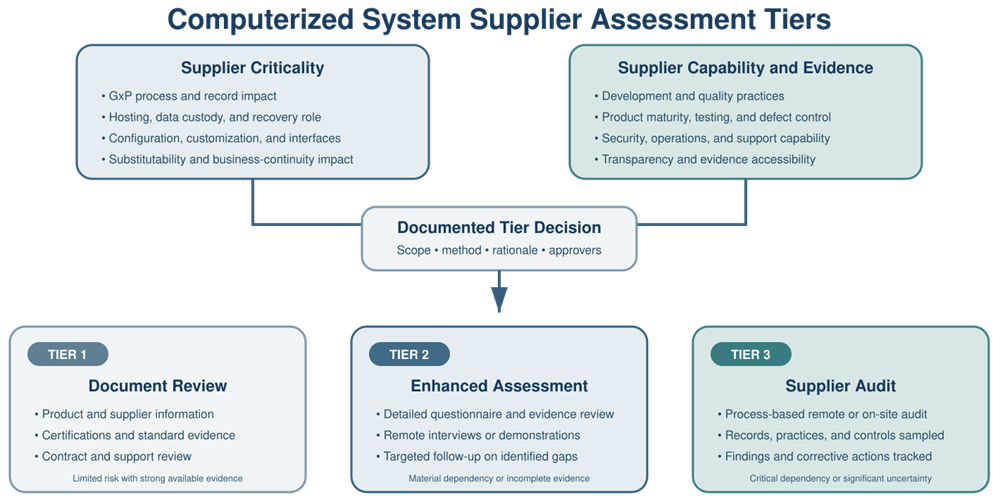
Supplier-assessment depth should reflect supplier criticality, supplier capability, uncertainty, and evidence quality.
A useful tiering model may include the following.
Tier 1—Document Review
A document review may be appropriate when:
- supplier dependency is limited;
- the product is mature;
- standard functionality is used;
- little or no customization is involved;
- the supplier does not host critical records;
- satisfactory evidence is readily available;
- and significant failure risks are independently controlled.
The review may include:
- supplier and product information;
- standard product documentation;
- certifications;
- independent assurance reports;
- licensing and support terms;
- release information;
- security information;
- backup information;
- and contractual commitments.
Tier 2—Enhanced Assessment
An enhanced assessment may be appropriate when:
- the supplier provides a material GxP function or service;
- the application is extensively configured;
- critical data or interfaces are involved;
- custom components are limited but significant;
- the supplier performs hosting or administration;
- standard documentation is incomplete;
- or follow-up is needed to confirm specific controls.
The assessment may include:
- a detailed questionnaire;
- supporting-document review;
- remote interviews;
- product demonstrations;
- review of sample lifecycle records;
- cybersecurity review;
- recovery review;
- and targeted follow-up on identified gaps.
Tier 3—Supplier Audit
A process-based audit may be justified when:
- supplier dependence is critical;
- custom development is extensive;
- the supplier controls critical records or operations;
- material concerns remain unresolved;
- evidence is inaccessible or unreliable;
- a serious incident has occurred;
- prior performance is unacceptable;
- or the regulated organization cannot otherwise establish confidence.
The audit may be remote, on-site, or hybrid. It should examine actual implementation of relevant controls rather than merely confirm that procedures exist.
A Tier 3 audit should not be automatic for every high-impact system. Strong evidence, mature commercial products, independent assurance reports, and effective site controls may justify another method. Conversely, an audit may be appropriate for a smaller system when supplier uncertainty or dependency is significant.
Planning the Supplier Assessment
The assessment should be planned before questionnaires are issued or audits are scheduled. The plan should identify:
- supplier and legal entity;
- product and service;
- intended use;
- system boundary;
- supplier responsibilities;
- critical subcontractors;
- data handled;
- hosting arrangement;
- software category;
- configuration and customization;
- identified risks;
- available evidence;
- proposed assessment tier;
- assessment participants;
- assessment criteria;
- deliverables;
- and approval responsibility.
Generic questionnaires frequently produce large volumes of low-value information. Assessment questions should be selected because the answers affect a validation, security, contractual, or lifecycle decision.
The assessment should distinguish:
- controls performed by the product supplier;
- controls performed by an implementation partner;
- controls performed by a cloud or infrastructure provider;
- controls performed by subcontractors;
- and controls retained by the regulated organization.
Development and Quality Practices
For suppliers that develop or maintain software, the assessment should address the software-development and quality framework. Relevant topics include:
- development lifecycle;
- requirements management;
- design controls;
- risk management;
- coding standards;
- source-code management;
- code review;
- automated code analysis;
- unit testing;
- integration testing;
- system testing;
- security testing;
- defect management;
- build management;
- release approval;
- documentation control;
- training;
- internal audits;
- corrective actions;
- and management oversight.
The assessment should determine whether practices are applied consistently—not merely whether procedures exist.
Evidence may include:
- lifecycle procedures;
- organizational charts;
- development plans;
- sample requirements;
- traceability records;
- code-review records;
- test summaries;
- defect records;
- release approvals;
- internal-audit summaries;
- and relevant certifications.
For a nonconfigured commercial product, detailed access to design records may be unnecessary or unavailable. For a custom application or critical custom component, greater visibility into design, code control, review, testing, and maintenance is normally justified.
The preceding GAMP 5 Software Categories and Validation Strategy article explains how software category affects supplier reliance and lifecycle evidence.
Product Maturity and Operational History
Product maturity can provide useful evidence, but market longevity alone does not establish fitness for the regulated organization’s intended use. The assessment may consider:
- years in production use;
- installed customer base;
- regulated-industry use;
- current product version;
- frequency of major releases;
- product roadmap;
- support lifecycle;
- known limitations;
- defect history;
- security history;
- performance history;
- and customer references.
A mature product may still present risk when:
- a newly released version is selected;
- a new module is implemented;
- configuration is novel;
- custom code is introduced;
- interfaces are unique;
- the hosting model has changed;
- or the intended use differs from common implementations.
A newer product is not automatically unacceptable. It may require more direct evidence, focused testing, contractual protection, and post-release monitoring.
Supplier Testing
Supplier testing may provide valuable evidence for functions and controls developed and maintained by the supplier. Relevant testing may include:
- unit testing;
- integration testing;
- system testing;
- regression testing;
- installation testing;
- performance testing;
- load testing;
- security testing;
- compatibility testing;
- browser or device testing;
- backup and restoration testing;
- failover testing;
- and disaster-recovery exercises.
The assessment should determine:
- what was tested;
- against which requirements or specifications;
- on what version;
- in what environment;
- using what test data;
- under what configuration;
- with what acceptance criteria;
- by whom;
- with what independence;
- and how deviations and defects were handled.
A statement that software was “fully tested” is insufficient without enough information to understand the scope, methods, results, and applicability.
Supplier test evidence is most useful when it is:
- approved;
- version-specific;
- traceable;
- complete;
- reviewable;
- protected;
- and relevant to the functionality being leveraged.
Defect and Problem Management
The supplier should have controlled processes for identifying, evaluating, resolving, and communicating defects. The assessment should address:
- defect reporting;
- unique identification;
- severity classification;
- impact assessment;
- root-cause analysis;
- correction;
- verification;
- closure;
- trend analysis;
- known-error management;
- and customer notification.
The regulated organization should understand:
- how known defects are disclosed;
- how customer-specific effects are evaluated;
- whether workarounds are documented;
- how security vulnerabilities are handled;
- and whether unresolved defects affect the intended use.
A supplier’s classification of a defect should not be accepted automatically. The regulated organization should assess the defect in the context of its own configuration, data, process, and controls.
Release Management
Supplier release practices directly affect the validated state. The assessment should consider:
- version identification;
- release types;
- development and test completion;
- release approval;
- release notes;
- defect disclosure;
- security content;
- compatibility;
- data-model changes;
- interface changes;
- documentation updates;
- deployment controls;
- rollback;
- and support periods.
For software as a service (SaaS), the supplier may control production deployment and release cadence. The organization should determine:
- whether updates can be deferred;
- how much notice is provided;
- what release information is available;
- whether a test environment is provided;
- whether configuration can be tested before production release;
- how emergency changes are managed;
- and how regression impact is assessed.
Release notes should be detailed enough to identify effects on:
- configured functions;
- records;
- metadata;
- calculations;
- reports;
- roles;
- interfaces;
- infrastructure;
- security;
- procedures;
- and validation evidence.
Configuration and Customization
The assessment should distinguish the supplier’s standard product from configured and custom components. It should identify:
- standard functionality;
- supported configuration tools;
- configured workflows;
- master data;
- calculations;
- reports;
- scripts;
- macros;
- plug-ins;
- custom modules;
- interface code;
- low-code components;
- and unsupported modifications.
Responsibility should be defined for:
- requirements;
- configuration specifications;
- design;
- development;
- review;
- testing;
- version control;
- deployment;
- defect resolution;
- documentation;
- and future maintenance.
Custom work performed by the principal software supplier remains custom. Supplier familiarity with its own platform may reduce implementation risk, but it does not eliminate the need for appropriate design, code control, testing, and maintenance evidence.
Cybersecurity
Cybersecurity should be included because supplier controls can affect the confidentiality, integrity, availability, and validated state of GxP systems and records.
The assessment may address:
- secure-development practices;
- threat and vulnerability management;
- supported components;
- software dependencies;
- secure configuration;
- authentication;
- multifactor authentication;
- privileged access;
- encryption;
- network protection;
- logging and monitoring;
- penetration testing;
- vulnerability scanning;
- patching;
- security incident response;
- coordinated vulnerability disclosure;
- ransomware resilience;
- protected backups;
- and customer notification.
The organization should determine:
- which party monitors vulnerabilities;
- how rapidly critical findings are assessed;
- who applies patches;
- how patches are validated;
- what compensating controls are available;
- and how security incidents affecting regulated records are communicated.
Certifications and independent assurance reports may support the assessment, but their scope, period, exclusions, and applicability should be reviewed.
Further lifecycle controls are addressed in Cybersecurity Controls for GMP Computerized Systems.
Data Ownership and Control
Contracts and system architecture should establish that the regulated organization retains appropriate ownership and control of its data and records. The assessment should address:
- data ownership;
- metadata ownership;
- audit-trail ownership;
- electronic signatures;
- attachments;
- configuration records;
- derived data;
- aggregated data;
- supplier use of customer data;
- data-location restrictions;
- privacy;
- encryption-key ownership;
- administrator access;
- record retention;
- legal holds;
- and controlled disposition.
The organization should understand whether the supplier may:
- access production data;
- use customer data for analytics;
- copy data into support environments;
- use data for model training;
- disclose data to subcontractors;
- or retain data after contract termination.
Data ownership without practical export and retrieval capability provides inadequate control.
Backup and Recovery
The supplier assessment should distinguish:
- operational backup;
- replication;
- snapshots;
- high availability;
- archival;
- restoration;
- disaster recovery;
- and business continuity.
The assessment should identify:
- data and configuration included in backup;
- metadata and audit trails included;
- backup frequency;
- retention;
- storage locations;
- encryption;
- separation from production;
- immutable or protected copies;
- monitoring;
- failed-backup response;
- restoration procedures;
- restoration testing;
- recovery-point objective;
- recovery-time objective;
- complete-system recovery;
- and customer access to recovery evidence.
A supplier statement that data are backed up does not demonstrate recoverability. Restoration and recovery should be periodically exercised and documented.
FDA’s Data Integrity and Compliance With Drug CGMP guidance explains that backup records should include associated metadata and remain protected and retrievable.
Cloud Operations and Shared Responsibility
Cloud arrangements may involve:
- software as a service;
- platform as a service;
- infrastructure as a service;
- private cloud;
- public cloud;
- hybrid cloud;
- and managed hosting.
The assessment should identify which party is responsible for:
- application development;
- application configuration;
- infrastructure;
- operating systems;
- databases;
- tenant separation;
- identity services;
- privileged access;
- logging;
- monitoring;
- security;
- patching;
- backup;
- restoration;
- disaster recovery;
- incident management;
- capacity;
- availability;
- and data export.
The primary application supplier may rely on several cloud and service providers. The regulated organization should understand the chain of responsibility instead of treating the application supplier as the only relevant party.
Cloud-specific controls are addressed further in Cloud and SaaS Systems in GMP Environments.
Subcontractors and Fourth Parties
Suppliers may depend on subcontractors for:
- hosting;
- data centers;
- software development;
- customer support;
- cybersecurity monitoring;
- backup;
- disaster recovery;
- implementation;
- data migration;
- and specialized services.
The assessment should determine:
- which subcontractors perform critical activities;
- where they operate;
- what data they can access;
- how they are selected;
- how their performance is monitored;
- what contractual controls apply;
- whether changes require notification;
- and whether the regulated organization has appropriate audit or information rights.
The objective is not necessarily to audit every subcontractor. The organization should understand the material dependencies and confirm that the principal supplier exercises adequate oversight.
Change Notification
Supplier change-notification commitments should be appropriate to the service and intended use. Notification may be required for changes to:
- application functionality;
- versions;
- configuration capabilities;
- calculations;
- data models;
- reports;
- interfaces;
- infrastructure;
- hosting location;
- subcontractors;
- security controls;
- backup;
- recovery;
- service levels;
- support status;
- ownership;
- and product retirement.
The agreement should define:
- which changes require notification;
- notification timing;
- information provided;
- emergency-change handling;
- customer-assessment period;
- access to test environments;
- deployment restrictions where available;
- and escalation.
Notification after deployment may be inadequate for changes that require prior validation or procedural preparation.
Audit and Information Rights
Contracts should provide rights proportionate to supplier criticality. These may include:
- questionnaires;
- documentation requests;
- remote review;
- independent audit reports;
- regulatory-inspection information;
- remote audits;
- on-site audits;
- subcontractor information;
- security reports;
- recovery-test evidence;
- incident records;
- and corrective-action follow-up.
Unlimited audit rights are not always realistic or necessary, particularly for large cloud suppliers. Alternative assurance may include independent reports, certifications, pooled audits, customer audit programs, and structured evidence packages.
The agreement should still permit adequate access to information needed to establish and maintain confidence in the service.
Business Continuity and Supplier Failure
The assessment should consider the supplier’s ability to continue supporting the product or service after disruptive events. Relevant scenarios include:
- data-center outage;
- regional cloud outage;
- cyberattack;
- ransomware;
- loss of key personnel;
- subcontractor failure;
- financial distress;
- acquisition;
- product discontinuation;
- support withdrawal;
- prolonged service interruption;
- and supplier insolvency.
Controls may include:
- redundant services;
- tested disaster recovery;
- alternate support arrangements;
- source-code escrow;
- local data extracts;
- documented manual procedures;
- alternate processing methods;
- recovery priorities;
- communication plans;
- and supplier-exit plans.
Business continuity should address both restoration of the technology and reconciliation of regulated work performed during the interruption.
Data Export and Portability
The organization should confirm that regulated records can be exported accurately and completely throughout the service period and at termination. Export capability should address:
- record content;
- metadata;
- audit trails;
- electronic signatures;
- attachments;
- relationships;
- status;
- code-table meaning;
- native formats;
- human-readable copies;
- open or documented formats;
- volume;
- extraction time;
- export validation;
- and supplier assistance.
A simple report or comma-separated-values export may not preserve the complete regulated record.
Export capability should be tested before it becomes necessary during an emergency, migration, contract dispute, or supplier failure.
Retirement and Termination Support
Supplier assessment and contracting should address retirement before the system is implemented. Retirement support may include:
- final data export;
- reconciliation;
- metadata and audit-trail extraction;
- migration assistance;
- archival support;
- continued read-only access;
- documentation transfer;
- configuration export;
- source-code transfer where applicable;
- license transition;
- data deletion;
- deletion certification;
- backup expiration;
- interface shutdown;
- subcontractor disposition;
- and termination assistance.
The agreement should establish:
- notice periods;
- export formats;
- service timeframes;
- responsibilities;
- costs;
- support after termination;
- and treatment of records remaining in backups.
Retirement planning should not depend on the supplier’s cooperation beyond what is contractually established.
Supplier Evidence Leverage
Supplier documentation may reduce unnecessary duplication when it is credible, applicable, and appropriately controlled. Potentially useful evidence includes:
- development procedures;
- quality-system information;
- architecture;
- specifications;
- design documentation;
- risk assessments;
- test plans;
- test results;
- traceability;
- defect records;
- release records;
- security assessments;
- backup and recovery tests;
- service reports;
- audit reports;
- and certifications.
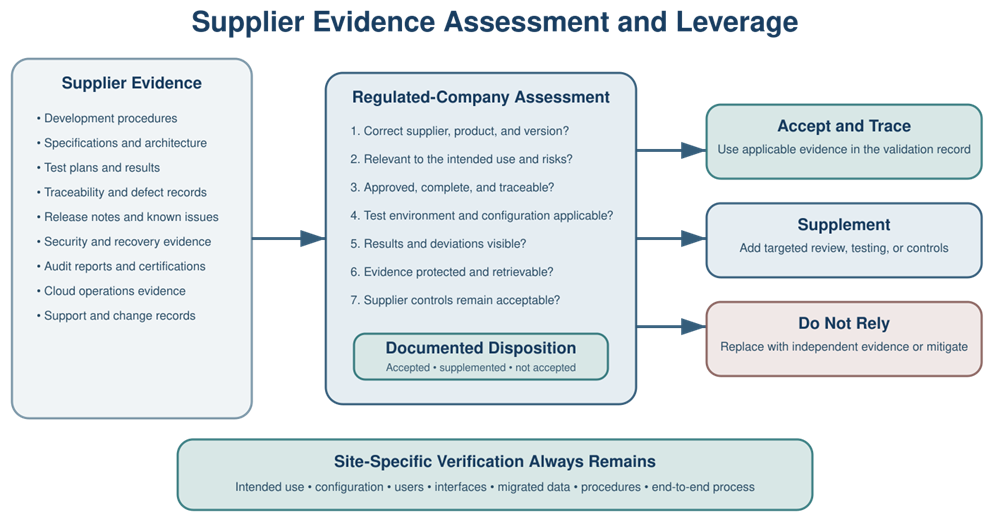
Supplier evidence should be evaluated before it is relied upon.
The evaluation should determine:
- correct supplier and product;
- correct version;
- relevance to intended use;
- relevance to identified risks;
- configuration applicability;
- test-environment applicability;
- approval status;
- completeness;
- traceability;
- visibility of results;
- visibility of deviations;
- protection and retention;
- and continued validity.
Supplier evidence may be:
- accepted and traced;
- accepted with limitations;
- supplemented;
- or not accepted.
Accepting Supplier Evidence
Supplier evidence may be accepted when:
- its source is known;
- the applicable product and version are identified;
- the supplier’s practices are acceptable;
- the evidence is approved;
- the scope is relevant;
- results are visible;
- deviations are adequately resolved;
- the environment and configuration are applicable;
- and the record can be retained and retrieved.
Accepted evidence should be referenced or traced within the site validation record.
The organization should identify:
- which requirement or risk control the evidence supports;
- what supplier record provides the evidence;
- what limitations apply;
- and who approved its use.
Acceptance should not consist solely of placing supplier documents in a project folder.
Supplementing Supplier Evidence
Supplementation may be necessary when supplier evidence is generally acceptable but does not fully address the site’s needs. Examples include:
- focused testing of a critical function;
- configuration review;
- independent calculation verification;
- interface testing;
- security testing;
- data-migration reconciliation;
- restoration testing;
- review of unresolved defects;
- contractual controls;
- procedural controls;
- and post-release monitoring.
Supplementation should address the identified gap rather than repeat supplier work without purpose.
Evidence That Should Not Be Relied Upon
Supplier evidence should not be relied upon when it is:
- unrelated to the applicable version;
- generic and unsupported;
- incomplete;
- unapproved;
- not traceable;
- based on an inapplicable configuration;
- missing results;
- missing deviation disposition;
- produced under unacceptable practices;
- or unavailable for retention and review.
The organization should replace inadequate evidence through:
- independent testing;
- additional supplier evidence;
- stronger contractual controls;
- compensating controls;
- reduced intended use;
- redesign;
- or selection of another supplier.
Site-Specific Verification Remains Necessary
Supplier evidence cannot establish that the site-specific computerized system is fit for intended use. The regulated organization should verify, as applicable:
- intended business processes;
- configured workflows;
- roles and permissions;
- electronic signatures;
- audit trails;
- master data;
- calculations;
- reports;
- interfaces;
- migrated data;
- local infrastructure;
- user procedures;
- exceptional conditions;
- backup and restoration responsibilities;
- and representative end-to-end operation.
Supplier testing demonstrates what the supplier tested. Site-specific verification demonstrates that the implemented system, as configured and used by the regulated organization, supports the approved intended use.
Supplier Findings and Risk Acceptance
Assessment findings should be documented and classified according to their effect on the intended relationship. Findings may concern:
- missing documentation;
- weak development practices;
- unresolved defects;
- insufficient security controls;
- inadequate recovery testing;
- unclear subcontractor oversight;
- inadequate change notification;
- limited audit rights;
- poor export capability;
- or insufficient retirement support.
Each finding should have:
- description;
- affected requirement or risk;
- supplier response;
- corrective action;
- compensating control;
- owner;
- due date;
- verification;
- and disposition.
Unresolved findings should not be accepted merely because project schedules are constrained.
Residual risk may be accepted when:
- the risk is understood;
- available controls are adequate;
- limitations are documented;
- required actions are assigned;
- appropriate owners approve;
- and the release decision remains defensible.
Contracts, Service Agreements, and Quality Agreements
Supplier controls should be reflected in enforceable agreements where they materially affect the regulated service. Relevant provisions may address:
- defined services;
- responsibilities;
- service levels;
- security;
- privacy;
- data ownership;
- data location;
- privileged access;
- backup;
- recovery;
- business continuity;
- incident notification;
- change notification;
- release cadence;
- subcontractors;
- audit rights;
- regulatory support;
- record retention;
- data export;
- termination;
- and retirement support.
A separate quality agreement may be useful when the supplier performs significant GxP activities. The document type is less important than ensuring that responsibilities and commitments are clear, approved, and enforceable.
Ongoing Supplier Monitoring
Supplier qualification should be maintained through performance monitoring. Monitoring inputs may include:
- service availability;
- incidents;
- support responsiveness;
- unresolved defects;
- security events;
- release quality;
- change-notification performance;
- backup failures;
- restoration results;
- recovery exercises;
- contract performance;
- audit findings;
- corrective actions;
- subcontractor changes;
- financial or ownership changes;
- and product-roadmap changes.
Monitoring should focus on evidence relevant to the service. Collecting generic supplier metrics that do not affect decisions creates administrative effort without improving control.
Reassessment Triggers
Supplier reassessment may be triggered by:
- major application change;
- new intended use;
- new critical module;
- significant customization;
- migration to cloud hosting;
- change of cloud provider;
- critical subcontractor change;
- serious defect;
- cybersecurity incident;
- prolonged outage;
- failed recovery;
- repeated service failures;
- acquisition;
- financial concern;
- regulatory observation;
- product discontinuation;
- or contract renewal.
Periodic reassessment frequency should reflect supplier criticality, performance, rate of change, evidence availability, and applicable procedures.
Reassessment does not require repeating the complete original assessment when the supplier, service, and controls remain stable. It should confirm continued acceptability and focus on changes, performance, new risks, and unresolved commitments.
Supplier Qualification Decision
The final qualification record should document:
- supplier and legal entity;
- product and service;
- intended use;
- supplier criticality;
- assessment tier;
- assessment activities;
- participants;
- evidence reviewed;
- findings;
- corrective actions;
- contractual requirements;
- accepted supplier evidence;
- required site verification;
- limitations;
- monitoring;
- reassessment triggers;
- conclusion;
- and approvals.
Possible conclusions include:
- approved;
- approved with conditions;
- restricted to a defined scope;
- temporarily approved with required actions;
- or not approved.
The conclusion should explain why the supplier is acceptable for the defined relationship—not merely state that a questionnaire or audit was completed.
Practical Supplier-Assurance Outcome
An effective supplier-assurance process establishes:
- why the supplier matters;
- what activities and records depend on the supplier;
- what the supplier controls;
- what subcontractors control;
- whether development and operational practices are adequate;
- what evidence can be leveraged;
- what evidence requires supplementation;
- what must be tested by the regulated organization;
- what contractual protections are required;
- how performance and changes will be monitored;
- how data can be recovered and exported;
- and how the relationship can be ended without losing regulated records or operational control.
The objective is neither unconditional trust nor automatic duplication of supplier work. It is a documented, risk-based allocation of responsibility and evidence that supports system validation and continued control throughout the computerized-system lifecycle.