
Swab Sampling for Cleaning Validation
Swab sampling is the principal direct-surface method used to determine whether product or cleaning-agent residues remain on accessible equipment surfaces after cleaning. Its strength is localization: unlike a rinse sample that represents a larger equipment pathway, a swab can directly challenge a valve, gasket interface, vessel outlet, agitator hub, spray shadow, low point, or other location identified as difficult to clean.
The analytical result, however, is only as reliable as the sampling process that produced it. Swab material, solvent, sampled area, surface geometry, operator technique, residue recovery, extraction, sample handling, and calculation convention can all materially affect the reported result. A highly capable chromatographic or TOC method cannot compensate for a sampling procedure that fails to recover residue consistently from the equipment surface.
FDA therefore expects the sampling method and analytical method to be evaluated together. Its cleaning-validation inspection guide specifically states that firms should demonstrate how effectively contaminants can be recovered from equipment surfaces before drawing conclusions from negative or low analytical results. ICH Q7 similarly requires cleaning-validation sampling methods to be capable of quantitatively measuring residues remaining on equipment surfaces and requires the attainable recovery level to be established.
Role of Swab Sampling in the Cleaning Validation Strategy
Swab sampling should not begin with a generic instruction to collect a fixed number of samples. Cleaning Validation Sampling Strategy and Worst-Case Locations should first identify which accessible surfaces provide the most meaningful evidence of cleaning effectiveness.
Direct surface sampling is particularly useful where contamination may be localized. FDA identifies direct sampling as the more desirable approach for reasonably accessible equipment because hard-to-clean locations can be evaluated directly and the residue can be related to a known surface area. Physical swabbing can also recover dried or poorly soluble residues that may not be represented adequately by rinse sampling.
A complete strategy may combine swab sampling with Rinse Sampling for Cleaning Validation for inaccessible surfaces. FDA currently states that rinse sampling alone is generally insufficient where direct residue measurement is feasible and expressly recognizes combined swab and rinse strategies.
Swab Sampling Is a Measurement Procedure
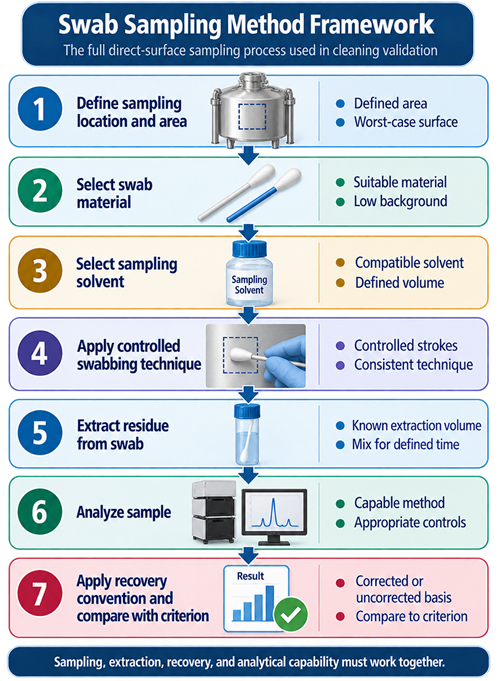
A swab result is not simply the amount detected by the analytical instrument. The complete measurement process includes:
Equipment surface → defined sampling area → swab collection → transfer into extraction solution → extraction of residue from swab → sample preparation → analytical measurement → recovery treatment → comparison with acceptance criterion
Variation or bias at any stage can change the reported result.
This makes swab sampling part of the analytical measurement system rather than merely a specimen-collection activity. The procedure should therefore be developed, qualified, documented, and executed with controls commensurate with the cleaning-validation decision it supports.
Define the Sampling Area
Where the cleaning acceptance criterion is expressed as residue per unit area, such as µg/cm², the swabbed surface area should be known or reproducibly defined.
Common square or rectangular sampling areas may be established with a template, for example 25 cm² or 100 cm², but there is no universal regulatory requirement for either dimension. The area should be appropriate to the equipment geometry, residue limit, analytical sensitivity, recovery performance, and practical ability of the operator to sample the surface consistently.
A larger sampled area can increase the total residue presented to the analytical method and may improve quantitative capability when surface limits are very low. However, increasing the area excessively can reduce sampling efficiency, make technique less reproducible, saturate the swab, or require the operator to cover heterogeneous surface conditions.
The selected area should therefore be established as part of method development rather than selected solely because a particular template is available.
The Sampled Area Must Be Reproducible
The protocol or sampling procedure should identify exactly where the defined area is located. Instructions such as “swab vessel wall” are usually inadequate when a large equipment surface contains different product-loading or cleaning conditions.
Location control can use:
- equipment drawings;
- photographs;
- numbered sampling maps;
- dimensional references;
- physical equipment landmarks;
- sampling templates.
The same location should be capable of being sampled consistently across validation runs and, where applicable, during routine verification.
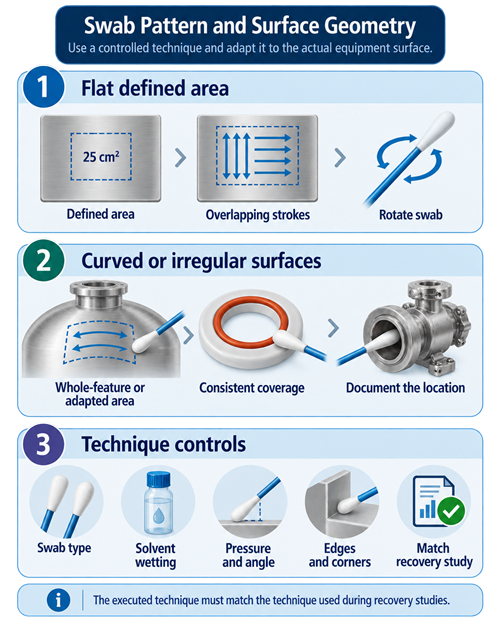
For a curved or irregular surface, a rigid square template may not be appropriate. The procedure may instead define the entire feature, a measured circumferential area, a flexible template, or another reproducible sampling boundary.
Swab Material Selection
The swab material should be compatible with the residue, sampling solvent, surface, extraction process, and analytical method.
Materials commonly used for cleaning-validation sampling include synthetic polyester and polyurethane foam. Specialized low-background swabs may be appropriate for TOC applications. The best material depends on the intended analytical procedure rather than on a universal preference.
Important properties include:
- residue pickup from the equipment surface;
- ability to release residue during extraction;
- solvent compatibility;
- low extractable background;
- low particulate or fiber shedding;
- mechanical durability;
- compatibility with the analytical method.
FDA specifically cautions that sampling materials themselves can interfere with analysis and notes historical problems such as adhesive components affecting sample results. The sampling medium and extraction solvent should therefore be demonstrated to be suitable before routine validation use.
Swab Background and Blanks
Swabs, handles, packaging materials, solvents, extraction containers, and sample-preparation materials can contribute analytical background. This is particularly important for nonspecific methods such as TOC, where organic material from the sampling system may be indistinguishable from product residue.
Appropriate blank controls may include:
- Swab blank — unused swab processed through the extraction and analytical procedure.
- Solvent blank — extraction or sampling solvent without the swab.
- Field blank, where justified — swab handled in the sampling environment without intentionally contacting the equipment.
The blank strategy should reflect the analytical method and the magnitude of background relative to the cleaning acceptance criterion.
FDA recognizes TOC as an acceptable cleaning-validation method when scientifically suitable but emphasizes control of background carbon and requires recovery studies for the complete measurement approach.
Selection of Sampling Solvent
The sampling solvent should facilitate transfer of the target residue from the equipment surface onto the swab without damaging the surface, compromising the swab, or interfering with analysis.
Relevant considerations include:
- residue solubility;
- wetting of the equipment surface;
- swab compatibility;
- surface-material compatibility;
- analytical-method compatibility;
- residue stability;
- microbial considerations where relevant;
- operator safety.
Water may be appropriate for readily soluble residues, but mixtures containing alcohols, buffers, acids, bases, or other solvents may provide better recovery for some materials. The selected solvent should be based on demonstrated recovery rather than the assumption that the residue is nominally soluble.
The solvent used to wet the swab should also be controlled. A swab that is excessively saturated can spread residue outside the intended area, produce dripping, alter recovery, or introduce inconsistent extraction volume.
Pre-Wetted Versus Dry Swabs
Many pharmaceutical cleaning-validation procedures use a pre-wetted swab because wetting can improve residue pickup and surface contact. This is not universally superior for every residue and surface.
The method should define whether the swab is:
- used dry;
- pre-wetted with a specified amount of solvent;
- dipped and expressed using a controlled procedure;
- supplied commercially pre-moistened.
The amount or preparation method should be reproducible. Descriptions such as “moisten swab as needed” introduce avoidable operator variability.
Where solvent volume materially influences recovery or analytical concentration, it should be controlled as part of the validated sampling method.
Swabbing Pattern
The physical swabbing pattern should provide systematic coverage of the defined surface while reducing the chance that significant areas are missed.
A common technique uses overlapping parallel strokes in one direction followed by a second series of strokes approximately perpendicular to the first. The swab can be rotated during sampling to expose clean swab surfaces and maximize contact.
The exact pattern, number of passes, swab orientation, and rotation should be established during recovery and method-development work. No single regulatory pattern is required.
The purpose is reproducible surface coverage, not compliance with a conventional drawing.
For example, a validated technique may specify:
- swab the defined area using overlapping vertical strokes;
- rotate the swab to expose another surface;
- swab the same area using overlapping horizontal strokes;
- use the swab tip to address the defined perimeter if the method includes edges.
The technique used during recovery studies should match the technique used during cleaning validation.
Avoid Uncontrolled Resampling of the Same Area
A swab physically removes some portion of the residue from the sampled surface. A second swab of the same area therefore does not represent the original residue condition unless sequential swabbing is intentionally part of the validated method.
This becomes important when:
- a sample is lost;
- an analyst requests a repeat;
- duplicate samples are desired;
- a first result is unacceptable;
- different analytical methods are required.
Replicate samples should preferably use equivalent adjacent areas or another predefined strategy unless multiple sequential swabs are part of the qualified procedure.
A second swab should not be used simply to replace an unfavorable first result without investigation.
Operator Technique
Swab sampling contains a manual component, so operator technique can materially affect recovery. Important variables include:
- pressure applied to the surface;
- stroke speed;
- angle of the swab;
- number of passes;
- degree of overlap;
- swab rotation;
- treatment of edges;
- maintenance of the defined sampling boundary.
The procedure should provide enough detail to reduce these sources of variability without pretending that manual pressure can always be controlled to an exact numerical value.
Training should include practical demonstration of the approved technique. Qualification can be appropriate where operator variability represents significant risk to the cleaning-validation result.
Recovery studies should use operators and techniques representative of the actual sampling procedure rather than an optimized laboratory technique that routine validation personnel cannot reproduce.
Surface Geometry
Flat stainless-steel coupons are useful for method development but do not represent every manufacturing surface. Actual cleaning-validation locations may include:
- curved vessel walls;
- nozzles;
- valve cavities;
- agitator hubs;
- gaskets;
- hoses;
- narrow transitions;
- corners;
- irregular fittings;
- textured or rough surfaces.
The sampling procedure should account for these geometries.
A defined 25 cm² square may work well on a vessel wall but be meaningless for a small valve body. In such cases the procedure may define the entire accessible internal surface of the valve or another reproducible boundary and establish the corresponding acceptance interpretation.
Sampling convenience should not drive replacement of a true worst-case location with an easy flat surface.
Different Surface Materials
Sampling recovery can differ significantly among stainless steel, glass, elastomers, polymers, coatings, and other product-contact surfaces.
Residue may adsorb differently, become physically trapped, or be more difficult to remove from one material than another. The swab and sampling solvent may also interact differently with these surfaces.
Swab and Rinse Recovery Studies for Cleaning Validation should determine whether separate recovery factors are required or whether scientifically justified surface grouping is appropriate.
A recovery value established on polished 316L stainless steel should not automatically be applied to an elastomer gasket or polymer hose.
Sampling Difficult Geometry
Some worst-case surfaces may be accessible but difficult to sample quantitatively because the area cannot be measured precisely or the swab cannot contact the surface uniformly.
The protocol should determine whether such a location will be:
- swabbed using a defined whole-feature approach;
- represented by an equivalent coupon or geometry;
- evaluated qualitatively;
- supplemented by rinse sampling;
- addressed through another justified method.
The important point is to preserve evidence from the cleaning-risk location. Difficult geometry should change the sampling strategy, not remove the location from consideration.
Transfer the Swab Immediately and Consistently
After sampling, the swab should be transferred promptly into the specified extraction container or otherwise handled according to the validated procedure.
The procedure should define:
- extraction container type;
- number of swabs per container;
- extraction-solvent volume;
- whether the swab shaft is cut or broken;
- whether the complete swab head remains immersed;
- container closure;
- labeling;
- storage temperature;
- protection from light where needed;
- maximum hold time before extraction or analysis.
Residue can adsorb to containers, evaporate, degrade, oxidize, hydrolyze, or undergo microbial change during storage. These effects can create negative bias even if initial surface recovery is adequate.
Extraction of Residue from the Swab
Collection from the equipment surface and extraction from the swab are separate physical processes, although a complete recovery study often measures their combined effect.
Extraction may use:
- vortex mixing;
- shaking;
- sonication;
- mechanical agitation;
- soaking;
- another defined technique.
The extraction solvent, volume, time, temperature, and agitation conditions should be controlled where they materially affect recovery.
If the method-development program separately determines swab pickup and extraction efficiency, the calculations should avoid applying both individual factors and a combined overall recovery factor unless the methodology explicitly requires it.
In many cleaning-validation programs, the most practical recovery value is the overall method recovery obtained by applying a known residue to a representative surface, swabbing it using the approved procedure, extracting the swab, and analyzing the extract.
Sample Extraction Volume
Extraction volume directly influences the concentration presented to the analytical method.
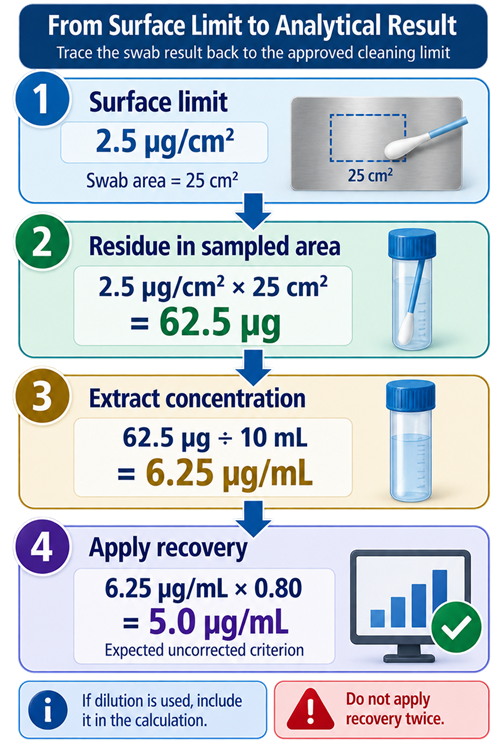
Assume:
- surface limit = 2.5 µg/cm²
- swab area = 25 cm²
The theoretical allowable mass within the sampled area is: 2.5 µg/cm² × 25 cm² = 62.5 µg
If the swab is extracted in 10 mL: 62.5 µg ÷ 10 mL = 6.25 µg/mL
If it is instead extracted in 25 mL: 62.5 µg ÷ 25 mL = 2.5 µg/mL
Both samples represent the same equipment surface limit, but the analytical concentrations differ substantially.
Extraction volume should therefore be selected in conjunction with Analytical Sensitivity and Quantitation Limits in Cleaning Validation so that the resulting concentration remains within reliable quantitative capability.
Dilution and Concentration Steps
Any dilution or concentration performed after extraction should be included explicitly in the calculation.
For a fivefold dilution: 6.25 µg/mL ÷ 5 = 1.25 µg/mL
For a validated sample-concentration step, the relationship operates in the opposite direction. Calculation worksheets should show each factor rather than rely on an unexplained laboratory conversion.
The acceptance criterion used by the analyst should be expressed in the same units and sample-preparation basis as the reported analytical result.
Recovery Studies
Recovery establishes the relationship between residue actually present on the equipment surface and residue ultimately measured by the laboratory.
A typical recovery study applies a known amount of residue to a representative coupon, allows it to equilibrate or dry under defined conditions, swabs it using the proposed sampling technique, extracts the swab, and analyzes the sample.
Conceptually: Recovery (%) = Measured Amount ÷ Applied Amount × 100
If 100 µg is applied and 80 µg is recovered: Recovery = 80%
FDA specifically expects firms to challenge the analytical method together with the sampling method so that the degree of surface recovery is understood. ICH Q7 likewise states that the attainable recovery level should be established.
Recovery Should Be Relevant to the Actual Method
Recovery studies should represent the important components of the routine procedure:
- residue;
- surface material;
- residue level;
- swab;
- sampling solvent;
- drying condition;
- sampling pattern;
- operator technique;
- extraction procedure;
- analytical method.
A recovery factor generated using a different solvent, swab material, surface, or sampling pattern may not support the procedure actually used during validation.
The recovery level should also be evaluated across a concentration range relevant to the cleaning acceptance criterion rather than only at very high residue loading.
Recovery Correction
Recovery can be incorporated into cleaning-validation results in more than one scientifically defensible way. The site should choose one convention and apply it consistently.
Assume:
- theoretical extract criterion before recovery treatment = 6.25 µg/mL
- validated overall recovery = 80%
If laboratory results are reported without mathematical correction, the expected measured concentration corresponding to a surface exactly at the theoretical limit would be:
6.25 µg/mL × 0.80 = 5.0 µg/mL
Alternatively, a measured result can be corrected back to an estimated surface-equivalent value: Recovery-Corrected Result = Measured Result ÷ Recovery Fraction
If the measured result is: 4.0 µg/mL , then: 4.0 ÷ 0.80 = 5.0 µg/mL recovery-corrected
The acceptance criterion and result should use the same convention.
Cleaning Validation Acceptance Criteria and Residue Limits should define the program-level calculation methodology.
Do Not Correct for Recovery Twice
Double recovery correction is a common calculation error.
For example, if the sample acceptance limit has already been reduced from 6.25 µg/mL to 5.0 µg/mL to account for 80% recovery, the analytical result should not then also be divided by 0.80 before comparison unless the calculation procedure was deliberately constructed that way.
Likewise, if the laboratory reports a recovery-corrected result, the acceptance criterion should correspond to that reporting basis.
The calculation worksheet should explicitly identify:
- Result reported as: corrected / uncorrected
- Acceptance criterion expressed as: corrected / uncorrected
This prevents hidden conservatism or, more seriously, accidental relaxation of the true limit.
Analytical Method Capability
The analytical method used for the swab extract should be capable of quantifying residue at the concentration corresponding to the cleaning acceptance criterion.
The method should address the complete sample matrix, including contributions from:
- swab material;
- extraction solvent;
- surface residue;
- cleaning agent;
- equipment material where relevant;
- sample containers.
Analytical Method Validation for Cleaning Residue Testing should demonstrate appropriate specificity or selectivity, accuracy, precision, range, quantitative capability, robustness, and matrix control.
A very sensitive instrument does not compensate for poor surface recovery.
TOC Swab Sampling
TOC can be appropriate for swab samples when a conservative nonspecific measure of organic residue is suitable. FDA recognizes TOC for both direct-surface and rinse cleaning-validation samples when the target material contains measurable oxidizable carbon and method suitability has been established.
TOC swab procedures require particular attention to:
- low-carbon swab materials;
- extraction-water quality;
- container background;
- analyst handling;
- environmental organic contamination;
- recovery;
- sample holding time.
Because TOC does not identify individual organic compounds, carbon from background sources should be minimized and appropriately considered in interpretation.
Sample Identification and Traceability
Every swab sample should be traceable to the exact equipment and location sampled.
The sample identification system should capture as applicable:
- equipment ID;
- cleaning-validation run;
- sample-location ID;
- product or residue;
- date and time;
- sampler;
- sampled area;
- sampling solvent;
- extraction information;
- analytical method.
Sampling maps and sample labels should use the same location identifiers to prevent ambiguity during data review.
Sample Holding Time
Swab extracts should not be assumed stable indefinitely.
Sample holding-time studies or other justified stability information should address the period between: sampling → extraction → analysis , where delays can occur.
Potential changes include analyte degradation, adsorption to the swab or container, solvent evaporation, microbial growth, precipitation, or chemical transformation.
FDA specifically notes sample-holding-time considerations for TOC when samples are stored before analysis. Similar scientific logic applies to compound-specific methods where analyte stability can affect the result.
Sampling Blanks and Controls
The required controls depend on the analytical method and sampling risk.
Possible controls include:
- swab blank;
- extraction-solvent blank;
- method blank;
- recovery control;
- laboratory control or standard;
- field blank where justified.
Blank results should be evaluated against the expected cleaning-validation concentration. A background that is negligible at a high residue level may become significant when acceptance criteria are very low.
Documentation in the Validation Protocol
The cleaning-validation protocol should identify the swab sampling procedure sufficiently to ensure reproducible execution.
It should define or reference:
- sampling locations;
- rationale for worst-case locations;
- surface material;
- swab area;
- swab type;
- sampling solvent;
- wetting technique;
- swabbing pattern;
- extraction container;
- extraction volume;
- recovery factor and convention;
- sample handling;
- analytical method;
- sample-specific acceptance criteria.
ICH Q7 specifically expects cleaning-validation protocols to describe the type of samples to be obtained and how those samples will be collected and labeled.
Swab Sampling Deviations
Sampling deviations can directly affect the validity of the cleaning-validation conclusion.
Examples include:
- wrong sampling location;
- incorrect swab area;
- wrong swab material;
- incorrect solvent;
- dropped or contaminated swab;
- incomplete swabbing;
- wrong extraction volume;
- excessive delay before extraction;
- incorrect storage;
- sample misidentification.
The impact should be evaluated against the purpose of the sample. Losing a general representative sample is different from losing the only swab from a defined worst-case valve or gasket.
A replacement sample collected after the original location has already been swabbed may not represent the original equipment condition.
Swab Results Above the Acceptance Criterion
An unacceptable swab result should be treated as evidence requiring investigation, not simply as an analytical anomaly because the surrounding samples passed.
The investigation should consider:
- cleaning execution;
- location-specific cleaning difficulty;
- dirty hold time;
- visual inspection;
- operator sampling technique;
- sample identity;
- recovery;
- analytical validity;
- calculation accuracy;
- previous results from the same location.
A localized failure can be particularly meaningful because the purpose of worst-case swab sampling is specifically to detect localized residue that broader methods might miss.
Cleaning Validation Deviations, Failures, and Investigations should govern the investigation and any resampling or recleaning decision.
Routine Verification
After cleaning validation is completed, the same swab methodology may support risk-based routine residue monitoring.
FDA recommends a risk-based residue-monitoring program after validation to demonstrate that the validated cleaning process continues to clean equipment consistently.
Routine verification does not necessarily require the complete validation sampling set after every cleaning event. Location and frequency can be reduced when justified by process capability, validation evidence, historical results, and risk.
The sampling technique, however, should remain consistent with the qualified method so that results remain comparable over time.
Lifecycle Control
Swab sampling methods should be reassessed when changes affect recovery, analytical capability, or location relevance.
Examples include:
- new swab material;
- changed sampling solvent;
- different extraction volume;
- new surface material;
- equipment modification;
- revised worst-case location;
- new product or formulation;
- changed residue limit;
- new analytical method;
- changed recovery factor.
A seemingly minor change in extraction volume can change the analytical concentration associated with the approved surface limit. A new gasket material may invalidate the existing recovery factor. A changed swab can alter TOC background.
Sampling procedures therefore belong under the same change-control and lifecycle framework as the broader cleaning-validation program.
Common Deficiencies
Common swab-sampling deficiencies include using a standard 25 cm² or 100 cm² area without demonstrating that it is appropriate, failing to define the sampling location precisely, selecting only easily accessible flat surfaces, and omitting difficult geometry because the area cannot be measured conveniently.
Other deficiencies include using a swab or solvent without demonstrated recovery, establishing recovery only on stainless steel when other product-contact materials are sampled, changing the swabbing technique between recovery studies and validation, and using an optimized laboratory sampler rather than representative validation personnel.
Calculation errors include ignoring extraction volume, ignoring dilution, applying recovery twice, mixing corrected and uncorrected reporting conventions, and comparing an analytical result in µg/mL directly with a surface criterion in µg/cm².
Sample-handling weaknesses include uncontrolled extraction timing, undefined hold time, unsuitable containers, swab background, inadequate blank controls, and poor traceability between the sample label and the equipment-location map.
Key Principles
- Swab sampling is a direct measurement of residue from an accessible equipment surface and is particularly valuable for challenging locations where contamination may be localized.
- The sampled area should be defined and reproducible, but no universal regulatory swab area exists. The area should be selected according to equipment geometry, residue limits, recovery performance, and analytical capability.
- Swab material and sampling solvent should be demonstrated to be compatible with the residue, equipment surface, extraction procedure, and analytical method.
- The approved swabbing pattern and operator technique should match the method used to establish recovery. Sampling recovery represents a critical part of the measurement process and should be established on representative surfaces and at relevant residue levels.
- Extraction volume, dilution, recovery treatment, and reporting units determine how a surface acceptance criterion becomes an analytical sample criterion. Every result should remain traceable through that conversion.
- Recovery can be handled through a corrected result or an adjusted sample criterion, but the convention should be defined prospectively and applied only once.
- Sample handling, extraction, storage, holding time, blank controls, and location traceability should be controlled because errors after the swab leaves the equipment can bias the final cleaning-validation result.
- Swab sampling should remain under lifecycle control as products, equipment surfaces, analytical methods, residue limits, sampling materials, and cleaning experience change.