

Thermal Mapping Study Design and Qualification
Thermal mapping characterizes temperature distribution throughout a defined storage or operating volume. It identifies spatial and temporal variation, supports definition of the qualified volume, evaluates normal and challenging operating conditions, and provides evidence for selecting routine monitoring locations.
A mapping study is not automatically equivalent to equipment qualification. Qualification considers the installed equipment, utilities, controls, alarms, procedures, loading configurations, monitoring systems, failure responses, and mapping results as an integrated system. Mapping supplies critical evidence within that broader qualification strategy.
Study design must reflect intended use and system risk. Fixed rules for sensor quantity, run duration, loading configuration, or number of qualification runs should not be applied universally.
This article addresses the general study strategy used for refrigerators, freezers, cold rooms, walk-in freezers, incubators, warm rooms, stability chambers, cryogenic vessels, and GMP warehouses. Equipment-specific design and qualification requirements are addressed in:
- Pharmaceutical Refrigerators and Freezers: Design and Qualification
- Cold Rooms and Walk-In Freezers: Design and Qualification
- Incubators and Warm Rooms: Design and Qualification
- Stability Chambers: Design and Qualification
- Liquid Nitrogen Cryogenic Storage: Design and Qualification
- GMP Warehouse Temperature Mapping and Qualification
Sensor technologies, calibration, uncertainty, and mapping software are addressed in Thermal Mapping Sensors, Data Loggers, and Measurement Uncertainty. Routine monitoring and alarms are addressed in Temperature Monitoring, Alarm Systems, and Data Integrity.
Purpose of Thermal Mapping
Thermal mapping may support several different objectives:
- Characterizing temperature distribution
- Identifying warmest and coldest locations
- Evaluating vertical and horizontal gradients
- Assessing control stability
- Defining the usable storage or operating volume
- Comparing empty and loaded configurations
- Evaluating door-opening effects
- Measuring recovery after a disturbance
- Evaluating power or control failure
- Assessing defrost behavior
- Evaluating seasonal conditions
- Supporting routine monitoring-probe placement
- Investigating an excursion
- Supporting initial qualification
- Supporting requalification after change
The protocol should identify the exact study objective. A characterization study, development study, qualification study, investigation, and requalification study may use similar equipment but require different configurations, challenges, acceptance criteria, and conclusions.
A study designed only to locate warm and cold points does not necessarily demonstrate that all qualification requirements have been met.
Mapping, Monitoring, and Control
Control, mapping, and routine monitoring serve different functions.
Control System
The control system regulates the equipment or room using one or more control sensors. Its displayed temperature represents the control measurement at the sensor location, not the complete chamber or room.
Mapping System
The mapping system temporarily uses multiple calibrated sensors to characterize spatial and temporal conditions across the defined volume.
Routine Monitoring System
The monitoring system provides continuing surveillance after qualification. Its probes should be located using mapping evidence and should detect conditions relevant to stored materials or the controlled process.
These functions may be integrated, but common sensors, software, networks, or power supplies can create shared failure modes. Independence should be defined according to intended use and risk.
Intended Use and System Boundary
Study design begins with a defined intended use. The intended-use statement should identify:
- Equipment or area
- Materials, products, or processes supported
- Approved temperature range
- Additional controlled parameters
- Qualified storage or operating volume
- Shelves, racks, pallets, or working positions
- Loading range
- Door or access frequency
- Normal operating schedule
- Control-system boundary
- Monitoring-system boundary
- Alarm requirements
- Backup and contingency arrangements
The system boundary should identify components that can affect mapped conditions, including:
- Chamber or room enclosure
- Refrigeration or heating equipment
- Air-handling components
- Fans
- Ductwork
- Supply and return openings
- Dampers
- Defrost systems
- Humidity generation
- CO₂ delivery where applicable
- Control sensors
- Monitoring sensors
- Controllers
- Software
- Utilities
- Backup power
- Adjacent environmental conditions
Mapping should evaluate the volume actually approved for storage or operation. Geometric space that cannot be used because of airflow restrictions, proximity to walls, door effects, or equipment components should not automatically be included.
Risk-Based Study Design
The study should translate intended use, system design, and credible failure modes into an approved protocol.
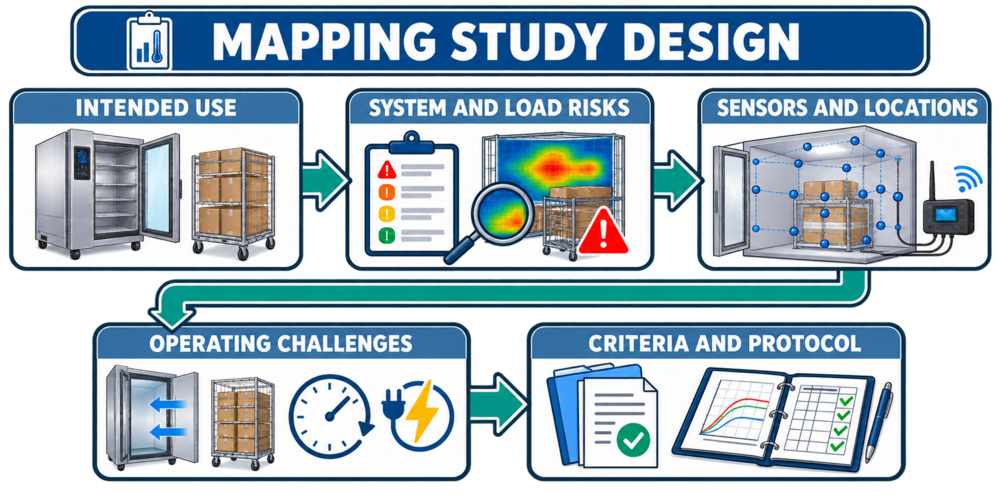
The design process should:
- Define intended use
- Assess system and load risks
- Select sensors and locations
- Select operating configurations
- Select credible challenges
- Establish acceptance criteria
- Approve the protocol before execution
Risk assessment should consider:
- Equipment size and geometry
- Airflow pattern
- Natural versus forced convection
- Heating or cooling source
- Control-sensor location
- Door size and location
- Number of access points
- Shelving and rack construction
- Load density
- Thermal mass
- Product arrangement
- External environment
- Defrost operation
- Seasonal effects
- Utility reliability
- Failure history
- Previous mapping results
- Material or process sensitivity
Risk assessment should guide the study without predetermining a passing result. Locations expected to be difficult should be challenged, not excluded without evidence.
Protocol Requirements
The approved mapping protocol should define:
- Study title and identification
- Equipment or area identity
- Purpose
- Scope
- Intended use
- System boundary
- Responsibilities
- Applicable procedures
- Configuration
- Loading condition
- Sensor quantity
- Sensor locations
- Sensor identification
- Calibration requirements
- Sampling interval
- Time synchronization
- Study duration
- Stabilization requirements
- Operating conditions
- Challenge tests
- Acceptance criteria
- Data-analysis methods
- Treatment of uncertainty
- Missing-data rules
- Deviation handling
- Required report content
Sensor-location drawings should be controlled and sufficiently detailed to permit reproducible placement.
For large rooms and warehouses, drawings may require plan and elevation views. For chambers, photographs or three-dimensional diagrams may provide clearer placement records.
Mapping Sensor Quantity
There is no universal regulatory sensor-count table applicable to every thermal system. Sensor quantity should be based primarily on usable volume, geometry, airflow, loading, and credible temperature gradients.
The following table may be used as an initial planning guide. The final quantity and placement must be confirmed through documented risk assessment.
| Usable mapped volume | Initial planning range |
|---|---|
| Less than 0.5 m³ | 9 sensors |
| 0.5–2 m³ | 12 sensors |
| Greater than 2–10 m³ | 15–20 sensors |
| Greater than 10–30 m³ | 20–30 sensors |
| Greater than 30 m³ | 30–50 sensors or a justified three-dimensional grid |
These values are starting ranges rather than mandatory minimums or maximums. Additional sensors may be required at:
- Doors and access openings
- Upper and lower storage levels
- Corners
- Supply-air outlets
- Return-air openings
- Evaporators
- Heating sources
- Control-sensor locations
- Routine monitoring-probe locations
- Areas behind dense loads
- Separate HVAC zones
- Previously identified warm or cold locations
The final quantity should consider:
- Usable volume
- Equipment geometry
- Number of shelves or rack levels
- Airflow design
- Expected gradients
- Door locations
- Heating or cooling sources
- Control-sensor location
- Load arrangement
- Previous study data
- Study objective
- Material or process risk
For small chambers, a three-dimensional arrangement commonly begins with sensors at the eight corners and geometric center. An additional sensor may be placed near the installed control or monitoring probe when correlation with that measurement is part of the study objective.
A small chamber with complex airflow or multiple shelves may require more sensors than a larger but thermally uniform enclosure. A large room with multiple HVAC zones, doors, racks, or vertical levels may require increased coverage even when its floor plan appears simple.
WHO Temperature Mapping of Storage Areas has no binding regulatory authority in the United States and does not establish FDA requirements. Its recommendations should not be adopted automatically or presented as mandatory GMP practices. They may be considered as optional technical input only when scientifically justified and consistent with applicable regulations, approved site procedures, product requirements, and the intended use of the qualified system.
The industry article How Many Sensors Should I Use in a Temperature Mapping Study? provides practical sensor-placement recommendations based partly on chamber volume. It recommends ten sensors for chambers up to 2 m³—nine distributed within the usable volume and one near the control or monitoring probe—and sixteen sensors for chambers up to 20 m³—fifteen within the usable volume and one near the control or monitoring probe. These recommendations are nonbinding industry guidance, not FDA or compendial requirements. They may support study planning but do not replace documented, system-specific justification for the final sensor quantity and placement.
The volume-based table should therefore be applied as planning guidance and supplemented by risk-based locations. The rationale should demonstrate that the selected coverage can detect credible warm, cold, and variable conditions.
Adding sensors without an underlying placement rationale does not automatically improve the study.
Three-Dimensional Sensor Placement
Sensors should represent the complete qualified volume in three dimensions.
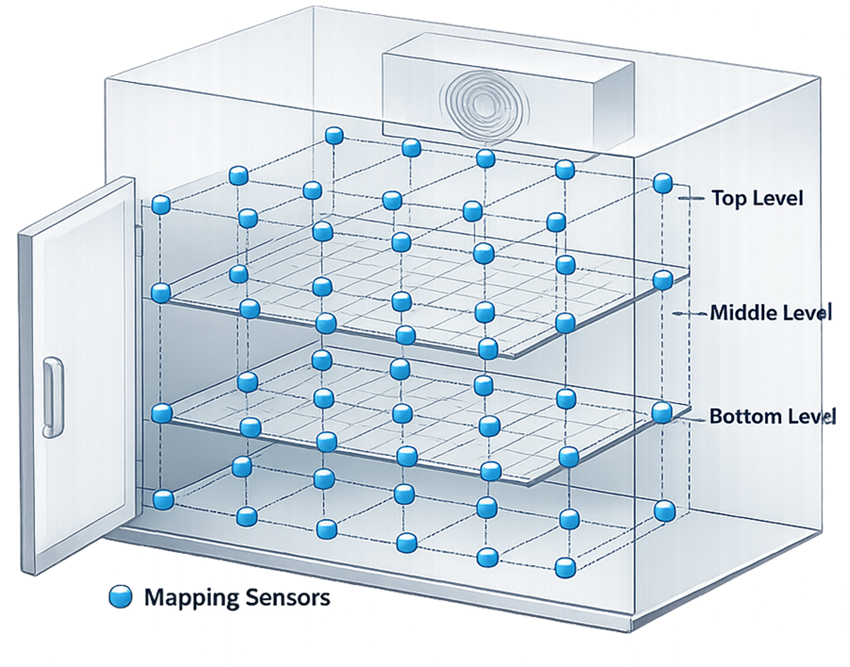
Potential locations include:
- Upper, middle, and lower levels
- Chamber or room corners
- Center positions
- Door-adjacent locations
- Locations near supply air
- Locations near return air
- Locations near evaporators
- Locations near heaters
- Positions behind or within representative loads
- Control-sensor location
- Existing monitoring-probe location
- Known warm or cold locations
- Areas with restricted airflow
Placement should reflect actual storage or process positions. Sensors placed directly against a wall, evaporator, heater, or supply-air discharge may measure a local surface or air-stream effect that stored materials do not experience. Such positions may still be useful as intentional engineering challenges, but their purpose must be defined.
Sensors should be secured to prevent movement, contact with chamber surfaces, obstruction by loads, or displacement during access.
Sensor Placement in Small Chambers
Small refrigerators, freezers, incubators, and stability chambers commonly require assessment of:
- Shelf-to-shelf variation
- Front-to-back gradients
- Top-to-bottom gradients
- Corners
- Door areas
- Locations near cooling or heating sources
- Control-sensor location
- Monitoring-probe location
The qualified volume should exclude areas prohibited by the manufacturer or operating procedure, such as positions directly against internal walls, below air outlets, or outside defined shelf boundaries.
A single center sensor cannot demonstrate chamber-wide uniformity.
Sensor Placement in Rooms and Warehouses
Large rooms require assessment of length, width, and height as well as operational and building effects.
Potential locations include:
- Floor and ceiling levels
- Highest and lowest approved storage levels
- Exterior walls
- Interior walls
- Corners
- Doors
- Loading docks
- Separate HVAC zones
- Supply diffusers
- Return grilles
- High-bay racks
- Mezzanines
- Dense storage areas
- Staging areas
Spacing should reflect room geometry and risk. A universal distance between loggers should not be presented as a regulatory requirement.
Detailed warehouse-specific strategy is addressed in GMP Warehouse Temperature Mapping and Qualification.
Mapping Configurations
The mapping configuration should represent the study objective and approved use. Potential configurations include:
- Empty
- Partially loaded
- Representative load
- Maximum approved load
- Minimum thermal mass
- Maximum thermal mass
- Different shelf arrangements
- Different rack arrangements
- Product-simulating load
- Actual product load
- Credible mixed load
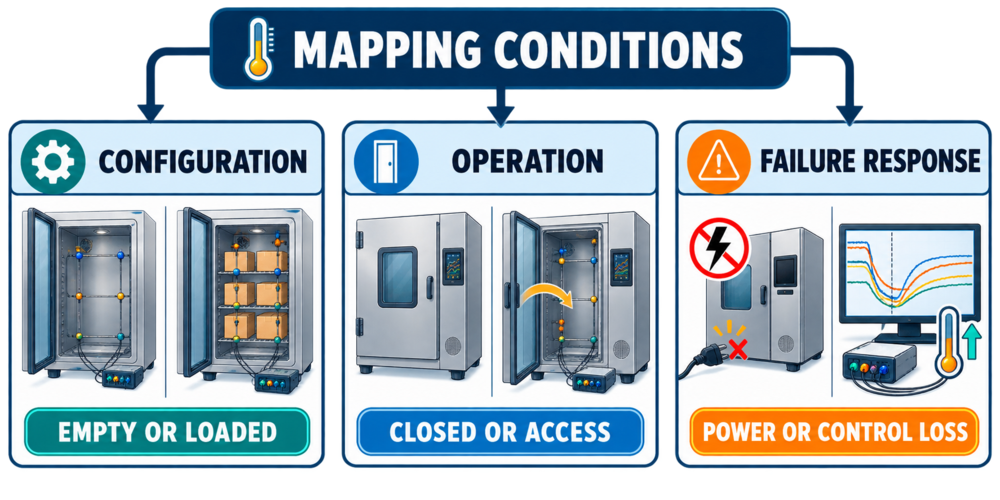
Empty mapping can expose inherent airflow and control-system behavior without the influence of stored thermal mass. Loaded mapping evaluates the effect of airflow obstruction, load distribution, and thermal mass.
Neither condition is universally superior. The qualification strategy should determine which configurations are needed.
If the system routinely operates empty or lightly loaded, a study performed only at maximum load may fail to represent the actual worst case. Conversely, an empty study cannot demonstrate loaded performance when dense routine loading materially changes airflow.
Representative and Worst-Case Loads
A representative load should reflect approved routine use.
The load rationale should consider:
- Load density
- Thermal mass
- Packaging
- Container size
- Shelf occupancy
- Airflow obstruction
- Storage height
- Product arrangement
- Minimum and maximum load
- Mixed-load conditions
Worst case should mean the most difficult credible approved configuration. An arrangement prohibited by procedure does not represent qualified routine use.
Water bottles, thermal blocks, or other simulated loads may be appropriate when they reasonably represent the thermal behavior and airflow effect of the intended materials. The scientific justification should be documented.
Stabilization Before Mapping
The study should define stabilization requirements before data are evaluated. Stabilization may depend on:
- Equipment size
- Starting temperature
- Load temperature
- Load thermal mass
- Control characteristics
- Door openings during setup
- Sensor response
- Refrigeration or heating cycles
A fixed stabilization time should not replace examination of actual temperature trends.
The report should identify when the system reached the defined study condition and whether data collected during stabilization were excluded from qualification analysis.
Study Duration
Study duration should capture the operating behavior relevant to the study objective.
The duration should consider:
- Heating or refrigeration cycles
- Defrost cycles
- Control modulation
- Day and night conditions
- Weekday and weekend operation
- Door-opening patterns
- Load equilibration
- Seasonal variation
- Process duration
- Stability-chamber operation
- Expected disturbances
- Recovery periods
There is no universal 24-hour, 48-hour, 72-hour, or seven-day requirement for every study.
A short study may be adequate for a small chamber with rapid, repeatable cycling when all relevant behaviors are captured. A room or warehouse may require a longer period to capture operational schedules, weather effects, or HVAC modes.
Study duration should be justified by the phenomena that must be observed, not by convention alone.
Sampling Interval
The sampling interval should be short enough to detect relevant temperature changes and recovery behavior. Selection should consider:
- Expected rate of temperature change
- Door-opening duration
- Control cycles
- Defrost behavior
- Sensor response time
- Study duration
- Logger memory
- Battery capacity
- Data volume
- Time synchronization
A long interval may miss short excursions or distort recovery-time calculations. An excessively short interval may generate large data sets without improving the study conclusion.
The interval should be defined before execution and applied consistently unless a justified study design requires different intervals for separate phases.
Door-Opening and Access Challenges
Door-opening testing evaluates the effect of normal or defined access on the controlled environment. The protocol should specify:
- Initial stabilized condition
- Door or access point
- Opening duration
- Number of openings
- Load movement
- Shelf or rack accessed
- Sensors evaluated
- Recovery endpoint
- Acceptance criteria
The challenge should represent credible approved operations. Leaving a door open for a period prohibited by procedure demonstrates the effect of an invalid operation rather than routine performance.
Testing may establish:
- Maximum approved access duration
- Recovery time
- Locations affected first
- Need for access restrictions
- Need for alarm delays
- Effect of repeated access
- Differences between loaded and empty conditions
For incubators, CO₂ chambers, and humidity-controlled systems, access recovery may require evaluation of additional controlled parameters.
Power-Loss and Control-Failure Challenges
Power-loss testing evaluates thermal holdover, alarm operation, restart behavior, and available response time.
The protocol should define:
- Initial configuration
- Initial load
- Failure initiated
- Components remaining operational
- Monitoring method
- Door condition
- Failure duration
- Restoration sequence
- Acceptance criteria
- Material-protection response
A power interruption may affect:
- Heating or refrigeration
- Circulation fans
- Controllers
- Local displays
- Monitoring systems
- Alarm notification
- Data communication
- Door heaters
- Humidity or CO₂ control
Complete facility power loss, control-system failure, monitoring failure, and loss of a single refrigeration component are different conditions and should not be treated as interchangeable.
Destructive or unsafe failure testing is not required when justified engineering analysis, historical evidence, or a controlled alternative can answer the study question.
Defrost Evaluation
Automatic defrost can cause normal but significant temperature variation in some refrigerators, freezers, cold rooms, and walk-in freezers. The study should determine:
- Defrost frequency
- Defrost duration
- Components affected
- Air-temperature response
- Product-simulating temperature response
- Spatial effect
- Recovery
- Alarm interaction
- Recorded cycle status
Mapping duration should capture representative defrost behavior where it is relevant.
Air-temperature increases during defrost do not automatically establish unacceptable product exposure. Product or load temperature may respond more slowly. The study objective and acceptance criteria must define which measurement is relevant.
Seasonal Conditions
Seasonal mapping should be considered where outdoor conditions materially affect the equipment or area.
Relevant systems may include:
- Warehouses
- Cold rooms
- Walk-in freezers
- Warm rooms
- Equipment located near exterior walls
- Systems with outdoor condensers
- Rooms served by seasonally changing HVAC modes
A study labeled summer or winter should document actual external conditions. Calendar timing alone does not prove that a meaningful seasonal challenge occurred.
Seasonal repetition may not be necessary for small self-contained equipment located in a well-controlled interior environment when existing evidence demonstrates that external conditions have no meaningful effect.
Additional Controlled Parameters
Some systems control parameters in addition to temperature.
Relative Humidity
Stability chambers and certain storage areas may require humidity distribution, control accuracy, recovery, and sensor-performance evaluation.
Temperature and humidity measurement systems have separate accuracy, calibration, response, and uncertainty characteristics. Temperature uniformity does not establish humidity uniformity.
Carbon Dioxide
CO₂ incubators may require evaluation of:
- Concentration accuracy
- Distribution
- Recovery after access
- Gas-supply failure
- Sensor calibration
- Interaction with temperature and humidity
Cryogenic Liquid Level
Liquid-nitrogen vessels may require assessment of both temperature and liquid level. Conventional rectangular mapping-grid logic may not represent a vessel’s vertical vapor-zone gradient.
Equipment-specific controls are addressed in Liquid Nitrogen Cryogenic Storage: Design and Qualification.
Qualification Strategy
Mapping scope should be integrated into the approved qualification strategy.
Installation Qualification
IQ establishes the installed configuration supporting later mapping and functional testing. Relevant verification may include:
- Equipment identification
- Location
- Enclosure
- Shelves and racks
- Heating or refrigeration components
- Fans and airflow paths
- Utilities
- Control sensors
- Monitoring sensors
- Alarm interfaces
- Software
- Drawings
- Calibration status
- Procedures
Operational Qualification
OQ commonly evaluates control functions, alarms, operating ranges, abnormal conditions, and temperature distribution under defined configurations. Mapping may be performed during OQ, but it should not automatically be limited to an empty configuration.
Performance Qualification
PQ evaluates performance under representative operating conditions, including approved loading and routine access where applicable. PQ does not universally require three runs. The required number of runs should be justified using:
- System variability
- Intended use
- Study objective
- Development knowledge
- OQ evidence
- Load variability
- Operational variability
- Product or process risk
Reducing the sensor count during PQ may be appropriate when earlier comprehensive mapping has established consistent warm and cold locations and the PQ objective is limited. It is not an automatic rule.
Study Execution Controls
Before study initiation, execution personnel should confirm:
- Approved protocol
- Correct equipment
- Approved configuration
- Current sensor calibration
- Sensor identification
- Time synchronization
- Battery capacity
- Logger memory
- Placement drawings
- Stabilized starting condition
- Monitoring-system status
- Alarm status
- Required operating procedures
During execution, the study record should capture:
- Start and stop times
- Sensor placement
- Load configuration
- Door openings
- Power interruptions
- Defrost cycles
- Alarm events
- Operator interventions
- Environmental conditions
- Deviations
- Removed or displaced sensors
Unrecorded disturbances can make interpretation unreliable even when the numerical data appear acceptable.
Data Retrieval and Integrity
After the study, data should be downloaded and preserved in a controlled manner. Controls should address:
- Complete data retrieval
- Original electronic records
- File identification
- Sensor-to-location traceability
- Time synchronization
- Missing data
- Altered settings
- Software calculations
- Audit trails where applicable
- Backup
- Review
- Reported-data traceability
Spreadsheet processing or exported reports should not replace retention of original logger data.
FDA’s Data Integrity and Compliance With Drug CGMP guidance supports risk-based controls ensuring that CGMP data remain reliable and accurate.
Data-Quality Review
Analysis should begin with data-quality verification. The review should confirm:
- All expected sensors produced data
- Logger identities match locations
- Timestamps are aligned
- Sampling intervals are correct
- Sensor ranges were suitable
- Calibration remained acceptable
- No unexplained data gaps occurred
- Sensors remained in position
- Recorded disturbances match observed trends
- Data processing is traceable
A technically sophisticated analysis cannot correct unidentified sensors, incorrect placement, missing records, or unreliable calibration.
Analysis of Mapping Results
The analysis should preserve both time and location relationships.
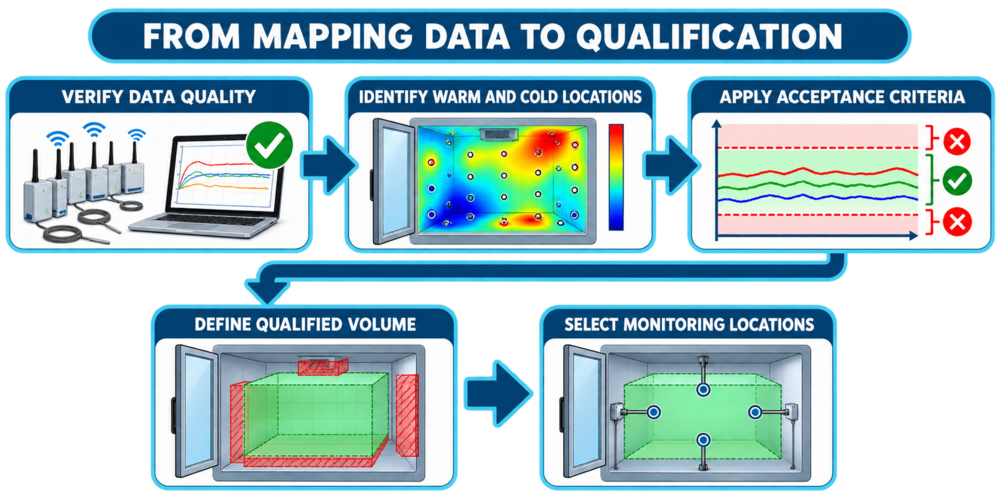
The review may include:
- Minimum temperature by sensor
- Maximum temperature by sensor
- Time of each extreme
- Average temperature where useful
- Temperature range
- Spatial gradients
- Vertical gradients
- Cycle behavior
- Defrost effects
- Door-opening response
- Recovery time
- Failure response
- Differences between configurations
- Differences between repeated runs
- Missing or suspect data
- Measurement uncertainty
Overlay plots can support comparison, but excessive numbers of traces may conceal individual behavior. Summary tables, targeted graphs, heat maps, and location drawings should be used together.
Warmest and Coldest Locations
The warmest and coldest locations should be identified using the complete study data rather than a single isolated reading.
Assessment should consider:
- Frequency of extremes
- Duration
- Normal operating periods
- Challenge periods
- Seasonal behavior
- Load configuration
- Sensor uncertainty
- Reproducibility
- Relationship to stored materials
The sensor with the single highest recorded value is not automatically the best high-temperature monitoring location. A brief door-opening effect may identify a transient location, while another point may represent the warmest sustained routine condition.
Monitoring-location selection should consider what failure or adverse condition the system must detect.
Mean Kinetic Temperature
Mean kinetic temperature, or MKT, is a calculated temperature representing the cumulative thermal stress produced by a varying temperature profile. Higher temperatures usually cause pharmaceutical materials to degrade faster. For this reason, the MKT calculation gives more weight to high-temperature readings than to low-temperature readings. A short period at an elevated temperature can therefore increase MKT more than an equal period at a lower temperature can reduce it. For measurements collected at equal time intervals, MKT is calculated as follows:
MKT (K) = (−ΔH ÷ R) ÷ ln{(1 ÷ n) × Σ exp[−ΔH ÷ (R × Tᵢ)]}
where:
- MKT is mean kinetic temperature in kelvin
- ΔH represents how strongly degradation responds to temperature
- R is a fixed scientific constant used in the calculation
- Tᵢ is each recorded temperature in kelvin
- n is the total number of temperature readings
- Σ means adding the calculated results for all readings
- ln and exp are standard mathematical functions available in scientific calculators and spreadsheet software
Convert each recorded temperature from degrees Celsius to kelvin before calculating MKT:
Temperature (K) = Temperature (°C) + 273.15
Convert the final MKT result back to degrees Celsius:
MKT (°C) = MKT (K) − 273.15
MKT may be used to:
- Estimate cumulative thermal exposure during a defined storage period
- Support assessment of a documented temperature excursion
- Compare thermal stress between temperature profiles
- Support product-impact assessment when justified by stability information
- Evaluate long-term storage data when the applicable procedure or scientific rationale permits it
MKT should not be used to:
- Replace individual logger review
- Demonstrate spatial temperature uniformity
- Establish warmest and coldest locations
- Erase short but potentially damaging excursions
- Justify unsuitable storage locations
- Convert a failed mapping or qualification study into a passing result
- Override product-specific maximum or minimum temperature restrictions
MKT is therefore primarily an exposure-assessment tool, not a general mapping acceptance criterion. Qualification conclusions should be based on the approved protocol, individual sensor results, excursion duration, measurement uncertainty, and the defined requirements for the stored material.
Measurement Uncertainty
Results near an acceptance limit require evaluation of measurement uncertainty. Relevant contributors may include:
- Reference-standard uncertainty
- Logger calibration uncertainty
- Sensor accuracy
- Resolution
- Drift
- Response time
- Data-acquisition effects
- Placement reproducibility
- Environmental variation
Calibration does not eliminate uncertainty.
The protocol should define how uncertainty will be considered, particularly when measured values approach an acceptance boundary. Rounding should not be used to convert a failure into a passing result.
A failed post-study calibration does not automatically invalidate the entire study. The effect should be assessed using the magnitude and direction of drift, affected location, acceptance margin, redundant nearby sensors, and study objective.
Acceptance Criteria
Acceptance criteria should be approved before execution and should identify what constitutes acceptable performance. Criteria may address:
- Temperature range
- Relative-humidity range
- CO₂ range
- Liquid level
- Individual readings
- Permitted transient conditions
- Duration of excursions
- Uniformity
- Stability
- Recovery time
- Alarm response
- Failure holdover
- Data completeness
- Calibration status
- Study repeatability
- Qualified volume
The criteria should state whether limits apply to:
- Every individual reading
- Defined steady-state periods
- Product-simulating temperatures
- Air temperatures
- Time-qualified exposure
- Another approved endpoint
An average value within limits does not demonstrate that all mapped locations passed.
Equipment control tolerance, mapping acceptance criteria, monitoring alarm setpoints, and product-impact limits may differ. Their relationships should be explained.
Defining the Qualified Volume
Mapping may demonstrate that some geometric locations are not suitable for use. Potential exclusions include:
- Areas near doors
- Locations directly below supply air
- Areas adjacent to evaporators
- Positions near heaters
- Space against walls
- Upper or lower shelf positions
- High rack levels
- Poorly circulated corners
Excluded locations should be reflected in:
- Equipment diagrams
- Shelf or rack labels
- Operating procedures
- Load diagrams
- Training
- Inventory controls
- Routine inspections
Qualification should not approve a general chamber or room while leaving failed locations available for uncontrolled storage.
Selection of Routine Monitoring Locations
Routine monitoring locations should be selected from mapping evidence. The assessment should consider:
- Warmest sustained location
- Coldest sustained location
- Locations sensitive to control loss
- Door effects
- Defrost effects
- Seasonal changes
- Load dependency
- Accessibility
- Protection from damage
- Calibration access
- Alarm usefulness
- Common-mode failures
The control sensor should not automatically be accepted as the monitoring location.
Monitoring probes should represent conditions relevant to stored materials or the process. A probe placed at an extreme location that experiences disturbances not representative of approved use can produce repeated alarms without improving material protection.
Selection should be documented and traceable to the applicable mapping results.
Deviations and Failed Studies
Deviations should be assessed for:
- Study validity
- Sensor placement
- Missing data
- Calibration failure
- Configuration changes
- Unplanned access
- Equipment malfunction
- Alarm events
- Acceptance-criterion failure
- Effect on other tests
- Need for repeat testing
- Qualification status
A study should not be repeated solely to obtain a passing result.
Before repetition, the investigation should determine:
- What failed
- Whether the failure was real
- Whether the protocol was appropriate
- Whether the system configuration changed
- Whether corrective action is required
- Whether previously executed testing remains valid
- Whether stored materials were affected
A supplemental targeted study may be more appropriate than complete repetition when the original study remains valid except for a defined gap.
Study Report
The final report should include:
- Objective and scope
- Intended use
- System description
- Study configuration
- Load description
- Sensor list
- Sensor-location drawings
- Calibration information
- Sampling interval
- Study duration
- Operating conditions
- Challenge execution
- Raw-data references
- Data-quality review
- Analysis
- Warm and cold locations
- Acceptance-criterion assessment
- Measurement-uncertainty assessment
- Deviations
- Qualified-volume definition
- Monitoring-location recommendations
- Corrective actions
- Final conclusion
The conclusion should specify exactly what configuration, volume, temperature range, load, operating condition, and study evidence were approved.
Requalification and Remapping
Changes and adverse trends should be assessed for potential effect on thermal distribution. Potential triggers include:
- Equipment relocation
- Major refrigeration or heating repair
- Fan replacement
- Airflow modification
- Shelf or rack changes
- Load-density changes
- Storage-height changes
- New product requirements
- Control-sensor replacement
- Monitoring-probe relocation
- Setpoint changes
- Defrost changes
- Software changes
- Door modification
- Insulation repair
- Utility changes
- Repeated excursions
- Adverse temperature trends
- Calibration failures
- Extended shutdown
The assessment should determine whether existing mapping evidence remains applicable.
Possible scopes include:
- Documentation-only assessment
- Calibration
- Functional testing
- Targeted mapping
- Challenge repetition
- Seasonal verification
- Partial requalification
- Comprehensive remapping
The rationale should identify both tests selected for repetition and tests not repeated.
Common Study-Design Weaknesses
Common weaknesses include:
- Using a fixed sensor-count table without justification
- Requiring three runs solely by convention
- Prescribing a universal study duration
- Treating empty mapping as universally required
- Treating loaded mapping as universally sufficient
- Mapping the geometric volume instead of the usable volume
- Omitting vertical levels
- Ignoring doors, airflow sources, or heaters
- Using an invalid worst-case load
- Failing to capture defrost
- Failing to document actual seasonal conditions
- Using averages to conceal individual failures
- Using mean kinetic temperature to excuse qualification failures
- Ignoring uncertainty near acceptance limits
- Selecting monitoring locations without mapping evidence
- Treating the controller sensor as representative of the entire system
- Repeating failed testing without investigation
- Failing to define excluded storage locations
- Assuming mapping alone completes equipment qualification
Conclusion
A defensible thermal-mapping study begins with intended use, system understanding, and risk assessment. It then defines a justified sensor arrangement, representative configuration, meaningful operating challenges, adequate duration, appropriate sampling interval, and objective acceptance criteria.
The resulting data should identify spatial and temporal temperature behavior, establish the qualified volume, support routine monitoring locations, and define necessary operating restrictions.
Sensor quantity, duration, loading configuration, and repeat studies should be justified for the specific system. Universal numerical conventions should not replace scientific and engineering rationale.