

Distribution Simulation and Transport Testing
Distribution simulation provides controlled laboratory evidence that a packaged product can withstand the mechanical and environmental hazards expected during transportation, handling, warehousing, and transfer through the distribution network. The objective is not to reproduce every movement experienced by a shipment. It is to challenge the packaged-product system with a justified sequence and severity of hazards capable of revealing weaknesses before commercial distribution.
A defensible study therefore begins with the expected distribution environment, packaging configuration, product sensitivity, and identified failure mechanisms. The protocol should establish why particular vibration, drop, shock, compression, conditioning, or other challenges are relevant; which packaged-product configurations represent the appropriate challenge; and how package and product condition will be evaluated afterward.
ASTM D4169-23e1 is currently the active ASTM practice for performance testing of shipping containers and systems. ASTM describes the practice as a laboratory method for evaluating shipping units by subjecting them to sequences of anticipated hazard elements associated with different distribution cycles. ASTM also directs users to ASTM D7386 for packages intended for single-parcel shipment. ASTM D7386-25 is the current active practice for performance testing of packages in single-parcel delivery systems.
ISTA provides a separate family of transport-performance procedures. Its 3-Series procedures are general simulation tests intended to reproduce the damage-producing motions, forces, conditions, and sequences of broad transportation environments. Current examples include ISTA 3A for parcel-delivery shipments up to 70 kg (150 lb), ISTA 3B for less-than-truckload distribution, and ISTA 3E for unitized loads.
For terminally sterilized medical devices, distribution performance is part of the broader packaging-system evidence needed to show that the sterile barrier and protective packaging remain suitable through handling, distribution, and storage. ISO 11607-1:2019 remains current and specifies requirements for materials, sterile barrier systems, and packaging systems intended to maintain sterility until the point of use.
Key Principles
- Distribution simulation should be derived from expected transportation hazards and packaging risks rather than from a preferred standard alone.
- The complete packaged-product configuration should be tested when secondary or tertiary packaging contributes to protection.
- Mechanical and environmental tests should be arranged in a sequence that represents the intended qualification objective.
- Worst-case selection should be based on the failure mechanism being challenged, not solely on package dimensions or nominal product size.
- Laboratory simulation and actual shipping studies provide different evidence and should not be treated as interchangeable.
- A transport test is incomplete without predetermined post-test evaluation of both packaging and product condition.
- Passing a standardized procedure demonstrates performance under the specified test conditions; it does not prove that every possible commercial distribution environment has been covered.
- Distribution simulation should remain linked to change control, complaints, transportation damage, and actual shipping experience throughout the product lifecycle.
Distribution Simulation Versus Shipping Validation
Distribution simulation and shipping validation address related but different questions. Distribution simulation asks whether a defined packaged-product configuration can withstand a controlled set of laboratory challenges representing anticipated transportation hazards. The emphasis is on package capability and the interaction between the product and packaging system.
Shipping validation addresses the broader logistics process. It considers actual routes, carriers, modes of transportation, transfer points, seasonal conditions, transit duration, handling practices, monitoring requirements, and other characteristics of the commercial distribution network.
A package may pass a rigorous laboratory transport simulation yet later encounter a shipping lane with unusually severe exposure, extended delays, poor handling, or conditions outside the qualified assumptions. Conversely, successful arrival of several commercial shipments does not prove that the package has been challenged by the worst mechanical hazards likely to occur over its lifecycle.
The two types of evidence should therefore complement each other. Laboratory simulation establishes controlled package-performance evidence, while Shipping Validation Strategy and Distribution Risk Assessment and Shipping Lane Qualification and Real-World Shipment Studies address the actual distribution process.
Start With the Distribution Profile
The first step is to characterize how the product is expected to move from the manufacturing or packaging site to the destination.
The distribution profile should identify the shipping configuration and the principal modes and transitions that can affect package performance. Depending on the product, this may include parcel delivery, less-than-truckload freight, full-truckload shipment, air transport, ocean freight, courier service, refrigerated transport, palletized distribution, distribution-center handling, or a combination of these.
Important characteristics include shipment distance, number of transfers, manual handling, palletization, unit-load configuration, warehouse storage, stacking, conveyor handling, loading and unloading practices, air shipment, and the possibility of parcel-network sorting.
The purpose is not to document every transportation movement in excessive detail. The objective is to identify the hazards that should influence the laboratory simulation.
For example, a small individually shipped diagnostic device moving through a parcel network may require substantially different simulation from a palletized pharmaceutical case moving by full truckload to a distribution center.
Distribution Hazards
Transportation exposes packaged products to several hazard classes that may act individually or in combination.
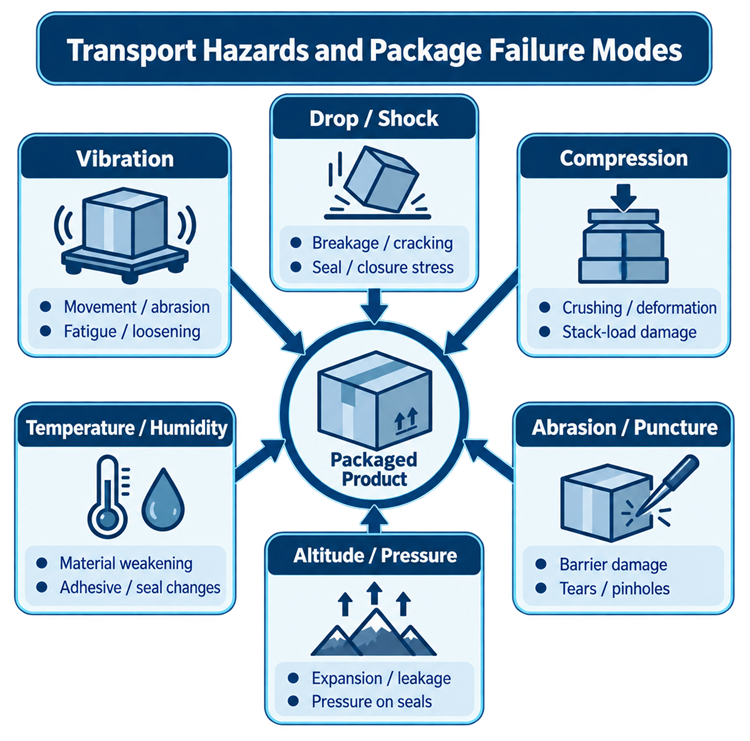
Mechanical hazards include vibration, drop, shock, impact, compression, concentrated loading, abrasion, puncture, load shifting, and repeated handling. Environmental hazards can include temperature, humidity, atmospheric pressure, altitude, and environmental conditioning that changes the mechanical properties of the package before other tests are performed.
The significance of a hazard depends on the product-package system. A glass vial shipment may be sensitive to impact and vial-to-vial contact. A sterile medical-device pouch may be vulnerable to abrasion or puncture caused by movement of the device. Corrugated shipping cases can lose compression strength under high humidity. A liquid-filled container may respond differently to vibration than a lightweight solid product.
The study should therefore link each selected hazard to a plausible package or product failure mechanism.
Distribution Risk Assessment
Distribution risk assessment provides the bridge between the expected logistics environment and the test plan.
A useful analysis considers:
| Distribution hazard | Potential package/product effect |
|---|---|
| Vibration | Product movement, abrasion, component loosening, fatigue |
| Drop / shock | Breakage, cracking, seal stress, component displacement |
| Compression | Carton deformation, product crushing, closure loading |
| Repetitive handling | Accumulated package damage |
| Impact | Local deformation, breakage, internal movement |
| Temperature / humidity | Reduced material strength, adhesive or seal changes |
| Altitude / pressure | Package expansion, leakage, seal or closure stress |
| Pallet instability | Load shifting, crushing, corner damage |
| Abrasion / puncture | Sterile-barrier or flexible-package breach |
Risk analysis should not stop with a numerical score. Its useful output is a test strategy that challenges the hazards capable of compromising the required packaging function.
The package design risks identified in Packaging System Requirements, Design, and Risk Assessment and the worst-case rationale established in Packaging Qualification Strategy and Worst-Case Configuration should therefore feed directly into distribution simulation.
Define the Test Article
Transport testing should use a clearly defined test article, meaning the complete packaged-product configuration being challenged.
Depending on the objective, the test article may include the product, primary package, secondary carton, protective packaging, corrugated case, dividers, inserts, cushioning, pallet, stretch wrap, and other distribution components.
The actual commercial configuration should be represented whenever those elements affect performance.
Testing only an inner package can underestimate risk when tertiary packaging controls compression, vibration, or impact. Conversely, testing an oversized development shipper that is more protective than the commercial configuration can create falsely favorable evidence.
Documentation should identify applicable part numbers, component revisions, quantities, orientation, product or simulator characteristics, case configuration, pallet pattern, wrapping, and other relevant elements.
Product Versus Product Simulant
Actual product is generally preferable where product characteristics can influence package behavior, but a justified simulant can be appropriate in some studies.
The simulant should reproduce the properties relevant to the test objective. These can include mass, center of gravity, geometry, rigidity, fluid movement, sharp features, thermal mass, fragility, or interaction with the package.
A simple weight substitute may be adequate for one compression study but completely inadequate for a sterile-device pouch where device geometry and movement determine puncture risk.
The protocol should state why the selected product or simulant is representative of the challenge.
Worst-Case Configuration
There is no single universal worst-case configuration for distribution simulation.
The configuration with maximum mass may be worst case for drop energy or stacking load. A minimum-loaded case may permit more internal movement and create greater impact or abrasion. A large package may experience greater bending, while an intermediate configuration may contain the product geometry most likely to damage a sterile barrier.
Worst-case selection should therefore consider product mass, package mass, center of gravity, package dimensions, internal clearance, product movement, cushioning, case quantity, product orientation, packaging materials, and other variables related to the failure mechanism.
Where multiple configurations form a product family, bracketing should be technically justified. The qualification strategy should explain which configurations were selected and why untested configurations are expected to perform no worse.
Selecting ASTM, ISTA, or a Custom Test Strategy
The test standard should be selected after the distribution environment and qualification objective are understood.
ASTM D4169 provides a structured system for testing shipping units through sequences of anticipated distribution hazards. The practice is designed to evaluate shipping-unit capability in a laboratory and includes different distribution cycles based on the expected distribution environment. ASTM specifically identifies D7386 as the appropriate practice to consider for single-parcel shipments.
ASTM D7386-25 provides a corresponding sequential approach for single-parcel delivery systems and requires the performance-test sequence to be conducted on the same container without opening between test elements.
ISTA classifies its methods according to intended purpose. ISTA identifies the 1-Series as non-simulation integrity tests, the 2-Series as partial simulation, and the 3-Series as general simulation. ISTA states that 3-Series procedures are intended to simulate general damage-producing transport motions, forces, conditions, and sequences and can therefore serve as predictive performance tools.
The selection should reflect the actual distribution system rather than a company preference for “ASTM” or “ISTA.”
Detailed application of the individual standards belongs in ASTM Distribution and Package Performance Test Methods and ISTA Distribution Simulation Protocols and Test Selection. This article establishes the strategy that determines which method is appropriate.
ASTM D4169
ASTM D4169-23e1 is currently active and provides a uniform approach for evaluating shipping units against anticipated distribution hazards. ASTM describes the program as a sequence of hazard elements associated with different distribution cycles.
A key concept is that distribution hazards are tested as a sequence rather than as unrelated standalone tests. Package damage can accumulate, and an earlier exposure can influence performance during a later challenge.
For use as a performance test, ASTM requires the shipping unit to remain unopened until the sequence is complete. ASTM notes that opening the unit between elements may be useful during development studies, but doing so can interfere with evaluating the combined effect of the test sequence.
This distinction should be respected in validation protocols. Development testing can be diagnostic. Qualification testing should normally preserve the integrity of the intended sequence unless a technically justified alternative is defined.
ASTM D7386 for Parcel Distribution
ASTM D7386 addresses packages distributed through single-parcel delivery systems. The current active edition is ASTM D7386-25.
The distinction is important because parcel networks can expose packages to repeated manual and automated handling, drops, impacts, vibration, compression, and orientation changes that differ from palletized freight distribution.
ASTM D7386 states that the recommended tests should be performed sequentially on the same containers and that the performance-test unit should remain unopened until completion.
A package shipped individually by parcel service should therefore not automatically be evaluated using a distribution model developed for unitized or freight shipments.
ISTA General Simulation Procedures
ISTA’s current test-procedure framework provides several general simulation options tailored to different distribution systems.
- ISTA 3A applies to individually packaged products weighing 70 kg (150 lb) or less shipped through parcel delivery networks. ISTA describes it as appropriate for standard, small, flat, and elongated packages distributed individually by air or ground.
- ISTA 3B addresses less-than-truckload shipments, where packages from different shippers and destinations can be combined within the same freight system.
- ISTA 3E is directed at unitized loads, with the current ISTA overview describing its application to unitized loads prepared for full-truckload shipment.
ISTA also maintains procedures for specialized distribution systems, including e-commerce and member-specific channels. The correct protocol should therefore be selected from the actual shipping model rather than from package weight alone.
Custom and Enhanced Simulation
A standardized procedure is not automatically sufficient when the distribution network contains hazards or exposure levels not adequately represented by the chosen standard.
A custom strategy may be justified when actual distribution data show unusual vibration spectra, high numbers of handling events, specific altitude conditions, unusually long transit durations, specialized containers, automated handling systems, or other distinctive characteristics.
ISTA also distinguishes enhanced simulation from its general simulation procedures. ISTA identifies 4AB as a framework for customizing the test plan more closely to a user-defined distribution hazard pattern.
A custom protocol should not simply increase every test severity “for safety.” Excessive laboratory challenge can create unrealistic failure mechanisms and drive unnecessary packaging changes. The challenge should remain technically connected to the distribution risk being evaluated.
Environmental Conditioning Before Mechanical Testing
Packaging materials can respond differently to mechanical stress depending on temperature and humidity.
Corrugated fiberboard can lose compression strength under high humidity. Polymer materials can become more brittle at low temperature or softer at elevated temperature. Adhesives and tapes can respond to moisture or temperature exposure. Environmental conditioning may therefore be needed before vibration, compression, drop, or other mechanical testing.
The selected conditioning should be consistent with the applicable test standard and the expected distribution environment.
Environmental conditioning for transport testing should not be confused with qualification of a temperature-controlled shipping system. The latter asks whether the product remains within a defined temperature range during shipment and is addressed separately in Temperature-Controlled Packaging System Qualification.
Vibration Testing
Vibration testing evaluates the response of the packaged product to dynamic excitation during transportation.
Vibration can produce product movement, abrasion, fatigue, loosening of components, collapse of cushioning, migration of contents, damage to labels, or progressive stress on seals and closures.
Random vibration is frequently used because actual vehicle vibration contains energy distributed across a range of frequencies. The specific vibration profile and duration should be determined by the selected standard or justified distribution data.
The qualification objective is not simply to demonstrate that a package survived a shaker table. Post-test evaluation should determine whether the vibration produced effects relevant to product or package requirements.
For a sterile medical-device package, for example, vibration may create abrasion between the device and sterile barrier even when no gross package deformation is visible.
Drop and Shock Testing
Drops and shocks simulate events associated with manual handling, parcel sorting, loading, unloading, or accidental impact.
The severity of a drop depends on factors including package weight, drop height, orientation, impact surface, package geometry, and product location.
Different orientations can create very different failure modes. Face, edge, and corner impacts should therefore be selected according to the applicable procedure or identified risk.
Post-drop evaluation should include the product and internal packaging, not merely the appearance of the outer shipper. A corrugated case can remain intact while a vial breaks, an internal component shifts, or a sterile barrier is punctured.
Compression and Stacking
Compression testing evaluates the ability of the shipping configuration to withstand loads imposed during stacking, storage, and transportation.
Relevant variables include case strength, stack height, duration, pallet configuration, load sharing, humidity, and whether the package itself carries the load or the product contributes structural support.
ASTM currently lists ASTM D642-25 as the active test method for determining compressive resistance of shipping containers, components, and unit loads.
Compression studies should reflect the actual configuration being qualified. Testing an individual case can answer a different question from evaluating a palletized unit load.
Impact and Concentrated Loads
Some distribution failures result from localized forces rather than general compression or drop events.
Concentrated impacts can damage packages through fork contact, edge loading, protruding objects, pallet interfaces, or localized handling events. For some products, these events can create punctures, cracks, or internal damage that would not be predicted by overall compression performance.
Where such hazards are credible, the test program should incorporate the appropriate standardized or risk-based challenge.
The need for specialized tests should originate from the distribution risk assessment rather than from an attempt to include every available ASTM method.
Altitude and Pressure Effects
Air transportation and movement through high-altitude regions can expose packages to reduced atmospheric pressure.
Flexible packaging, liquid containers, closed headspaces, and some closure systems can experience pressure differentials that cause expansion, leakage, distortion, or stress on seals.
The need for altitude or pressure testing should therefore be assessed where the shipping route or package design makes this a credible failure mechanism.
A package transported only by ground at low altitude may not require the same test strategy as a sealed liquid container routinely shipped by air.
Test Sequence Matters
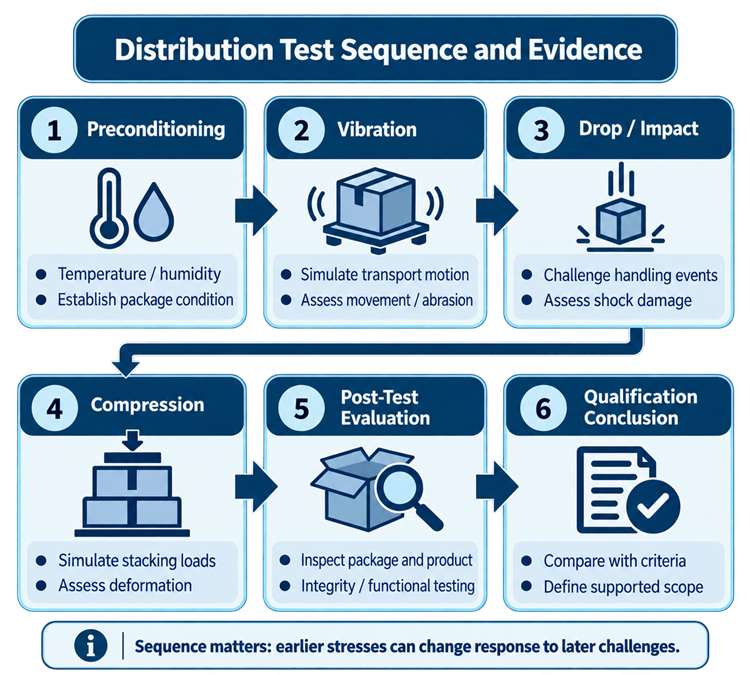
The order of transport challenges can influence the final result.
Environmental conditioning can weaken a corrugated shipper before compression. Vibration can alter cushioning before a subsequent drop. Repeated handling can weaken a package before final impact. Aging can change the mechanical properties of materials before distribution simulation.
The protocol should therefore define the test sequence and explain how it supports the qualification objective.
A typical medical-device packaging sequence might be: manufacture and seal → sterilization → aging → environmental conditioning → distribution simulation → package integrity and device evaluation
The sequence is not universal. Another study might specifically investigate whether transport damage affects later aging performance. The important validation principle is that test order should be deliberate.
New Versus Aged Test Samples
Distribution simulation performed only on newly manufactured packaging may not represent package performance near the end of shelf life.
Materials, adhesives, seals, and protective components can change with age. For products with defined expiration periods, the strategy should determine whether aged or otherwise shelf-life-representative packages need to undergo distribution testing.
The relationship between accelerated aging, real-time aging, and distribution performance is addressed in Packaging Aging, Shelf-Life, and Stability Integration.
ASTM F1980 distinguishes time-related package aging from event-related hazards associated with transportation. Those studies answer different questions and should be integrated rather than substituted for one another.
Sample Quantity
Sample quantity should be technically justified. A fixed number of shipping cases or packages should not be assumed sufficient merely because it was used in previous protocols.
The number of test articles should reflect package variability, number of configurations, destructive post-test testing, product risk, test method, expected failure rate, and whether multiple orientations or conditions must be evaluated.
Testing more units does not compensate for testing the wrong configuration or an inappropriate distribution cycle. Representative selection and technically appropriate challenge remain more important than arbitrary sample count.
Test Execution and Laboratory Control
Distribution simulation should be performed using equipment capable of reproducing the defined challenge conditions within appropriate tolerances.
The test program should identify applicable equipment calibration, test fixtures, environmental conditions, setup requirements, package orientation, instrumentation, and test sequence.
Where an external testing laboratory is used, the sponsor remains responsible for ensuring that the selected test plan, package configuration, acceptance criteria, and report satisfy the intended qualification objective.
A laboratory’s standard report can demonstrate that a prescribed procedure was executed. It does not automatically establish that the procedure was the correct one for the product.
Pre-Test Inspection
Test articles should be inspected before testing to establish their initial condition. The inspection can include packaging configuration, package dimensions, visible damage, seal condition, container condition, labeling, and product functional checks where appropriate.
Pre-existing defects should be documented because they can complicate interpretation of post-test observations.
For validation work, the goal is to distinguish defects introduced by transport simulation from conditions already present before testing.
Post-Test Evaluation
The most important evidence is frequently generated after the transport sequence has been completed.
Post-test evaluation should correspond to the identified failure risks and can include:
- outer and inner package inspection;
- product breakage or leakage assessment;
- sterile-barrier inspection;
- seal-strength testing;
- package-integrity testing;
- container-closure integrity testing where applicable;
- device functionality;
- label condition and readability;
- dimensional assessment;
- closure or component position;
- particulate or cosmetic damage where functionally relevant.
Testing methods should be defined before the transport study begins.
For sterile barrier systems, Package Seal Strength, Integrity, and Sterile Barrier Testing addresses appropriate distinctions among seal strength, visual condition, and package integrity.
Acceptance Criteria
Acceptance criteria should define what constitutes successful package and product performance after the entire test sequence.
A criterion such as “no significant damage” is inadequate unless significant damage is formally defined.
More defensible criteria might specify that no primary containers are broken or leaking, no sterile-barrier breach is detected, the product remains within functional specifications, closure components remain properly positioned, labels remain legible and attached, and secondary or tertiary damage does not compromise the required packaging function.
Cosmetic changes should be distinguished from functional failures. A shipping case can show scuffing or minor deformation and still protect the product adequately. Conversely, an apparently undamaged case can contain significant internal product damage.
ISTA specifically advises the shipper to define product damage, allowable damage tolerance, methodology for determining product condition, and acceptable package condition before testing.
Opening the Package During Testing
For formal performance qualification, the package should generally remain unopened throughout the test sequence when required by the selected standard.
ASTM D4169 states that shipping units used for performance testing should remain unopened until the test sequence has been completed. Opening packages during development may help identify when damage occurs, but it can alter subsequent performance and invalidate assessment of the accumulated sequence.
ASTM D7386 applies the same basic principle to parcel-delivery performance testing.
This distinction is useful for validation planning. Diagnostic development studies and formal qualification studies can use different approaches, but the purpose should be stated clearly.
Qualification Failures
A failed distribution-simulation study should trigger investigation rather than immediate repetition.
Potential causes can include inadequate package design, incorrect internal restraint, insufficient cushioning, weak tertiary packaging, closure or seal problems, product fragility, unrealistic test setup, incorrect test configuration, or a test severity that does not represent the intended distribution environment.
The investigation should determine whether the failure represents a true weakness in the commercial packaging system.
A repeat should be scientifically justified. Replacing a damaged component or modifying the test article without documenting the change can invalidate the qualification rationale.
Where packaging changes are made following a failure, the revised configuration should be clearly identified and appropriately retested.
Transport Simulation Report
The final report should document enough information to reproduce and interpret the study. The report should identify the tested product and packaging configuration, applicable specification revisions, selected standard and procedure, distribution cycle or ISTA protocol, conditioning requirements, challenge sequence, equipment, sample quantity, orientations, acceptance criteria, test deviations, post-test inspections, product evaluation, and final conclusion.
The report should also state the qualification boundary. It should identify which package family, shipping configuration, product variants, and distribution assumptions are supported by the completed study.
The conclusion should avoid an overly broad statement such as “packaging is validated for shipping worldwide” unless the evidence genuinely supports that scope.
Relationship to Actual Distribution
Laboratory testing provides reproducibility and controlled challenge, but the effectiveness of the simulation should be compared with actual distribution experience when data become available.
ISTA recommends monitoring actual shipments after testing and comparing real-world performance with laboratory results so that the effectiveness of the test strategy can be evaluated and future testing decisions improved.
Useful lifecycle information can include damaged-product reports, carrier claims, package complaints, temperature-monitoring data, returned products, handling observations, and shipping-lane performance.
A sustained mismatch between successful laboratory testing and recurring commercial damage indicates that either the distribution environment or the qualification assumptions require reassessment.
Temperature-Controlled Shipments
Mechanical distribution simulation and thermal qualification should remain technically coordinated but conceptually distinct.
A passive insulated shipper, for example, must maintain product temperature while also surviving vibration, impact, handling, and compression. A thermal study performed on an undamaged laboratory shipper does not necessarily demonstrate performance after mechanical abuse.
Likewise, a mechanically robust package does not demonstrate that temperature conditions remain acceptable.
The combined qualification strategy should therefore determine whether thermal and mechanical challenges interact and whether sequential or separate studies are needed. Detailed thermal-system qualification is addressed in Temperature-Controlled Packaging System Qualification.
Medical-Device Sterile Barrier Considerations
For terminally sterilized medical devices, distribution simulation should evaluate whether transportation hazards can compromise the sterile barrier or device function.
ISO 11607-1:2019 specifies requirements for packaging systems intended to maintain sterility until use. The standard remains current and includes a 2023 amendment addressing application of risk management.
For these packages, post-distribution evaluation can include visual inspection, seal testing, integrity testing, and functional evaluation of the packaged device.
The test strategy should consider the possibility that the device itself creates the package failure through movement, abrasion, concentrated loading, or sharp geometry.
Pharmaceutical Packaging Considerations
For pharmaceuticals and biologics, distribution testing should remain linked to the functions of the marketed container-closure and shipping system.
Mechanical testing may evaluate vial breakage, stopper or closure displacement, bottle leakage, blister damage, carton deformation, syringe damage, label condition, and other product-specific risks.
For sterile pharmaceutical container-closure systems, detailed integrity evaluation should remain within the pharmaceutical CCIT framework rather than applying medical-device sterile-barrier terminology indiscriminately.
Where distribution can affect product stability, the packaging and stability programs should also remain connected. Product damage or package deformation can influence moisture protection, containment, light protection, or other characteristics relevant to shelf life.
Change Control and Requalification
Distribution-simulation evidence remains valid only while the assumptions supporting the study remain applicable. Changes that can require assessment include packaging material changes, package dimensions, product mass, new device geometry, case quantity, cushioning, shipping-carton construction, pallet configuration, closure systems, sterilization, labeled shelf life, or major changes to distribution mode.
A change from palletized full-truckload shipment to parcel delivery can materially alter the distribution hazard profile even if the primary package is unchanged.
Requalification should therefore be risk-based. Some changes remain within the established test envelope; others require focused or full repeat testing.
Validation Perspective
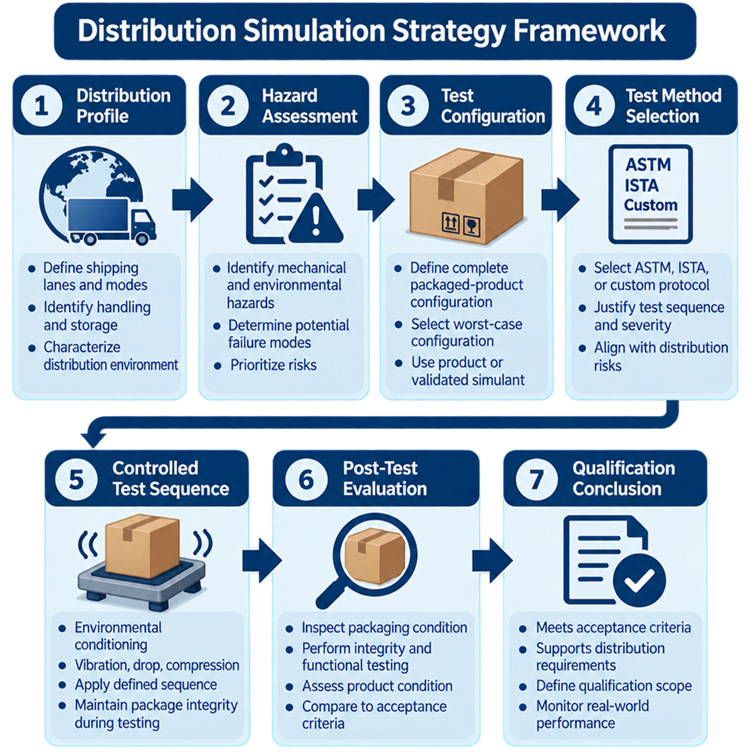
A defensible distribution-simulation strategy establishes a clear sequence of engineering decisions. The distribution environment is characterized first, followed by identification of credible hazards and package failure mechanisms. The appropriate test article and worst-case configuration are then selected, followed by the ASTM, ISTA, or custom simulation strategy capable of challenging those risks. Predetermined post-test acceptance criteria establish how package and product performance will be evaluated.
The resulting qualification path can be summarized as:
Distribution profile → hazard assessment → test configuration → simulation standard and sequence → controlled challenge → post-test evaluation → qualification conclusion → lifecycle comparison with actual shipping performance
This approach avoids treating transport simulation as a generic laboratory service. It makes the study part of the packaging validation lifecycle and creates traceable evidence that the commercial packaged product is capable of withstanding the distribution environment for which it was designed.