

Risk-Based Requalification of GMP Equipment, Systems, and Utilities
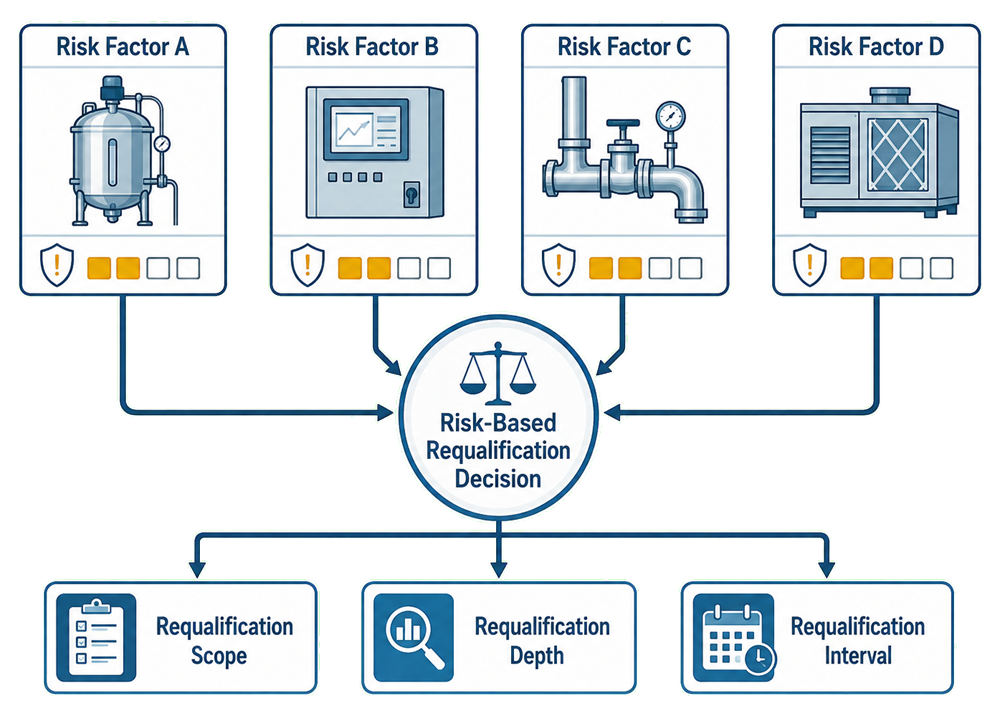
Risk-based requalification is a documented process used to determine whether previously qualified equipment, systems, or utilities require additional qualification testing. It also defines which functions must be tested and when the work should be performed.
The decision is based on current evidence rather than equipment age alone. Relevant evidence includes the original risk assessment, Periodic Equipment Assessment, changes, deviations, maintenance, calibration, operating performance, and the potential consequences of failure.
Risk-based requalification does not eliminate required testing. It directs qualification effort toward the functions and conditions that could affect product quality, patient safety, data integrity, or the continued qualified state.
Purpose of Requalification
Initial qualification provides documented evidence that equipment, systems, and utilities are properly installed, operate as intended, and perform reliably under defined conditions.
Requalification determines whether that evidence remains valid after the equipment has been placed into routine use. It may be needed when operating experience, changes, failures, or other lifecycle information creates uncertainty about the qualified state.
Risk-based requalification is intended to:
- Confirm that GMP-critical functions remain effective
- Verify that affected equipment continues to meet approved requirements
- Evaluate the qualification impact of changes and adverse events
- Focus testing on functions that may have been affected
- Avoid unnecessary repetition of unaffected qualification tests
- Provide a documented basis for continued GMP use
Requalification should not be performed merely to satisfy a calendar date. However, established frequencies required by an approved procedure, regulatory commitment, recognized standard, or validated control strategy remain applicable unless they are formally revised with adequate justification.
Regulatory and Lifecycle Basis
FDA regulations require equipment to be appropriately designed, maintained, cleaned, inspected, checked, and calibrated according to written procedures. FDA’s process-validation lifecycle approach also expects qualified facilities, utilities, and equipment to remain suitable for their intended use.
ICH Q9(R1) supports the application of quality risk management throughout the product lifecycle. The level of effort, formality, and documentation should be proportionate to risk, but risk management must not be used to justify practices that would otherwise be unacceptable.
These principles support a scientifically justified requalification program. They do not establish one universal interval or require the complete repetition of IQ, OQ, and PQ for every system on the same schedule.
Relevant sources include 21 CFR Part 211, Subpart D, FDA Process Validation Guidance, and ICH Q9(R1).
Relationship to Periodic Equipment Assessment
Periodic Equipment Assessment and requalification are related but separate activities.
Periodic assessment reviews lifecycle information to determine whether the equipment remains qualified and in a state of control. Requalification involves documented verification or testing when existing evidence is insufficient or indicates that particular functions may have been affected.
Periodic assessment does not automatically trigger requalification. It provides evidence supporting one of several possible decisions:
- Continue routine operation without additional qualification testing
- Implement corrective actions or enhanced monitoring
- Perform targeted requalification
- Perform comprehensive requalification
- Restrict GMP use pending investigation and resolution
A system may remain qualified without repeated testing when current evidence adequately demonstrates continued control. Conversely, requalification may be required immediately following a significant event without waiting for the next periodic assessment.
Information Used in the Decision
The decision should consider information relevant to the equipment and the period being evaluated.
Qualification and Risk Information
Review:
- Approved intended use and system boundaries
- GMP-critical functions and requirements
- Original qualification results
- Open qualification discrepancies or deferred actions
- Initial and current risk assessments
- Previous requalification results
Changes and Configuration
Evaluate changes involving:
- Equipment design or configuration
- Critical components or instruments
- Software, firmware, recipes, or control settings
- Operating ranges or setpoints
- Supporting utilities or system interfaces
- Intended use, products, processes, or load configurations
Changes should be evaluated through the established change-control process, including verification that approved post-implementation testing was completed.
Performance and Quality History
Review:
- Deviations, investigations, and CAPA
- Failures, alarms, and recurring operator interventions
- Process or environmental monitoring trends
- Maintenance and repair history
- Calibration failures, adjustments, and overdue activities
- Product-quality events potentially associated with equipment performance
- Results of the latest Periodic Equipment Assessment
The information should be evaluated collectively. Several individually minor events may establish an adverse trend that is not apparent when each event is reviewed separately.
Requalification Decision Process
The assessment should answer four questions.
1. What occurred?
Clearly identify the change, failure, trend, elapsed interval, or other condition prompting the evaluation.
The decision should not begin with an assumption that either no testing or complete requalification is required.
2. Which qualified functions could be affected?
Determine whether the condition could affect:
- Installation or configuration
- Critical operating functions
- Controls, alarms, or interlocks
- Measurement accuracy
- Operating ranges or setpoints
- Supporting utilities
- System interfaces
- Cleaning, sanitization, or sterilization functions
- Data generation, processing, storage, or retrieval
- Performance under routine or worst-case conditions
The assessment should evaluate affected functions rather than assigning one general risk classification to the entire system.
3. Is existing evidence sufficient?
Existing qualification, maintenance, calibration, monitoring, investigation, or vendor documentation may provide useful evidence. It should be accepted only when its scope, quality, and applicability are adequate for the current decision.
Additional testing is required when the available evidence does not adequately demonstrate that the affected function remains qualified.
4. What action is justified?
The final decision should identify the required requalification scope, testing conditions, acceptance criteria, timing, and approval requirements.
High-consequence functions should not be excluded from testing solely because failure is considered unlikely or detectable.
Requalification Outcomes
No Additional Qualification Testing
No additional testing may be justified when:
- No qualified function was affected
- The approved configuration remains unchanged
- Performance remains within established limits
- Maintenance and calibration remain effective
- No significant adverse trends are present
- Existing evidence adequately supports continued operation
The decision and supporting evidence should still be documented.
Targeted Requalification
Targeted requalification verifies only the functions affected by a change, failure, repair, trend, or identified uncertainty.
Examples include:
- Repeating installation checks after replacement of a critical component
- Verifying an alarm or interlock after a control-system change
- Testing an affected operating range following instrument replacement
- Repeating temperature mapping after a significant chamber modification
- Verifying data transfer after changing a system interface
- Repeating selected performance tests after a major repair
Targeted testing is appropriate only when unaffected functions can be clearly identified and their continuing qualified state is supported by documented evidence.
Comprehensive Requalification
Comprehensive requalification may be required when:
- Equipment has undergone extensive modification
- Multiple critical functions may have been affected
- The approved configuration cannot be confirmed
- Significant qualification records are missing or unreliable
- Repeated failures indicate loss of control
- The equipment has been relocated or returned after an extended uncontrolled shutdown
- Intended use or operating conditions have changed substantially
- Existing evidence cannot establish which functions remain qualified
Comprehensive requalification does not necessarily mean mechanically repeating every historical test. The protocol should reflect the current intended use, configuration, risks, requirements, and control strategy.
Defining the Requalification Scope
The scope should be traceable to the affected requirements and functions. Depending on the assessment, it may include:
- Installation Qualification verification for installation, components, utilities, documentation, and configuration
- Operational Qualification of functions, controls, alarms, interlocks, and operating ranges
- Performance Qualification under representative or worst-case operating conditions
- Verification of interfaces and supporting utilities
- Review or testing of automated functions and electronic records
- Confirmation of cleaning, sanitization, or sterilization performance, where applicable
The rationale should explain both what is included and why potentially relevant elements are excluded.
Documentation review alone is not requalification testing. It may support a conclusion that testing is unnecessary, but it should not be presented as requalification unless defined verification activities are performed.
Establishing Requalification Intervals
Some equipment requires requalification at established intervals because continued performance cannot be demonstrated adequately through routine monitoring alone. Other equipment may be effectively controlled through maintenance, calibration, monitoring, periodic assessment, and event-driven requalification.
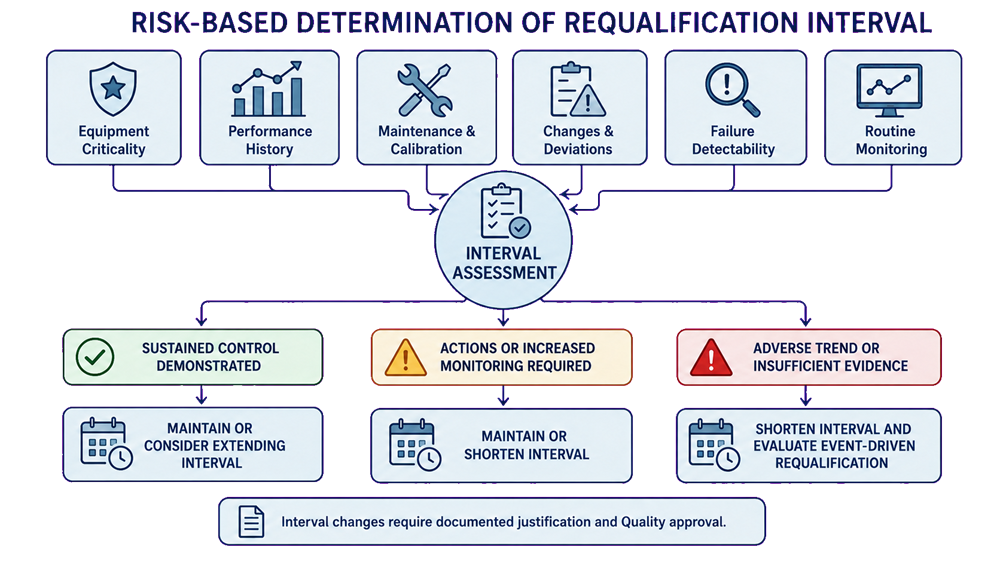
The interval should consider:
- GMP criticality and consequences of failure
- Equipment complexity and reliability
- Stability of operating and performance trends
- Calibration and maintenance history
- Frequency of changes, deviations, and repairs
- Ability to detect deterioration before product is affected
- Results of previous qualification and requalification
- Effectiveness of routine monitoring
- Applicable procedural, regulatory, or standard-based requirements
Possible decisions include:
- Maintain the existing interval
- Shorten the interval because of increased risk or adverse performance
- Extend the interval when sustained control is demonstrated
- Replace routine calendar-based testing with periodic assessment and event-driven requalification, when justified and permitted
An extended interval should be supported by sufficient performance history and approved through the applicable quality-system process. A low numerical risk score alone is not adequate justification.
Event-Driven Requalification
Requalification should be evaluated whenever an event may affect the qualified state, regardless of the planned interval.
Potential triggers include:
- Significant equipment modification
- Relocation
- Critical component replacement
- Major software or control-system change
- Change in intended use or operating range
- Extended shutdown or improper storage
- Critical calibration failure
- Major repair
- Repeated deviations, alarms, or failures
- Adverse performance trend
- Loss or interruption of a supporting utility
- Evidence that an existing control is ineffective
- Regulatory observation or formal commitment
Not every event requires requalification. Each event requires a documented impact assessment that determines whether qualification evidence remains valid.
Requalification Protocol and Acceptance Criteria
When testing is required, it should be performed under an approved protocol or other controlled document.
The protocol should define:
- Reason for requalification
- Equipment identification and current configuration
- Affected requirements and functions
- Risk and impact-assessment references
- Tests to be performed
- Test conditions and required challenges
- Acceptance criteria
- Required instruments and calibration status
- Handling of deviations
- Review and approval responsibilities
Acceptance criteria should be established before execution and traceable to approved requirements, operating limits, process needs, or validated conditions.
Documentation of the Decision
The requalification assessment should document:
- Event or condition prompting the evaluation
- Equipment, system, or utility evaluated
- Intended use and GMP impact
- Documents and data reviewed
- Affected requirements and functions
- Current qualification and configuration status
- Identified risks and uncertainties
- Adequacy of existing controls and evidence
- Requalification decision
- Justification for the selected scope and timing
- Required actions, owners, and due dates
- Quality review and approval
The record should be sufficiently detailed for an independent reviewer to understand how the evidence supports the decision.
Quality Oversight
The assessment should involve personnel knowledgeable about the equipment, its intended use, operating history, and qualification basis. Engineering, Operations, Maintenance, Automation, Validation, and other technical functions should participate as applicable.
Quality oversight should confirm that:
- Relevant evidence was reviewed
- Affected functions were correctly identified
- Significant uncertainty was not ignored
- Regulatory or procedural requirements remain satisfied
- Excluded testing is adequately justified
- Acceptance criteria are appropriate
- Open actions do not prevent continued GMP use
- The final decision is documented and approved
Risk-based requalification is not a mechanism for reducing qualification work without technical justification. Quality risk management supports the decision but does not replace scientific evidence, applicable requirements, or Quality responsibility.
Conclusion
Risk-based requalification uses current lifecycle evidence to determine whether qualified equipment, systems, and utilities require additional verification. The decision should focus on affected functions, potential consequences, available evidence, uncertainty, and the effectiveness of existing controls.
Equipment with demonstrated control and no affected critical functions may continue in use without additional testing. A defined change or isolated concern may require targeted requalification. Extensive changes, loss of control, or inadequate evidence may require comprehensive requalification.
The resulting decision must be technically justified, documented, and approved. Requalification effort should be proportionate to risk while remaining sufficient to demonstrate that the equipment is fit for its intended GMP use.