

Periodic Equipment Assessment
Periodic Equipment Assessment is a structured, documented review performed to confirm that GMP-relevant equipment, systems, and utilities remain fit for their intended use and continue to operate in a state of control following initial qualification. Unlike initial validation, which establishes fitness for use, periodic assessment evaluates ongoing performance, emerging risks, and the continued adequacy of controls over time.
Periodic assessment is a key element of lifecycle validation and supports risk-based decisions related to maintenance, change management, and requalification.
Purpose of Periodic Equipment Assessment
The primary purpose of periodic equipment assessment is to provide objective evidence of continued control. It ensures that previously qualified equipment continues to meet GMP expectations and that changes in performance, usage, or operating conditions are identified and addressed proactively.
Periodic assessment supports:
- Verification of continued equipment performance
- Identification of adverse trends or recurring issues
- Confirmation that existing controls remain effective
- Input to risk-based requalification decisions
Periodic assessment does not replace validation or qualification activities. Instead, it complements them by providing lifecycle oversight.
Regulatory and Lifecycle Basis
Periodic Equipment Assessment supports the lifecycle expectation that qualified equipment, systems, and utilities remain suitable for their intended use after initial qualification. The assessment consolidates operating and quality-system information to determine whether the original qualification remains valid and whether the equipment continues to perform within approved conditions.
FDA’s lifecycle approach to process validation expects manufacturers to maintain facilities, utilities, and equipment in a condition suitable for continued operation and to use accumulated performance information to maintain a state of control. ICH Q9(R1) establishes risk review as part of quality risk management throughout the product lifecycle, while ICH Q10 supports the continuing evaluation of process performance, equipment operating conditions, deviations, CAPA, and changes.
Periodic Equipment Assessment should not be confused with the annual product-quality evaluation required under 21 CFR 211.180(e). The annual product review evaluates product and batch-related quality information. Periodic Equipment Assessment evaluates the continuing qualified state and performance of specific equipment, systems, or utilities. Information from each review may support the other, but they have different scopes and purposes.
This distinction prevents the article from implying that FDA specifically requires every piece of equipment to undergo an annual assessment. 21 CFR 211.180(e), FDA Process Validation guidance, and ICH Q10 support the lifecycle principles.
Scope and Applicability
Periodic Equipment Assessment applies to GMP-relevant equipment, systems, and utilities whose operation or failure could affect:
- Product quality
- Patient safety
- Data integrity
- Regulatory compliance
- The continued qualified or validated state
The scope of each assessment should be based on the defined system boundaries established in the approved qualification documentation, validation plan, or system description. The assessment should address the equipment or system as a complete operating unit, including applicable:
- GMP-critical functions and components
- Critical instruments and control devices
- Software, firmware, recipes, and configuration settings
- Supporting utilities
- Interfaces with other systems
- Alarms, interlocks, and protective controls
- Operating, cleaning, maintenance, and calibration procedures
- Qualification and other lifecycle records
The assessment does not require every component to receive the same level of review. Greater attention should be given to functions, components, controls, and records whose failure could have a significant GMP impact. Noncritical elements may receive a more limited review when the rationale is documented.
The depth and frequency of the assessment should be determined using a documented risk-based approach that considers:
- GMP impact and equipment criticality
- Complexity and degree of automation
- Results of the initial risk assessment
- Operational history and performance trends
- Deviation, alarm, maintenance, and calibration history
- Frequency and significance of changes
- Results of previous periodic assessments
- Potential consequences of failure
Similar equipment may be covered by a common assessment when the units have equivalent designs, intended uses, operating conditions, critical functions, maintenance programs, qualification approaches, and performance histories. The basis for grouping must be documented. Units with significant differences, changes, recurring failures, or adverse trends should be assessed individually.
A risk-based approach ensures that assessment effort is proportionate to GMP impact. It does not exclude critical equipment from review or justify overlooking incomplete records, unresolved issues, or evidence that the qualified state may no longer be adequately supported.
Assessment Frequency
Periodic assessments should be performed at intervals established through an approved procedure and documented risk evaluation. The interval should reflect:
- GMP impact and equipment criticality
- System complexity and degree of automation
- Product-contact or contamination-control functions
- Failure consequences
- Equipment reliability and service history
- Deviation, alarm, and CAPA trends
- Calibration and maintenance performance
- Change frequency
- Results of previous assessments
- Availability of continuous monitoring or other lifecycle oversight
- Regulatory, corporate, or site-specific requirements
The interval should not be selected solely because a standard calendar period is convenient. Higher-risk or poorly performing equipment may require more frequent assessment, while stable equipment supported by effective continuous monitoring may justify a longer interval.
Event-driven assessment remains necessary when significant information arises between scheduled reviews. A major change, recurring failure, adverse trend, extended shutdown, critical calibration failure, or loss of supplier support may require immediate evaluation without waiting for the next scheduled assessment.
Data Sources Reviewed
The assessment should review information generated since the previous approved assessment. Relevant data should be organized into the following categories:
- Qualification status: Current qualification status, open discrepancies, deferred actions, prior validation documents, and completion of previous assessment actions
- Changes and configuration: Changes to intended use, operating ranges, critical components, software, firmware, recipes, system configuration, or supporting utilities
- Maintenance and calibration: Preventive and corrective maintenance, component replacements, calibration results, overdue activities, failures, and recurring adjustments
- Equipment performance: Operating data, process or environmental monitoring results, alarms, system logs, failures, interruptions, and adverse performance trends
- Quality events: Deviations, nonconformances, investigations, CAPA, complaints, and other quality events potentially related to equipment performance
- Operational controls: Cleaning, sanitization, sterilization, backup, recovery, access-control, and audit-trail records, where applicable
- Equipment lifecycle: Vendor notices, obsolescence, loss of technical support, and availability of critical replacement parts
The review should cover the complete period since the previous assessment and focus on trends, recurring problems, significant changes, and unresolved issues. Records that are not applicable should be identified as such. Missing or incomplete records should be evaluated as potential findings.
Assessment Methodology
Periodic Equipment Assessment should compare the equipment’s current condition and performance with its approved intended use, qualified configuration, operating ranges, critical functions, and established control strategy.
The assessment should include the following steps:
- Confirm the equipment identity, intended use, system boundaries, and GMP criticality.
- Verify the current qualification status and approved configuration.
- Review changes made since the previous assessment.
- Evaluate deviations, investigations, CAPA, alarms, failures, and operator observations.
- Review calibration and maintenance completion, failures, overdue activities, and recurring adjustments.
- Evaluate performance data for adverse trends, increased variability, or declining reliability.
- Confirm that critical procedures, controls, monitoring, and training remain current and effective.
- Review whether the original risk assessment remains valid or requires revision.
- Identify unresolved findings and determine their potential GMP impact.
- Assign an overall assessment outcome and document the required disposition.
The evaluation should consider trends and relationships among data sources rather than treating each record independently. For example, repeated calibration adjustments, increasing maintenance frequency, and intermittent process alarms may collectively indicate declining equipment performance even when no individual event caused a confirmed product-quality failure.
The assessment should also determine whether changes or operating experience have invalidated any original qualification assumptions, worst-case conditions, acceptance criteria, or established operating ranges.
Assessment Outcomes
The assessment should conclude whether the available information supports continued GMP use of the equipment or system. The conclusion should be based on qualification status, changes, maintenance and calibration history, quality events, performance trends, and unresolved issues.
The assessment should result in one of the following outcomes:
| Outcome | Required action |
|---|---|
| Continued use approved | The equipment remains qualified and performs as intended. Continue routine operation and monitoring. |
| Continued use with actions | The equipment remains suitable for use, but specific corrective actions or additional monitoring are required. Assign an owner and due date for each action. |
| Further evaluation required | The available evidence does not fully support the qualified state. Evaluate the need for investigation, restricted use, corrective action, or requalification before approving continued GMP use. |
The final outcome and its justification should be documented and approved by the responsible functions. Significant unresolved issues must not be classified as acceptable solely because they have not yet caused a confirmed product-quality failure.
Actions Resulting from Periodic Assessment
Depending on the assessment findings, actions may include:
- Continued routine operation and monitoring
- Enhanced monitoring or a shorter assessment interval
- Preventive maintenance or procedural updates
- Investigation, corrective action, or CAPA
- Change control
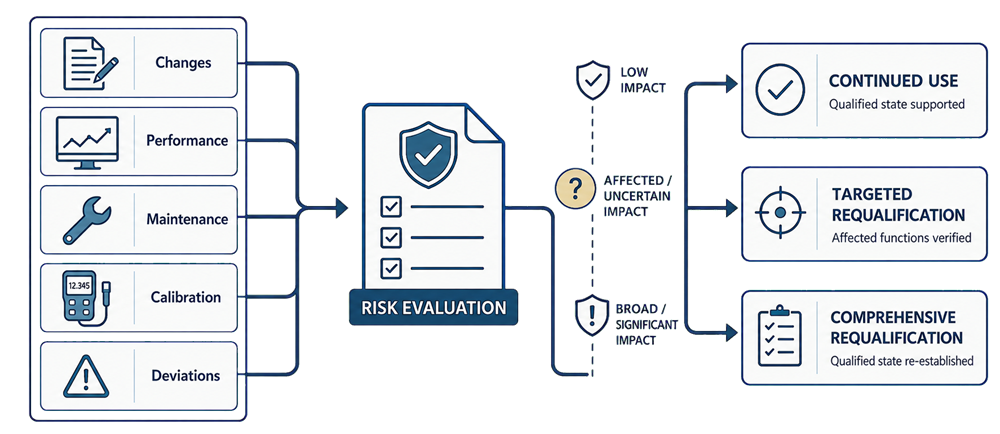
- Evaluation of the need for targeted or comprehensive requalification
Periodic assessment does not automatically trigger requalification. It provides documented evidence for determining whether the equipment remains qualified, whether corrective actions are required, and whether requalification should be considered.
Each action should have a defined owner, priority, due date, and method for documenting completion. Findings that may affect product quality, patient safety, data integrity, or the qualified state should be managed through the applicable deviation, CAPA, or change-control system.
The assessment may be approved with open actions only when continued GMP use is justified and the actions are formally tracked. It should not be closed merely by listing unresolved actions.
Documentation and Review
Each Periodic Equipment Assessment should be documented in an approved assessment record. The record should clearly identify:
- Equipment or system assessed
- Intended use and GMP impact
- Assessment period
- Documents and data reviewed
- Current qualification status
- Significant changes, maintenance activities, and calibration results
- Deviations, investigations, CAPA, alarms, and performance trends
- Open issues or incomplete records
- Assessment findings
- Required actions
- Final outcome and justification
- Proposed date for the next assessment
The assessment should be reviewed by personnel familiar with the equipment and its operation. Engineering, Operations, Maintenance, Automation, Validation, or other responsible functions should participate as applicable. Quality should review and approve the assessment when required by site procedures.
The review should confirm that:
- The assessment covered the defined period and appropriate data sources
- The equipment remains in its approved configuration
- Qualification requirements remain satisfied
- Significant changes and quality events were adequately evaluated
- Maintenance and calibration programs remain effective
- Adverse trends and recurring problems were identified
- Open issues do not prevent continued GMP use
- Required actions have assigned owners and due dates
- The final outcome is supported by the evidence reviewed
- Any need for additional evaluation or requalification has been addressed
The assessment may be approved with open actions when continued GMP use is justified and the actions are formally tracked. Issues that could affect product quality, patient safety, data integrity, or the qualified state should be managed through the applicable deviation, CAPA, or change-control system.
The approved assessment record should be retained with the equipment’s qualification and lifecycle documentation. Completion of assigned actions should be documented and followed through the established quality system.
Role of Periodic Assessment in Requalification
Periodic assessment evaluates whether the qualified state remains supported by current evidence. Requalification is one possible response when that evidence identifies an affected function, changed condition, adverse trend, or unacceptable uncertainty. The scope may range from targeted verification of one affected function to comprehensive repetition of qualification activities.
The outcomes of the Periodic Equipment Assessment are evaluated together with:
- The initial risk assessment
- Equipment criticality
- Change history
- Deviation and CAPA history
- Historical performance and trend data
This combined information is used to support risk-based decisions related to requalification, including:
- The appropriate scope of requalification activities
- The required depth of testing or verification
- The appropriate requalification interval
The process for determining requalification requirements based on risk and performance history is addressed in the Risk-Based Requalification article.
Conclussion
Periodic Equipment Assessment provides documented evidence that GMP-relevant equipment, systems, and utilities remain fit for their intended use and continue to operate in a state of control. The assessment evaluates qualification status, changes, deviations, maintenance, calibration, performance trends, and emerging risks to determine whether existing controls remain adequate.
Periodic assessment does not automatically require requalification. Its findings support a documented decision to continue routine operation, implement corrective actions, increase monitoring, revise the assessment frequency, or perform targeted or comprehensive requalification. The basis for determining the appropriate requalification scope is addressed in the Risk-Based Requalification article.