

Risk-Based Validation Approach for GMP Systems
A risk-based validation approach uses documented scientific and technical evaluation to determine the appropriate scope, depth, and rigor of validation activities. It concentrates validation effort on systems, functions, parameters, and controls whose failure could affect product quality, patient safety, data integrity, or GMP compliance.
The approach does not reduce the obligation to validate GMP-critical systems. It determines how validation should be planned and performed so that higher-risk functions receive greater scrutiny while lower-risk functions are addressed with a level of control proportionate to their actual impact.
When properly applied, risk-based validation creates a clear connection between intended use, system criticality, identified failure risks, validation deliverables, qualification testing, acceptance criteria, and lifecycle controls.
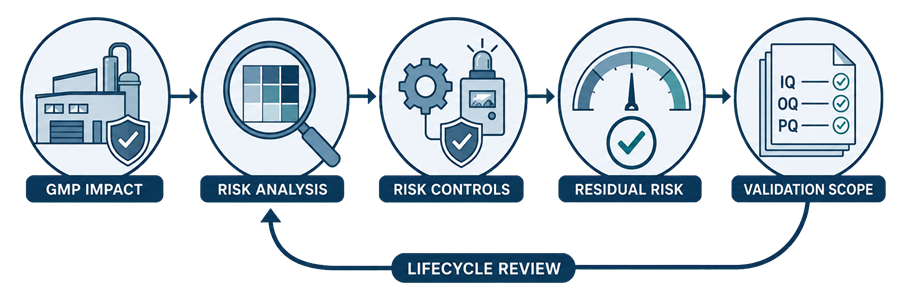
What Is a Risk-Based Validation Approach?
A risk-based validation approach is a structured method for making validation decisions based on:
- The system’s intended use
- Its potential GMP impact
- The severity of possible failures
- The likelihood that failures could occur
- The ability of existing controls to prevent or detect those failures
- The uncertainty associated with the available knowledge
- The residual risk remaining after controls are applied
Not every component or function within a GMP system has the same importance. A temperature sensor controlling a critical sterilization parameter requires more rigorous verification than a local display used only for operator convenience. Similarly, a computerized function that calculates and stores batch-release data requires greater control than a non-GMP informational screen.
Risk-based validation therefore directs the greatest effort toward the requirements, functions, components, parameters, records, and failure conditions that matter most to product quality and patient protection.
The resulting decisions must remain documented, scientifically justified, traceable, and approved through the pharmaceutical quality system.
Regulatory and Industry Basis
Quality risk management is an established element of modern pharmaceutical validation.
ICH Q9(R1), Quality Risk Management, defines quality risk management as a systematic process for assessing, controlling, communicating, and reviewing risks to product quality throughout the lifecycle. It establishes two fundamental principles:
- Risk evaluation should be based on scientific knowledge and ultimately linked to patient protection.
- The level of effort, formality, and documentation should be commensurate with the level of risk.
ICH Q9(R1) also emphasizes that risk decisions may be affected by subjectivity, uncertainty, and the formality of the assessment. The selected method should therefore be appropriate for the importance, complexity, and uncertainty of the decision.
The FDA Process Validation guidance applies lifecycle and risk-management principles to process design, process qualification, and continued process verification. It expects manufacturers to use process knowledge and objective data to identify sources of variability, establish controls, and maintain the process in a state of control.
ASTM E2500 provides an industry framework for science- and risk-based verification of manufacturing systems and equipment. It focuses verification on critical aspects of systems that can affect product quality and patient safety.
These frameworks support proportionate validation. They do not permit risk management to override regulatory requirements or justify an otherwise unacceptable practice.
System Classification and GMP Impact
Risk-based validation begins by defining the system and determining its GMP impact. System classification establishes whether the system requires formal qualification or validation and identifies the functions that require the greatest control.
The assessment should define:
- System boundaries and interfaces
- Intended use
- Products and processes supported
- GMP functions performed
- Product-contact or process-contact conditions
- Critical operating parameters
- Records created, processed, calculated, or retained
- Controls protecting product quality or data integrity
- Supporting utilities and infrastructure
- Failure consequences
A practical classification model may distinguish among direct-impact, indirect-impact, and no-impact systems.
| Classification | Typical meaning | Validation approach |
|---|---|---|
| Direct GMP impact | The system directly controls, measures, produces, cleans, stores, or protects product, critical process conditions, or GMP records | Formal qualification or validation with risk-focused verification |
| Indirect GMP impact | The system supports a direct-impact system but does not itself directly affect product quality | Documented assessment with appropriate commissioning, verification, procedural controls, or targeted qualification |
| No GMP impact | Failure would not reasonably affect product quality, patient safety, data integrity, or GMP compliance | Normal engineering and business controls generally apply |
Classification applies to both the overall system and its individual functions. A system classified as direct impact may contain critical, noncritical, and purely informational functions. Conversely, an indirect system may contain a particular alarm, interface, or control whose failure has significant GMP consequences.
System criticality should not be determined solely by the equipment name, cost, size, or department ownership. It must be based on intended use and credible failure consequences.
A documented classification provides the starting point for validation planning, but it does not replace the more detailed assessment of specific risks.
Risk Identification and Analysis
Risk identification asks what could go wrong and how the failure could affect the product, process, patient, data, or validated state.
The assessment should consider the complete system and its intended operating environment, including:
- Design deficiencies
- Incorrect materials of construction
- Installation errors
- Component or instrument failures
- Loss of utilities
- Incorrect operating ranges or setpoints
- Alarm or interlock failures
- Control-system or software failures
- Unauthorized access or configuration changes
- Calculation and data-processing errors
- Incomplete or inaccurate electronic records
- Cleaning, sanitization, or sterilization failures
- Operator errors and procedural weaknesses
- Maintenance or calibration failures
- Interfaces with other systems
- Abnormal, start-up, shutdown, and recovery conditions
- Foreseeable misuse
Risk analysis examines the nature of each credible failure, its causes, existing controls, and possible consequences.
The assessment should be performed by personnel with appropriate knowledge of engineering, operations, Quality, process science, automation, maintenance, and the product or manufacturing process. A multidisciplinary review reduces the likelihood that risks will be overlooked or evaluated from only one functional perspective.
Different tools may be used depending on the decision. Failure Mode and Effects Analysis is useful for evaluating individual failure modes, while Fault Tree Analysis is useful for working backward from a defined undesirable event to its possible causes. Simpler documented assessments may be adequate for well-understood, lower-complexity decisions.
The method should fit the problem. A complex scoring system does not automatically produce a better assessment.
Risk Evaluation and Prioritization
Risk evaluation compares identified risks against predefined criteria to determine which risks require control and how validation effort should be prioritized.
Common evaluation factors include:
- Severity: The potential consequence of the failure
- Occurrence: The likelihood that the failure will occur
- Detectability: The likelihood that the failure will be detected before it affects the product or patient
- Uncertainty: The degree to which the system, failure mechanism, or available evidence is not fully understood
Severity should retain independent importance. A failure with potentially serious consequences should not be dismissed solely because a numerical score is reduced by a low estimated occurrence or favorable detectability rating.
Risk rankings should be supported by evidence where available, such as:
- Development and engineering studies
- Supplier information
- Qualification history
- Process-performance data
- Deviations and investigations
- Maintenance and calibration records
- Alarm and failure history
- Industry experience
- Applicable standards and regulatory requirements
Numerical risk scores can support prioritization, but they are not objective facts. Scoring scales, weighting methods, and category boundaries involve judgment. The assessment should document the rationale behind the ratings rather than relying only on the final number.
The output should identify:
- Unacceptable risks requiring reduction
- Significant risks requiring defined validation controls
- Lower risks that can be managed through established engineering or procedural controls
- Areas where insufficient knowledge requires additional investigation or testing
Risk Control and Residual Risk
Risk control establishes measures to prevent failures, reduce their likelihood, limit their consequences, or improve their detection.
Controls may include:
- Improved system design
- Redundant components or instruments
- Physical segregation or containment
- Automated controls
- Alarms and interlocks
- Operating limits
- Access and security restrictions
- Independent verification
- Monitoring and trending
- Calibration
- Preventive maintenance
- Approved procedures
- Personnel training
- Supplier controls
- Periodic review
- Backup and recovery provisions
Controls should follow an appropriate hierarchy. Robust design and engineering controls are generally more reliable than controls that depend entirely on operator action or retrospective detection.
After controls are selected, the risk must be reassessed. The risk remaining after implementation of the controls is the residual risk.
Residual risk must be:
- Clearly identified
- Evaluated against approved acceptance criteria
- Supported by evidence that the controls were implemented
- Verified during qualification or another controlled activity where appropriate
- Formally accepted by authorized personnel
- Subject to monitoring or future review when necessary
Risk acceptance does not mean that the risk has been eliminated. It means that the remaining risk is understood and judged acceptable in relation to product quality, patient safety, intended use, regulatory requirements, and available controls.
If the residual risk remains unacceptable, additional controls, design changes, operating restrictions, or further verification are required before the system can be approved for GMP use.
Defining Validation Scope and Testing Depth
The risk assessment should directly influence the validation strategy and its deliverables. It should not exist as an isolated document prepared only to satisfy a procedural requirement.
Risk may affect:
| Validation element | Risk-based application |
|---|---|
| Validation plan | Defines system classification, applicable lifecycle activities, responsibilities, and required deliverables |
| User requirements | Identifies critical and GMP-relevant requirements requiring formal traceability |
| Design review or DQ | Concentrates review on critical design features, controls, materials, interfaces, and failure prevention |
| Supplier assessment | Determines the extent to which supplier documentation and testing may be relied upon |
| IQ | Focuses verification on critical components, instruments, materials, software versions, configuration, utilities, and installation conditions |
| OQ | Defines challenge tests for critical functions, alarms, interlocks, operating ranges, security controls, calculations, and failure responses |
| PQ | Determines representative or worst-case conditions, loads, users, materials, operating duration, and repeat testing |
| Traceability | Links critical requirements and identified risks to design controls, test cases, deviations, and final conclusions |
| Acceptance criteria | Establishes objective limits based on requirements, process needs, product risk, and scientific justification |
| Final report | Confirms completion of required controls, testing, deviations, and residual-risk acceptance |
| Lifecycle controls | Defines monitoring, maintenance, calibration, periodic review, and requalification requirements |
Higher-risk functions generally require more detailed requirements, stronger traceability, greater test independence, more challenging test conditions, and more objective evidence.
Lower-risk functions may be addressed through commissioning records, supplier documentation, inspection, procedural controls, or limited verification when the rationale is documented and approved.
Reduced testing must not mean superficial testing. The selected tests must still provide sufficient evidence that the system is suitable for its intended use and that identified risks are adequately controlled.
Applying Risk During Qualification and Validation
Risk should be applied throughout the validation life cycle, not only during preparation of the initial risk assessment.
During design, risk evaluation identifies critical design features and provides an opportunity to eliminate or reduce hazards before installation. Design Qualification should confirm that the proposed design adequately addresses critical requirements and risk controls.
During Installation Qualification, risk determines which installed components, instruments, utilities, materials, software versions, and configuration items require documented verification.
During Operational Qualification, risk supports selection of:
- Critical operating functions
- Upper and lower operating limits
- Alarms and interlocks
- Failure and recovery conditions
- Security and access functions
- Critical calculations
- Data recording and reporting functions
- Interfaces with other systems
- Challenge and worst-case conditions
During Performance Qualification, risk informs selection of representative loads, products, materials, users, recipes, operating conditions, duration, and repeat runs. The approach must demonstrate reliable performance under the conditions that are meaningful for routine GMP use.
Executed tests should demonstrate that the specified risk controls work as intended. Testing should not merely repeat written procedures or confirm normal operation without challenging critical functions.
Deviations discovered during qualification must be evaluated for their effect on previously assessed risk. A deviation may expose a new failure mode, invalidate an existing control, or change the residual-risk conclusion.
The final validation report should confirm that required testing was completed, deviations were resolved, controls were verified, and remaining risks are acceptable before release.
Lifecycle Risk Review
Risk assessment is not a one-time project activity. Assumptions made during design and qualification must be compared with actual operating experience.
Lifecycle risk review may be triggered by:
- Proposed changes
- Deviations or investigations
- Repeated alarms or failures
- Adverse performance trends
- Calibration failures
- Significant maintenance or repair
- Replacement of critical components
- Software or configuration changes
- Changes in intended use
- New products or operating ranges
- New regulatory or technical information
- Supplier changes
- Extended shutdown
- Periodic assessment
- Obsolescence or loss of vendor support
Change control should evaluate whether a proposed change introduces new risks, alters existing controls, affects previously tested functions, or changes the accepted residual risk.
A periodic equipment assessment should compare the approved risk assessment with accumulated lifecycle information. The review should determine whether:
- The original assumptions remain valid
- Existing controls remain effective
- New failure modes have emerged
- Risk ratings require revision
- Monitoring remains adequate
- Additional verification is required
- Requalification is necessary
Risk review should occur at a frequency and level of formality appropriate to system criticality, complexity, performance history, and regulatory requirements. Event-driven review remains necessary even when a periodic review schedule has been established.
Limitations of a Risk-Based Approach
Risk-based validation is effective only when the assessment is technically sound and honestly applied.
Common weaknesses include:
- Using risk assessment to justify a predetermined reduction in validation work
- Classifying systems without adequately defining intended use
- Treating all functions within a system as having the same criticality
- Relying exclusively on numerical risk scores
- Allowing low occurrence or high detectability ratings to conceal severe consequences
- Assigning ratings without supporting evidence
- Ignoring uncertainty or lack of process knowledge
- Assuming procedural controls are as reliable as engineered controls
- Failing to verify that risk-control measures were implemented
- Accepting residual risk without documented justification
- Failing to update the assessment after changes, deviations, or new information
- Treating supplier testing as automatically acceptable without evaluating its scope and quality
- Using risk management to avoid explicit regulatory requirements
A risk assessment cannot compensate for an inadequate design, incomplete requirements, insufficient process understanding, poor documentation, or ineffective quality oversight.
Risk management supports decision-making. It does not replace scientific evidence, qualified personnel, sound engineering, approved procedures, or Quality Unit responsibility.
Summary
A risk-based validation approach aligns validation effort with the actual GMP impact and failure risk of a system, process, or function. It begins with system classification, progresses through risk identification, analysis, evaluation, and control, and concludes with documented acceptance of the residual risk.
The assessment should directly determine validation deliverables, testing depth, acceptance criteria, traceability, supplier-documentation use, lifecycle monitoring, and requalification requirements.
Higher-risk functions require stronger controls and more rigorous verification. Lower-risk functions may receive reduced or alternative verification when the rationale is scientifically justified and documented. Regulatory requirements and critical patient-protection controls cannot be eliminated through risk scoring.
When maintained throughout the lifecycle, risk-based validation provides a defensible framework for concentrating effort where failure matters most while preserving product quality, patient safety, data integrity, and the validated state.