

Validation Life Cycle
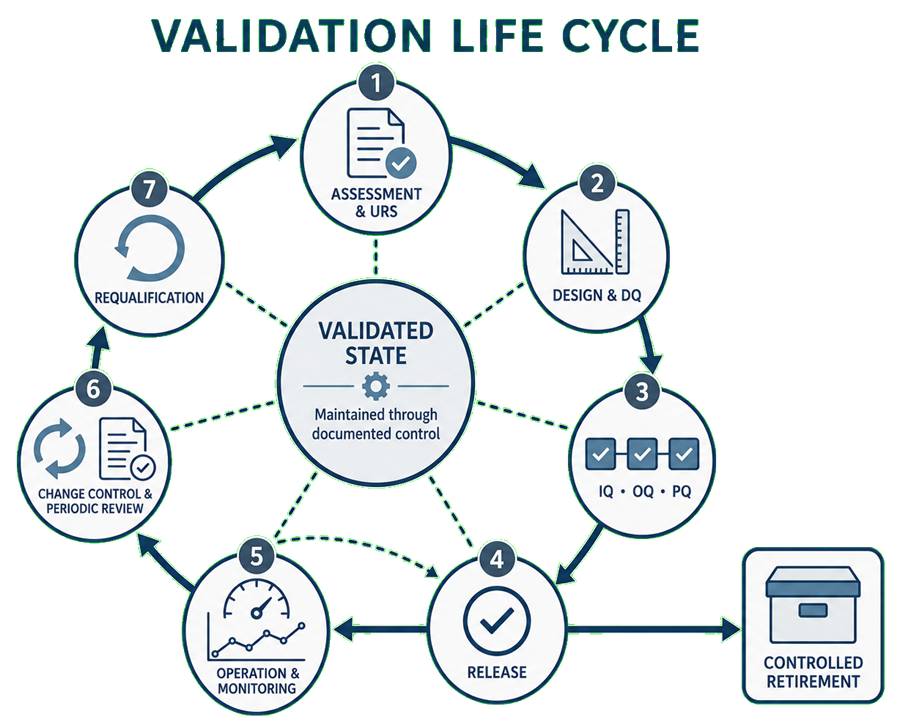
The Validation Life Cycle is a structured framework used to establish, demonstrate, and maintain the validated state of GMP facilities, utilities, equipment, computerized systems, analytical instruments, and other regulated systems throughout their operational life.
The life cycle begins before design and procurement and continues through qualification, release, routine operation, change management, periodic review, requalification, and eventual retirement. Each stage produces documented evidence supporting the conclusion that the system remains suitable for its intended use.
Validation is not a one-time testing event. It is a controlled state maintained throughout the operational life of the system.
Purpose and Scope of the Validation Life Cycle
The validation life cycle provides a consistent framework for managing GMP systems from initial concept through retirement. Its purpose is to ensure that:
- The intended use and GMP requirements are clearly defined
- Validation effort is proportionate to system risk and complexity
- The design satisfies approved user and regulatory requirements
- Installation, operation, and performance are verified
- The system is formally approved before routine GMP use
- Maintenance, calibration, monitoring, and change control preserve the validated state
- Periodic review and requalification decisions are based on documented evidence
- System retirement is planned and controlled
The specific documents, terminology, and qualification activities may vary according to system type, complexity, intended use, GMP impact, and site procedures. The underlying principles of requirements definition, risk assessment, verification, documented approval, and ongoing control remain applicable throughout the life cycle.
System Classification and Validation Assessment
The life cycle begins by defining the system and determining its potential effect on product quality, patient safety, data integrity, and regulatory compliance.
The initial assessment should identify:
- System name, boundaries, function, and intended use
- Process or operation supported by the system
- Interfaces with other systems, equipment, and utilities
- Potential direct or indirect impact on product quality
- GMP-relevant functions, components, and records
- Data integrity and electronic-record requirements
- System complexity and degree of automation
- Applicable regulatory and procedural requirements
A documented risk-based approach is then used to determine whether formal validation or qualification is required and to establish the appropriate scope, depth, and rigor of the work.
Not every system requires the same documentation or testing. Validation effort should be concentrated on functions, parameters, and controls that can affect product quality, patient safety, or data integrity. Lower-risk functions may be addressed through commissioning, engineering verification, procedural controls, or documented supplier evidence when justified.
The resulting validation strategy may be documented in the Validation Master Plan, a project validation plan, a system validation plan, or another approved lifecycle document.
User Requirements
The User Requirements Specification defines what the system must accomplish from the user, operational, engineering, quality, and regulatory perspectives.
Requirements should be clear, testable, traceable, and appropriate for the intended use of the system. Depending on system type, the requirements may address:
- Functionality and operating capacity
- Required operating ranges and performance
- Product-contact materials and construction
- Cleaning, sanitization, or sterilization requirements
- Environmental and utility requirements
- Controls, alarms, and interlocks
- Data acquisition, retention, security, and integrity
- Calibration and maintenance requirements
- Access, safety, and operator needs
- Interfaces with other equipment or systems
- Documentation, training, and support requirements
- Applicable regulatory and quality requirements
The URS provides the basis for design, procurement, risk assessment, acceptance criteria, and qualification testing. Requirements should remain traceable through design documents, test protocols, deviations, and final system acceptance.
Changes to approved requirements must be documented and assessed because they may affect design decisions, qualification scope, cost, and project schedule.
Design and Design Qualification
During the design stage, approved user requirements are translated into engineering, functional, configuration, and technical specifications.
Design documentation may include:
- Process flow diagrams
- Piping and instrumentation diagrams
- Equipment and instrument specifications
- Layout and construction drawings
- Functional and detailed design specifications
- Control-system architecture
- Software and hardware specifications
- Alarm and interlock definitions
- Materials-of-construction requirements
- Utility and environmental requirements
- Cleaning, calibration, and maintenance provisions
Design Qualification provides documented verification that the proposed design is suitable for its intended use and satisfies the approved URS and applicable GMP requirements.
DQ should confirm that:
- Critical requirements are addressed by the design
- Appropriate engineering and quality standards have been applied
- Product-contact and other critical materials are suitable
- Required operating ranges, controls, alarms, and safeguards are defined
- Cleaning, maintenance, calibration, and inspection access have been considered
- GMP and data-integrity risks have been evaluated
- Design deficiencies and unresolved issues are documented and controlled
- The system is suitable to proceed to fabrication, construction, configuration, or installation
Identifying deficiencies during design reduces the risk of discovering them during qualification or routine operation, when correction is generally more disruptive and expensive.
Installation Qualification
Installation Qualification confirms and documents that the system has been installed or configured in accordance with approved design documents, specifications, manufacturer recommendations, and applicable site requirements.
IQ commonly verifies:
- System identification, model numbers, serial numbers, and asset tags
- Installed components and configuration
- Materials of construction
- Equipment location, orientation, and connections
- Required utilities and supporting services
- Instruments, sensors, and calibration status
- Software, firmware, and configuration versions
- Environmental and installation conditions
- Safety features and protective devices
- Manuals, drawings, certificates, and vendor documentation
- Spare-parts and maintenance information
- As-built documentation
Discrepancies between the approved design and the installed configuration must be documented and evaluated. The final IQ conclusion should confirm whether the system provides an acceptable installed baseline for operational testing.
IQ confirms installation. It does not, by itself, demonstrate that the system operates throughout its intended range or performs consistently under routine-use conditions.
Operational Qualification
Operational Qualification demonstrates that the installed system operates according to approved requirements and functional specifications throughout its defined operating range.
OQ testing may include:
- Operating controls and sequences
- Normal operating ranges
- Upper and lower operating limits
- Setpoints and adjustable parameters
- Alarms and interlocks
- Failure responses and recovery functions
- Start-up, shutdown, and restart sequences
- Security and access controls
- Data collection, calculations, and reporting
- Electronic records and audit-trail functions
- Interfaces with supporting systems
- Operation under anticipated challenge conditions
Testing should focus on critical and risk-relevant functions. Challenge or worst-case conditions should be included when necessary to demonstrate adequate operating control.
Acceptance criteria must be predefined, scientifically or technically justified, and traceable to approved requirements. Deviations must be documented, investigated, and assessed before OQ approval.
Successful OQ establishes that the system functions as intended and is ready for performance evaluation or other approved release activities.
Performance Qualification
Performance Qualification demonstrates that equipment, utilities, or systems perform consistently and effectively under routine or simulated operating conditions.
PQ may use:
- Representative materials or loads
- Approved operating procedures
- Normal operators or intended users
- Routine recipes and operating parameters
- Actual or simulated production conditions
- Defined environmental conditions
- Repeated operating cycles
- System performance and monitoring data
The number and duration of PQ runs should be based on the system’s intended use, complexity, variability, criticality, and risk. A fixed number of runs should not be applied without technical justification.
PQ acceptance criteria should demonstrate that the system can reliably support its intended GMP function. Results, deviations, and conclusions must be documented in an approved qualification report.
Not every system requires a separately identified PQ protocol. The approved validation strategy should define whether PQ is required and how performance under intended-use conditions will be demonstrated.
Release for Routine Use
Completion of testing does not automatically authorize a system for GMP use. A formal release decision must confirm that the required lifecycle activities have been completed and that the system is suitable for its intended operation.
Before release, the organization should confirm that:
- Required DQ, IQ, OQ, and PQ activities are complete
- Approved acceptance criteria have been met
- Deviations and discrepancies have been resolved or acceptably controlled
- Requirements traceability is complete
- Required procedures have been approved
- Operators, administrators, and maintenance personnel have been trained
- Calibration and preventive-maintenance requirements have been established
- Required monitoring and alarm-response procedures are active
- System documentation reflects the approved configuration
- Qualification reports and conclusions have been approved
- Remaining actions do not create an unacceptable GMP risk
The release decision should identify the approved system configuration, intended use, operating limitations, and effective date. Quality approval should be obtained in accordance with site procedures.
Operation, Maintenance, Calibration, and Monitoring
After release, the system enters its operational phase. Maintaining the validated state requires continued control of the system, its configuration, its supporting documentation, and its operating environment.
Lifecycle controls commonly include:
- Use of approved operating and cleaning procedures
- Personnel training and qualification
- Preventive and corrective maintenance
- Calibration and metrology control
- Review of alarms, deviations, failures, and atypical events
- Performance and environmental monitoring
- Backup, recovery, access, and security controls for computerized systems
- Management of spare parts and critical components
- Review and maintenance of drawings, specifications, and configuration records
- Trending of performance, reliability, and quality data
Maintenance or repair activities must be evaluated before the system is returned to service. Depending on their impact, post-maintenance actions may range from basic operational verification to targeted or full requalification.
Monitoring provides evidence that the system continues to operate within its qualified state. Adverse trends, repeated failures, or unexplained performance shifts may indicate that corrective action, expanded investigation, or requalification is required.
Change Control and Periodic Review
Changes to a validated system must be evaluated through formal change control before implementation, except where approved emergency procedures apply.
The validation impact assessment should consider whether the change affects:
- Intended use
- Approved requirements
- Design or system configuration
- Critical components or materials
- Operating ranges or setpoints
- Alarms, interlocks, or control logic
- Software, firmware, or infrastructure
- Interfaces with other systems
- Calibration or maintenance requirements
- Procedures, training, or documentation
- Previously executed qualification tests
- Product quality, patient safety, or data integrity
The assessment determines what documentation, verification, regression testing, or requalification is required. Validation scope should be based on the nature and risk of the change rather than automatically repeating every original test.
A periodic equipment assessment provides a broader review of accumulated lifecycle evidence. The review may include:
- Change history
- Deviation and investigation history
- Maintenance and repair records
- Calibration performance
- Alarm and failure history
- Monitoring and trend data
- CAPA status
- System reliability and availability
- Configuration and documentation status
- Obsolescence and vendor-support status
- Previous qualification and requalification results
Periodic review confirms whether the system remains suitable for its intended use and whether existing controls remain effective. It does not automatically require requalification; it provides evidence for a documented, risk-based decision.
Requalification and Retirement
Requalification confirms that a previously qualified system continues to meet defined requirements following change, maintenance, adverse performance, extended shutdown, or another identified trigger.
Potential requalification triggers include:
- Significant equipment or configuration changes
- Replacement of critical components
- Software or firmware changes
- Major maintenance or repair
- Changes to intended use or operating range
- Repeated deviations or failures
- Adverse performance trends
- Loss of calibration or control
- Extended shutdown or relocation
- Periodic-review findings
- Regulatory commitments
The requalification scope may include documentation review, targeted verification, partial repeat testing, or full requalification. The selected scope and depth should be justified using system risk, change impact, performance history, and available objective evidence.
When a system reaches the end of its useful or supported life, it should be retired through a controlled decommissioning process. Retirement activities may include:
- Approval of the retirement decision
- Evaluation of product, operational, and data-integrity impact
- Completion or transfer of open records and actions
- Retention, migration, or archival of GMP data
- Removal of system access and electronic interfaces
- Removal from calibration, maintenance, and monitoring programs
- Decontamination or safe physical disposition
- Updating system inventories, drawings, and lifecycle records
- Archival of validation and qualification documentation
Retirement completes the validation life cycle and provides documented evidence that the system was removed from GMP use in a controlled manner.
Distinction from Pharmaceutical Process Validation
The general validation life cycle described in this article applies to equipment, utilities, facilities, computerized systems, analytical instruments, and other GMP systems.
Pharmaceutical manufacturing processes follow the related three-stage process validation lifecycle of Process Design, Process Qualification, and Continued Process Verification. Process Performance Qualification belongs within that manufacturing-process lifecycle and should not be confused with equipment or system Performance Qualification.
Key Principles of the Validation Life Cycle
- Validation begins with intended use, requirements, and design—not with protocol execution.
- Validation and qualification scope must be based on system impact, complexity, and risk.
- Requirements, design documents, testing, deviations, and conclusions must remain traceable.
- Commissioning and vendor documentation may be leveraged when their suitability and quality are documented.
- Completion of testing does not replace formal review and release.
- Maintenance, calibration, monitoring, and change control are essential to preserving the validated state.
- Periodic review evaluates accumulated evidence and supports requalification decisions.
- Requalification should be targeted according to risk and documented system history.
- Retirement must protect GMP records, data integrity, and traceability.
Summary
The Validation Life Cycle provides a structured and defensible approach for controlling GMP systems from initial classification and requirements definition through design, qualification, routine operation, requalification, and retirement.
A lifecycle approach ensures that system suitability is not established only at initial release. It is continually supported by documented maintenance, calibration, monitoring, change control, periodic review, and risk-based decision-making throughout the operational life of the system.