
Process Qualification: Equipment Qualification and PPQ
Process Qualification is Stage 2 of the FDA process validation lifecycle. It evaluates whether the process developed during Process Design can be implemented in the intended commercial manufacturing environment and perform reproducibly at commercial scale.
Process Qualification has two distinct but connected elements:
- Design and readiness of the facility and qualification of utilities and equipment
- Process Performance Qualification (PPQ)
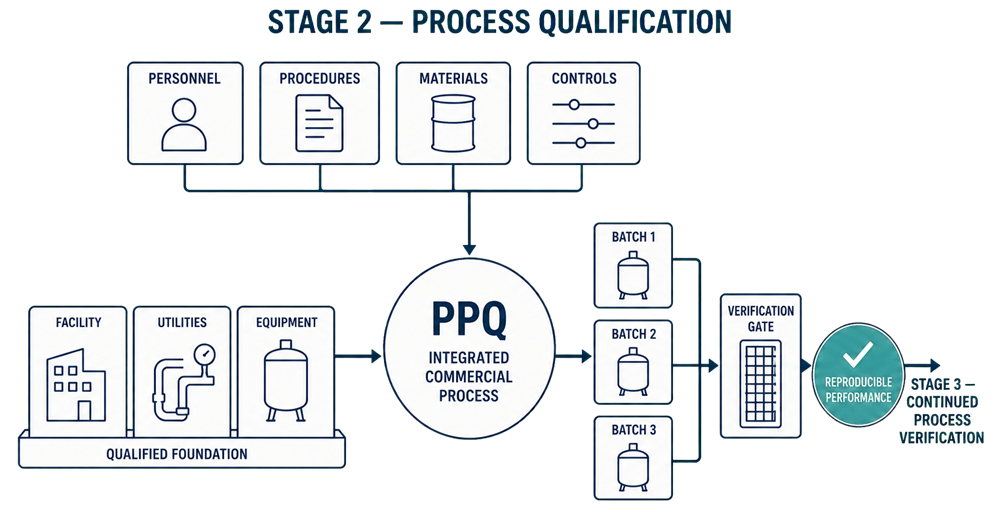
The first element establishes that the manufacturing environment and supporting systems are suitable for their intended use. PPQ then evaluates the complete manufacturing process using the qualified facility, utilities, equipment, trained personnel, approved procedures, materials, and process controls.
Process Qualification is broader than PPQ. PPQ is the second element of Process Qualification, not a replacement for equipment and utility qualification.
FDA sometimes abbreviates Process Qualification as PQ. Because PQ is also commonly used to mean equipment or system Performance Qualification, this article spells out Process Qualification and uses PPQ specifically for Process Performance Qualification.
What Process Qualification Means
Process Qualification is the lifecycle stage during which the commercial process design is evaluated under the conditions intended for routine manufacturing.
The objective is to demonstrate that:
- The facility and manufacturing environment are suitable for the process
- Critical utilities and equipment are properly designed, installed, and operated
- Process requirements have been translated into approved procedures and controls
- Personnel are trained and qualified
- Materials, components, and analytical methods are ready
- The integrated commercial process can operate reproducibly
- Process parameters and controls can consistently produce acceptable product
- Sufficient objective evidence supports transition to routine commercial manufacturing
Process Qualification converts the process knowledge established during Stage 1 into documented evidence of commercial manufacturing capability.
It does not repeat process development. However, qualification may reveal limitations in the process design, equipment capability, operating ranges, sampling strategy, or control strategy. When significant deficiencies are identified, the organization may need to return to Process Design, make corrections, and repeat affected qualification activities.
Process Qualification must be conducted under approved cGMP procedures with appropriate quality-unit oversight.
Position Within FDA Stage 2
The FDA process validation lifecycle consists of three related stages:
- Stage 1 — Process Design: The commercial manufacturing process and its control strategy are developed using product and process knowledge.
- Stage 2 — Process Qualification: The facility, utilities, equipment, personnel, procedures, and commercial manufacturing process are evaluated for readiness and reproducible performance.
- Stage 3 — Continued Process Verification: Routine manufacturing data are monitored to confirm that the process remains in a state of control.
Stage 2 provides the bridge between process development and sustained commercial manufacturing.
Inputs carried forward from Stage 1 should include:
- Defined manufacturing process and sequence of operations
- Critical Quality Attributes (CQAs)
- Critical Process Parameters (CPPs)
- Material attributes and known sources of variability
- Approved operating ranges and processing limits
- Process risk assessments
- Established control strategy
- Scale-up and process-characterization knowledge
- Proposed in-process controls
- Commercial manufacturing and control instructions
Process Qualification confirms whether these elements can be successfully implemented in the intended commercial manufacturing environment.
Qualification of Facilities, Utilities, and Equipment
FDA describes the first element of Stage 2 as the design of the facility and qualification of utilities and equipment.
Facility design and commissioning must precede PPQ. The facility must provide the space, environmental conditions, material and personnel flows, contamination controls, and supporting infrastructure necessary for the manufacturing process.
Depending on the process, facility readiness may include verification or qualification of:
- Manufacturing rooms and controlled areas
- HVAC and environmental-control systems
- Cleanrooms and classified spaces
- Personnel and material flows
- Containment systems
- Environmental monitoring systems
- Warehousing and controlled storage areas
- Process-support and laboratory areas
- Facility automation and monitoring systems
Critical utilities may include:
- Purified Water
- Water for Injection
- Clean steam
- Compressed air and process gases
- Heating and cooling systems
- Vacuum systems
- Clean-in-place and steam-in-place utilities
- Electrical power and emergency power
- Building and environmental-control systems
Process equipment must be suitable for its intended use, capacity, operating range, materials, controls, and required level of performance.
Qualification commonly includes:
- Design Qualification to verify that the proposed design satisfies approved requirements
- Installation Qualification to verify the installed equipment, utilities, instruments, materials, connections, and configuration
- Operational Qualification to challenge controls, alarms, interlocks, functions, and defined operating ranges
- Performance Qualification where required to demonstrate reliable equipment or system performance under routine or representative conditions
Qualification should verify that equipment and utilities:
- Are constructed from appropriate materials
- Have the required capacity and performance characteristics
- Are installed according to approved specifications
- Are properly connected and calibrated
- Operate throughout the ranges required by the manufacturing process
- Can operate under representative loads
- Respond appropriately to expected interventions, stoppages, and restarts
- Can maintain required operating conditions for the necessary process duration
- Are supported by approved operation, maintenance, cleaning, and calibration procedures
Qualification plans should define the activities, acceptance criteria, responsibilities, documentation, change-management requirements, and quality-unit approvals.
Approved qualification protocols and reports provide the documented evidence that the systems supporting the process are ready for PPQ.
Equipment or system Performance Qualification must not be confused with PPQ:
- Performance Qualification demonstrates that an individual equipment item, utility, or system performs reliably under intended-use conditions.
- Process Performance Qualification evaluates the integrated commercial manufacturing process using the qualified facility, utilities, equipment, personnel, procedures, and materials.
Equipment qualification supports readiness for PPQ but does not demonstrate that the complete manufacturing process is reproducible.
Readiness Requirements Before PPQ
PPQ should not begin until sufficient evidence demonstrates that the process and manufacturing organization are ready for commercial-scale evaluation.
Readiness should be confirmed through a documented assessment or formal PPQ-readiness review.
Process and Control Strategy Readiness
The organization should confirm that:
- Stage 1 process-development and characterization activities are complete
- The commercial manufacturing process is defined
- CPPs and CQAs are identified
- Material attributes and sources of variability are understood
- Operating ranges, limits, setpoints, and in-process controls are established
- The commercial control strategy is documented
- Process risks have been evaluated and adequately controlled
- Scale-up considerations have been assessed
- Hold times, processing times, and required interventions are defined
- Commercial master production and control records are approved
Facility, Utility, and Equipment Readiness
Before PPQ:
- Facility design and commissioning must be complete
- Critical utilities and manufacturing equipment must be qualified
- Calibration must be current
- Preventive-maintenance requirements must be established
- Equipment cleaning and sterilization procedures must be approved
- Required cleaning, sterilization, or decontamination validation must be complete or appropriately addressed
- Computerized systems supporting manufacturing and data collection must be validated where applicable
- Approved system configurations must be documented
- Critical qualification deviations must be resolved
Material and Analytical Readiness
The organization should confirm that:
- Raw materials, components, and container-closure systems are defined
- Approved material suppliers and specifications are established
- Material sampling and testing requirements are approved
- Analytical methods are validated or otherwise demonstrated suitable for their intended use
- In-process and release test methods are available
- Laboratory instruments and supporting data systems are qualified or validated
- Sample handling, storage, transport, and retention requirements are defined
Procedural and Personnel Readiness
Required manufacturing, cleaning, sampling, testing, deviation-management, and data-review procedures must be approved before execution.
Personnel participating in PPQ should be trained and qualified for their assigned responsibilities. PPQ should use the personnel ordinarily expected to perform the process rather than a specially selected validation team operating outside routine practices.
Protocol and Documentation Readiness
The PPQ protocol must be reviewed and approved before execution. It should define:
- PPQ scope and objectives
- Manufacturing conditions
- Commercial batch size and process scale
- Number and sequence of PPQ batches
- CPPs, CQAs, and other monitored variables
- Sampling locations, timing, frequency, and sample quantity
- In-process, release, and characterization testing
- Predefined acceptance criteria
- Statistical methods
- Data-review requirements
- Deviation and nonconformance handling
- Batch and overall study success criteria
- Departmental responsibilities and approvals
Open items should not be carried into PPQ when they could affect process performance, product quality, data integrity, or interpretation of PPQ results. Any remaining noncritical items must be documented, risk-assessed, assigned, and approved.
Process Performance Qualification
PPQ is the second element of FDA Stage 2. It combines:
- The actual commercial facility
- Qualified utilities and equipment
- Trained manufacturing and support personnel
- Approved manufacturing and control procedures
- Defined materials and components
- The commercial-scale manufacturing process
- The established control strategy
PPQ batches should be produced using routine procedures, normal operating conditions, and the personnel expected to perform commercial manufacturing.
PPQ generally applies more extensive sampling, additional testing, and greater process scrutiny than routine production. This increased evaluation is intended to characterize intra-batch and inter-batch variability and provide objective evidence that the commercial process performs reproducibly.
PPQ should demonstrate that:
- CPPs remain within established ranges or limits
- CQAs satisfy predefined requirements
- In-process controls function as intended
- The control strategy effectively manages process variability
- Process performance is consistent within and between batches
- Unexpected results and deviations are adequately investigated
- The total evidence supports a conclusion that the process is in a state of control
The number of PPQ batches must be scientifically justified based on process knowledge, variability, complexity, risk, scale-up experience, prior knowledge, and the amount of evidence required to demonstrate reproducibility. A fixed number of batches should not be applied without justification.
Detailed PPQ batch strategy and the rationale for the number and selection of PPQ batches are addressed in PPQ Strategy and Batch Selection.
After execution, a PPQ report should:
- Confirm adherence to the approved protocol
- Summarize and analyze the collected data
- Evaluate intra-batch and inter-batch variability
- Assess all deviations, nonconformances, and unexpected observations
- Identify necessary corrective actions or process changes
- State whether the predefined acceptance and success criteria were met
- Conclude whether the process is in a state of control
- Include the required departmental and quality-unit approvals
Stage 2 Completion and Release to Commercial Operation
Stage 2 is complete only when both of its elements have been successfully concluded:
- The facility, utilities, equipment, and supporting systems have been demonstrated suitable for their intended use.
- PPQ has demonstrated that the integrated commercial manufacturing process performs reproducibly and remains controlled under defined conditions.
Completion should be supported by:
- Approved facility, utility, and equipment qualification reports
- Approved PPQ protocol and final report
- Completion of requirements and risk traceability
- Resolution or approved disposition of deviations and nonconformances
- Confirmation that critical procedures are approved
- Confirmation that personnel are trained and qualified
- Approved manufacturing and control records
- Established maintenance and calibration programs
- Approved process-monitoring and data-review requirements
- A defined Continued Process Verification plan
- Formal quality-unit approval
The PPQ report must provide a clear, documented conclusion regarding process performance and state of control. Protocol execution alone is not sufficient.
In most cases, PPQ should be completed successfully before routine commercial distribution begins. PPQ batches may be released when they meet all applicable product-release requirements and the available qualification evidence supports release.
Release of a PPQ batch before complete execution and evaluation of the PPQ study is concurrent release. FDA expects this approach to be used only in rare, justified circumstances under a predefined and approved protocol.
Release to commercial operation does not mean that process validation is finished. It means that sufficient evidence supports transition from initial qualification into routine manufacturing and ongoing process verification.
Relationship to Continued Process Verification
Successful Process Qualification establishes the initial evidence that the commercial manufacturing process can operate reproducibly. Continued Process Verification provides ongoing assurance that the process remains in a state of control during routine production.
The transition from Stage 2 to Stage 3 should carry forward:
- Critical Process Parameters
- Critical Quality Attributes
- Material attributes
- Process limits and normal operating ranges
- In-process controls
- Sampling locations and frequencies
- Statistical methods and performance measures
- Alert and action criteria
- Known sources of variability
- Residual process risks
- PPQ deviations and corrective actions
- Commitments for heightened monitoring
The increased sampling and monitoring used during PPQ may continue into initial commercial production until sufficient data support an appropriate routine monitoring frequency.
CPV data should be reviewed for:
- Process shifts and trends
- Increased variability
- Changes in process capability
- Repeated deviations or atypical results
- Equipment or utility performance changes
- Changes in raw-material characteristics
- Deterioration in control-strategy effectiveness
- Emerging risks to product quality
CPV findings may lead to process improvement, change control, investigation, additional monitoring, targeted qualification, or revalidation.
Process Qualification establishes commercial process capability at a defined point in the lifecycle. Continued Process Verification demonstrates that this capability is maintained as manufacturing experience accumulates.
Summary
Process Qualification is FDA Stage 2 of the process validation lifecycle. It consists of facility design and readiness, qualification of utilities and equipment, and Process Performance Qualification.
Equipment and utility qualification establish that the systems supporting manufacturing are suitable for their intended use. PPQ then combines those qualified systems with trained personnel, approved procedures, materials, controls, and the commercial manufacturing process to demonstrate reproducible performance.
Successful Stage 2 completion supports release to routine commercial manufacturing and distribution. Continued Process Verification then provides ongoing evidence that the process remains controlled throughout its commercial lifecycle.