

The Role of Validation in GMP Compliance
Pharmaceutical validation is a core GMP control that provides documented evidence that manufacturing processes, equipment, utilities, facilities, computerized systems, and analytical methods are capable of operating consistently within predefined requirements. In FDA-regulated environments, validation supports product quality, patient safety, regulatory compliance, and inspection readiness by demonstrating that critical operations are understood, controlled, and maintained throughout the system lifecycle.
Validation activities help manufacturers establish confidence that systems and processes perform as intended under routine operating conditions. This includes confirming that critical process parameters remain controlled, product quality attributes are consistently achieved, and operational risks are identified and mitigated before they affect product quality or patient safety.
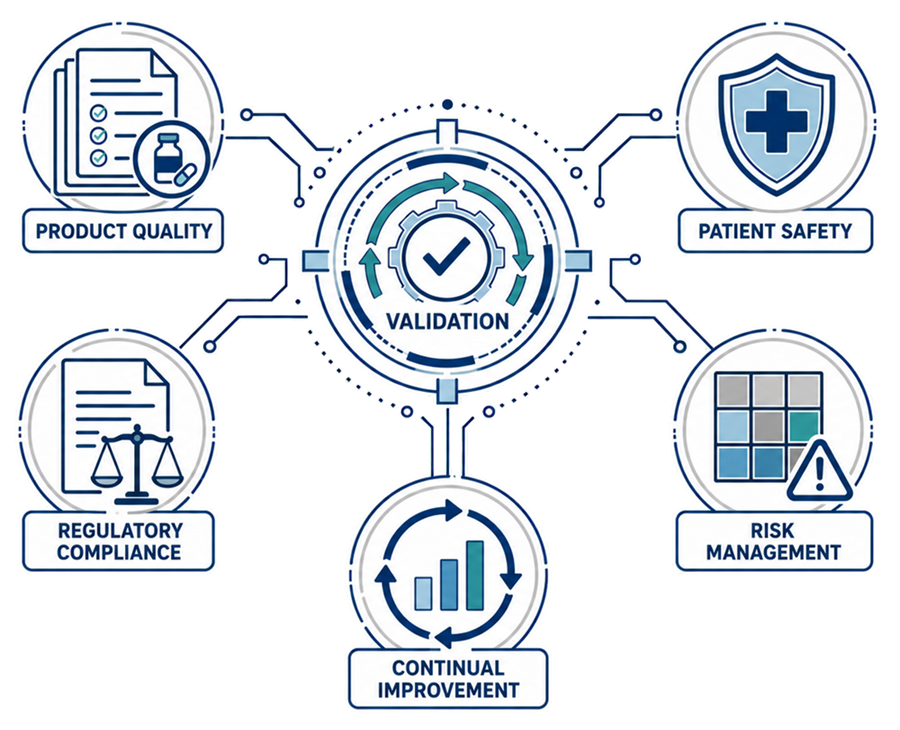
Validation also supports compliance with FDA expectations, international GMP requirements, and industry guidance documents by providing objective evidence that manufacturing controls are scientifically justified, documented, reviewed, and maintained throughout the operational life of the system or process.
Validation and Product Quality
Validation helps ensure that products consistently meet predefined quality attributes including identity, strength, purity, safety, and performance. Proper qualification and validation activities reduce variability within manufacturing operations and support long-term process consistency.
By establishing documented control over critical manufacturing operations, validation activities help reduce the likelihood of contamination events, process failures, deviations, batch rejections, and product recalls.
Validation and Patient Safety
Patient safety remains one of the primary objectives of pharmaceutical validation. Properly validated systems help ensure that products are manufactured under controlled conditions and consistently meet intended quality standards before release for patient use.
Validation activities support control of sterilization processes, aseptic manufacturing operations, environmental conditions, cleaning procedures, computerized systems, and utility systems that may directly or indirectly impact product safety and efficacy.
Validation and Regulatory Compliance
Regulatory agencies including the FDA expect manufacturers to establish and maintain validated systems and processes appropriate for their intended use. Validation documentation demonstrates that critical systems have been evaluated, tested, reviewed, and approved according to established procedures and quality requirements.
Effective validation programs support inspection readiness by providing documented evidence of system control, risk management, traceability, deviation handling, change management, and ongoing lifecycle oversight.
Validation and Risk Management
Modern validation approaches are strongly connected to quality risk management principles. Risk-based validation strategies help organizations focus qualification and verification efforts on systems, functions, and process parameters with the greatest potential impact on product quality and patient safety.
This approach supports more effective allocation of resources while maintaining appropriate scientific and regulatory justification for validation scope, acceptance criteria, and testing activities.
Validation as a Lifecycle GMP Control
Validation should not be treated as a one-time protocol execution activity. A compliant validation program begins with user requirements, design review, and risk assessment, continues through qualification and process verification activities, and remains active throughout the operational lifecycle of the system.
Ongoing lifecycle activities may include calibration, preventive maintenance, environmental monitoring, change control, deviation investigation, periodic review, continued process verification, and requalification activities where appropriate. This lifecycle approach helps maintain a controlled and inspectable state as systems, equipment, procedures, materials, and operating conditions evolve over time.
Conclusion
Pharmaceutical validation plays a critical role in maintaining GMP compliance, protecting patient safety, supporting product quality, and ensuring that regulated manufacturing systems operate in a controlled and consistent manner. A properly designed validation program provides documented evidence that systems and processes remain capable, reliable, inspectable, and suitable for their intended use throughout their operational lifecycle.