

Utility Systems in GMP Manufacturing
Utility systems support pharmaceutical manufacturing by supplying controlled materials, energy, environmental conditions, cleaning media, or process functions. Their GMP significance depends on intended use, the pathway by which the utility can affect the process or product, and the consequences of losing control.
A utility should not be classified solely by its name. Pharmaceutical water, clean steam, compressed air, nitrogen, or another utility can have different GMP impacts at different points of use. The required design controls, qualification evidence, monitoring, and lifecycle oversight must therefore be established through a documented, use-specific assessment.
Purpose and Scope
This article establishes the common framework for classifying, designing, qualifying, monitoring, and controlling utility systems used in GMP manufacturing. It applies to:
- Pharmaceutical water systems
- Clean steam systems
- Compressed air systems
- Process gas systems
- Utilities supporting cleaning and sterilization
- Utility distribution systems and points of use
- Utility automation, alarms, monitoring, and electronic records
- Utility interfaces with manufacturing equipment, facilities, and processes
Clean-in-place and steam-in-place systems are included within this domain because they rely on controlled utility infrastructure and integrated distribution paths. However, CIP and SIP are more accurately treated as cleaning and sterilization systems than as conventional utility supplies. Their equipment qualification does not replace cleaning validation or sterilization-process validation.
Utility Systems as GMP-Controlled Infrastructure
A utility system may include generation, treatment, storage, distribution, control, monitoring, and point-of-use components. Depending on its intended use, For potable-water systems and associated plumbing, 21 CFR 211.48 requires potable water to be supplied under continuous positive pressure through plumbing free from defects that could contaminate drug products. It also addresses drain sizing and protection against back-siphonage. These requirements form part of the regulatory foundation for utility-system design and contamination control.
Qualification Strategy
The lifecycle principles described in FDA’s Process Validation: General Principles and Practices include qualification of facilities, utilities, and equipment as part of establishing a commercial manufacturing process capable of reproducible performance. The guidance does not prescribe one universal utility-qualification format; qualification scope must reflect the utility’s intended use, product-quality risks, system complexity, and available lifecycle evidence.
Pharmaceutical Water Systems
Pharmaceutical-water requirements are determined by the selected water quality and intended use. The control strategy must address generation, storage, distribution, chemical quality, microbial control, sanitization, sampling, monitoring, and seasonal performance.
FDA’s High Purity Water System Inspection Guide may provide useful historical inspection context. Because the guide dates from 1993, it should not be treated as a current regulation, a comprehensive description of modern water-system technology, or a substitute for current compendial requirements and scientifically justified system controls.
Regulatory and Technical Framework
US drug-manufacturing requirements relevant to utility systems arise principally from 21 CFR Part 211, including requirements applicable to facilities, plumbing, equipment, automated equipment, production controls, laboratory controls, investigations, and records. The regulations do not establish one consolidated utility-system classification or qualification model. Applicable controls depend on how the utility supports manufacturing operations and how its failure could affect product quality.
Relevant requirements may include:
- Suitable facility and equipment design
- Potable-water and plumbing controls
- Prevention of contamination
- Appropriate equipment construction
- Cleaning and maintenance
- Written procedures
- Laboratory testing and controls
- Investigation of discrepancies
- Record retention
- Control of automated equipment
Compendial monographs and general chapters may establish utility-specific quality requirements or provide technical information. Consensus standards and industry guidance may support engineering decisions, but they should not be presented as equivalent to binding regulations or applicable compendial requirements.
Intended Use as the Governing Principle
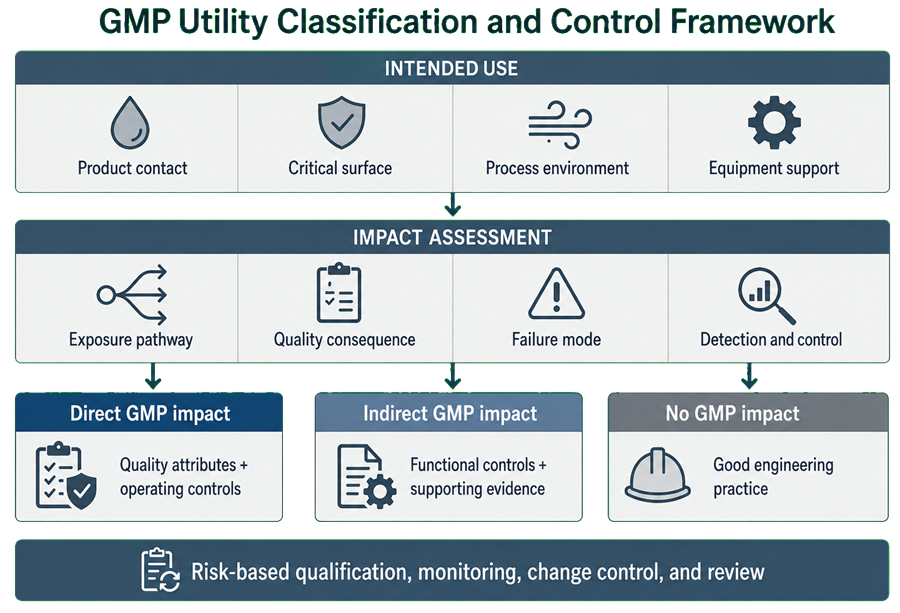
The intended-use assessment establishes how and where a utility is used and what the utility must provide at each user point.
The assessment should identify:
- Utility type and source
- User equipment or process
- Point-of-use location
- Normal and maximum demand
- Direct or indirect exposure pathway
- Product, component, or critical-surface contact
- Required identity and quality
- Required pressure, flow, temperature, or capacity
- Required microbial, particulate, chemical, or endotoxin control
- Point-of-use filtration or treatment
- Required availability and recovery
- Monitoring and alarm expectations
- Failure consequences
- Controls available to prevent or detect failure
A single distribution system may support several intended uses. For example, compressed air used only to operate a closed pneumatic valve has a different risk profile from air used to dry a cleaned product-contact surface. The common upstream system must be assessed against the most demanding applicable use, while point-of-use controls may differ according to the exposure pathway.
New or expanded uses should be evaluated through change control before implementation. Historical use alone does not demonstrate that an existing utility specification, system capacity, or monitoring program is suitable for the new application.
GMP Utility Impact Classification
Terms such as direct impact, indirect impact, and no GMP impact are useful engineering and qualification classifications. They are not universal regulatory categories with fixed definitions. Each site should define the terms in its validation or qualification procedures and apply them consistently.
Direct GMP Impact
A utility or function may be classified as direct impact when its operation, quality, or failure can directly affect a product, component, product-contact surface, critical process environment, or validated process outcome.
Examples may include:
- Water used as a formulation ingredient
- Water used for a final rinse of product-contact equipment
- Clean steam contacting sterilized equipment surfaces
- Nitrogen used for product blanketing
- Compressed air contacting exposed product
- Utility parameters that directly control a validated cleaning or sterilization cycle
Direct-impact classification normally requires documented utility quality requirements, risk-based qualification, controlled operating parameters, appropriate monitoring, and formal lifecycle control.
Indirect GMP Impact
A utility or function may be classified as indirect impact when it does not directly contact the product or a critical surface but supports another system or function whose performance can affect product quality.
Examples may include:
- Instrument air operating process valves
- Cooling water supporting a process heat exchanger
- Plant steam supplying energy to a clean-steam generator
- A utility supporting HVAC control in a classified area
- A gas used to actuate equipment without entering the process
Indirect-impact systems still require sufficient engineering, commissioning, verification, maintenance, and change control to demonstrate that the supported GMP function remains reliable.
No GMP Impact
A utility may be classified as having no GMP impact when a documented assessment determines that its operation or failure has no credible pathway to affect product quality, GMP process control, or required GMP records.
These systems may be managed primarily under good engineering practice. The absence of GMP impact does not eliminate safety, environmental, building-code, reliability, or business-continuity requirements.
Classification at the Appropriate Level
Classification should not stop at the overall system level. The assessment may need to distinguish among:
- Entire utility systems
- Generation and treatment stages
- Storage and distribution sections
- Individual branches or subloops
- Critical components
- Control functions and alarms
- Monitoring instruments
- Individual points of use
This prevents an excessively broad classification from either over-controlling low-risk components or under-controlling critical user points.
Defining Utility System Boundaries
A documented system boundary establishes which components, functions, records, and interfaces are included within the controlled utility system.
The boundary should address, as applicable:
- Incoming source or feed
- Generation or treatment equipment
- Storage vessels
- Distribution headers and loops
- Return paths
- Branch lines and subloops
- Point-of-use assemblies
- Final filters, regulators, traps, or heat exchangers
- Sampling locations
- Instruments and sensors
- Control panels and programmable systems
- Alarms, interlocks, and electronic records
- Drain, vent, condensate, or exhaust connections
- Interfaces with user equipment and manufacturing processes
The physical boundary and the qualification boundary may not be identical. A plant-steam connection, electrical supply, building-management interface, or upstream feed-water system may be outside the formal qualification boundary but remain an essential prerequisite or supporting system.
Boundary drawings should identify the transfer point between the utility and the user system. Responsibilities for monitoring, maintenance, sanitization, sampling, and release should be clear on both sides of that interface.
Utility Quality Attributes and Operating Parameters
Utility control requires a distinction between what the delivered utility must be and how the system is operated to achieve that condition.
Critical Quality Attributes
Utility quality attributes describe characteristics of the delivered utility that must be controlled because they can affect its suitability for use.
Depending on the utility, these may include:
- Identity
- Chemical purity
- Conductivity
- Total organic carbon
- Microbial level
- Bacterial endotoxins
- Particulate content
- Oil content
- Moisture or dew point
- Gas purity
- Condensate quality
- Steam dryness
- Noncondensable gases
- Superheat
Not every listed attribute applies to every utility or use. Requirements should be derived from compendial obligations, process needs, product risks, equipment requirements, and scientific justification.
Critical Operating Parameters
Operating parameters control the generation and delivery process. Examples include:
- Temperature
- Pressure
- Flow
- Circulation velocity
- Tank level
- Differential pressure
- Treatment-system recovery
- Sanitization temperature and duration
- Chemical concentration
- Filter condition
- Compressor or pump sequencing
- Valve position
- Cycle time
- Alarm setpoints
An operating parameter should not automatically be called critical merely because it is measured. Criticality depends on its relationship to utility quality, process performance, contamination control, or failure detection.
Functional and Availability Requirements
Some utilities must also meet functional requirements that are not quality attributes, including:
- Available capacity
- Peak-demand response
- Redundancy
- Recovery following interruption
- Stable pressure or flow
- Required temperature at the user point
- Backup supply
- Alarm response
- Controlled shutdown and restart
For certain indirect-impact applications, functional performance and availability may be more important than chemical or microbiological purity.
Risk Assessment and Control Strategy
The utility risk assessment should evaluate credible ways in which the system could fail to meet its intended use.
Relevant risks include:
- Chemical contamination
- Microbial proliferation or biofilm formation
- Endotoxin contamination
- Oil, moisture, or particle carryover
- Cross-connection or backflow
- Incorrect gas identity
- Utility mix-up
- Loss of pressure, flow, temperature, or capacity
- Inadequate drainage or condensate removal
- Stagnation
- Failure of sanitization
- Point-of-use filter failure
- Utility interruption
- Control or alarm failure
- Instrument drift
- Unauthorized configuration change
- Incomplete or unreliable electronic records
- Maintenance-related contamination
- Obsolete or unsupported components
Risk controls may be implemented through design, operation, monitoring, procedural control, qualification, maintenance, or detection. The selected controls should be traceable to the identified risk and verified at the appropriate lifecycle stage.
Risk ranking should not be used to dismiss a high-severity failure merely because its estimated occurrence is low. Where consequences are significant, prevention, detection, contingency, and response controls should be explicitly evaluated.
Utility System Lifecycle Control
Utility-system control begins before installation and continues until the system is retired.
The lifecycle normally includes:
- Intended-use and impact assessment
- User and quality requirements
- System-boundary definition
- Risk assessment
- Design development and design review
- Supplier, fabrication, and construction controls
- Commissioning and turnover
- Installation and functional qualification
- Performance verification
- Release for GMP operation
- Routine operation and monitoring
- Maintenance and calibration
- Data review and trending
- Deviation and excursion management
- Change control
- Periodic review and requalification
- Decommissioning and retirement
Commissioning records may support qualification when their scope, methods, acceptance criteria, execution controls, and documentation are suitable for the intended evidentiary use. Qualification should not mechanically repeat acceptable commissioning work, but gaps between engineering turnover and approved GMP requirements must be addressed.
The detailed lifecycle is addressed in Utility System Lifecycle, Monitoring, and Risk-Based Control. Changes, failures, deficiencies, and requalification decisions are addressed in Utility System Change Control, Requalification, and Deficiencies.
Qualification Strategy
Qualification should demonstrate that the installed system and its critical functions are suitable for the defined intended uses.
Depending on system impact and complexity, the strategy may include:
- Requirements traceability
- Design review or design qualification
- Supplier-document assessment
- Material and fabrication verification
- Installation qualification
- Instrument calibration verification
- Control-system and alarm testing
- Functional and operational challenges
- Capacity and recovery testing
- Sanitization or sterilization-cycle verification
- Utility-quality testing
- Point-of-use testing
- Performance verification under representative demand
- Verification following shutdown and restart
- Deviation resolution
- Approved release for use
The amount of documentation and testing should be proportionate to risk, but reduced scope must remain justified by objective evidence. System classification alone does not determine the complete testing strategy.
Qualification of the utility also does not establish that every supported manufacturing process is validated. For example:
- Clean-steam qualification does not replace sterilizer or SIP validation.
- CIP-system qualification does not replace cleaning validation.
- Compressed-air qualification does not establish suitability for every future product-contact application.
- Water-system qualification does not replace product- or process-specific justification for the selected water quality.
Routine Monitoring and Continued Control
Routine monitoring verifies that the utility remains within its approved operating and quality conditions.
A monitoring program should define:
- Parameters and quality attributes
- Online and offline measurements
- Sampling locations
- Test methods
- Monitoring frequencies
- Alert and action levels
- Data-review responsibilities
- Alarm assessment
- Trending methods
- Excursion handling
- Product-impact assessment
- Escalation requirements
- Record retention
Monitoring frequency and location should reflect intended use, system design, variability, contamination risk, historical performance, and the ability to detect deterioration before product is affected.
Trending should evaluate patterns rather than isolated results. Relevant patterns may include gradual deterioration, recurring alerts, location-specific changes, seasonal variability, recovery delays, increasing sanitization demand, or changes following maintenance.
Automation and Data Integrity
Utility systems frequently rely on programmable controllers, supervisory systems, building-management interfaces, historians, laboratory systems, or electronic monitoring platforms.
The assessment should determine whether these systems:
- Control critical utility functions
- Generate GMP decisions or records
- Record quality or operating data
- Manage alarms and events
- Maintain recipes or sanitization cycles
- Transfer data to other GMP systems
- Require electronic signatures
- Retain audit trails
- Support trending or batch-impact decisions
Applicable controls may include user-access management, configuration control, audit-trail review, time synchronization, backup and recovery, data retention, interface verification, cybersecurity controls, and assessment under 21 CFR Part 11.
Utility qualification and computerized-system assurance should be coordinated so that control logic, instruments, data paths, records, and interfaces are not tested as unrelated systems.
Utility-Specific Control Frameworks
Pharmaceutical Water Systems
Pharmaceutical water requirements are determined by the selected water quality and intended use. The control strategy must address generation, storage, distribution, chemical quality, microbial control, sanitization, sampling, monitoring, and seasonal performance.
See:
- Pharmaceutical Water Quality Categories and Intended Use
- Pharmaceutical Water System Design and Distribution
- USP Water Specifications, Testing, and Monitoring
- Pharmaceutical Water System Qualification and Performance Verification
- Pharmaceutical Water System Lifecycle Control and Requalification
Clean Steam Systems
Clean-steam control depends on whether steam or condensate contacts product, product-contact surfaces, sterilized equipment, or another critical process boundary. System qualification must distinguish condensate chemistry, physical steam quality, distribution performance, and the requirements of the supported sterilization process.
See:
- Clean Steam Systems for GMP Applications
- Clean Steam System Design and Quality Attributes
- Clean Steam System Qualification, Monitoring, and Requalification
Compressed Air and Process Gases
Requirements for compressed air and process gases depend on gas identity, exposure pathway, point-of-use conditions, and process function. A single universal purity class is not appropriate for every application.
See:
- Compressed Air Systems for GMP Manufacturing
- Process Gas Systems for GMP Manufacturing
- Qualification, Monitoring, and Requalification of Gas Utilities
CIP and SIP Systems
CIP and SIP systems combine utility supply, distribution, equipment interfaces, recipes, instrumentation, and automated cycles. Their system qualification must be integrated with the validation of the supported cleaning or sterilization process.
See:
Regulatory and Technical Framework
US GMP regulations do not provide one consolidated utility-system classification or qualification model. Applicable requirements arise from the way a utility supports facilities, equipment, manufacturing operations, cleaning, laboratory control, and product quality.
Relevant requirements may include:
- Suitable facility and equipment design
- Potable-water requirements
- Prevention of contamination
- Appropriate equipment construction
- Cleaning and maintenance
- Written procedures
- Laboratory testing and controls
- Investigation of discrepancies
- Record retention
- Control of automated equipment
Compendial monographs and general chapters may establish utility-specific quality requirements or provide technical information. Consensus standards and industry guidance may support engineering decisions, but they should not be presented as equivalent to binding regulations or applicable compendial requirements.
Summary
A GMP utility system should be controlled according to what it is required to do, how it can affect the product or process, and how failure would be prevented or detected. The governing sequence is:
Intended use → system boundary → impact assessment → quality and functional requirements → risk controls → qualification → monitoring → lifecycle review
Direct, indirect, and no-GMP-impact classifications are useful only when supported by this underlying assessment. The classification must lead to a defined and defensible control strategy rather than serve as a substitute for one.