

Qualification, Monitoring, and Requalification of Gas Utilities
Purpose and Lifecycle Position
Compressed air and process gases can support equipment actuation, cleaning and drying, material transfer, product blanketing, sparging, aeration, packaging, aseptic processing, analytical instruments, and personnel respiratory protection. The required assurance is not determined by the gas name alone. It depends on what the gas does, where it enters the process, whether it can contact product or product-contact surfaces, and what could occur if identity, purity, pressure, availability, or microbiological control is lost.
This article establishes a unified, intended-use-based strategy for qualification, point-of-use testing, routine monitoring, trending, maintenance, excursions, changes, periodic review, and requalification of GMP gas utilities. It applies to central and local compressed-air systems, supplied process gases, bulk and cylinder installations, on-site nitrogen or other gas generation, and shared distribution systems.
The system architecture and contaminant-control basis are addressed in Compressed Air Systems for GMP Manufacturing. Gas identity, supplier control, supplied and generated sources, cross-connections, and safety interfaces are addressed in Process Gas Systems for GMP Manufacturing.
This article does not establish one universal gas-quality specification or testing frequency. It defines how a facility develops, verifies, and maintains the controls appropriate to each approved use.
Qualification Begins with Intended Use
A gas utility should not be qualified as an undifferentiated plant service. Qualification begins with an approved inventory of use points and their process functions. The inventory should identify, as applicable:
- gas identity and source;
- system, header, branch, and use-point identification;
- manufacturing area and connected equipment;
- functional use;
- product, component, container-closure, or product-contact-surface exposure;
- whether exposure occurs before or after a sterilizing step;
- whether the use occurs inside an aseptic or other controlled environment;
- required pressure, flow, capacity, purity, and availability;
- relevant particles, moisture, oil, hydrocarbons, microorganisms, endotoxins, oxygen, carbon dioxide, or other impurities;
- terminal filtration and filter-integrity requirements;
- sampling location and test method;
- routine monitoring and alarm requirements;
- alternate-supply or interruption strategy; and
- responsible system owner and process owner.
The Utility Systems in GMP Manufacturing framework classifies utilities by intended use and product-quality impact rather than by utility name.
Functional Use and Product-Impact Pathway Are Separate
Functional use describes what the gas does. Product-impact classification describes how a failure could affect the product. A nitrogen supply used for valve actuation and the same nitrogen supply used for product blanketing have the same gas identity but different use-point requirements. Process air used to move closures after sterilization has a different control basis from process air used upstream of a validated cleaning or sterilization step.
For qualification planning, use points can be grouped into the following broad impact pathways, provided that the facility defines and justifies the grouping:
| Product-impact pathway | Representative examples | Principal qualification concern |
|---|---|---|
| No credible product-quality impact | General pneumatic tools isolated from manufacturing; noncritical actuation with safe failure | Correct installation, pressure, availability, and protection from unintended interconnection |
| Indirect process impact | Instrument air controlling a critical valve; gas maintaining equipment function without contacting product | Functional performance, failure response, alarms, capacity, and the effect of loss or drift on the process |
| Direct product or product-contact-surface exposure | Product blanketing, sparging, transfer, drying, package purging, direct air blow-off | Delivered identity and quality at representative use points under operating conditions |
| Aseptic or post-sterilization exposure | Gas contacting sterile product, sterile components, or sterilized surfaces downstream of sterilization | Delivered quality plus sterilizing-grade filtration, installation and sterilization controls, integrity testing, and protection of the sterile boundary |
| Personnel respiratory use | Supplied-air respirators or breathing-air stations | OSHA respiratory-protection requirements and a safety program separate from the GMP product-quality specification |
These categories support analysis; they do not prescribe a fixed protocol package. The test scope should be selected from requirements, failure modes, controls, and the evidence needed for release.
Shared Systems Require Layered Assessment
A shared system may contain one generation source, common treatment, receivers or storage, multiple headers, pressure zones, and users with different consequences. The qualification strategy should therefore distinguish:
- Common-source evidence — generation or supplied-gas acceptance, treatment performance, capacity, alarms, and source changeover.
- Distribution evidence — configuration, segregation, materials, pressure control, cleanliness, leakage, backflow protection, and representative worst-case conditions.
- Use-point evidence — delivered quality, pressure, flow, terminal controls, filtration, and suitability for the connected process.
- Application evidence — confirmation that the receiving process performs as intended with the qualified gas utility.
Qualification of the utility does not validate the receiving manufacturing process. Conversely, successful process performance at one machine does not establish control of the entire gas system.
Requirements, Risk Assessment, and Qualification Plan
The URS for GMP Facilities, Utilities, and Equipment should define the required gas identity, delivered quality, operating envelope, capacity, availability, interfaces, monitoring, testability, maintenance, and records for the approved uses.
The risk assessment should connect each credible failure mode to its prevention, detection, qualification evidence, routine control, and response. Relevant failure modes include:
- wrong gas connected or delivered;
- loss of purity or excessive impurity;
- compressor oil, particles, moisture, rust, or microbial contamination;
- failed dryer, separator, drain, filter, or generator media;
- contaminated intake air;
- cross-connection or backflow from a process;
- incorrect valve alignment or pressure-regulator setting;
- inadequate flow, pressure, recovery, or simultaneous-demand capacity;
- failure of automatic source changeover or reserve supply;
- terminal-filter damage, wetting, incorrect installation, or loss of integrity;
- unsuitable sample location or sampling method;
- analyzer drift, alarm failure, or data loss;
- maintenance contamination or an uncontrolled temporary supply;
- extended stagnation, shutdown, or abnormal restart; and
- undocumented change to source, grade, distribution, use, or control logic.
The Risk-Based Validation Approach for GMP Systems provides the broader basis for aligning qualification effort with intended use, credible failure modes, control effectiveness, detectability, and product-quality consequence.
Qualification Plan
The qualification plan should define:
- system and study boundaries;
- approved use-point inventory and impact classification;
- requirements and traceability approach;
- commissioning evidence proposed for leverage;
- prerequisite documentation and readiness criteria;
- installation, functional, capacity, quality, and use-point tests;
- sampling locations and representation rationale;
- conditions to be challenged;
- acceptance criteria and data-treatment rules;
- protocol responsibilities and required approvals;
- handling of discrepancies and deviations;
- release criteria and operating restrictions;
- initial monitoring or enhanced-surveillance period; and
- baseline evidence to be retained for lifecycle comparison.
Supplier, commissioning, or construction testing may be used when its scope, methods, instruments, execution controls, raw data, deviations, and results are reviewed and accepted. The source of a test does not determine its value; fitness for the intended qualification purpose does.
Risk-Informed Qualification Depth
The legacy risk-based qualification illustration presents a useful general relationship: qualification depth normally increases as intended use, product-contact consequence, and system complexity increase. Its three paths—non-product-contact, indirect or incidental contact, and direct product contact—show why all gas-utility users should not receive an identical qualification package.
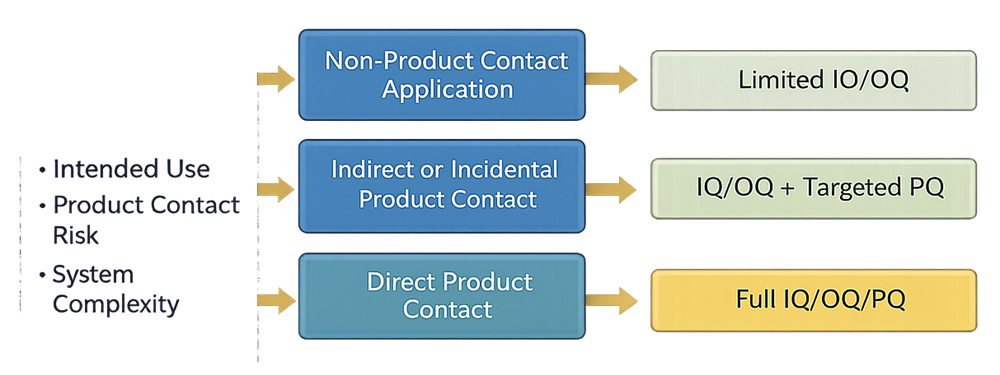
The labels “limited IQ/OQ,” “IQ/OQ plus targeted PQ,” and “full IQ/OQ/PQ” should be read as a directional example, not as a mandatory protocol matrix. Contact category alone does not determine scope. The approved requirements, credible failure modes, engineered controls, shared-system impact, available evidence, and uncertainty should determine which installed-state checks, functional challenges, capacity tests, delivered-quality tests, point-of-use samples, aseptic-boundary verifications, and application-specific confirmations are required. A non-product-contact use can still require extensive functional testing when loss of pressure could affect a critical process, while direct contact does not justify indiscriminate testing unrelated to a credible quality risk.
Readiness and Design Confirmation
Qualification should begin only after requirements, design, construction, turnover, procedures, instruments, and sampling provisions are sufficiently mature to support controlled testing. Open items should be assessed for impact rather than carried forward without a documented decision.
Design Qualification (DQ) should confirm that the gas source, treatment, storage, distribution, segregation, controls, sampling provisions, capacity, redundancy, maintainability, and safety interfaces can meet the approved requirements.
Readiness evidence normally includes:
- approved requirements and system-impact assessment;
- design descriptions, flow diagrams, P&IDs, and use-point lists;
- equipment and instrument data;
- materials, fabrication, cleaning, flushing, or passivation records as applicable;
- pressure-test and leakage-test records;
- software or configuration documentation for automated controls;
- supplier and commissioning records proposed for use;
- calibration status of test and installed instruments;
- approved operating, maintenance, sampling, and alarm-response procedures;
- completed operator and maintenance training; and
- a controlled list of open items with disposition.
Installed-State Verification
Installation Qualification (IQ) confirms that the installed system and its documented configuration support the approved design and intended uses.
The verification should address applicable common and use-specific elements.
Source and Generation Equipment
- compressor, generator, vaporizer, cylinder bank, bulk tank, or microbulk installation;
- intake location and protection for compressed-air systems;
- separators, dryers, filters, adsorbers, catalysts, receivers, drains, and cooling provisions;
- generator media, membrane, or pressure swing adsorption train identification;
- primary, standby, reserve, and emergency supply configuration;
- relief devices, venting, exhaust, gas detection, and other safety interfaces; and
- utilities required for operation and regeneration.
Distribution and Use Points
- line identification, gas labels, flow direction, and use-point tags;
- conformance of installed routing to controlled drawings;
- materials, joining methods, surface condition, and required certificates;
- segregation between gases, grades, pressure zones, and breathing-air service;
- regulators, check valves, excess-flow devices, relief devices, and backflow prevention;
- receiver, header, branch, drop, low-point, drain, and dead-end configuration;
- terminal filters, housings, vents, sample ports, and sterilization provisions;
- absence or documented control of unauthorized hoses, quick connects, bypasses, and cross-connections; and
- accessibility for inspection, calibration, filter replacement, integrity testing, and safe maintenance.
Instrumentation and Automation
- tag, range, accuracy, location, orientation, and calibration status;
- alarm and interlock inputs and outputs;
- analyzer sample conditioning and return or vent arrangements;
- controller and software versions where GMP functions depend on configuration;
- data recording, time synchronization, access, and retention where electronic records support release or monitoring; and
- loss-of-power and restart configuration.
As-built drawings and the use-point inventory should be corrected before release. Qualification should not normalize uncontrolled field differences by merely recording them in a protocol.
Functional and Operational Verification
Operational Qualification (OQ) should challenge the functions and operating ranges necessary to maintain the required gas supply and quality.
Tests should be selected from system design and failure modes. Applicable challenges include:
- normal start-up and controlled shutdown;
- automatic compressor or generator sequencing;
- load and unload control;
- dryer cycling, purge, regeneration, and dew-point response;
- separator and condensate-drain operation;
- pressure control across headers and regulated zones;
- low and high pressure, high dew point, low purity, high temperature, filter differential pressure, low reserve, and equipment-failure alarms;
- duty-to-standby and primary-to-reserve changeover;
- power loss, control restart, communication loss, and instrument failure;
- manual and automatic bypass controls;
- generator off-spec diversion or inhibition of release where provided;
- cross-connection prevention and keyed or dedicated connection controls;
- remote alarm annunciation and operator response;
- data acquisition, audit trail, and record retention where applicable; and
- safe failure of connected critical instruments or equipment.
Alarm tests should verify the complete path from the initiating condition through detection, annunciation, time stamp, recipient, response instruction, and documented restoration. For a critical alarm, forcing a display bit without challenging the field signal may not establish end-to-end performance.
Operating Ranges and Setpoints
The protocol should distinguish:
- design limits;
- qualified operating ranges;
- normal operating ranges;
- control setpoints;
- alert levels;
- alarm or action levels; and
- product or process acceptance criteria.
These values can differ. A pressure alarm is not automatically a gas-quality failure, and an in-specification test result does not automatically make a prolonged operating excursion acceptable.
Capacity, Recovery, and Interruption Verification
Gas systems should demonstrate adequate performance at the demand conditions represented by approved use. Nameplate capacity or a compressor vendor calculation alone does not demonstrate delivery at remote users.
Testing should address, where relevant:
- normal demand;
- representative simultaneous or peak demand;
- minimum demand and turndown;
- remote or hydraulically disadvantaged users;
- pressure and flow at critical use points;
- receiver or buffer performance;
- compressor, generator, or vaporizer cycling;
- recovery after a large demand or restart;
- duty/standby operation;
- source changeover without unacceptable pressure or purity disturbance;
- reserve duration and restoration time;
- common-mode failures; and
- permitted production response to degraded capacity.
A redundant compressor does not establish redundant service if both units depend on one dryer, receiver, electrical feeder, cooling supply, controller, intake environment, or distribution header. Claims of redundancy should identify the failures actually protected against.
Interruption tests should not create an uncontrolled product or personnel hazard. Where a live challenge is unsafe, the rationale, simulation method, supporting design evidence, and residual uncertainty should be documented.
Delivered-Quality and Performance Verification
Performance Qualification (PQ) should demonstrate that the gas utility consistently delivers the required identity, quality, pressure, flow, and protective functions under the conditions of actual or representative use.
The term performance verification can be used when a facility does not organize utility studies as a separate PQ protocol. The evidence requirement remains: the released system must perform reproducibly at the locations and conditions that matter.
Attributes Are Selected by Intended Use
Compressed-air attributes may include particles, pressure dew point or water vapor, oil aerosol, oil vapor, microorganisms, pressure, flow, temperature, and selected gaseous contaminants. ISO 8573-1 can support particle, water, and oil classification, but the facility must specify each applicable attribute, measurement location, operating condition, and method. ISO purity classes do not by themselves define a complete GMP specification.
Process-gas attributes may include identity, assay or purity, oxygen, moisture, carbon dioxide, carbon monoxide, hydrocarbons, particles, microorganisms, endotoxins, pressure, flow, and application-specific impurities. Not every attribute applies to every gas or use.
For aseptic applications, the qualification evidence should address the terminal sterilizing-grade gas filter, installation, sterilization or sanitization approach, protection after sterilization, and integrity-test method and timing. FDA’s sterile-drug inspection program specifically directs attention to final filtration of process gases, integrity testing of typically hydrophobic filters, generation systems, preventive maintenance, temperature, pressure, humidity, and sampling.
Test Methods Must Be Suitable
The protocol or controlled method should define:
- sample location and connection;
- sample conditioning, pressure reduction, tubing, and flow;
- purge or stabilization criteria;
- operating status and represented use condition;
- test instrument range, sensitivity, calibration, and suitability;
- sample volume and duration;
- recovery correction or method limitation;
- blank, control, or background requirements where applicable;
- handling of condensate or high-pressure samples;
- microbial collection and incubation conditions;
- calculation and reporting basis;
- acceptance criteria; and
- actions for invalid, atypical, or failing results.
The sampling train can change the result. Excessive tubing, unsuitable elastomer, dirty pressure regulators, lubricated fittings, high decompression temperature, condensation, particle shedding, microbial loss, or ambient ingress can create false high or false low values.
Point-of-Use Selection and Representation
Testing every use point for every attribute at the same frequency is not automatically necessary, but testing only at the source is rarely sufficient for a distributed GMP utility. The strategy should establish which points are individually tested and which are represented by justified locations.
Selection factors include:
- direct, indirect, or aseptic exposure;
- use before or after a sterilization or contamination-reduction step;
- required gas grade and specification;
- distance from the source;
- branch length, diameter, material, and configuration;
- high and low elevation;
- highest and lowest pressure zones;
- intermittent or low-flow use;
- remote or hydraulically disadvantaged location;
- proximity to low points, receivers, drains, or dead ends;
- terminal regulator, hose, filter, or sterilizable assembly;
- risk of backflow from the process;
- different buildings, distribution loops, or environmental conditions;
- maintenance or modification history; and
- previous adverse results or trends.
Sampling Categories
| Sampling category | Purpose | Typical evidence |
| Source or generation outlet | Verify generated or accepted source quality | Identity/purity, dew point, oil, particles, analyzer comparison, source-release evidence |
| Distribution header | Verify common treatment and main distribution condition | Pressure, dew point, representative chemical or particulate attributes |
| Remote or worst-case branch | Challenge transport, moisture, contamination, and pressure loss | Delivered quality and operating performance |
| Representative use point | Support a defined group of comparable users | Use-point attributes with documented representation rationale |
| Individually critical use point | Verify a unique, direct-contact, aseptic, or otherwise nonrepresentable user | Full applicable specification, terminal controls, filter evidence, pressure and flow |
| Event-driven location | Investigate a failure, intervention, or trend | Focused testing selected from the suspected mechanism and affected boundary |
Representation should be documented before results are known. A convenient port near the compressor, generator, or bulk source cannot represent a remote, intermittently used, pressure-reduced, or aseptic use point without supporting engineering evidence.
Initial Performance Period
The initial performance study should provide enough operating diversity and elapsed time to demonstrate the proposed state of control. The number and spacing of samples should be justified from system dynamics, use schedule, source variability, dryer or generator cycles, distribution risk, and detectability of failure. Repeating an identical test on consecutive days may add little evidence if the principal risks arise from seasonal intake humidity, intermittent branches, source deliveries, regeneration cycles, or peak production demand.
Release and Qualified Baseline
Release should occur only after the required evidence has been reviewed and approved. The release package should establish the baseline against which later changes and trends are evaluated.
Release criteria normally include:
- approved requirements and traceability;
- accepted installation and functional results;
- completed capacity and performance evidence;
- approved use-point inventory and sampling rationale;
- resolved or formally accepted deviations;
- current drawings, equipment lists, and critical settings;
- calibrated instruments and analyzers;
- approved operating, monitoring, maintenance, sampling, alarm, and excursion procedures;
- trained personnel;
- defined routine limits and frequencies;
- spare, consumable, and terminal-filter controls;
- approved restrictions or open actions with owners and due dates; and
- Quality Unit authorization where required by procedure.
A phased release can be appropriate when its boundary, permitted users, restrictions, remaining evidence, monitoring, expiration, and approval are explicit. Informal use while qualification remains open is not a controlled phased release.
Routine Monitoring and Point-of-Use Testing
Routine control should combine continuous or frequent operating data with periodic quality testing. These evidence streams answer different questions.
Online and Operating Monitoring
Depending on the system and use, online or routine operating parameters may include:
- header and use-point pressure;
- flow or demand;
- compressor status, load, hours, starts, and temperature;
- dryer status and pressure dew point;
- filter differential pressure;
- separator and drain operation;
- receiver pressure;
- generated-gas purity;
- oxygen concentration;
- source level, reserve status, and changeover;
- room gas detection or oxygen-deficiency monitoring;
- terminal-filter sterilization or integrity-test status; and
- alarm occurrence, duration, acknowledgement, and restoration.
Online analyzers should have defined sample conditioning, calibration, verification, failure response, data review, and maintenance. A displayed value is not reliable merely because it is continuous.
Periodic Quality Testing
Periodic point-of-use testing confirms attributes that are not continuously measured or provides an independent check of online instruments. The program should define:
- points and attributes;
- test method and laboratory responsibility;
- frequency and rotation plan;
- operating conditions at sampling;
- limits and data reporting;
- review and approval;
- trend grouping;
- invalid-test handling; and
- escalation requirements.
Frequencies should be justified individually. A higher-risk use, weak detectability, variable source, difficult distribution, recurring adverse trend, or significant intervention can support more frequent testing. Sustained control, strong online detection, stable configuration, and representative evidence can support a different frequency when allowed by procedures and commitments.
Breathing-air testing and alarms required for supplied-air respirators should remain governed by the respiratory-protection program. Product-quality testing cannot be assumed to satisfy OSHA breathing-air requirements, and Grade D breathing-air evidence does not establish suitability for direct GMP product contact.
Trending and Data Review
Pass/fail review alone can miss deterioration. Trending should identify movement toward loss of control while the system still meets a specification.
Useful trend groups include:
- particles by size range and location;
- pressure dew point by season, dryer, load, and location;
- total oil, oil aerosol, or oil vapor as separately measured;
- microbial counts, recoveries, and recurring organisms;
- gas purity and critical impurities;
- pressure, flow, demand, and recovery;
- filter differential pressure and replacement interval;
- terminal-filter integrity failures or atypical results;
- compressor, dryer, generator, drain, regulator, and analyzer failures;
- alarms by type, frequency, duration, shift, and cause;
- calibration as-found results;
- maintenance work orders and repeated component failures;
- use-point additions or temporary connections; and
- deviations, complaints, batch events, and process effects associated with the utility.
Data should be grouped in a way that preserves meaningful differences. Combining all points into one average can hide a deteriorating remote branch. Conversely, reacting to each small result fluctuation without considering method variability and operating context can create noise rather than control.
Alert levels can identify adverse movement before an action or specification limit is reached. They should be statistically and technically justified, periodically reviewed, and tied to defined responses. An alert is a signal for assessment; it is not automatically an out-of-specification result or product failure.
Maintenance, Calibration, and Return to Service
Maintenance can change gas quality, pressure, availability, configuration, and sterile-boundary integrity. The Preventive Maintenance and System Reliability Strategy should address gas-utility failure modes as well as the contamination introduced by intervention.
Relevant assets include compressors, lubricants, separators, dryers, desiccant or molecular sieve, filters, receivers, drains, generators, membranes, valves, regulators, relief devices, vaporizers, bulk controls, cylinder manifolds, analyzers, gas detectors, hoses, terminal filters, and sterilization assemblies.
The Calibration Program and Metrology Control should include instruments whose accuracy supports operating control, alarms, release, trend interpretation, or qualification acceptance.
Maintenance Controls
Work planning should define:
- affected boundary and users;
- isolation and lockout;
- approved materials, lubricants, filters, seals, and parts;
- cleanliness and foreign-material controls;
- temporary hose, compressor, dryer, cylinder, or bypass requirements;
- protection against wrong-gas connection;
- draining, cleaning, purging, flushing, drying, or sterilization;
- restoration of valve and control configuration;
- calibration or functional checks;
- post-maintenance testing;
- enhanced monitoring; and
- authorized return to service.
Maintenance completion is not equivalent to GMP release. Return-to-service evidence should be selected from what the work could have changed. Replacing an identical pressure transmitter may require calibration and loop verification. Opening a direct-contact branch can require cleanliness, purge, delivered-quality testing, and terminal-filter controls. Replacing a compressor, dryer, generator bed, or common header can require broader capacity and quality verification.
Excursions and Adverse Signals
An excursion program should distinguish the observed signal from the confirmed condition and its potential product effect. Relevant signals include:
- out-of-specification or atypical quality result;
- alert-level or adverse trend;
- prolonged high dew point or low purity;
- pressure loss or supply interruption;
- failed terminal-filter integrity test;
- wrong gas, wrong cylinder, or wrong bulk connection;
- analyzer drift or missed calibration;
- drain, dryer, filter, compressor, generator, or regulator failure;
- backflow or suspected process ingress;
- contaminated or uncontrolled temporary supply;
- undocumented use point or system modification;
- extended shutdown or abnormal restart; and
- complaint, deviation, environmental event, or batch anomaly with a plausible gas-utility pathway.
Immediate Control
Initial actions should be defined by procedure and may include:
- place the affected source, header, branch, user, or product on hold;
- stop or restrict use;
- switch to an approved alternate source;
- preserve alarms, trends, samples, parts, and configuration evidence;
- identify the last known acceptable condition;
- define the potentially affected time window and system boundary;
- notify production, engineering, laboratory, Quality, and safety functions; and
- implement safe temporary monitoring where continued operation is considered.
Investigation
The investigation should evaluate:
- validity and representativeness of the result;
- sampling-train and method performance;
- analyzer and calibration status;
- source, treatment, distribution, and use-point conditions;
- alarms, trends, maintenance, changes, and operator actions;
- common versus local failure mechanisms;
- duration and spatial extent;
- affected products, batches, equipment, rooms, and processes;
- terminal-filter and sterile-boundary status;
- alternate-source or changeover performance;
- recurrence and prior related events; and
- corrective and preventive actions.
Passing resamples do not erase an original valid failure. Resampling should answer a defined investigation question, such as whether the condition persists, whether it is local or systemic, or whether corrective work restored control.
Continued use during an investigation requires documented justification, defined restrictions, risk controls, monitoring, approval, and an expiration or review point. It is a decision, not the default consequence of production need.
Change Control
Gas-utility changes should be assessed before implementation when planned and promptly controlled when emergent. The assessment should consider requirements, product-contact pathways, shared users, qualification baseline, procedures, monitoring, maintenance, safety, regulatory commitments, and product impact.
Changes that may affect the qualified state include:
- new or changed use point;
- changed product, process, gas function, or contact pathway;
- new gas, grade, supplier, source, or delivery mode;
- compressor, dryer, filter, generator, receiver, vaporizer, or bulk-system replacement;
- pipe, valve, regulator, hose, fitting, terminal filter, or sample-port modification;
- changed materials, lubricant, desiccant, membrane, or consumable;
- control-logic, alarm, analyzer, historian, or network change;
- changed pressure, flow, purity, dew point, or alarm setting;
- temporary compressor, cylinder manifold, bypass, or cross-tie;
- building expansion or changed demand;
- changed maintenance or test frequency; and
- extended shutdown, mothballing, or restart.
Utility System Change Control, Requalification, and Deficiencies provides the broader decision framework for assessing utility changes, unplanned failures, continued use, corrective work, verification, and release.
Equivalent replacement should not be defined solely by part number or vendor claim. Equivalence should address function, materials, dimensions, range, accuracy, capacity, control behavior, surface or cleanliness requirements, software or configuration, maintainability, and effect on the qualified baseline.
Periodic Review
Periodic review determines whether the qualified baseline remains accurate and whether the combined evidence continues to support approved use. It is broader than checking whether scheduled tests were completed.
Review inputs should include:
- current system boundary, drawings, equipment list, and use-point inventory;
- current specifications, limits, and monitoring plan;
- online data and point-of-use test trends;
- alarms and operational excursions;
- deviations, investigations, CAPA, and product-impact assessments;
- maintenance history and recurring failures;
- calibration history and adverse as-found conditions;
- terminal-filter installation, sterilization, replacement, and integrity results;
- supplier, certificate, source, delivery, and incoming-release history;
- generated-gas performance and feed-air dependencies;
- changes, temporary configurations, and return-to-service evidence;
- capacity, demand growth, reserve use, and interruptions;
- software, automation, access, backup, and data-review issues where relevant;
- previous qualification and requalification results;
- open actions, restrictions, and continued-use decisions;
- vendor support, spare availability, and obsolescence; and
- regulatory, compendial, procedural, or process changes affecting requirements.
The review conclusion should state whether:
- the system remains suitable for all approved uses;
- the inventory and qualification baseline remain current;
- monitoring and maintenance remain effective;
- limits or frequencies require revision;
- actions or enhanced monitoring are required;
- targeted verification or requalification is required; or
- continued use should be restricted or suspended.
Periodic review does not replace required periodic testing, and calendar-based testing does not replace periodic review. They provide different evidence.
Lifecycle Control Loop
The legacy gas-utility lifecycle illustration summarizes the continuing relationship among design, qualification, routine operation, monitoring and trending, change control, and requalification. Initial design and qualification establish the approved system and evidence baseline. Routine operation generates monitoring, testing, alarm, maintenance, calibration, and performance evidence. Change control evaluates planned modifications and relevant adverse events. Requalification renews affected evidence when the impact assessment shows that the existing baseline is no longer sufficient.
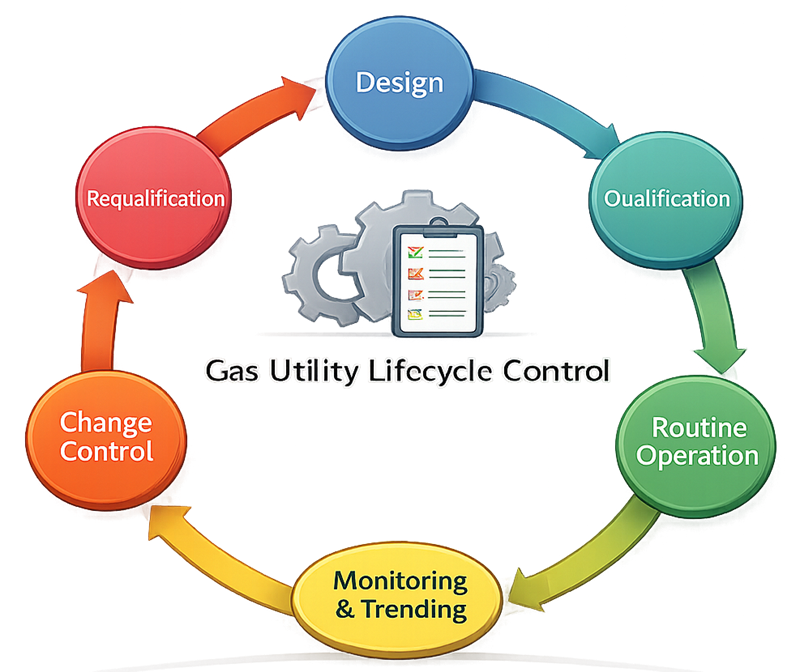
The circular arrangement represents continuing governance, not a requirement that every event pass through every stage or that every requalification require redesign. A minor controlled replacement may need only focused verification. A significant change, recurring failure, new intended use, or unresolved evidence gap may require targeted or comprehensive requalification and may also return the system to design review. Approved release establishes the new or reconfirmed baseline before routine use resumes.
Requalification Triggers
Requalification may be driven by a planned change, unplanned event, adverse trend, evidence gap, elapsed-time requirement, or periodic-review conclusion. Relevant triggers include:
- change in intended use or product-contact status;
- source, supplier, grade, generator, treatment, storage, or distribution change;
- new building, header, branch, or critical use point;
- major maintenance or line opening;
- repeated or significant quality excursions;
- failed terminal-filter integrity or loss of sterile-boundary assurance;
- inadequate capacity, recovery, or redundancy performance;
- prolonged shutdown, construction, contamination event, or abnormal restart;
- loss of critical records or uncertainty about configuration;
- recurring analyzer, alarm, dryer, drain, compressor, or generator failures;
- revised requirement, method, specification, or regulatory commitment;
- adverse periodic-review conclusion; and
- scheduled requalification required by an approved procedure or justified control strategy.
Not every trigger requires comprehensive requalification. It requires a documented impact and evidence review.
Selecting Requalification Scope
The scope should be based on:
- what changed or failed;
- affected requirements and use points;
- product-quality and sterile-boundary consequence;
- physical and temporal extent;
- configuration certainty;
- available qualification, monitoring, maintenance, and investigation evidence;
- ability to isolate affected from unaffected portions;
- detectability of an unacceptable condition; and
- confidence that corrective work restored the approved state.
Possible outcomes include:
No Additional Qualification
Documented review concludes that the event did not affect a qualified requirement and existing evidence remains sufficient. Administrative correction, normal maintenance closure, or routine monitoring may be adequate.
Targeted Verification
Focused checks confirm a limited attribute or function, such as calibration and loop verification after instrument replacement, leak testing after a controlled fitting replacement, or pressure confirmation after regulator adjustment.
Targeted Requalification
A defined portion of the prior qualification is repeated or extended because an affected requirement needs renewed evidence. Examples include use-point quality testing after a branch modification, capacity testing after demand expansion, dryer performance after replacement, or terminal-filter installation and integrity verification after aseptic-path work.
Comprehensive Requalification
Broader installation, functional, capacity, quality, distribution, and use-point evidence is regenerated when the system has been substantially changed, control has been lost across an uncertain boundary, configuration cannot be reliably established, or available evidence cannot support a narrower conclusion.
Requalification Release
Requalification closure should document:
- trigger and affected boundary;
- impact and continued-use decisions;
- selected scope and rationale;
- prerequisites and approved protocols;
- results, deviations, and corrective actions;
- product-impact conclusion;
- updated drawings, inventories, settings, and procedures;
- revised monitoring or maintenance where required;
- restrictions or open actions;
- approved release; and
- the new or confirmed qualification baseline.
Regulatory and Technical Framework
US drug GMP regulations do not prescribe one qualification protocol or one universal specification for gas utilities. The applicable basis is assembled from intended use and relevant requirements, including:
- 21 CFR Part 211, including facility, equipment, component, production-control, laboratory, record, maintenance, and automated-equipment provisions as applicable;
- FDA Compliance Program 7356.002A, Sterile Drug Process Inspections, which addresses process-gas generation, final sterilizing-grade filtration for aseptic or post-sterilization uses, filter integrity testing, preventive maintenance, monitoring, and sampling;
- ISO 8573-1:2010 and applicable ISO 8573 measurement-method parts for compressed-air contaminants and purity classes; and
- 29 CFR 1910.134 for breathing air supplied to respirators.
ISO 8573 is a technical framework, not a general FDA-mandated compressed-air class. OSHA breathing-air requirements protect personnel and should not be presented as the specification for product-contact air. Supplier or commodity standards may define gas identity and purity, but facility-level qualification must still address the installed distribution and actual use points.
Common Program Weaknesses
Common weaknesses include:
- qualifying the gas name rather than the intended use;
- no controlled use-point inventory;
- treating all users on a shared header as equivalent;
- using supplier certificates as the only facility evidence;
- testing only at the compressor or source;
- selecting points for convenience rather than representation;
- prescribing one ISO 8573 class for every use without attribute-specific rationale;
- confusing process air, product-contact air, and breathing air;
- assuming Class 0 means contaminant-free air;
- omitting microorganisms or application-specific impurities without rationale;
- ignoring sampling-train bias;
- relying on nameplate capacity instead of delivered performance;
- claiming redundancy without assessing common-mode failures;
- testing alarm displays without the field-to-response path;
- failing to control terminal gas filters as part of an aseptic boundary;
- undocumented temporary compressors, cylinders, hoses, bypasses, or cross-ties;
- returning a system to use immediately after maintenance without risk-based verification;
- treating passing resamples as invalidation of a valid failure;
- reviewing results only as pass or fail without trending;
- allowing drawings and use-point inventories to drift from the field;
- treating periodic testing as the entire periodic review; and
- automatically selecting full requalification or no requalification without an impact-and-evidence assessment.
Lifecycle Outcome
A gas utility remains qualified when the facility can demonstrate that approved requirements and use points are current, the installed configuration is known, critical functions and capacity remain controlled, delivered quality is suitable at representative and critical locations, adverse signals are detected and investigated, maintenance and changes are controlled, and requalification decisions are supported by risk and evidence.
The lifecycle is not a repeated sequence of identical protocols. It is a controlled evidence system: initial qualification establishes the baseline; monitoring, testing, maintenance, calibration, change control, and periodic review challenge that baseline; and targeted or comprehensive requalification restores evidence where impact or uncertainty requires it.