

Pharmaceutical Water System Lifecycle Control and Requalification
Initial qualification establishes that a pharmaceutical-water system is suitable for its intended use at the time of release. Lifecycle control determines whether that conclusion remains valid as the system operates, ages, is maintained, experiences changing demand, undergoes sanitization, accumulates performance history, and is modified.
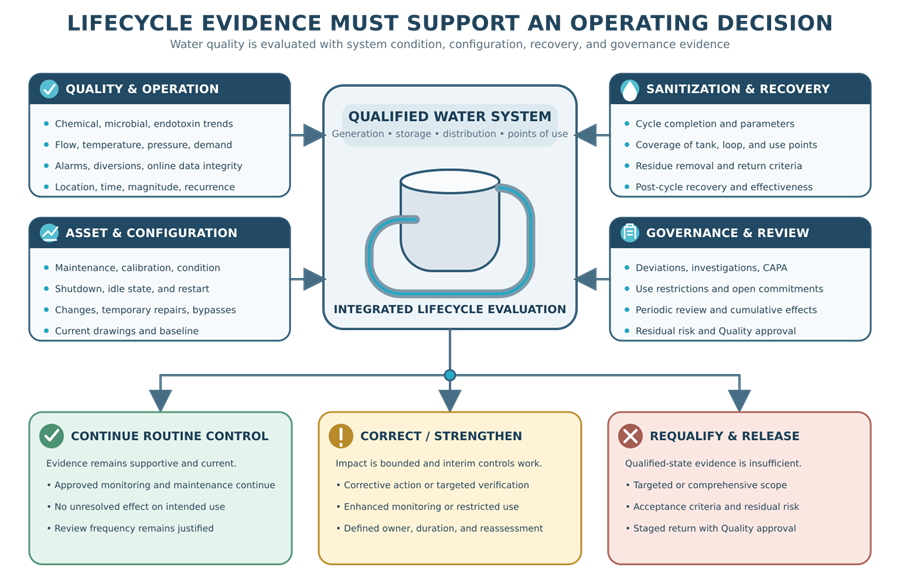
Continued control is not demonstrated by acceptable water samples alone. It depends on an integrated body of evidence covering:
- Chemical, microbial, and endotoxin performance, as applicable
- Critical operating parameters and online monitoring
- Sanitization execution and effectiveness
- Maintenance, calibration, repairs, and component condition
- Deviations, investigations, and adverse trends
- Shutdown, idle-state, and restart control
- Changes to configuration, operation, automation, and intended use
- Periodic review and cumulative risk assessment
- Continued-use and return-to-service decisions
- Targeted or comprehensive requalification when required
The objective is to preserve confidence that the system continues to deliver water of the required quality at every approved point of use—not merely to maintain a historical qualification status.
Purpose and Lifecycle Position
This article addresses lifecycle governance after initial release of bulk pharmaceutical-water systems, primarily:
- Purified Water systems
- Water for Injection systems
- Associated source-water, pretreatment, generation, storage, and distribution functions
- Online analyzers, automation, alarms, historians, and supporting utilities within the controlled system boundary
- Point-of-use branches, hoses, coolers, and delivery assemblies included in normal use
It focuses on how operating evidence is evaluated and converted into decisions concerning continued use, corrective action, monitoring changes, sanitization, maintenance, shutdown recovery, change implementation, and requalification.
Initial DQ, IQ, OQ, performance verification, and release are addressed in Pharmaceutical Water System Qualification and Performance Verification. Selection of the required water grade for each application is addressed in Pharmaceutical Water Quality Categories and Intended Use. Detailed sampling, compendial testing, microbial control, alert and action levels, and trend analysis are addressed in USP Water Specifications, Testing, and Monitoring.
The Lifecycle Control Model
A pharmaceutical-water system remains in control when current evidence supports all of the following conclusions:
- The approved intended use and required water quality remain defined.
- The actual system configuration agrees with controlled records.
- Critical operating conditions remain within approved ranges.
- Water quality remains acceptable throughout generation, storage, distribution, and delivery.
- Sanitization remains effective and reproducible.
- Maintenance and calibration preserve system capability.
- Changes, failures, and adverse trends are detected, assessed, and resolved.
- Residual risk remains acceptable for continued use.
Lifecycle evidence should lead to one of three broad decisions:
| Decision | Meaning | Typical controls |
|---|---|---|
| Continue | Current evidence supports routine operation | Continue approved monitoring, maintenance, sanitization, and review |
| Correct or strengthen controls | A condition requires action, but available evidence supports controlled operation | Corrective maintenance, enhanced monitoring, restricted use, revised procedures, CAPA, or targeted verification |
| Requalify before unrestricted use | The qualified-state conclusion is affected or no longer adequately supported | Targeted or comprehensive requalification followed by documented release |
The broader governance model for critical utilities is addressed in Utility System Lifecycle Control and Monitoring.
Controlled Baselines and Responsibilities
Lifecycle decisions require a current baseline. The controlled baseline should identify, as applicable:
- Approved system boundary and intended uses
- Water type and quality requirements
- Current process-flow diagrams and P&IDs
- Equipment, instrument, valve, point-of-use, and sampling-point lists
- Materials of construction and hygienic-design requirements
- Approved operating ranges and control setpoints
- Alarm, interlock, and diversion configuration
- Sanitization method, parameters, sequence, and frequency
- Routine online and laboratory monitoring program
- Current calibration and preventive-maintenance requirements
- Automation configuration, access, data retention, backup, and recovery controls
- Qualified operating states and known limitations
- Open actions, temporary controls, and remaining commitments
Responsibilities should be defined among system ownership, Engineering, Utilities, Maintenance, Metrology, Automation, Microbiology, Quality Control, manufacturing users, Validation, and the Quality Unit. A lifecycle issue should not remain unresolved because monitoring, investigation, maintenance, and release decisions are divided among different functions.
Design features that establish and preserve the pharmaceutical-water baseline are addressed in Pharmaceutical Water System Design and Distribution.
Routine Monitoring and Trend Evaluation
Routine monitoring provides the principal continuing evidence of water-system performance. It should combine quality results with operating and equipment data rather than treating laboratory samples as the entire control program.
Water-Quality Evidence
The program may include:
- Conductivity
- Total organic carbon
- Microbial enumeration
- Organism identification under defined conditions
- Bacterial endotoxins for WFI and where otherwise required
- Source-water and pretreatment attributes
- Sanitant concentration or residue
- Other intended-use or process-specific requirements
Operating and Engineering Evidence
Relevant data may include:
- Generation rate and recovery
- Membrane pressure, differential pressure, rejection, and normalized performance
- Storage-tank level and turnover
- Distribution flow, return flow, pressure, and temperature
- Ozone concentration and destruction
- Ultraviolet intensity
- Chemical-dosing performance
- Vent-filter status or integrity
- Pump operating condition and standby availability
- Alarm, interlock, diversion, and bypass status
- Analyzer diagnostics, calibration status, and data availability
Trend Review
Trend review should evaluate location, time, magnitude, frequency, organism identity, operating state, sanitization history, demand, maintenance, and related system parameters. Relevant signals include:
- Increasing microbial counts that remain below an action level
- Repeated alert-level results
- Recovery of the same or related organisms at multiple locations
- Shifts in flora or recovery of objectionable organisms
- Gradual conductivity, TOC, endotoxin, temperature, or flow change
- Increasing difference between supply and return conditions
- Repeated alarms, short cycling, diversions, or analyzer faults
- Slow recovery after sanitization
- Deterioration concentrated at remote, low-use, cooled, or intermittently used points
- Increasing membrane differential pressure or declining rejection
- Repeated missed samples, invalid tests, or data gaps
A single result should be interpreted in context, but isolated acceptance must not be used to dismiss a persistent pattern. Conversely, a statistical signal does not automatically prove loss of control. It identifies the need for technical assessment.
Detailed monitoring controls are addressed in USP Water Specifications, Testing, and Monitoring.
Sanitization as a Lifecycle Control
Sanitization is not only a scheduled operating task. Its execution and effectiveness are continuing evidence about the hygienic condition of the system.
The lifecycle program should control:
- Sanitization method and system boundary
- Cycle parameters and acceptance criteria
- Frequency and permitted operating window
- Coverage of storage, distribution, points of use, sample valves, standby paths, and other included components
- Instrument and control-system sequence
- Operator actions and manual connections
- Thermal distribution or chemical concentration, as applicable
- Contact time, flow, and return conditions
- Ozone generation and destruction, where used
- Chemical neutralization, rinsing, and residue acceptance
- Cycle deviations and interrupted cycles
- Return-to-service requirements
- Post-sanitization monitoring and recovery
Sanitization frequency should be supported by system design, qualification evidence, microbial performance, use patterns, idle conditions, and operating history. A fixed interval may remain appropriate, but the interval should be reassessed when performance changes.
Repeatedly increasing sanitization frequency can temporarily suppress microbial counts while concealing a developing design, maintenance, operational, or biofilm problem. When an established frequency no longer maintains control, the response should include investigation of cause rather than indefinite escalation of sanitization alone.
A change to sanitization chemistry, temperature, exposure time, flow path, sequence, frequency, or return-to-service criteria requires documented impact assessment. Verification may need to address both sanitization effectiveness and adverse effects such as material degradation, residue, corrosion, elastomer damage, or analyzer exposure.
Maintenance, Calibration, and Repair Control
Water-system maintenance can preserve control or create a contamination and configuration risk. Each activity should be assessed based on what was disturbed, exposed, replaced, adjusted, or reconfigured.
Representative Lifecycle Activities
- Membrane, filter, resin, carbon, electrode, UV lamp, ozone component, or chemical-dosing maintenance
- Pump, seal, valve, gasket, diaphragm, spray device, or heat-exchanger work
- Tank entry or vent-filter replacement
- Instrument calibration, adjustment, repair, or relocation
- Welding, piping modification, passivation, or surface repair
- Automation hardware, network, software, alarm, or configuration work
- Cleaning after intrusive maintenance
- Temporary bypasses, jumpers, hoses, or alternate operating modes
Pre-Maintenance Controls
Before intrusive work, the plan should define:
- Affected system boundary and points of use
- Water and product-use restrictions
- Isolation and lockout method
- Drainage and depressurization
- Cleanliness and material controls
- Temporary components and connection protection
- Required drawings, procedures, permits, and change controls
- Expected post-maintenance cleaning, passivation, sanitization, testing, and release
Post-Maintenance Assessment
Completion of a work order does not by itself authorize return to GMP service. The post-maintenance assessment should consider:
- Correct component identity, rating, material, and installation
- Cleanliness and removal of tools, debris, and temporary materials
- Restoration of valve positions, safeguards, alarms, and interlocks
- Leak, pressure, rotation, alignment, and functional checks
- Calibration or verification of affected instruments
- Drawing, spare-parts, and configuration updates
- Cleaning, flushing, passivation, or sanitization
- Chemical-residue removal
- Representative water-quality testing
- Required targeted qualification testing
- Review and approval before release
Like-for-like replacement can reduce the required verification scope, but the label does not eliminate assessment. Actual equivalence must consider material, surface finish, dimensions, capacity, performance, software or firmware, hygienic design, connection method, and effect on the qualified baseline.
General maintenance and calibration principles are addressed in Preventive Maintenance and Equipment Reliability and GMP Calibration Program and Metrology Control.
Adverse Signals, Deviations, and Investigation
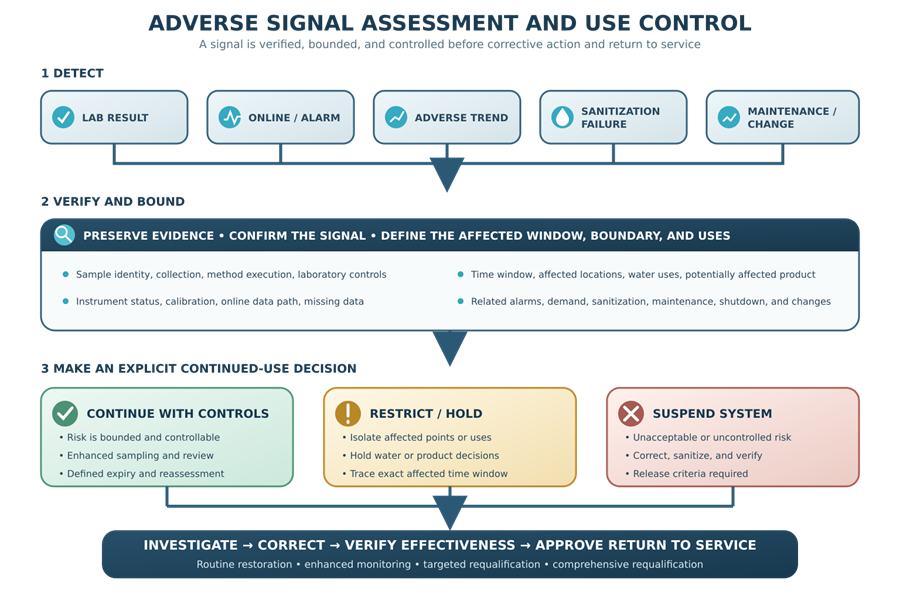
An adverse signal may originate from laboratory testing, online monitoring, alarms, maintenance, an operator observation, a complaint, an audit, a failed sanitization, or a change discovered outside formal control.
The initial response should distinguish among:
- Confirmed water-quality failure
- Alert or adverse trend without a specification failure
- Sampling or laboratory error with a demonstrated assignable cause
- Instrument or data-path failure
- Localized point-of-use condition
- System-wide operating or microbial-control condition
- Documentation gap without evidence of physical failure
- Unknown condition requiring precautionary control
Investigation Sequence
The investigation should:
- Preserve original data and document the detected condition.
- Verify sample identity, method execution, instrument status, and data integrity.
- Define the affected time window, system area, water uses, and potentially affected product.
- Review related online data, alarms, sanitization, maintenance, demand, and operating conditions.
- Compare related locations and identify whether the condition is isolated or systemic.
- Evaluate organism identity and objectionability when microbiological risk is involved.
- Establish immediate controls and a continued-use decision.
- Determine root cause or the most scientifically supportable causal conclusion.
- Define corrective action, verification, and requalification requirements.
- Confirm effectiveness and formally close the issue.
Resampling may provide useful information about current condition, but a passing resample does not erase the original result. The original result may be invalidated only when a scientifically supportable assignable cause is demonstrated through the approved laboratory or deviation process.
Continued-Use Decisions
Continued use during an investigation must be an explicit, documented decision. The absence of a system shutdown is itself a decision and requires a technical basis.
Possible outcomes include:
| Use decision | Conditions that may support it | Required documentation and controls |
| Continue routine use | Evidence confirms no adverse effect on water quality or system control | Investigation rationale, data review, approval |
| Continue with enhanced controls | Uncertainty remains, but risk is bounded and can be controlled | Increased sampling, real-time review, temporary limits, defined duration, reassessment date, Quality approval |
| Restrict specific points or uses | The condition is localized or some uses have greater risk | Physical or procedural restriction, alternative supply, affected-point verification, communication to users |
| Hold water or affected product decisions | Product impact cannot yet be excluded | Defined hold window, lot and use traceability, laboratory and Quality review |
| Suspend the system | Evidence indicates unacceptable or uncontrolled risk | Formal shutdown, investigation, correction, recovery plan, and release criteria |
The assessment should consider:
- Water type and intended use
- Product route of administration and process stage
- Direct or indirect product contact
- Endotoxin and microbial risk
- Result magnitude and trend
- Organism identity and location
- System-wide versus localized evidence
- Time since the last acceptable evidence
- Online data and alarm history
- Sanitization and maintenance history
- Ability to segregate points of use or applications
- Availability and control of an alternate water source
- Detectability of potential product impact
- Residual uncertainty
Temporary controls require an owner, approval, start date, expiration or reassessment date, and defined conditions for escalation. They should not become an undocumented permanent operating strategy.
Shutdown, Idle-State, and Restart Control
Water systems can deteriorate during idle conditions even when no component has failed. Shutdown control should distinguish the actual system state rather than use one generic restart procedure.
Shutdown Categories
| Condition | Examples | Principal risks |
| Controlled standby with circulation maintained | Generation stopped while qualified storage and loop circulation continue | Capacity, temperature, sanitant, or monitoring drift |
| Short controlled idle period | Reduced use during weekends or campaigns | Low turnover, local stagnation, underused points |
| Partial shutdown | Pretreatment or generator offline while part of the system remains operating | Interface control, loss of production capacity, recovery instability |
| Drained or dry shutdown | Planned outage with defined drainage and preservation | Incomplete drainage, retained moisture, loss of hygienic condition |
| Wet static shutdown | System remains filled without normal circulation | Microbial proliferation, biofilm development, temperature loss |
| Open or intrusive outage | Tank entry, piping work, major repair, or construction | Environmental contamination, debris, incorrect reassembly |
| Unplanned loss of control | Power loss, pump failure, automation failure, loss of heat, ozone, or circulation | Unknown state, missing data, uncontrolled stagnation or contamination |
No universal idle duration separates acceptable restart from required requalification. The recovery scope should be based on water type, shutdown duration, temperature, circulation, sanitant state, drainability, system opening, monitoring continuity, prior history, and intended use.
Shutdown Planning
A planned shutdown procedure should define:
- Authorized shutdown state
- Continued circulation or preservation strategy
- Drainage, drying, inerting, heating, ozonation, or chemical preservation where applicable
- Point-of-use and hose disposition
- Vent-filter and tank protection
- Monitoring retained during the outage
- Alarm and data-recording status
- Maintenance or construction controls
- Maximum approved idle duration or reassessment trigger
- Inspection and restart prerequisites
- Sanitization and flushing requirements
- Sampling and release requirements
Restart and Return to Service
Restart assessment may require:
- Inspection of system configuration and cleanliness
- Confirmation that maintenance and changes are complete
- Removal of temporary components and restoration of normal flow paths
- Leak, pressure, rotation, and functional testing
- Calibration and alarm verification
- Flushing, cleaning, passivation, and sanitization
- Verification of sanitization parameters and complete cycle execution
- Residue removal where chemical sanitants were used
- Online parameter stabilization
- Representative chemical, microbial, and endotoxin testing
- Enhanced sampling over a defined recovery period
- Targeted operational testing or broader requalification
- Documented approval for restricted or full GMP use
The restart protocol should identify what evidence is required before water can be used, what enhanced evidence continues after limited release, and what conditions cause renewed shutdown.
Change Control and Configuration Management
Planned and unplanned changes should be evaluated against the approved design, qualified functions, monitoring strategy, and water uses.
Changes requiring assessment include:
- Water type or intended use
- Source-water supply or pretreatment chemistry
- Generator technology, membrane arrangement, resin, electrodeionization, distillation, or polishing
- Storage-tank size, venting, spray device, or level control
- Distribution piping, branch geometry, return arrangement, or materials of construction
- Addition, removal, relocation, or reduced use of a point of use
- Pump, heat exchanger, cooler, UV, ozone, filter, or sanitization equipment
- Operating range, setpoint, alarm, delay, interlock, diversion, or sequence
- Sanitization method, parameters, frequency, or system boundary
- Sampling location, technique, test method, frequency, alert level, or action level
- Automation hardware, software, network, interface, historian, access, backup, or recovery
- Maintenance strategy, spare part, supplier, or component substitution
- Demand, production schedule, seasonal operation, or prolonged idle state
- Temporary repair or bypass
Impact Assessment
The assessment should address:
- Chemical, microbial, endotoxin, particulate, and residue risks
- Hydraulic flow, pressure, turnover, drainability, and stagnation
- Sanitization coverage and reproducibility
- Capacity and recovery under actual demand
- Monitoring representativeness
- Instrument accuracy and data integrity
- Alarm, interlock, diversion, and failure response
- Materials, surface finish, extractables, and corrosion
- Maintenance access and future reliability
- Previously qualified functions and acceptance criteria
- Product, process, cleaning, and laboratory uses
- Required document, procedure, training, and spare-part updates
- Preimplementation, postimplementation, and release testing
The change record should state the validation decision explicitly: no additional qualification, documented verification, targeted requalification, or comprehensive requalification. The rationale should be based on affected requirements and credible risks, not the administrative category assigned to the change.
General change-impact principles are addressed in GMP Change Control and Validation Impact Assessment and Utility Change Control and Requalification.
Periodic Review
Periodic review is a structured evaluation of accumulated evidence. It complements real-time monitoring and event-driven change control by identifying cumulative effects, weak signals, overdue actions, recurring failure modes, and baseline drift that individual records may not reveal.
The review interval should be defined by system risk, intended use, complexity, performance history, change rate, and site procedure. An annual review is common for critical water systems, but the interval is not a universal regulatory number. The review should be performed early when adverse evidence makes the scheduled date irrelevant.
Required Review Inputs
The review should evaluate, as applicable:
- Current intended uses and water-quality requirements
- System boundary, configuration, and as-built documentation
- Added, removed, inactive, or seldom-used points of use
- Water demand, capacity, recovery, and use-pattern changes
- Conductivity, TOC, microbial, endotoxin, and other quality trends
- Organism identifications and recurring flora
- Online operating data, alarms, diversions, and missing data
- Sampling-plan coverage, missed samples, and method changes
- Alert and action levels and their continuing suitability
- Sanitization execution, failures, recovery, and frequency
- Preventive and corrective maintenance history
- Repeated repairs, component failures, and obsolescence
- Calibration, adjustment, and out-of-tolerance history
- Deviations, OOS results, investigations, CAPA, and effectiveness checks
- Planned, emergency, and undocumented changes
- Shutdowns, idle periods, restarts, and temporary controls
- Automation access, configuration, audit history, backup, and recovery
- Supplier notices, spare-part availability, and service support
- Open actions, overdue items, and prior-review commitments
- Applicable compendial, regulatory, procedural, and technical updates
- Prior qualification and requalification status
Periodic-Review Outcomes
The report should reach one or more documented conclusions:
- Continue the existing control strategy
- Correct records or restore the approved baseline
- Revise sampling locations, frequencies, or review methods
- Revise alert or action levels using justified data
- Adjust sanitization, maintenance, or calibration controls
- Increase monitoring or add temporary restrictions
- Initiate deviation, investigation, CAPA, or change control
- Perform retrospective water or product-impact assessment
- Execute targeted verification or requalification
- Perform comprehensive requalification
- Replace, redesign, or retire part or all of the system
Each action should have an owner, due date, priority, governing quality-system record, and closure evidence. The review is not complete when observations are merely listed.
Requalification Triggers
Requalification is required when available evidence is insufficient to support the qualified-state conclusion without additional formal verification. Potential triggers include:
- Change in water type, intended use, product risk, or process application
- Major modification to generation, storage, distribution, or sanitization
- Addition or significant relocation of points of use
- Change in materials of construction or hygienic design
- Major repair, tank entry, extensive welding, or system opening
- Extended or uncontrolled shutdown
- Loss of circulation, heat, ozone, chemical control, or critical monitoring
- Repeated microbial alerts, action-level events, or objectionable organisms
- Adverse endotoxin, TOC, conductivity, or other quality trend
- Sanitization failure or declining post-sanitization recovery
- Significant capacity or demand change
- Control-system, alarm, interlock, diversion, or data-integrity change
- Unexplained discrepancy between online and laboratory results
- Recurring maintenance or calibration failure
- Evidence that original qualification did not cover current operation
- Missing or unreliable baseline documentation
- Regulatory, compendial, procedural, or technical change affecting the accepted control strategy
- Periodic-review conclusion that additional evidence is necessary
Not every trigger requires comprehensive requalification. Every trigger requires documented assessment and disposition.
Scheduled verification may also be appropriate when required by an approved site procedure, risk strategy, external standard, regulatory commitment, or accumulated system history. Calendar-based activity and event-driven assessment are complementary; neither should be used mechanically.
The general method for relating criticality, failure modes, controls, and verification depth is addressed in Risk-Based Validation Approach for GMP Systems.
Selecting Requalification Scope
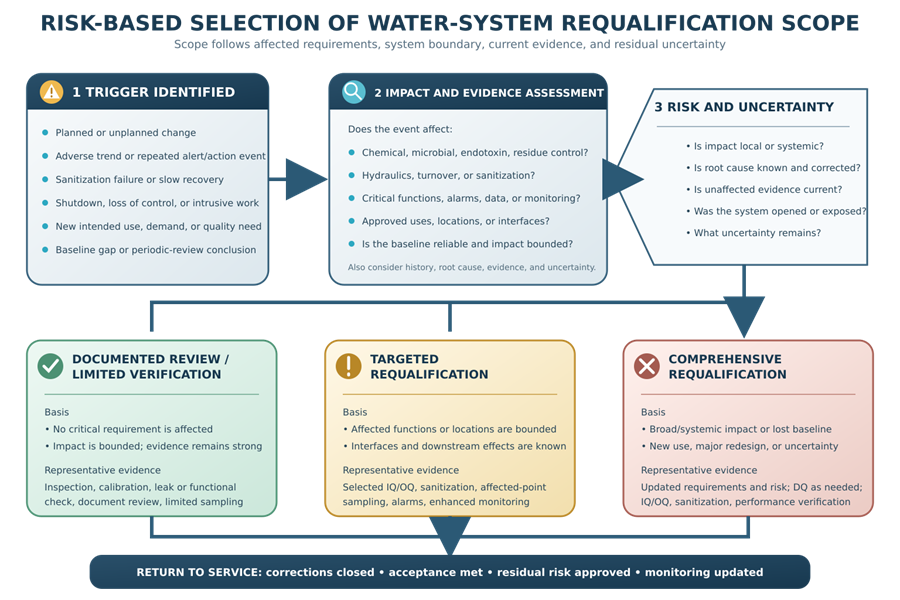
Scope should follow the affected requirements, system boundary, failure mechanism, uncertainty, and risk. The decision should consider:
- What changed or failed
- Which components, functions, locations, and records are affected
- Whether the condition is local or systemic
- Whether water quality or product impact occurred
- Whether the root cause is known and corrected
- Whether the as-built and configuration baselines remain reliable
- Whether unaffected functions have current supporting evidence
- Whether operating history is favorable and relevant
- Whether the system was opened or exposed
- Whether sanitization coverage was affected
- Whether automation, data, alarms, or monitoring were affected
- Whether current use differs from the original qualification basis
- Residual uncertainty after correction
Requalification Outcomes
| Outcome | Appropriate basis | Representative evidence |
| Documented review or limited verification | No affected critical requirement and strong current evidence remains | Document review, inspection, calibration, leak test, functional check, limited sampling |
| Targeted requalification | Impact is bounded to identified components, functions, locations, or operating states | Selected IQ/OQ tests, sanitization verification, affected-point sampling, alarm/interlock test, defined enhanced monitoring |
| Comprehensive requalification | Broad impact, lost baseline confidence, new intended use, major redesign, widespread adverse performance, or substantial uncertainty | Updated requirements and risk assessment, DQ as applicable, IQ, OQ, sanitization verification, broad performance verification, controlled release |
Representative Targeted Requalification Scope
The following examples illustrate possible scope, not automatic prescriptions.
| Event or change | Possible targeted evidence |
| Like-for-like calibrated instrument replacement | Installation identity, material and range confirmation, calibration, scaling, alarm or interlock verification, data-path check |
| Distribution pump replacement | Installation verification, rotation, flow and pressure across representative demand, standby changeover, alarms, leak check, water-quality recovery |
| Point-of-use valve or short branch replacement | Material and weld documentation, slope or drainability, leak test, passivation if applicable, sanitization coverage, affected-point microbial and chemical testing |
| New point of use | Drawing and boundary update, hydraulic capacity, branch design, backflow control, sanitization coverage, identification, sampling, representative performance verification |
| UV lamp or ozone component replacement | Installation, intensity or concentration, alarm and interlock, operating range, microbial-control recovery |
| Heat-exchanger repair | Material and pressure-boundary verification, leak or integrity testing, temperature control, alarm testing, sanitization, water-quality verification |
| Sanitization parameter change | Control sequence, distribution of time, temperature or concentration, worst-case locations, residues, post-cycle recovery, reproducibility as justified |
| Alarm or diversion logic change | Configuration review, setpoint and delay, initiating condition, notification, interlock or diversion response, recording, acknowledgment, recovery |
| Short controlled shutdown with circulation maintained | Operating-state review, sanitization if required, online stabilization, representative sampling, enhanced monitoring for a defined period |
| Intrusive maintenance opening the system | Material and assembly records, cleaning or passivation, sanitization, leak and functional tests, representative chemical and microbial recovery evidence |
Targeted scope should include interfaces and downstream consequences. Testing only the replaced component may be inadequate when the change can affect hydraulics, sanitization, monitoring, or water delivered elsewhere.
When Comprehensive Requalification Is Appropriate
Comprehensive requalification should be considered when:
- The system has been substantially redesigned or relocated.
- The water type or intended GMP use changes materially.
- Multiple interacting modifications affect generation, storage, distribution, control, and monitoring.
- Widespread adverse results indicate that the affected boundary cannot be confidently limited.
- A prolonged uncontrolled shutdown or open construction state creates broad uncertainty.
- The as-built, software, or qualification baseline is missing, unreliable, or materially inconsistent with the installed system.
- The original qualification was inadequate for current system use.
- Sanitization failure or suspected biofilm cannot be bounded to a specific location.
- Repeated corrective actions have not restored predictable control.
- A new control strategy replaces the basis of the prior qualified state.
Comprehensive does not necessarily mean blind repetition of every historical test. The current requirements, risk assessment, design, and accumulated knowledge should define a scientifically current qualification program.
General principles for event-driven scope and interval decisions are addressed in Risk-Based Requalification of GMP Equipment.
Requalification Planning, Execution, and Acceptance
The approved protocol or plan should define:
- Trigger and governing quality-system record
- System boundary and configuration to be tested
- Intended use and affected requirements
- Impact and risk assessment
- Rationale for included and excluded tests
- Prerequisites and required corrections
- IQ, OQ, sanitization, and performance-verification scope
- Sampling locations, tests, frequency, and collection conditions
- Challenge conditions and operating states
- Acceptance criteria
- Deviation and retesting controls
- Interim use restrictions
- Stage gates and release authority
- Required reports and retained raw data
- Follow-up monitoring and effectiveness review
Acceptance should confirm, as applicable:
- Approved configuration and documentation
- Correct installation of affected components
- Successful functional, alarm, interlock, diversion, and recovery testing
- Effective sanitization across the required boundary
- Acceptable chemical, microbial, and endotoxin performance
- Representative performance at affected and worst-case locations
- Resolution of deviations and acceptable residual risk
- Completion of procedures, training, maintenance, calibration, and data controls
The report should reconcile the trigger, completed actions, actual results, deviations, residual limitations, and release decision. A statement that testing was completed is not sufficient.
Protocol structure, controlled execution, deviation reconciliation, traceability, and report conclusions are addressed in GMP Validation Protocol and Final Report Requirements.
Return to Service and Enhanced Verification
Return to service may occur in stages:
- Engineering or non-GMP operation
- Restricted GMP use
- GMP use with enhanced monitoring or product hold
- Full routine GMP operation
The release record should define:
- Exact released system boundary and points of use
- Permitted water uses
- Any excluded applications or locations
- Monitoring and review frequency
- Product or water holds
- Temporary operating limits
- Open actions and due dates
- Conditions that suspend use
- Date or evidence threshold for reassessment
- Authority approving expanded or full release
Enhanced verification should have predefined completion criteria. It should not continue indefinitely because the organization has not reached a final qualification conclusion.
Documentation and Data Integrity
Lifecycle evidence should remain attributable, legible, contemporaneous, original or verified as an accurate copy, accurate, complete, consistent, enduring, and available.
Controlled records may include:
- Monitoring and laboratory raw data
- Trend reports and statistical analyses
- Sanitization records and cycle data
- Alarm, event, and audit histories
- Maintenance and calibration records
- Deviations, OOS investigations, CAPA, and effectiveness checks
- Shutdown and restart assessments
- Change controls and configuration records
- Periodic-review reports
- Continued-use and return-to-service approvals
- Requalification protocols, data, deviations, reports, and traceability
- Current drawings, lists, procedures, and training records
- Backup, restoration, and data-reconciliation evidence
Missing electronic data should be investigated as a control failure even when available water samples pass. The assessment should determine what evidence was lost, whether critical conditions can be reconstructed, and whether additional verification is required.
Common Lifecycle-Control Weaknesses
Frequent weaknesses include:
- Treating passing compendial tests as complete evidence of system control
- Reviewing individual results without evaluating location and time trends
- Failing to connect microbial results with operating, sanitization, and maintenance data
- Increasing sanitization frequency without investigating recurring deterioration
- Releasing intrusive maintenance based only on work-order completion
- Calling a replacement like-for-like without demonstrating equivalence
- Leaving temporary bypasses, restrictions, or enhanced monitoring open indefinitely
- Restarting after shutdown without classifying the actual idle or exposure condition
- Resampling until a passing result is obtained
- Failing to assess affected water uses and manufactured product
- Treating continued use as a default rather than an approved decision
- Assessing changes individually while ignoring cumulative impact
- Performing periodic review as a checklist without conclusions or actions
- Automatically repeating every original test regardless of impact
- Avoiding necessary comprehensive requalification by fragmenting a major change into small work orders
- Performing comprehensive requalification without updating obsolete requirements or risk assessments
- Closing requalification without a defined release decision
Regulatory and Technical Framework
Principal references include:
- 21 CFR Part 211—Current Good Manufacturing Practice for Finished Pharmaceuticals
- 21 CFR 211.48—Plumbing
- 21 CFR 211.58—Maintenance
- 21 CFR 211.63—Equipment Design, Size, and Location
- 21 CFR 211.67—Equipment Cleaning and Maintenance
- 21 CFR 211.68—Automatic, Mechanical, and Electronic Equipment
- 21 CFR 211.100—Written Procedures; Deviations
- 21 CFR 211.160—General Requirements for Laboratory Controls
- 21 CFR 211.180—General Record Requirements and Annual Evaluations
- 21 CFR 211.192—Production Record Review and Investigations
- USP monographs for Purified Water and Water for Injection
- USP General Chapter 〈1231〉, Water for Pharmaceutical Purposes
- USP General Chapter 〈643〉, Total Organic Carbon
- USP General Chapter 〈645〉, Water Conductivity
- USP General Chapter 〈85〉, Bacterial Endotoxins Test
- USP FAQs—Water for Pharmaceutical and Analytical Purposes
- FDA Guide to Inspections of High Purity Water Systems
- FDA Inspection Technical Guide—Water for Pharmaceutical Use
- FDA Q7 Good Manufacturing Practice Guidance for Active Pharmaceutical Ingredients
- FDA/ICH Q9(R1)—Quality Risk Management
- FDA/ICH Q10—Pharmaceutical Quality System
- ISPE Baseline Guide, Volume 4—Water and Steam Systems, Third Edition
- ISPE Good Practice Guide—Commissioning and Qualification of Pharmaceutical Water and Steam Systems
The FDA high-purity-water inspection guide and water-for-pharmaceutical-use technical guide contain useful technical observations, but they are dated, nonbinding inspection references. They should not be presented as current compendial text or as the only acceptable lifecycle-control approach.
Summary
Pharmaceutical-water lifecycle control converts routine evidence into defensible operating decisions:
Monitor → trend → assess → control use → correct → verify → release → review
An effective program ensures that:
- Monitoring covers quality, operation, equipment, sanitization, and data integrity.
- Adverse trends are evaluated before they become repeated failures.
- Sanitization remains an effective control rather than a substitute for investigation.
- Maintenance and calibration preserve the approved configuration and hygienic state.
- Continued use during an investigation is explicitly assessed and approved.
- Shutdown and restart scope reflects the actual idle, exposure, and control condition.
- Changes are assessed against affected requirements and interfaces.
- Periodic review evaluates cumulative evidence and closes assigned actions.
- Requalification scope is targeted when impact is bounded and comprehensive when baseline confidence is lost.
- Return to service occurs through defined evidence gates and Quality approval.
The maintained state of control is not a label carried forward from initial qualification. It is a current conclusion supported by current evidence.
The requirements-to-retirement framework in which these activities operate is addressed in GMP Validation Life Cycle: Requirements to Retirement.