
Pharmaceutical Water Quality Categories and Intended Use
Pharmaceutical water quality is selected according to intended use, product exposure, route of administration, process stage, and the chemical, microbial, endotoxin, and particulate risks that must be controlled.
Treatment terms such as reverse-osmosis water, deionized water, distilled water, and ultrapure water describe technologies or performance characteristics. They do not, by themselves, identify an official pharmaceutical-water category.
The principal distinctions are between:
- Drinking Water used as source water or for justified supporting applications
- Bulk Purified Water and Water for Injection generated for manufacturing use
- Water for Hemodialysis used for a specialized clinical application
- Packaged pharmaceutical waters manufactured, sterilized, packaged, and labeled as separate official articles
Purified Water and Water for Injection are not automatically interchangeable. Packaged sterile waters are also not interchangeable merely because each is sterile.
Purpose and Scope
This article explains:
- How pharmaceutical-water quality is connected to intended use
- The distinction between bulk and packaged waters
- Appropriate uses of Drinking Water, Purified Water, and Water for Injection
- The specialized status of Water for Hemodialysis
- Differences among packaged sterile waters
- The distinction between compendial requirements and site-defined controls
- Selection of water for manufacturing, cleaning, laboratory, and clinical applications
- Controls for purchased bulk water
- Documentation of water-quality decisions
The article focuses on United States pharmaceutical manufacturing and USP terminology.
Generation, storage, distribution, sanitization, and point-of-use design are addressed in Pharmaceutical Water System Design and Distribution. Qualification is addressed in Pharmaceutical Water System Qualification and Performance Verification.
For the broader GMP utility framework, see Utility Systems in GMP Manufacturing and Utility System Lifecycle, Monitoring, and Risk-Based Control.
Water Quality Begins with Intended Use
Water quality should be determined from the actual application rather than from the treatment system available at the facility.
The assessment should determine:
- Whether the water becomes a product ingredient
- Whether the product is parenteral or nonparenteral
- Whether the process is sterile, aseptic, or nonsterile
- Whether the water contacts product-contact equipment
- Whether it is used for an initial wash or final rinse
- Whether it contacts containers or closures
- Whether endotoxin control is required
- Whether microorganisms or objectionable organisms create product risk
- Whether the water is removed during later processing
- Whether a subsequent validated process step controls the identified risk
- Whether a product monograph, formulation, analytical method, approved filing, or label specifies a water category
- Whether the water will be administered directly to a patient
- Whether the water is generated onsite, delivered in bulk, or purchased as a packaged article
Water-category selection should follow the principles described in the Risk-Based Approach to Validation, with emphasis on product exposure, process stage, downstream controls, and patient risk.
Selecting a higher water grade does not eliminate the need to control its generation, storage, distribution, handling, sampling, or conditions of use.
Principal Pharmaceutical-Water Categories
Pharmaceutical waters should first be separated into source water, bulk compendial water, specialized water, and packaged pharmaceutical water.
Source Water
Drinking Water normally provides the feed water for production of Purified Water or Water for Injection. It may also be used for justified supporting or preliminary-cleaning applications.
Bulk Compendial Waters
Bulk waters are normally generated, stored, and distributed through a controlled facility system.
The principal bulk pharmaceutical waters are:
- Purified Water
- Water for Injection
These waters are controlled at the point of use through system design, qualification, sanitization, monitoring, maintenance, and lifecycle management.
Specialized Water
Water for Hemodialysis is intended for dialysis-related applications. It should not be treated as a general manufacturing-water grade or as an intermediate grade between Purified Water and Water for Injection.
Packaged Pharmaceutical Waters
Packaged waters are manufactured and released as finished articles for identified uses. They include:
- Sterile Purified Water
- Sterile Water for Injection
- Bacteriostatic Water for Injection
- Sterile Water for Irrigation
- Sterile Water for Inhalation
Each has its own official monograph, formulation or starting-water requirements, packaging controls, and intended-use limitations.
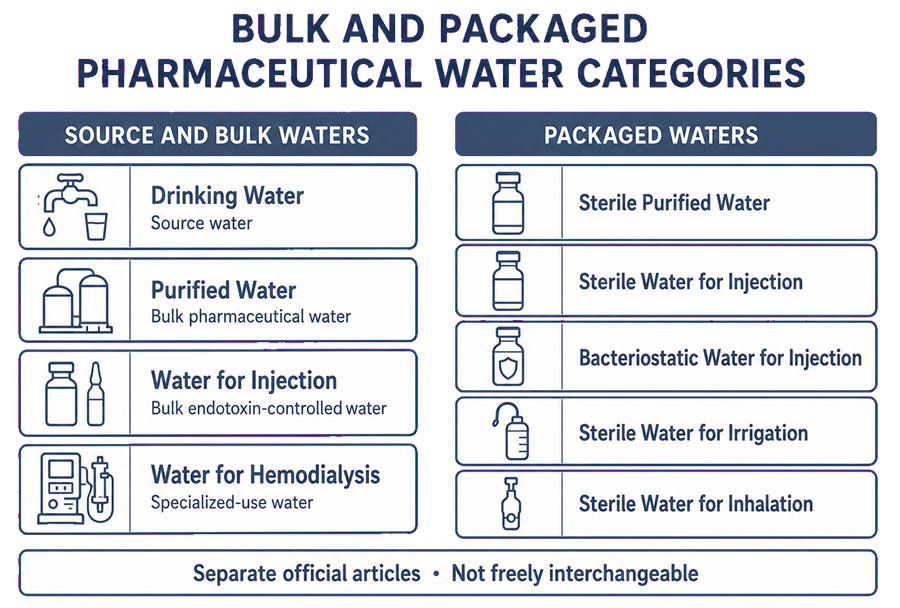
Pharmaceutical-Water Category Summary
| Water category | Form | Principal intended use | Important limitation |
|---|---|---|---|
| Drinking Water | Bulk supply | Source water, initial washing, utility make-up, and justified non-product applications | Does not automatically satisfy Purified Water or WFI requirements |
| Purified Water | Bulk | Nonparenteral formulation, suitable laboratory applications, and cleaning where appropriate | Not inherently sterile and does not carry the WFI bacterial-endotoxin requirement |
| Water for Injection | Bulk | Parenteral manufacturing and other endotoxin-sensitive applications | Bulk WFI is not a packaged sterile article and is not intended for direct patient administration |
| Water for Hemodialysis | Specialized | Preparation of dialysis fluids and support of dialysis equipment | Not a general substitute for Purified Water or WFI |
| Sterile Purified Water | Packaged | Applications requiring sterile, packaged Purified Water | Not automatically suitable as a parenteral diluent |
| Sterile Water for Injection | Packaged | Sterile solvent or diluent for parenteral products when used as labeled | Contains no antimicrobial agent |
| Bacteriostatic Water for Injection | Packaged | Multiple-dose parenteral dilution where the antimicrobial agent is acceptable | Antimicrobial agent and labeling restrict its use |
| Sterile Water for Irrigation | Packaged | Irrigation applications | Not intended for injection |
| Sterile Water for Inhalation | Packaged | Inhalation and humidification applications as labeled | Not intended for parenteral administration |
The table provides general direction. Applicable monographs, product labeling, approved filings, process requirements, and documented risk assessments remain controlling.
Drinking Water
Drinking Water is normally the starting feed for a pharmaceutical-water generation system.
Under 21 CFR 211.48, potable water must be supplied under continuous positive pressure through plumbing free of defects that could contribute contamination. The applicable drinking-water requirements are established under the EPA National Primary Drinking Water Regulations in 40 CFR Part 141.
Potential sources include:
- Municipal water
- A controlled facility well
- Another approved potable-water supply
Source-water controls should consider:
- Seasonal chemical changes
- Municipal treatment changes
- Disinfectant type and concentration
- Hardness
- Turbidity
- Organic loading
- Microbial quality
- Supply interruption
- Construction and repair events
- Changes between available sources
Potential Uses
Drinking Water may be appropriate for:
- Feed to a pharmaceutical-water generation system
- Initial equipment washing
- Utility make-up
- General facility cleaning
- Non-product-contact applications
- Other uses supported by documented assessment
Drinking Water should not automatically be accepted for:
- Formulating a compendial drug product
- Final rinsing of product-contact surfaces
- Parenteral processing
- Endotoxin-sensitive applications
- Preparing compendial laboratory reagents
Compliance with drinking-water requirements demonstrates potability. It does not demonstrate suitability for every pharmaceutical application.
Purified Water
Purified Water is defined by the USP official monograph Purified Water and is further discussed in USP General Chapter 〈1231〉 Water for Pharmaceutical Purposes.
Purified Water is obtained by a suitable purification process from water meeting applicable drinking-water requirements. It contains no added substance.
Possible production technologies include:
- Pretreatment
- Softening
- Activated carbon
- Reverse osmosis
- Deionization
- Electrodeionization
- Ultrafiltration
- Ultraviolet treatment
- Distillation
- Other suitable chemical or microbial-control stages
The treatment technology does not establish the official identity of the resulting water. Reverse-osmosis water or deionized water is Purified Water only when it satisfies the applicable monograph and is produced and controlled for its intended pharmaceutical use.
Typical Uses
Purified Water is commonly used for:
- Formulation of nonparenteral drug products
- Preparation of nonsterile aqueous intermediates
- Granulation
- Coating solutions
- Nonsterile cleaning solutions
- Final rinsing of equipment used for nonsterile products
- Laboratory reagents and solutions where Purified Water is specified
- Feed to an additional purification process
- Other uses supported by documented assessment
Important Limitations
Bulk Purified Water:
- Is not defined as sterile
- Does not carry the same bacterial-endotoxin requirement as WFI
- Can support microbial growth
- Requires a qualified generation and distribution system
- Requires site-defined microbial controls
- May be unsuitable for parenteral or endotoxin-sensitive applications
Meeting the USP conductivity and total organic carbon requirements does not, by itself, demonstrate adequate microbial control.
Conductivity, total organic carbon, microbial monitoring, bacterial endotoxins, sampling, and trending are addressed in USP Water Specifications, Testing, and Monitoring.
Water for Injection
Water for Injection is defined by the USP official monograph Water for Injection and discussed in USP General Chapter 〈1231〉 Water for Pharmaceutical Purposes.
WFI is prepared from water meeting applicable drinking-water requirements and is produced through distillation or another purification process demonstrated to be equivalent or superior in removing chemicals and microorganisms. It contains no added substance.
WFI includes compendial chemical-purity requirements and a bacterial-endotoxin requirement appropriate to its intended applications.
Typical Uses
WFI is commonly used for:
- Formulation of parenteral drug products
- Late-stage processing of sterile biological products
- Preparation of solutions that directly contact sterile product
- Final rinsing of parenteral product-contact equipment
- Final rinsing of injectable-product containers or closures where endotoxin control is required
- Other endotoxin-sensitive manufacturing applications
- Production of certain packaged sterile waters
The exact requirement should be established from the product, process stage, approved filing, official monograph, and contamination-control strategy. WFI should not be described as universally required for every operation performed within a sterile-manufacturing facility.
Bulk WFI Is Not Sterile Water for Injection
The distinction is fundamental:
- Water for Injection is normally a bulk manufacturing component.
- Sterile Water for Injection is a sterilized and suitably packaged finished article.
- Bulk WFI is not defined as sterile.
- Bulk WFI is maintained through a qualified microbial and endotoxin-control strategy.
- A sterility test does not convert bulk WFI into Sterile Water for Injection.
- Bulk WFI is not intended for direct administration to a patient.
The word “injection” in Water for Injection identifies the water’s pharmaceutical quality and manufacturing applications. It does not mean that water taken from a WFI loop may be injected into a patient.
Purified Water Versus Water for Injection
The selection should be based on product and process requirements rather than an unsupported preference for the higher grade.
| Assessment factor | Purified Water may be appropriate | WFI is generally expected or strongly indicated |
|---|---|---|
| Product route | Nonparenteral | Parenteral |
| Product status | Nonsterile | Sterile or aseptically processed |
| Endotoxin risk | Endotoxin is not a critical attribute | Endotoxin can affect product or patient safety |
| Process stage | Early or noncritical stage with effective downstream controls | Late-stage or final product-contact operation |
| Equipment final rinse | Nonsterile product-contact equipment | Parenteral product-contact equipment |
| Container or closure rinse | Nonsterile application | Injectable-product components requiring endotoxin control |
| Laboratory use | Method specifies PW or a suitable equivalent | Method specifically requires WFI |
| Regulatory commitment | PW is specified or justified | WFI is specified |
| Downstream control | Validated removal or control exists | No adequate downstream contamination or endotoxin control exists |
Use of Purified Water in sterile-product manufacturing requires application-specific justification. The assessment should address:
- Process stage
- Product exposure
- Downstream processing
- Microbial risk
- Endotoxin risk
- Product characteristics
- Cleaning or rinsing purpose
- Regulatory commitments
Use of WFI does not compensate for an inadequately designed or controlled distribution system. WFI can become unsuitable through stagnation, biofilm, poor sanitization, improper sampling, inadequate maintenance, or uncontrolled point-of-use handling.
Water for Hemodialysis
Water for Hemodialysis is a specialized water category associated with preparation of dialysis fluids and operation of dialysis equipment.
The technical framework is addressed in USP General Chapter 〈1230〉 Water for Hemodialysis Applications and applicable dialysis standards.
Dialysis exposes patients to large volumes of fluid across a semipermeable membrane. Chemical and microbial constituents that may be acceptable in ordinary drinking water can therefore create unacceptable patient risk.
Water for Hemodialysis should not be treated as:
- A general pharmaceutical-manufacturing water
- A higher grade of Purified Water
- A substitute for WFI
- A packaged sterile water
- A category selected merely because dialysis equipment is present
Its controls should be established from the dialysis application, equipment configuration, patient-exposure pathway, and applicable standards.
Packaged Pharmaceutical Waters
Packaged pharmaceutical waters are controlled finished articles. They are not ordinary containers filled from a facility water loop.
Applicable requirements may address:
- Starting-water quality
- Sterilization
- Bacterial endotoxins
- Particulate matter
- Antimicrobial agents
- Container type and volume
- Container-closure integrity
- Labeling
- Intended route of administration
- Clinical application
Sterile Purified Water
Sterile Purified Water is defined by the USP official monograph Sterile Purified Water.
It is Purified Water that has been sterilized and suitably packaged. It contains no antimicrobial agent.
It may be appropriate when:
- A sterile packaged water is required
- Only a limited quantity is needed
- The application does not require another specifically designated packaged water
- Its package and labeling are suitable for the operation
Sterile Purified Water should not automatically replace Sterile Water for Injection in a parenteral application.
Sterile Water for Injection
Sterile Water for Injection is defined by the USP official monograph Sterile Water for Injection.
It is WFI that has been sterilized and suitably packaged. It contains no antimicrobial agent or other added substance.
It is commonly used as a sterile solvent or diluent for injectable products when permitted by the applicable product instructions.
It should not be confused with:
- Bulk WFI
- Bacteriostatic Water for Injection
- Sterile Water for Irrigation
- Sterile Water for Inhalation
Because it contains no antimicrobial agent, opened-container handling and permitted use must follow the product labeling and approved procedures.
Bacteriostatic Water for Injection
Bacteriostatic Water for Injection is defined by the USP official monograph Bacteriostatic Water for Injection.
It is prepared from WFI, sterilized, suitably packaged, and contains one or more suitable antimicrobial agents.
Suitability should consider:
- Identity and concentration of the antimicrobial agent
- Patient population
- Route of administration
- Dose volume
- Drug-product compatibility
- Labeling restrictions
- Potential interaction with the drug substance
- Whether multiple withdrawals are permitted
It is not simply Sterile Water for Injection with a longer permissible hold time.
Sterile Water for Irrigation
Sterile Water for Irrigation is defined by the USP official monograph Sterile Water for Irrigation.
It is prepared from WFI, sterilized, suitably packaged, and contains no antimicrobial agent or other added substance. It is intended for irrigation applications and is not intended for injection.
Its package and particulate requirements reflect its intended use and may differ from those applicable to Sterile Water for Injection.
Sterile Water for Inhalation
Sterile Water for Inhalation is defined by the USP official monograph Sterile Water for Inhalation.
It is prepared from WFI, sterilized, suitably packaged, and contains no added antimicrobial agent. It is intended for inhalation-related applications as labeled.
It is not suitable for parenteral administration merely because it is sterile and prepared from WFI.
Packaged Waters Are Not Freely Interchangeable
Before substituting one packaged water for another, the assessment should compare:
- Official monograph
- Product labeling
- Intended route
- Clinical application
- Starting-water quality
- Bacterial-endotoxin requirements
- Particulate requirements
- Package size
- Container-closure system
- Presence or absence of antimicrobial agents
- Product or process compatibility
- Open-container limitations
- Approved procedures
- Regulatory commitments
The substitution decision cannot be based only on sterility or general chemical purity.
One packaged water may exceed another in a particular attribute while remaining unsuitable for the intended route or application.
Bulk and Packaged Waters Are Controlled Differently
| Control element | Bulk Purified Water or WFI | Packaged pharmaceutical water |
|---|---|---|
| Production | Facility generation system | Controlled manufacturing and packaging process |
| Storage | Tank and distribution system | Final container-closure system |
| Delivery | Point of use | Individual package |
| Microbial control | System design, circulation, sanitization, and monitoring | Sterilization and container-closure integrity |
| Release | System release and continuing operational controls | Batch release of the packaged article |
| Use period | Controlled through system operation and point-of-use procedures | Labeled expiration and applicable in-use limitations |
| Change control | Utility-system lifecycle process | Product, process, and packaging change control |
| Principal risks | Biofilm, stagnation, poor circulation, sanitization failure | Package integrity, sterility failure, labeling error, improper reuse |
| Verification | Qualification and continuing monitoring | Finished-product testing and process validation |
Transferring bulk water into a container does not create an official packaged-water article. The applicable sterilization, packaging, testing, release, and labeling requirements must also be satisfied.
Compendial Requirements and Site-Defined Controls
A complete water-control strategy should distinguish three layers.
1. Compendial Requirements
Applicable USP official monographs establish requirements for identified pharmaceutical-water articles.
Relevant general chapters may include:
- 〈85〉 Bacterial Endotoxins Test
- 〈71〉 Sterility Tests
- 〈643〉 Total Organic Carbon
- 〈645〉 Water Conductivity
- 〈788〉 Particulate Matter in Injections
- 〈1230〉 Water for Hemodialysis Applications
- 〈1231〉 Water for Pharmaceutical Purposes
The applicable monograph determines which tests and requirements apply to a particular water article. Not every listed chapter applies to every water category.
2. Regulatory and Product Requirements
Additional requirements may arise from:
- 21 CFR Part 211
- An approved NDA, ANDA, BLA, or other regulatory application
- Drug-product or dosage-form monographs
- Product and process specifications
- Manufacturing instructions
- Laboratory methods
- Container and closure requirements
- Product labeling
- FDA guidance applicable to the operation
These requirements may be more restrictive or more application-specific than the basic water monograph.
3. Site-Defined Controls
The site should establish the additional controls needed to maintain the system and ensure suitability at each point of use.
These commonly include:
- Microbial alert and action levels
- Objectionable-organism controls
- Online conductivity limits
- Online total-organic-carbon limits
- Temperature or ozone operating ranges
- Flow, pressure, and recirculation requirements
- Sanitization parameters and frequency
- Sampling locations and frequencies
- Point-of-use flushing requirements
- Sample hold times
- Instrument alerts and alarms
- Maintenance and calibration requirements
- Investigation thresholds
- Trending rules
- Use restrictions and release criteria
These controls are not necessarily additional USP monograph tests. They are established from intended use, system design, risk assessment, qualification results, and operating history.
Microbial Requirements Require Special Care
A recommended microbial value in an informational chapter or technical reference should not automatically be presented as a universal monograph specification.
The control strategy should distinguish:
- Compendial acceptance criteria
- Product-specific specifications
- Site action levels
- Site alert levels
- Operating targets
- Adverse-trend criteria
- Objectionable-organism requirements
Microbial controls should consider:
- Water category
- Product route
- Process stage
- Product ability to support microbial growth
- Preservative system
- Exposure pathway
- Endotoxin risk
- Distribution-system design
- Sampling location and method
- Historical performance
- Sample transport and test initiation time
An alert-level excursion is not automatically a compendial failure. Conversely, an adverse trend or action-level excursion cannot be dismissed merely because conductivity and total organic carbon remain acceptable.
Water Used for Cleaning and Rinsing
Water quality may differ between cleaning stages, but each selection must be justified and incorporated into the equipment-specific Cleaning Validation Approach and approved cleaning procedures.
Initial Cleaning
Drinking Water or another controlled water quality may be acceptable for an initial wash when:
- It is compatible with the equipment and cleaning agents.
- It does not introduce unacceptable contaminants.
- Subsequent cleaning and rinsing adequately remove residues.
- The use is defined in the cleaning procedure.
- Cross-connection and microbial risks are controlled.
Final Rinse
The final-rinse water should be suitable for the equipment’s next intended manufacturing use.
Typical applications include:
- Purified Water or a justified higher quality for nonsterile product-contact equipment
- WFI for final rinsing of parenteral product-contact equipment
- WFI where endotoxin control is required
- Another specified quality where supported by the product, process, approved filing, and validated cleaning procedure
Final-rinse water quality does not, by itself, validate the cleaning process. Cleaning validation must also address residues, sampling, recovery, acceptance criteria, equipment coverage, and dirty and clean hold times.
Water Used in Laboratories
Laboratory-water terminology does not necessarily correspond to pharmaceutical-manufacturing water categories.
An analytical method may specify:
- Purified Water
- Water for Injection
- Carbon-dioxide-free water
- Deaerated water
- Ammonia-free water
- Reagent water of a stated grade
- Chromatographic-grade water
- Water prepared according to a specified procedure
Terms such as Type I water, HPLC water, ultrapure water, and deionized water describe laboratory performance or preparation. They do not automatically establish compliance with a pharmaceutical-water monograph.
Laboratory water should be suitable for the analytical method and controlled to prevent adverse effects on:
- Blank response
- Sensitivity
- Specificity
- Standard preparation
- Reagent stability
- Chromatographic performance
- Microbiological testing
- Bacterial-endotoxin testing
Purchased Bulk Water
A facility may obtain Purified Water or WFI from an external supplier. Purchasing the water does not remove the receiving site’s responsibility for suitability.
Controls should address:
- Supplier qualification
- Applicable compendial and site specifications
- Manufacturing source
- Tanker or container construction
- Cleaning and sanitization
- Previous cargo
- Transfer connections
- Tamper controls
- Transportation time
- Transportation temperature
- Microbial proliferation risk
- Receipt sampling
- Certificate-of-analysis verification
- Identity and release
- Maximum storage time
- Transfer into the site system
- Traceability to affected batches
Water that met requirements when released by the supplier may deteriorate during transportation, transfer, or storage.
Intended-Use Matrix
A facility should maintain an approved matrix connecting each process or point of use to the required water category.
| Process or application | Required water category | Justification source | Critical attributes | Restrictions |
|---|---|---|---|---|
| Oral-liquid formulation | Purified Water | Formula and process requirements | Chemical and microbial quality | Defined manufacturing hold time |
| Injectable formulation | WFI | Product and compendial requirements | Chemical, microbial, and endotoxin quality | Controlled transfer and use |
| Nonsterile equipment final rinse | Purified Water or higher | Cleaning procedure and risk assessment | Chemical and microbial quality | Defined drying or clean hold time |
| Parenteral-equipment final rinse | WFI | Product and contamination-control strategy | Endotoxin and microbial control | Post-rinse protection |
| Laboratory mobile phase | Method-defined water | Analytical procedure | Method-specific purity | Prepare and store as specified |
| Injectable-product reconstitution | Labeled packaged diluent | Product labeling | Sterility, endotoxin, and compatibility | Follow labeled conditions |
| Irrigation | Sterile Water for Irrigation | Product labeling | Sterility and application-specific attributes | Not for injection |
| Inhalation | Sterile Water for Inhalation | Product labeling | Sterility and application-specific attributes | Not for injection |
The matrix should identify actual uses and points of use. Broad statements such as “Purified Water is used by Production” are inadequate.
Water-Quality Selection Process
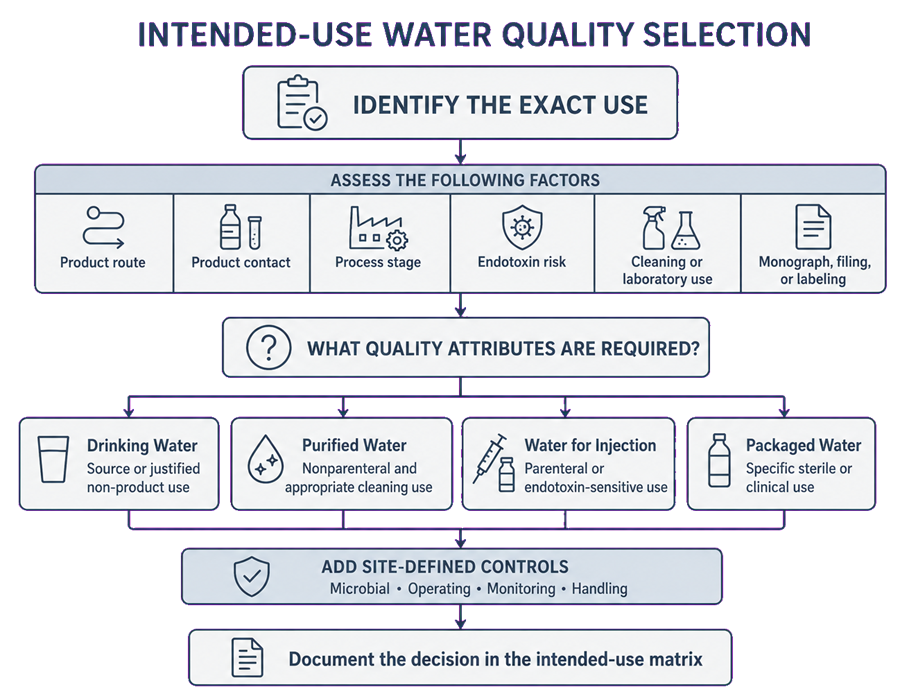
Water selection should follow a controlled sequence:
- Identify the exact application.
- Determine the water-to-product or water-to-equipment exposure pathway.
- Identify the product route and process stage.
- Review the product monograph, formulation, method, approved filing, and labeling.
- Assess chemical, microbial, endotoxin, and particulate risks.
- Evaluate downstream controls and their validated capability.
- Select the minimum justified water category.
- Establish additional site-defined controls.
- Confirm that generation, distribution, packaging, and handling controls support the intended use.
- Document the decision in the intended-use matrix, specification, procedure, or risk assessment.
Using WFI throughout a facility may simplify some distribution arrangements, but it does not replace the requirement to identify the critical attributes and controls applicable to each use.
Change Control and New Uses
A new use, point of use, generation unit, storage tank, or distribution-loop modification should be assessed before implementation.
Requirements should be defined through the URS for GMP Facilities, Utilities, and Equipment.
The change assessment should address:
- Required water category
- Product and process exposure
- Flow and volume demand
- Temperature requirement
- Point-of-use design
- Hose and transfer arrangements
- Backflow prevention
- Sampling capability
- Sanitization coverage
- Drainability
- Microbial and endotoxin risk
- Monitoring requirements
- Qualification scope
- Cleaning-validation impact
- Regulatory-filing impact
Qualification should follow the GMP Validation Life Cycle and the water-system-specific approach described in Pharmaceutical Water System Qualification and Performance Verification.
A system qualified to produce WFI is not automatically qualified to support every new user, peak-demand condition, or modified distribution arrangement.
See Utility System Change Control, Requalification, and Deficiencies for the broader change-impact framework. Continued monitoring, periodic review, and requalification are addressed in Pharmaceutical Water System Lifecycle Control and Requalification.
Common Deficiencies
Category-Selection Deficiencies
- Water quality is selected from treatment technology rather than intended use.
- Reverse-osmosis water or deionized water is treated as an official category without demonstrating monograph compliance.
- Purified Water is used for a parenteral application without justification.
- Bulk WFI and Sterile Water for Injection are treated as the same article.
- Packaged sterile waters are considered interchangeable.
- Water for Hemodialysis is treated as a general pharmaceutical water.
- Product filings, monographs, and labels are not reviewed.
Specification Deficiencies
- Compendial criteria and internal action levels are combined without distinction.
- Informational microbial recommendations are presented as universal monograph limits.
- Objectionable-organism controls are absent.
- Online operating limits conflict with laboratory specifications.
- Sampling and test methods are not defined.
- Purchased-water receipt and transportation controls are omitted.
- Requirements are not updated after process or compendial changes.
Intended-Use Deficiencies
- The facility has no approved water-use matrix.
- Cleaning stages do not identify the required water quality.
- Laboratory-water requirements are ambiguous.
- New users are connected without impact assessment.
- Temporary hoses or portable containers bypass approved controls.
- Point-of-use quality is assumed from generator results.
- Higher-grade water is distributed through an inadequately controlled delivery system.
Packaged-Water Deficiencies
- Package labels are not reviewed before substitution.
- Open containers are retained without justified in-use periods.
- Sterile irrigation or inhalation water is used for injection.
- Bacteriostatic water is substituted without evaluating the antimicrobial agent.
- Bulk water is filled into containers and treated as packaged sterile water.
- Supplier qualification and receipt verification are inadequate.
Regulatory and Compendial Framework
The principal United States sources include:
- 21 CFR Part 211
- 21 CFR 211.48
- 40 CFR Part 141
- Applicable USP official water monographs
- USP General Chapter 〈1231〉 Water for Pharmaceutical Purposes
- USP General Chapter 〈1230〉 Water for Hemodialysis Applications
- Applicable analytical general chapters, including 〈85〉, 〈71〉, 〈643〉, 〈645〉, and 〈788〉
- Product and dosage-form monographs
- Approved regulatory applications
- FDA’s Sterile Drug Products Produced by Aseptic Processing—Current Good Manufacturing Practice
These sources do not have identical authority:
- Applicable federal regulations establish binding CGMP requirements.
- An applicable official monograph establishes compendial requirements for an article represented as complying with that monograph.
- An approved regulatory application may establish product- or process-specific commitments.
- USP general chapters below 〈1000〉 are generally applicable when referenced by a monograph, another applicable compendial requirement, or a regulatory commitment.
- Informational chapters numbered 〈1000〉 and above provide technical guidance but should not automatically be presented as enforceable specifications.
- FDA guidance describes the Agency’s current thinking and does not independently establish legally enforceable requirements.
The site should document the source and authority of each water-system requirement.
Summary
Pharmaceutical-water classification follows intended use.
The controlling distinctions are:
- Drinking Water normally serves as source water or supports justified non-product applications.
- Purified Water is commonly used for nonparenteral products, suitable laboratory applications, and appropriate cleaning operations.
- WFI is used for parenteral and endotoxin-sensitive applications.
- Bulk WFI is not Sterile Water for Injection.
- Packaged sterile waters have separate monographs, labels, and intended uses.
- Water for Hemodialysis is a specialized category.
- Compendial testing does not constitute a complete site control strategy.
- Microbial, operating, monitoring, and distribution controls must reflect the system and intended use.
The governing sequence is:
Intended use → applicable requirements → risk assessment → water-category selection → site-defined controls → qualification → monitoring and lifecycle control