

Pharmaceutical Water System Qualification and Performance Verification
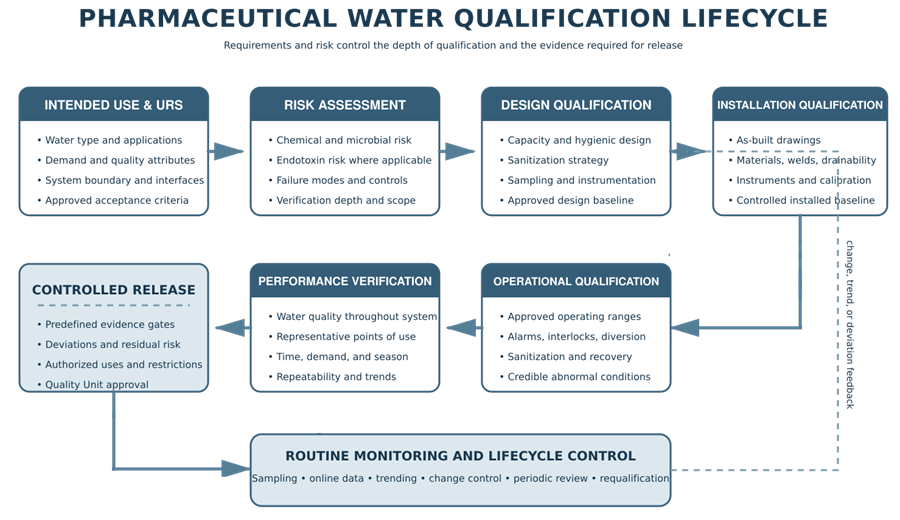
Pharmaceutical-water qualification must demonstrate more than successful equipment start-up or a short series of acceptable samples. It must establish that the complete generation, storage, and distribution system is appropriately designed, correctly installed, functionally controlled, and capable of repeatedly delivering water of the required quality under defined operating conditions.
The qualification strategy should integrate:
- Intended use and approved requirements
- System and product-quality risk
- Design Qualification
- Installation Qualification
- Operational Qualification
- Performance verification over time
- Representative sampling
- Seasonal and feedwater variability
- Deviations and investigations
- Controlled release
- Transition to routine monitoring
- Lifecycle change control and requalification
The familiar three-phase water-system validation model can provide a useful structure, but its durations and sampling frequencies are not universal requirements. The strategy must preserve the essential evidence—procedure development, repeatability, sustained control, and seasonal coverage—while adapting execution to the system design, water type, intended use, risk, and accumulated data.
Purpose and Scope
This article addresses qualification and performance verification of on-site pharmaceutical-water systems, primarily:
- Purified Water systems
- Water for Injection systems
- Associated source-water, pretreatment, generation, storage, and distribution functions
- Online analyzers, automation, alarms, data acquisition, and supporting utilities within the defined system boundary
It does not treat packaged sterile waters as utility systems. Sterile Water for Injection and other packaged sterile-water products are finished drug products subject to their applicable monographs, manufacturing controls, and release requirements.
Selection of the required water quality is addressed in Pharmaceutical Water Quality Categories and Intended Use. Detailed design principles are addressed in Pharmaceutical Water System Design and Distribution. Compendial testing and routine monitoring are addressed in USP Water Specifications, Testing, and Monitoring.
Qualification Is a Lifecycle, Not a Sampling Exercise
Water samples are essential evidence, but sampling alone cannot qualify a system. Acceptable results do not compensate for an inadequate design, undocumented installation, ineffective sanitization, uncontrolled software, unreliable instruments, or procedures that do not represent actual operation.
Qualification should answer four different questions:
| Lifecycle element | Primary question |
|---|---|
| Design Qualification | Is the proposed design suitable for its intended GMP use and capable of controlling the identified risks? |
| Installation Qualification | Does the installed system conform to the approved design and establish a controlled as-built baseline? |
| Operational Qualification | Does the system function throughout its approved operating ranges, including alarms, interlocks, sanitization, abnormal conditions, and recovery? |
| Performance verification | When operated by trained personnel under approved procedures, does the integrated system repeatedly deliver acceptable water throughout the system and over time? |
These activities may overlap when scientifically justified, but their conclusions should remain distinct. Commissioning data, supplier documentation, factory tests, site-acceptance tests, and construction records may be leveraged only after documented assessment confirms that they are complete, reliable, traceable, and suitable for the intended qualification purpose.
Define the System Boundary Before Qualification
The qualification plan should define where the system begins and ends. The boundary may include:
- Incoming potable-water connection and monitoring
- Pretreatment equipment
- Chemical-dosing systems
- Softeners, carbon beds, filtration, and microbial-control stages
- Reverse osmosis, electrodeionization, ultrafiltration, distillation, or other generation steps
- Storage tank, vent filter, spray device, and level controls
- Distribution pumps, heat exchangers, ozone or ultraviolet systems
- Supply and return headers
- Point-of-use branches, valves, hoses, and delivery assemblies included in normal use
- Sampling valves
- Online quality analyzers
- Automation, historian, interfaces, alarms, diversion logic, and electronic records
- Clean steam, plant steam, electrical power, cooling water, compressed gas, and other supporting utilities affecting operation
Boundary drawings should identify:
- Flow direction
- Equipment
- Instruments
- Sampling locations
- Points of use
- Drains and vents
- Chemical additions
- Bypasses
- Normally open and normally closed valves
- Interfaces with manufacturing equipment
Temporary hoses or portable delivery assemblies should not be excluded merely because they are not permanently installed. If they affect the water delivered to the process, their control and representative sampling must be addressed.
Qualification Planning and Risk Assessment
The qualification plan should convert requirements and risk knowledge into a controlled verification strategy. It should define:
- System description and boundary
- Water type and intended uses
- Applicable compendial, regulatory, engineering, and site requirements
- Roles and approval responsibilities
- Supplier and commissioning documentation to be leveraged
- DQ, IQ, OQ, and performance-verification scope
- Requirements traceability
- Critical quality attributes and critical operating parameters
- Sampling locations, tests, frequencies, methods, and collection conditions
- Challenge conditions and expected system responses
- Prerequisites and stage-gate criteria
- Deviation, investigation, and retesting controls
- Acceptance criteria
- Interim and final release conditions
- Transition to routine monitoring
- Required reports and retained raw data
- Change control and requalification triggers
Risk assessment should evaluate potential failure modes throughout generation, storage, distribution, and use. Relevant risks include:
- Inadequate pretreatment during adverse source-water conditions
- Chemical or microbial breakthrough
- Generator undercapacity or unstable recovery
- Loss of circulation
- Stagnant branches or low-use points
- Inadequate tank mixing or turnover
- Vent-filter wetting, blockage, or loss of integrity
- Heat-exchanger leakage
- Inadequate sanitant concentration, temperature, contact time, or distribution
- Sanitant residue after return to service
- Poorly located or nonrepresentative monitoring instruments
- Analyzer drift or failure
- Incorrect alarm, interlock, or diversion configuration
- Loss of electronic data or time synchronization
- Operator actions that create contamination or bypass controls
- Demand patterns outside the design basis
Risk determines the depth of verification; it does not authorize omission of evidence necessary to support the intended-use conclusion.
The general risk method is addressed in Risk-Based Validation Approach, and the requirements foundation is addressed in URS for GMP Facilities, Utilities, and Equipment.
Design Qualification
Design Qualification confirms that the proposed pharmaceutical-water system is suitable for its intended use before the design is accepted for fabrication, construction, or installation. It should connect approved user requirements to design features and risk controls.
DQ Inputs
Typical inputs include:
- Approved User Requirements Specification
- Product and process water-use assessment
- Required water quality and point-of-use needs
- Source-water characterization and anticipated variability
- Design basis and capacity calculations
- Process-flow diagrams and P&IDs
- Equipment and instrument specifications
- Materials-of-construction and surface-finish requirements
- Hygienic piping and drainability criteria
- Storage and distribution philosophy
- Sanitization strategy
- Control philosophy, alarm list, and cause-and-effect documentation
- Sampling and monitoring strategy
- Maintenance and calibration requirements
- Automation, security, electronic-record, backup, and recovery requirements
- Applicable codes, standards, and regulatory commitments
DQ Review Topics
The design review should evaluate whether the design adequately addresses:
- Peak, normal, and minimum demand
- Generation capacity, storage capacity, turnover, and recovery
- Redundancy and response to equipment unavailability
- Feedwater excursions and seasonal conditions
- Chemical, microbial, and endotoxin control, as applicable
- Continuous circulation or justified alternative operation
- Flow, velocity, pressure, and return conditions
- Dead-leg minimization and branch management
- Hygienic valve and instrument connections
- Drainability and elimination of unintended hold-up
- Tank venting, spray coverage, mixing, and access
- Heat-exchanger contamination control
- Sanitization coverage and residue removal
- Sampling representativeness and accessibility
- Instrument location, range, accuracy, calibration, and maintainability
- Alarm, interlock, and diversion functions
- System access, maintenance, and safe intervention
- Data availability, auditability, backup, and recovery
Open design issues should be resolved or formally controlled before approval. DQ approval establishes the controlled design baseline and the basis for downstream traceability.
General DQ principles are addressed in Design Qualification for GMP Systems and Equipment.
Installation Qualification
Installation Qualification verifies that the constructed system conforms to approved design documents, supplier requirements, and established installation standards.
Turnover and Document Review
IQ should assess the completeness and acceptability of:
- Approved as-built P&IDs and process-flow drawings
- Equipment and instrument lists
- Component datasheets and manuals
- Material certificates
- Surface-finish documentation
- Weld maps, weld logs, and welder qualifications
- Borescope or weld-inspection records where specified
- Passivation and cleaning records
- Slope and drainability verification
- Pressure and leak-test records
- Vent-filter certificates and installation records
- Calibration records
- Electrical and utility drawings
- Automation configuration and software documentation
- Factory- and site-acceptance-test records
- Commissioning and start-up records
- Spare-parts and preventive-maintenance information
Physical Verification
The installed system should be walked down against current drawings. Verification commonly includes:
- Equipment identity, manufacturer, model, serial number, and capacity
- Correct treatment sequence and flow direction
- Materials of construction and surface finish
- Pipe size, routing, supports, slope, orbital welds, sanitary fittings, and connection type
- Valve type, orientation, identification, and normal position
- Point-of-use and sampling-point identity
- Tank connections, vent filter, spray device, level instrumentation, and lower outlet
- Pump, heat-exchanger, membrane, UV, ozone, and filter installations
- Instrument tag, location, range, accuracy, and calibration status
- Drain, vent, bypass, and return connections
- Supporting utilities and electrical supply
- Automation hardware, network connection, and panel identification
- Accessibility for sampling, sanitization, calibration, maintenance, and filter-integrity testing
Discrepancies between drawings and the physical installation must be resolved through controlled correction or approved as-built revision. Unresolved punch-list items require risk assessment and explicit disposition before OQ.
General IQ principles are addressed in Installation Qualification for GMP Equipment.
Operational Qualification
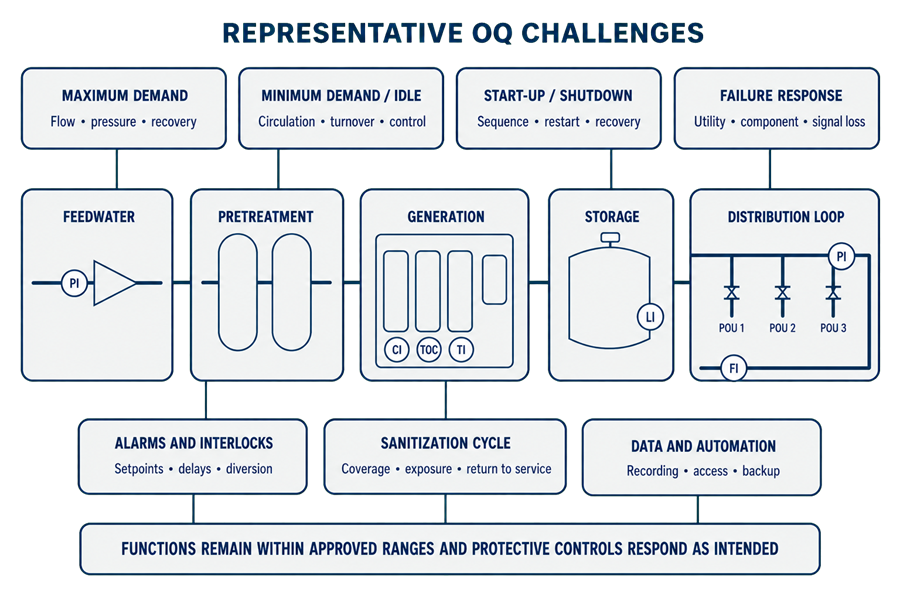
Operational Qualification demonstrates that the installed system and its controls operate as intended throughout approved ranges and foreseeable operating states. OQ should challenge functions, not merely document normal start-up.
OQ Prerequisites
Before OQ begins, the following should be adequately complete:
- IQ approved or conditionally released with justified noncritical items
- Critical deviations closed
- As-built configuration controlled
- Instruments calibrated
- Automation configuration baselined
- Test equipment calibrated
- Approved test methods and acceptance criteria available
- Draft or approved operating, sanitization, sampling, and maintenance procedures available
- Operators and testers trained for assigned activities
- Laboratory readiness confirmed
Functional and Operating-Range Tests
OQ should evaluate applicable functions such as:
- Start-up, normal operation, shutdown, and restart
- Automatic and manual operating modes
- Generation rate and recovery
- Tank level control and overflow protection
- Distribution flow, return flow, pressure, and temperature
- Conductivity and TOC monitoring
- Ozone generation, distribution, and destruction where used
- UV intensity and failure detection
- Chemical-dosing control
- Membrane pressure, differential pressure, rejection, and diversion
- Pump duty, standby, changeover, and failure response
- Heat-exchanger control and contamination-prevention features
- Data display, recording, calculation, alarm, and historian functions
- Communication failure and recovery
- Backup and restoration of critical configuration and records
Alarm, Interlock, and Diversion Verification
Tests should confirm:
- Alarm setpoint and delay
- Initiating condition
- Operator notification
- Alarm priority
- Required acknowledgment
- Interlock or diversion response
- Recorded date, time, value, status, and user action
- Return-to-normal behavior
- Prevention or control of unauthorized bypass
The test method should create the condition safely by simulation, controlled parameter adjustment, or another justified technique. Qualification should not damage equipment or contaminate the water system.
Representative Challenge Conditions
Challenge conditions should be selected from the system design and risk assessment. They may include:
- Maximum simultaneous or representative demand
- Minimum demand and extended low-use operation
- High and low tank level
- Normal and prolonged recirculation
- Weekend or planned idle conditions
- Loss and restoration of power
- Loss of feedwater or supporting utility
- Duty-pump failure and standby-pump changeover
- Analyzer failure or out-of-range signal
- High-conductivity diversion
- Low return temperature or flow
- Communication loss
- Controlled shutdown and recovery
- Operation near approved range limits
Operating outside approved design limits solely to create an extreme condition is not automatically justified. The challenge should be severe enough to verify the control strategy without creating an irrelevant or unsafe condition.
General OQ principles are addressed in Operational Qualification for GMP Equipment.
Sanitization Verification
Sanitization is a controlled system function and should be verified during qualification. The study should demonstrate that the approved cycle reaches and maintains the defined conditions throughout the required system boundary.
Depending on the sanitization method, verification may include:
- Temperature distribution and minimum exposure
- Sanitant concentration
- Contact time
- Flow and hydraulic coverage
- Tank spray-device operation
- Coverage of points of use, sample valves, standby paths, and low points
- Ozone concentration and destruction
- Chemical preparation, addition, circulation, neutralization, and rinsing
- Sequence control, alarms, interlocks, and cycle records
- Post-sanitization residue acceptance
- Return-to-service criteria
- Microbial response before and after sanitization
- Reproducibility across multiple executions where required
The sanitization study should include credible worst-case locations and operating conditions. It should not rely only on a single convenient temperature or concentration measurement.
Deliberate introduction of microorganisms into an operating GMP water system is generally inappropriate. Sanitization effectiveness is normally established through physical and chemical cycle evidence, controlled microbial monitoring, recovery behavior, and accumulated system data.
Performance Verification
Performance verification begins after the installed system has demonstrated functional readiness. It provides evidence that the complete system, operated under approved or near-final procedures, consistently delivers acceptable water throughout the defined boundary and over time.
The study should evaluate:
- Compendial chemical quality
- Microbial control
- Bacterial endotoxins for WFI and where otherwise required
- Source-water and pretreatment performance
- Generation stability
- Storage and distribution performance
- Quality at representative and worst-case points of use
- Sanitization effectiveness and recovery
- Variability under actual demand patterns
- Low-use and idle conditions
- Operator and procedural consistency
- Online-versus-laboratory data relationships
- Trends and seasonal effects
The term performance verification is useful because water-system evidence commonly continues through controlled release and routine operation. The work should not be confused with process performance qualification batches for a drug-manufacturing process.
General system PQ principles are addressed in Performance Qualification for GMP Equipment and Systems.
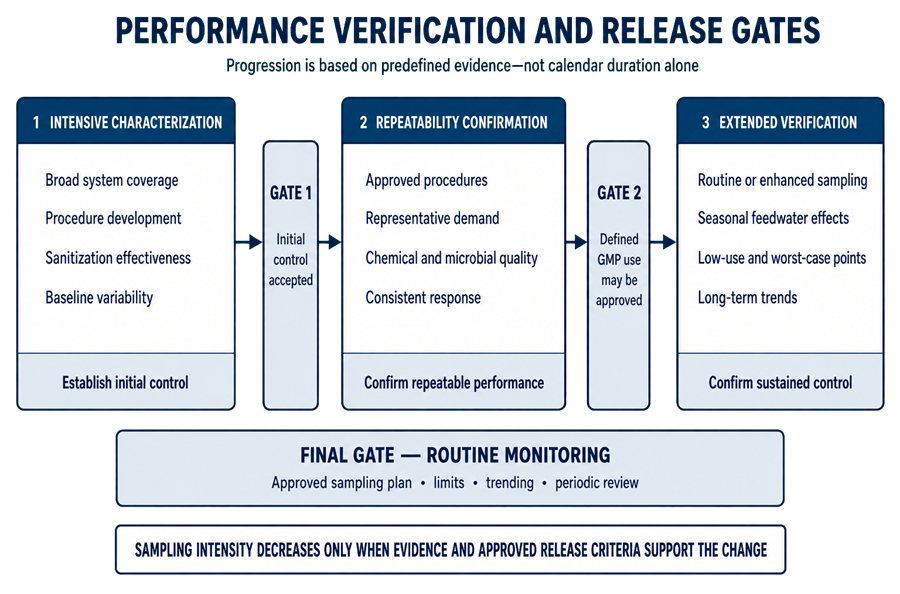
Phase-Based Performance Verification Without Mechanical Durations
The FDA’s 1993 inspection guide describes an example with two intensive two-to-four-week periods followed by longer-term routine-frequency sampling and a full year of data. The same guide states that this is not the only way to validate a water system.
Because the publication is dated and nonbinding, its durations should not be copied as automatic universal requirements.
A defensible phase-based strategy retains the underlying purposes:
| Evidence stage | Primary objective | Typical sampling posture | Release position |
|---|---|---|---|
| Intensive characterization | Develop and confirm operating and sanitization procedures; characterize variability and locations | High frequency with broad coverage of treatment stages and points of use | Normally restricted from GMP use unless separately justified controls are approved |
| Repeatability confirmation | Demonstrate that approved procedures consistently produce acceptable water | Continued intensive or appropriately reduced sampling with complete representative coverage | Defined GMP use may begin only after predefined evidence and Quality approval |
| Extended verification | Confirm sustained performance, routine controls, low-use locations, and relevant seasonal variation | Approved routine or enhanced frequencies with rotating point-of-use coverage | Continued controlled use subject to ongoing review and final qualification conclusion |
| Routine monitoring | Maintain continued verification after qualification | Risk-based online and laboratory monitoring under the approved program | Routine released operation |
Stage duration should be determined before execution using:
- System complexity
- Water type and intended use
- Degree of microbial and endotoxin risk
- Source-water knowledge
- Sanitization strategy
- Number and diversity of points of use
- Demand variation
- Laboratory turnaround time
- Quality and completeness of commissioning evidence
- Similar-system experience
- Data variability and emerging trends
- Deviations encountered during execution
The protocol should state minimum evidence requirements and criteria for extending a stage. A date on the calendar should not force progression when adverse results, missing samples, unresolved deviations, incomplete coverage, or unstable operation remain.
Performance-Verification Sampling Plan
The sampling plan must be linked to the system drawing, risk assessment, intended use, and laboratory methods. It should define:
- Location and unique sample-point identity
- Attribute to be tested
- Sample volume
- Container and preservation
- Flushed, unflushed, or in-use collection condition
- Valve or hose sanitization
- Sample temperature
- Holding time and transport
- Analytical or microbiological method
- Sampling frequency
- Alert and action levels
- Compendial and site specifications
- Required organism identification
- Missing-sample and invalid-result handling
- Review, escalation, and investigation requirements
Representative Locations
Qualification sampling commonly includes:
- Incoming source water
- Critical pretreatment stages
- Final generation outlet
- Storage tank or representative tank location
- Distribution supply
- Distribution return
- Each point of use during intensive characterization where feasible and scientifically appropriate
- High-risk, remote, low-use, and hydraulically disadvantaged points
- Locations before and after microbial- or endotoxin-control barriers
- Temporary hoses or delivery assemblies when part of normal use
Intermediate-treatment samples are used primarily to characterize and diagnose system performance; not every location has the same finished-water specification.
Required Tests
The test panel should be based on water type and location. It may include:
- Conductivity
- Total organic carbon
- Microbial enumeration
- Organism identification
- Bacterial endotoxins
- Temperature
- Sanitant concentration or residue
- Source-water attributes
- Pretreatment-specific chemistry
- Other intended-use requirements
Purified Water and WFI monograph requirements and microbial-control distinctions are addressed in USP Water Specifications, Testing, and Monitoring.
Sampling Must Represent Actual Use
Collection conditions should represent the question being asked.
If a manufacturing hose is routinely attached, qualification may need to sample from the end of that hose. If the approved procedure requires a defined flush before use, the sample may need to be collected after that flush. A separate unflushed sample may be appropriate to characterize local outlet control.
Data from unlike collection conditions should not be pooled without accounting for the difference.
Seasonal and Source-Water Considerations
Seasonal verification is intended to determine whether anticipated changes in source water and ambient conditions affect pretreatment, generation, sanitization, distribution, or finished-water quality.
Potential influences include:
- Source-water temperature
- Microbial population and flora
- Organic load
- Conductivity and dissolved solids
- Disinfectant concentration
- Municipal treatment changes
- Rainfall, drought, runoff, and construction events
- Membrane recovery and pressure
- Carbon-bed and softener performance
- Cooling-water capacity
- Demand patterns
A full calendar year of acceptable data is one traditional way to capture seasonal variation, but the technical objective is representative coverage of relevant variation. The strategy should use available source-water history, municipal data, commissioning results, prior-site experience, and actual monitoring data to justify the required period and conditions.
Limited GMP use may be approved before extended seasonal verification is complete when sufficient early evidence exists and residual risk is controlled. Such release should define:
- Authorized uses
- Enhanced monitoring
- Any batch or water holds
- Review frequency
- Expiration or reassessment date
- Conditions that suspend use
- Remaining qualification commitments
- Final-report requirements
Early use must not be presented as completion of the long-term qualification evidence.
Online Monitoring and Automation Verification
Where online measurements, automation, or historians support control or release decisions, qualification should verify the complete data path from sensor to displayed, recorded, reviewed, and retained result.
The scope may include:
- Sensor identity, range, accuracy, and calibration
- Sample flow and installation conditions
- Scaling and engineering units
- Temperature measurement and compensation
- Data-acquisition frequency
- Calculations and rounding
- Alarm, delay, deadband, and priority
- Diversion and interlock logic
- User access and administrative control
- Configuration baseline
- Audit trail and change history
- Date and time synchronization
- Interface failure and missing-data detection
- Backup and recovery
- Record retention
- Manual data-entry and transcription controls
A passing grab sample should not automatically invalidate an earlier online excursion. The discrepancy must be investigated using time, location, sample handling, process state, calibration, and instrument evidence.
Acceptance Criteria
Acceptance criteria should be approved before execution and traceable to requirements, specifications, design limits, system capability, or justified procedural controls.
They should address:
- Approved installation and documentation baseline
- Functional test results
- Operating ranges
- Alarm, interlock, and diversion response
- Sanitization parameters and coverage
- Compendial water-quality requirements
- Site microbial and endotoxin controls
- Point-of-use and system-stage performance
- Sampling completeness
- Trend acceptability
- Deviations and unresolved risk
- Required stage duration or minimum evidence volume
- Release-gate criteria
Vague criteria such as “system operates satisfactorily” or “all samples pass” are inadequate unless the underlying requirements and specifications are explicitly defined.
Deviations, Atypical Results, and Retesting
Qualification deviations should be documented when execution, results, conditions, or system behavior depart from the approved protocol or acceptance criteria.
The record should define:
- What occurred
- When and where it occurred
- Affected test, sample, location, or period
- Immediate containment
- Investigation and root cause
- Impact on prior and subsequent data
- Impact on water and product use
- Corrective action
- Retest or added-testing rationale
- Effect on stage progression or release
- Required protocol or procedure change
- Quality approval and closure
Resampling may characterize current condition, but a passing resample does not erase an original adverse result without a scientifically demonstrated assignable cause. Results from different points or times should not be averaged to convert an unacceptable result into an acceptable conclusion.
Repeated alerts, recurring organisms, related-location events, missing data, or slow recovery after sanitization may require escalation even when individual results do not exceed an action level.
Critical deviations should be closed before release. Noncritical open items require:
- Documented risk assessment
- Assigned ownership
- Due dates
- Interim controls
- Explicit approval
Qualification Reports and Traceability
Each protocol or integrated report should document:
- Approved scope and objective
- Actual configuration tested
- Personnel and execution dates
- Test equipment and calibration status
- Raw data and recorded observations
- Sampling and laboratory results
- Deviations and investigations
- Changes made during execution
- Statistical or trend analysis where appropriate
- Requirements traceability
- Acceptance-criteria evaluation
- Residual risk
- Stage-gate or release recommendation
- Required follow-up actions
- Approval signatures
The final qualification report should reconcile all DQ, IQ, OQ, and performance-verification evidence. It should not simply state that protocols were executed. It must provide a defensible conclusion regarding:
- Intended use
- Remaining limitations
- Seasonal commitments
- Routine monitoring
- Lifecycle control
General protocol and report principles are addressed in Validation Protocol and Report.
Controlled Release
Release should occur through predefined gates rather than an informal decision that the data “look good.”
Depending on the strategy, release may be:
- Restricted engineering use
- Controlled non-GMP use
- Limited GMP use under enhanced controls
- Full routine GMP release
Before routine GMP release, responsible functions should confirm, as applicable:
- DQ, IQ, and OQ acceptance
- Required performance-verification stage acceptance
- Water-quality conformance
- Approved operating and sanitization procedures
- Approved sampling and monitoring plan
- Established alert, action, and specification controls
- Trained operators, samplers, laboratory personnel, and reviewers
- Current calibration and preventive maintenance
- Controlled automation configuration
- Data-review and backup arrangements
- Acceptable deviation status
- Defined product- and water-impact response
- Spare parts and consumables available
- Remaining seasonal or extended-verification commitments controlled
- Quality Unit approval
Release conditions should identify the exact system boundary, points of use, water types, permitted applications, and any restrictions.
Transition to Routine Monitoring
Transition is a controlled change in monitoring posture, not the end of verification. Qualification data should establish the baseline for the routine program.
The transition package should define:
- Routine online measurements and review frequency
- Laboratory sampling locations and rotation
- Test frequencies and methods
- Alert and action levels
- Specification and release decisions
- Organism-identification criteria
- Trend-analysis method and frequency
- Sanitization frequency and effectiveness review
- Response to missed samples and missing data
- Deviation and investigation thresholds
- Periodic-review inputs
- Change-control and requalification triggers
Routine frequencies should reflect qualification results. Low-use, remote, historically adverse, and high-risk points may require more frequent monitoring than convenient or consistently favorable locations.
Long-term control and requalification are addressed in Pharmaceutical Water System Lifecycle Control and Requalification.
Requalification Triggers Established at Initial Release
The qualification program should define conditions requiring assessment after release, including:
- Change to water type or intended use
- Added, removed, or relocated point of use
- Generation, storage, or distribution modification
- Membrane, tank, pump, heat exchanger, vent filter, or control-system change
- Sanitization method or parameter change
- Major repair or invasive maintenance
- Extended shutdown or loss of circulation
- Recurring alerts, action excursions, or adverse trends
- Objectionable-organism recovery
- Repeated endotoxin increase
- Seasonal performance concern
- Analyzer or data-integrity failure
- Change to source water
- Significant demand increase
- Regulatory or compendial change
The response may range from documented review or targeted verification to partial or comprehensive requalification. Scope should follow impact and risk rather than automatic repetition of every original test.
Common Qualification Weaknesses
Frequent weaknesses include:
- Treating qualification as laboratory sampling only
- Starting performance verification before installation and functional readiness
- Copying legacy phase durations without technical justification
- Releasing the system without a defined stage gate
- Failing to distinguish early controlled use from completion of seasonal evidence
- Sampling convenient points while neglecting remote, low-use, or actual-use assemblies
- Using collection conditions that do not represent manufacturing use
- Failing to verify sanitization coverage and reproducibility
- Testing alarms without confirming interlock, diversion, recording, and recovery
- Omitting automation, historian, access, backup, or data-path verification
- Accepting supplier documents without assessment
- Allowing unresolved as-built discrepancies
- Dismissing online excursions because a later grab sample passed
- Resampling without investigating the original result
- Advancing phases despite missing data or unresolved adverse trends
- Failing to convert qualification data into the routine monitoring plan
Regulatory and Technical Framework
Principal references include:
- 21 CFR Part 211 — Current Good Manufacturing Practice for Finished Pharmaceuticals
- 21 CFR 211.63 — Equipment design, size, and location
- 21 CFR 211.67 — Equipment cleaning and maintenance
- 21 CFR 211.68 — Automatic, mechanical, and electronic equipment
- 21 CFR 211.100 — Written procedures; deviations
- 21 CFR 211.160 — General requirements for laboratory controls
- 21 CFR 211.194 — Laboratory records
- USP monographs for Purified Water and Water for Injection
- USP General Chapter 〈1231〉, Water for Pharmaceutical Purposes
- USP General Chapter 〈643〉, Total Organic Carbon
- USP General Chapter 〈645〉, Water Conductivity
- USP General Chapter 〈85〉, Bacterial Endotoxins Test
- USP FAQ — Water for Pharmaceutical and Analytical Purposes
- FDA Guide to Inspections of High Purity Water Systems
- FDA Inspection Technical Guide — Water for Pharmaceutical Use
- FDA Q7 Guidance for Active Pharmaceutical Ingredients
- ISPE Baseline Guide, Volume 4 — Water and Steam Systems, Third Edition
- ISPE Good Practice Guide — Approaches to Commissioning and Qualification of Pharmaceutical Water and Steam Systems
The FDA water inspection publications contain useful technical observations and remain important historical inspection references. They are dated, nonbinding documents and should not be presented as current compendial text or as the only acceptable qualification method.
Summary
Pharmaceutical-water qualification should establish an integrated and traceable body of evidence:
Intended use → requirements → risk assessment → DQ → IQ → OQ → performance verification → controlled release → routine monitoring → lifecycle review
The program should ensure that:
- Design decisions control chemical, microbial, and endotoxin risks as applicable.
- The as-built system and supporting records match the approved design.
- Functions, alarms, interlocks, diversion, sanitization, and recovery are challenged across approved ranges.
- Sampling represents the complete system and the water actually delivered for use.
- Performance is demonstrated over sufficient time and operating variability.
- Seasonal and source-water effects are addressed with evidence.
- Phase durations and sampling frequencies are scientifically justified.
- Deviations and atypical results are investigated rather than erased by retesting.
- Release is based on predefined evidence gates and Quality approval.
- Qualification results directly establish the routine monitoring program.
- Changes, trends, and failures trigger documented lifecycle assessment.